Bright “Star” Next to Moon: What Is Next to the Moon Tonight?
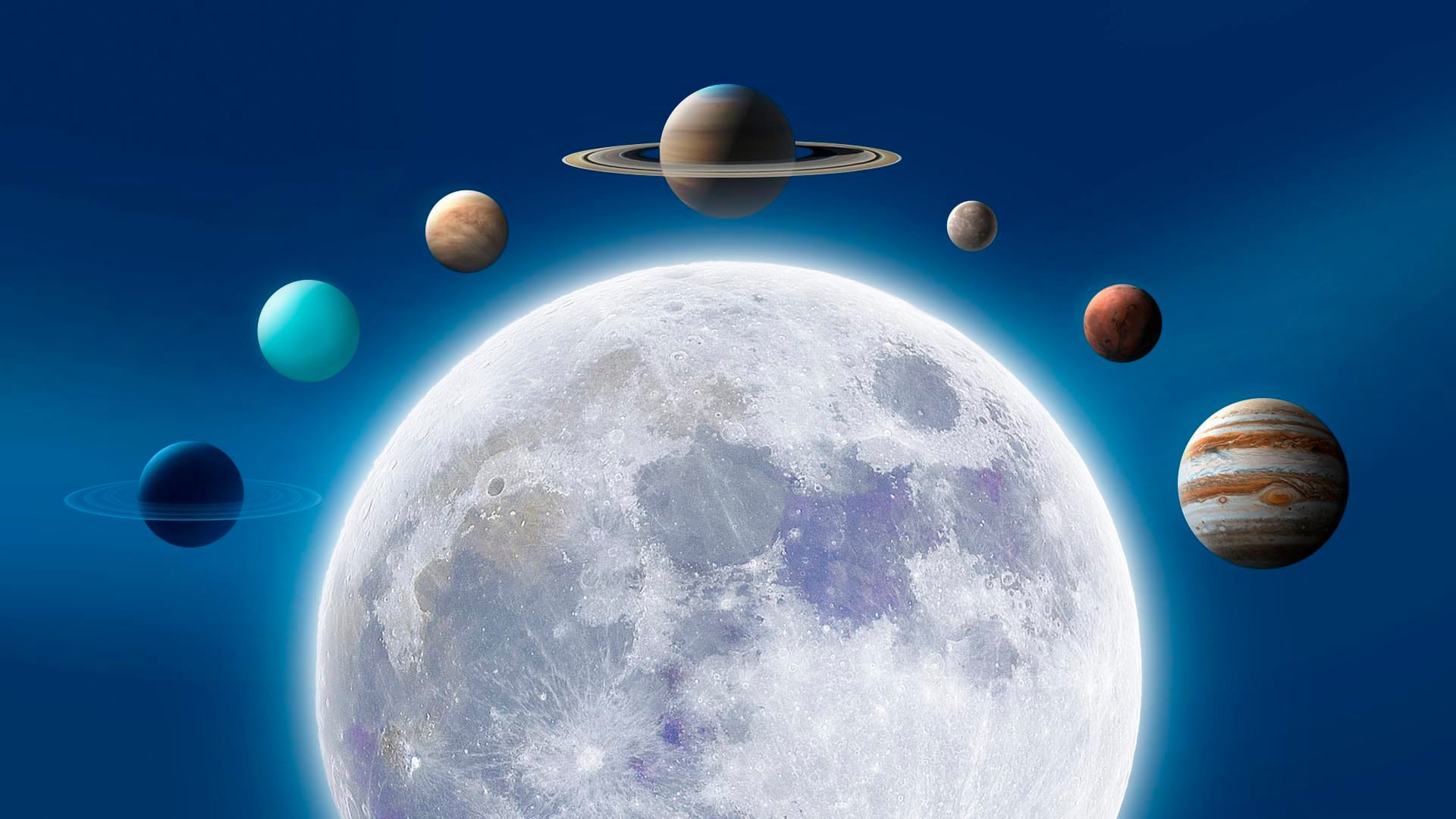
A bright planet near the Moon — what a beautiful sight, easily visible to the naked eye! Want to know if Venus or Jupiter is close to the Moon tonight? Use the free Sky Tonight app! Featuring an astronomical calendar, it can also identify any bright dot near the Moon in real time. Check out this article to learn about the upcoming Moon-planet conjunctions.
Contents
- What’s next to the Moon tonight?
- What do astronomers call the approach of the Moon to the planet?
- Observations
- What planet is next to the Moon tonight? October 2026
- What planet is closest to the Moon in the sky: Bottom line
What’s next to the Moon tonight?
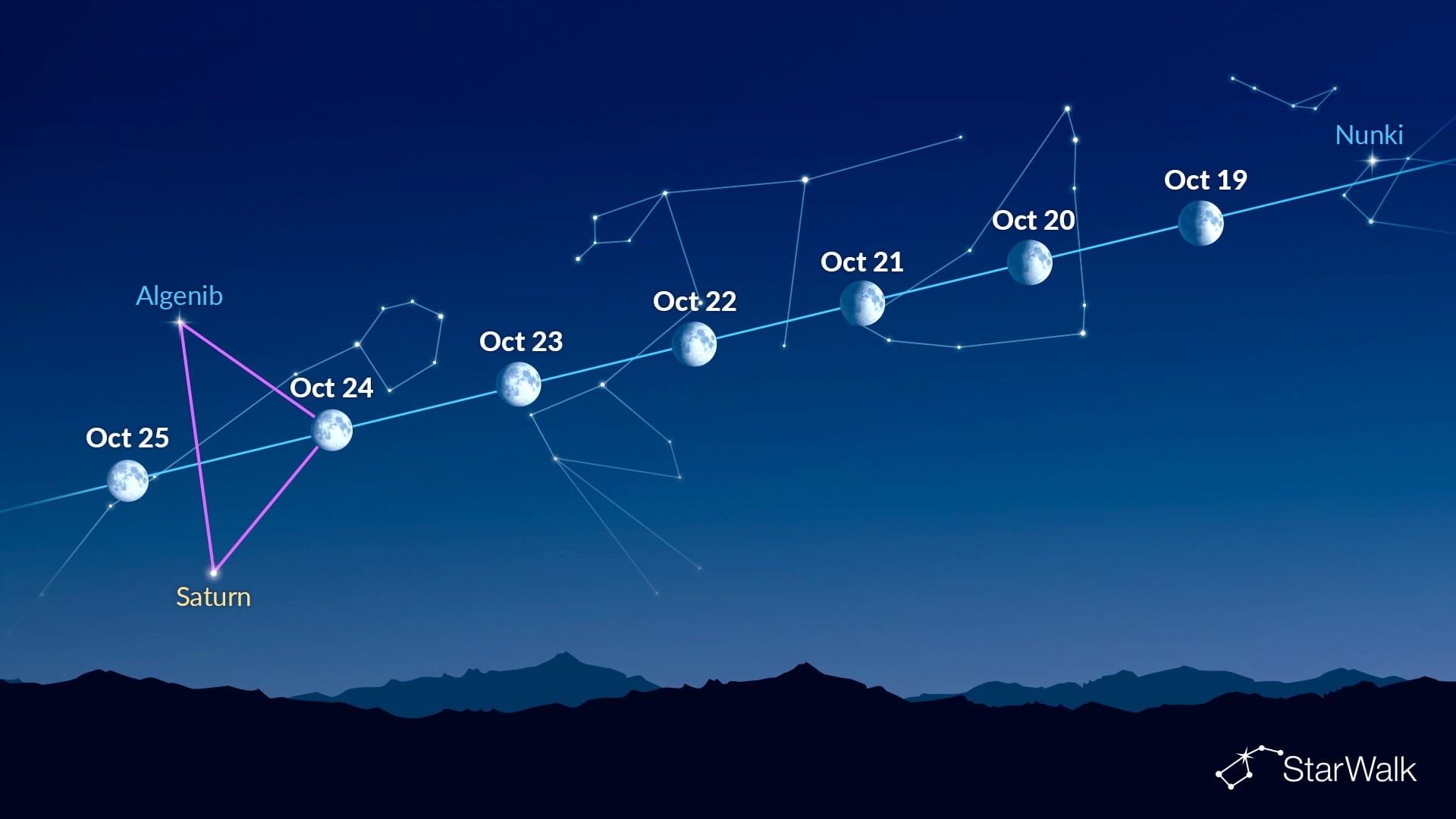
From October 19 to 25, the Moon will pass through constellations with few bright stars, but the Moon itself will be hard to miss. The Full Moon occurs on October 25 or 26, depending on your time zone. The lunar disk will look almost fully illuminated for several nights around that date.
On the night of October 24–25, the nearly full Moon will appear near Saturn. That night or the following night, depending on your location, the Moon, Saturn, and Algenib (mag 2.8) will form a triangle that looks nearly equilateral from some locations. Algenib is a star in the constellation Pegasus.
Each side of the triangle will span about 15° — roughly the width of one and a half fists held at arm’s length. All three objects can be seen with the naked eye, though Algenib may be harder to spot in the bright moonlight.
The shape will look especially close to an equilateral triangle from New Zealand and parts of the South Pacific, where the three sides will be almost exactly the same length. From other locations, the triangle may look slightly stretched because the Moon’s apparent position changes with both your location and the time of observation.
| City | Time zone | Visibility start | Visibility end | Best time | Side spread | Lowest object | Altitude |
|---|---|---|---|---|---|---|---|
| Vancouver, Canada | PDT (UTC−07) | Oct 24, 18:35 | Oct 25, 04:40 | Oct 25, 04:40 | 1°18′ | Saturn | 10° |
| New York, USA | EDT (UTC−04) | Oct 24, 18:30 | Oct 25, 04:35 | Oct 25, 04:35 | 2°58′ | Saturn | 10° |
| London, UK | GMT (UTC+00) | Oct 25, 17:20 | Oct 26, 03:25 | Oct 25, 17:20 | 3°56′ | Saturn | 10° |
| Denpasar, Indonesia | WITA (UTC+08) | Oct 25, 18:35 | Oct 26, 03:25 | Oct 25, 19:05 | 56′ | Moon | 22° |
| Tokyo, Japan | JST (UTC+09) | Oct 25, 17:20 | Oct 26, 03:20 | Oct 25, 21:40 | 1°12′ | Saturn | 55° |
| Sydney, Australia | AEDT (UTC+11) | Oct 25, 19:45 | Oct 26, 03:20 | Oct 25, 22:00 | 21′ | Moon | 35° |
| Christchurch, New Zealand | NZDT (UTC+13) | Oct 25, 20:35 | Oct 26, 03:25 | Oct 26, 00:15 | 6′ | Algenib | 30° |
- Visibility window: All three objects are at least 10° above the horizon, and the Sun is below −6°.
- Best time: The moment within the visibility window when the difference between the longest and shortest sides is smallest.
- Side spread: The longest side minus the shortest side.
- Lowest object / Altitude: The lowest object and its altitude at the best time.
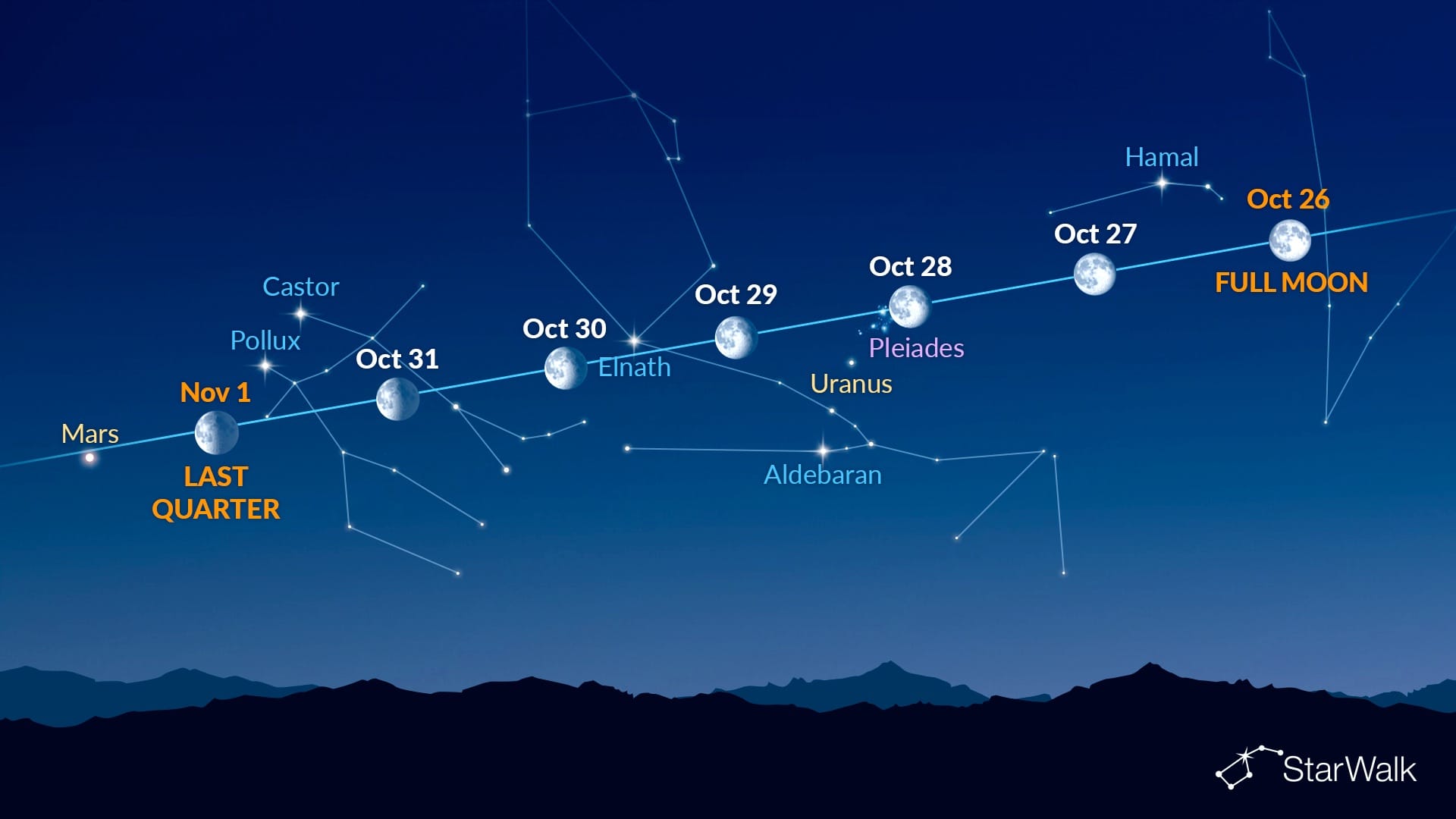
From October 27 to 30, the Moon travels through Taurus, a constellation with several bright space objects. On the night of October 28–29, our natural satellite passes roughly 10–13° from Aldebaran (mag 0.9), the constellation’s brightest star. Around October 29, it appears much closer to Elnath (mag 1.7), the second-brightest star in Taurus, which marks the tip of the bull’s northern horn. Depending on your location, look on the night of October 28–29 or October 29–30, preferably after midnight.
The Moon then moves to Gemini. On the mornings of October 31 and November 1, look for Castor (mag 1.6) and Pollux (mag 1.2) near the Moon. The best morning to see the grouping will depend on your location. As the week ends, the Moon leaves Gemini and moves closer to the reddish planet Mars (mag 0.9).
What do astronomers call the approach of the Moon to the planet?
In this article, you'll come across several types of celestial events. They all involve the relative positions of the Moon and celestial objects and occur close together in time. However, they differ in detail. Here is what each one means.
Closest approach (appulse)
Closest approach or appulse happens when two celestial objects have the smallest apparent distance as seen from the Earth. For the Moon and planets, appulse often takes place close to conjunction.
Conjunction
Conjunction occurs when two celestial objects have the same apparent right ascension or ecliptic longitude in the sky. In everyday language, the terms “conjunction” and “closest approach” are often used interchangeably. However, conjunction has a more technical meaning and does not necessarily occur with every appulse.
Moon-planet conjunctions occur frequently. Once every 27.3 days, our natural satellite passes through a narrow part of the sky centered on the ecliptic and encounters planets. Planetary conjunctions are less frequent; you can learn more about them in our separate article.
Occultation
Occultation takes place when a celestial body with a greater apparent diameter passes in front of a body with a smaller apparent diameter; for example, when the Moon passes in front of a star or planet. The occultation of the Sun by the Moon is called a solar eclipse. Each lunar occultation is only visible from some parts of the Earth. That's because the exact position of the Moon in the sky varies by up to 2° at different locations.
Observations
How to spot planets next to the Moon?
Here are some things to keep in mind for successful observations.
-
You may miss the exact time of conjunction or closest approach, but don't worry! Even before or after the exact moment of the event, the objects will stay relatively close together, and that's just as worth observing.
-
Depending on the angular distance between the objects, some events should be seen with a telescope and some with binoculars. In general, a good 10×50 binocular will give you a 6-7° field of view; for telescopes, this figure varies — it could be less than 1°. You can calculate the field of view of your optics yourself. And, of course, you can also observe an event with the naked eye.
-
When the Moon is close to its full phase, it outshines fainter objects, so the planets and stars near the Full Moon may appear not as bright as they usually do.
-
A bright object near the Moon can be a star or a planet. To know for sure which one you're seeing, use Sky Tonight: point your device at the object in question, and the app will tell you its name.
Jupiter and Venus (sometimes Mars and Saturn, too) are way brighter than most stars. You can tell the planets apart by their colors:
- Mercury is gray or brownish;
- Venus is pale yellow;
- Mars is pale pink or bright red;
- Jupiter is orange;
- Saturn is gold.
- To identify an object or find out when objects are closest together for your exact location, use the free stargazing tools — Sky Tonight or Star Walk 2.
Sky Tonight app
To identify an object in the sky with the help of Sky Tonight, follow these steps:
Step 1. Open Sky Tonight and point your device at the sky or tap the big blue button. A live representation of what you see in the sky will appear on the screen, and the app will start to follow your movements.
Step 2. Point your device at the part of the sky where the object is located. For convenience, you can limit the visual magnitude so that only those objects that can be seen with the naked eye appear on the screen. To do this, tap the panel at the bottom of the screen and drag the top slider to the left, closer to the eye icon. From this panel, you can also turn on the night mode, change the constellation appearance, and more.
Step 3. Now you can identify the bright object and get information about it by tapping on its name.
You can also watch our detailed video tutorial.
Star Walk 2 app
To identify an object in the sky with the help of Star Walk 2, follow these steps:
Step 1. Open Star Walk 2 and point your device at the sky or tap the compass icon in the top left corner of the screen. A live representation of what you see in the sky will appear on the screen, and the app will start to follow your movements.
Step 2. Point your device at the part of the sky where the object is located. For convenience, drag the slider on the left down until only the objects you can see in the sky remain on the screen.
Step 3. Now you can identify the bright object and get information about it by tapping on its name at the bottom of the screen.
You can also watch our detailed video tutorial. Find more videos in the Tutorials section.
How to photograph the Moon with planets?
You can take a picture of a planet near the Moon with a professional camera or even a smartphone. Here are some tips to help you:
-
Check the weather forecast. Open the Sky Tonight app and tap the telescope icon at the bottom. You'll see two tabs — Stargazing Index and Weather. Select the latter and find the date with cloudless weather, so clouds don't interfere with your night of astrophotography.
-
Find out when objects are well-placed for your location. In Sky Tonight, tap the magnifier icon at the bottom. Enter the name of the object you're interested in and tap the target icon next to the corresponding search result. When the app shows you the object's location, use the panel at the top to scroll through time and determine the best time to take the picture.
-
Set up a frame. Determine the apparent distance between the Moon and the planet and find their altitude using Sky Tonight. Next, define a rectangle large enough to fit everything you want in the frame, but leave yourself some room. Then use a field of view calculator to find the right lens size for the coverage.
-
Bring something else into the shot. It could be a tree or a small house, depending on your surroundings. Here is an example of how a target in the foreground improves a shot. Use the AR mode in Sky Tonight to superimpose the image of the night sky on your background. Tap the big blue button on the main screen for this.
-
Use a tripod. It will help your camera to stay still and take several pictures from the same angle.
What planet is next to the Moon tonight? October 2026
Here is a quick table of all the planets the Moon passes close to in October 2026.
| Date | Event | Where/when to look | Visibility |
|---|---|---|---|
| October 1 | Moon near Uranus | Late evening to before dawn; binoculars or a telescope needed | 🟡 Moderate |
| October 5 | Moon near Mars; lunar occultation of Mars | Before dawn | 🟢 Good |
| October 6 | Moon near Jupiter; lunar occultation of Jupiter | Before dawn | 🟢 Good |
| October 12 | Moon near Venus | Shortly after sunset | 🟡 Moderate |
| October 12 | Moon near Mercury | Shortly after sunset | 🟡 Moderate |
| October 23–24 | Moon near Neptune | From evening through much of the night; a telescope is needed | 🔴 Difficult |
| October 24 | Moon near Saturn | From evening through much of the night | 🟢 Good |
| October 28 | Moon near Uranus | Late evening to before dawn; binoculars or a telescope needed | 🟡 Moderate |
October 23–24: Moon near Neptune
- Close approach time: October 23, 23:22 GMT (October 23, 7:22 PM ET)
- Close approach distance: 4°15′
- Conjunction time: October 24, 03:16 GMT (October 23, 11:16 PM ET)
- Conjunction distance: 4°49′
On the night of October 23–24, the waxing gibbous Moon will appear close to Neptune (mag 7.7) in the constellation Pisces. Neptune is far too faint to see with the naked eye, and the bright moonlight will make it even harder to detect, so you’ll need a telescope for the best chance of spotting it.
| City | Time zone | Visibility start | Visibility end | Best time | Separation | Moon altitude | Neptune altitude |
|---|---|---|---|---|---|---|---|
| New York, USA | UTC−04:00 | Oct 23, 19:35 | Oct 24, 04:00 | Oct 23, 19:35 | 3.5° | 32° | 29° |
| Los Angeles, USA | UTC−07:00 | Oct 23, 19:35 | Oct 24, 04:05 | Oct 23, 19:35 | 4.1° | 34° | 32° |
| Toronto, Canada | UTC−04:00 | Oct 23, 19:55 | Oct 24, 04:20 | Oct 23, 19:55 | 3.5° | 30° | 27° |
| London, UK | UTC+01:00 | Oct 23, 19:40 | Oct 24, 03:55 | Oct 24, 00:20 | 3.8° | 38° | 36° |
| New Delhi, India | UTC+05:30 | Oct 23, 19:05 | Oct 24, 03:30 | Oct 24, 03:30 | 4.6° | 10° | 12° |
| Singapore | UTC+08:00 | Oct 23, 20:00 | Oct 24, 04:10 | Oct 24, 04:10 | 5.4° | 10° | 14° |
| Sydney, Australia | UTC+11:00 | Oct 23, 20:45 | Oct 24, 03:40 | Oct 24, 03:40 | 6.6° | 10° | 16° |
| Auckland, New Zealand | UTC+13:00 | Oct 23, 21:20 | Oct 24, 04:00 | Oct 24, 04:00 | 7.2° | 10° | 17° |
- Visibility start: The Sun reaches 18° below the horizon, while both objects are at least 10° above it.
- Best time: The Moon and Neptune appear closest while both are high enough to see and the sky is dark enough. This may be at the start or end of the viewing window.
- Visibility end: One of the objects drops below 10° above the horizon.
- Separation and altitudes are provided for the “best time”.
October 24: Moon near Saturn
- Close approach time: 12:24 GMT (8:24 AM ET)
- Close approach distance: 6°04′
- Conjunction time: 17:42 GMT (1:42 PM ET)
- Conjunction distance: 6°49′
Around October 24, the nearly full Moon will appear near Saturn (mag 0.4). The Moon will be in Pisces, while Saturn will be in Cetus, close to the border with Pisces.
Look for them in the evening and through much of the night. This will be a fairly wide pairing, with about 6° between the Moon and Saturn. Their monthly close approaches will remain fairly wide over the next few years, with separations of roughly 5–8°. By 2030, some close approaches will bring the pair within 2–4° of each other.
Saturn reached opposition on October 4, so it will still appear close to its largest and brightest for the year. You can see the planet with the naked eye, but if you own a telescope, you can see Saturn’s rings.
| City | Time zone | Visibility start | Visibility end | Best time | Separation | Moon altitude | Saturn altitude |
|---|---|---|---|---|---|---|---|
| New York, USA | UTC−04:00 | Oct 23, 18:30 | Oct 24, 04:30 | Oct 24, 04:30 | 6.7° | 10° | 12° |
| Los Angeles, USA | UTC−07:00 | Oct 23, 18:35 | Oct 24, 04:35 | Oct 24, 04:35 | 6.1° | 10° | 11° |
| Toronto, Canada | UTC−04:00 | Oct 23, 18:50 | Oct 24, 04:50 | Oct 24, 04:50 | 6.5° | 10° | 11° |
| London, UK | Europe/London | Oct 24, 18:25 (UTC+01:00) | Oct 25, 03:30 (UTC+00:00) | Oct 24, 18:25 (UTC+01:00) | 6.0° | 14° | 10° |
| New Delhi, India | UTC+05:30 | Oct 24, 18:05 | Oct 25, 04:05 | Oct 24, 18:05 | 5.4° | 22° | 18° |
| Singapore | UTC+08:00 | Oct 24, 19:10 | Oct 25, 04:50 | Oct 24, 19:10 | 5.7° | 27° | 25° |
| Sydney, Australia | UTC+11:00 | Oct 24, 19:40 | Oct 25, 04:05 | Oct 24, 20:00 | 6.4° | 30° | 31° |
| Auckland, New Zealand | UTC+13:00 | Oct 24, 20:15 | Oct 25, 04:25 | Oct 24, 21:50 | 6.7° | 40° | 43° |
- Visibility start: Both objects are at least 10° above the horizon, and the Sun is at least 6° below it.
- Best time: The Moon and Saturn appear closest while both are high enough to see and the sky is dark enough.
- Visibility end: One of the objects drops below 10° above the horizon.
- Separation and altitudes are provided for the “best time”.
October 28: Moon near Uranus
- Close approach time: 08:56 GMT (4:56 AM ET)
- Close approach distance: 5°09′
- Conjunction time: 10:26 GMT (6:26 AM ET)
- Conjunction distance: 5°13′
On October 28, the waning gibbous Moon will pass close to Uranus (mag 5.6) in the constellation Taurus. Uranus is faint, so you’ll need powerful binoculars or a small telescope to find it; the bright Moon may make the planet even harder to spot.
The Pleiades star cluster (mag 1.2) and the bright star Aldebaran (mag 0.9) will also shine nearby.
| City | Time zone | Visibility start | Visibility end | Best time | Separation | Moon altitude | Uranus altitude |
|---|---|---|---|---|---|---|---|
| New York, USA | UTC−04:00 | Oct 27, 20:25 | Oct 28, 05:50 | Oct 28, 05:50 | 4.9° | 48° | 46° |
| Los Angeles, USA | UTC−07:00 | Oct 27, 20:30 | Oct 28, 05:45 | Oct 27, 23:35 | 4.9° | 51° | 47° |
| Toronto, Canada | UTC−04:00 | Oct 27, 20:40 | Oct 28, 06:10 | Oct 28, 06:10 | 4.8° | 47° | 45° |
| London, UK | UTC+00:00 | Oct 27, 19:05 | Oct 28, 04:55 | Oct 28, 04:55 | 5.6° | 43° | 42° |
| New Delhi, India | UTC+05:30 | Oct 28, 20:10 | Oct 29, 05:10 | Oct 28, 20:10 | 6.3° | 10° | 11° |
| Singapore | UTC+08:00 | Oct 28, 21:45 | Oct 29, 05:35 | Oct 28, 21:45 | 6.4° | 10° | 13° |
| Sydney, Australia | UTC+11:00 | Oct 28, 23:10 | Oct 29, 04:30 | Oct 28, 23:10 | 6.4° | 10° | 16° |
| Auckland, New Zealand | UTC+13:00 | Oct 28, 23:45 | Oct 29, 04:45 | Oct 28, 23:45 | 6.1° | 10° | 15° |
- Visibility start: Both objects are at least 10° above the horizon, and the Sun is at least 18° below it.
- Best time: The Moon and Uranus appear closest while both are high enough to see and the sky is dark enough.
- Visibility end: The Sun reaches 18° below the horizon, marking the start of astronomical twilight.
- Separation and altitudes are provided for the “best time”.
What planet is closest to the Moon in the sky: Bottom line
Now you know what those bright dots near the Moon are. To view the planets and stars near our natural satellite, choose a cloudless night and use Star Walk 2 or Sky Tonight to learn when the celestial objects are best placed for your location. For a visual explanation, watch our recently released video on how to identify bright objects near the Moon using the Sky Tonight app, step by step.
Here, you can learn about past conjunctions of the Moon and planets:
- Moon-planet conjunctions 2022;
- Moon-planet conjunctions 2023;
- Moon-planet conjunctions 2024;
- Moon-planet conjunctions 2025.
- Moon-planet conjunctions 2026.
Wishing you clear skies and happy observations!