Past Moon-Planet Conjunctions 2026
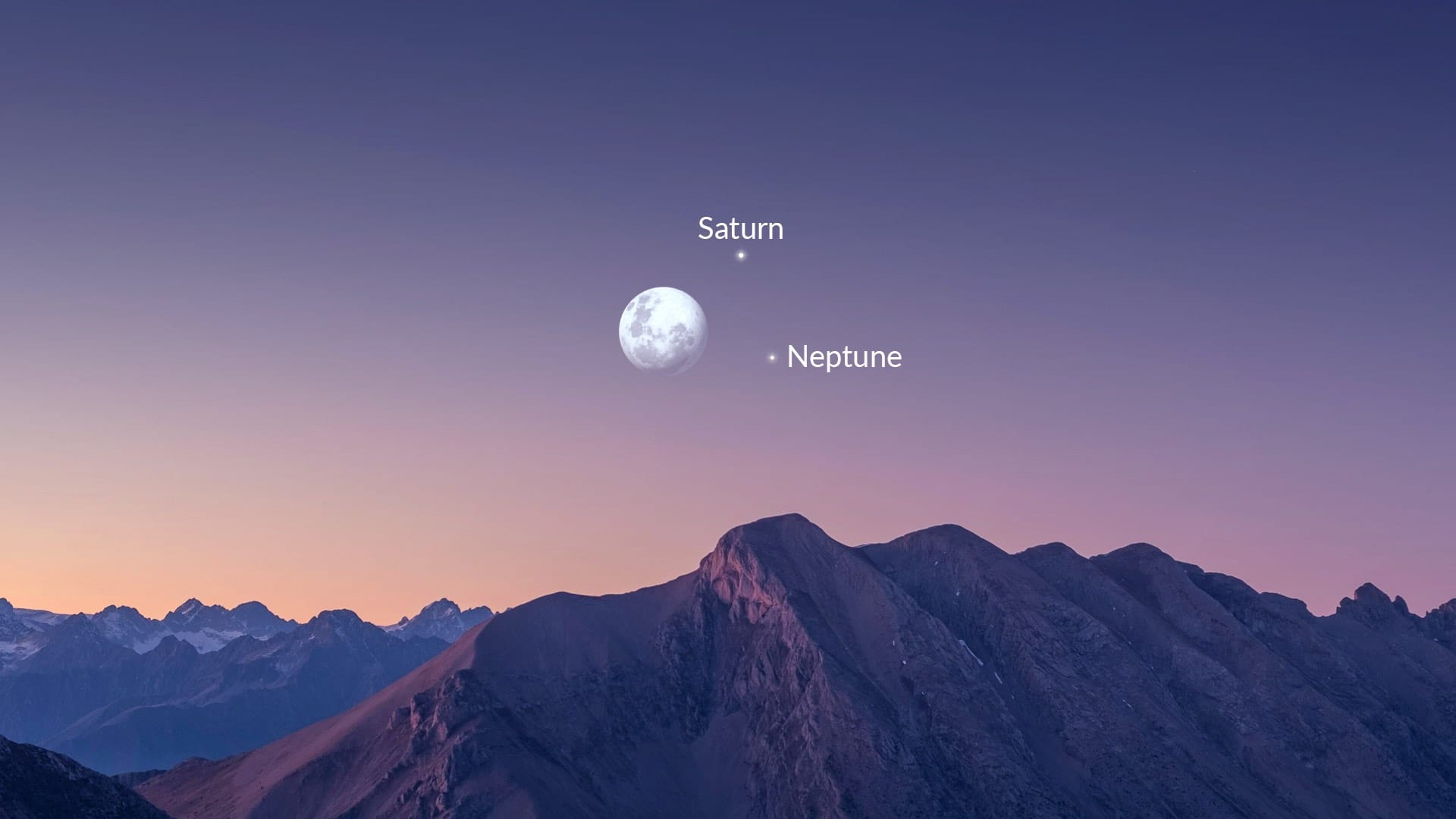
From this article, you’ll learn when the planets passed near the Moon in our sky in 2026. For the upcoming conjunctions, read our other monthly-updated article.
Contents
What planet is next to the Moon tonight? October 2026
Here is a quick table of all the planets the Moon passes close to in October 2026.
| Date | Event | Where/when to look | Visibility |
|---|---|---|---|
| October 1 | Moon near Uranus | Late evening to before dawn; binoculars or a telescope needed | 🟡 Moderate |
| October 5 | Moon near Mars; lunar occultation of Mars | Before dawn | 🟢 Good |
| October 6 | Moon near Jupiter; lunar occultation of Jupiter | Before dawn | 🟢 Good |
| October 12 | Moon near Venus | Shortly after sunset | 🟡 Moderate |
| October 12 | Moon near Mercury | Shortly after sunset | 🟡 Moderate |
| October 23–24 | Moon near Neptune | From evening through much of the night; a telescope is needed | 🔴 Difficult |
| October 24 | Moon near Saturn | From evening through much of the night | 🟢 Good |
| October 28 | Moon near Uranus | Late evening to before dawn; binoculars or a telescope needed | 🟡 Moderate |
October 1: Moon near Uranus
- Close approach time: 02:47 GMT (September 30, 10:47 PM ET)
- Close approach distance: 5°17′
- Conjunction time: 04:20 GMT (12:20 AM ET)
- Conjunction distance: 5°22′
On October 1, the waning gibbous Moon will appear near Uranus (mag 5.7) in the constellation Taurus. The Moon will be easy to see without any optical aid, while Uranus will require binoculars or a small telescope. Since the Moon will be quite bright, spotting faint Uranus nearby may be challenging.
The Pleiades star cluster (mag 1.2) and the star Aldebaran (mag 0.9) will also appear nearby.
| City | Time zone | Visibility start | Visibility end | Best time | Separation | Moon altitude | Uranus altitude |
|---|---|---|---|---|---|---|---|
| New York, USA | UTC−04:00 | Sep 30, 22:10 | Oct 1, 05:20 | Sep 30, 22:10 | 4.6° | 13° | 10° |
| Los Angeles, USA | UTC−07:00 | Sep 30, 22:20 | Oct 1, 05:25 | Sep 30, 22:20 | 5.2° | 11° | 10° |
| Toronto, Canada | UTC−04:00 | Sep 30, 22:25 | Oct 1, 05:40 | Sep 30, 22:25 | 4.5° | 13° | 10° |
| London, UK | UTC+01:00 | Sep 30, 21:55 | Oct 1, 05:10 | Oct 1, 02:20 | 4.8° | 54° | 50° |
| New Delhi, India | UTC+05:30 | Sep 30, 22:00 | Oct 1, 04:55 | Oct 1, 04:55 | 5.7° | 74° | 75° |
| Singapore | UTC+08:00 | Sep 30, 23:25 | Oct 1, 05:45 | Oct 1, 05:45 | 6.6° | 59° | 65° |
| Sydney, Australia | UTC+10:00 | Sep 30, 23:30 | Oct 1, 04:10 | Oct 1, 04:10 | 8.0° | 28° | 34° |
| Auckland, New Zealand | UTC+13:00 | Oct 1, 01:05 | Oct 1, 05:30 | Oct 1, 05:30 | 8.7° | 25° | 32° |
- Visibility start: Both objects are at least 10° above the horizon, and the Sun is at least 18° below it.
- Best time: The Moon and Uranus appear closest while both are high enough to see and the sky is dark enough.
- Visibility end: The Sun reaches 18° below the horizon, marking the start of astronomical twilight.
- Separation and altitudes are provided for the “best time”.
October 5: Moon near Mars; lunar occultation of Mars
- Global occultation start: 05:07 GMT (1:07 AM ET)
- Global occultation end: 07:15 GMT (3:15 AM ET)
- Conjunction time: 05:32 GMT (1:32 AM ET)
- Conjunction distance: 1°08′
- Close approach time: 06:11 GMT (2:11 AM ET)
- Close approach distance: 1°05′
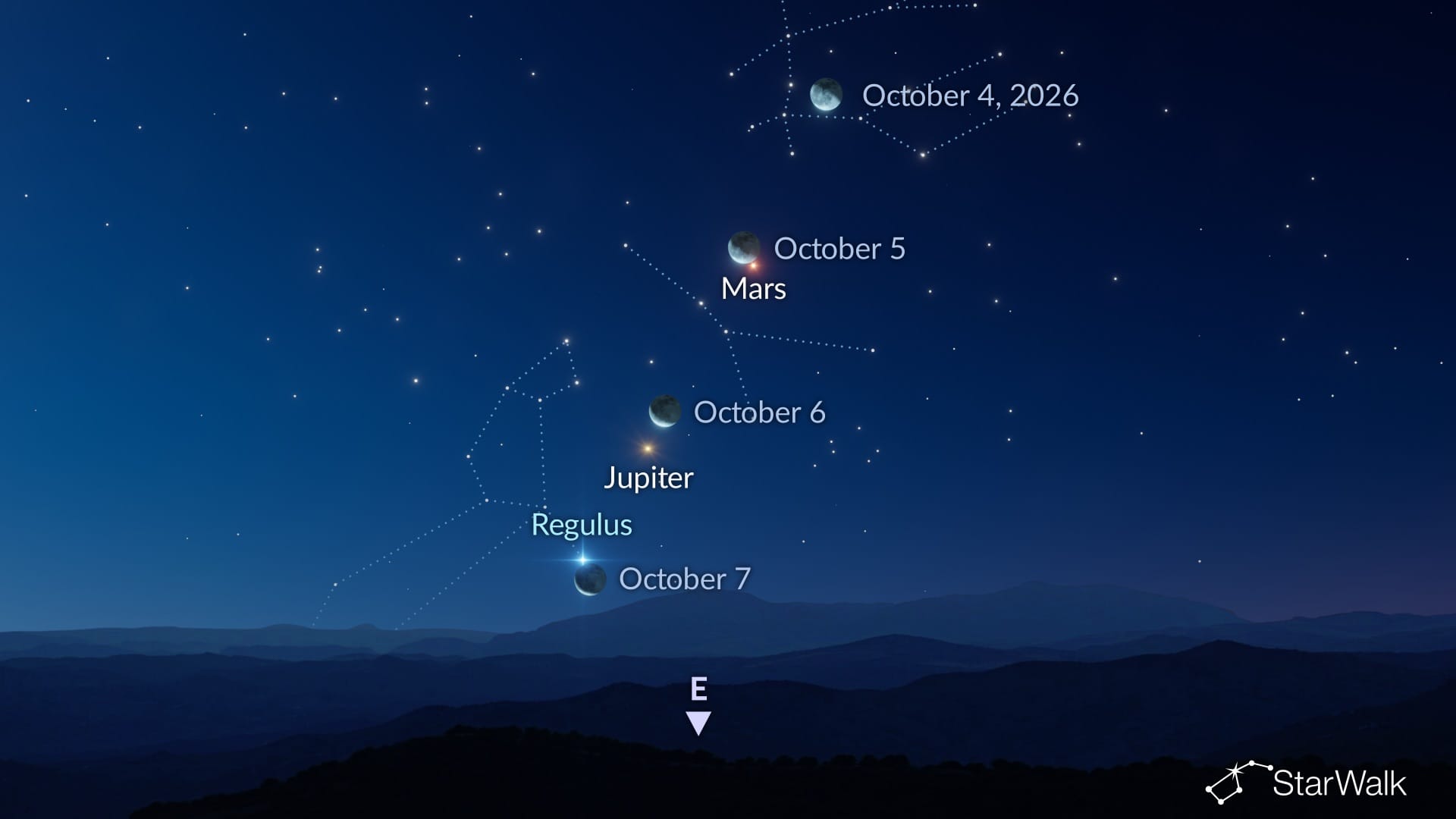
On October 5, the waning crescent Moon will pass near Mars (mag 1.0) in the constellation Cancer. Look for the pair in the predawn sky. A lunar occultation of Mars will be visible from parts of northern Canada; elsewhere, where the pair is above the horizon before dawn, observers will see the Moon and Mars close together.
Another bright planet, Jupiter (mag −1.9), shines in the same area of the sky. It appears closer to the eastern horizon in the constellation Leo.
| City | Time zone | Visibility start | Visibility end | Best time | Separation | Moon altitude | Mars altitude |
|---|---|---|---|---|---|---|---|
| New York, USA | UTC−04:00 | Oct 5, 02:15 | Oct 5, 06:30 | Oct 5, 02:15 | 1°11′ | 10° | 11° |
| Los Angeles, USA | UTC−07:00 | Oct 5, 02:30 | Oct 5, 06:25 | Oct 5, 02:30 | 2°56′ | 10° | 13° |
| Toronto, Canada | UTC−04:00 | Oct 5, 02:30 | Oct 5, 06:50 | Oct 5, 02:30 | 1°16′ | 10° | 11° |
| Resolute, Canada | UTC−05:00 | Oct 5, 00:10 | Oct 5, 06:50 | Oct 5, 00:15 | 0°16′ | 11° | 10° |
| Eureka, Canada | UTC−05:00 | Oct 4, 19:05 | Oct 5, 06:05 | Oct 5, 00:25 | 0°16′ | 16° | 15° |
| London, UK | UTC+01:00 | Oct 5, 01:55 | Oct 5, 06:35 | Oct 5, 06:20 | 0°42′ | 50° | 50° |
| New Delhi, India | UTC+05:30 | Oct 5, 01:55 | Oct 5, 05:55 | Oct 5, 05:55 | 3°02′ | 64° | 61° |
| Sydney, Australia | UTC+11:00 | Oct 5, 04:20 | Oct 5, 06:00 | Oct 5, 06:00 | 6°23′ | 25° | 26° |
| Auckland, New Zealand | UTC+13:00 | Oct 6, 05:20 | Oct 6, 06:25 | Oct 6, 05:20 | 6°21′ | 10° | 14° |
- Visibility start: Both objects are at least 10° above the horizon, and the Sun is at least 6° below it.
- Best time: The Moon and Mars appear closest while both are high enough to see and the sky is dark enough. In Resolute and Eureka, Mars passes behind the Moon around this time.
- Visibility end: The Sun reaches 6° below the horizon, marking the start of civil twilight.
- Separation is the center-to-center angular distance between the Moon and Mars. During an occultation, it is smaller than the Moon’s apparent radius but does not necessarily reach 0°.
- Separation and altitudes are provided for the “best time”.
October 6: Moon near Jupiter; lunar occultation of Jupiter
- Conjunction time: 10:16 GMT (6:16 AM ET)
- Conjunction distance: 0°10′
- Close approach time: 10:24 GMT (6:24 AM ET)
- Close approach distance: 0°09′
On October 6, the waning crescent Moon will pass extremely close to brilliant Jupiter (mag −1.9) in the constellation Leo. The pair will be easy to see with the naked eye. Binoculars can show Jupiter’s four bright Galilean moons, while a telescope may also reveal the planet’s Great Red Spot under favorable conditions. The Moon will offer plenty of detail too, with shadowed craters standing out along its rugged terminator.
Look above the Moon and Jupiter to see Mars (mag 1.0) in the constellation Cancer. It shines with its unmistakable red color.
| City | Time zone | Visibility start | Visibility end | Best time | Separation | Moon altitude | Jupiter altitude |
|---|---|---|---|---|---|---|---|
| New York, USA | UTC−04:00 | Oct 6, 03:30 | Oct 6, 06:30 | Oct 6, 04:55 | 0°04′ | 26° | 26° |
| Los Angeles, USA | UTC−07:00 | Oct 6, 03:40 | Oct 6, 06:25 | Oct 6, 03:40 | 1°05′ | 10° | 11° |
| Toronto, Canada | UTC−04:00 | Oct 6, 03:50 | Oct 6, 06:50 | Oct 6, 04:55 | 0°07′ | 22° | 22° |
| London, UK | UTC+01:00 | Oct 6, 03:20 | Oct 6, 06:35 | Oct 6, 06:35 | 2°08′ | 41° | 39° |
| New Delhi, India | UTC+05:30 | Oct 6, 03:10 | Oct 6, 05:55 | Oct 6, 05:55 | 5°07′ | 51° | 46° |
| Singapore | UTC+08:00 | Oct 6, 04:20 | Oct 6, 06:30 | Oct 6, 06:30 | 6°19′ | 46° | 41° |
| Sydney, Australia | UTC+11:00 | Oct 7, 05:15 | Oct 7, 06:00 | Oct 7, 05:15 | 5°01′ | 10° | 13° |
| Auckland, New Zealand | UTC+13:00 | Oct 7, 05:50 | Oct 7, 06:25 | Oct 7, 05:50 | 4°09′ | 10° | 12° |
- Visibility start: Both objects are at least 10° above the horizon, and the Sun is at least 6° below it.
- Best time: The Moon and Jupiter appear closest while both are high enough to see and the sky is dark enough. In New York and Toronto, Jupiter is hidden behind the Moon at this time.
- Visibility end: The Sun reaches 6° below the horizon, marking the start of civil twilight.
- Separation is the center-to-center angular distance between the Moon and Jupiter. During an occultation, it is smaller than the Moon’s apparent radius but does not necessarily reach 0°.
- Separation and altitudes are provided for the “best time”.
Observers in parts of Africa and the Americas may also witness a lunar occultation of Jupiter. On October 6, between 08:14 and 12:32 GMT, the Moon will pass directly in front of the planet, briefly hiding it from view. Use the free Sky Tonight app to check the occultation visibility and exact timing for your location.
October 12: Moon near Venus
- Conjunction time: 02:31 GMT (October 11, 10:31 PM ET)
- Conjunction distance: 3°05′
- Close approach time: 04:37 GMT (12:37 AM ET)
- Close approach distance: 2°49′
On October 12, a very thin crescent Moon will appear near brilliant Venus (mag −4.4), which will be in Virgo. Look for them low above the western horizon shortly after sunset. Fainter Mercury (mag 0.0) will also be nearby, in Libra.
The best views will be from the Southern Hemisphere. Near the equator, you'll have only a brief chance to spot it as the sky darkens. At mid- and high northern latitudes, the pair will be too low by the time the sky darkens enough for observation.
The viewing window begins when the Sun is 6° below the horizon and both objects are at least 10° above it. In every city listed, this is also the best time.
| City | Time zone | Best time | Separation | Moon altitude | Venus altitude | Visibility end |
|---|---|---|---|---|---|---|
| Cape Town, South Africa | UTC+02:00 | Oct 12, 19:25 | 6.7° | 18° | 13° | Oct 12, 19:35 |
| Durban, South Africa | UTC+02:00 | Oct 12, 18:30 | 6.2° | 17° | 12° | Oct 12, 18:40 |
| Perth, Australia | UTC+08:00 | Oct 12, 18:50 | 3.9° | 15° | 13° | Oct 12, 19:05 |
| Adelaide, Australia | UTC+10:30 | Oct 12, 19:55 | 3.5° | 14° | 13° | Oct 12, 20:10 |
| Brisbane, Australia | UTC+10:00 | Oct 12, 18:15 | 3.1° | 13° | 12° | Oct 12, 18:30 |
| Sydney, Australia | UTC+11:00 | Oct 12, 19:30 | 3.2° | 14° | 13° | Oct 12, 19:45 |
| Auckland, New Zealand | UTC+13:00 | Oct 12, 20:00 | 3.1° | 13° | 13° | Oct 12, 20:15 |
| Christchurch, New Zealand | UTC+13:00 | Oct 12, 20:20 | 3.2° | 13° | 13° | Oct 12, 20:35 |
- Best time: The Moon and Venus appear closest while both are high enough to see and the sky is dark enough.
- Separation and altitudes are provided for the “best time”.
- Visibility end: Venus drops below 10° above the horizon.
October 12: Moon near Mercury
- Close approach time: 18:43 GMT (2:43 PM ET)
- Close approach distance: 2°01′
- Conjunction time: 20:08 GMT (4:08 PM ET)
- Conjunction distance: 2°07′
On October 12, a very thin crescent Moon will appear near Mercury (mag 0.0). Look for them above the western horizon shortly after sunset. Mercury will be in Libra, while much brighter Venus (mag −4.4) will be nearby in Virgo.
The best views will be from the Southern Hemisphere, where the pair will be higher above the horizon as the sky darkens. Near the equator, the viewing window will be shorter, so a clear western horizon is especially important. At mid- and high northern latitudes, Mercury will be very low in the twilight and may be hidden by buildings or trees.
| City | Time zone | Visibility start | Visibility end | Best time | Separation | Moon altitude | Mercury altitude |
|---|---|---|---|---|---|---|---|
| Cape Town, South Africa | UTC+02:00 | Oct 12, 19:25 | Oct 12, 20:05 | Oct 12, 20:05 | 2.2° | 10° | 11° |
| Durban, South Africa | UTC+02:00 | Oct 12, 18:30 | Oct 12, 19:05 | Oct 12, 19:05 | 2.5° | 10° | 11° |
| Singapore | UTC+08:00 | Oct 12, 19:15 | Oct 12, 19:20 | Oct 12, 19:20 | 5.0° | 10° | 15° |
| Perth, Australia | UTC+08:00 | Oct 12, 18:50 | Oct 12, 19:15 | Oct 12, 19:15 | 4.9° | 10° | 14° |
| Adelaide, Australia | UTC+10:30 | Oct 12, 19:55 | Oct 12, 20:15 | Oct 12, 20:15 | 5.5° | 10° | 15° |
| Sydney, Australia | UTC+11:00 | Oct 12, 19:30 | Oct 12, 19:50 | Oct 12, 19:50 | 5.9° | 10° | 15° |
| Auckland, New Zealand | UTC+13:00 | Oct 13, 20:00 | Oct 13, 21:15 | Oct 13, 20:00 | 5.4° | 24° | 19° |
- Visibility start: The Sun reaches 6° below the horizon, while the Moon is at least 10° above it and Mercury is at least 5° above it.
- Best time: The Moon and Mercury appear closest while both are high enough to see and the sky is dark enough.
- Visibility end: The Moon drops below 10° or Mercury drops below 5°, whichever happens first.
- Separation and altitudes are provided for the “best time”.
What planet is next to the Moon tonight? September 2026
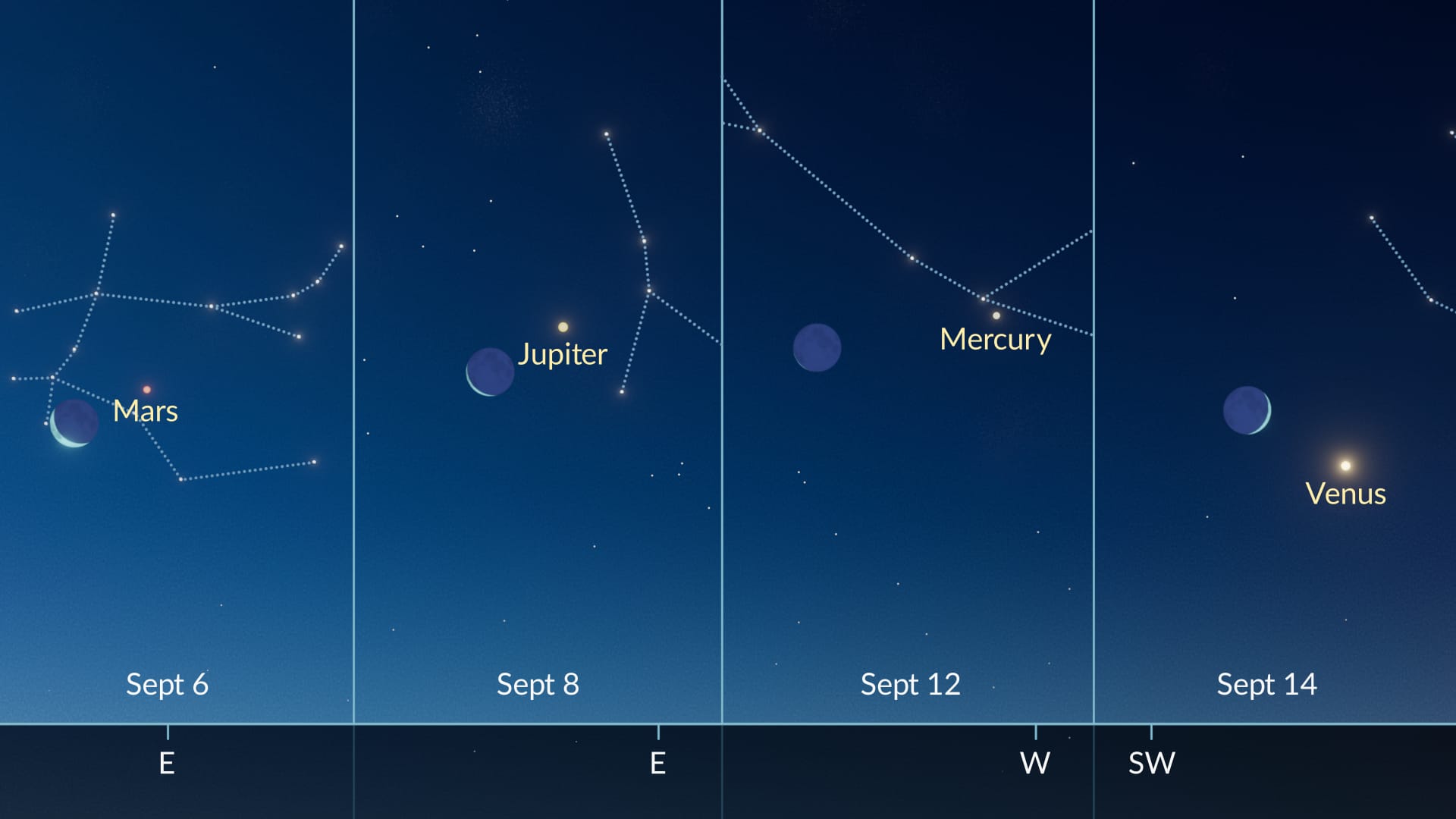
Here is a quick table of all the planets the Moon passes close to in September 2026.
| Date | Event | Where/when to look | Visibility |
|---|---|---|---|
| September 3–4 | Moon near Uranus | Before dawn above the eastern horizon; binoculars or a telescope needed | 🟡 Moderate |
| September 6–7 | Moon near Mars | Before dawn above the eastern horizon | 🟢 Good |
| September 8–9 | Moon near Jupiter | Before dawn, low above the eastern horizon | 🟡 Moderate |
| September 12 | Moon near Mercury | Shortly after sunset, extremely low above the western horizon | 🔴 Difficult |
| September 14 | Moon near Venus | After sunset above the western horizon | 🟢 Good |
| September 26–27 | Moon near Neptune | Visible throughout the night; a telescope is needed | 🔴 Difficult |
| September 26–27 | Moon near Saturn | From evening until sunrise | 🟢 Good |
September 3: Moon near Uranus
- Close approach time: 21:31 GMT
- Close approach distance: 5°23′
- Conjunction time: 23:05 GMT
- Conjunction distance: 5°30′
On the morning of September 4, the Moon near its Last Quarter phase will appear near Uranus (mag 5.8) in the constellation Taurus. Look for the objects after local midnight, when they will already be well above the eastern horizon. To spot Uranus, you’ll need binoculars or a telescope.
Observers at mid-northern latitudes will have better viewing conditions, as Uranus will climb higher during the darker part of the night. The Pleiades star cluster will also be nearby.
| City | Time zone | Best time (local) | Separation | Moon altitude | Uranus altitude | Sun altitude |
|---|---|---|---|---|---|---|
| New York, USA | EDT (UTC−4) | Sep 4, 4:50 AM | 8.6° | 63° | 63° | −18° |
| Los Angeles, USA | PDT (UTC−7) | Sep 3, 5:02 AM | 7.5° | 76° | 69° | −18° |
| Toronto, Canada | EDT (UTC−4) | Sep 4, 5:03 AM | 8.7° | 60° | 60° | −18° |
| London, UK | BST (UTC+1) | Sep 4, 4:15 AM | 6.1° | 54° | 51° | −18° |
| New Delhi, India | IST (UTC+5:30) | Sep 4, 4:40 AM | 5.4° | 75° | 74° | −18° |
| Singapore | SGT (UTC+8) | Sep 4, 5:51 AM | 5.8° | 63° | 68° | −18° |
| Sydney, Australia | AEST (UTC+10) | Sep 4, 4:47 AM | 6.4° | 29° | 35° | −18° |
| Auckland, New Zealand | NZST (UTC+12) | Sep 4, 5:12 AM | 6.7° | 26° | 32° | −18° |
September 6: Moon near Mars
- Conjunction time: 18:25 GMT
- Conjunction distance: 3°01′
- Close approach time: 19:28 GMT
- Close approach distance: 2°57′
On the mornings of September 6 and 7, look above the eastern horizon for the waning crescent Moon near reddish Mars (mag 1.2) in Gemini.
The pair will be joined by Castor and Pollux, Gemini’s brightest stars. Mars, Castor, and Pollux will form a striking triangle beside the Moon.
Look lower toward the horizon to spot Jupiter (mag –1.8), the second-brightest planet in the sky after Venus.
| City | Time zone | Best time (local) | Separation | Moon altitude | Mars altitude | Sun altitude |
|---|---|---|---|---|---|---|
| New York, USA | EDT (UTC−4) | Sep 6, 4:53 AM | 6.0° | 40° | 34° | −18° |
| Los Angeles, USA | PDT (UTC−7) | Sep 6, 5:04 AM | 4.5° | 41° | 37° | −18° |
| Toronto, Canada | EDT (UTC−4) | Sep 6, 5:06 AM | 5.8° | 39° | 33° | −18° |
| London, UK | BST (UTC+1) | Sep 7, 4:21 AM | 5.8° | 26° | 29° | −18° |
| New Delhi, India | IST (UTC+5:30) | Sep 7, 4:42 AM | 4.1° | 36° | 38° | −18° |
| Singapore | SGT (UTC+8) | Sep 7, 5:50 AM | 3.9° | 32° | 36° | −18° |
| Sydney, Australia | AEST (UTC+10) | Sep 7, 5:00 AM | 3.8° | 15° | 18° | −15° |
| Auckland, New Zealand | NZST (UTC+12) | Sep 7, 5:31 AM | 3.9° | 13° | 17° | −13° |
September 8: Moon near Jupiter
- Conjunction time: 18:11 GMT
- Conjunction distance: 0°49′
- Close approach time: 18:43 GMT
- Close approach distance: 0°46′
On the mornings of September 8 and 9, a very thin crescent Moon will pass close to brilliant Jupiter (mag –1.8). On September 8, both objects will be in Cancer. By the following morning, the Moon will have moved into Leo.
Look for the pair low above the eastern horizon about an hour before sunrise. There is a trade-off: the earlier you observe, the darker the sky will be — but the lower the Moon and Jupiter will sit. Closer to sunrise, they will rise higher but become harder to spot in the brightening twilight.
| City | Time zone | Best time (local) | Separation | Moon altitude | Jupiter altitude | Sun altitude |
|---|---|---|---|---|---|---|
| New York, USA | EDT (UTC−4) | Sep 8, 5:40 AM | 4.5° | 23° | 19° | −10° |
| Los Angeles, USA | PDT (UTC−7) | Sep 8, 5:46 AM | 2.7° | 23° | 20° | −10° |
| Toronto, Canada | EDT (UTC−4) | Sep 8, 5:57 AM | 4.3° | 22° | 18° | −10° |
| London, UK | BST (UTC+1) | Sep 9, 5:24 AM | 6.5° | 11° | 17° | −10° |
| New Delhi, India | IST (UTC+5:30) | Sep 9, 5:21 AM | 4.0° | 17° | 21° | −10° |
| Singapore | SGT (UTC+8) | Sep 9, 6:22 AM | 3.2° | 16° | 19° | −10° |
| Sydney, Australia | AEST (UTC+10) | Sep 9, 5:46 AM | 1.9° | 10° | 12° | −4° |
| Auckland, New Zealand | NZST (UTC+12) | Sep 9, 6:19 AM | 1.7° | 10° | 12° | −3° |
Observers in parts of Canada, Greenland, eastern Russia, and the contiguous United States may also witness a lunar occultation of Jupiter. On September 8, between 17:03 and 20:25 GMT, the Moon will pass in front of the planet and briefly hide it from view.
The occultation will occur in daylight across much of the visibility area, making it challenging to observe. Only some locations in eastern Russia can see it under a dark or twilight sky. Your best chance may be to catch Jupiter shortly before it disappears behind the Moon or just after it reappears. Use the free Sky Tonight app to check the visibility map and exact timing for your location.
September 12: Moon near Mercury
- Close approach time: 03:48 GMT
- Close approach distance: 3°24′
- Conjunction time: 07:28 GMT
- Conjunction distance: 3°52′
On the evening of September 12, an extremely thin waxing crescent Moon will appear near Mercury (mag –0.6) in Virgo. Look for the pair very low above the western horizon shortly after sunset. Brilliant Venus (mag –4.7) will shine nearby, higher in the southwestern sky.
The view will be considerably better from southern latitudes, where the Moon and Mercury will remain higher above the horizon as the sky darkens. From much of the Northern Hemisphere, the pair will sit almost directly on the horizon and may be lost in the evening twilight.
| City | Time zone | Best time (local) | Separation | Moon altitude | Mercury altitude | Sun altitude |
|---|---|---|---|---|---|---|
| New York, USA | EDT (UTC−4) | Not visible | — | — | — | — |
| Los Angeles, USA | PDT (UTC−7) | Not visible | — | — | — | — |
| Toronto, Canada | EDT (UTC−4) | Not visible | — | — | — | — |
| London, UK | BST (UTC+1) | Not visible | — | — | — | — |
| New Delhi, India | IST (UTC+5:30) | Not visible | — | — | — | — |
| Singapore | SGT (UTC+8) | Sep 12, 7:26 PM | 4.8° | 7° | 6° | −6.1° |
| Sydney, Australia | AEST (UTC+10) | Sep 12, 6:11 PM | 3.5° | 8° | 6° | −6° |
| Auckland, New Zealand | NZST (UTC+12) | Sep 12, 6:36 PM | 3.3° | 7° | 6° | −6° |
September 14: Moon near Venus
- Conjunction time: 11:11 GMT
- Conjunction distance: 0°31′
- Close approach time: 11:34 GMT
- Close approach distance: 0°28′
If you notice a dazzling “star” beside the Moon around September 14, it isn’t a star at all — it’s Venus. On the evening of September 14, the thin waxing crescent Moon will appear near the brilliant planet (mag –4.7) in Virgo. The two objects will also remain relatively close on the evenings before and after the event.
Look for them low above the western horizon in the evening twilight. Venus will be easy to spot even from a light-polluted city, while the Moon’s delicate crescent will make the pairing especially photogenic.
The view will be best from the Southern Hemisphere, where the Moon and Venus will remain above the horizon into darker twilight. Observers there may also spot Spica (mag 1.0), the brightest star in Virgo, nearby.
| City | Time zone | Best time (local) | Separation | Moon altitude | Venus altitude | Sun altitude |
|---|---|---|---|---|---|---|
| New York, USA | EDT (UTC−4) | Sep 14, 7:36 PM | 5.7° | 8° | 6° | −6° |
| Los Angeles, USA | PDT (UTC−7) | Sep 13, 7:33 PM | 5.0° | 7° | 10° | −7° |
| Toronto, Canada | EDT (UTC−4) | Sep 14, 7:54 PM | 5.9° | 7° | 5° | −5° |
| London, UK | BST (UTC+1) | Not visible | — | — | — | — |
| New Delhi, India | IST (UTC+5:30) | Sep 14, 7:11 PM | 0.6° | 10° | 10° | −10° |
| Singapore | SGT (UTC+8) | Sep 14, 8:13 PM | 0.5° | 16° | 17° | −18° |
| Sydney, Australia | AEST (UTC+10) | Sep 14, 7:09 PM | 2.2° | 21° | 23° | −18° |
| Auckland, New Zealand | NZST (UTC+12) | Sep 14, 7:37 PM | 2.9° | 20° | 23° | −18° |
There is another highlight: a lunar occultation of Venus will be visible from much of Europe, western Russia, and large parts of Africa and Asia. Between 09:26 and 13:42 GMT, the Moon will pass in front of Venus and temporarily hide it from view. The event will occur in daylight across most locations, although some eastern parts of the path can experience it after sunset. Use the free Sky Tonight app to check the visibility map and exact timing for your location.
September 26: Moon near Neptune
- Close approach time: 15:06 GMT
- Close approach distance: 4°16′
- Conjunction time: 19:04 GMT
- Conjunction distance: 4°51′
On the night of September 26–27, the Full Moon will pass near Neptune (mag 7.7) in Pisces. Neptune will be at opposition, when it appears brightest and stays in the sky from around sunset to sunrise.
Unfortunately, the timing is far from ideal for observing the distant planet. Neptune is never visible to the naked eye, and the glare of the nearby Full Moon will make it particularly difficult to find. You'll need a telescope, an accurate sky map, and clear atmospheric conditions.
A much easier target will be Saturn (mag 0.4). The ringed planet will shine nearby as a bright, steady point of light and will be clearly visible without optical aid.
| City | Time zone | Best time (local) | Separation | Moon altitude | Neptune altitude | Sun altitude |
|---|---|---|---|---|---|---|
| New York, USA | EDT (UTC−4) | Sep 26, 5:16 AM | 5.8° | 14° | 17° | −18° |
| Los Angeles, USA | PDT (UTC−7) | Sep 26, 5:21 AM | 4.8° | 15° | 17° | −18° |
| Toronto, Canada | EDT (UTC−4) | Sep 26, 5:33 AM | 5.7° | 15° | 17° | −18° |
| London, UK | BST (UTC+1) | Sep 26, 8:42 PM | 4.3° | 20° | 17° | −18° |
| New Delhi, India | IST (UTC+5:30) | Sep 26, 7:32 PM | 3.5° | 20° | 17° | −18° |
| Singapore | SGT (UTC+8) | Sep 26, 8:47 PM | 3.9° | 30° | 28° | −28° |
| Sydney, Australia | AEST (UTC+10) | Sep 26, 10:12 PM | 4.8° | 48° | 49° | −48° |
| Auckland, New Zealand | NZST (UTC+12) | Sep 27, 12:53 AM | 5.0° | 48° | 52° | −51° |
September 27: Moon near Saturn
- Close approach time: 06:36 GMT
- Close approach distance: 6°11′
- Conjunction time: 12:01 GMT
- Conjunction distance: 6°59′
On the night of September 26–27, the Full Moon will appear near Saturn (mag 0.4). Although the two objects will look close together, the Moon will be in Pisces, while Saturn will have crossed into neighboring Cetus.
Look toward the eastern horizon after 8 p.m. local time. The pair will climb higher throughout the night and remain visible until sunrise. Despite the Moon’s bright glare, Saturn will be easy to recognize with the naked eye as a steady, yellowish point of light.
The ringed planet will reach opposition on October 4, so this is the best time of the year to observe it.
| City | Time zone | Best time (local) | Separation | Moon altitude | Saturn altitude | Sun altitude |
|---|---|---|---|---|---|---|
| New York, USA | EDT (UTC−4) | Sep 27, 12:44 AM | 5.8° | 56° | 51° | −51° |
| Los Angeles, USA | PDT (UTC−7) | Sep 26, 9:29 PM | 5.5° | 33° | 28° | −34° |
| Toronto, Canada | EDT (UTC−4) | Sep 27, 12:52 AM | 5.7° | 52° | 47° | −48° |
| London, UK | BST (UTC+1) | Sep 27, 6:21 AM | 6.0° | 12° | 11° | −6° |
| New Delhi, India | IST (UTC+5:30) | Sep 27, 7:25 PM | 7.2° | 12° | 10° | −17° |
| Singapore | SGT (UTC+8) | Sep 27, 8:12 PM | 7.1° | 10° | 11° | −19° |
| Sydney, Australia | AEST (UTC+10) | Sep 27, 7:31 PM | 6.9° | 10° | 14° | −20° |
| Auckland, New Zealand | NZDT (UTC+13) | Sep 27, 8:57 PM | 6.6° | 10° | 13° | −20° |
Planets next to the Moon in August 2026
Here is a quick table of all the planets the Moon passes close to in August 2026.
| Date | Event | Where/when to look | Visibility |
|---|---|---|---|
| August 3 | Moon near Neptune | Above the eastern horizon from late evening; a small telescope is needed | 🔴 Difficult |
| August 3 | Moon near Saturn | From late evening; look east | 🟢 Good |
| August 7 | Moon near Uranus | Above the eastern horizon from about 2 a.m.; binoculars or a telescope needed | 🟡 Moderate |
| August 9 | Moon near Mars | Above the eastern horizon in the morning | 🟢 Good |
| August 11 | Moon near Mercury | Very low above the eastern horizon shortly before sunrise | 🔴 Difficult |
| August 12 | Moon near Jupiter | The Moon will be invisible, and Jupiter will be difficult or impossible to spot | 🔴 Difficult |
| August 16 | Moon near Venus | Low above the western horizon in bright evening twilight | 🟢 Good |
| August 30 | Moon near Neptune | Above the eastern horizon from late evening; a small telescope is needed | 🔴 Difficult |
| August 31 | Moon near Saturn | From about 10 p.m.; look east | 🟢 Good |
August 3: Moon near Neptune
- Close approach time: 03:47 GMT
- Close approach distance: 4°21′
- Conjunction time: 07:56 GMT
- Conjunction distance: 4°58′
On August 2–3, the waning gibbous Moon will appear close to Neptune (mag 7.7) in the constellation Pisces. Start looking for them low above the eastern horizon after around 11 p.m. local time until morning twilight. Neptune will require a small telescope to spot. Nearby, you will also see Saturn (mag 0.6), easily visible to the naked eye.
| City | Best time (local) | Separation | Altitude, Moon / Neptune |
|---|---|---|---|
| New York, USA | Aug 3, 4:47 AM | 4.6° | 54° / 49° |
| Los Angeles, USA | Aug 3, 5:06 AM | 5.8° | 61° / 55° |
| Toronto, Canada | Aug 3, 4:56 AM | 4.6° | 51° / 47° |
| London, UK | Aug 3, 3:53 AM | 3.8° | 41° / 38° |
| New Delhi, India | Aug 3, 4:48 AM | 5.0° | 59° / 59° |
| Singapore | Aug 3, 6:19 AM | 5.7° | 59° / 64° |
| Sydney, Australia | Aug 3, 5:50 AM | 6.8° | 36° / 42° |
| Auckland, New Zealand | Aug 3, 6:19 AM | 7.4° | 34° / 40° |
August 3: Moon near Saturn
- Close approach time: 22:38 GMT
- Close approach distance: 6°14′
- Conjunction time: August 4, 04:10 GMT
- Conjunction distance: 6°56′
On August 3–4, the waning gibbous Moon will appear near Saturn (mag 0.6) in the constellation Pisces. You can see them in the sky from late evening until sunrise. Look towards the eastern horizon — the pair will climb higher in the morning. A small telescope will reveal faint Neptune (mag 7.7) nearby.
| City | Best time (local) | Separation | Altitude, Moon / Saturn |
|---|---|---|---|
| New York, USA | Aug 3, 11:45 PM | 6.3° | 14° / 10° |
| Los Angeles, USA | Aug 3, 11:39 PM | 7.4° | 12° / 10° |
| Toronto, Canada | Aug 4, 12:07 AM | 6.4° | 14° / 10° |
| London, UK | Aug 3, 11:56 PM | 5.4° | 15° / 10° |
| New Delhi, India | Aug 4, 1:18 AM | 5.8° | 44° / 38° |
| Singapore | Aug 4, 2:30 AM | 6.3° | 53° / 49° |
| Sydney, Australia | Aug 4, 6:19 AM | 7.2° | 34° / 41° |
| Auckland, New Zealand | Aug 4, 6:49 AM | 7.4° | 31° / 38° |
August 7: Moon near Uranus
- Close approach time: 14:57 GMT
- Close approach distance: 5°27′
- Conjunction time: 16:29 GMT
- Conjunction distance: 5°32′
On August 7, the waning crescent Moon will appear near Uranus (mag 5.8) in the constellation Taurus. Look for the objects from about 2 a.m. local time above the eastern horizon. To spot Uranus, you’ll need binoculars or a telescope.
Observers at mid-northern latitudes will have better viewing conditions, as Uranus will climb higher during the darker part of the night. Mars (mag 1.3) and the Pleiades star cluster will also be nearby.
| City | Best time (local) | Separation | Altitude, Moon / Uranus |
|---|---|---|---|
| New York, USA | Aug 7, 4:51 AM | 5.9° | 50° / 45° |
| Los Angeles, USA | Aug 7, 5:09 AM | 5.2° | 54° / 50° |
| Toronto, Canada | Aug 7, 5:02 AM | 5.8° | 48° / 42° |
| London, UK | Aug 7, 4:02 AM | 8.2° | 41° / 34° |
| New Delhi, India | Aug 8, 4:51 AM | 7.6° | 51° / 54° |
| Singapore | Aug 8, 6:19 AM | 7.6° | 49° / 56° |
| Sydney, Australia | Aug 8, 5:46 AM | 7.0° | 25° / 32° |
| Auckland, New Zealand | Aug 8, 6:15 AM | 6.7° | 23° / 30° |
August 9: Moon near Mars
- Conjunction time: 05:31 GMT
- Conjunction distance: 4°25′
- Close approach time: 05:49 GMT
- Close approach distance: 4°24′
On August 9, the thin crescent Moon will appear near Mars (mag 1.3) in the constellation Taurus — look for them in the morning, above the eastern horizon. In addition to the Moon and Mars, you can enjoy reddish Aldebaran, the brightest star in Taurus, shining relatively close by. The Pleiades star cluster will also be nearby. Observers with binoculars will also be able to spot Uranus (mag 5.8) in the same area of the sky.
| City | Best time (local) | Separation | Altitude, Moon / Mars |
|---|---|---|---|
| New York, USA | Aug 9, 3:10 AM | 4.1° | 11° / 10° |
| Los Angeles, USA | Aug 9, 3:27 AM | 5.3° | 10° / 11° |
| Toronto, Canada | Aug 9, 3:25 AM | 4.1° | 11° / 10° |
| London, UK | Aug 9, 4:53 AM | 3.9° | 32° / 29° |
| New Delhi, India | Aug 9, 5:21 AM | 5.1° | 44° / 40° |
| Singapore | Aug 9, 6:43 AM | 5.9° | 41° / 40° |
| Sydney, Australia | Aug 9, 6:14 AM | 7.3° | 21° / 23° |
| Auckland, New Zealand | Aug 9, 6:44 AM | 8.0° | 19° / 21° |
August 11: Moon near Mercury
- Conjunction time: 12:47 GMT
- Conjunction distance: 2°08′
- Close approach time: 14:05 GMT
- Close approach distance: 1°58′
On August 11, a very thin waning crescent Moon will pass close to Mercury (mag –0.9) in the constellation Cancer. The pair will rise shortly before sunrise, low above the eastern horizon. About 30 minutes later, bright Jupiter (mag –1.8) will follow them into the morning sky.
There is one catch: both the Moon and Mercury will be very close to the Sun. Your chances of seeing them will depend heavily on your location and how clear your eastern horizon is. From many places south of the equator, Mercury will rise around or after the start of civil twilight, when the sky is already brightening.
The morning sky will bring us a much bigger event. Around the same date, Mercury, Jupiter, Mars, Uranus, Saturn, and Neptune will all appear before sunrise, creating a six-planet alignment across the sky.
For local viewing times, planet visibility details, and tips on finding the harder targets, read our complete guide to the August 2026 planetary alignment.
| City | Best time (local) | Separation | Altitude, Moon / Mercury |
|---|---|---|---|
| New York, USA | Aug 11, 5:32 AM | 2.2° | 10° / 8° |
| Los Angeles, USA | Aug 11, 5:25 AM | 1.7° | 6° / 5° |
| Toronto, Canada | Aug 11, 5:46 AM | 2.1° | 10° / 8° |
| London, UK | Aug 11, 5:01 AM | 4.9° | 11° / 7° |
| New Delhi, India | Aug 11, 5:23 AM | 7.0° | 17° / 10° |
| Singapore | Aug 11, 6:43 AM | 7.8° | 16° / 10° |
| Sydney, Australia | Not visible | — | — |
| Auckland, New Zealand | Not visible | — | — |
August 12: Moon near Jupiter
- Conjunction time: August 11, 23:23 GMT
- Conjunction distance: 1°27′
- Close approach time: 00:14 GMT
- Close approach distance: 1°20′
On August 12, the New Moon will pass close to Jupiter (mag –1.8) in the constellation Cancer.
Do not expect an easy-to-view event. Both objects will sit very close to the Sun and rise only shortly before sunrise. The Moon will be invisible in the solar glare, while Jupiter may be difficult — or impossible — to spot from some locations. Mercury (mag –0.9) will appear nearby, slightly higher above the eastern horizon.
The observing window will be extremely short. You will need a flat, unobstructed eastern horizon and perfectly clear skies. If you use binoculars, stop searching well before the Sun rises.
The real highlight is the larger morning display. Around the same date, Mercury, Jupiter, Mars, Uranus, Saturn, and Neptune will all appear before sunrise, forming a six-planet alignment across the sky.
For local viewing times, planet visibility details, and tips on finding the harder targets, read our complete guide to the August 2026 planetary alignment.
August 16: Moon near Venus
- Close approach time: 06:57 GMT
- Close approach distance: 1°50′
- Conjunction time: 08:45 GMT
- Conjunction distance: 2°05′
On August 16, the thin waxing crescent Moon will pass close to Venus (mag –4.4) in the constellation Virgo. Look for them low above the western horizon in bright evening twilight. Brilliant Venus will be easy to spot even from a light-polluted city, and the Moon’s delicate crescent will make the scene especially beautiful.
In the Southern Hemisphere, the pair will remain above the horizon during the darker part of twilight. From these latitudes, observers may also see other bright objects nearby, such as Spica (mag 1.0) — the brightest star in Virgo.
| City | Best time (local) | Separation | Altitude, Moon / Venus |
|---|---|---|---|
| New York, USA | Aug 15, 8:44 PM | 4.4° | 5° / 9° |
| Los Angeles, USA | Aug 15, 8:26 PM | 3.5° | 10° / 14° |
| Toronto, Canada | Aug 15, 9:03 PM | 4.3° | 5° / 9° |
| London, UK | Not visible | — | — |
| New Delhi, India | Aug 16, 7:25 PM | 4.1° | 20° / 21° |
| Singapore | Aug 16, 7:36 PM | 2.9° | 35° / 35° |
| Sydney, Australia | Aug 16, 5:57 PM | 1.7° | 38° / 38° |
| Auckland, New Zealand | Aug 16, 8:39 PM | 1.7° | 10° / 10° |
August 30: Moon near Neptune
- Close approach time: 08:45 GMT
- Close approach distance: 4°20′
- Conjunction time: 12:50 GMT
- Conjunction distance: 4°58′
On August 30—31, the waning gibbous Moon will pass near Neptune (mag 7.7) in the constellation Pisces. Start looking for the pair above the eastern horizon from around 11 p.m. local time until morning twilight. The Moon will be easy to find, but Neptune is another story: it is too faint for the naked eye and will require a small telescope.
The Moon will be just two days past full and bright enough to wash out the surrounding sky, making Neptune harder than usual to spot. Much easier to see will be Saturn (mag 0.5), shining nearby and clearly visible to the naked eye.
| City | Best time (local) | Separation | Altitude, Moon / Neptune |
|---|---|---|---|
| New York, USA | Aug 30, 5:19 AM | 4.1° | 37° / 35° |
| Los Angeles, USA | Aug 30, 5:29 AM | 4.4° | 39° / 37° |
| Toronto, Canada | Aug 30, 5:34 AM | 4.0° | 36° / 35° |
| London, UK | Aug 30, 4:51 AM | 5.1° | 32° / 32° |
| New Delhi, India | Aug 30, 5:06 AM | 7.2° | 33° / 38° |
| Singapore | Aug 30, 6:16 AM | 8.1° | 30° / 38° |
| Sydney, Australia | Aug 31, 5:21 AM | 7.6° | 24° / 27° |
| Auckland, New Zealand | Aug 31, 5:48 AM | 7.0° | 23° / 26° |
August 31: Moon near Saturn
- Close approach time: 02:35 GMT
- Close approach distance: 6°17′
- Conjunction time: 08:36 GMT
- Conjunction distance: 7°04′
On the night of August 30–31, the waning gibbous Moon will appear near Saturn (mag 0.5) in the constellation Pisces. Look toward the eastern horizon from about 10 p.m. local time. The pair will rise higher as the night goes on and remain visible until sunrise. Saturn will be easy to spot with the naked eye, shining close to the bright Moon.
| City | Best time (local) | Separation | Altitude, Moon / Saturn |
|---|---|---|---|
| New York, USA | Aug 30, 9:57 PM | 5.4° | 15° / 10° |
| Los Angeles, USA | Aug 30, 9:51 PM | 5.8° | 14° / 10° |
| Toronto, Canada | Aug 30, 10:20 PM | 5.4° | 15° / 10° |
| London, UK | Aug 31, 2:08 AM | 5.7° | 45° / 39° |
| New Delhi, India | Aug 31, 5:34 AM | 6.6° | 40° / 41° |
| Singapore | Aug 31, 6:40 AM | 7.3° | 35° / 41° |
| Sydney, Australia | Aug 31, 5:50 AM | 8.2° | 19° / 27° |
| Auckland, New Zealand | Aug 31, 10:11 PM | 8.4° | 10° / 17° |
Planets next to the Moon in July 2026
July 6: Moon near Neptune
- Close approach time: 22:36 GMT
- Close approach distance: 4°13′
- Conjunction time: July 7, 02:37 GMT
- Conjunction distance: 4°46′
On July 6, the waning gibbous Moon will appear close to Neptune (mag 7.7) in the constellation Pisces. Look for them low above the eastern horizon after midnight. Neptune will require a small telescope to spot. Nearby, you will also see Saturn (mag 0.7), easily visible to the naked eye.
| City | Best time (local) | Separation | Altitude, Moon / Neptune |
|---|---|---|---|
| London | Jul 7, 01:21 AM BST | 3.5° | 13° / 10° |
| New York | Jul 7, 01:05 AM EDT | 5.2° | 12° / 10° |
| Los Angeles | Jul 7, 12:57 AM PDT | 6.6° | 10° / 10° |
| Lagos | Jul 7, 12:44 AM WAT | 4.0° | 11° / 10° |
| Singapore | Jul 7, 03:45 AM SGT | 4.1° | 53° / 51° |
| Delhi | Jul 7, 02:19 AM IST | 3.6° | 38° / 35° |
| Sydney | Jul 7, 06:31 AM AEST | 5.0° | 46° / 51° |
| Auckland | Jul 7, 07:03 AM NZST | 5.3° | 43° / 48° |
July 7: Moon near Saturn
- Close approach time: 16:31 GMT
- Close approach distance: 5°58′
- Conjunction time: 21:49 GMT
- Conjunction distance: 6°40′
On July 7, the Last Quarter Moon will appear near Saturn (mag 0.7) in the constellation Pisces. You can see them in the sky from about 1 a.m. local time until sunrise. Face towards the eastern horizon — the pair will climb higher in the morning. Mars (mag 1.4) will also rise above the horizon in the morning, shortly before sunrise. A small telescope will reveal faint Neptune (mag 7.9).
| City | Best time (local) | Separation | Altitude, Moon / Saturn |
|---|---|---|---|
| London | Jul 8, 01:40 AM BST | 7.0° | 14° / 10° |
| New York | Jul 7, 04:59 AM EDT | 6.8° | 50° / 45° |
| Los Angeles | Jul 7, 05:19 AM PDT | 5.9° | 59° / 53° |
| Lagos | Jul 8, 01:24 AM WAT | 7.6° | 10° / 12° |
| Singapore | Jul 8, 01:38 AM SGT | 5.7° | 11° / 10° |
| Delhi | Jul 8, 12:53 AM IST | 5.6° | 13° / 10° |
| Sydney | Jul 8, 12:52 AM AEST | 6.1° | 10° / 11° |
| Auckland | Jul 8, 01:33 AM NZST | 6.2° | 13° / 13° |
July 11: Moon near Uranus
- Close approach time: 05:33 GMT
- Close approach distance: 5°18′
- Conjunction time: 07:07 GMT
- Conjunction distance: 5°20′
On July 11, the thin crescent Moon will appear near Uranus (mag 5.8) in the constellation Taurus. This event will be difficult to observe, as both objects will be low above the horizon. To spot Uranus, you’ll need binoculars or a telescope.
Observers at lower latitudes, especially in parts of Asia, will have better viewing conditions, as there Uranus will climb higher before dawn. Mars (mag 1.4) and the Pleiades star cluster will also be nearby. Look for the objects low above the eastern horizon a couple of hours before sunrise.
| City | Best time (local) | Separation | Altitude, Moon / Uranus |
|---|---|---|---|
| London | Jul 11, 04:08 AM BST | 4.6° | 23° / 19° |
| New York | Jul 11, 03:28 AM EDT | 4.9° | 12° / 10° |
| Los Angeles | Jul 11, 03:36 AM PDT | 6.0° | 10° / 10° |
| Lagos | Jul 11, 04:11 AM WAT | 5.1° | 12° / 10° |
| Singapore | Jul 11, 06:40 AM SGT | 6.4° | 41° / 38° |
| Delhi | Jul 11, 05:02 AM IST | 5.8° | 38° / 33° |
| Sydney | Jul 11, 06:30 AM AEST | 7.8° | 25° / 26° |
| Auckland | Jul 11, 07:02 AM NZST | 8.4° | 23° / 25° |
July 11: Moon near Mars
- Close approach time: 13:23 GMT
- Close approach distance: 5°16′
- Conjunction time: 14:35 GMT
- Conjunction distance: 5°21′
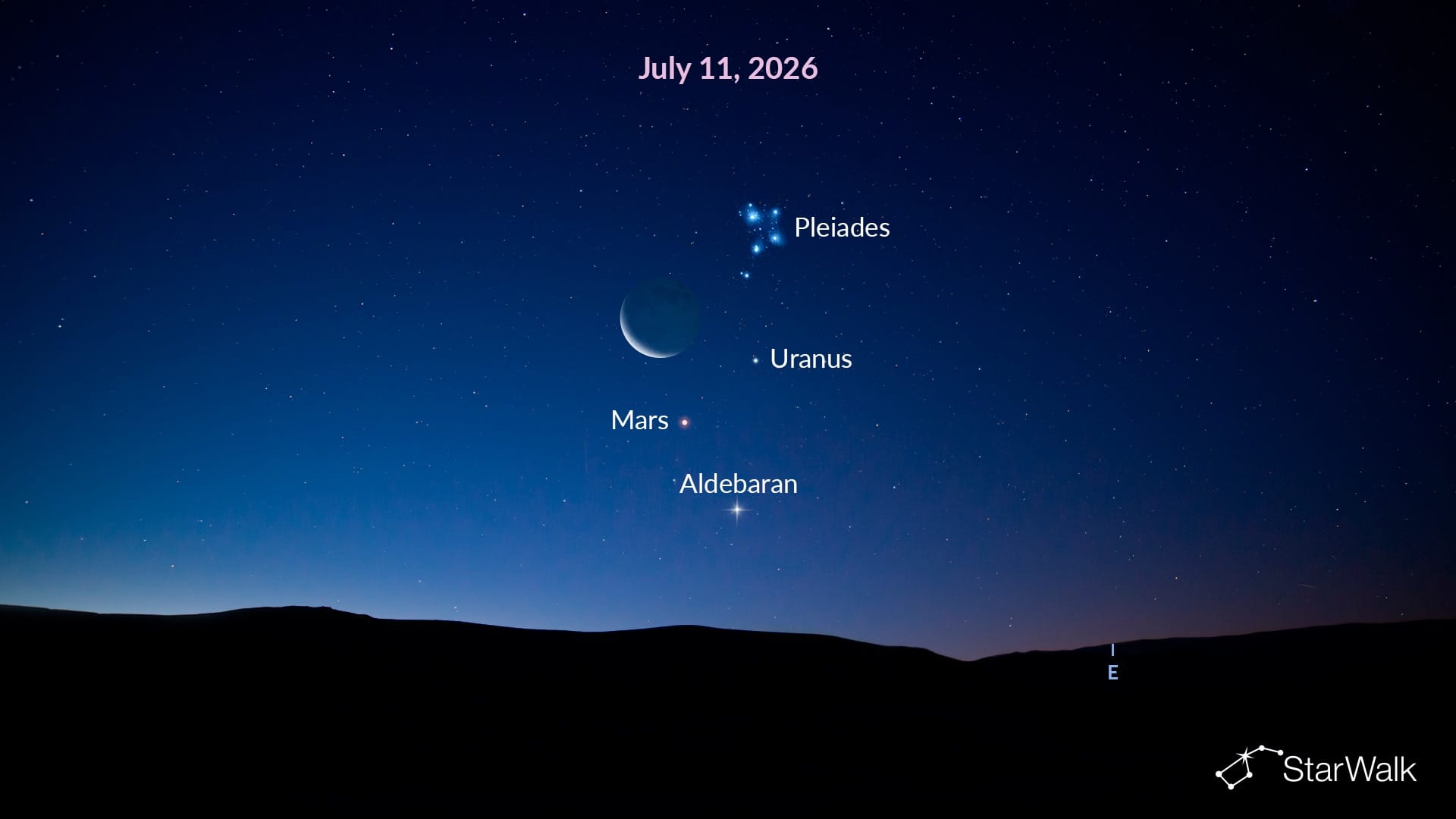
On July 11, the thin crescent Moon will appear near Mars (mag 1.4) in the constellation Taurus. Look for them in the morning, low above the eastern horizon shortly before sunrise. Aldebaran, the brightest star in the constellation also known as the “Bull’s fiery eye”, will shine nearby. In some locations, Aldebaran, Mars, and the Moon will form a beautiful line in the sky.
Reddish Mars and orange Aldebaran may be easy to confuse. In the Northern Hemisphere, Mars will appear between Aldebaran and the Moon. In the Southern Hemisphere, Mars will be the reddish dot closest to the horizon. The easiest way to identify stars and planets is to use the free Sky Tonight app.
The Pleiades star cluster in Taurus will also be nearby. In some locations, the Moon will briefly pass in front of the cluster, making some of its stars seem to “vanish” for a while. This lunar occultation of the Pleiades will be visible across much of Asia, including the Middle East, Central Asia, India, China, Southeast Asia, and parts of Eastern Europe.
Observers with binoculars will also be able to spot Uranus (mag 5.8) in the same area of the sky. Earlier that day, the Moon will make a close approach to Uranus.
| City | Best time (local) | Separation | Altitude, Moon / Mars |
|---|---|---|---|
| London | Jul 11, 04:11 AM BST | 7.1° | 23° / 16° |
| New York | Jul 11, 05:02 AM EDT | 5.0° | 29° / 24° |
| Los Angeles | Jul 11, 03:55 AM PDT | 4.7° | 14° / 10° |
| Lagos | Jul 11, 06:15 AM WAT | 6.6° | 38° / 34° |
| Singapore | Jul 12, 05:20 AM SGT | 7.7° | 10° / 15° |
| Delhi | Jul 12, 03:43 AM IST | 7.7° | 10° / 13° |
| Sydney | Jul 12, 05:49 AM AEST | 7.5° | 10° / 17° |
| Auckland | Jul 12, 06:26 AM NZST | 7.0° | 10° / 17° |
July 14: Moon near Mercury
- Conjunction time: 04:36 GMT
- Conjunction distance: 8°27′
- Close approach time: 07:15 GMT
- Close approach distance: 8°14′
On July 14, the New Moon will pass close to Mercury (mag 5.4) in the constellation Gemini. Unfortunately, both objects will be too close to the Sun to be visible. Mercury will return to the morning sky by late July.
July 15: Moon near Jupiter
- Conjunction time: 03:03 GMT
- Conjunction distance: 2°00′
- Close approach time: 04:04 GMT
- Close approach distance: 1°53′
On July 15, the very thin crescent Moon will appear close to Jupiter (mag –1.8) in the constellation Cancer. Jupiter will be hidden in the Sun’s glare, but the lunar crescent may be visible low above the western horizon in evening twilight. Jupiter reaches conjunction with the Sun on July 29 and will return to the morning sky in August.
July 17: Moon near Venus
- Close approach time: 14:46 GMT
- Close approach distance: 1°47′
- Conjunction time: 16:31 GMT
- Conjunction distance: 2°00′
On July 17, the thin waxing crescent Moon will pass close to Venus (mag –4.2) in the constellation Leo. Look for them low above the western horizon in bright evening twilight. Brilliant Venus will be easy to spot even from a light-polluted city, and the Moon’s delicate crescent will make the scene especially beautiful.
In the Southern Hemisphere, the pair will remain above the horizon during the darker part of twilight. From these latitudes, observers may also see some other bright objects nearby, such as Regulus (mag 1.3) — the brightest star in Leo.
| City | Best time (local) | Separation | Altitude, Moon / Venus |
|---|---|---|---|
| New York | Jul 17, 08:55 PM EDT | 5.7° | 17° / 17° |
| Los Angeles | Jul 16, 09:03 PM PDT | 6.8° | 10° / 15° |
| Lagos | Jul 17, 07:27 PM WAT | 2.5° | 35° / 35° |
| Johannesburg | Jul 17, 05:59 PM SAST | 1.6° | 36° / 36° |
| Singapore | Jul 17, 09:13 PM SGT | 2.8° | 10° / 13° |
| Delhi | Jul 17, 08:44 PM IST | 2.6° | 10° / 12° |
| Sydney | Jul 17, 07:20 PM AEST | 4.2° | 10° / 14° |
| Auckland | Jul 17, 07:36 PM NZST | 5.0° | 10° / 14° |
Planets next to the Moon in June 2026
Here is a quick table of all the planets the Moon passes nearby in June 2026.
| Date | Event | Where/when to look | Visibility |
|---|---|---|---|
| June 9 | Moon near Neptune | Low above the eastern horizon before sunrise; Neptune requires a small telescope | 🟡 Moderate |
| June 10 | Moon near Saturn | Above the eastern horizon about an hour before sunrise | 🟡 Moderate |
| June 12 | Moon near Mars | Low above the eastern horizon shortly before sunrise | 🟡 Moderate |
| June 13 | Moon near Uranus | Very low above the eastern horizon in morning twilight; Uranus lost in the Sun’s glare | ⚫ Not visible |
| June 16 | Moon near Mercury | Low above the western horizon after sunset | 🟡 Moderate |
| June 17 | Moon near Jupiter | Above the western horizon after sunset | 🟢 Good |
| June 17 | Moon near Venus | Low above the western horizon in evening twilight; daytime/twilight occultation in some locations | 🟢 Good |
June 9: Moon near Neptune
- Close approach time: 15:32 GMT
- Close approach distance: 3°57′
- Conjunction time: 19:13 GMT
- Conjunction distance: 4°28′
On June 9, the waning crescent Moon will appear close to Neptune (mag 7.9) in the constellation Pisces. Look for them low above the eastern horizon before local sunrise. Neptune will require a small telescope to spot. Nearby, you will also see Saturn (mag 0.9) and, depending on your location, Mars (mag 1.3) — both visible to the naked eye.
June 10: Moon near Saturn
- Close approach time: 06:50 GMT
- Close approach distance: 5°32′
- Conjunction time: 11:41 GMT
- Conjunction distance: 6°11′
On June 10, the waning crescent Moon will appear near Saturn (mag 0.9) in the constellation Pisces. Look for them in the morning, above the eastern horizon, about an hour before sunrise. Mars (mag 1.3) will also be visible nearby. A small telescope will reveal faint Neptune (mag 7.9) south of the Moon if you’re in the Northern Hemisphere and north of it if you’re in the Southern Hemisphere.
| City | Best time (local) | Separation | Altitude, Moon / Saturn |
|---|---|---|---|
| New York City, United States | Jun 10, 3:16 AM EDT | 4.7° | 14° / 10° |
| Los Angeles, United States | Jun 10, 3:10 AM PDT | 5.3° | 13° / 10° |
| London, United Kingdom | Jun 10, 3:56 AM BST | 5.1° | 19° / 14° |
| Toronto, Canada | Jun 10, 3:39 AM EDT | 4.7° | 14° / 10° |
| Lagos, Nigeria | Jun 10, 4:45 AM WAT | 5.3° | 39° / 35° |
| Nairobi, Kenya | Jun 10, 6:03 AM EAT | 5.7° | 61° / 58° |
| Johannesburg, South Africa | Jun 10, 5:08 AM SAST | 5.9° | 42° / 42° |
| Singapore | Jun 10, 6:35 AM SGT | 6.9° | 64° / 58° |
| Sydney, Australia | Jun 10, 6:28 AM AEST | 8.1° | 49° / 50° |
| Auckland, New Zealand | Jun 10, 7:00 AM NZST | 8.8° | 47° / 48° |
June 12: Moon near Mars
- Close approach time: 18:25 GMT
- Close approach distance: 5°23′
- Conjunction time: 21:15 GMT
- Conjunction distance: 5°38′
On June 12, the thin crescent Moon will appear near Mars (mag 1.3) in the constellation Aries. Look for them in the morning, low above the eastern horizon, shortly before sunrise. Saturn (mag 0.9) will be visible farther away in the same part of the morning sky. The Pleiades star cluster in Taurus will also be nearby and very low above the horizon; the Moon will pass even closer to the Pleiades and Uranus on June 13. You’ll have the best chance to see the scene with a clear eastern to northeastern horizon, more likely from the Southern Hemisphere.
| City | Best time (local) | Separation | Altitude, Moon / Mars |
|---|---|---|---|
| New York City, United States | Jun 12, 4:51 AM EDT | 6.9° | 20° / 14° |
| Los Angeles, United States | Jun 12, 5:11 AM PDT | 5.6° | 22° / 17° |
| Toronto, Canada | Jun 12, 4:59 AM EDT | 6.8° | 18° / 12° |
| Lagos, Nigeria | Jun 13, 5:21 AM WAT | 8.5° | 10° / 15° |
| Nairobi, Kenya | Jun 13, 5:16 AM EAT | 7.7° | 10° / 15° |
| Johannesburg, South Africa | Jun 13, 5:51 AM SAST | 8.7° | 10° / 18° |
| Singapore | Jun 13, 5:31 AM SGT | 5.9° | 10° / 11° |
| Sydney, Australia | Jun 13, 5:37 AM AEST | 6.0° | 10° / 14° |
| Auckland, New Zealand | Jun 13, 6:10 AM NZST | 5.9° | 10° / 14° |
June 13: Moon near Uranus
- Close approach time: 17:30 GMT
- Close approach distance: 5°11′
- Conjunction time: 19:09 GMT
- Conjunction distance: 5°18′
On June 13, the very thin waning crescent Moon will appear near Uranus (mag 5.8) in the constellation Taurus. This event will be very difficult to observe, as both objects will be close to the Sun. You may be able to spot the Moon’s thin crescent low above the eastern horizon in the morning twilight, but Uranus will be lost in the glare and will most likely remain invisible. The Pleiades star cluster will also be nearby — in fact, the Moon will pass less than 1° from it — but the cluster will also be extremely hard to see in bright twilight.
June 16: Moon near Mercury
- Conjunction time: 19:32 GMT
- Conjunction distance: 2°32′
- Close approach time: 20:26 GMT
- Close approach distance: 2°35′
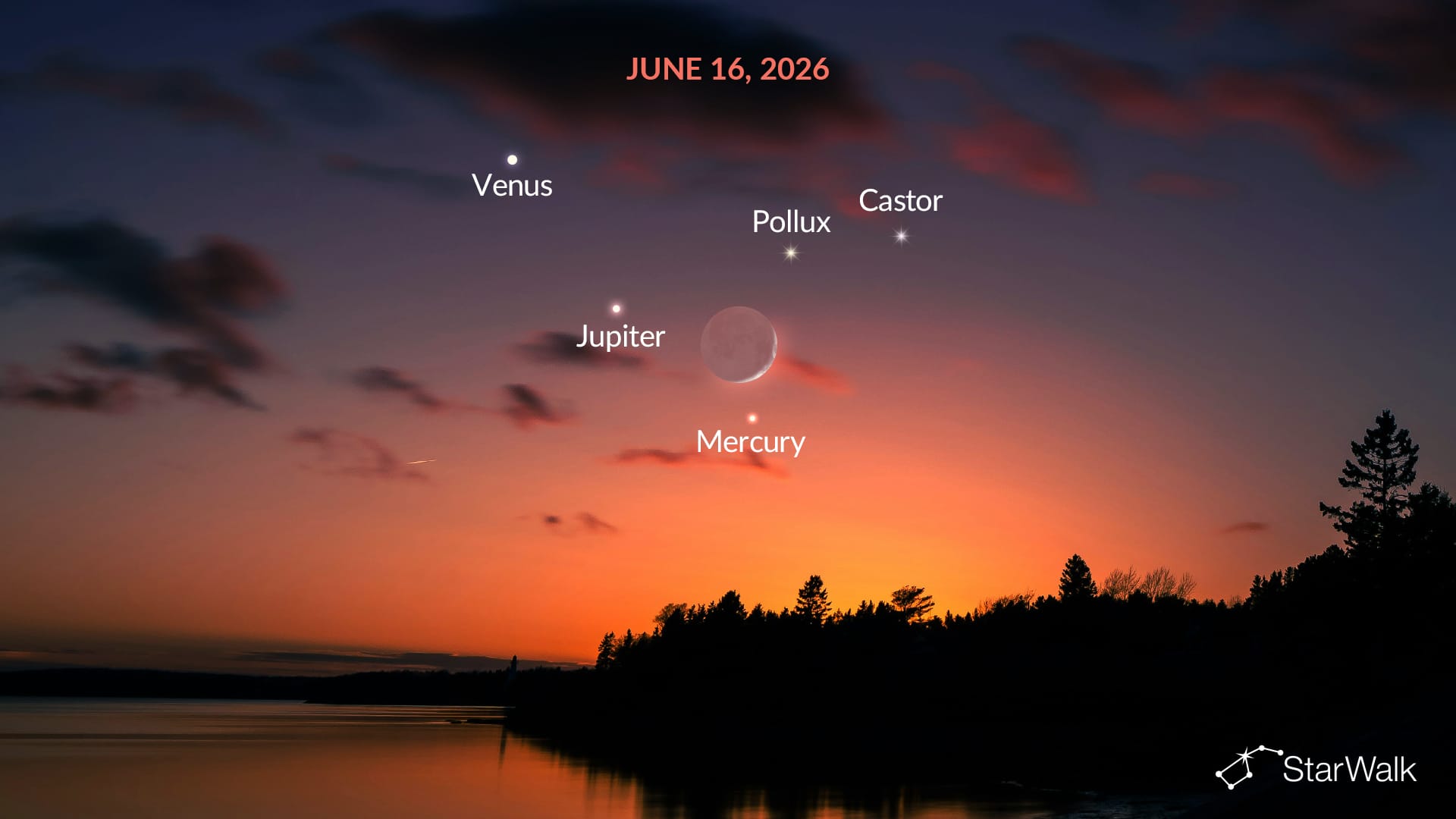
On June 16, the thin waxing crescent Moon will pass close to Mercury (mag 0.6) in the constellation Gemini. The pair will be very low above the western horizon after sunset. Around this time, a beautiful evening scene will unfold: the Moon and Mercury will be joined by Venus and Jupiter, with the three planets forming a loose line in the twilight sky. Jupiter will be closest to the Moon early on June 17, while Venus will make an even closer approach later the same day. The bright stars Castor and Pollux in Gemini will also be nearby.
| City | Best time (local) | Separation | Altitude, Moon / Mercury |
|---|---|---|---|
| New York City, United States | Jun 16, 9:02 PM EDT | 2.7° | 14° / 11° |
| Los Angeles, United States | Jun 16, 8:35 PM PDT | 4.0° | 17° / 13° |
| Lagos, Nigeria | Jun 16, 7:55 PM WAT | 3.0° | 10° / 11° |
| Nairobi, Kenya | Jun 16, 7:20 PM EAT | 4.2° | 10° / 13° |
| Johannesburg, South Africa | Jun 16, 5:52 PM SAST | 4.6° | 10° / 15° |
| Singapore | Jun 16, 7:45 PM SGT | 6.6° | 10° / 16° |
| Sydney, Australia | Jun 17, 5:20 PM AEST | 6.4° | 16° / 13° |
| Auckland, New Zealand | Jun 17, 5:40 PM NZST | 5.6° | 14° / 12° |
Learn more: June mini planetary alignment of Mercury, Venus, and Jupiter
June 17: Moon near Jupiter
- Conjunction time: 06:51 GMT
- Conjunction distance: 2°36′
- Close approach time: 07:58 GMT
- Close approach distance: 2°27′
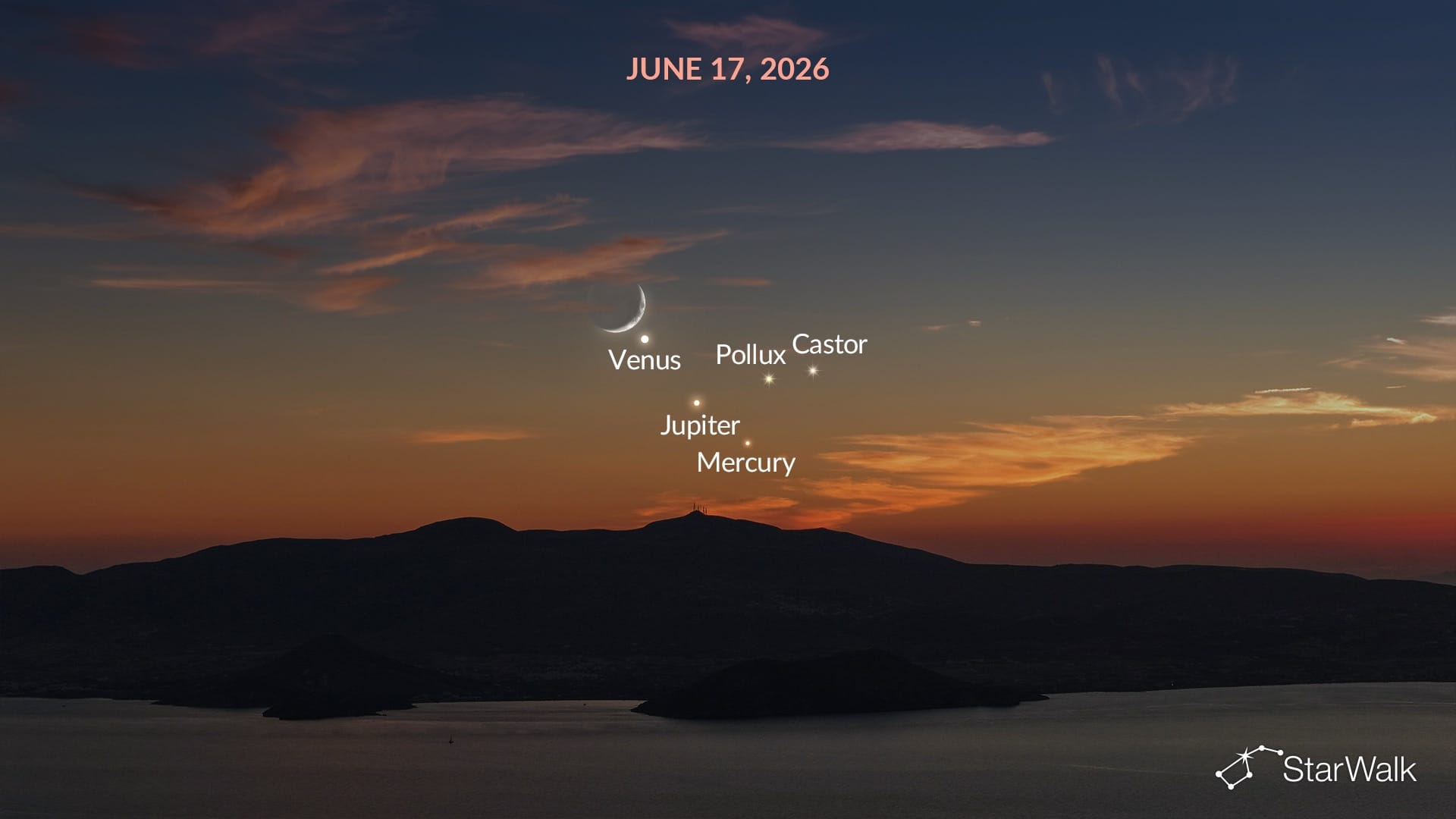
On June 17, the crescent Moon will appear close to Jupiter (mag –1.8) in the constellation Gemini. Look for them after sunset above the western horizon. Jupiter will be easy to spot with the naked eye, while the Moon’s thin crescent may be more challenging in bright twilight. Nearby, the bright stars Castor and Pollux will also be visible. Mercury will lie lower in the same part of the sky, and brilliant Venus will shine farther along the line — later that day, the Moon will pass extremely close to Venus.
| City | Best time (local) | Separation | Altitude, Moon / Jupiter |
|---|---|---|---|
| New York City, United States | Jun 16, 9:24 PM EDT | 4.9° | 10° / 11° |
| Los Angeles, United States | Jun 16, 9:13 PM PDT | 3.4° | 10° / 11° |
| Toronto, Canada | Jun 16, 9:54 PM EDT | 4.5° | 10° / 11° |
| Lagos, Nigeria | Jun 17, 7:25 PM WAT | 5.9° | 30° / 25° |
| Nairobi, Kenya | Jun 17, 6:57 PM EAT | 4.6° | 29° / 25° |
| Johannesburg, South Africa | Jun 17, 5:49 PM SAST | 4.9° | 23° / 21° |
| Singapore | Jun 17, 7:34 PM SGT | 2.7° | 27° / 25° |
| Sydney, Australia | Jun 17, 6:02 PM AEST | 3.0° | 10° / 12° |
| Auckland, New Zealand | Jun 17, 6:10 PM NZST | 3.6° | 10° / 13° |
June 17: Moon near Venus
- Conjunction time: 20:20 GMT
- Conjunction distance: 0°17′
- Close approach time: 20:29 GMT
- Close approach distance: 0°16′
- Occultation start: 18:15 GMT
- Occultation end: 22:28 GMT
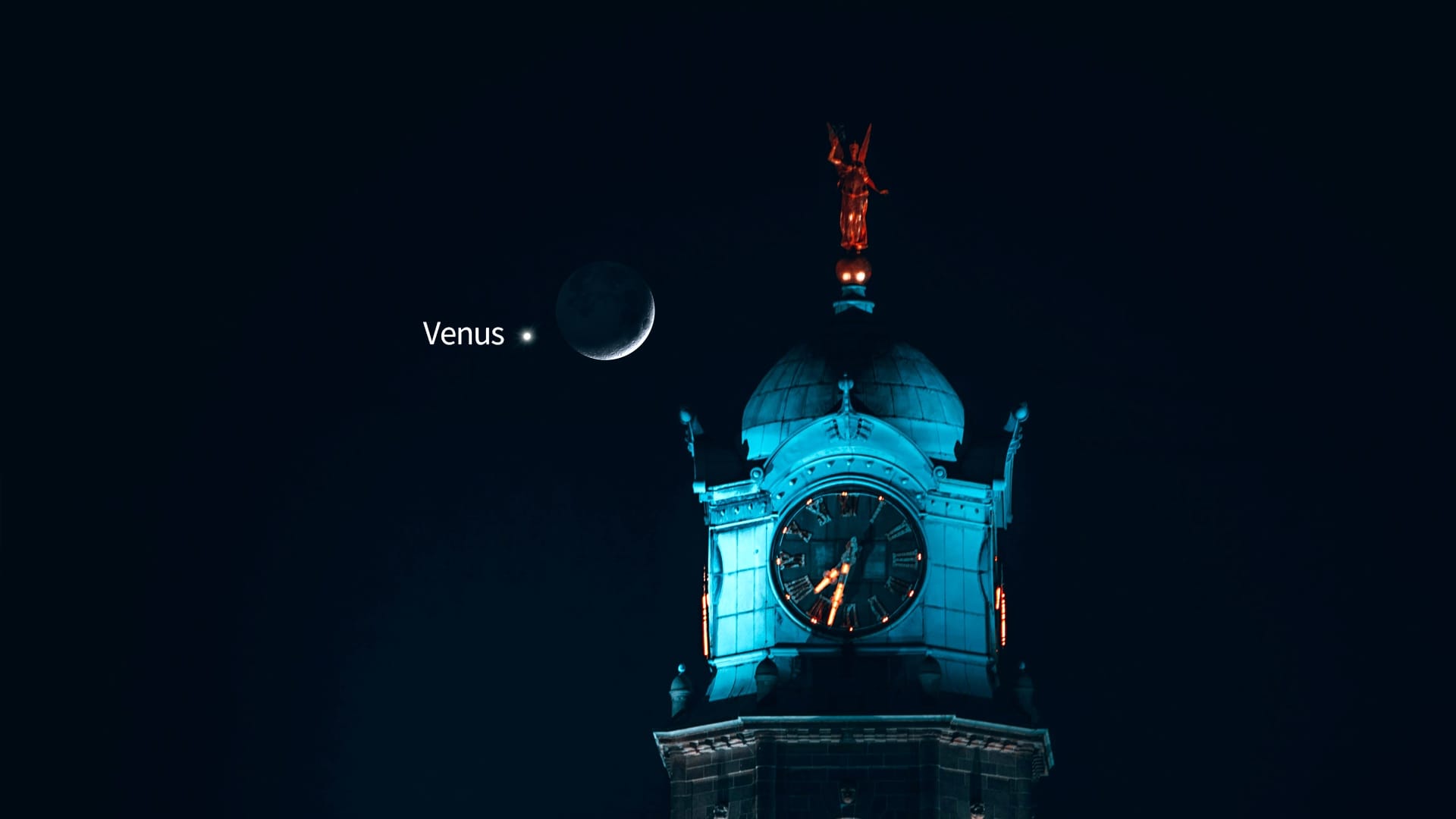
On June 17, the thin waxing crescent Moon will pass extremely close to Venus (mag –4.0) in the constellation Cancer. Look for them low above the western horizon in the evening twilight. Brilliant Venus will be easy to spot even from a light-polluted city, and the Moon’s crescent will make the scene especially beautiful. Nearby, Jupiter, Mercury, Castor, and Pollux will add to the evening lineup.
| City | Best time (local) | Separation | Altitude, Moon / Venus |
|---|---|---|---|
| New York City, United States | Jun 17, 9:03 PM EDT | 2.1° | 22° / 21° |
| Los Angeles, United States | Jun 17, 8:35 PM PDT | 3.4° | 26° / 25° |
| London, United Kingdom | Jun 17, 10:08 PM BST | 0.6° | 13° / 13° |
| Toronto, Canada | Jun 17, 9:37 PM EDT | 2.5° | 20° / 19° |
| Lagos, Nigeria | Jun 17, 8:55 PM WAT | 1.2° | 10° / 11° |
| Nairobi, Kenya | Jun 17, 8:23 PM EAT | 2.7° | 10° / 13° |
| Johannesburg, South Africa | Jun 17, 7:06 PM SAST | 2.9° | 10° / 13° |
| Singapore | Jun 17, 8:49 PM SGT | 5.3° | 10° / 15° |
| Sydney, Australia | Jun 18, 5:21 PM AEST | 5.4° | 27° / 24° |
| Auckland, New Zealand | Jun 18, 5:40 PM NZST | 4.5° | 25° / 22° |
In some locations, the Moon will pass in front of Venus, creating a lunar occultation. The event will be visible from the contiguous United States, Canada, and Mexico, mostly in daytime, and from parts of Brazil and Venezuela around evening or twilight. But don’t worry — both Venus and the thin crescent Moon are bright enough to be visible in the daylight sky (assuming you have clear skies).
The best time for observations is just before or just after the occultation. Note that the exact times vary by location — for example, in New York, USA, the lunar occultation of Venus will start at 15:53 EDT and end at 17:10 EDT.
| Location | Occultation starts | Occultation ends | Visibility conditions |
|---|---|---|---|
| Toronto, Canada | 3:40 PM EDT | 4:58 PM EDT | Daytime |
| San Francisco, USA | 11:33 AM PDT | 12:45 PM PDT | Daytime |
| New York, USA | 3:53 PM EDT | 5:10 PM EDT | Daytime |
| Tijuana, Mexico | 11:44 AM PDT | 12:43 PM PDT | Daytime |
| Cancún, Mexico | 3:30 PM EST | 3:48 PM EST | Daytime; short event |
| San Juan, Puerto Rico | 4:45 PM AST | 6:03 PM AST | Late afternoon / early evening |
| Caracas, Venezuela | 5:10 PM VET | 6:07 PM VET | Late afternoon / early evening |
| Recife, Brazil | 6:52 PM BRT | 7:43 PM BRT | Night; low above the horizon |
To find the timing for your area, open the Sky Tonight app, go to the Calendar, and check the event details.
Planets next to the Moon in May 2026
May 13: Moon near Neptune
- Close approach time: 05:50 GMT (01:50 ET)
- Close approach distance: 3°40′
- Conjunction time: 09:12 GMT (05:12 ET)
- Conjunction distance: 4°09′
On May 13, the crescent Moon will appear close to Neptune (mag 7.9) in the constellation Pisces. Look for them low above the eastern horizon before local sunrise. Neptune will require a small telescope to spot. Nearby, you will also see Saturn (mag 0.9) and Mars (mag 1.3), visible to the naked eye.
May 13: Moon near Saturn
- Close approach time: 17:33 GMT (13:33 ET)
- Close approach distance: 5°03′
- Conjunction time: 21:58 GMT (17:58 ET)
- Conjunction distance: 5°42′
On May 13, the crescent Moon will appear near Saturn (mag 0.9); the Moon will be in Pisces, and Saturn in Cetus. Look for them in the morning, low above the eastern horizon, about an hour before sunrise. Mars (mag 1.3) will also be visible nearby.
May 14: Moon near Mars
- Close approach time: 21:06 GMT (17:06 ET)
- Close approach distance: 4°41′
- Conjunction time: May 15, 00:44 GMT (May 14, 20:44 ET)
- Conjunction distance: 5°10′
On May 14, the crescent Moon will appear near Mars (mag 1.3) in the constellation Pisces. Look for them in the morning, low above the eastern horizon, about an hour before sunrise. Saturn (mag 0.9) will also be visible nearby.
May 17: Moon near Mercury
- Close approach time: 01:03 GMT (May 16, 21:03 ET)
- Close approach distance: 4°24′
- Conjunction time: 02:51 GMT (May 16, 22:51 ET)
- Conjunction distance: 4°32′
On May 17, the New Moon will pass close to Mercury (mag –1.9) in the constellation Taurus. The pair will rise low above the eastern horizon before sunrise. However, this event will be very difficult to observe: Mercury will lie too close to the Sun, and the Moon at its new phase will be barely noticeable in the sky.
May 17: Moon near Uranus
- Close approach time: 04:14 GMT (00:14 ET)
- Close approach distance: 5°09′
- Conjunction time: 05:58 GMT (01:58 ET)
- Conjunction distance: 5°16′
On May 17, the New Moon will pass near Uranus (mag 5.8) in the constellation Taurus. This event will go unnoticed, as both objects will be too close to the Sun. You may be able to spot the Moon’s dark disk low above the western horizon in the evening twilight, but Uranus, which requires binoculars even on a dark night, will certainly remain invisible.
May 19: Moon near Venus
- Conjunction time: 01:49 GMT (May 18, 21:49 ET)
- Conjunction distance: 2°56′
- Close approach time: 02:04 GMT (May 18, 22:04 ET)
- Close approach distance: 2°56′
On May 19, the thin crescent Moon will pass close to Venus (mag –3.9) in the constellation Taurus. Look for them low above the western horizon in the evening twilight. Brilliant Venus will be easy to spot, even from a light-polluted city. It will be a beautiful sight — don’t miss it!
May 20: Moon near Jupiter
- Conjunction time: 12:36 GMT (08:36 ET)
- Conjunction distance: 3°04′
- Close approach time: 13:46 GMT (09:46 ET)
- Close approach distance: 3°00′
On May 20, the crescent Moon will appear close to Jupiter (mag –1.9) in the constellation Gemini. Look for them after sunset above the western horizon. Both objects will be easy to spot with the naked eye. Nearby, the bright stars Castor and Pollux will also be visible, adding to the beauty of the scene.
Planets next to the Moon in April 2026
April 15: Moon near Mercury
- Close approach time: 14:27 GMT (10:27 AM EDT)
- Close approach distance: 4°33′
- Conjunction time: 19:10 GMT (03:10 PM EDT)
- Conjunction distance: 5°10′
On April 15, the 5%-illuminated Moon will be close to Mercury (mag 0.0) in the sky. They will be positioned in the constellation Pisces. Look for them in the morning, low above the eastern horizon. In the Southern Hemisphere, Mercury will appear higher above the horizon during the darker part of twilight, providing a better view. Bright Mars (mag 1.2) and Saturn (mag 0.9) will also be nearby.
April 15: Moon near Neptune
- Close approach time: 18:17 GMT (02:17 PM EDT)
- Close approach distance: 3°26′
- Conjunction time: 21:23 GMT (05:23 PM EDT)
- Conjunction distance: 3°56′
On April 15, the 4%-illuminated Moon will be close to Neptune (mag 7.8) in the sky. The two will be positioned in the constellation Pisces, not far from the rising Sun. While you may be able to see the thin lunar crescent, it is unlikely that you will be able to spot dim Neptune in the bright dawn sky.
April 15: Moon near Mars
- Close approach time: 21:38 GMT (05:38 PM EDT)
- Close approach distance: 3°16′
- Conjunction time: April 16, 00:46 GMT (April 15, 08:46 PM EDT)
- Conjunction distance: 3°41′
On April 15, the 4%-illuminated Moon will appear close to Mars (mag 1.2) in the constellation Pisces. Because both objects will be relatively close to the Sun in the sky, spotting them will be difficult. In the Northern Hemisphere, the Moon and Mars will be close to the horizon. In the Southern Hemisphere, Mars will appear higher above the horizon during morning twilight, providing a better view. Mercury (mag 0.0) and Saturn (mag 0.9) will also be nearby.
April 16: Moon near Saturn
- Close approach time: 02:00 GMT (April 15, 10:00 PM EDT)
- Close approach distance: 4°38′
- Conjunction time: 06:08 GMT (02:08 AM EDT)
- Conjunction distance: 5°15′
On April 16, the 3%-illuminated Moon will appear near Saturn (mag 0.9); the Moon will be in Pisces, and Saturn in Cetus. Look for them in the morning, low above the eastern horizon, about an hour before sunrise. Mercury (mag 0.0) and Mars (mag 1.2) will also be nearby.
April 19: Moon near Venus
- Close approach time: 06:34 GMT (02:34 AM EDT)
- Close approach distance: 4°35′
- Conjunction time: 08:47 GMT (04:47 AM EDT)
- Conjunction distance: 4°45′
On April 19, the 5%-illuminated Moon will pass close to Venus (mag –3.9); our natural satellite will be travelling from Aries to Taurus, while Venus will stay in Taurus. They will appear in the evening sky, relatively low above the western horizon. Brilliant Venus will be easy to see even from a light-polluted city.
April 19: Moon near Uranus
- Close approach time: 15:36 GMT (11:36 AM EDT)
- Close approach distance: 5°12′
- Conjunction time: 17:36 GMT (01:36 PM EDT)
- Conjunction distance: 5°21′
On April 19, a very thin 7%-illuminated crescent Moon will approach Uranus (mag 5.8) in Taurus. The faint planet will require powerful binoculars or a small telescope to detect, appearing as a small, steady point of light.
The lovely Pleiades star cluster (mag 1.2) will enhance the view, also shining close to the Moon. Observers across Europe, the Middle East, and North Africa will witness a lunar occultation of the Pleiades, when the Moon passes directly in front of the cluster, temporarily hiding some of its stars from view.
April 22: Moon near Jupiter
- Conjunction time: 22:03 GMT (06:03 PM EDT)
- Conjunction distance: 3°29′
- Close approach time: 23:12 GMT (07:12 PM EDT)
- Close approach distance: 3°35′
On April 22, the 37%-illuminated Moon will pass close to Jupiter (mag –2.1) in the sky. In the evening, as soon as the Sun sets, look for the bright Moon and Jupiter high above the southwestern horizon (or northwestern, if you’re in the southern latitudes) in the constellation Gemini. Even in light-polluted cities, both objects will be clearly visible to the naked eye in the evening sky. Bright stars Castor and Pollux will also shine nearby, forming a narrow triangle with Jupiter. In some locations, the Moon will appear within this narrow triangle of bright dots.
Planets next to the Moon in March 2026
March 17: Moon near Mercury
- Conjunction time: 14:07 GMT (10:07 AM ET)
- Conjunction distance: 1°59′
- Close approach time: 15:45 GMT (11:45 AM ET)
- Close approach distance: 1°45′
On March 17, the 2%-illuminated Moon will be close to Mercury (mag 1.6) in the sky. They will be positioned in the constellation Aquarius. Due to their proximity to the Sun, both objects will be difficult to see. In the Northern Hemisphere, the Moon and Mercury will be close to the horizon. In the Southern Hemisphere, Mercury will appear higher above the horizon during morning twilight, providing a better view.
March 17: Moon near Mars
- Close approach time: 20:33 GMT (4:33 PM ET)
- Close approach distance: 1°21′
- Conjunction time: 21:52 GMT (5:52 PM ET)
- Conjunction distance: 1°34′
On March 17, the 2%-illuminated Moon will be close to Mars (mag 1.2) in the sky. They will be positioned in the constellation Aquarius. Because they will be very close to the Sun, both objects will be difficult to see. In the Northern Hemisphere, the Moon and Mars will be close to the horizon. In the Southern Hemisphere, Mars will appear higher above the horizon during morning twilight, providing a better view.
March 19: Moon near Neptune
- Close approach time: 06:29 GMT (2:29 AM ET)
- Close approach distance: 3°19′
- Conjunction time: 09:30 GMT (5:30 AM ET)
- Conjunction distance: 3°46′
On March 19, the very thin crescent Moon will appear near Neptune (mag 7.8) in the constellation Pisces. Unfortunately, both objects will be too close to the Sun in the sky to be observable.
March 19: Moon near Saturn
- Close approach time: 10:13 GMT (6:13 AM ET)
- Close approach distance: 4°19′
- Conjunction time: 14:12 GMT (10:12 AM ET)
- Conjunction distance: 4°55′
On March 19, the extremely thin crescent Moon will appear near Saturn (mag 0.9) in the constellation Pisces. Unfortunately, both objects will be too close to the Sun in the sky to be observable.
March 20: Moon near Venus
- Close approach time: 08:50 GMT (4:50 AM ET)
- Close approach distance: 4°07′
- Conjunction time: 12:37 GMT (8:37 AM ET)
- Conjunction distance: 4°38′
On March 20, the Moon will pass close to Venus in the evening twilight. Venus will shine as the brightest dot in the sky at a magnitude of -3.9, easy to spot even in twilight. The Moon will be just a day after its New Moon phase, at 2% illumination, making it nearly invisible. While you might not see the Moon, this is still a great chance to enjoy Venus glowing brilliantly in the evening sky – look for it near the western horizon in the constellation Pisces.
March 23: Moon near Uranus
- Close approach time: 05:29 GMT (1:29 AM ET)
- Close approach distance: 5°19′
- Conjunction time: 07:42 GMT (3:42 AM ET)
- Conjunction distance: 5°28′
On March 23, the 22%-illuminated crescent Moon will glide past Uranus (mag 5.8) in the constellation Taurus. Although Uranus is technically visible to the naked eye under perfect dark-sky conditions (and with excellent eyesight), you’ll need powerful binoculars or a small telescope to spot Uranus with confidence.
The scene becomes even more beautiful with the Pleiades star cluster (mag 1.2) also sparkling near the Moon. Skywatchers in Japan, Korea, northern China and Russia, as well as northern parts of the U.S., Canada, and Greenland, will be treated to something extra special — a lunar occultation of the Pleiades, as the Moon briefly covers part of this famous star cluster.
March 26: Moon near Jupiter
- Conjunction time: 12:11 GMT (8:11 AM ET)
- Conjunction distance: 3°53′
- Close approach time: 13:21 GMT (9:21 AM ET)
- Close approach distance: 3°49′
On March 26, the 59%-illuminated Moon will pass close to Jupiter (mag -2.2) in the sky. As soon as the Sun sets, look for the bright Moon and Jupiter high above the southwestern horizon in the constellation Gemini. Even in light-polluted cities, both objects will be clearly visible to the naked eye in the evening sky. Bright stars Castor and Pollux will also shine nearby, forming a narrow triangle with Jupiter.
Planets next to the Moon in February 2026
February 16: Moon near Mars
- Conjunction time: 17:41 GMT (12:41 ET)
- Conjunction distance: 0°45'
- Close approach time: 18:17 GMT (13:17 ET)
- Close approach distance: 0°42'
On February 16, the 1% illuminated Moon will be close to Mars (mag 1.1) in the sky. They will be positioned in the constellation Capricornus. Both objects will be too close to the Sun to be observable. As visible from Antarctica, the Moon even covers Mars, creating a lunar occultation of the planet.
February 18: Moon near Venus
- Close approach time: 07:42 GMT (02:42 ET)
- Close approach distance: 1°32'
- Conjunction time: 09:19 GMT (04:19 ET)
- Conjunction distance: 1°45'
On February 18, the Moon will pass close to Venus in the evening sky. Venus will shine as the brightest dot in the sky at a magnitude of -3.8, easy to spot even in twilight. The Moon will be just a day after its New Moon phase, at 1% illumination, making it nearly invisible. While you might not see the Moon, this is still a great chance to enjoy Venus glowing brilliantly in the evening sky – look for it near the western horizon in the constellation Aquarius.
February 18: Moon near Mercury
- Conjunction time: 23:02 GMT (18:02 ET)
- Conjunction distance: 0°08′
- Close approach time: 23:09 GMT (18:09 ET)
- Close approach distance: 0°06′
On February 18, a very thin 1% illuminated Moon and Mercury (mag -0.5) will put on a great show. For observers in parts of the U.S. mainland, Mexico, eastern Australia, New Zealand, and a few other regions, the Moon will pass in front of Mercury, creating a lunar occultation of the planet. The event runs roughly from 20:50 to 01:30 GMT (15:50 to 20:30 ET), but the exact timing depends on your location. To check visibility and local time for you, open the Sky Tonight app, go to Calendar, and tap the event on February 18 — your local time will appear under the image in the Event card.
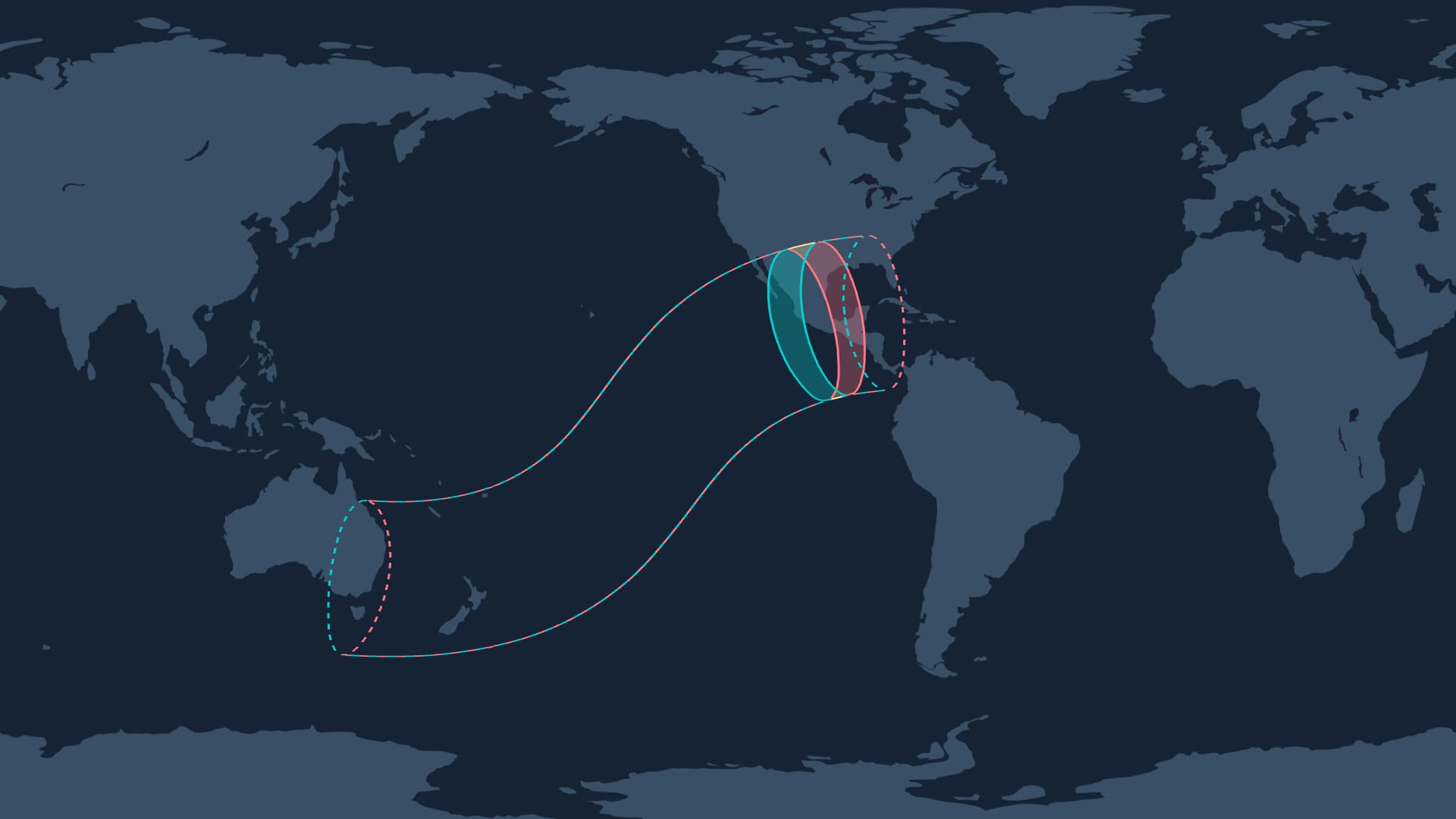
Elsewhere, you’ll still see the Moon very close to Mercury. And there’s a bonus: Mercury reaches its greatest elongation on February 19, meaning it will be at its maximum apparent distance from the Sun and easier than usual to spot in the evening. Look low above the western horizon about an hour after sunset; both objects will be in Aquarius. Venus will be nearby too — closer to the Sun, but so bright it’s visible even in twilight.
February 19: Moon near Saturn
- Close approach time: 20:09 GMT (15:09 ET)
- Close approach distance: 4°04'
- Conjunction time: February 20, 00:03 GMT (February 19, 19:03 ET)
- Conjunction distance: 4°38'
On February 19, the 6%-illuminated Moon will pass close to Saturn (mag 1.0) in the sky. Both objects will be in the constellation Pisces. You can observe them with the naked eye or through binoculars — look above the western–southwestern horizon after sunset. If you have a telescope, you can also spot Neptune (mag 7.8) nearby.
February 19: Moon near Neptune
- Close approach time: 20:25 GMT (15:25 ET)
- Close approach distance: 3°15'
- Conjunction time: 23:30 GMT (18:30 ET)
- Conjunction distance: 3°40'
On February 19, the 6%-illuminated Moon will be close to Neptune (mag 7.8) in the sky. You can observe Neptune through powerful binoculars or a telescope in the constellation Pisces. Bright Saturn (mag 1.0) will also be nearby, easily visible to the naked eye.
February 23: Moon near Uranus
- Close approach time: 22:19 GMT (17:19 ET)
- Close approach distance: 5°21'
- Conjunction time: February 24, 00:35 GMT (February 23, 19:35 ET)
- Conjunction distance: 5°31'
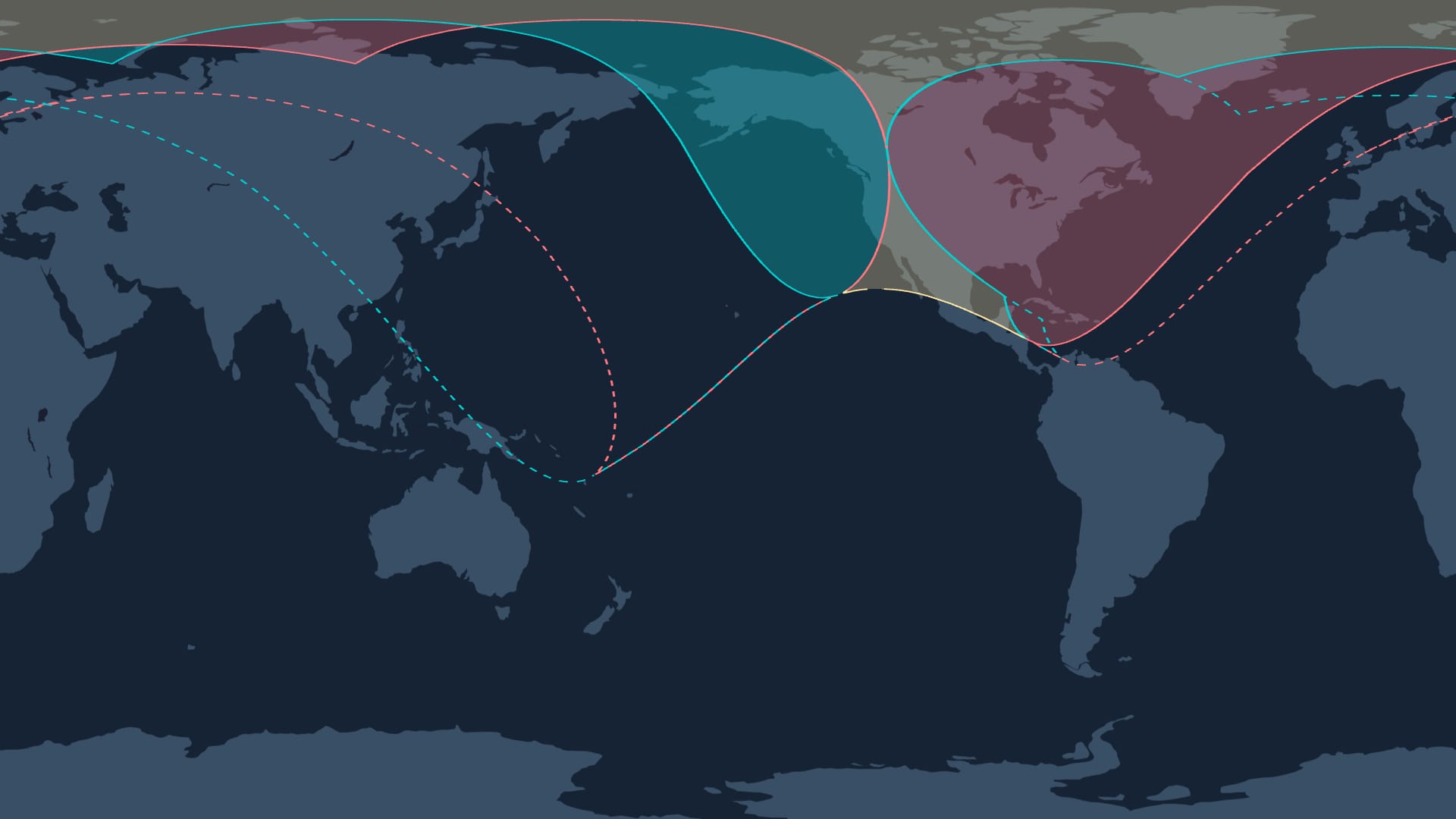
On February 23, the 44%-illuminated Moon will pass near Uranus (mag 5.8) in the constellation Taurus. To observe Uranus (especially when it’s close to the bright Moon), you’ll need powerful binoculars or a small telescope.
As a bonus, the Pleiades star cluster (mag 1.2) will also shine near the Moon. Observers across North America, Central America, and the Caribbean will see a lunar occultation of the Pleiades.
February 27: Moon near Jupiter
- Conjunction time: 06:24 GMT (01:24 ET)
- Conjunction distance: 3°08'
- Close approach time: 07:31 GMT (02:31 ET)
- Close approach distance: 3°54'
On February 27, the 80% illuminated Moon will pass close to Jupiter (mag -2.5) in the sky. As soon as the Sun sets, look for the bright Moon and Jupiter high above the south-eastern horizon in the constellation Gemini. Even in light-polluted cities, both objects will be clearly visible to the naked eye in the evening sky. Bright stars Castor and Pollux will also shine nearby.
Planets next to the Moon in January 2026
January 18-19, 2026: Moon near Mars, Mercury, and Venus
On January 18 and 19, the Moon in its new phase (0% illuminated) will pass near three planets — Mars (mag 1.1), Mercury (mag -1.2), and Venus (mag -3.9). Unfortunately, all of these objects will be too close to the Sun to be observable.
January 19: Moon near Pluto
- Close approach time: 04:27 GMT
- Close approach distance: 0°44'
- Conjunction time: 04:56 GMT
- Conjunction distance: 0°45'
On January 19, the Moon in its new phase (0% illuminated) will get extremely close to the dwarf planet Pluto (mag 14.5) in the sky. In some locations, the Moon will even cover Pluto — this phenomenon is known as a lunar occultation. However, both objects will be too close to the Sun to be observable.
January 23: Moon near Saturn
- Close approach time: 08:57 GMT
- Close approach distance: 3°49'
- Conjunction time: 12:40 GMT
- Conjunction distance: 4°22'
On January 23, the 21%-illuminated Moon will pass close to Saturn (mag 1.0) in the sky. Both objects will be in the constellation Pisces. You can observe them with the naked eye or through binoculars — look above the western–southwestern horizon after sunset. If you have a telescope, you can also spot Neptune (mag 7.8) nearby.
January 23: Moon near Neptune
- Close approach time: 12:48 GMT
- Close approach distance: 3°08'
- Conjunction time: 15:49 GMT
- Conjunction distance: 3°34'
On January 23, the 22%-illuminated Moon will be close to Neptune (mag 7.8) in the sky. You can observe Neptune through powerful binoculars or a telescope in the constellation Pisces. Bright Saturn (mag 1.0) will also be nearby, easily visible to the naked eye.
January 27: Moon near Uranus
- Close approach time: 16:33 GMT
- Close approach distance: 5°16'
- Conjunction time: 18:46 GMT
- Conjunction distance: 5°26'
On January 27, the 67%-illuminated Moon will pass near Uranus (mag 5.7) in the constellation Taurus. To observe Uranus (especially when it’s close to the bright Moon), you’ll need powerful binoculars or a small telescope.
As a bonus, the Pleiades star cluster (mag 1.2) will also shine near the Moon. Observers across Europe, northern Africa, the Middle East, and parts of western Asia will see a lunar occultation of the Pleiades.
January 31: Moon near Jupiter
- Conjunction time: 02:30 GMT
- Conjunction distance: 3°50'
- Close approach time: 03:38 GMT
- Close approach distance: 3°47'
On January 31, the 95%-illuminated Moon will be close to Jupiter (mag -2.6) in the sky. Observe them with the naked eye or through a pair of binoculars in the constellation Gemini. Both objects will be high in the sky already at sunset and will be visible almost until dawn.