Blood Moon 2026: Total Lunar Eclipse on March 2–3 (Exact Times + Visibility Map)
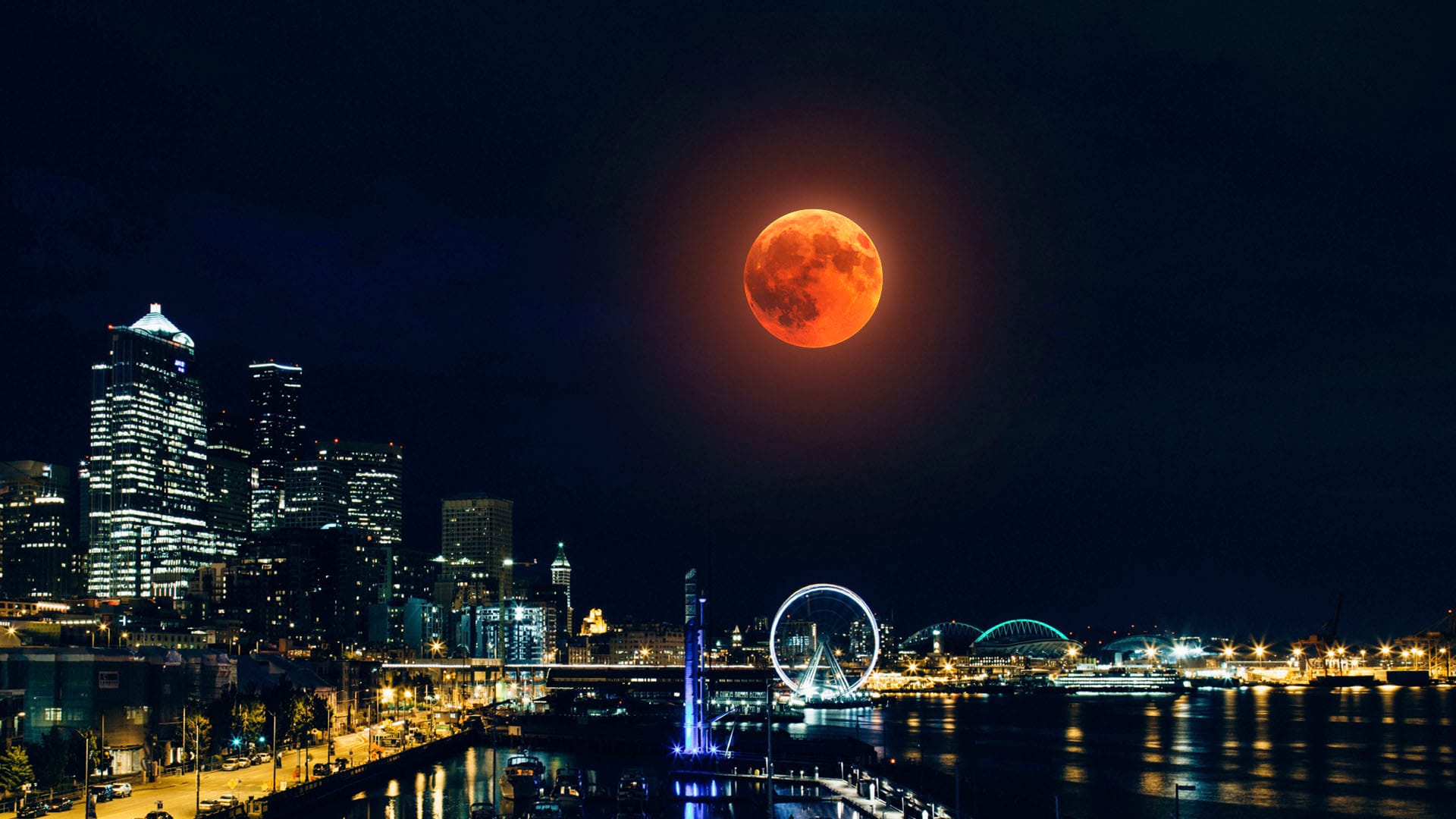
The lunar eclipse described in this article has already occurred. If you’re planning your next skywatching session, be sure to check out the partial lunar eclipse on August 27-28, 2026.
Contents
- March 2026 lunar eclipse: date & time (quick facts)
- Red Moon vs Blood Moon: what’s the difference?
- Where is the Blood Moon in March 2026? Visibility map & Best locations
- What time is the lunar eclipse? (March 2–3, 2026) — Eclipse time & timeline
- Best tips for watching the Blood Moon 2026
- Best tips for photographing the Blood Moon 2026
Blood Moon 2026: Frequently Asked Questions
- Is there a Blood Moon or lunar eclipse tonight?
- Why will the Moon turn red in March 2026?
- Are a Blood Moon and a lunar eclipse the same thing?
- Is it safe to watch a Blood Moon?
- How often does a Blood Moon occur?
- What is the best time to watch the Blood Moon 2026?
- What are the best locations to watch the Blood Moon 2026?
- Is the March 2026 Blood Moon visible in Europe?
- What if the Blood Moon 2026 isn’t visible from my location?
- Next lunar eclipse: when to see the red Moon again?
- More events around the Blood Moon 2026
- Total Lunar Eclipse March 2026: Bottom line
March 2026 lunar eclipse: date & time (quick facts)
- Date: March 2-3, 2026
- UTC date: March 3, 2026
- Type: total lunar eclipse (Blood Moon)
- Totality: 11:04 – 12:03 UTC/GMT
- Maximum: 11:33 UTC/GMT
- Overall duration: 5 hours 39 minutes
- Totality duration: 58 minutes 19 seconds
- Totality (red Moon) visible from: eastern Asia, Australia, New Zealand (on March 4), the Pacific region, North and Central America, far western South America
- Partial eclipse visible from: much of South America and central Asia
- Eclipse not visible from: Africa, Europe
- Other lunar eclipse in 2026: Aug 27–28, 2026 — partial lunar eclipse (not a Blood Moon)
A lunar eclipse can only occur at Full Moon. The March eclipse coincides with the March Full Moon 2026, also known as the Worm Moon. Full Moon peak is at 11:38 UTC/GMT — about half an hour after totality begins.
Blood Moon 2026 time: when does the lunar eclipse start?
The eclipse begins at 08:44 UTC/GMT (penumbral). The partial eclipse starts at 09:50 UTC/GMT, and totality lasts from 11:04 to 12:03 UTC/GMT (maximum at 11:33 UTC/GMT).
Popular time zones (totality window):
- UTC−8 (Pacific Time): 03:04–04:03 (Mar 3)
- UTC−5 (Eastern Time): 06:04–07:03 (Mar 3)
- UTC+9 (Japan/Korea): 20:04–21:03 (Mar 3)
- UTC+11 (Eastern Australia daylight time): 22:04–23:03 (Mar 3)
- UTC+13 (New Zealand daylight time): 00:04–01:03 (Mar 4)
Visibility still depends on whether the Moon is above your horizon — use the map below or check your exact location.
Can’t see the eclipse? Watch the Blood Moon live online (free livestreams)
Even if the eclipse isn’t visible from your location (or clouds block the view), you can still watch it live online. Here are a few reliable free streams and live broadcasts:
timeanddate.com — LIVE stream + interactive maps
- Live broadcast starts at 09:30 UTC on March 3 (check the page for updates).
- Stream page: https://www.timeanddate.com/live/eclipse-lunar-2026-march-3
Griffith Observatory (Los Angeles) — live online broadcast (weather permitting)
- Broadcast window: 12:37–6:25 a.m. PST (08:37–14:25 UTC).
- Event page (includes “Watch here” button): https://griffithobservatory.lacity.gov/event/total-lunar-eclipse-broadcast-march-3-2026/
- Direct YouTube link: https://www.youtube.com/live/JeOlqcK5Edg
The Virtual Telescope Project — international live event
- Scheduled start: 08:30 UTC on March 3.
- Event info: https://www.virtualtelescope.eu/2026/02/20/the-3-march-2026-total-lunar-eclipse-a-live-international-event/
- Join via WebTV: https://www.virtualtelescope.eu/webtv/
SunshineNate (ZWO) — HD livestream from Hawai‘i (listed by Sky & Telescope)
- Time window: March 2, 10:00 pm – March 3, 4:30 am HST (08:00–14:30 UTC).
- Event listing: https://skyandtelescope.org/astronomy-events/total-lunar-eclipse-livestream-blood-moon-hawaii-march-3rd-2026/
- Organizer’s site: https://www.sunshinenate.com/
Tip: Streams often begin before the first eclipse phase and may run past the end. If one link doesn’t load, check the organizer’s event page for an updated player link.
Red Moon vs Blood Moon: what’s the difference?
The terms “Red Moon” and “Blood Moon” usually refer to the same thing: a total lunar eclipse, when the Moon passes fully through Earth’s shadow (umbra) and turns coppery-red. The next red Moon / Blood Moon will occur on March 2–3, 2026 (the calendar date depends on your time zone).
Keep in mind: the Moon can also look reddish when it’s low on the horizon or in hazy skies — that’s not an eclipse.
Where is the Blood Moon in March 2026? Visibility map & Best locations
Looking for the eclipse “path”? Lunar eclipses don’t have a narrow path like solar eclipses. If the Moon is above your horizon, you can see at least some phases. The map below shows where totality is visible and where the eclipse happens during moonrise/moonset (low on the horizon).
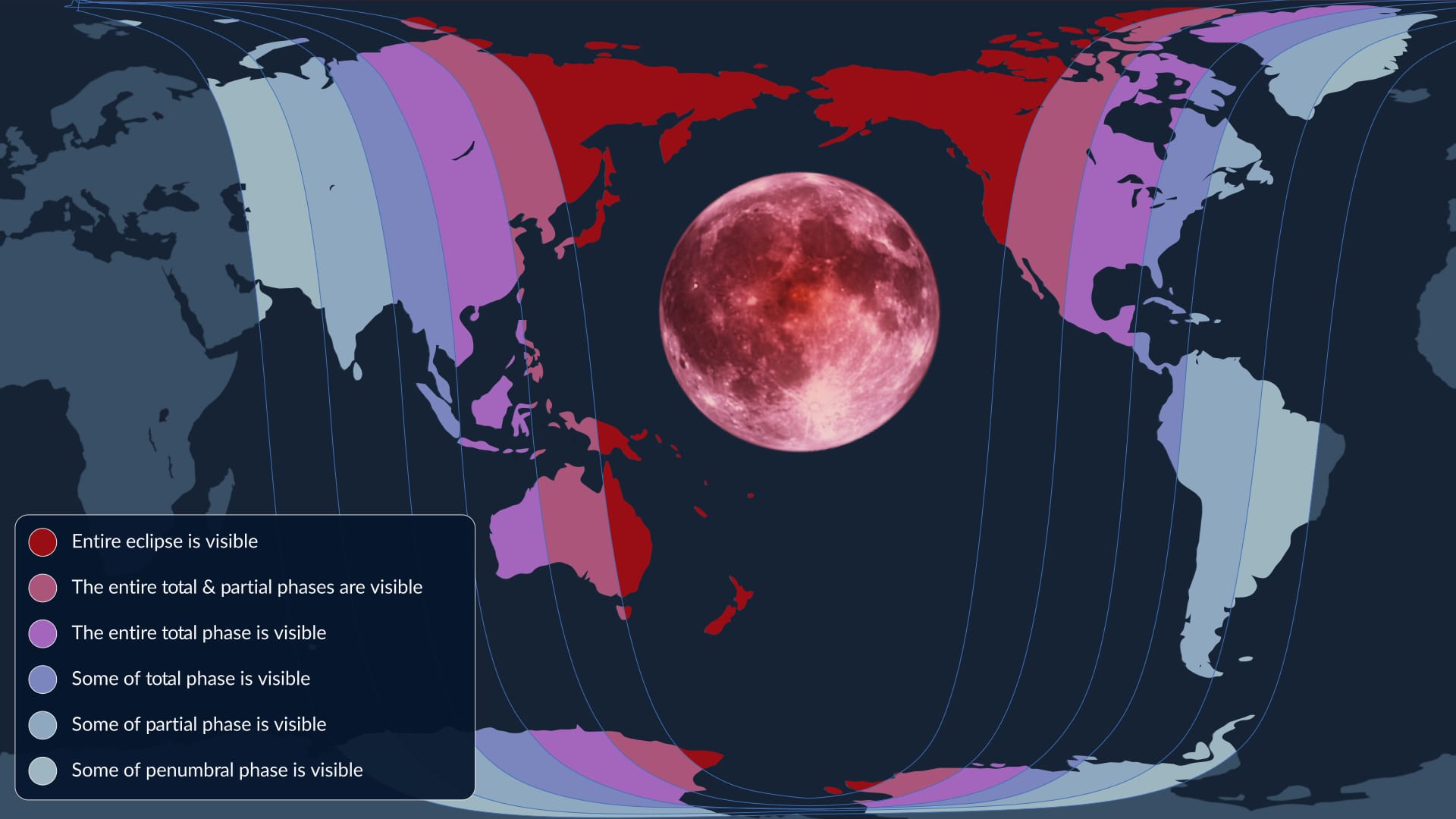
The total lunar eclipse in March 2026 will be visible across a large part of the world. What exactly can be seen depends on location:
- The entire eclipse will be visible across the easternmost parts of Asia, eastern Australia, New Zealand, the Pacific, and parts of western North America. In these regions, you’ll see the Moon turn red during totality and then slowly return to its normal color. Note that in New Zealand, the totality will occur after midnight, with the maximum phase taking place on March 4 local time.
- In parts of eastern Asia and western/central Australia, the eclipse starts before moonrise. Observers there will see the Moon rise partially eclipsed, allowing them to watch the red Moon during totality, even though the beginning of the penumbral phase is missed.
- In parts of eastern North America and westernmost South America, the eclipse ends after the moonset. In these regions, the Moon turns red very low above the horizon, and the end of the totality will not be visible.
- Across parts of central Asia, eastern South America, and nearby regions, you will see only a partial eclipse. Part of the Moon will look dark, as if a curved shadow is moving across it, while the rest stays bright. In some places, the eclipse will appear as only a slight dimming, which can be hard to notice.
- In Europe, Africa, and most of the Middle East, the Moon will be below the horizon for the entire eclipse, meaning the event will not be visible at all from these regions.
If you’re new to lunar eclipses, our complete guide explains how lunar eclipses work, the difference between total and partial eclipses, and why the Moon turns red.
Total lunar eclipse 2026 visibility map: North America
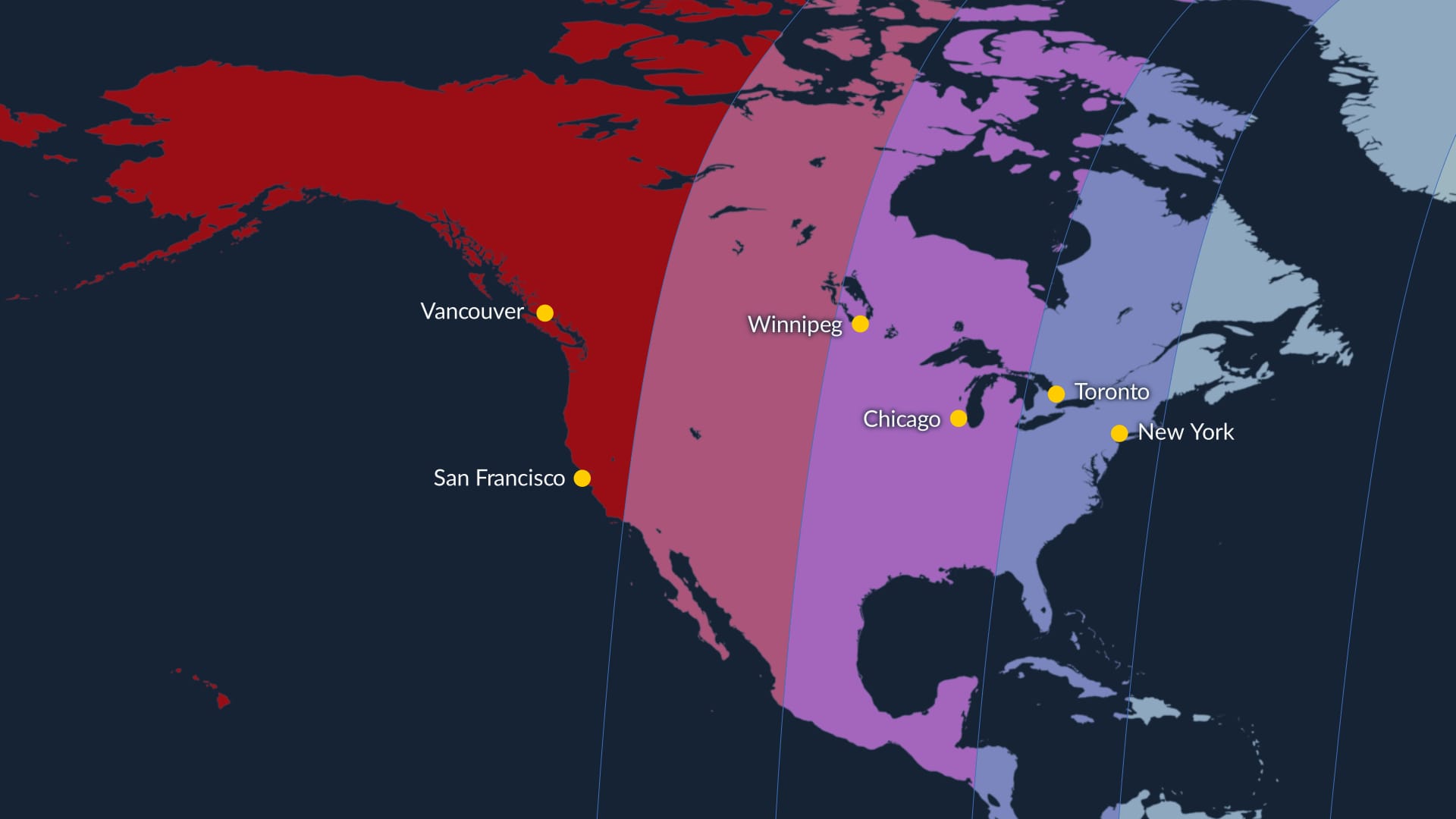
Across North America — including the United States, Canada, and Mexico — eclipse visibility will vary noticeably from west to east:
- Western North America, including parts of western Canada and the western United States, will see the entire lunar eclipse. In cities such as Los Angeles, San Francisco, Seattle, and Vancouver, observers will be able to follow the most dramatic stages of the eclipse, with the Moon appearing red above the horizon.
- Central regions, including Denver, Dallas, Chicago, and Winnipeg, will see the Moon reach the maximum phase of the eclipse. In these locations, the red Moon will also be visible, but the full eclipse will not be seen from start to finish.
- Eastern North America, including New York, Toronto, Washington, and Miami, will see the Moon reach totality very low above the horizon. In these locations, the red Moon may be visible briefly, but the later stages of the eclipse will not be visible as the Moon will set soon after.
Total lunar eclipse 2026 visibility map: South America
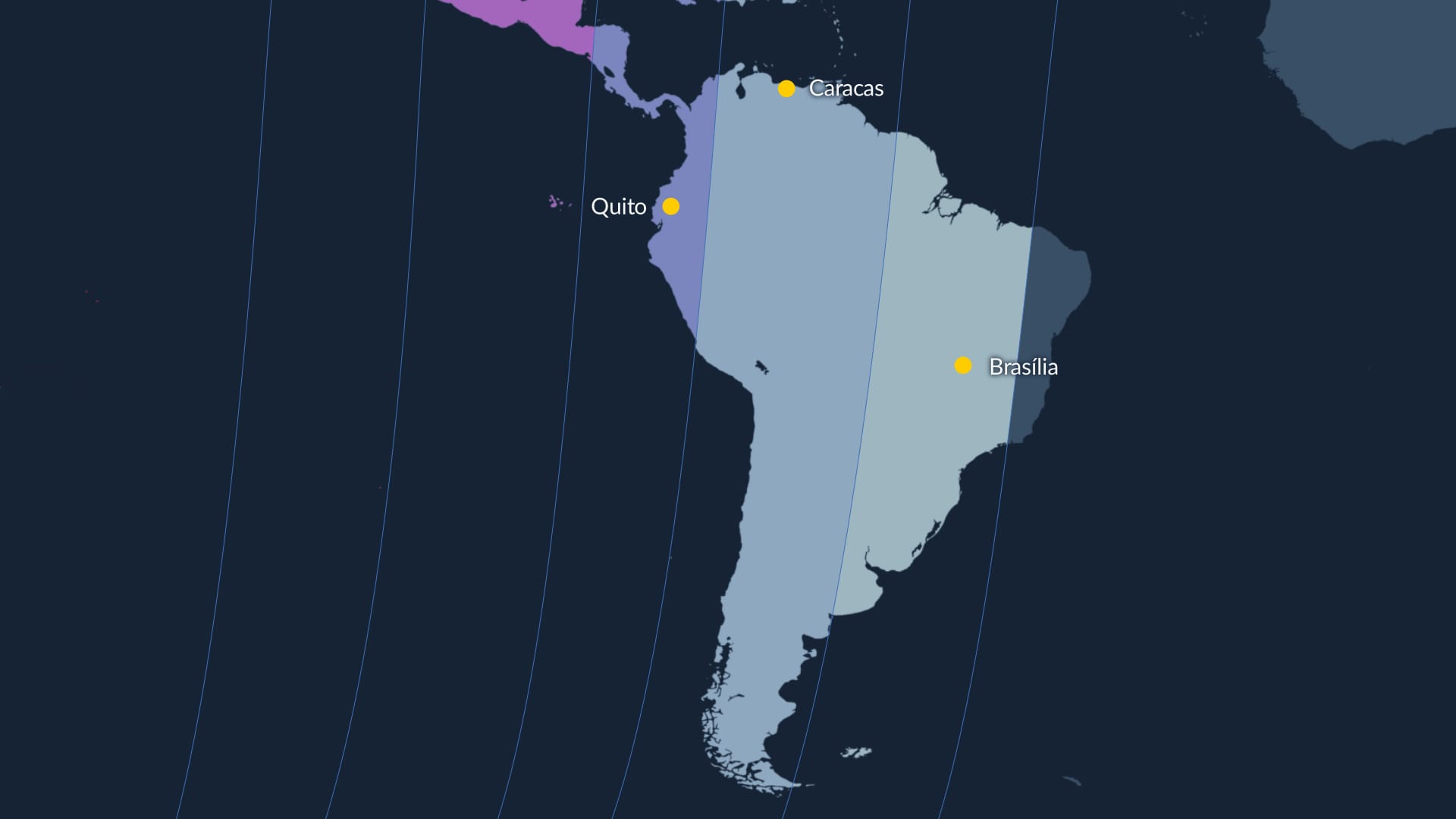
Across South America, the March 2026 lunar eclipse happens around dawn, so visibility depends strongly on how long the Moon stays above your western horizon. In general, the farther west you are, the better your chances of seeing the deepest phases.
- Far western South America (Pacific coast and nearby areas) has the best chance to catch the most dramatic part of the eclipse. In places like Lima, Quito, and Guayaquil, observers may be able to see the Moon reach the deepest eclipse stages very low above the horizon (in some locations, totality may be visible briefly).
- Central regions (parts of the Andes and interior) will often see a deep partial eclipse near moonset. In cities such as Bogotá, La Paz, and Santiago, the Moon may appear noticeably “bitten” by Earth’s shadow, but the fully red phase may happen at or below the horizon, depending on the exact location.
- Eastern South America, including much of Brazil, Uruguay, and Argentina, will typically miss totality. In cities like São Paulo, Rio de Janeiro, Brasília, Buenos Aires, and Montevideo, the Moon may set before the red phase, so you’ll see at most a partial eclipse or subtle penumbral dimming close to moonset (and in some places, the effect can be hard to notice).
For the exact visibility (which phases you’ll see and whether the Moon is above your horizon), check your location in the Sky Tonight app.
Total lunar eclipse 2026 visibility map: Australia & New Zealand
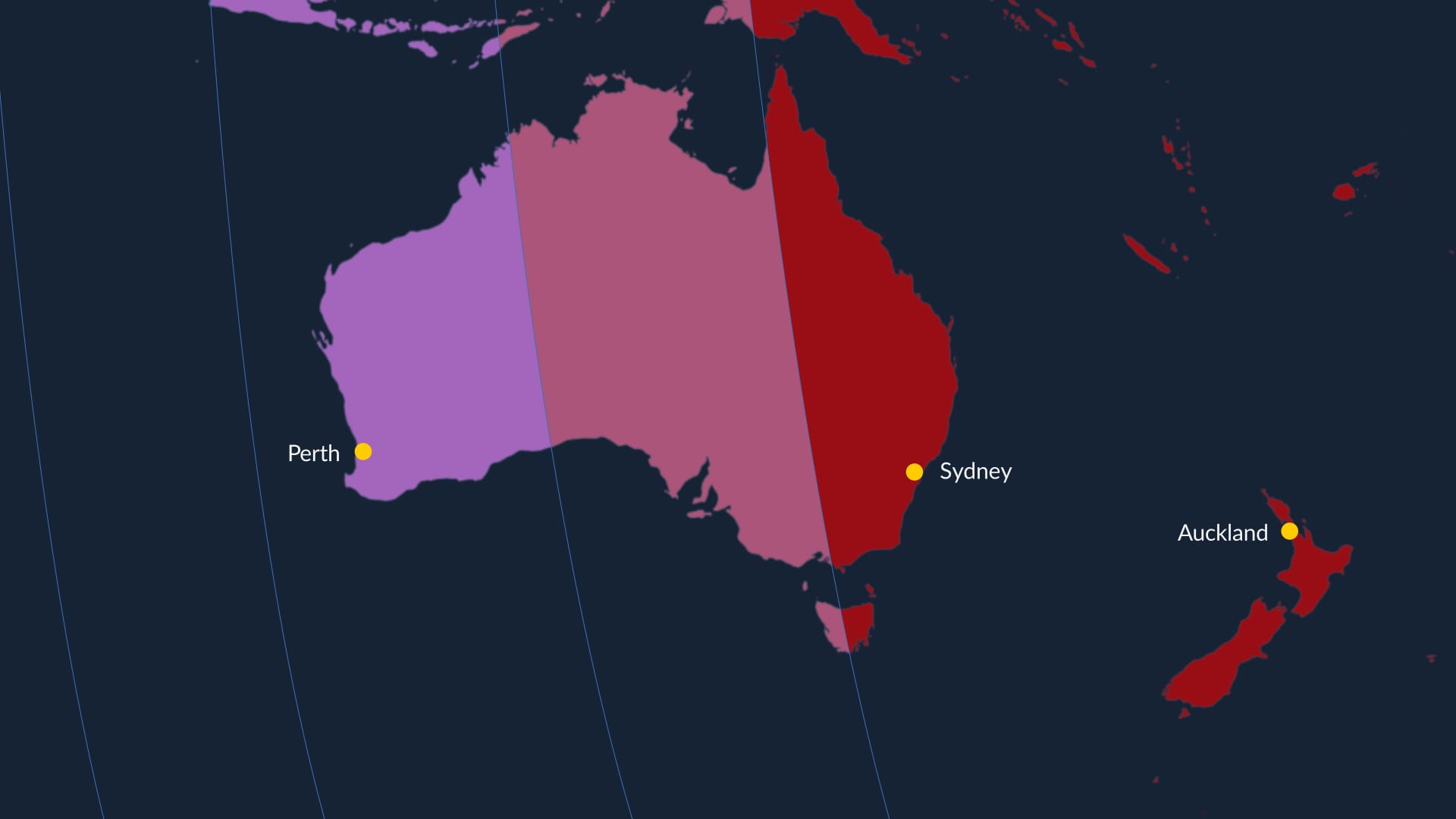
The entire lunar eclipse will be visible across most of New Zealand and eastern Australia. Parts of central and western Australia will see totality or its maximum phase, but will miss the earliest stages of the eclipse.
- Eastern Australia and all of New Zealand, including Sydney, Brisbane, Canberra, Auckland, and Wellington, will see the entire eclipse from start to finish. In these locations, the Moon will be high enough in the sky during totality, clearly turning a deep red as it passes fully through Earth’s shadow. In New Zealand, the eclipse will occur after midnight, with the maximum phase taking place on March 4 local time.
- Western and central Australia, including Perth and Adelaide, will miss the earliest stages of the eclipse, as they occur before moonrise. Observers there will see the Moon rise already eclipsed, allowing them to observe the highlight of the eclipse — the red Moon shortly after moonrise.
Total lunar eclipse 2026 visibility map: Asia
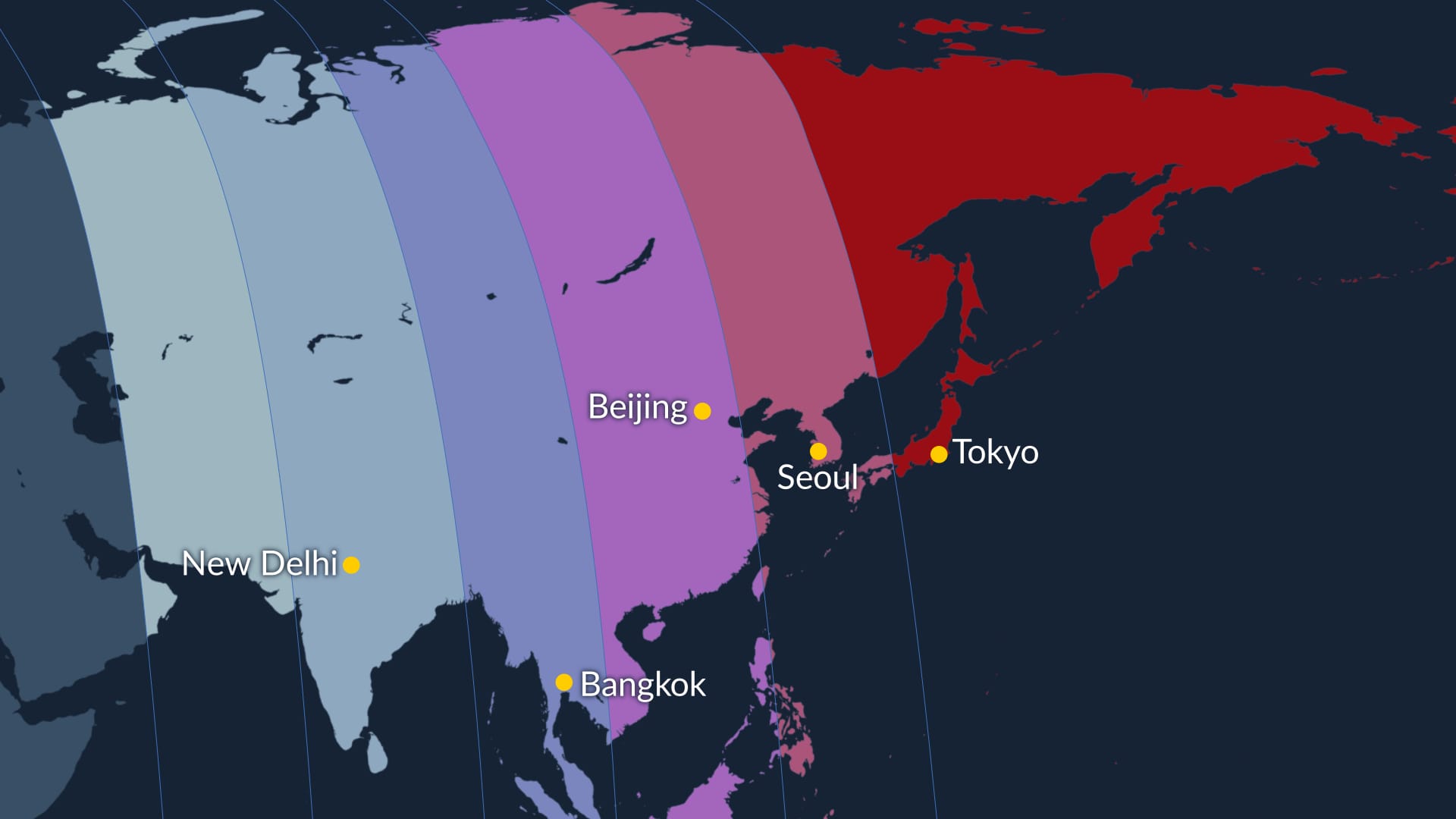
Across Asia, visibility of the March 2026 total lunar eclipse will change gradually from east to west:
- In the far eastern parts of Asia (far eastern Russia, eastern Japan), observers will be able to see the entire eclipse from start to finish, with the red Moon hanging well above the horizon.
- Across eastern Asia (western Japan, the Korean Peninsula, eastern China), the eclipse will begin just before moonrise. In these regions, the Moon will rise already eclipsed, allowing observers to watch the Moon turn red during totality, even though the earliest stages will be missed.
- In southeastern parts of Asia (eastern Mongolia, central parts of China, Southeast Asia, northeastern India), the Moon will rise during or near the end of totality. Observers there will see the red Moon shortly after moonrise, followed by the final partial phases as the Moon slowly leaves Earth’s shadow.
- In western and central Asia (western China, most of India, Sri Lanka, Central Asia), only the end of a partial lunar eclipse will be visible. The red Moon won’t be observable, as totality occurs while the Moon is still below the horizon.
- In the westernmost parts of Asia, including the Middle East, the eclipse will take place entirely below the horizon, meaning it will not be visible at all.
Can I see the red Moon from my location?
The easiest way to find out whether the 2026 lunar eclipse will be visible from your exact location is to use the Sky Tonight app.
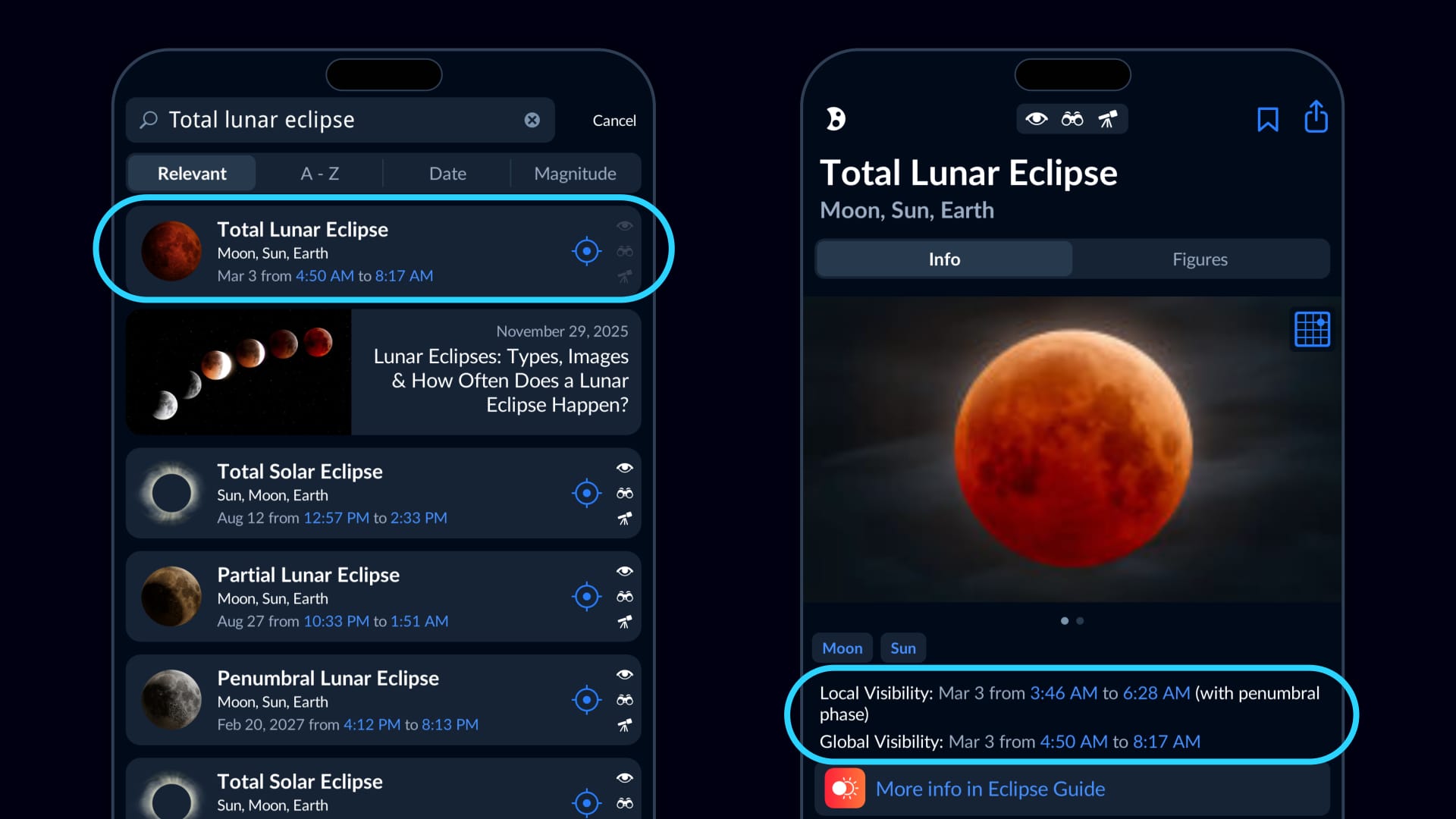
- Open the app and type “lunar eclipse” in the search field. Tap the matching result to open the event page for the March 2026 lunar eclipse. Below the image, you’ll see the exact visibility time based on your location — or a message indicating that the event is not visible from your region.
- The same page also includes a detailed visibility map. Swipe the image to the left or tap the blue map icon in the upper-right corner, then zoom in to your location. Tap the “i” icon to see what the map colors mean and which eclipse phases you’ll be able to observe.
- To find out where the Moon will appear in your sky during the eclipse, tap the target icon to center the Moon on the sky map. Then use the compass icon to align the map with the real sky and follow the on-screen arrow until the Moon appears on your screen. This helps you know where to look and plan your viewing in advance.
What time is the lunar eclipse? (March 2–3, 2026) — Eclipse time & timeline
The best time to see the Blood Moon in 2026 is during totality, when the Moon is completely inside Earth’s shadow and turns deep red. For the lunar eclipse on March 2-3, 2026, totality lasts 58 minutes 19 seconds, from 11:04 to 12:03 UTC/GMT, with the maximum phase at 11:33 UTC/GMT.
The entire lunar eclipse will last 5 hours and 39 minutes, and the timeline below shows when each phase begins and ends in UTC/GMT, helping you plan the perfect viewing moment.
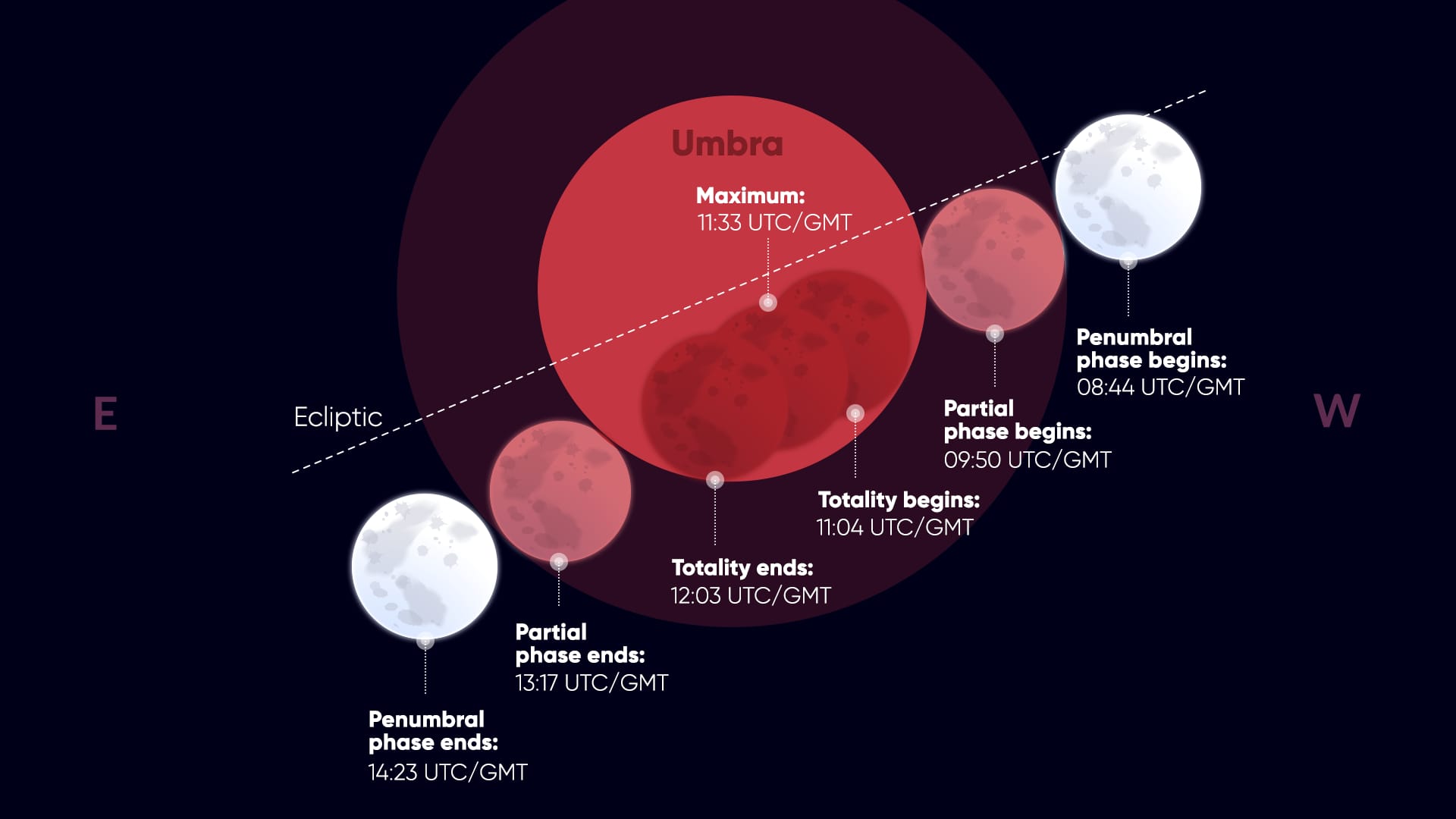
| Time | Eclipse phase | What’s happening |
|---|---|---|
| 08:44 UTC/GMT | Penumbral eclipse begins | The Moon enters Earth’s penumbra; the shading is very subtle and hard to notice. |
| 09:50 UTC/GMT | Partial eclipse begins | Earth’s dark shadow starts covering the Moon, making it look like a “bite” is taken out of it. |
| 11:04 UTC/GMT | Totality begins | The Moon is fully inside Earth’s shadow and begins to turn red. |
| 11:33 UTC/GMT | Maximum eclipse | The most striking phase, when the Moon is as deep as possible in Earth’s shadow. |
| 12:03 UTC/GMT | Totality ends | The Moon starts leaving the shadow and the red color slowly fades. |
| 13:17 UTC/GMT | Partial eclipse ends | Earth’s shadow completely leaves the Moon’s disk. |
| 14:23 UTC/GMT | Penumbral eclipse ends | The Moon exits the penumbra and the eclipse is fully over. |
When is the Blood Moon 2026 in North America?
The total lunar eclipse reaches its most dramatic phase — totality, when the Moon appears red — between 11:04 and 12:03 UTC/GMT on March 3. Below are the corresponding local times for totality across U.S. time zones:
- ET (UTC−5) (eastern United States and eastern Canada; parts of eastern Mexico; e.g. New York, Toronto, Cancún): 06:04–07:03 AM (Moon sets during totality)
- CT (UTC−6) (central United States and central Canada; most of Mexico; e.g. Chicago, Dallas, Mexico City): 05:04–06:03 AM
- MT (UTC−7) (mountain regions of the United States and Canada; parts of northwestern Mexico; e.g. Denver, Phoenix, Hermosillo): 04:04–05:03 AM
- PT (UTC−8) (western United States and western Canada; Mexico’s Baja California; e.g. Los Angeles, San Francisco, Vancouver, Tijuana): 03:04–04:03 AM
- AKST (Alaska; e.g. Anchorage): 02:04–03:03 AM
- HST (Hawaii; e.g. Honolulu): 01:04–02:03 AM
For the best experience, try to start watching at least half an hour earlier, during the partial phase, to see Earth’s shadow slowly move across the Moon.
When is the Blood Moon 2026 in South America?
Totality (when the Moon looks fully red) happens on March 3 from 11:04 to 12:03 UTC/GMT. In South America, visibility depends strongly on location because the eclipse occurs around dawn: most places will see only a partial eclipse near moonset, and totality is limited to the far western parts of the continent (near the Pacific coast) — and even there, the red Moon will be very low above the western horizon.
Here are the local times for the totality window in common South American UTC offsets:
- UTC−5 (e.g., Bogotá, Quito, Lima): 06:04–07:03 AM (Mar 3) (Moon very low; may set during totality depending on your exact location)
- UTC−4 (e.g., Caracas, La Paz): 07:04–08:03 AM (Mar 3) (totality often happens after moonset; you may catch only the partial phase at the horizon)
- UTC−3 (e.g., Buenos Aires, Montevideo, São Paulo): 08:04–09:03 AM (Mar 3) (after moonset for most locations; no red Moon)
For the best chance, try to start watching at least 30 minutes earlier, during the partial phase, and find a spot with a clear western horizon. To confirm exactly which phases you’ll be able to see from your city (and whether the Moon is above your horizon), use the Sky Tonight app.
When is the Blood Moon 2026 in Australia & New Zealand?
The most dramatic part of the lunar eclipse — totality, when the Moon turns red — will be visible in the evening of March 3 across Australia and after midnight on March 4 in New Zealand. Below are the local times for totality in different parts of Australia and New Zealand.
- AWST (western Australia; e.g. Perth): 7:04–8:03 PM
- ACST (central Australia; e.g. Alice Springs): 8:34–9:33 PM
- ACDT (central Australia with daylight saving; e.g. Adelaide): 9:34–10:33 PM
- AEST (eastern Australia; e.g. Brisbane): 9:04–10:03 PM
- AEDT (eastern Australia with daylight saving; e.g. Sydney, Melbourne): 10:04–11:03 PM
- NZDT (New Zealand; e.g. Auckland, Wellington): March 4, 12:04–1:03 AM
For the best view, start watching at least half an hour earlier, during the partial phase, as Earth’s shadow slowly moves across the Moon before totality begins.
When is the Blood Moon 2026 in Asia?
The best views of the red Moon in Asia will be in the far eastern parts of the region and across eastern Asia, where the total lunar eclipse or its maximum phase will be visible. The times below show when the Moon appears red (totality or the peak of the eclipse) in different Asian time zones.
- JST (Japan; e.g., Tokyo, Kyoto): 8:04–9:03 PM
- KST (South Korea; e.g., Seoul, Busan): 8:04–9:03 PM
- CST (China; e.g., Beijing, Shanghai, Hong Kong): 7:04–8:03 PM
- ICT (parts of Southeast Asia; e.g., Bangkok, Hanoi): 6:04–7:03 PM
For the best view, start watching at least half an hour earlier, during the partial phase, as Earth’s shadow slowly moves across the Moon before totality begins.
When is the Blood Moon 2026 in my location?
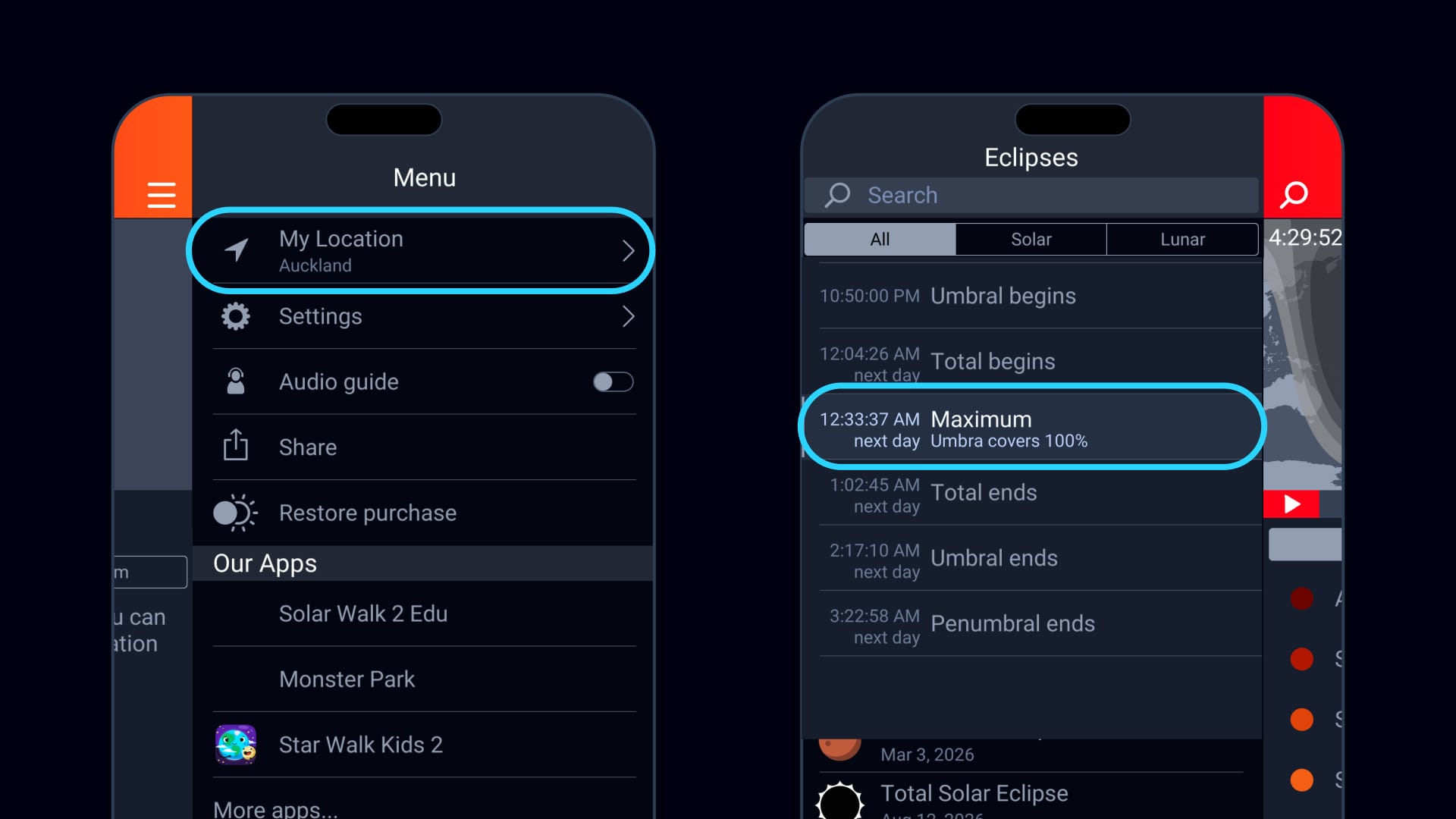
To find the exact local timing of the March 2026 Blood Moon, use the Eclipse Guide app, designed specifically for tracking lunar and solar eclipses.
- Open the app and tap the menu icon in the upper-right corner to select your location. Once a location is chosen, Eclipse Guide automatically calculates the precise timing and duration of all key eclipse phases — from the subtle penumbral stages to totality and the moment of maximum eclipse — specifically for your location.
This makes it easy to see when each phase begins and ends, without converting time zones or doing any manual calculations.
Best tips for watching the Blood Moon 2026
A lunar eclipse is one of the easiest and safest astronomical events to observe — no special skills or equipment are required.
- No eclipse glasses needed: Unlike solar eclipses, the Blood Moon is safe to watch with the naked eye.
- You can observe the Blood Moon without optics, though binoculars or a small telescope may reveal subtle color variations across the Moon’s surface as it passes through Earth’s shadow.
- Check the weather forecast in advance and make sure the skies above you will be clear, as clouds can easily obscure the eclipse.
- Find a spot with a clear horizon, especially if you’re observing from regions where the eclipse occurs during moonrise or moonset, such as eastern Asia, parts of Southeast Asia, eastern North America, or western South America. In these areas, the red Moon will appear very low above the horizon, so make sure that buildings, trees, or hills don’t block your view.
- For the full experience, start watching at least 30 minutes before totality, around 10:30 UTC/GMT — during the partial phase, to see Earth’s shadow slowly moving across the Moon.
Best tips for photographing the Blood Moon 2026
Photographing a lunar eclipse is easier than it may seem, but the Moon’s brightness changes dramatically during the event, so some preparation helps.
- Use a tripod. During totality, the Moon becomes much darker, and longer exposures may be needed, especially if you are not using a tracking mount. A stable setup is essential to avoid blur.
- A DSLR or mirrorless camera with a telephoto lens (about 200–600 mm for close-up shots) works best. Smartphones can also capture the eclipse, especially during brighter partial phases, though details may be limited.
- Expect the Moon to look much dimmer and redder during totality. Take test shots and adjust exposure gradually as the light fades and returns.
- As the eclipse progresses, the Moon dims significantly. Be ready to increase ISO (about 400–1600), slow down the shutter (from around 1/250 s to 1–2 seconds), and fine-tune exposure as totality approaches.
- If the Moon is low above the horizon in your region, atmospheric haze may soften details — this can add mood to photos, but requires slightly higher ISO or longer exposure.
- For more creative shots, try including a foreground element (trees, buildings, landscape) to show scale and give context to the red Moon.
Planning ahead helps: apps like Sky Tonight can show the Moon’s path and altitude for your location in advance, making it easier to choose the right shooting location and framing.
Blood Moon 2026: Frequently Asked Questions
Is there a Blood Moon or lunar eclipse tonight?
Yes, a total lunar eclipse — also known as a Blood Moon — is happening tonight, on March 2–3, 2026. Totality, when the Moon turns deep red as it passes completely through Earth’s shadow, lasts from 11:04 to 12:03 UTC/GMT, with the maximum at 11:33 UTC/GMT. The red Moon is visible from eastern Asia, Australia, New Zealand, the Pacific region, North and Central America, and far western South America. You can learn more about the different reasons the Moon can change color by taking our quiz.
Why will the Moon turn red in March 2026?
In March 2026, a total lunar eclipse will take place. During the event, the Earth moves between the Sun and the Moon, blocking direct sunlight. Some sunlight still reaches the Moon after passing through Earth’s atmosphere. Blue light is scattered more easily in the atmosphere, while red light is scattered less, so mostly red light reaches the Moon. This filtered light gives the Moon its deep red or coppery color — the effect known as a Blood Moon. If you’d like to learn more about how this works, explore the science behind lunar eclipses in our dedicated article.
Are a Blood Moon and a lunar eclipse the same thing?
A Blood Moon is a total lunar eclipse, when the Moon passes fully through Earth’s umbra and turns reddish. In other words, every Blood Moon is a lunar eclipse, but not every lunar eclipse is a Blood Moon.
Is it safe to watch a Blood Moon?
Yes, it’s completely safe to watch a Blood Moon with your naked eyes, binoculars, or a telescope. Unlike a solar eclipse, a lunar eclipse does not require any special eye protection.
How often does a Blood Moon occur?
Blood Moons are relatively rare. On average, one to two total lunar eclipses happen each year, though some years may have none at all. After the Blood Moon on March 3, 2026, the next one won’t occur until the night of December 31, 2028 – January 1, 2029. For an overview of upcoming events, see our regularly updated infographic showing the next five eclipses.
What is the best time to watch the Blood Moon 2026?
The best time to watch the Blood Moon depends on what exactly you’d like to see. If you want to observe the intensely red Moon at its most dramatic, watch anytime during totality, from 11:04 to 12:03 UTC/GMT, with the deepest color around the maximum at 11:33 UTC/GMT. Many skywatchers, however, prefer to begin watching earlier, from the beginning of the partial phase, to see the Moon gradually darkening from one edge as Earth’s shadow moves across its surface turning coppery red. The partial phase begins at 09:50 UTC/GMT.
What are the best locations to watch the Blood Moon 2026?
The best locations to see the Blood Moon are regions where the Moon is well above the horizon during totality and the sky is unobstructed. In March 2026, the best views will be from eastern Asia, Australia, New Zealand, the Pacific region, and much of North and Central America.
Is the March 2026 Blood Moon visible in Europe?
No, the March 2026 Blood Moon will not be visible from Europe, as the Moon will be below the horizon during the entire eclipse. The total lunar eclipse, including the red Moon phase, will be visible from eastern Asia, Australia, New Zealand, the Pacific region, and much of North and Central America, with limited visibility in the far western parts of South America.
What if the Blood Moon 2026 isn’t visible from my location?
If the Blood Moon 2026 isn’t visible where you live, you still have options. You can travel to a region where totality is visible, such as eastern Asia, Australia, New Zealand, the Pacific region, or parts of North and Central America. If traveling isn’t possible, you can watch the eclipse online — for example, the Griffith Observatory will host a live broadcast on March 3 from 12:37 a.m. to 6:25 a.m. US PT (08:37–14:25 UTC/GMT). This allows you to follow the entire eclipse, including totality and the maximum phase, even if the red Moon doesn’t rise above your local horizon.
Next lunar eclipse: when to see the red Moon again?
After the total lunar eclipse in March 2026, the next lunar eclipse will occur on August 28, 2026. However, the Blood Moon will only occur in almost three years.
When is the next lunar eclipse in 2026?
The next lunar eclipse in 2026 will be a partial lunar eclipse on August 27-28, 2026. This event will be visible from parts of the Americas, Europe, Africa, and surrounding regions, with the Moon partly covered by Earth’s shadow. This eclipse takes place during the Full Moon in August 2026, also known as the Sturgeon Moon.
When is the next Blood Moon?
A “Blood Moon” refers to a total lunar eclipse, when the Moon takes on a red hue. After March 2026, such an event won’t happen until December 31, 2028 – January 1, 2029. It will be visible across Asia, Australia, New Zealand, Africa, and much of Europe.
To keep track of upcoming eclipses, check out our regularly updated infographic of the next 5 eclipses. It shows key timings, visibility maps, and only the essential details in a clear, visual format.

More events around the Blood Moon 2026
The total lunar eclipse 2026 has more to offer than just a red Moon. Observers can enjoy a striking star pairing, see the Full Moon in an unusual light, and explore how lunar eclipses are viewed in different cultures.
Regulus near the red Moon 2026
The night before the lunar eclipse 2026, the Moon puts on an extra show in the constellation Leo, passing exceptionally close to Regulus, the brightest star in Leo. At their closest approach, the visible distance between the two bodies will be just 0°24ʹ.
On the eclipse night, Regulus will still be nearby, about 13° from the Moon (roughly a little more than the width of your clenched fist at arm’s length). The reduced brightness of the eclipsed Moon makes it easier to trace the famous Sickle of Leo — a star pattern shaped like a backward question mark, with Regulus marking its base. Together, the red Moon, Regulus, and the Sickle create a picture-perfect scene.
The Full Moon in March 2026: Blood Worm Moon
A lunar eclipse can only occur at Full Moon, when the Sun, Earth, and Moon align so that Earth’s shadow falls on the Moon. That’s why the upcoming total lunar eclipse coincides with the March Full Moon 2026, which reaches its exact phase at 11:38 UTC/GMT, shortly after totality begins.
During a total lunar eclipse, the Full Moon turns red as filtered sunlight passes through Earth’s atmosphere — this is what’s known as a Blood Moon. At the same time, the March Full Moon is traditionally called the Worm Moon, a seasonal name marking the approach of spring in the Northern Hemisphere.
Selenelion: can you see the Sun and the Blood Moon at the same time?
In places where the eclipse happens right at moonset (or moonrise), atmospheric refraction can sometimes make it possible to see the eclipsed Moon while the Sun is already rising (or has just set). This rare effect is called a selenelion.
To try it, choose an elevated spot with a clear view of the horizon and start watching 10–15 minutes before moonset/moonrise. (Don’t stare at the Sun — a quick glance at sunrise is enough.)
End of the Lunar New Year celebration
In many East Asian cultures, the Lunar New Year begins with the first New Moon of the lunar calendar, often defined as the second New Moon after the winter solstice. In 2026, the Lunar New Year starts on February 17, and the celebrations traditionally last for about 15 days, ending with the Full Moon during the Lantern Festival.
In 2026, this closing Full Moon coincides with a total lunar eclipse, making the final night of the Lunar New Year period truly special. The red Moon 2026 will be visible in many Asian countries, including China, South Korea, and Japan.
While the eclipse itself has no formal role in Lunar New Year traditions, the rare overlap of a total lunar eclipse with the final Full Moon of the celebrations makes this night particularly memorable.
Chandra Grahan 2026: the lunar eclipse in Indian tradition
In India, a lunar eclipse is known as Chandra Grahan (from Sanskrit “chandra” — Moon, “grahan” — eclipse). While modern astronomy explains lunar eclipses as a natural alignment of the Sun, Earth, and Moon, traditional interpretations of Chandra Grahan are deeply rooted in mythology and cultural beliefs.
According to Puranic mythology, eclipses are explained through the actions of Rahu and Ketu, the so-called shadow planets. During a Chandra Grahan, it is traditionally believed that Rahu temporarily swallows the Moon, symbolizing a brief disruption of clarity and emotional balance. After the eclipse, the Moon is “released,” marking the restoration of order.
During the lunar eclipse in 2026, the red Moon will be visible from the northeastern part of India, where the Moon rises while the eclipse is still in its total phase. Across the rest of India, however, the total phase occurs below the horizon, so observers will see only the later partial stages after the Moon comes up. Farther east across Asia, the red Moon will be easier to observe, with totality higher above the horizon.
Total Lunar Eclipse March 2026: Bottom line
The March 2026 Blood Moon is the only total lunar eclipse of the year — and the last one until 2028. The red Moon will be visible from Australia, New Zealand, the Pacific region, eastern parts of Asia, and western North America, where the Moon enters Earth’s darkest shadow during totality. In other parts of the world, observers will see a partial eclipse, with Earth’s shadow moving across part of the Moon. To check precisely what will be visible from your location, use the Sky Tonight app.
Blood Moon is one of the best sky events of 2026
The 2026 total lunar eclipse is one of the most impressive sky events of the year and part of our list of the 12 best astronomy events of 2026. Read our article to see what else is worth watching in the sky this year.
Are you ready for the lunar eclipse? Test your knowledge
You’ve just learned all about the March 2026 lunar eclipse — now see how much you really know. Take our quiz on lunar and solar eclipses and find out if you’re an eclipse expert!

Sources: