Comet MAPS Did Not Survive — See What Happens Next
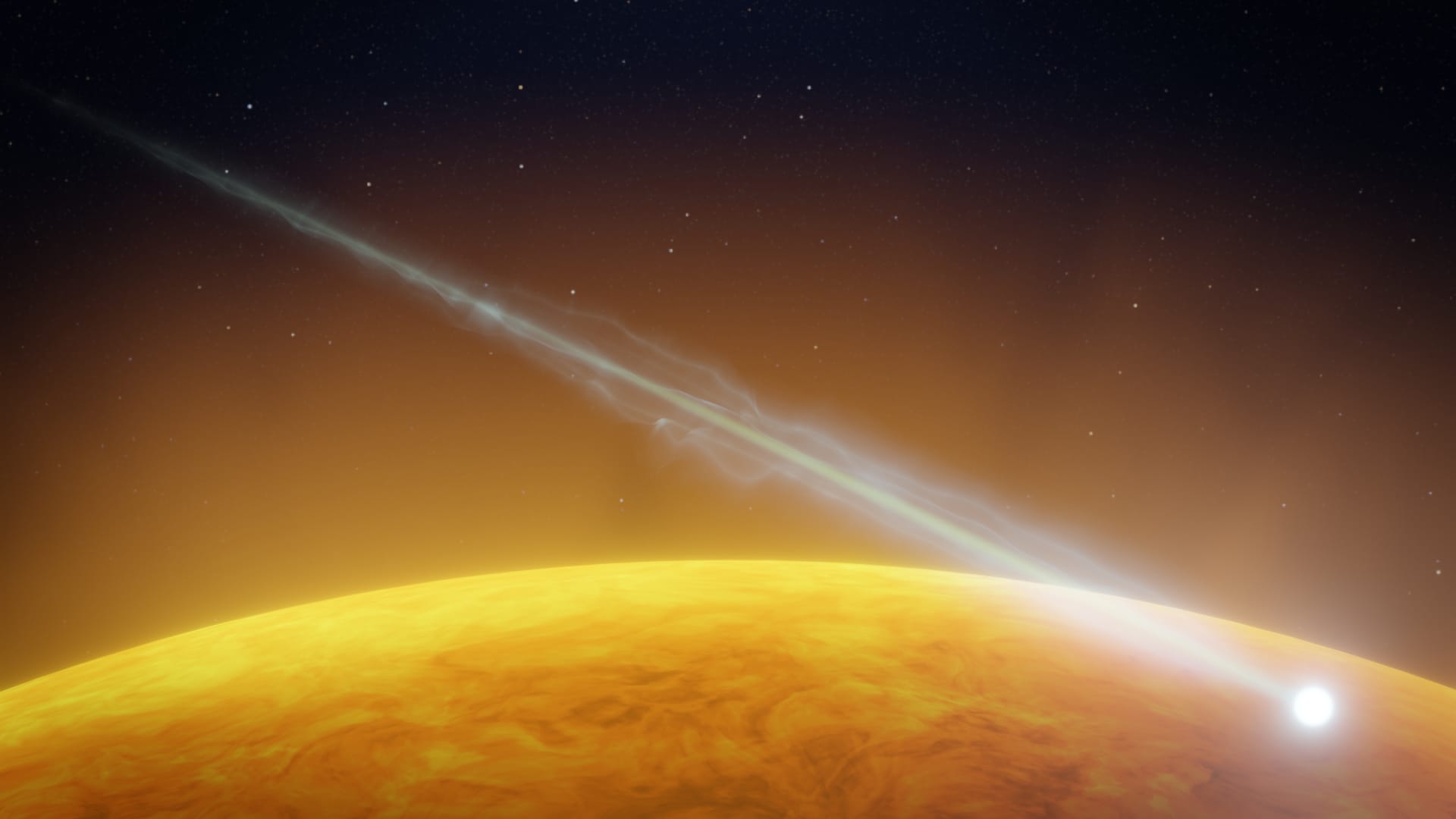
Comet C/2026 A1 (MAPS) broke apart during its extremely close pass by the Sun on April 4, and the dust left behind has now dispersed. So MAPS is no longer expected to produce the bright post-perihelion show many skywatchers had hoped for. Still, comet watchers have another reason to keep looking up: C/2025 R3 (PanSTARRS) now looks like a much more promising target for April. If you’d like to track what remains of MAPS or see where PanSTARRS is in your sky, the Star Walk 2 app can help you.
Contents
- Comet C/2026 A1 (MAPS) At a Glance: What’s Happening Now?
- Latest News on Comet C/2026 A1 (MAPS)
- What is Comet C/2026 A1 (MAPS)?
- Will Comet C/2026 A1 (MAPS) Be Visible to the Naked Eye?
- When and Where to See Comet C/2026 A1?
- Comet C/2026 A1: Orbit and Trajectory
- Frequently Asked Questions about Comet C/2026 A1 (MAPS)
- Comet C/2026 A1: Discovery
- Potentially Naked-Eye Comet C/2026 A1: Summary

Comet C/2026 A1 (MAPS) At a Glance: What’s Happening Now?
- Current status: nucleus disintegrated during perihelion on April 4, 2026
- Visibility: not visible
Latest News on Comet C/2026 A1 (MAPS)
Comet MAPS fell apart during its close swing around the Sun on April 4. And now, as the leftover debris cloud appears to be dispersing, it looks unlikely that there will be anything left to see.
April 5: Comet MAPS broke apart — and the show is over
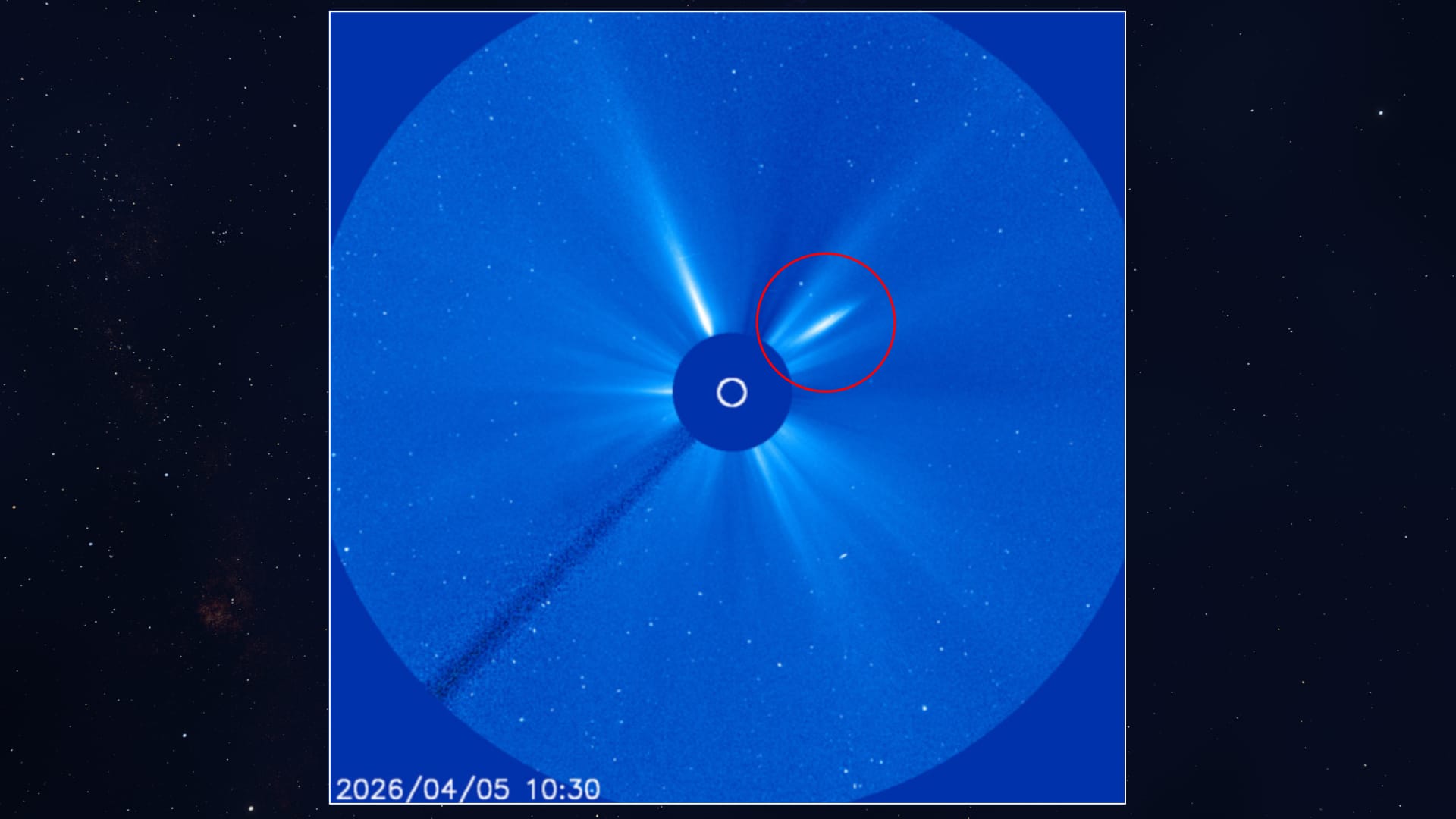
Comet MAPS did not survive its closest pass by the Sun on April 4. What emerged from behind the Sun was not an intact comet head, but a dust tail, likely produced when the nucleus broke apart and released a large amount of material. In coronagraph images, this dust plume was clearly visible: it appeared curved along our line of sight and stretched across roughly one degree.
At first, that raised hopes that MAPS might still give us a faint dust trail visible — perhaps even a brief “headless wonder.” But those hopes are now fading. The leftover debris cloud appears to be dispersing, which means MAPS is becoming less and less likely to produce anything noticeable in the sky. The attention is now shifting to more promising targets, such as C/2025 R3 (PanSTARRS).
Comet C/2026 A1 (MAPS) News Recap: March-April 2026
A lot has happened since Comet C/2026 A1 (MAPS) first raised hopes of becoming a naked-eye sungrazer. Here’s a quick recap of the main developments.
- April 4: MAPS made its closest pass by the Sun and broke apart.
- April 3: MAPS became visible in LASCO C3 images and appeared bright, suggesting it was still holding together at that stage.
- April 2: With MAPS sinking into the Sun’s glare, ground-based observing became nearly impossible, and attention shifted to SOHO coronagraph images.
- March 31: Ground-based observing became much harder as MAPS slipped into bright twilight, shifting attention to perihelion and a possible return after April 6.
- March 26: A flare-up after a slowdown in brightening made the comet’s behavior look less predictable, though images still showed a healthy coma and ion tail.
- March 18: JWST-based size estimates suggested a nucleus about 0.4 km across, raising the possibility of a dramatic “headless wonder” finale.
- March 17: Rumors linking MAPS to 3I/ATLAS spread online, but orbital evidence did not support them.
- March 15: Observations were still encouraging, with MAPS brightening more strongly than Lovejoy had at a similar stage.
- March 12: The comet passed close to galaxies NGC 942 and NGC 945, offering a nice target for astrophotographers.
- March 4: Light-curve comparisons fueled hopes that MAPS could become one of the more notable sungrazers of recent years.
- March 3: Extreme model-based brightness estimates appeared, but remained highly speculative.
What is Comet C/2026 A1 (MAPS)?
- Type: Kreutz sungrazer
- Orbital period: about 2,000 years (according to NASA JPL and COBS) – unusually long for a Kreutz sungrazer
C/2026 A1 was a rare type of comet called a sungrazer — it passes extremely close to the Sun. It belonged to the Kreutz family and was believed to be fragments of a much larger comet that broke apart long ago. Like the majority of Kreutz sungrazers, comet C/2026 A1 (MAPS) was destroyed by the Sun during perihelion.
Comets come in many forms, not just sungrazers like C/2026 A1. They differ in their orbits, origins, and behavior. For a quick and easy way to learn the basics about comets, check out our comet infographic.
Will Comet C/2026 A1 (MAPS) Be Visible to the Naked Eye?
Probably not anymore.
As a Kreutz sungrazer, comet C/2026 A1 (MAPS) was often compared to famous comets from the same family, including Comet Ikeya–Seki (1965) and Comet Lovejoy (2011). These comets passed extremely close to the Sun, became dramatically brighter, and put on an unforgettable show in the sky.
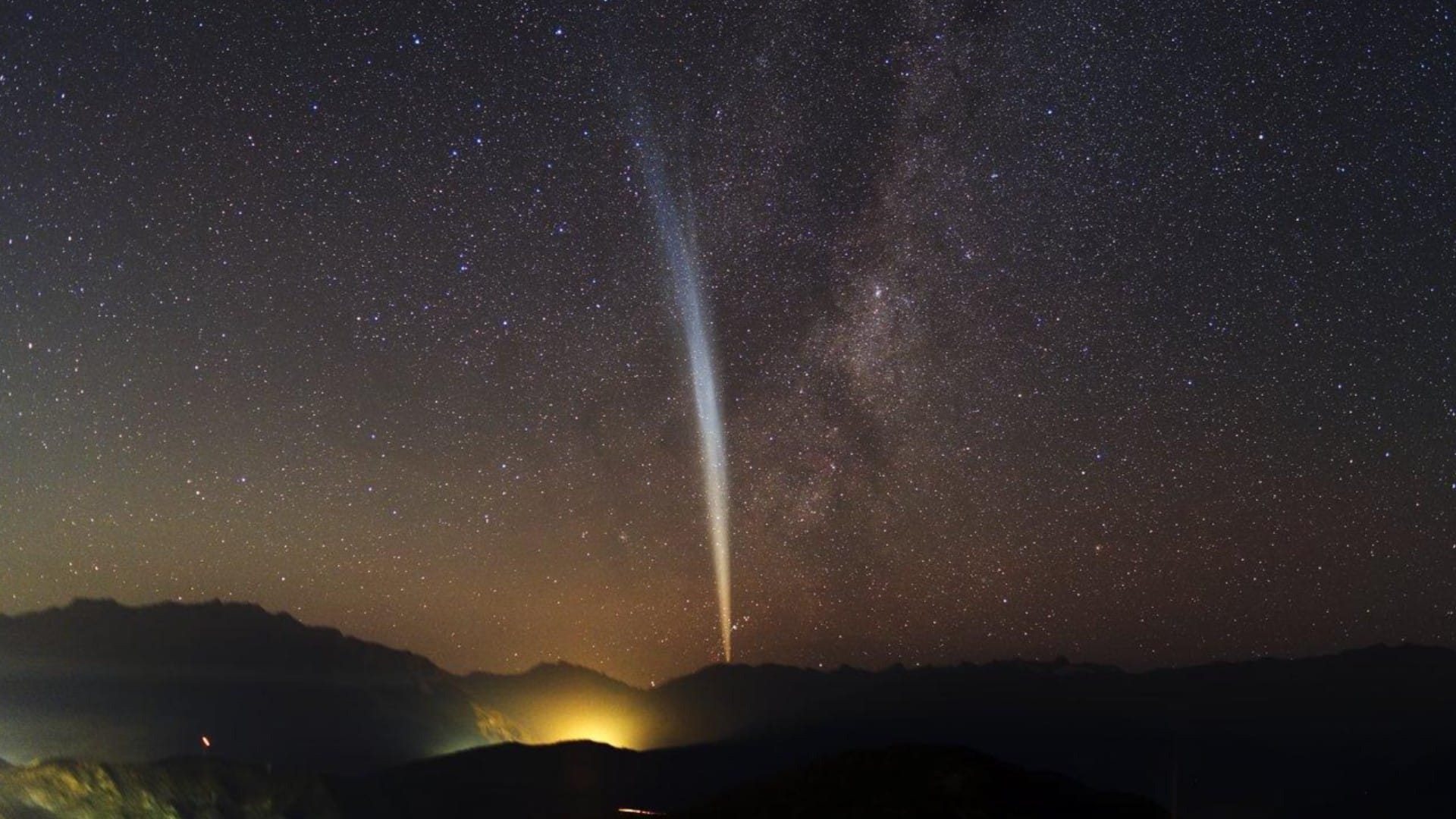
If MAPS had stayed in one piece, it might have become a bright comet with a clearly defined head and tail. But the comet broke apart during its close pass by the Sun, and the debris left behind has dispersed quickly.
When and Where to See Comet C/2026 A1?
At this point, there is nothing left to see from the ground. After Comet MAPS broke apart near the Sun, there was a short-lived hope that the leftover dust might still form a faint tail or glow. But that debris has now dispersed, and even on coronagraph images, the cloud is already fading away.
So MAPS is not expected to put on any more of a show. What remained after the breakup did not hold together long enough to become a real observing target from Earth.
Comet C/2026 A1: Orbit and Trajectory
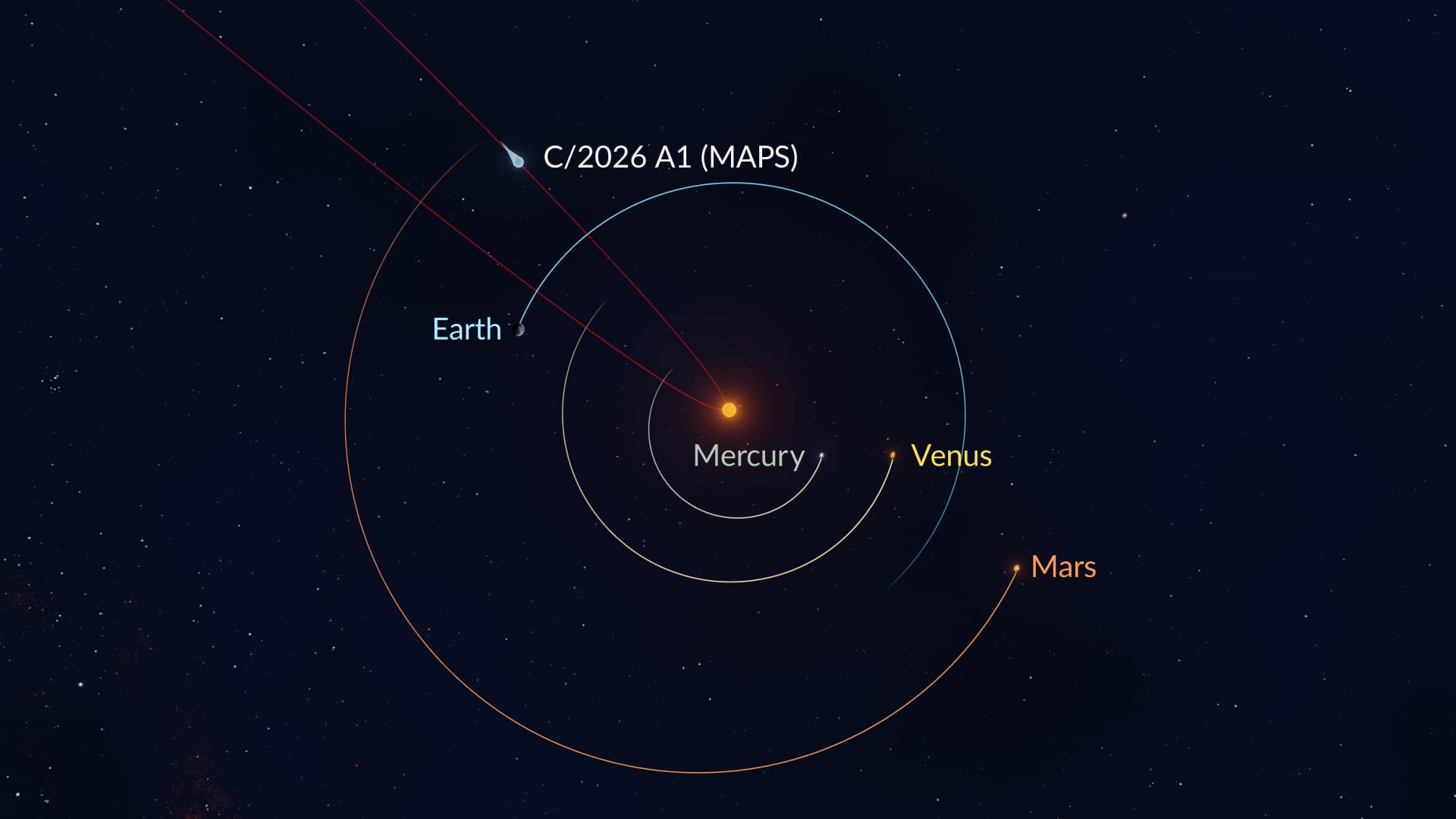
Unlike the planets, which all move around the Sun in the same direction, comet C/2026 A1 traveled the opposite way on a sharply tilted path (about 144.5°). Like other Kreutz sungrazers, it followed a long, stretched orbit that brought it extremely close to the Sun — a dramatic and risky passage that led to its breakup.
- At perihelion on April 4, 2026, the comet passed about 170,000 km (105,600 miles) above the Sun’s surface. The nucleus is now disintegrated during that close solar pass.
Frequently Asked Questions about Comet C/2026 A1 (MAPS)
What happened to Comet C/2026 A1 (MAPS)?
Comet MAPS went so close to the Sun on April 4, 2026, that it did not survive. Its nucleus appears to have broken apart during the solar pass. After that, some leftover dust was still visible, raising hopes for a faint tail or “headless wonder.” But that dust now seems to be fading away, so the comet’s story is most likely over.
Is Comet C/2026 A1 (MAPS) visible right now?
No. The comet broke apart near the Sun, and the coronograph images show that the remaining debris cloud now appears to be dispersing.
Will Comet C/2026 A1 (MAPS) be visible to the naked eye?
No. What was left of MAPS has already faded, so it is no longer expected to become visible to the naked eye.
Comet C/2026 A1: Discovery
C/2026 A1 (MAPS) was first spotted on January 13, 2026, by a team of four astronomers: Alain Maury, Georges Attard, Daniel Parrott, and Florian Signoret, using robotic telescopes in Chile as part of the MAPS (Maury/Attard/Parrott/Signoret) program. The discovery images showed a fuzzy, tailed object, classic signs of a comet. Follow-up observations confirmed the cometary nature of the object, and the Minor Planet Center moved it to the Comet Confirmation Page within days.
Why was the comet called C/2026 A1 (MAPS)?
The name follows the standard naming convention for comets:
- C/ — Indicated a non-periodic comet (typically with orbital periods longer than 200 years or on open trajectories).
- 2026 — The year the comet was discovered.
- A1 — The first half-month of January is labeled "A", and this was the first comet discovered during that period.
- (MAPS) — Acknowledges the discovery team’s survey program: Maury/Attard/Parrott/Signoret, which detected the comet using telescopes in Chile.
Before receiving its formal name, the comet was cataloged under the temporary internal code 6AC4721, which was an internal provisional identifier used prior to formal designation.
MAPS program
The MAPS program (Maury, Attard, Parrott, Signoret) is an independent project dedicated to discovering near-Earth asteroids using the synthetic tracking technique.
All four are amateur astronomers. Alain Maury previously worked as an engineer at major observatories, including the Côte d’Azur Observatory, Mount Palomar Observatory in California, and La Silla Observatory, before founding his own observatory in San Pedro de Atacama, Chile. Georges Attard, Florian Signoret, and Daniel Parrott have professional backgrounds in computer science, which contributed to the development of the project’s high-performance software. Attard, Signoret, and Maury are members of GAPRA (Groupement d’Astronomie Populaire de la Région d’Antibes). Parrott is also the author of the Tycho Tracker software and a co-inventor of the synthetic tracking technique.
We sincerely thank Florian Signoret for reaching out to us and kindly pointing out the inaccuracies in the article. We also encourage readers to explore Alain Maury’s blog post about the discovery of the comet for a firsthand account of this remarkable event.
Why was Comet C/2026 A1 Special?
C/2026 A1 has drawn early excitement because:
- It was a large Kreutz comet, which are considered remnants of an ancient object that broke apart centuries ago.
- It was discovered unusually early for a sungrazer — at about 2 AU from the Sun, whereas most sungrazing comets are first detected only when they are much closer, often within 0.1–0.3 AU.
- Its orbital period (about 1900 years ) is unusually long for a Kreutz sungrazer. Most Kreutz comets are tiny and short-lived, so seeing a larger one with a well-defined long-period orbit is uncommon.
- Its orbit and brightness raised hopes that it might become one of the more impressive sungrazers of recent years, comparable to Ikeya-Seki (1965) and Lovejoy (2011).
That early excitement is also why MAPS was often compared to the famous great comets of the past — exceptionally bright comets with huge tails that leave a lasting mark in the history of skywatching. To learn more about what makes a comet “great”, read our article on great comets.
Why Is Comet C/2026 A1 Important For Science?
Comets like C/2026 A1 offer a glimpse into the early Solar System. Being relatively pristine, they preserve materials from the system’s formation. Its extremely close perihelion also provides a unique opportunity to study how intense solar heating affects volatile-rich bodies. Additionally, its orbital parameters may help refine models of the Kreutz family’s fragmentation history, possibly tracing its ancestry back to a single massive progenitor that broke up a millennium ago.
Potentially Naked-Eye Comet C/2026 A1: Summary
Comet C/2026 A1 (MAPS) broke apart during its close solar pass on April 4, 2026. For a short time, there was hope that the leftover dust might still create a faint tail or glow. But the debris has now dispersed, so MAPS is not expected to give us anything more to see. The comet’s story is effectively over — and attention is now shifting to more promising targets, such as C/2025 R3 (PanSTARRS). To follow current comet positions and find other targets in the sky, use Star Walk 2.
Comets Visible Tonight: What Else to See in 2026
Even if MAPS no longer turns into the bright comet many people were hoping for, 2026 still has plenty to offer comet watchers. Оur article about other comets you can observe right now covers other comets that are currently visible with binoculars or small telescopes, depending on your location and sky conditions. They may not be headline-makers, but they’re great targets and good reasons to gaze into the sky.
One More Bright Comet In April 2026: C/2025 R3 (PanSTARRS)
Comet MAPS is fading out of the picture, so if you’re looking for a comet with a better chance of putting on a clearer show this month, C/2025 R3 (PanSTARRS) may be the better bet. It has been tracked for months and is expected to brighten significantly, possibly enough to become visible to the naked eye. To learn what makes this comet special and how best to observe it, take a look at our separate article on C/2025 R3 (Pan-STARRS).