All About Mars: Facts, Visibility, and Viewing Tips
In this article, we’ll tell you everything you need to know about Mars and answer the most common questions related to the Red Planet: why Mars is red, how big it is, what it looks like, and when it’s best to observe it. We'll also highlight upcoming celestial events involving Mars. Use the Sky Tonight app to quickly find Mars from your location. Let’s get started!
Contents
- Can you see Mars tonight?
- How to find Mars in the sky
- What does Mars look like when observed from Earth?
- Mars Facts
- How big is Mars?
- Mars orbital period and rotation period
- How far away is Mars?
- Missions to Mars
- What is Mars made of?
- How many moons does Mars have?
- What does Mars look like?
- When and where is Mars visible in 2026?
- Upcoming Events
- F.A.Q.
- Planet Mars: to sum up
Can you see Mars tonight?
Yes, you can — in late September and October 2026, Mars is visible in the morning sky before sunrise. Look for it above the eastern horizon as a reddish-orange point of light. It rises several hours before the Sun and gradually becomes visible earlier in the night. Mars brightens from about magnitude 1.1 in late September to magnitude 0.9 by late October, making it easy to see with the naked eye.
The easiest way to check whether Mars is visible from your exact location is to use the Sky Tonight app. Open the app, search for “Mars,” and see where it is in your sky right now.
Mars will become progressively easier to observe through the rest of 2026 as it rises earlier and brightens on its way to opposition. The best time to observe the Red Planet will be around opposition on February 19, 2027.
How to find Mars in the sky
Mars is one of the easiest planets to recognize with the naked eye — when it’s well placed. It usually looks like a bright reddish-orange “star” that shines with a steady light. Unlike the real stars, Mars slowly changes its position against the background constellations from night to night.
The easiest way to find Mars is to use an astronomy app like Sky Tonight:
- Open the app and tap the search icon.
- Type “Mars.”
- Tap the target icon next to Mars.
- Follow the arrow on the screen until you see Mars’ position in the sky.
You can also check Mars’ rise and set times in the app to know when the planet is visible from your location. For the best view, choose a time when Mars is higher above the horizon — the higher it climbs, the easier it is to spot and observe.
If you’re not sure whether the reddish object you see is Mars, point your device at the sky and use the app’s live sky map to identify the object. This is especially helpful because Mars can sometimes be confused with other reddish objects, such as Antares, Aldebaran, or Betelgeuse.
What does Mars look like when observed from Earth?
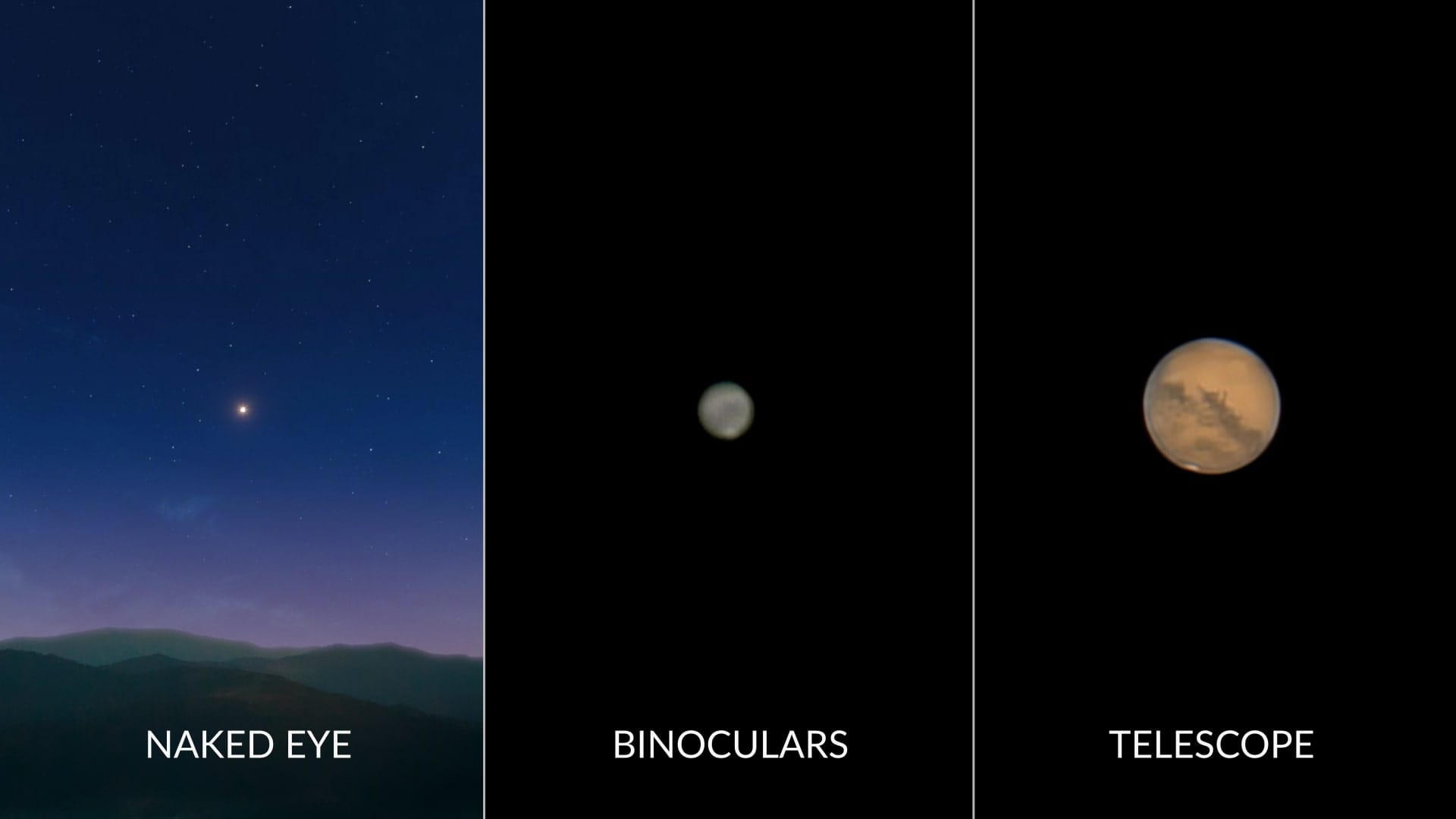
- When observed with the naked eye, Mars looks like a small, bright, reddish-orange dot. The planet doesn’t appear large enough to show any surface details. It looks similar to a bright star, though it stands out thanks to its color and steady light, as planets don’t twinkle as much as stars do.
- Through binoculars, Mars will still look mostly like a bright reddish point of light. Binoculars are useful for spotting Mars near the Moon, stars, or planets.
- In a telescope, Mars looks like a small disk. Depending on the size and magnification of the telescope, you can get a much more detailed view of the planet. Surface features like polar ice caps, dark markings, and even atmospheric activity can become visible.
Mars Facts
- Planet type: terrestrial
- Radius: 3,396 km
- Mass: 6.417 × 10^23 kg
- Aphelion: 249.2 million km (154.9 million miles)
- Perihelion: 206.6 million km (128.4 million miles)
- Average distance from the Earth: 225 million km (140 million miles)
- Surface temperature: −143 °C to 35 °C (-226 °F to 95 °F)
- Solar day length: 24 h 39 m 35 s
- Sidereal day length: 24 h 37 m 22 s
- Year length: 686.98 Earth days
- Age: 4.503 billion years
- Named after: Roman god of war
5 fun facts about Mars
-
Mars can boast the largest volcano in the entire Solar System – Olympus Mons. With a height of 21 km, it stands about 2.5 times taller than Mount Everest.
-
Mars’ larger moon, Phobos, gradually gets closer to the planet at a rate of about 2 cm per year. In 50 million years, Phobos will either crash into Mars or disintegrate to form a ring around the Red Planet.
-
Billions of years ago, Mars may have looked much more like Earth. Large areas of the planet’s surface were likely covered with liquid water, and some scientists think the Red Planet may once have had conditions suitable for primitive life. However, over time, Mars lost most of its atmosphere and dried up.
-
During the late 19th and early 20th centuries, many astronomers observed a network of canals on the Martian surface. Some believed them to be irrigation canals constructed by an alien civilization. However, it turned out to be an optical illusion.
-
Humanity is considering colonizing Mars. Elon Musk, the founder of SpaceX, has long stated his vision of building a self-sustaining city on Mars. NASA is also working on a mission to send people to Mars: the agency plans to first establish human presence on the Moon by the early 2030s and then land astronauts on Mars in the 2040s. Hopefully, these plans will come to reality one day! In the meantime, you can brush up on your knowledge of Mars with a quiz.
How big is Mars?
Mars is the second smallest planet in the Solar System – only Mercury is smaller. Let’s measure this planet and compare it to the Earth.
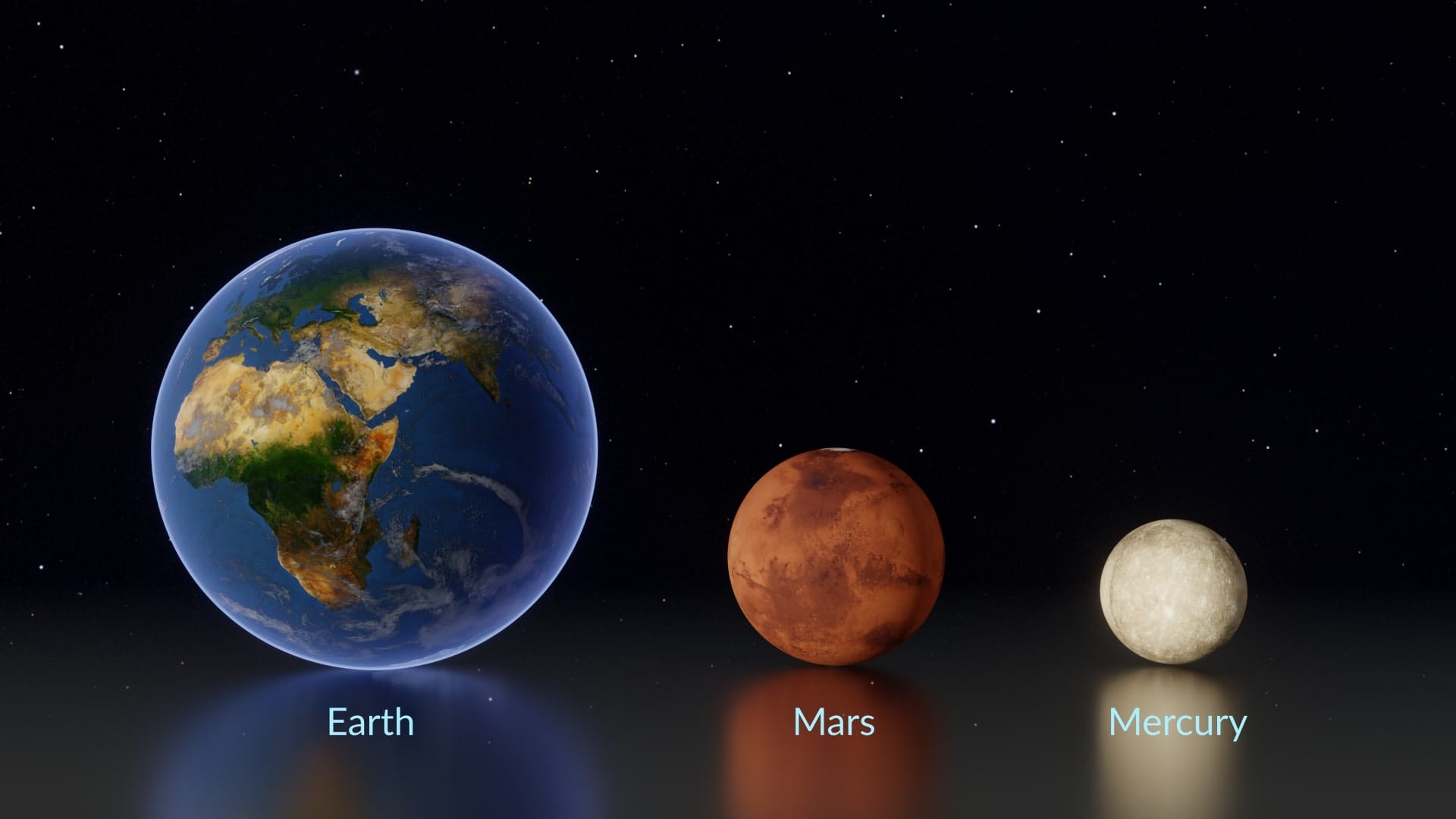
Mars size
Mars has a diameter of 6,792 km (4,220 miles); the planet’s circumference around the equator is 21,326 km (13,300 miles). Thus, if you’re moving at a speed of about 100 km per hour (62 miles per hour), it will take you about nine days to travel around the planet's equator.
Is Mars bigger than the Earth?
No, it’s not. The diameter of Mars is only about half of the Earth’s diameter, which is 12,742 km (7,917 miles). Also, Mars is only about two times bigger than our Moon, which is 3,474 km (2,158 miles) in diameter.
Mars orbital period and rotation period
Every planet in the Solar System has its own orbital period (that determines the length of year) and rotation period (that determines the length of a day-night cycle). Let’s take a look at how fast Mars revolves around the Sun and spins on its axis.
How long is a year on Mars?
As Mars is located farther away from the Sun than the Earth, it takes longer for the Red Planet to complete one orbit around the Sun. A year on Mars lasts for about 687 Earth days, which equals 1.88 Earth years.
How long is a day on Mars?
Mars rotates on its axis at almost the same speed as the Earth. For this reason, daily cycles on these two planets are quite similar. One Martian day (called a sol) lasts 24 hours 39 minutes, which is only 39 minutes longer than a day on the Earth.
Does Mars have seasons?
As you probably know, seasons are caused by the tilt of a planet’s axis of rotation. Mars’ axial tilt is very similar to the Earth’s: the Red Planet is tilted at 25.2°, while the Earth's axial tilt is about 23.5°. For this reason, Mars has four distinct seasons: spring, summer, fall, and winter. However, each season on Mars lasts about two times longer than on the Earth. That’s because it takes almost two Earth years for Mars to travel around the Sun once.
How far away is Mars?
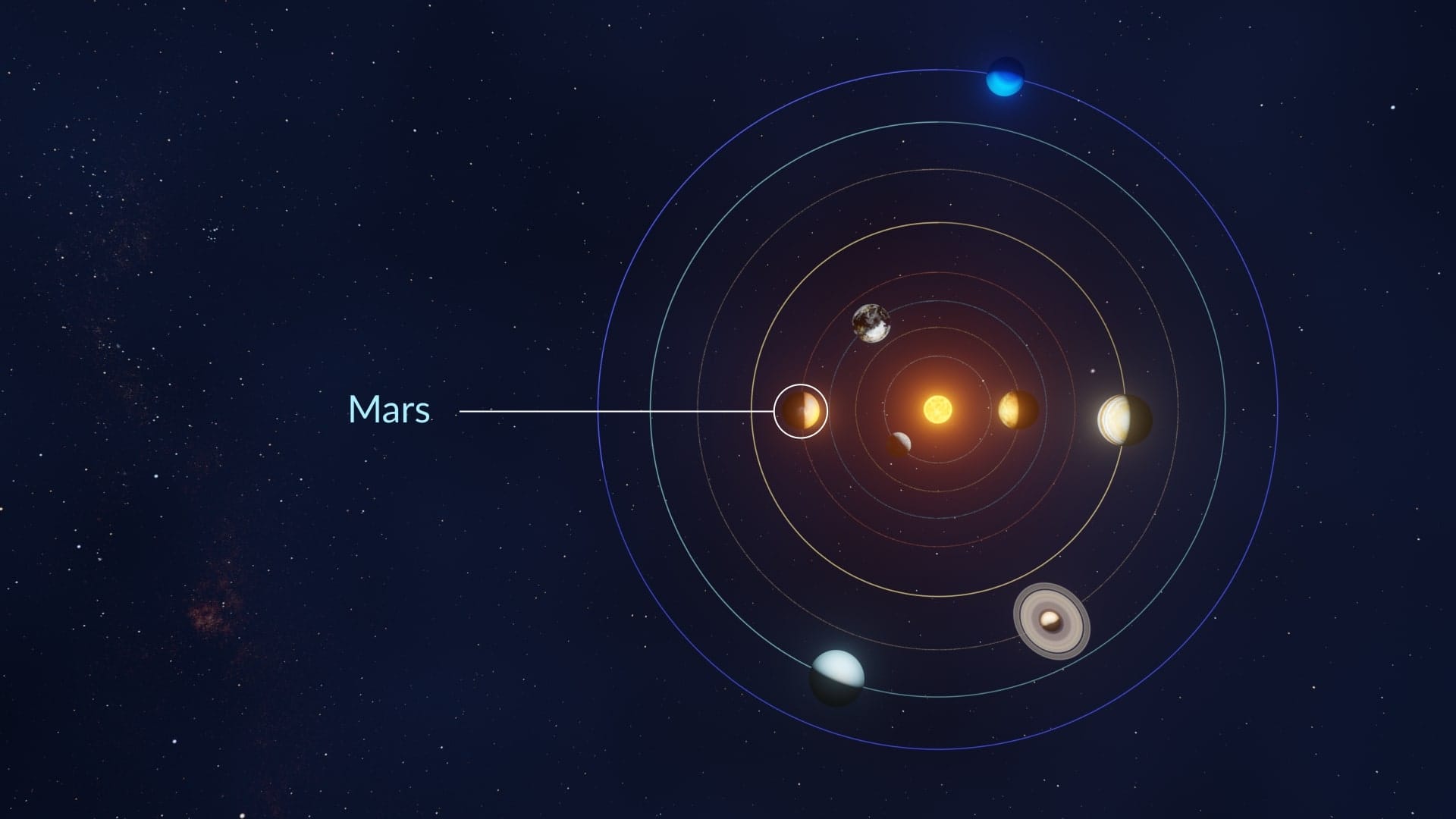
Mars is the fourth planet from the Sun and one of the Earth’s two closest neighbors (the other one being Venus).
How far is Mars from the Sun?
Due to the high eccentricity of the Red Planet’s orbit, there’s a significant difference between Mars’ closest and farthest points from the Sun, which equal 206.6 million km (128.4 million miles) and 249.2 million km (154.9 million miles), respectively. On average, Mars is positioned 228 million km (142 million miles) away from our star, which equals 1.5 astronomical units.
How far is Mars from the Earth?
The distance between Mars and our planet is constantly changing. The farthest distance between Mars and the Earth equals 401 million km (249 million miles). The closest distance the two planets can get to each other is 54.6 million km (33.9 million miles). However, such a close approach never happened in recorded history. The closest approach between Mars and the Earth in almost 60,000 years occurred in 2003 when the two celestial bodies were 55.7 million km (34.6 million miles) away from each other.
How long does it take to get to Mars?
The duration of a trip to Mars depends on when it is taken. The best time to launch a spaceship to Mars is about three months before the Red Planet gets closest to the Earth. Such a moment happens about every two years, around Mars’ opposition. According to NASA, an average trip to Mars takes about nine months.
The two fastest trips to Mars were taken by Mariner 6 (five months) and Mariner 7 (four months). However, these two spacecraft performed flybys of Mars and so didn’t need to slow down as orbiters, landers, and rovers do. The latest rover to land on Mars – Perseverance – reached the planet in about seven months.
Missions to Mars
As the Earth’s close neighbor, Mars has been the destination of numerous space missions. Since 1960, about 50 missions have been sent to the Red Planet, though only about half of them have been successful. Let’s take a look at the most significant ones.
NASA’s Mariner 9 entered Mars’ orbit in 1971, becoming the first spacecraft to orbit another planet. Mariner 9 mapped 85% of the Martian surface and sent more than 7,000 images back to the Earth.
The first human-made object to reach the Martian surface was the Soviet Union’s Mars 2, launched the same year as Mariner 9. Unfortunately, the speed at which Mars 2 approached the planet was too high; as a result, the descent system malfunctioned, and the spacecraft crashed into the Red Planet’s surface.
The first spacecraft to successfully land on Mars was NASA’s Viking 1. This spacecraft operated on the planet from 1976 to 1982 and sent back more than 57,000 images.
NASA’s Sojourner, which arrived on Mars in 1997 as part of the Pathfinder mission, became the first rover to operate on another planet. The Sojourner rover operated for 83 sols, making scientific measurements and taking pictures.
NASA’s twin rovers Spirit and Opportunity reached the Red Planet in 2004. The rovers were tasked with studying the planet’s climatic history and looking for evidence of past water activity. Originally, the mission was planned to last 90 days. However, both rovers exceeded their planned mission lifetimes by many years: Spirit operated until 2010, and Opportunity stopped working only in 2018.
In 2012, NASA’s rover Curiosity arrived at Gale Crater on Mars. The rover has studied the Martian climate and geology and found evidence that Mars once had conditions favorable for microbial life. Curiosity is still active on Mars, more than a decade after landing.
In 2021, China successfully landed its first spacecraft on Mars as part of the Tianwen-1 mission. Its rover, Zhurong, became the first non-NASA rover to operate on Mars. Zhurong worked on the Martian surface for about a year before entering hibernation in 2022; it has not resumed operations since then.
Also in 2021, NASA’s Perseverance rover landed on the Red Planet. The rover is exploring Jezero Crater, searching for signs of ancient microbial life, and collecting rock and soil samples for possible return to Earth. The mission also carried the Ingenuity helicopter, which made the first powered, controlled flight on another planet on April 19, 2021. Ingenuity completed 72 flights before its mission ended in January 2024.
What is Mars made of?
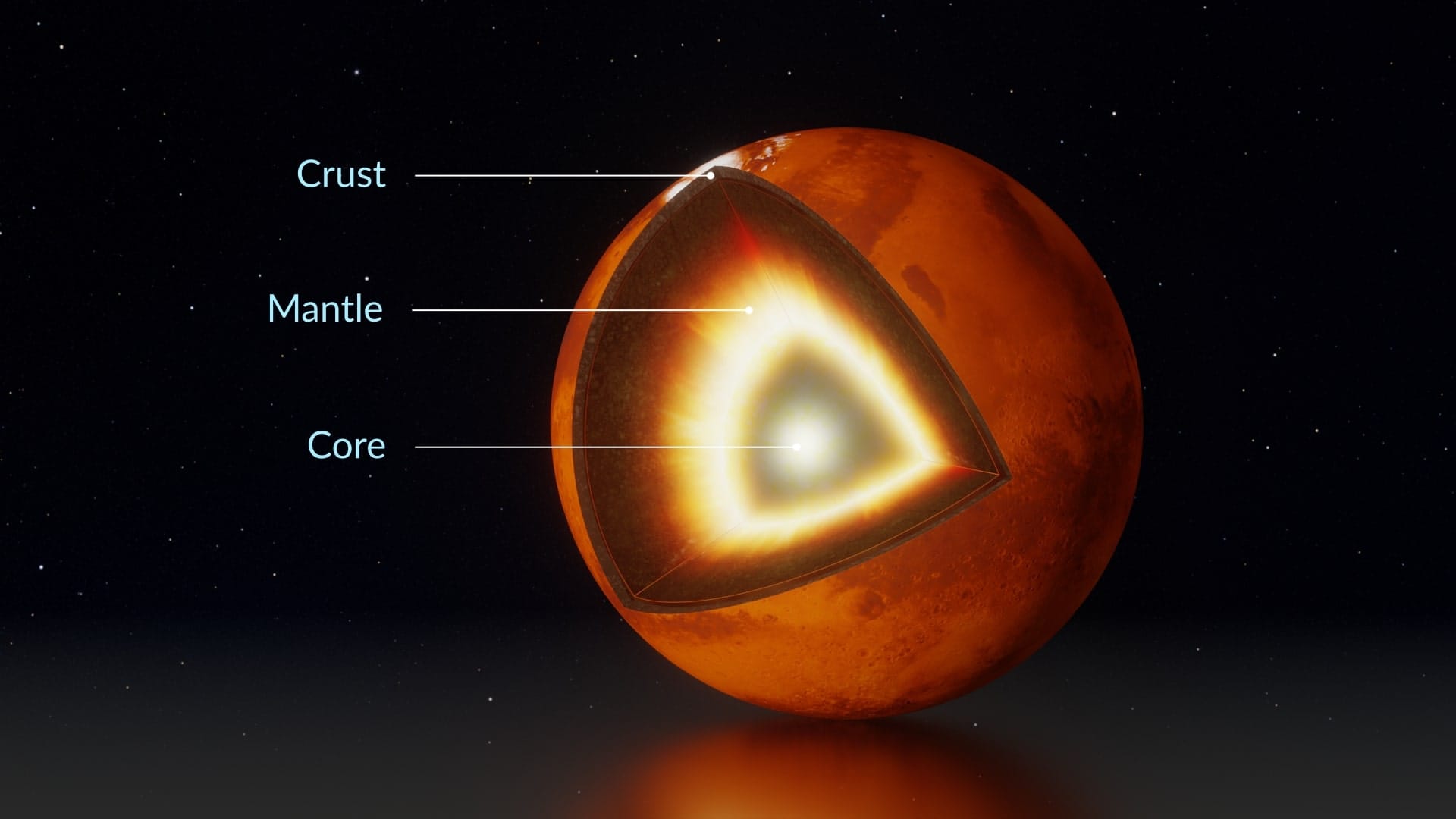
Like the other three terrestrial planets (Mercury, Venus, and the Earth), Mars is a rocky celestial body. Let’s take a closer look at the planet’s physical peculiarities.
How was Mars formed?
Mars formed together with the other Solar System planets. About 4.5 billion years ago, a giant cloud of interstellar gas and dust collapsed under its own gravity and flattened into a protoplanetary disk. Mars and the other rocky planets formed in the inner part of this disk, while the gas giants settled in the outer regions of the young Solar System.
Mars structure
Mars has a central core, a mantle, and a crust. The Red Planet’s core is made of iron, nickel, and sulfur. It is surrounded by a rocky mantle and a crust made of iron, magnesium, aluminum, calcium, and potassium.
Mars atmosphere
The atmosphere of Mars is much thinner than the Earth’s. It is composed primarily of carbon dioxide (95%), while our planet’s atmosphere is rich in nitrogen and oxygen. Thus, humans would not be able to breathe on Mars.
However, in April 2021, NASA’s rover Perseverance successfully converted a small portion of the Martian atmosphere into oxygen. In the future, this technology might be able to provide astronauts with breathable air.
How many moons does Mars have?
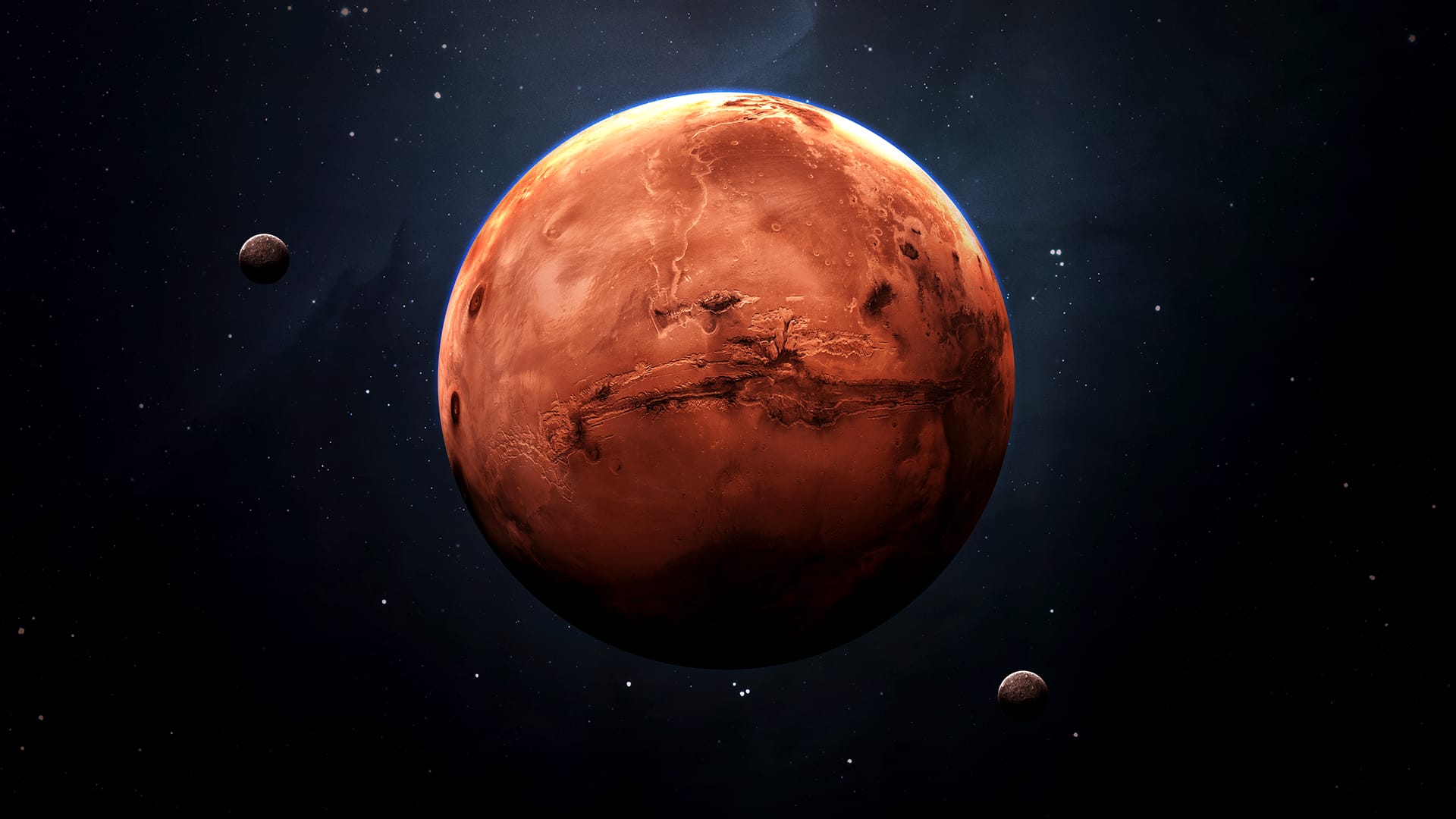
Mars has two moons: Phobos and Deimos. Both of them were discovered by American astronomer Asaph Hall in 1877. The moons of Mars are among the smallest moons in the Solar System: for reference, the Earth's Moon has a diameter more than 100 times greater than that of Phobos, the larger Martian moon. Like our Moon, Phobos and Deimos are tidally locked to their planet and always show only one side to it.
What does Mars look like?
Mars surface
Mars' surface is primarily composed of basalt. The prevalence of iron oxide in the Martian soil gives the planet its distinct red color.
The Red Planet has many surface features similar to our planet: valleys, deserts, mountains, and polar ice caps. There are even former river deltas that suggest that Mars was a watery planet in the past.
When and where is Mars visible in 2026?
Throughout the year, Mars will move across the background constellations from Sagittarius toward Leo. The planet will start to look better in a telescope in September 2026, as its apparent size increases. The best viewing will be in December 2026, when it becomes brighter and easier to see. The real prime time will come in February 2027, when Mars reaches opposition and appears even bigger and brighter.
Upcoming Events
October 26–27: Mars, Jupiter, Regulus, and the Beehive Cluster form a line
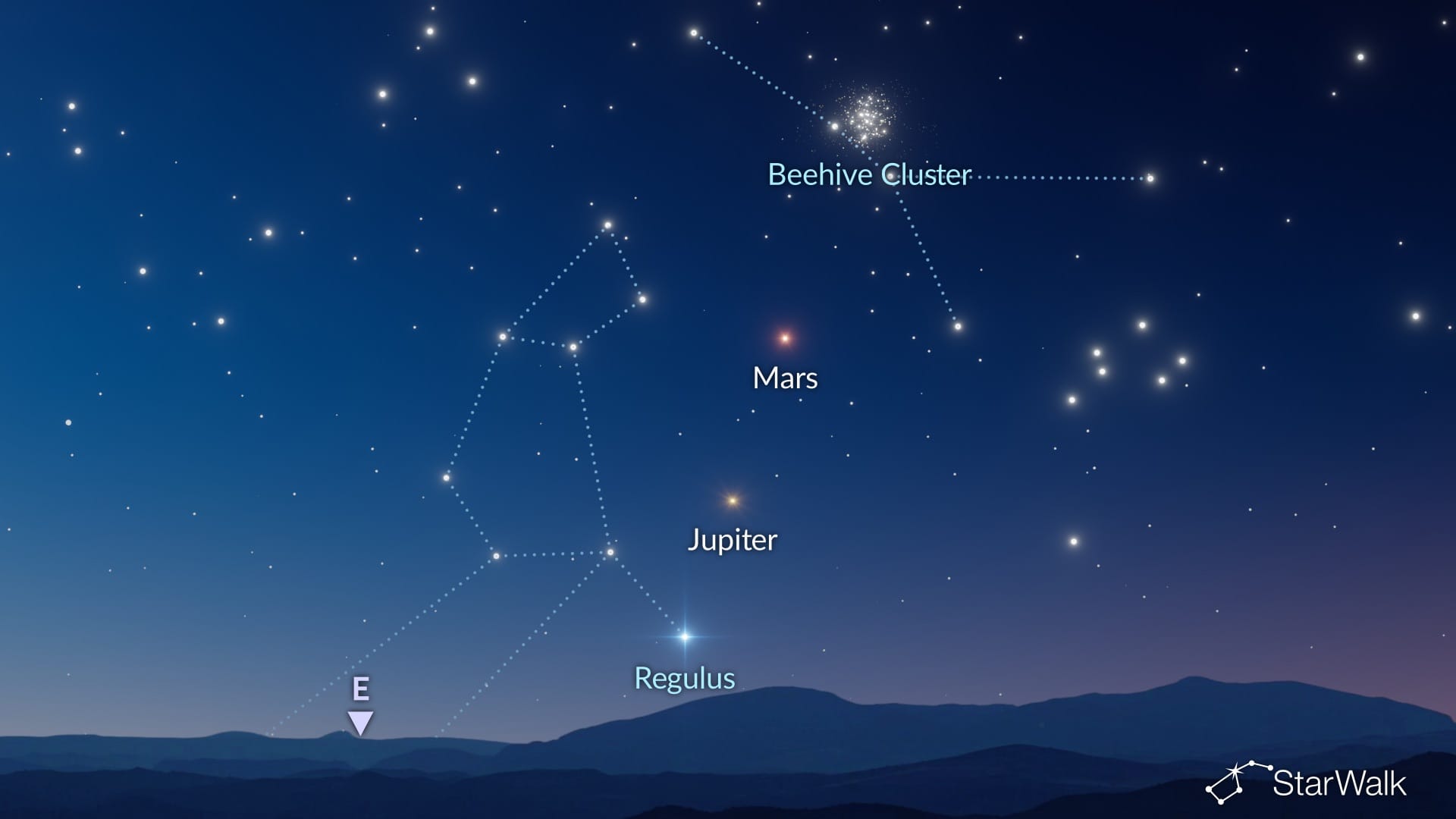
Before sunrise on October 26–27, the Beehive Cluster (M44, mag 3.1), Mars (mag 0.9), Jupiter (mag −2.0), and Regulus (mag 1.4) will form an almost straight, nearly evenly spaced line. Mars, Jupiter, and Regulus will be visible to the naked eye, while the Beehive Cluster is best viewed through binoculars. Look for this celestial chain above the eastern horizon before dawn.
The formation will appear higher in the sky from the Northern Hemisphere. Observers in the Southern Hemisphere can also see all four objects, but the line will remain lower above the eastern horizon.
| City | Time zone | Viewing begins | Best time | Viewing ends | Sun altitude | M44 altitude | Mars altitude | Jupiter altitude | Regulus altitude |
|---|---|---|---|---|---|---|---|---|---|
| London, UK | GMT (UTC+0) | Oct 26, 02:00 | Oct 26, 05:29 | Oct 26, 06:10 | −12° | 57° | 52° | 46° | 41° |
| New York, USA | EDT (UTC−4) | Oct 26, 03:00 | Oct 26, 06:19 | Oct 26, 06:50 | −12° | 66° | 60° | 53° | 47° |
| Los Angeles, USA | PDT (UTC−7) | Oct 26, 03:00 | Oct 26, 06:12 | Oct 26, 06:40 | −12° | 70° | 63° | 55° | 49° |
| Beijing, China | CST (UTC+8) | Oct 27, 02:15 | Oct 27, 05:37 | Oct 27, 06:10 | −12° | 67° | 60° | 53° | 47° |
| Shanghai, China | CST (UTC+8) | Oct 27, 02:00 | Oct 27, 05:12 | Oct 27, 05:40 | −12° | 72° | 64° | 57° | 50° |
| Tokyo, Japan | JST (UTC+9) | Oct 27, 01:45 | Oct 27, 05:02 | Oct 27, 05:30 | −12° | 69° | 62° | 55° | 49° |
| Sydney, Australia | AEDT (UTC+11) | Oct 27, 04:05 | Oct 27, 05:03 | Oct 27, 05:35 | −12° | 28° | 25° | 23° | 20° |
| Auckland, New Zealand | NZDT (UTC+13) | Oct 27, 04:40 | Oct 27, 05:22 | Oct 27, 05:55 | −12° | 24° | 22° | 20° | 18° |
- Viewing begins: All four objects are at least 10° above the horizon, and the Sun is at least 6° below it.
- Best time: The table gives the best balance between the formation’s altitude and sky darkness. The Sun is about 12° below the horizon, so the faint Beehive Cluster remains observable while the celestial line is already high in the sky.
- Viewing ends: The Sun reaches about 6° below the horizon, after which the brightening sky makes the Beehive Cluster and Regulus increasingly difficult to see.
- Sun and object altitudes are provided for the “best time”.
November 2: Moon near Mars; lunar occultation of Mars
- Occultation start: 12:15 GMT (07:15 AM EST)
- Occultation end: 15:02 GMT (10:02 AM EST)
- Close approach time: 13:39 GMT (08:39 AM EST)
- Close approach distance: 0°58′
- Conjunction time: 14:24 GMT (09:24 AM EST)
- Conjunction distance: 1°03′
On November 2, the waning crescent Moon will pass near Mars (mag 0.8) in the constellation Leo. The pair will be visible in the morning sky before sunrise. A lunar occultation of Mars will be visible from French Polynesia, the Cook Islands, and Pitcairn; observers elsewhere will see a close Moon–Mars pairing.
| City | Time zone | Viewing begins | Best time | Viewing ends | Separation | Moon altitude | Mars altitude |
|---|---|---|---|---|---|---|---|
| London, UK | GMT (UTC+0) | Nov 2, 00:25 | Nov 2, 05:40 | Nov 2, 06:20 | 4.4° | 54° | 53° |
| New York, USA | EST (UTC−5) | Nov 2, 12:35 AM | Nov 2, 5:26 AM | Nov 2, 5:55 AM | 1.9° | 62° | 61° |
| Los Angeles, USA | PST (UTC−8) | Nov 2, 12:40 AM | Nov 2, 4:59 AM | Nov 2, 5:45 AM | 1.1° | 62° | 62° |
| Singapore, Singapore | SGT (UTC+8) | Nov 3, 02:40 | Nov 3, 03:03 | Nov 3, 06:20 | 3.9° | 16° | 19° |
| New Delhi, India | IST (UTC+5:30) | Nov 3, 01:35 | Nov 3, 02:01 | Nov 3, 06:05 | 4.8° | 16° | 20° |
| Sydney, Australia | AEDT (UTC+11) | Nov 3, 03:20 | Nov 3, 03:50 | Nov 3, 05:25 | 2.1° | 15° | 16° |
| Auckland, New Zealand | NZDT (UTC+13) | Nov 3, 03:55 | Nov 3, 04:24 | Nov 3, 05:45 | 1.3° | 16° | 16° |
- Viewing begins: Both objects are at least 10° above the horizon.
- Best time: The Moon and Mars are closest within the local viewing window while both are sufficiently high and the sky is still dark enough.
- Viewing ends: The Sun reaches about 6° below the horizon, and the brightening sky makes the pair harder to see.
- Separation and altitudes are provided for the “best time”.
November 14: Mars in a small planetary alignment
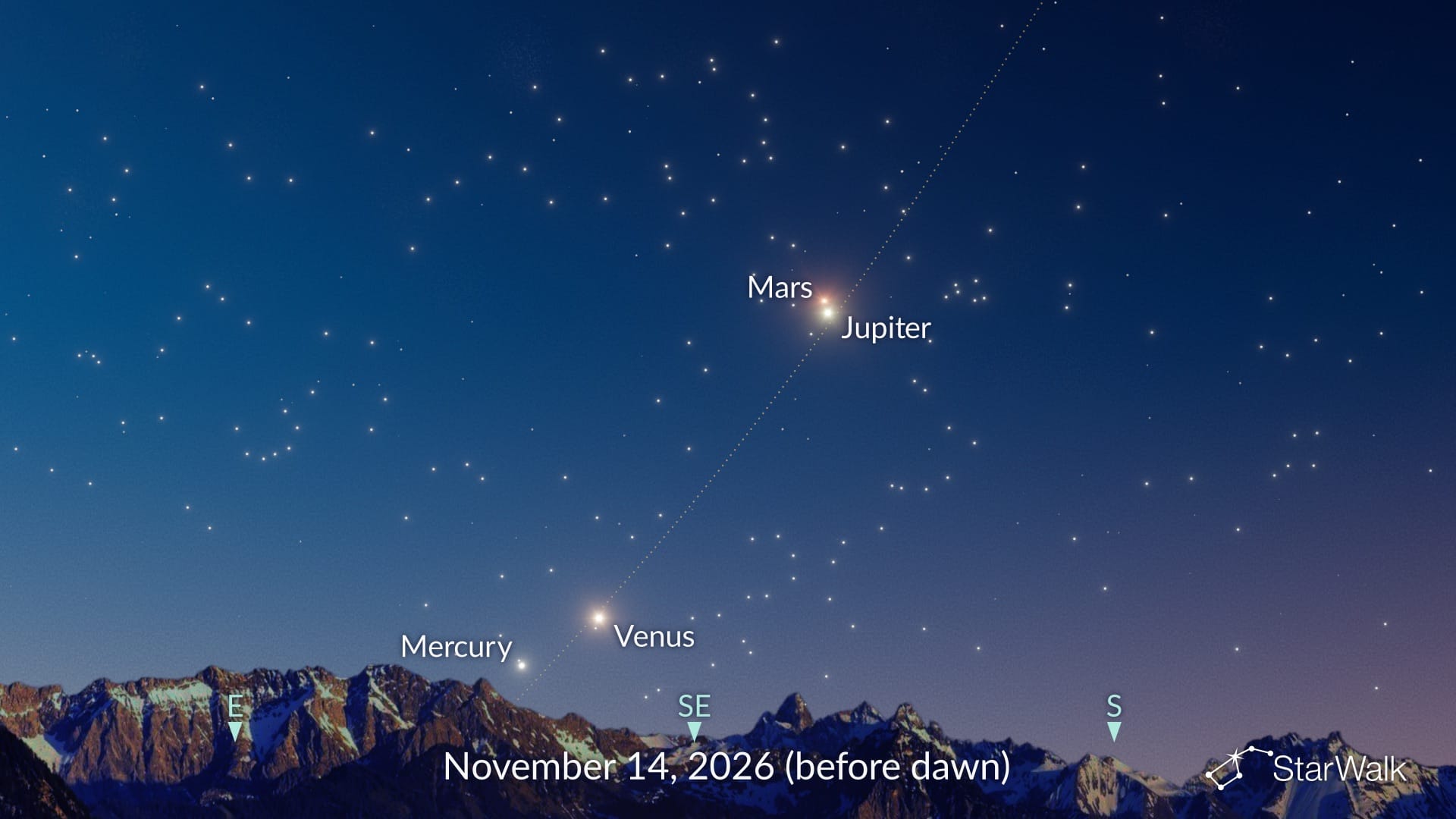
Before dawn around November 14, four naked-eye planets will gather in the eastern sky. Mars (mag 0.7) and Jupiter (mag -2.1) will rise first, appearing close together ahead of their conjunction on November 15. Brilliant Venus (mag -4.8) and Mercury (mag 0.2) will emerge closer to sunrise and remain lower above the horizon.
Exact rise times and visibility will vary considerably by location. Use the Planet Walk mode in the Star Walk 2 app to find the best viewing time and see how the planets will appear from your exact location. Learn more about the upcoming planetary alignments in our dedicated article.
November 15–16: Mars near Jupiter
- Conjunction time: November 15, 02:42 GMT (November 14, 09:42 PM EST)
- Conjunction distance: 1°14′
- Close approach time: November 16, 02:04 GMT (November 15, 09:04 PM EST)
- Close approach distance: 1°11′
On November 15–16, Mars (mag 0.7) and Jupiter (mag -2.1) will shine close together in the constellation Leo. The planets will rise around midnight and climb higher until dawn. Both will be easy to spot with the naked eye near the Sickle asterism.
| City | Time zone | Viewing begins | Best time | Viewing ends | Separation | Mars altitude | Jupiter altitude |
|---|---|---|---|---|---|---|---|
| London, UK | GMT (UTC+0) | Nov 16, 00:10 | Nov 16, 06:02 | Nov 16, 06:40 | 1.2° | 53° | 52° |
| New York, USA | EST (UTC−5) | Nov 16, 12:15 AM | Nov 16, 5:41 AM | Nov 16, 6:10 AM | 1.2° | 63° | 62° |
| Los Angeles, USA | PST (UTC−8) | Nov 16, 12:20 AM | Nov 16, 5:29 AM | Nov 16, 6:00 AM | 1.2° | 69° | 68° |
| Singapore, Singapore | SGT (UTC+8) | Nov 16, 02:00 | Nov 16, 06:00 | Nov 16, 06:25 | 1.2° | 66° | 67° |
| New Delhi, India | IST (UTC+5:30) | Nov 16, 00:55 | Nov 16, 05:50 | Nov 16, 06:15 | 1.2° | 73° | 72° |
| Sydney, Australia | AEDT (UTC+11) | Nov 16, 02:45 | Nov 16, 04:42 | Nov 16, 05:15 | 1.2° | 30° | 31° |
| Auckland, New Zealand | NZDT (UTC+13) | Nov 16, 03:20 | Nov 16, 04:58 | Nov 16, 05:30 | 1.2° | 26° | 27° |
- Viewing begins: Both planets are at least 10° above the horizon.
- Best time: Mars and Jupiter are closest within the local viewing window while both are sufficiently high and the sky is still dark enough.
- Viewing ends: The Sun reaches about 6° below the horizon, and the brightening sky makes the planets harder to see.
- Separation and altitudes are provided for the “best time”.
February 19, 2027: Mars at opposition
On February 19, 2027, Mars will reach opposition. Opposition is the moment when a planet lies opposite the Sun in the sky as seen from Earth — meaning it rises at sunset, stays up all night, and sets at sunrise. This is usually the best time to observe outer planets, since they appear brighter and larger than at any other point in their cycle.
During this opposition, Mars will shine at about -1.3 magnitude and reach an apparent diameter of 13.8 arcseconds. It will be visible all night in the constellation Leo, offering excellent conditions for naked-eye, binocular, and telescopic viewing.
Oppositions of Mars don’t happen every year — the next one after February 2027 will occur only on March 25, 2029, so don’t miss your chance to see the Red Planet at its best! We also have an article about oppositions of other planets and Solar System bodies, so feel free to explore more.
F.A.Q.
Is there water on Mars?
Yes, there is water on Mars. Various missions and studies have confirmed the presence of water ice at the polar ice caps. Recent discoveries have also suggested that a large liquid water reservoir might exist below the planet’s surface. Additionally, there is evidence of liquid water in the past, with signs of ancient riverbeds, lake beds, and minerals that only form in the presence of water.
In the search for extraterrestrial life, scientists pay special attention to worlds where water is present in one form or another, including Mars. Why is this the case, are other conditions for the origin of life possible, and where is humanity on its journey to find extraterrestrial life? Find out in our comprehensive infographic on life in the Universe.
What is the gravity on Mars?
The gravity on Mars is 62% lower than on the Earth. This means that a person who weighs 80 kg (176 lbs) on our planet would weigh only 30 kg (66 lbs) on Mars. Although it would be much easier for humans to walk on Mars, such low gravity can have other not-so-pleasant effects on hypothetical Mars colonists – like causing muscle deterioration and osteoporosis.
What color is Mars?
The predominant color of the Martian surface is red. It is explained by the prevalence of iron oxide – more commonly known as rust – in the planet’s soil. Other colors on Mars include golden, brown, and tan.
What is the temperature on Mars?
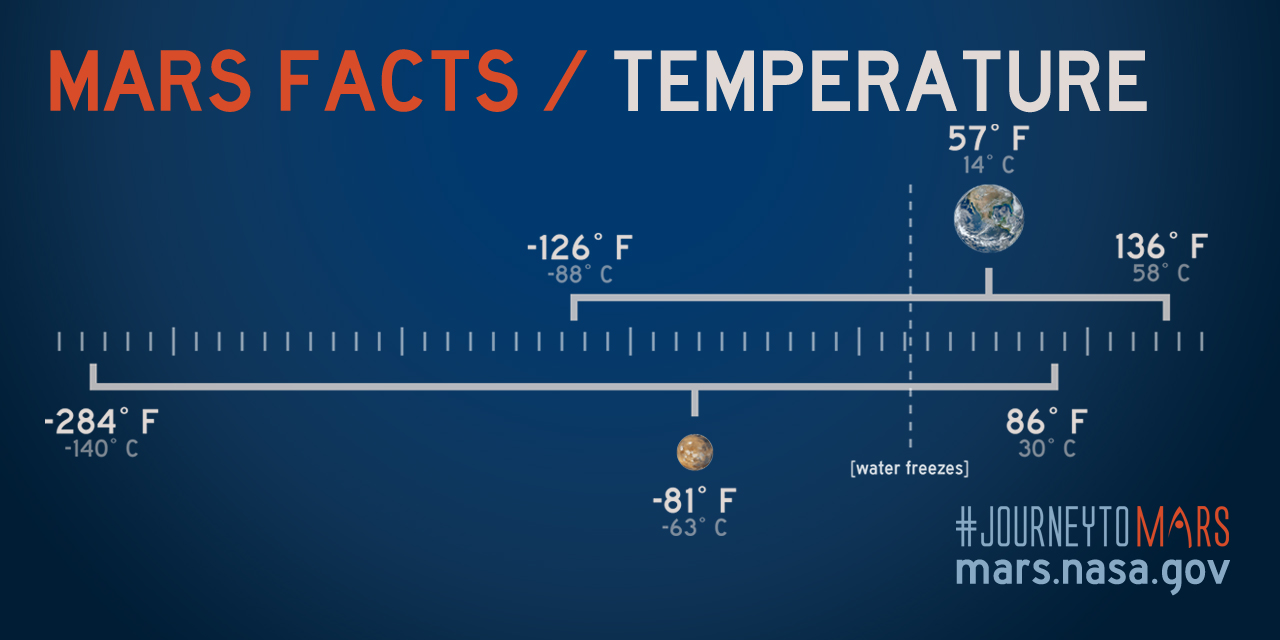
Overall, Mars is a very cold place. The average temperature on the Red Planet equals -62 °C (-81°F). However, according to Michael Mischna, a research scientist at NASA’s Jet Propulsion Laboratory, the air temperature on Mars wouldn’t feel the same as on the Earth. There’s little water vapor and few air molecules on Mars, so -70 °C (-100 °F) would feel like -34 °C (-30 °F). To better understand temperature conditions on Mars, check this infographic made by NASA.
How many rovers are on Mars?
As of 2026, there are two currently operating rovers on the Red Planet: Curiosity and Perseverance, both owned by NASA.
Planet Mars: to sum up
Mars is the fourth planet from the Sun and the seventh largest planet in the Solar System. With evidence suggesting that it once had flowing water, Mars holds many secrets waiting to be uncovered. As you gaze up at the night sky, don’t forget that this planet is not just a distant dot; it’s a world rich with history and potential. Download Sky Tonight to track Mars' position in the sky and be updated on all the astronomical events involving the Red Planet. Also, you’re welcome to watch our educational cartoon with fun facts about Mars. We wish you clear skies and happy observations!
Explore the other Solar System planets
We hope you enjoyed the article about Mars! You can also check out our articles about the other planets in the Solar System:
- Mercury – the smallest and fastest planet;
- Venus – the Earth’s evil twin;
- Jupiter – the biggest planet;
- Saturn – the “Lord of the Rings” (and moons!);
- Uranus – the coldest planet;
- Neptune – the farthest planet;
- and Pluto, which was famously demoted from planet status (and the decision remains a hot topic in the astronomical community for almost 20 years).
Learn more space facts
Want to learn more facts about space? Then you'll love our quiz about the “most-est” objects in the Solar System! Find out which of them is the hottest or fastest, and where the tallest mountain and deepest canyon are located.