Betelgeuse News 2026: Will Betelgeuse Go Supernova?
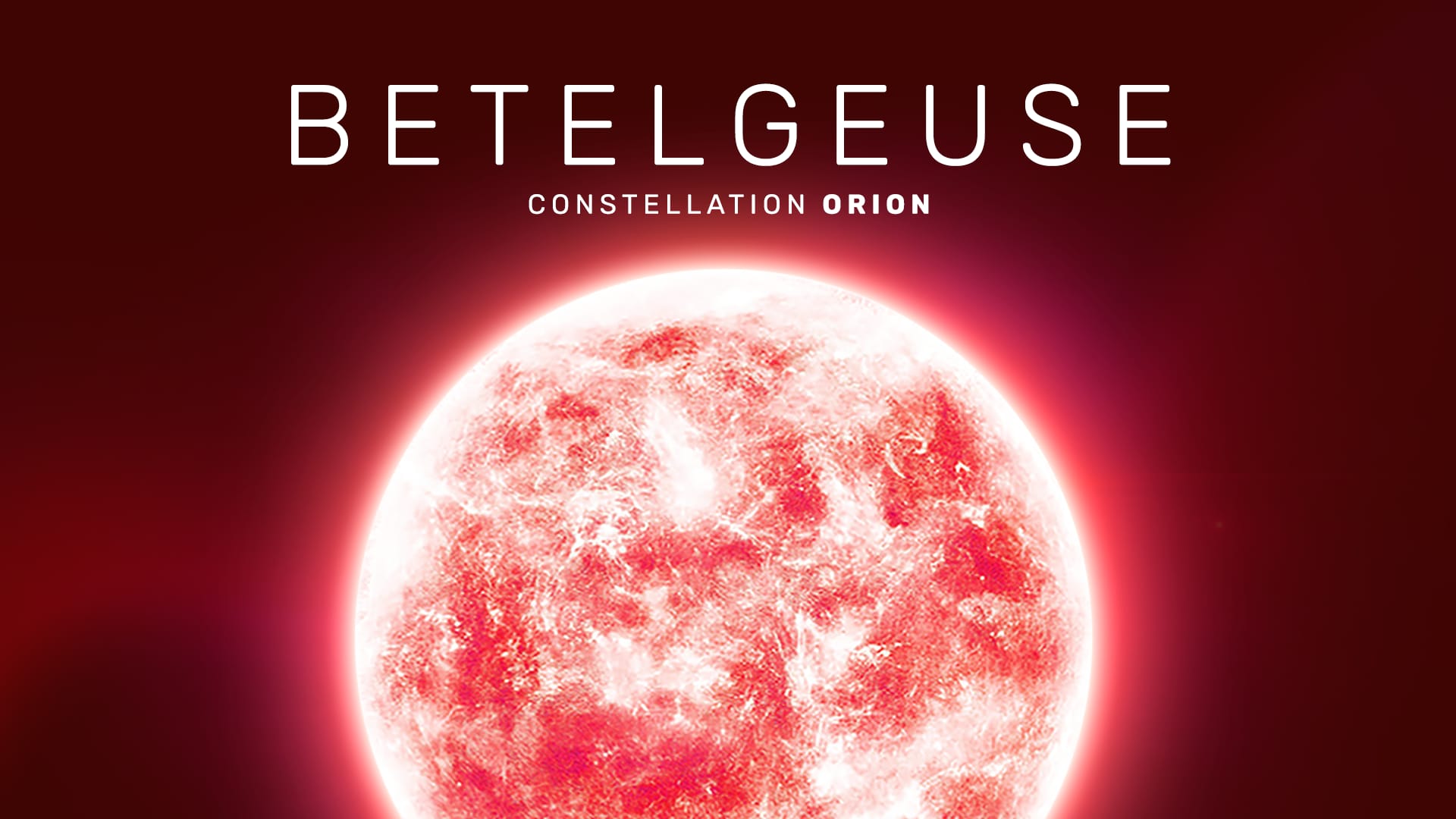
Betelgeuse probably won’t go supernova anytime soon — but that’s no reason to overlook it. This bright orange star, marking the shoulder of the famous constellation Orion, is an excellent target from September through March. Want to spot Betelgeuse in your sky right now? Open the Star Walk 2 app, and it will guide you straight to it. Read on to learn more about Betelgeuse, its mysterious dimming, and the faint companion hiding in its glow.
Contents
- What Is Betelgeuse?
- Where Is Betelgeuse Located?
- When Is Betelgeuse Visible?
- Why Does Betelgeuse Change in Brightness?
- Betelgeuse Star: Key Takeaways
What Is Betelgeuse?
Betelgeuse is the bright orange-red star marking Orion’s shoulder. It’s easy to see without a telescope, and its color stands out among the constellation’s blue-white stars. Behind that point of light is an enormous, changing star: its outer layers swell, release material into space, and interact with a faint stellar companion.
- Other names: Betelgeuse, α Orionis, Alpha Orionis, Alpha Ori, α Ori
- Catalog designations: 58 Ori, HR 2061, HD 39801, HIP 27989
- Constellation: Orion
- Star type: Red supergiant
- Right ascension: 05h 55m 10.305s
- Declination: +07° 24′ 25.4304″
- Apparent brightness: Variable; usually around magnitude 0–1, with occasional deeper fades¹
- Mass: 16.5 to 19 solar masses
- Luminosity: 79,000 to 100,000 L☉
- Radius: Hundreds of times the Sun’s; one widely cited estimate is about 750 solar radii
- Surface temperature: 3,500 K
- Distance from the Earth: Roughly 650 light-years
¹ During the Great Dimming in 2020, Betelgeuse faded to about magnitude 1.6. On the magnitude scale, larger numbers mean fainter objects. Read about the Great Dimming further in the article.
What type of star is Betelgeuse?
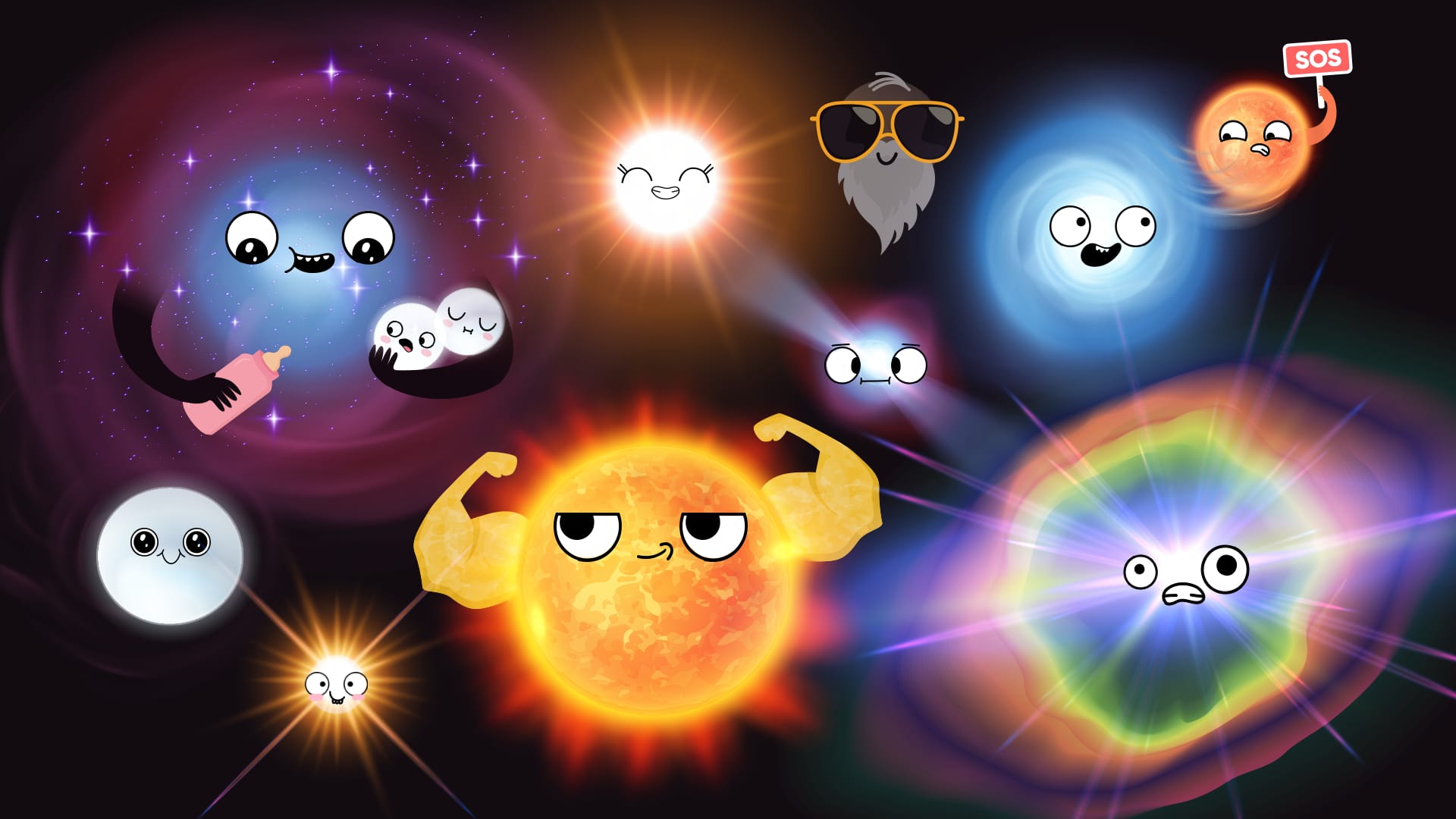
Betelgeuse is a red supergiant. These stars are nearing the end of their lives. They are among the largest stars in the Universe, having expanded outward into space as they evolved. You can learn more about the life cycles of stars in our colorful infographic.
How big is Betelgeuse?
Betelgeuse’s radius is hundreds of times larger than the Sun’s. A 2020 study estimated about 750 solar radii. At that size, placing Betelgeuse at the center of our Solar System would put Mercury, Venus, Earth, and Mars inside it.
Unfortunately, there is no single, precisely measured radius to quote. Betelgeuse has an extended, changing atmosphere, and its apparent size depends partly on the wavelength used to observe it. Uncertainty in its distance also affects estimates of its physical size.
How far is Betelgeuse from Earth?
Betelgeuse is about 650 light-years away, which means the light we see from Betelgeuse today began its journey in the Middle Ages. Still, it’s one of the closest red supergiants to our Solar System, making it an important object for scientists to study.
The exact distance is still debated — different models provide different estimates. For example, the 2020 modeling study estimated about 550 light-years, while a 2021 study of the Great Dimming adopted about 720 light-years.
What does the name Betelgeuse mean?
The name Betelgeuse is generally traced to an Arabic phrase meaning “the hand of al-Jawza’,” referring to a figure in traditional Arabian astronomy later associated with Orion. The companion’s name, Siwarha, means “her bracelet” — a reference to its close orbit around the larger star, as explained in NASA’s report on the discovery.
Where Is Betelgeuse Located?
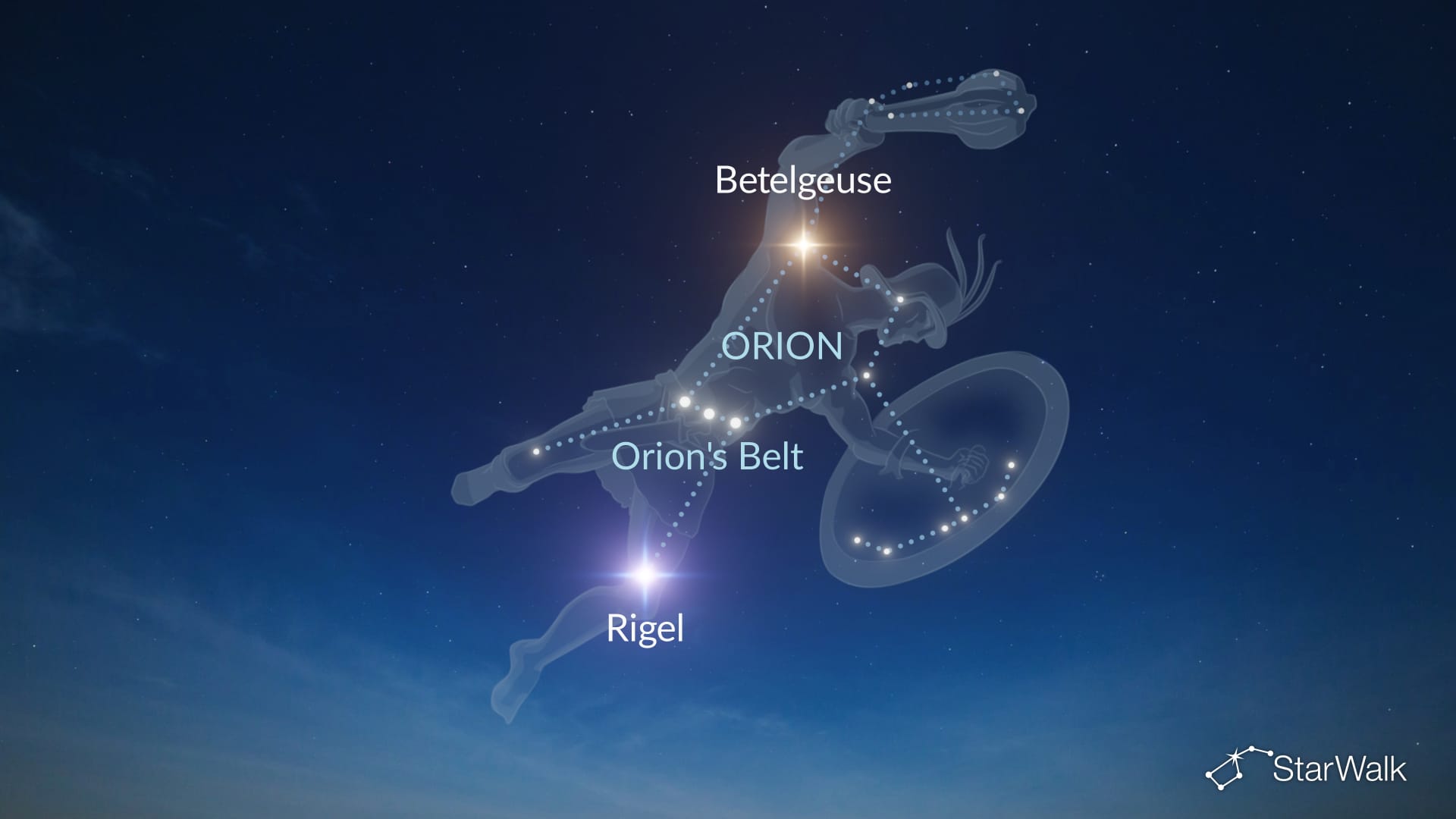
Betelgeuse marks one shoulder of Orion the Hunter. It lies close enough to the celestial equator to be visible from most inhabited parts of both hemispheres.
It’s usually the constellation’s second-brightest star, after the bluish Rigel, which shines at the hunter’s foot, but Betelgeuse can occasionally outshine it. You will find Betelgeuse north of Alnitak — the easternmost of the three stars that form the famous asterism Orion’s Belt. Rigel sits on the other side of the Belt, south of Mintaka. Need help remembering this? Check out our captivating celestial poem on Instagram, which will guide you to Orion's prominent stars!
Betelgeuse is part of the asterism Winter Triangle, also known as the Great Southern Triangle. This asterism resides within the Winter Hexagon and also contains the bright stars Sirius and Procyon.
How to find Betelgeuse in the sky
To find Betelgeuse in the night sky, use an astronomy app such as Star Walk 2 or Sky Tonight. Just enter “Betelgeuse” in the search bar, select the star from the search results, and point your device at the sky. Follow the on-screen arrow until you see the bright reddish Betelgeuse on the app’s sky map and in the real sky above you.

When Is Betelgeuse Visible?
November through March is a convenient season for evening observations, with January and February especially good for seeing Betelgeuse well above the horizon without staying up late. These months fall in winter in the Northern Hemisphere and summer in the Southern Hemisphere.
In September and October, Betelgeuse is easier to catch late at night or before dawn. Through November and December, it becomes visible earlier in the evening. By March and April, the evening viewing window is shortening as Orion moves toward the setting Sun. Around June, Betelgeuse is lost in the Sun’s glare; it returns to the morning sky in the following weeks, depending on latitude and local conditions.
Choose a clear evening and wait until Orion has risen above the horizon. No binoculars or telescope are needed: Betelgeuse is bright enough to see from a city, provided haze, clouds, or nearby lights don’t obscure it.
Ready to go stargazing? Test your skills with our stargazing quiz!
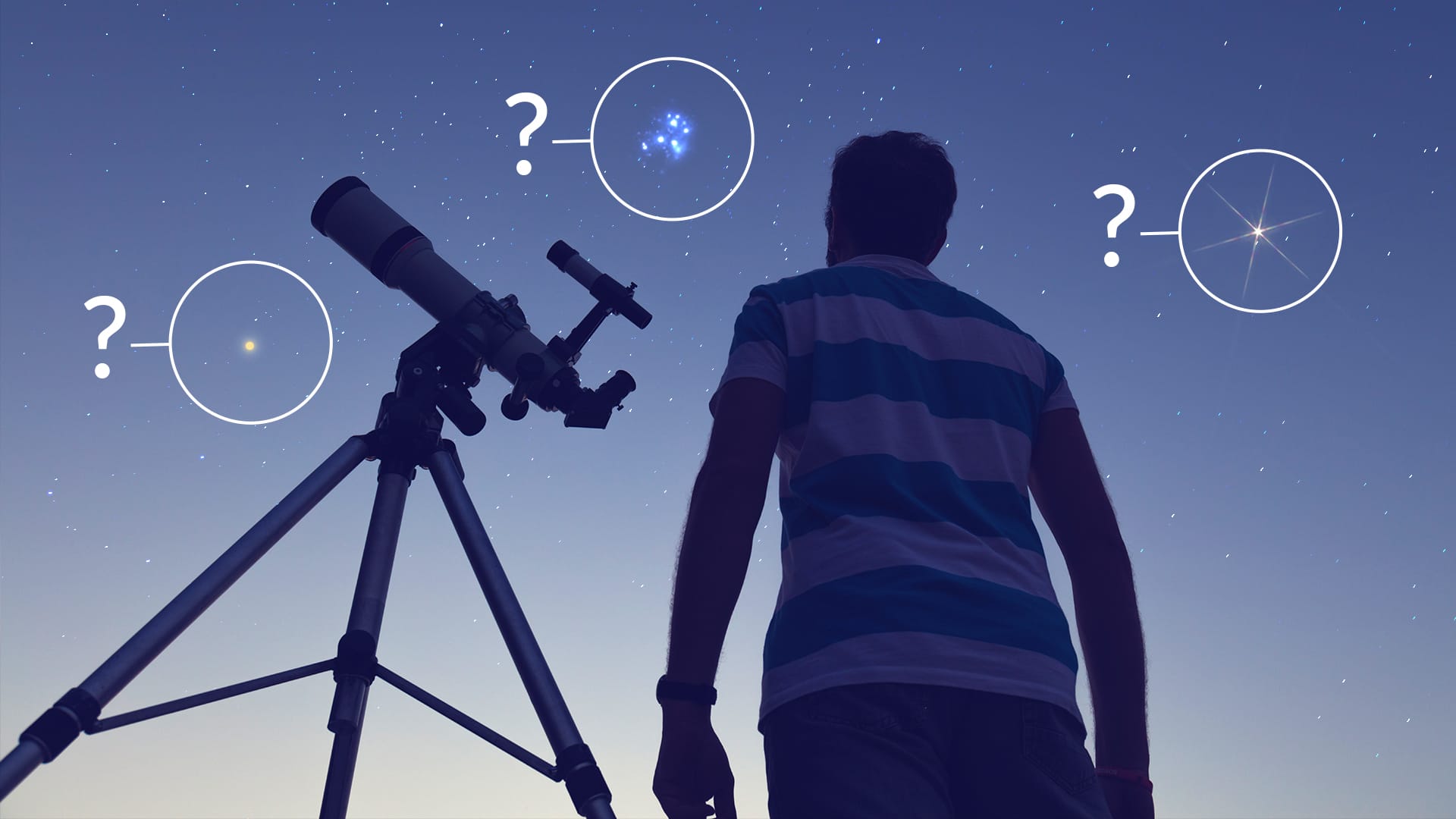
Once you’ve found Betelgeuse, try returning to it throughout the observing season. Its brightness changes over time, sometimes noticeably even to the naked eye.
November 26, 2026: Moon forms an equilateral triangle with Aldebaran and Betelgeuse
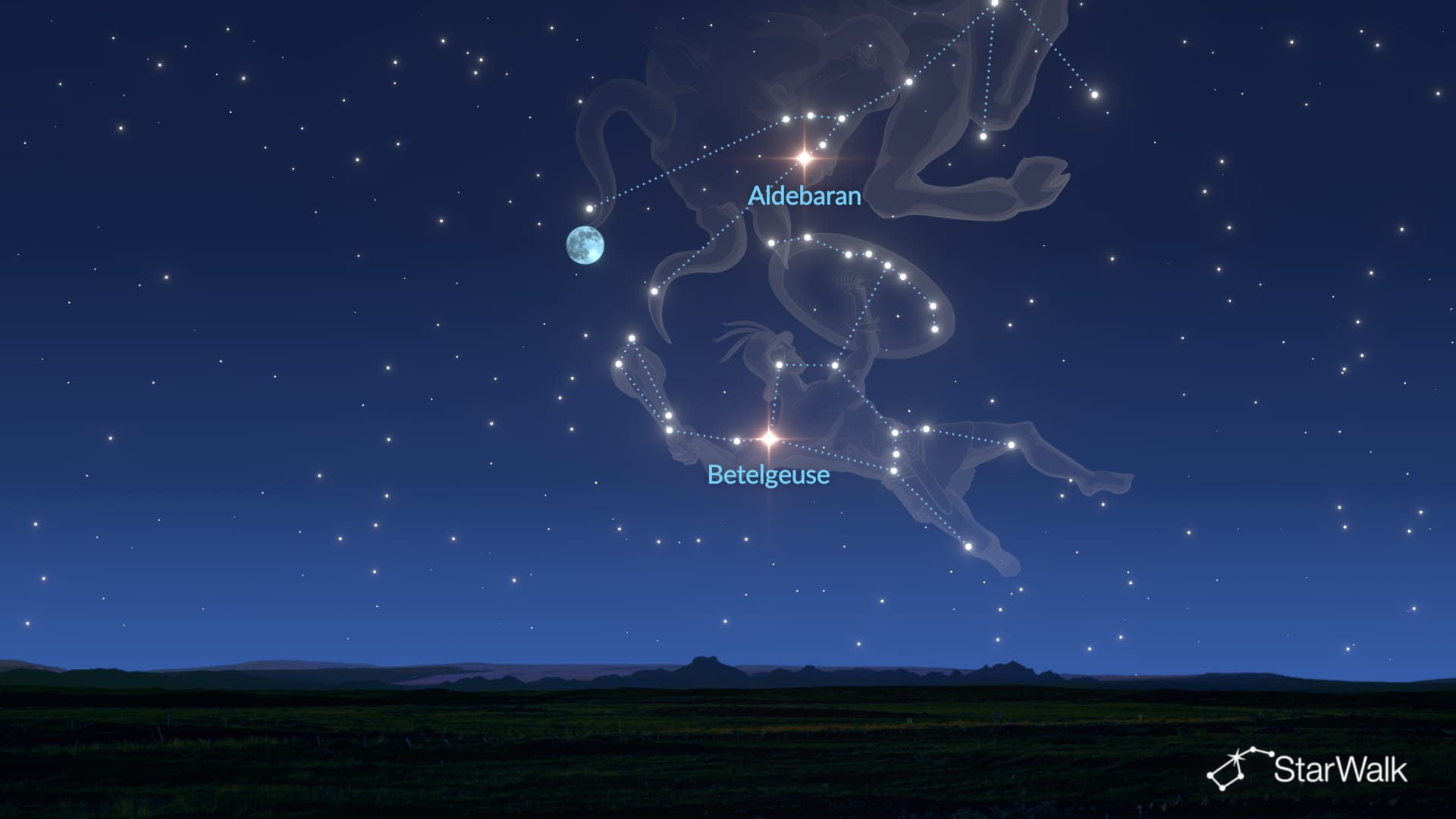
Around November 26, the waning gibbous Moon will join Aldebaran and Betelgeuse to form a large, nearly equilateral triangle. From certain locations, its three sides will measure roughly 20–21° — about two clenched fists held at arm’s length. This is a figure that needs a generous patch of sky!
Timing makes a difference. Among the cities below, St. John’s and Natal get the most balanced views before dawn on November 26. In St. John’s, the two sides meeting at the Moon will each span about 19.8°, while the distance between the stars will be 21.4°. The triangle will look more uneven from the other locations.
The two stars are easy to recognize by their warm colors. Aldebaran (mag 0.9), the bright eye of Taurus, shines orange. Betelgeuse, marking Orion’s shoulder, looks orange-red; its brightness varies, typically between mag 0.0 and 1.0. The Moon will still look almost full, with roughly 94–97% of its disk illuminated at the best times listed below.
No binoculars are needed. Both stars should remain visible despite the moonlight, even from a city under a clear sky. The wide triangle is best viewed with the naked eye. At some locations, it looks most symmetrical when one corner is still low, so choose a spot with an open view of the horizon.
| City | Time zone | Visibility start | Visibility end | Best time | Moon–Betelgeuse | Moon–Aldebaran | Lowest object | Altitude |
|---|---|---|---|---|---|---|---|---|
| St. John’s, Canada | NST (UTC−3:30) | Nov 25, 20:05 | Nov 26, 06:25 | Nov 26, 04:35 | 19°47′ | 19°49′ | Aldebaran | 29° |
| Natal, Brazil | BRT (UTC−3) | Nov 25, 19:45 | Nov 26, 04:30 | Nov 26, 04:30 | 20°40′ | 19°37′ | Aldebaran | 14° |
| Larnaca, Cyprus | EET (UTC+2) | Nov 25, 19:55 | Nov 26, 05:55 | Nov 26, 05:55 | 20°23′ | 17°22′ | Aldebaran | 11° |
| Nairobi, Kenya | EAT (UTC+3) | Nov 25, 20:55 | Nov 26, 05:50 | Nov 26, 05:50 | 21°13′ | 17°09′ | Aldebaran | 14° |
| Hong Kong, China | HKT (UTC+8) | Nov 26, 20:30 | Nov 27, 06:15 | Nov 26, 20:30 | 19°57′ | 23°38′ | Betelgeuse | 10° |
| Perth, Australia | AWST (UTC+8) | Nov 26, 22:30 | Nov 27, 04:35 | Nov 26, 22:30 | 21°02′ | 24°56′ | Moon | 11° |
| Dunedin, New Zealand | NZDT (UTC+13) | Nov 27, 01:15 | Nov 27, 05:05 | Nov 27, 01:15 | 21°05′ | 23°29′ | Moon | 10° |
The Betelgeuse–Aldebaran angular distance rounds to 21°23′ in every row, so this column is omitted.
- Visibility window: All three objects are at least 10° above the horizon, and the Sun is below −6°.
- Best time: The time when the difference between the longest and shortest of all three sides is smallest within the viewing window.
- Lowest object / Altitude: The lowest of the three objects and its altitude at the best time.
Why Does Betelgeuse Change in Brightness?
Unlike most stars with a constant glow, Betelgeuse brightens and dims over time in patterns that do not repeat perfectly. Its behavior involves several processes, including pulsations, moving gas in its outer layers, and material surrounding the star. Changes over days or months are different from the rapid twinkling caused by Earth’s atmosphere.
Astronomers have identified a roughly 400-day pulsation and a longer variation lasting about 2,100 days, or nearly six years. Evidence now links the longer cycle to a close stellar companion. The shorter pulsation and occasional dramatic dimming events need their own explanations.
You can see these changes with the naked eye. Try comparing Betelgeuse with nearby bright stars once or twice a month and keeping notes. For more consistent estimates, use comparison stars at similar heights above the horizon; haze and atmospheric dimming can otherwise distort the comparison.
What caused the Great Dimming of Betelgeuse in 2019–2020?
All the buzz about Betelgeuse going supernova started in 2019 when the star suddenly dropped to about 40% of its usual brightness before gradually returning to normal by early 2020.
At first, many believed that Betelgeuse was about to explode, but this theory has been proven wrong. Observations with ESO’s Very Large Telescope linked the event to ejected material and cooling near the star’s surface. Gas released by Betelgeuse cooled enough for dust to form, and that dust obscured part of the star from our viewpoint.

Betelgeuse’s companion star: How does it affect the red supergiant’s brightness?
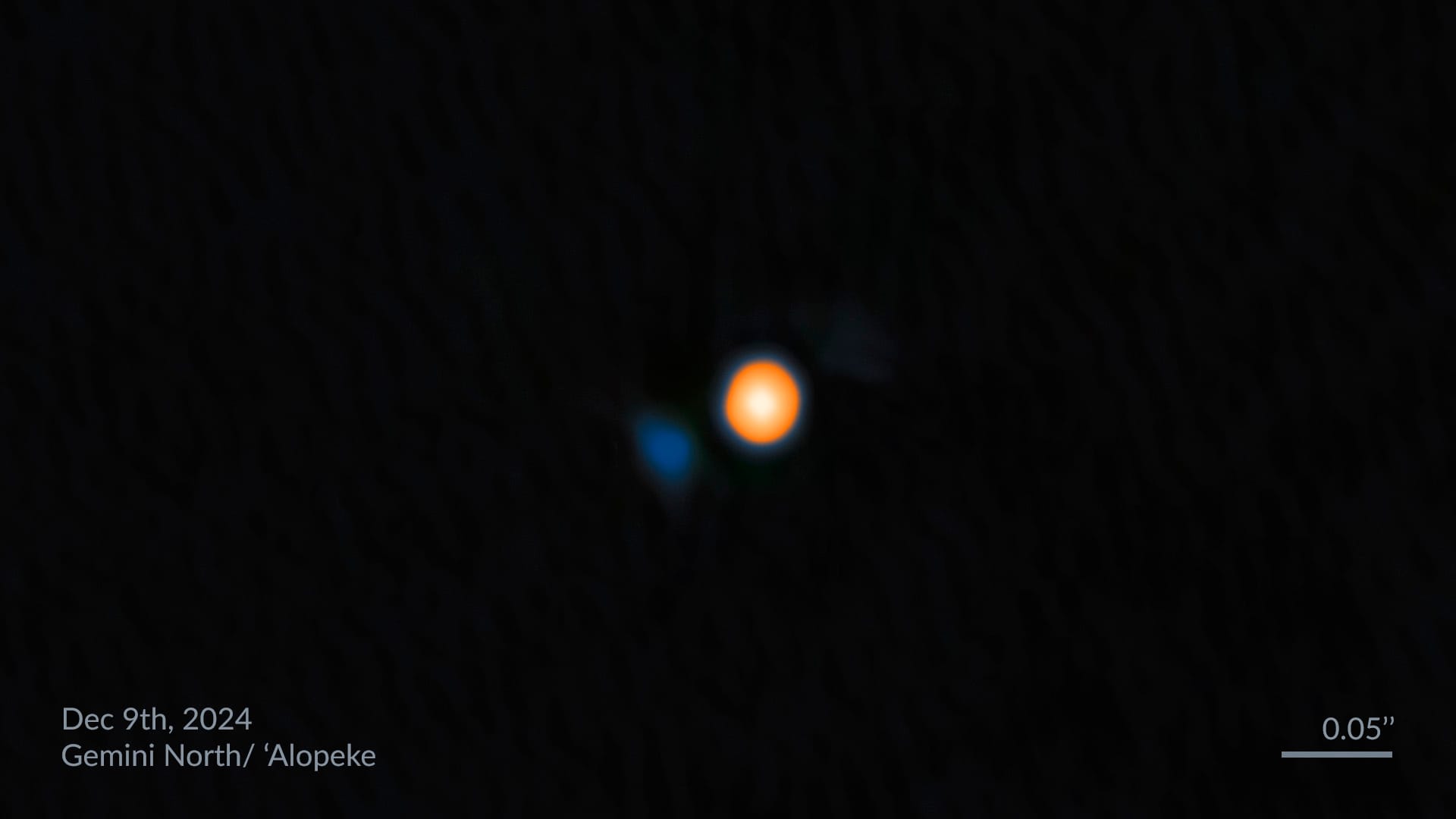
A probable direct detection reported in 2025, followed by stronger evidence in 2026, changed how astronomers interpret Betelgeuse’s famous brightness swings. The leading explanation for this roughly six-year cycle is now a close companion, and this cycle is no longer considered a countdown to a supernova.
In July 2025, astronomers reported the first probable direct detection of Betelgeuse’s long-suspected companion. Then, in July 2026, astronomers published observations with ESO’s Very Large Telescope obtained in December 2024, providing the clearest image yet of what is likely Betelgeuse B.
Betelgeuse B is also known as Siwarha, which means “her bracelet” in Arabic. The name echoes Betelgeuse’s traditional Arabic name — often translated as “the hand of Orion” — and reflects the close link between the two stars. The name Siwarha was officially recognized by the IAU on September 22, 2025.
The July 2026 study suggests that Siwarha could be a young main-sequence star with a mass of about 2.6–3.1 times that of the Sun, assuming it formed together with Betelgeuse. However, its mass is still debated. An August 2026 preprint proposed that some of the detected light might actually be Betelgeuse’s light reflected by material surrounding the companion. If confirmed, this could mean that Siwarha is a lower-mass star than originally estimated.
The companion completes an orbit roughly every 2,100 days (about six years). It moves through the red supergiant’s vast, extended outer atmosphere, and as it goes, it stirs up the gas behind it. Think of it like a boat cutting through water: Siwarha leaves a dense wake of disturbed material in its path. That wake can absorb and scatter some of Betelgeuse’s light, which could help explain the long-term brightness variations that puzzled astronomers for years.
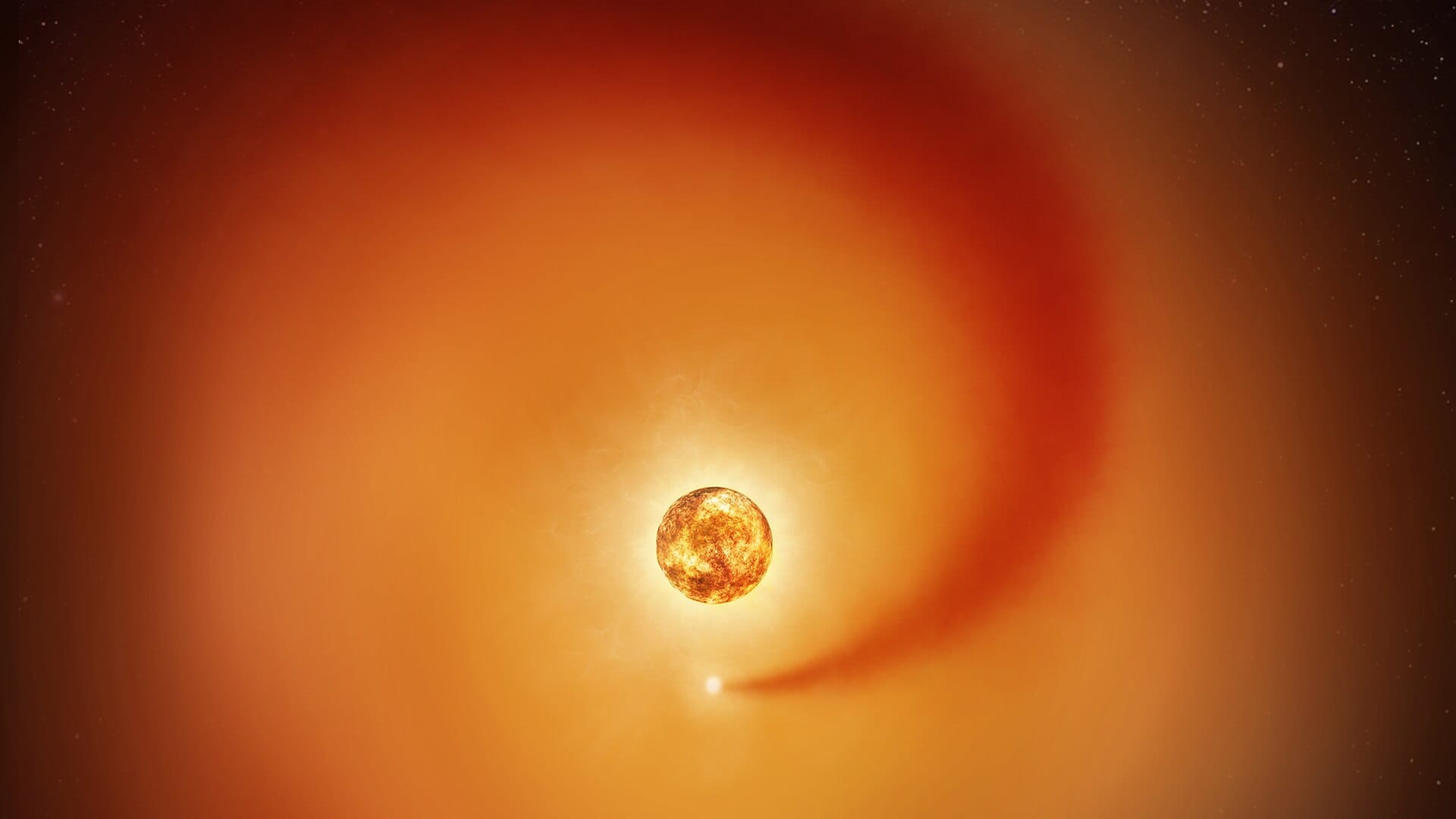
For years, astronomers observed that Betelgeuse’s brightness varies in a 2,000 to 2,200-day cycle, and this cycle was interpreted by some researchers as a possible sign that Betelgeuse was in the late stages of core carbon burning — a phase that would precede a supernova within a few centuries. But recent observations and modeling support an explanation involving its companion.
High-resolution imaging and long-term spectroscopy have now revealed signs of the companion’s impact, including evidence of disturbed gas in Betelgeuse’s atmosphere. This evidence weakens the argument that the brightness cycle signals an imminent supernova. Separate stellar models place Betelgeuse in the core-helium-burning phase and suggest that an explosion may still be 100,000 years away, although the timing remains uncertain.
A September 2026 ALMA and VLA study found changes in Betelgeuse’s atmospheric shape consistent with disturbance by its companion. The companion itself was not detected in these radio images, and observations covering more of its orbit are needed.
By the way, Siwarha might have a dramatic endgame. Tidal interactions are expected to pull the companion star inward, and it may be engulfed by Betelgeuse within about 10,000 years — long before Betelgeuse eventually goes supernova.
Astronomers expect the next especially good opportunity to observe and study Siwarha to be in November 2027, when it will be at its widest apparent separation from Betelgeuse. Unfortunately, Siwarha can only be seen from Earth with professional telescopes. Siwarha stayed hidden for so long because it’s around six magnitudes fainter than Betelgeuse and orbits extremely close to the supergiant.
The companion helps explain Betelgeuse’s long brightness cycle. Its eventual supernova, however, depends on what happens deep inside the star. What do astronomers know about that final stage?
When Will Betelgeuse Go Supernova? Betelgeuse Star Explosion Date
Betelgeuse is expected to explode as a supernova eventually, but there is no reliable explosion date. Models that place it in the core-helium-burning stage suggest it may have roughly 100,000 years left, as summarized in NASA’s overview of Betelgeuse.
When the star reaches the end of its nuclear-burning stages, its core is expected to collapse and its outer layers to be expelled in a supernova. The result would dramatically change Orion’s familiar outline.
Has Betelgeuse exploded yet?
No supernova explosion of Betelgeuse has been observed from Earth. Astronomers continue to study the red supergiant and its atmosphere. The Great Dimming of 2019–2020 was not a supernova event.
Because the light reaching us is centuries old, we cannot directly check what is happening at the star right now. It could, in principle, have exploded without the light reaching us yet, but there is no evidence that this has happened.
Will Betelgeuse explode in 2026?
There is no scientific evidence that Betelgeuse will explode in 2026. Although its unusual brightness changes and recently discovered companion have attracted considerable attention, neither indicates that a supernova is imminent. Current stellar evolution models suggest that Betelgeuse may still have a very long time to go before its final explosion, potentially around 100,000 years or more.
When will we see Betelgeuse explode?
We cannot give a calendar date. We will see the explosion when its light reaches Earth. At the approximate distance used here, that would be about 650 years after it happens. However, the roughly 650-year light-travel time is not a prediction that the supernova will appear 650 years from now.
What would a Betelgeuse supernova look like from Earth?
It could appear as an extraordinarily bright point in Orion, visible even in daylight. In a modeled scenario described by astronomer Andy Howell, the supernova would shine roughly as brightly as a half-lit Moon and could cast shadows at night. To the naked eye, the initial display would still look like a brilliant point, not a second Moon-sized disk.
As the explosion faded, Orion would eventually lose its familiar red shoulder star. Expanding gas and a compact stellar remnant would remain at the supernova site.
How long will the Betelgeuse supernova be visible?
When Betelgeuse explodes, it will shine as brightly as the half-Moon for over three months. People would be able to see it in the daytime sky for about a year, and it would remain visible to the naked eye at night for several years as it gradually fades.
Would the explosion threaten Earth?
Massive stars such as Betelgeuse can end their lives in core-collapse supernovae. These supernovae occur when a star runs out of fuel and collapses rapidly and violently. However, for a supernova to threaten Earth, it would need to occur much closer to cause a significant effect. Still, a supernova could have unexpected effects on the Earth. For instance, many animals use the Moon for navigation and may be confused by an unusual light source. Even astronomers would face challenges. Observing the night sky is already difficult when the Moon is bright, and a Betelgeuse supernova would make it even harder.
But despite the challenges, a Betelgeuse supernova would be an incredible event to witness. The last supernova in the Milky Way to be widely observed with the naked eye was Kepler’s supernova in 1604. While stars explode regularly in the universe, most are too far away to see without powerful telescopes. Betelgeuse would be the closest supernova ever observed by humans.
Astronomers predict that we would receive advance warning of the explosion, with instruments on Earth detecting neutrinos (and possibly gravitational signals) hours in advance. Just imagine people all around the world staying up to watch Betelgeuse, eagerly awaiting the spectacular light show and cheering when it finally begins.
When is the next supernova?
Astronomers cannot reliably name the next star that will produce a naked-eye supernova. Betelgeuse is a well-known future candidate.
Another widely discussed target is T Coronae Borealis, a binary system monitored for a recurring nova eruption. As NASA explains, this is a thermonuclear outburst on a white dwarf’s surface; the white dwarf survives. Its eruption date is also uncertain.
Betelgeuse Star: Key Takeaways
Betelgeuse is an orange-red supergiant in Orion, visible without a telescope and especially convenient to observe on evenings from November through March. Its enormous size, changing brightness, and close companion make it worth returning to throughout the observing season. No Betelgeuse supernova has been observed, and Betelgeuse is not expected to explode anytime soon.
The upside is simple: we get more time to enjoy it. With its changing brightness, immense size, and newly revealed companion, Betelgeuse remains one of the most captivating stars.
Want to find it fast? Use the user-friendly Star Walk 2 app, locate Betelgeuse, and take a moment to admire one of the most famous stars in the sky.
