How to See the Planetary Alignment in August 2026
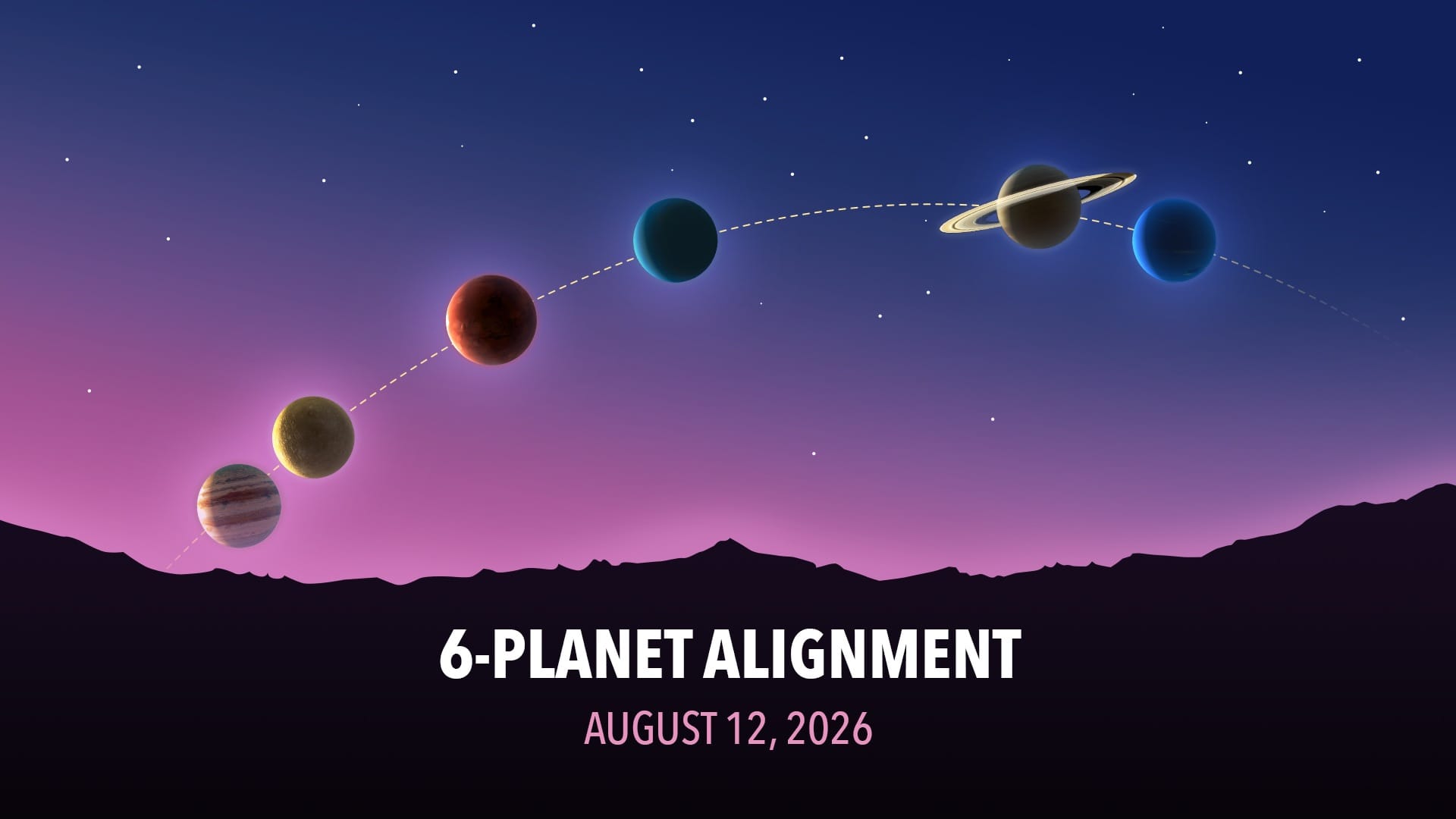
Around August 12, 2026, six planets — Jupiter, Mercury, Mars, Uranus, Saturn, and Neptune — will appear in the morning sky before sunrise. But this doesn’t mean all six will be easy to see with the naked eye. Mars and Saturn will be the easiest targets, Mercury will be low but possible to catch with a clear horizon, Jupiter will sit even lower than Mercury, Uranus will require binoculars, and Neptune will need a telescope. Use Star Walk 2 to find the planets from your exact location and check the best viewing time.
Contents
- August 12, 2026 Planetary Alignment: date, time, and visible planets
- Reality check: how many planets will you actually see?
- Best time to see the August 2026 planetary alignment
- Observing strategy: When to see the August 2026 planetary alignment
- What the August 2026 planet parade will look like
- Best dates to see the August 2026 planet parade
- Where to look to see the August 2026 planetary alignment
- Which planets will be visible during the August 2026 alignment?
- How to find all six planets easily
- Quick tips for observing the August 2026 planet parade
- What else to see on August 12, 2026
- FAQ: August 2026 planet parade
- What time is the planetary alignment on August 12, 2026?
- Which planets will align on August 12, 2026?
- Can I see the August 2026 planetary alignment with the naked eye?
- Where should I look to see the August planet parade?
- Will the planets form a perfect straight line on August 12, 2026?
- Why is August 12, 2026, special?
- Six-planet alignment around August 12, 2026: key takeaways
August 12, 2026 Planetary Alignment: date, time, and visible planets
- Main date: August 12, 2026
- Type: Large planetary alignment / six-planet parade
- Planets: Jupiter, Mercury, Mars, Uranus, Saturn, Neptune
- Best time to watch: Before sunrise
- Where to look: From the eastern horizon toward the southwestern sky (northwestern sky in the Southern Hemisphere)
- Easiest naked-eye planets: Mars and Saturn
- Possible but difficult to see: Mercury and Jupiter, low in bright twilight
- Binoculars or telescope needed: Uranus, Neptune
- Not part of this lineup: Venus
This is a morning alignment, so plan your observation before dawn. The exact best time depends on your location, local sunrise, horizon, and whether Mercury has risen high enough before the sky becomes too bright.
New to the terms “planetary alignment” and “planet parade”? Read our dedicated article: What is a planetary alignment?
Reality check: how many planets will you actually see?
Six planets take part in the August 12 alignment, but your actual view will depend on your location, horizon, sky clarity, and timing. Even seeing two or three naked-eye planets is a good result — especially because Mercury and Jupiter will be low above the horizon.
A good way to judge your observing session:
- Level 1 — Easy: spot Mars (mag 1.3) and Saturn (mag 0.5).
- Level 2 — Intermediate: add Mercury (mag -1.0) near the horizon before sunrise.
- Level 3 — Hard: catch very low Jupiter (mag -1.8) in brightening dawn.
- Level 4 — Expert: find Uranus (mag 5.7) and Neptune (mag 7.7) with binoculars or a telescope.
Don’t judge the event by “all six or nothing”. Mars and Saturn are already worth the early wake-up, and a clear eastern horizon may let you add Mercury — or even very low Jupiter — to the view.
Best time to see the August 2026 planetary alignment
The main date of the alignment is August 12, but the best practical viewing time depends on your location. In some cities, the best morning may fall on August 11, 12, or 13 because Mercury and Jupiter rise very close to sunrise.
For the tables below, we calculated the preferred viewing window from the moment Mercury reaches 5° above the horizon until the start of civil twilight, when the Sun is 6° below the horizon. This gives Mercury enough altitude to appear above the eastern horizon while the sky is still dark enough for the bright planets to stand out. Jupiter will sit even lower than Mercury, so treat this window as the earliest practical chance to try for both low eastern planets. You can learn more about the different types of twilight in our dedicated article: Understanding Twilight.
In the Southern Hemisphere cities marked by an asterisk, Mercury reaches 5° above the horizon around or after the start of civil twilight. This means the sky will already be brightening, and it will be difficult to catch Mercury and Jupiter.
Best viewing times in the Northern Hemisphere
| City | Best date | Local sunrise | Best time to see the planet parade |
|---|---|---|---|
| Los Angeles, USA | August 12 | 6:12 AM | around 5:28–5:46 AM |
| Mexico City, Mexico | August 12 | 6:16 AM | around 5:35–5:53 AM |
| Toronto, Canada | August 12 | 6:19 AM | around 5:33–5:47 AM |
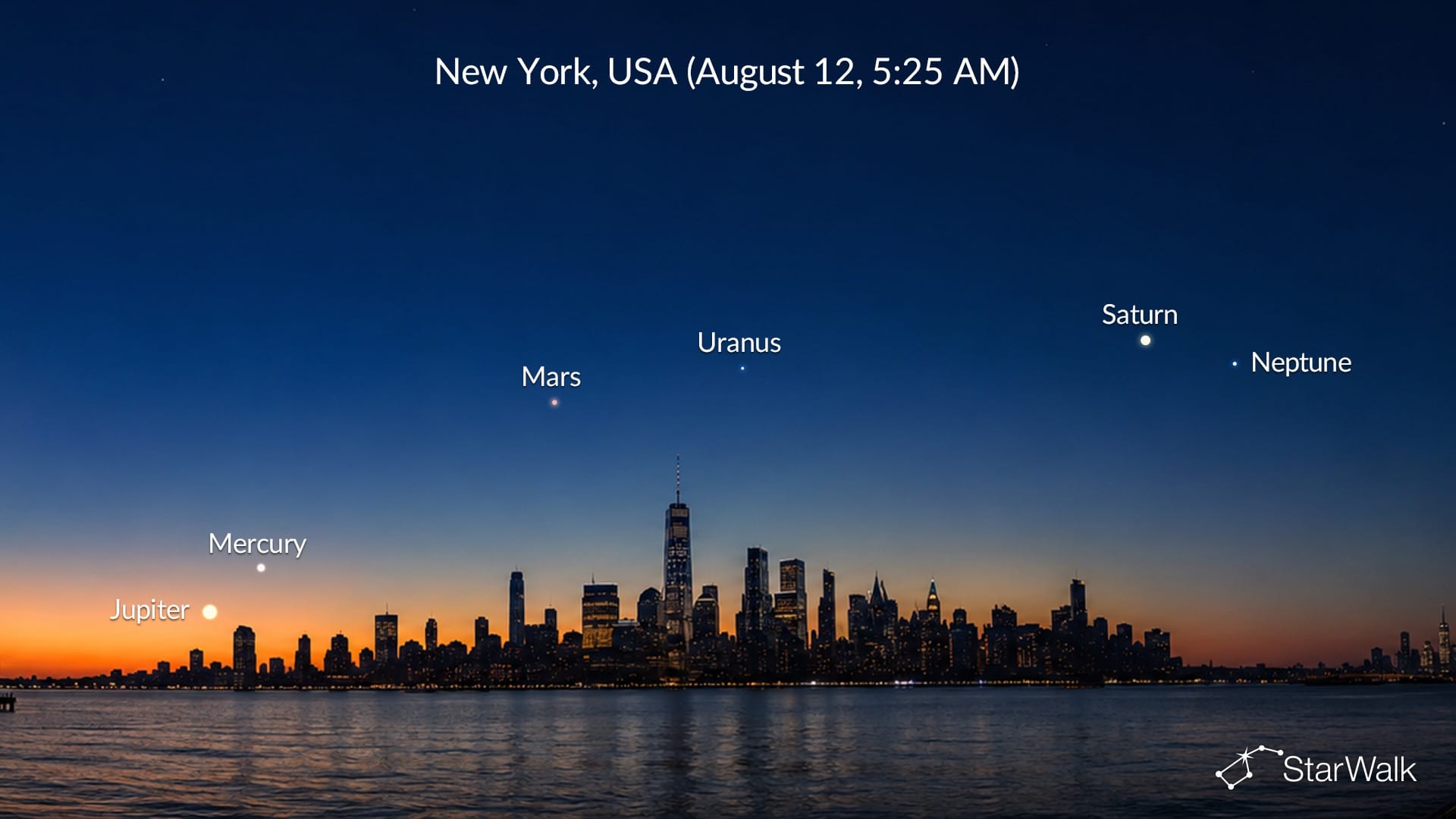
| New York, USA | August 12 | 6:03 AM | around 5:18–5:34 AM |
| London, UK | August 12 | 5:41 AM | around 4:54–5:03 AM |
| Paris, France | August 12 | 6:39 AM | around 5:52–6:03 AM |
| Berlin, Germany | August 12 | 5:43 AM | around 4:56–5:04 AM |
| New Delhi, India | August 12 | 5:48 AM | around 5:04–5:24 AM |
| Tokyo, Japan | August 13 | 4:58 AM | around 4:15–4:31 AM |
Best viewing times in the Southern Hemisphere
| City | Best date | Local sunrise | Best time to see the planet parade |
|---|---|---|---|
| Santiago, Chile | August 11 | 7:25 AM | around 7:06–7:25 AM* |
| Buenos Aires, Argentina | August 11 | 7:37 AM | around 7:20–7:37 AM* |
| São Paulo, Brazil | August 11 | 6:35 AM | around 6:08–6:35 AM* |
| Cape Town, South Africa | August 11 | 7:29 AM | around 7:10–7:29 AM* |
| Johannesburg, South Africa | August 11 | 6:40 AM | around 6:14–6:40 AM* |
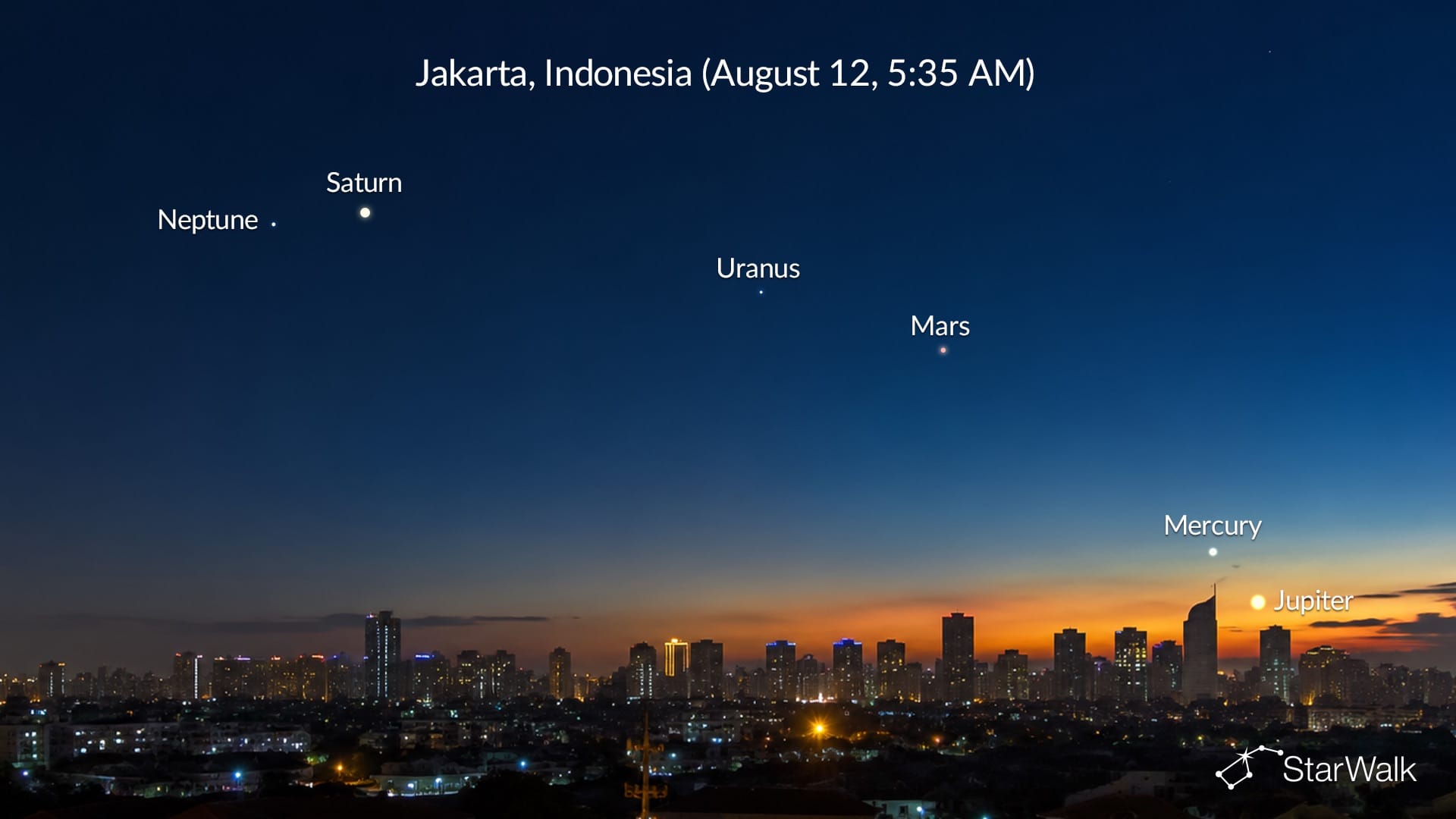
| Jakarta, Indonesia | August 12 | 6:01 AM | around 5:26–5:40 AM |
| Perth, Australia | August 11 | 6:57 AM | around 6:35–6:57 AM* |
| Brisbane, Australia | August 11 | 6:22 AM | around 5:56–6:22 AM* |
| Melbourne, Australia | August 11 | 7:10 AM | around 6:54–7:10 AM* |
| Sydney, Australia | August 11 | 6:39 AM | around 6:18–6:39 AM* |
| Auckland, New Zealand | August 11 | 7:09 AM | around 6:52–7:09 AM* |
| Wellington, New Zealand | August 11 | 7:17 AM | around 7:05–7:17 AM* |
Observing strategy: When to see the August 2026 planetary alignment
Start observing while the sky is still dark enough for the faint planets, then watch the bright naked-eye planets appear one by one as dawn approaches.
A simple observing plan:
- 2–3 hours before sunrise: Saturn, Neptune, Uranus, and Mars are already well placed in the sky. This is the best time to try the faint planets with binoculars or a telescope.
- About 30–60 minutes before sunrise in many Northern Hemisphere locations: Mercury appears low in the eastern sky, while Jupiter sits even lower, closer to the horizon. This is the best compromise window for the naked-eye lineup.
- Closer to sunrise in many Southern Hemisphere locations: Mercury and Jupiter may only become reasonably placed late in twilight, sometimes just minutes before sunrise.
For many Northern Hemisphere observers, the optimal compromise is to observe roughly 30–60 minutes before local sunrise. In the Southern Hemisphere, the observing window is often later and shorter. To see all six planets, check the exact rise times and planet positions in Star Walk 2.
What the August 2026 planet parade will look like
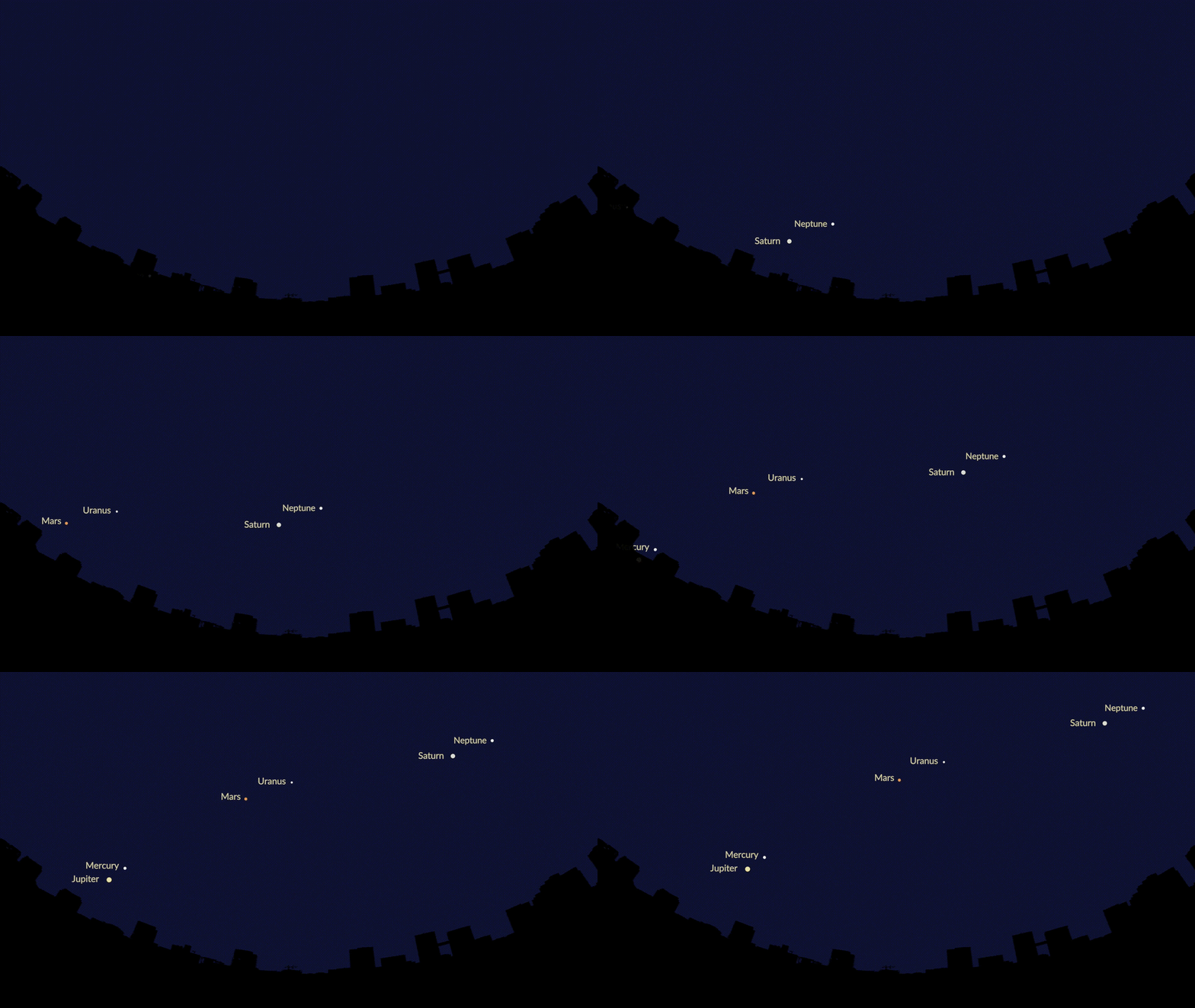
Before sunrise on August 12, six planets will appear stretched across the sky. Saturn and Neptune rise first, followed later by Uranus and Mars. Closer to dawn, Mercury and Jupiter complete the lineup near the eastern horizon.
The planets won’t form a perfect straight line in the sky. Instead, they’ll appear along a broad arc from the east toward the southwest in the Northern Hemisphere, or toward the northwest in the Southern Hemisphere. This is why the event is often called a “planet parade”: your eyes travel from planet to planet across the sky.
The planets also won’t be lined up in space. They’ll be scattered across different parts of their orbits around the Sun, at very different distances from Earth. The “alignment” is a line-of-sight effect: from our viewpoint, the planets appear near the same path in the sky — the ecliptic — because they all orbit the Sun in roughly the same plane.
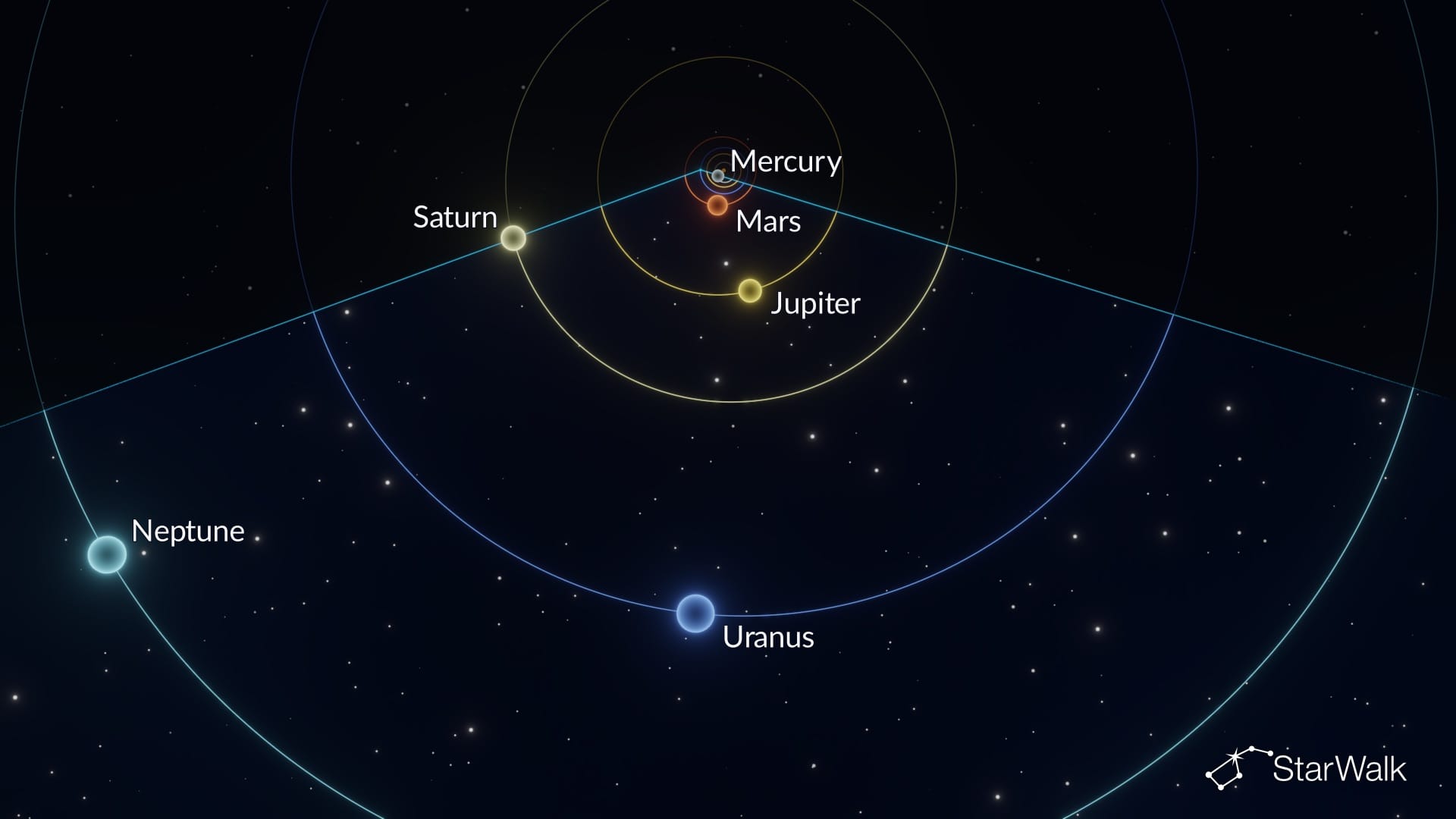
Want to understand how planet parades work? Check out our illustrated guide: Planetary Alignment Infographic.
Best dates to see the August 2026 planet parade
The alignment is not a one-minute event. The planets will be visible on several mornings around August 12, though the layout changes from day to day.
| Date | What to watch | Why it matters |
|---|---|---|
| August 9–10 | Mars, Uranus, Saturn, Neptune before dawn | Good warm-up mornings for practicing the route across the sky |
| August 11 | Very thin Moon near Mercury | Beautiful but difficult low-horizon scene before sunrise |
| August 12 | Six-planet alignment | Main date for Jupiter, Mercury, Mars, Uranus, Saturn, and Neptune |
| August 13–14 | Planets still visible before dawn | Good backup mornings if August 12 is cloudy |
If the weather is bad on August 12, don't give up. Try the mornings before and after the main date. You may not see the exact same arrangement, but the pre-dawn planet line will still be worth watching.
Advanced targets near the planets
The planets also pass near several beautiful deep-sky objects around the alignment. They’re worth checking if your sky is dark enough and you have binoculars.
- August 12: Jupiter near the Beehive Cluster. Jupiter will be very low, so this will be a difficult scene. You’ll need an unobstructed horizon and binoculars to have a chance of seeing the faint cluster stars in the brightening dawn.
- August 12: Uranus near the Pleiades and Hyades in Taurus. Uranus itself is not easy to see, but the nearby star clusters can help you orient yourself in this part of the sky and make it more rewarding to explore.
- August 14: Mercury very close to the Beehive Cluster. This is a challenging pairing, but a good target for observers with a flat, unobstructed eastern view.
- August 14: Mars near M35. Mars will be easier to see than Mercury or Jupiter, and binoculars will help you spot the open star cluster M35 nearby.
Use Star Walk 2 or another mobile sky map to confirm the exact positions of the planets and star clusters for your location.
Where to look to see the August 2026 planetary alignment
Look before sunrise along the ecliptic, the imaginary line across the sky where the Sun, Moon, and planets appear to travel. The planets will stretch from the eastern horizon toward the southwestern sky (northwestern sky in the Southern Hemisphere).
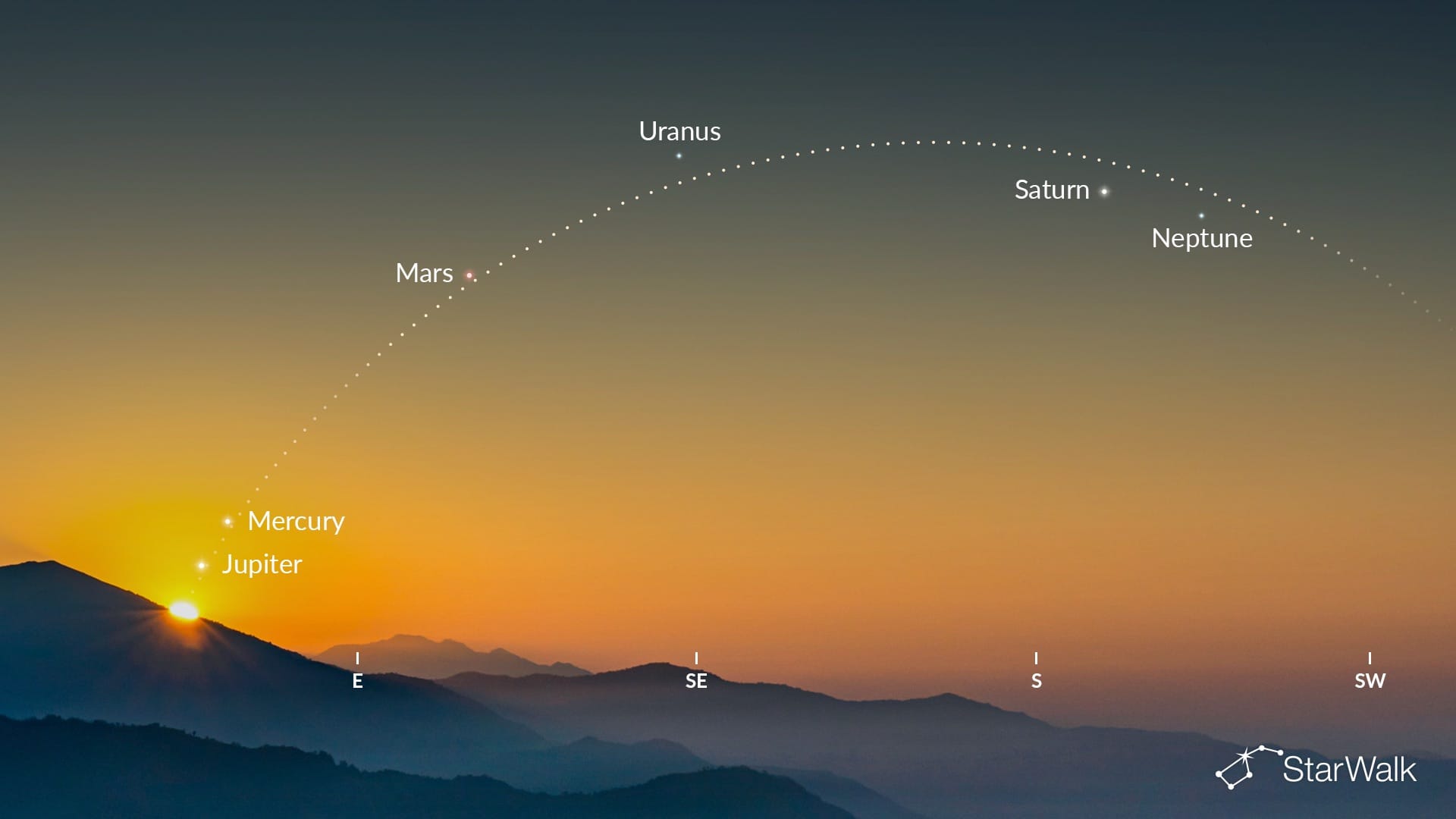
The easiest approach:
- Find the eastern horizon first. This is where Jupiter and Mercury will appear closer to dawn.
- Look higher for Mars.
- Follow the ecliptic across the sky to find Saturn — toward the southwestern sky in the Northern Hemisphere and toward the northwestern sky in the Southern Hemisphere.
- Use binoculars or a telescope for Uranus and Neptune.
The alignment will stretch across a large part of the sky, so choose a place with a wide, open view. The eastern horizon matters most: Mercury and Jupiter will appear very low before sunrise, and the viewing window will be short. If buildings, trees, hills, or haze block that part of the sky, these two planets will be easy to miss.
Good observing locations include open fields, coastlines, hilltops, rooftops, and balconies with a clear view toward the east. Avoid places with trees, buildings, hills, or haze near the sunrise direction.
Which planets will be visible during the August 2026 alignment?
Saturn: easiest bright planet to spot
Saturn (mag 0.5) will be one of the easiest planets to see in this alignment. Around August 12, it will appear in Pisces (near the border with Cetus), shining with a steady, slightly golden light.
If you have a small telescope, Saturn becomes one of the best targets of the morning. Even modest equipment can reveal its famous rings, though the exact view depends on magnification, atmospheric conditions, and the planet’s altitude at your location.
Mars: relatively bright and high in the sky
Mars (mag 1.3) will also be visible to the naked eye and will be much easier to catch than Mercury or Jupiter because it will stand high in the sky before dawn. Look for a steady point of light with a warm reddish or orange tint. On the dates around August 12, Mars will be moving from Taurus into Gemini.
Mars is not as brilliant as Jupiter, but its reddish color makes it easier to recognize, especially for beginners. It also helps mark the path between the low eastern planets and the farther part of the alignment.
Mercury: low dawn target
Mercury (mag -1.0) will appear low in the eastern sky before sunrise in the constellation Cancer. To see it, you’ll need a clear, unobstructed horizon and good timing. Look too early, and Mercury may not be high enough. Look too late, and twilight may wash it out.
Binoculars can help, but use them safely. Never point binoculars, a telescope, or a zoom lens near the Sun. Stop using optical equipment before sunrise and avoid sweeping the brightening sky close to the Sun’s position.
Jupiter: bright but extremely low
Jupiter is usually one of the easiest planets to recognize because it looks like a very bright, steady “star”. During this alignment, however, it will be the hardest naked-eye planet to catch because it will sit even lower than Mercury, very close to the eastern horizon. Like Mercury, Jupiter will be positioned in Cancer.
To see Jupiter (mag -1.8), you’ll need a perfectly clear view of the eastern horizon with no buildings, trees, hills, or haze in the way. If you spot a bright point very low below Mercury as dawn approaches, that may be Jupiter — but don’t be surprised if it’s hidden from your location.
Uranus: binocular target
Uranus is technically near the edge of naked-eye visibility under excellent dark skies, but for most observers, binoculars are the realistic choice.
To find Uranus (mag 5.7), don’t rely on brightness alone. It can look like a faint star, so use a detailed sky map or astronomy app to confirm the exact position. Dark skies and stable binoculars will improve your chances. Around August 12, Uranus will be positioned in Taurus.
Neptune: telescope challenge
Neptune is the most difficult planet in the August 12 parade. It is too faint for naked-eye viewing and is best seen with a telescope.
Like Uranus, Neptune (mag 7.7) can look like a tiny bluish star-like point through optics. You’ll need a detailed sky map or an app to identify it confidently. Look for it in Pisces, not far from Saturn. A dark sky, stable mount, and experience with telescope navigation will help.
How to find all six planets easily
For this parade, don't start with bright Jupiter — it will be very low near the eastern horizon and difficult to catch. Begin with the easier naked-eye planets first, then try Mercury and Jupiter as dawn approaches.
For the naked-eye planets, a practical observing route is:
Saturn → Mars → Mercury → Jupiter
Or, if you have binoculars or a telescope and the sky is still dark enough, try the faint planets before the horizon gets too bright:
Saturn → Neptune → Uranus → Mars → Mercury → Jupiter
The easiest way to find the planets is to use the Planet Walk feature in Star Walk 2.
Here's how to do it:
- Open Star Walk 2.
- Go to Menu > Planets.
- Tap Planet Walk or select a planet from the list.
- Point your phone at the sky and follow the arrows.
- Move from planet to planet along the alignment.
Quick tips for observing the August 2026 planet parade
- Wake up early and start before twilight gets too bright.
- Choose a location with an unobstructed view toward the east.
- Bring binoculars for Uranus and a telescope for Neptune.
- Use an astronomy app to avoid confusing planets with stars.
- Check local sunrise time in advance.
- Don't wait until the last few minutes before sunrise — Mercury may be easier to catch, but the faint planets will disappear in twilight.
- Never point binoculars, telescopes, or zoom lenses near the Sun!
- If the sky is cloudy on August 12, try the mornings before or after.
What else to see on August 12, 2026
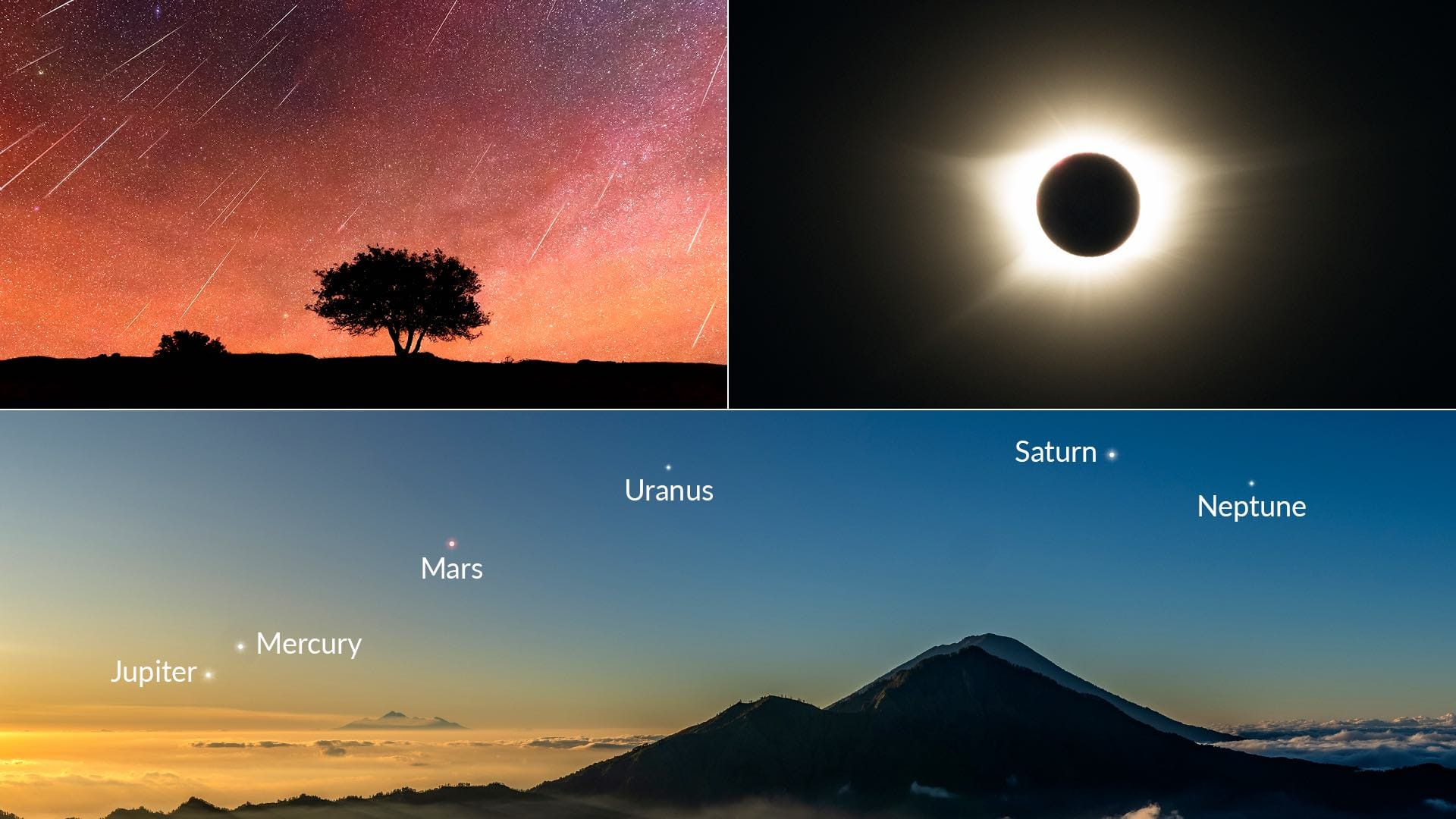
The six-planet alignment is the main focus of this guide, but two other major skywatching events happen around the same date:
- Perseid meteor shower peak — best viewed on the night of August 12–13.
- Total solar eclipse on August 12, 2026 — visible as a total eclipse only from selected regions.
For visibility maps, timing, safety tips, and observing details, use the dedicated guides linked above.
FAQ: August 2026 planet parade
What time is the planetary alignment on August 12, 2026?
The planetary alignment is visible before sunrise. In many Northern Hemisphere cities, the best compromise window is about 30–60 minutes before local sunrise. In many Southern Hemisphere cities, the useful window may be shorter and closer to sunrise.
Which planets will align on August 12, 2026?
Six planets take part in the alignment: Jupiter, Mercury, Mars, Uranus, Saturn, and Neptune.
Can I see the August 2026 planetary alignment with the naked eye?
Partly. Mars and Saturn should be the easiest naked-eye targets. Mercury may also be visible if you have a clear horizon. Jupiter will be much trickier because it sits very low in the dawn glow. Uranus and Neptune are beyond easy naked-eye visibility, so bring binoculars or a telescope if you want to track down all six planets.
Where should I look to see the August planet parade?
Look before sunrise along the ecliptic. Mercury and Jupiter will appear low in the east, while the rest of the lineup stretches across the sky toward the southwest in the Northern Hemisphere or northwest in the Southern Hemisphere.
Will the planets form a perfect straight line on August 12, 2026?
No. The planets won’t form a perfect straight line, either in space or in the sky. From Earth, they’ll appear as a broad arc along the ecliptic.
Why is August 12, 2026, special?
August 12, 2026, is packed with sky events: the six-planet alignment before sunrise, a total solar eclipse during the day, and the Perseid meteor shower peak after dark. Learn more in our guide to the August 12, 2026 sky events.
Six-planet alignment around August 12, 2026: key takeaways
Around August 12, 2026, six planets — Jupiter, Mercury, Mars, Uranus, Saturn, and Neptune — will appear across the pre-dawn sky. Start before sunrise, choose a place with an open view of the eastern horizon, and use Star Walk 2 to guide you from planet to planet. Even if you don’t catch all six, seeing part of the lineup can still make for a memorable morning skywatching session.
Clear skies!