What Happens on August 12, 2026? The Biggest Skywatching Day of the Year
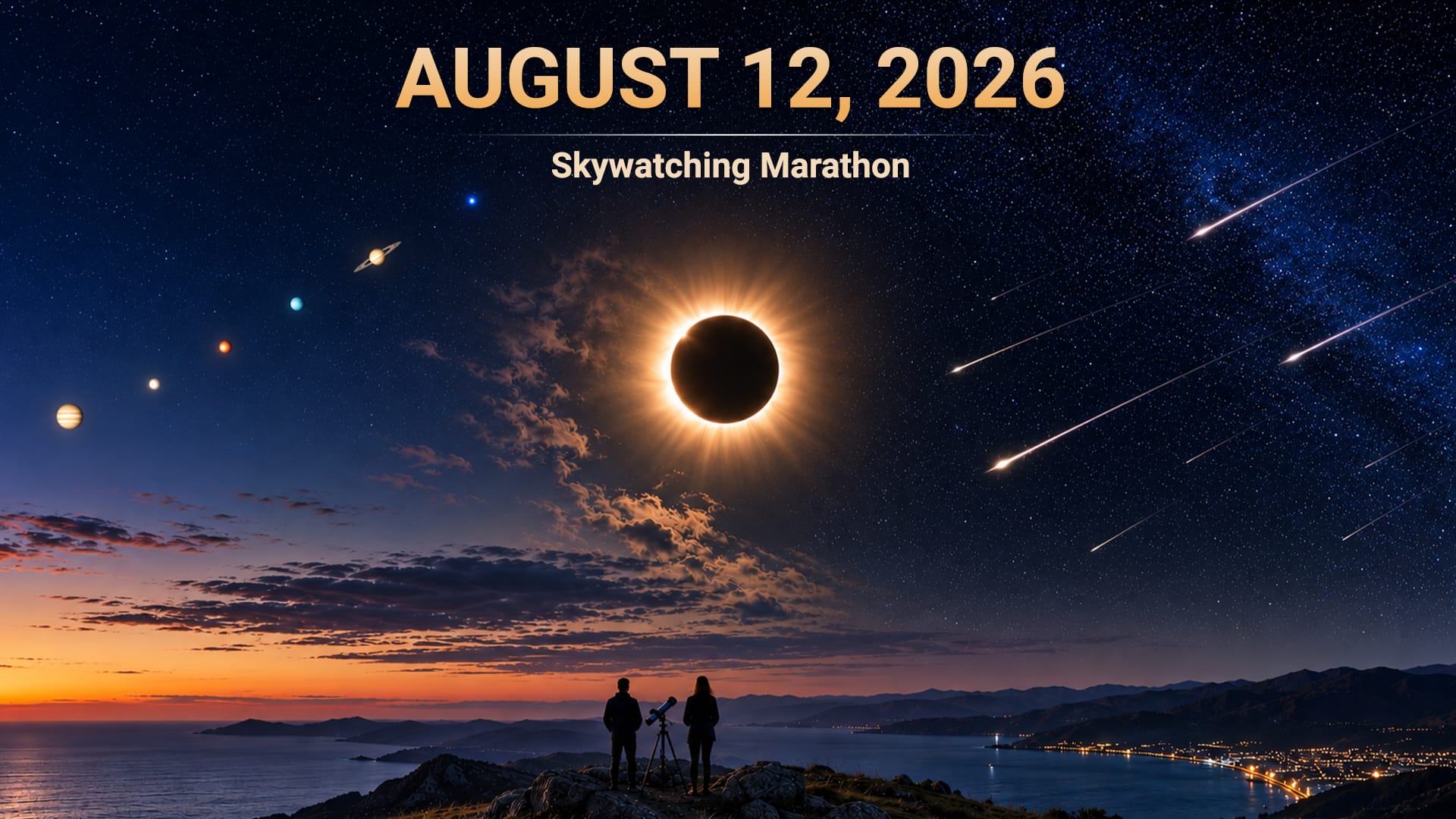
Circle this date: August 12, 2026. In less than 24 hours, the sky will put on three major shows — a six-planet alignment before sunrise, a total solar eclipse during the day or evening, and the peak of the Perseid meteor shower after dark.
Plan your skywatching marathon with the free Star Walk 2 astronomy app, check what is visible from your location, and make sure you do not miss the best moments.
Contents
- What happens on August 12, 2026?
- What is happening on August 12 2026 in the USA?
- Why is August 12, 2026, so special?
- Morning: start with the six-planet parade
- Day/evening: watch the solar eclipse
- Night: continue with the Perseids
- Best places to see all three events on August 12, 2026
- What equipment do I need?
- Common mistakes to avoid
August 12, 2026 astronomy events FAQ
- What will happen on August 12, 2026?
- Will gravity disappear on August 12, 2026?
- Will the whole world go dark on August 12, 2026?
- Why is August 12, 2026 special?
- Where is the best place to see all three events?
- Will everyone see the total solar eclipse?
- Is 99% eclipse coverage the same as totality?
- Which planets align on August 12, 2026?
- Is August 12 or August 13 better for the Perseids?
- Is August 12, 2026, good for watching meteors?
- August 12, 2026: Bottom Line
What happens on August 12, 2026?
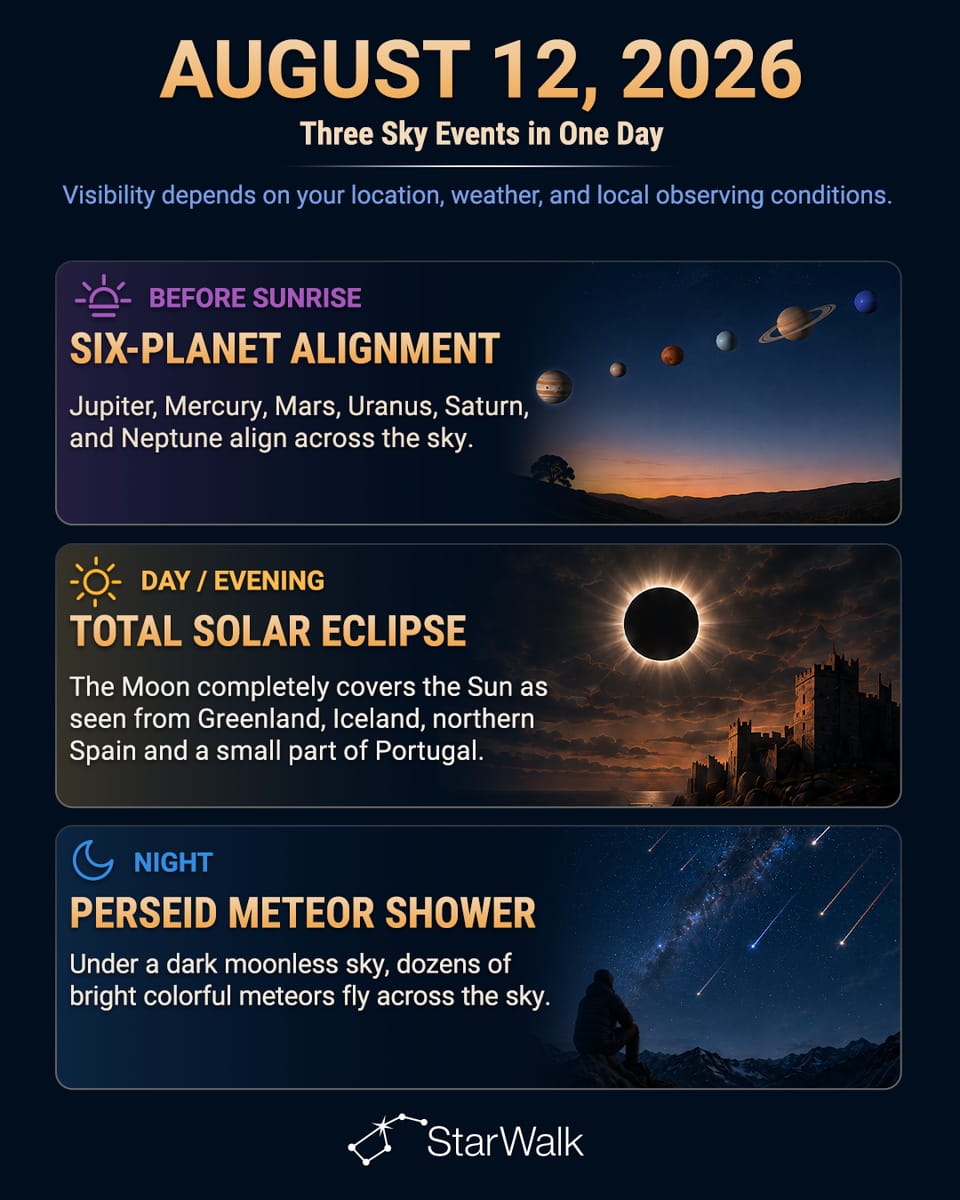
August 12, 2026, is a rare all-day skywatching date. What you will see depends on where you are — but for many observers, the day can include planets before sunrise, an eclipse later on, and meteors after dark.
Across much of the world, you can start the day with the planetary alignment before sunrise and end it by watching for some Perseid meteors after sunset.
Across Europe, parts of North America and the western part of North Africa, the day gets even better: a partial solar eclipse will be visible during the day, with the planet parade before sunrise and the Perseids at night.
Across parts of Spain, the Balearic Islands, and a small part of northeastern Portugal, the full trio is possible: a total solar eclipse during the day or evening, the planetary alignment before sunrise, and the Perseid meteors after dark.
A total solar eclipse also occurs in parts of Greenland and Iceland, but visibility of the Perseids and the six-planet alignment is much worse.
Here is the simple plan for the day:
Before sunrise — Start with the planet parade. Find a place with an open eastern horizon and begin observing before the sky gets too bright. Mars and Saturn will be the easiest to spot. Mercury and Jupiter will sit low, so a clear horizon will matter.
Day or evening — Watch the solar eclipse. Check the exact eclipse times for your location in advance. Use certified eclipse glasses, follow safe solar eclipse viewing rules, and never look at the Sun without proper protection. If you are in Spain, Portugal, or another low-Sun location, a clear western horizon is essential.
Night — Stay out for the Perseids. After dark, move away from city lights, let your eyes adjust, and watch the sky from late evening into the early hours of August 13. The New Moon will keep the sky dark, so conditions should be excellent.
Detailed guides for each event
- For exact planet visibility times, see our August 2026 planet parade guide.
- For eclipse maps, local timings, and safety tips, see our August 12, 2026 solar eclipse guide.
- For meteor rates, radiant maps, and observing advice, see our Perseid meteor shower 2026 guide.
What is happening on August 12 2026 in the USA?
For US skywatchers, the August 12 astronomical event lineup includes a six-planet alignment before sunrise, a partial solar eclipse in selected regions during the afternoon, and the Perseid meteor shower after dark. However, visibility varies across the country, especially for the eclipse.
Before sunrise: Look for Jupiter, Mercury, Mars, Uranus, Saturn, and Neptune. Mars and Saturn are easiest to see; Uranus requires binoculars and Neptune a telescope. The best viewing window is around 5:18–5:34 AM in New York and 5:28–5:46 AM in Los Angeles. You will need a clear eastern horizon.
During the afternoon: A partial solar eclipse will be visible in the Northeast and parts of the Mid-Atlantic and Upper Midwest. Totality will not be visible anywhere in the US. In New York City, the eclipse lasts from about 1:07 PM to 2:38 PM EDT, with maximum coverage at 1:54 PM. Certified eclipse glasses are required.
After dark: The Perseids peak on the night of August 12–13. The New Moon provides a dark sky, with the best viewing from a location away from city lights after midnight and before dawn.
Why is August 12, 2026, so special?
Some skywatching dates are good. This one is packed.
On August 12, the solar eclipse is the main event. It will be the first total solar eclipse visible from mainland Europe since 1999. In Spain and a small part of northeastern Portugal, where totality will be visible, the eclipse will happen late in the day. That means the Sun will be low in the sky, creating a rare “sunset eclipse” or “golden hour eclipse.” For photographers, it could be one of the most dramatic eclipse scenes in years.
The Perseids are also unusually well-timed in 2026. Their peak falls on the night of the New Moon, so the sky will be dark and free from moonlight. That is a big upgrade from 2025, when the Moon spoiled the view for many observers. The next time the Perseid peak falls on a New Moon night will be in 2045, so this is a rare chance to see the meteor shower under a perfectly dark sky.
How many astronomical events are you planning to watch on August 12, 2026?
Morning: start with the six-planet parade
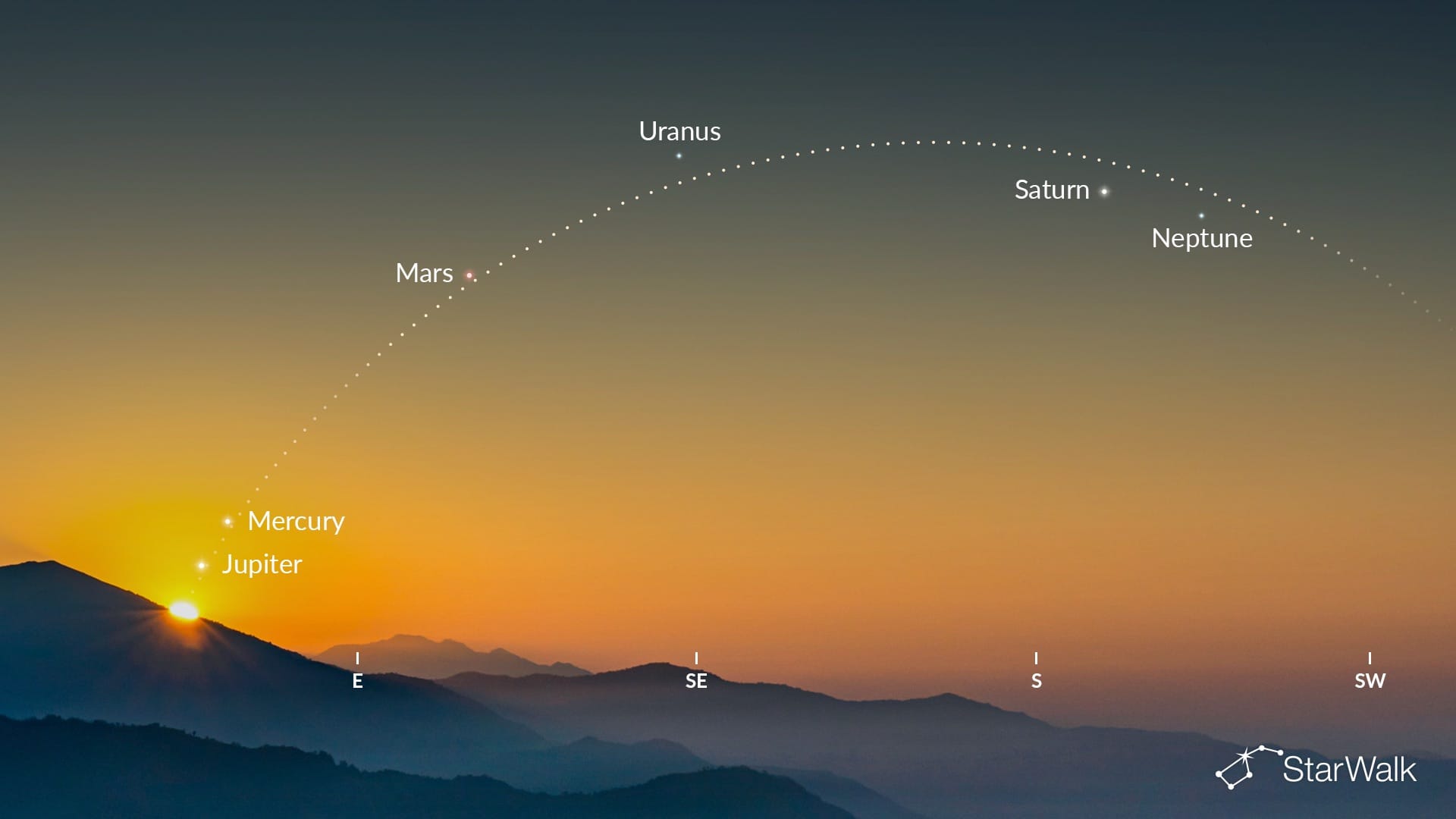
The day starts before the Sun comes up. On the morning of August 12, six planets — Jupiter, Mercury, Mars, Uranus, Saturn, and Neptune — will appear spread across the sky.
Do not expect a tight line of bright dots. This is a wide planetary alignment, stretching from the horizon across a large part of the sky. Mars and Saturn will be the easiest planets to spot with the naked eye. Mercury will sit low above the horizon shortly before sunrise. Jupiter will be bright, but very close to the horizon. Uranus and Neptune will need binoculars or a telescope.
If you want to see what this kind of event looks like visually, check out our planetary alignment chart.
Where to look for the planets?
In the Northern Hemisphere, look from the eastern horizon toward the southwestern sky (northwestern in the Southern Hemisphere) shortly before sunrise. The exact view depends on your location, sunrise time, and how clear your horizon is.
The good news: this is not a one-minute event. The planets will be worth watching on the mornings before and after August 12, too. Use those days as a practice run — especially if you want to catch low Mercury and Jupiter.
Best places to see the planet parade
The best place to watch the August 2026 planetary alignment is at mid-northern latitudes, such as New York, Madrid, and Tokyo. There, all six planets become visible about 30–60 minutes before local sunrise. That is the sweet spot: the sky is still dark enough, but the low planets have had time to rise.
In the Southern Hemisphere, the observing window is often later and shorter. Mercury and Jupiter may only become visible when the sky is already getting bright, so you will need a very clear horizon and, ideally, binoculars. Remember not to point your binoculars at or near the Sun!
Here are the best times to watch the planetary alignment on August 12, 2026, for selected cities. For more locations and observing tips, visit our complete guide to the August 2026 planet parade.
| City | Best date | Local sunrise | Best time to see the planet parade |
|---|---|---|---|
| London, UK | August 12 | 5:41 AM | around 4:54–5:03 AM |
| Berlin, Germany | August 12 | 5:43 AM | around 4:56–5:04 AM |
| New York, USA | August 12 | 6:03 AM | around 5:18–5:34 AM |
| Mexico City, Mexico | August 12 | 6:16 AM | around 5:35–5:53 AM |
| Toronto, Canada | August 12 | 6:19 AM | around 5:33–5:47 AM |
| São Paulo, Brazil | August 12 | 6:35 AM | around 6:11–6:35 AM* |
| Sydney, Australia | August 12 | 6:38 AM | around 6:21–6:38 AM* |
| Paris, France | August 12 | 6:39 AM | around 5:52–6:03 AM |
| Tokyo, Japan | August 13 | 4:58 AM | around 4:15–4:31 AM |
*In the cities marked with an asterisk, Mercury reaches 5° above the horizon around or after the start of civil twilight. By then, the sky will already be brightening, so Mercury and Jupiter will be difficult to catch.
Day/evening: watch the solar eclipse
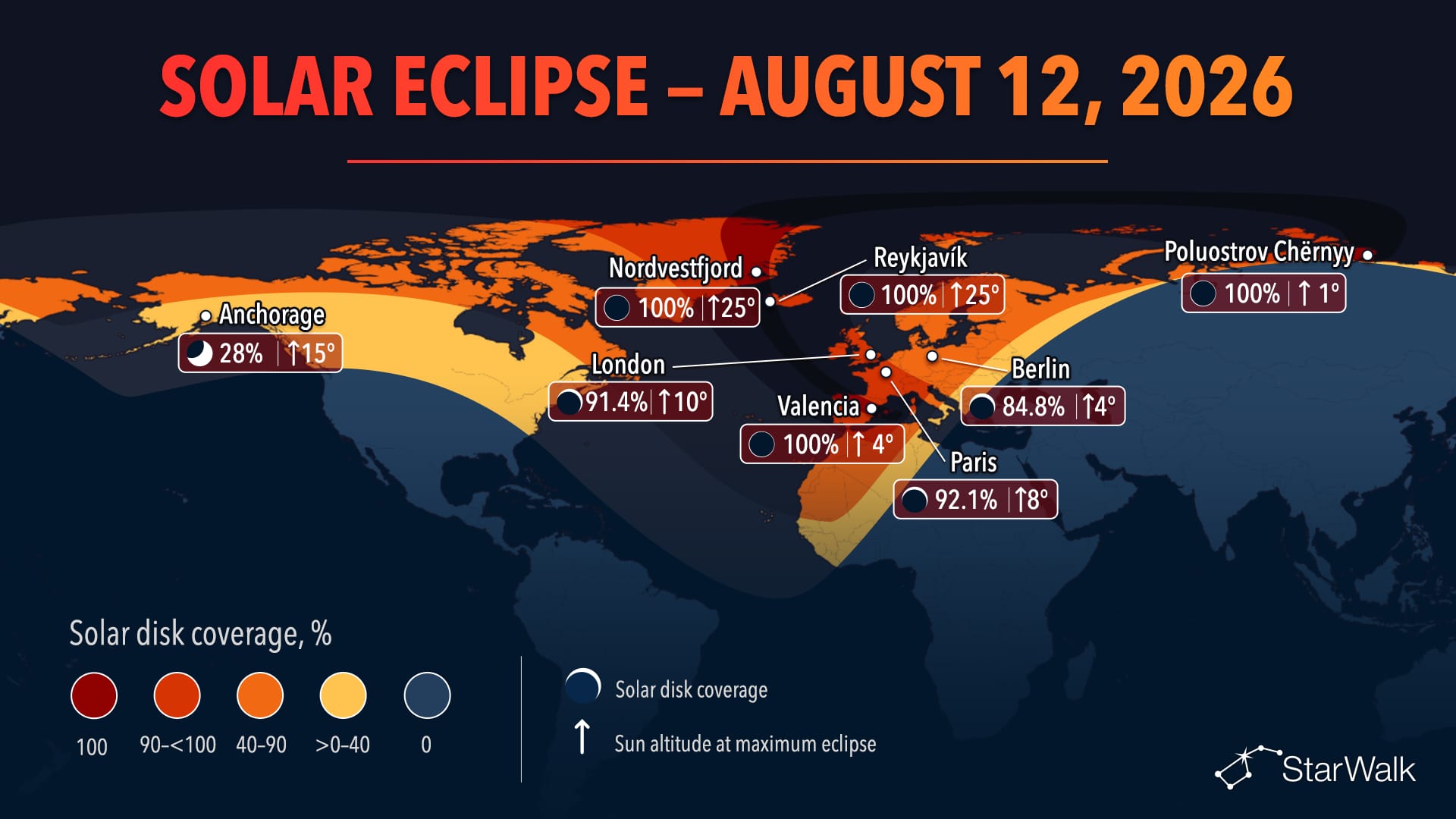
Planning your eclipse trip? Download the complete collection of August 12, 2026 eclipse maps, including country maps and local times for selected cities. Download all eclipse maps (ZIP)
This is the main event of the day.
On August 12, 2026, the Moon will pass directly in front of the Sun and completely cover it along a narrow path across far Arctic Russia, Greenland, Iceland, a small part of Portugal, northern Spain, and the Balearic Islands. If you are inside that path, day will briefly turn into twilight, the brightest stars and planets may appear, and the Sun’s outer atmosphere — the corona — will shine around the black disk of the Moon.
No wonder ancient people saw total eclipses as omens, warnings, or messages from the gods. Today, we know that the Moon and the Sun have the same size in our sky by a remarkable cosmic coincidence. And even that will not last forever — in about 1.2 billion years, the Moon will be too far from Earth to fully cover the Sun.
For a simple explanation of the geometry, see our guide to what causes a solar eclipse.
Best places to see the total eclipse
Totality will be visible only along a narrow path crossing far Arctic Russia, Greenland, Iceland, a small part of northeastern Portugal, northern Spain, and the Balearic Islands. Only inside this path will you get the full eclipse experience: the darkened sky, the glowing corona, and the brief moment when the Sun disappears completely.
For eclipse chasers, the big question is not just “Where is totality visible?” but “Which place gives me the best chance to actually see it?”
Spain is likely to be the most accessible travel option. It also offers a better chance of clear skies. The catch is the Sun: it will be very low on the western horizon during totality, which will occur late in the day. This could make the eclipse look spectacular, but it also means that even a hill, building, trees, or low clouds could block the view.
Large crowds are expected at the best locations — local governments are preparing designated viewing areas with open western sightlines, parking, and emergency services. And Spain will not have to wait long for another total eclipse: the next one visible from the country comes just a year later, on August 2, 2027. You can compare it with other upcoming eclipses in our visual eclipse calendar.
Iceland offers a very different eclipse experience. The Sun will be higher than in Spain, and the scenery could be unforgettable. But the weather is far less predictable, and the crowds could be intense. Totality will also be visible from Reykjavík — it will be the first total solar eclipse there since June 17, 1433; the next one won’t take place until May 26, 2245. Road closures and special crowd-management plans are expected.
Greenland may offer the wildest setting of all: Arctic landscapes, dramatic horizons, and a true expedition feel. But it is remote, expensive, and much harder to reach — it will be less of a casual eclipse trip and more of a serious adventure.
Outside the path of totality, a partial solar eclipse will be visible across much of Europe, parts of North America, and northwestern Africa. In some places, more than 90% of the Sun will be covered by the Moon. The sky will not go dark as it does during totality, but the Sun will look as if a huge bite has been taken out of it. Parts of the United States and Canada will also see a smaller partial eclipse.
When to see the eclipse on August 12?
Across Earth, the total phase of the eclipse will begin at 16:58 GMT and end at 18:34 GMT. But a total solar eclipse does not work the same way as a lunar eclipse. You do not get the whole 96-minute show from one place. The Moon’s shadow races across Earth, so each location gets only a short moment of totality.
For example, in S’Arenal in Mallorca, Spain, totality will last 1 minute 36 seconds, starting at 20:30:56 CEST. In Reykjavík, Iceland, totality will last 1 minute, starting at 17:48:18 GMT.
That is why planning matters. Check the exact eclipse time for your location in the free Sky Tonight app before you go out, and make sure the Sun will not be hidden behind buildings, mountains, or trees.
Night: continue with the Perseids
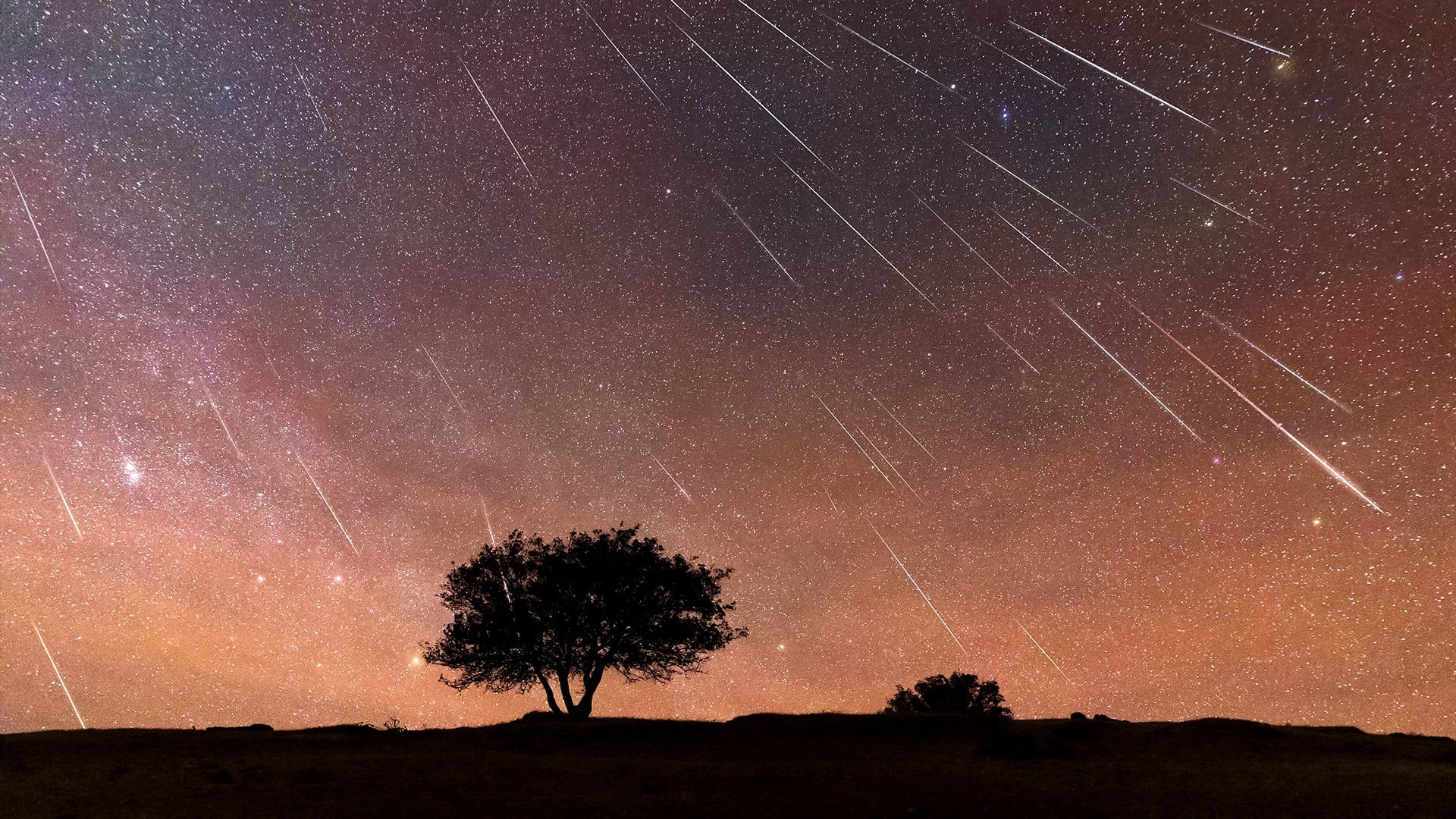
After the eclipse, the show is not over. Once the sky gets dark, the Perseids take over.
The Perseids are always one of the most popular meteor showers of the year. They arrive during warm summer nights in the Northern Hemisphere and are famous for high meteor rates, fast meteors, and occasional bright fireballs. In a good year, they can turn a quiet August night into a natural fireworks show.
And 2026 is a particularly favorable year.
How many meteors can you see?
Under dark skies, far from city lights, the Perseids can produce up to about 100 meteors per hour at peak. In real life, most observers will see fewer. Light pollution, clouds, trees, buildings, and the height of the radiant all make a difference.
Still, the New Moon gives 2026 a major advantage. Without moonlight in the sky, even fainter meteors should be easier to spot.
Not sure how dark your sky is? Use our Bortle Scale infographic to estimate your observing conditions.
Best places to watch Perseids
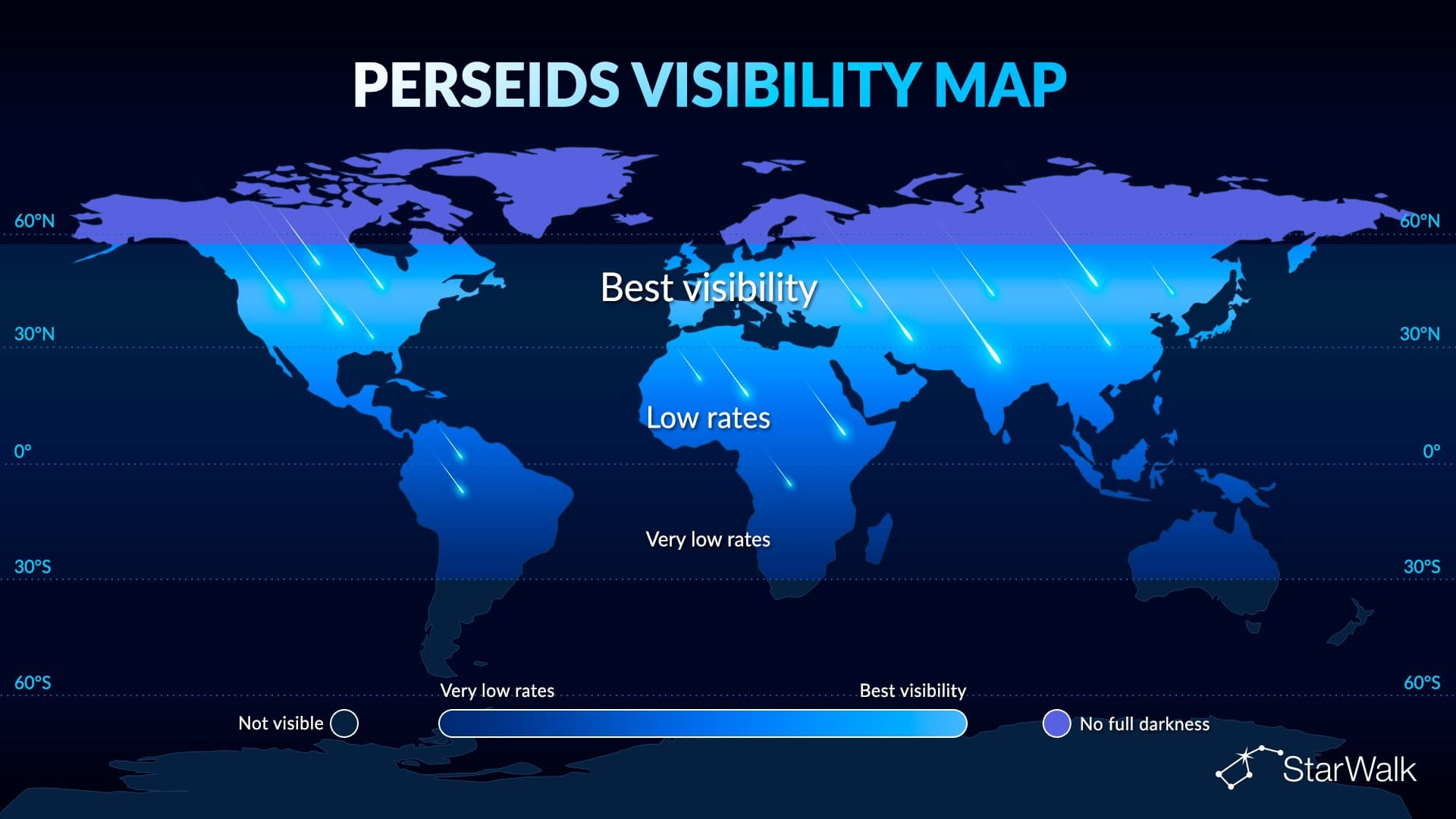
The Perseids are best seen from mid-northern latitudes. From there, the radiant — the point from which meteors appear to originate — rises high enough in the sky by around 10:30 p.m. local time, and the view usually improves later in the night.
Due to the brightness of the August sky, locations north of about 60°N (including Iceland and Greenland) are poor choices for viewing the Perseids.
The meteor shower is much harder to observe from most of the Southern Hemisphere. Some meteors may still be visible from northern tropical regions, but the radiant stays low, so the display is weaker.
Best places to see all three events on August 12, 2026
Northern Spain is probably the best overall choice. Before sunrise, you can catch the planet parade: Jupiter and Mercury rise above the eastern horizon about 40 minutes before sunrise. In the evening, you can see the total solar eclipse — or at least a very deep partial eclipse — and after dark, the Perseids take over.
The main challenge is the eclipse. The Sun will be very low above the western horizon, so you will need a clear, open view with no hills, buildings, trees, or low clouds in the way.
And then there is the weather — every skywatcher’s favorite problem.
Our recommendation for Northern Spain is based not only on eclipse visibility but also on historical cloud cover data. Here are the estimated clear-sky chances for selected locations in the path of totality:
| Location | Average cloud cover | Historical chance of a clear view | Viewing outlook |
|---|---|---|---|
| Zaragoza, Spain | ≈21% | ≈86% | Most promising |
| Burgos, Spain | ≈29% | ≈81% | Very good |
| León, Spain | ≈30% | ≈81% | Very good |
| Soria, Spain | ≈28% | ≈70–75% | Good |
| Scoresby Sund, Greenland | ≈45–50% | ≈62% | Promising |
| A Coruña, Spain | ≈48% | ≈45–50% | Uncertain |
| Bilbao, Spain | ≈61% | ≈30–50% | Risky |
| Reykjavík, Iceland | ≈76% | ≈25–35% | Low odds |
| Borgarnes, Iceland | ≈77% | ≈20–30% | Low odds |
Historical clear-view odds are based on satellite cloud-cover climatology and past August 12 satellite imagery. They are not a weather forecast for August 12, 2026.
For much of Europe, the realistic plan is still excellent: a planet parade before sunrise, a deep partial solar eclipse in the evening, and the Perseids at night. Across many parts of Europe and northwestern Africa, most of the Sun will be covered during the partial eclipse — not totality, but still a spectacular sight.
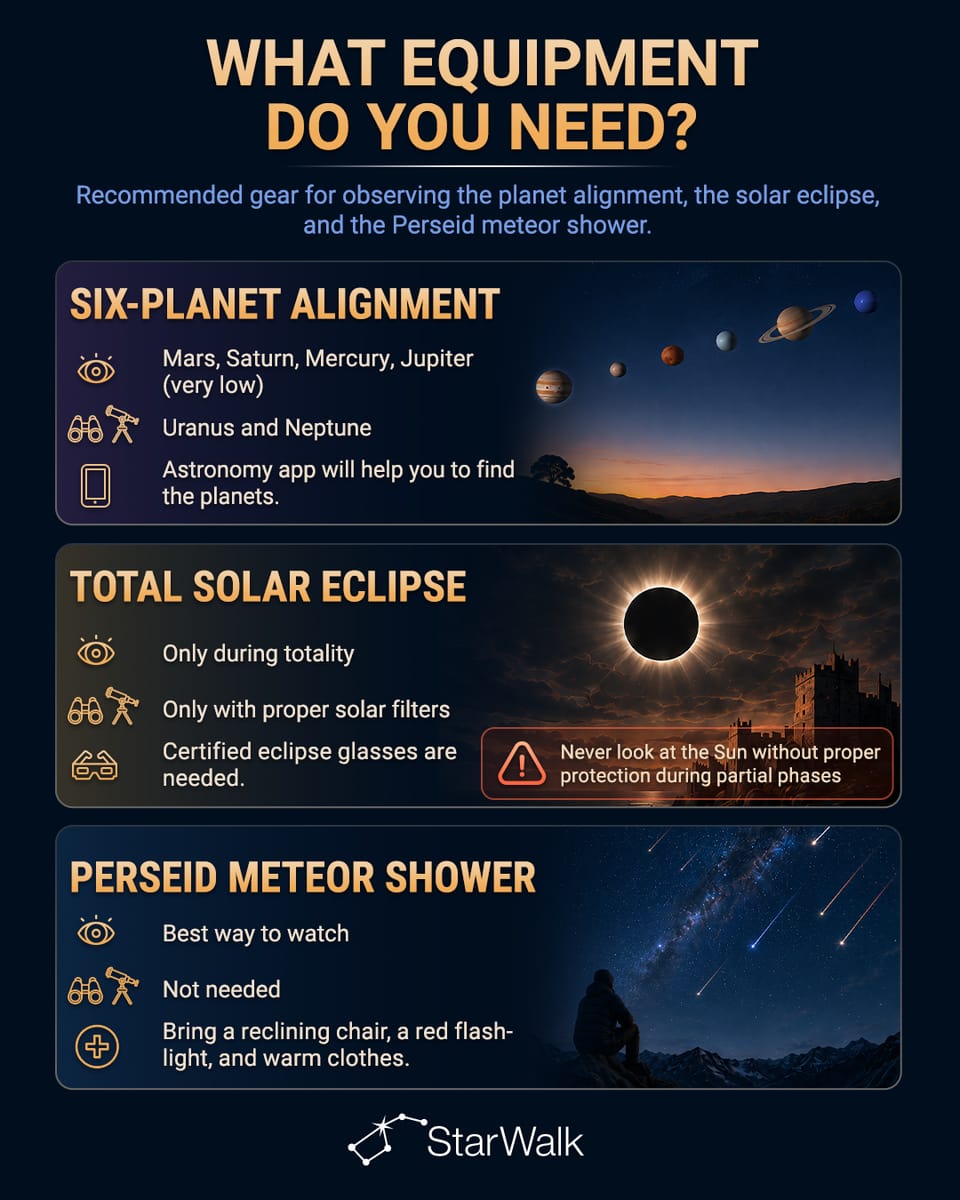
What equipment do I need?
Common mistakes to avoid
- Choosing an eclipse spot without checking the western horizon. Even if you are in the eclipse path, a hill, building, trees, or clouds near the horizon can block the view.
- Looking at the Sun without proper protection. Use certified eclipse glasses during all partial phases.
- Thinking 99% eclipse coverage is the same as totality. It is not. Only places inside the path of totality will see the corona.
- Expecting the six planets to form a perfect straight line. They will appear as a wide arc across the sky, not a neat row of dots.
- Watching the Perseids from a bright city. The New Moon helps, but light pollution can still hide many meteors.
August 12, 2026 astronomy events FAQ
What will happen on August 12, 2026?
Three major sky events happen within about 24 hours: a six-planet alignment, a total solar eclipse, and the peak of the Perseid meteor shower.
Will gravity disappear on August 12, 2026?
No. Viral claims that Earth will lose gravity for several seconds have no scientific basis. The eclipse is simply the Moon’s shadow crossing Earth; it cannot switch off or noticeably change the planet’s gravity. August 12 will bring several spectacular but completely predictable astronomical events — not the end of the world.
Will the whole world go dark on August 12, 2026?
No. A brief period of darkness will occur only inside the narrow path of totality. Most locations in that path will experience less than two minutes of totality. Places with a partial eclipse will not become completely dark, and most of the world will not see the eclipse at all.
Why is August 12, 2026 special?
It brings together Europe’s first total solar eclipse visible from central and western Europe since 1999, a morning planet parade, and a moon-free Perseid peak.
Where is the best place to see all three events?
Northern Spain is probably the strongest overall choice. It offers eclipse visibility, better chances of clear skies, and good conditions for watching the Perseids after dark.
Will everyone see the total solar eclipse?
No. Totality is visible only inside a narrow path crossing parts of far Arctic Russia, Greenland, Iceland, a small part of Portugal, Spain, and the Balearic Islands. Many other regions will see a partial solar eclipse.
Is 99% eclipse coverage the same as totality?
No. A 99% partial eclipse is still not totality. The sky does not change in the same way, and the Sun’s corona is visible only from inside the path of totality.
Think you know eclipses? Take our solar and lunar eclipse quiz before the big day and test your smarts.
Which planets align on August 12, 2026?
Jupiter, Mercury, Mars, Uranus, Saturn, and Neptune will appear across the morning sky.
Is August 12 or August 13 better for the Perseids?
The best window is the night of August 12–13, especially from late night to before dawn.
Is August 12, 2026, good for watching meteors?
Yes. The Perseids peak under a New Moon, so the sky will be dark and free from moonlight. From a dark location, this could be one of the best Perseid displays of the decade.
You can also test your meteor-watching skills with our meteor shower quiz.
August 12, 2026: Bottom Line
August 12, 2026, is not just another date on the skywatching calendar. It is a rare full-day observing marathon: six planets before sunrise, a solar eclipse later in the day, and the Perseids under a dark New Moon sky after nightfall.
For the complete experience, northern Spain may be the best overall destination, especially if you can find a clear western horizon for the low eclipse Sun. For the eclipse alone, Iceland and Greenland could also offer unforgettable views — if the weather cooperates.
Wherever you are, plan ahead. Check what will be visible from your location, save the best observing times, and use Star Walk 2 to find the planets, follow the eclipse, and locate the Perseids’ radiant in your sky.