Solar Eclipse 2026 UK: August 12 Eclipse Path Map
A spectacular solar eclipse is coming to the UK and Ireland on Wednesday, 12 August, 2026. The Moon will cover up to 96% of the Sun — a partial eclipse this deep won’t be visible here again until 2081!
Across the UK and Ireland, the eclipse will begin between 6:00 p.m. and 6:20 p.m., reaching its maximum between approximately 7:00 p.m. and 7:17 p.m.. Exact timings and the percentage of the Sun covered will depend on your location — find them in the free Sky Tonight app.
Although the UK and Ireland will miss totality, this will still be an exceptional partial solar eclipse. The Sun will become a thin, inverted crescent low over the western horizon.
Download all 2026 solar eclipse maps: Get the complete map pack for Europe, the UK, Ireland, Spain, Iceland, and Greenland in one ZIP archive. Download all eclipse maps (ZIP)
Contents
- August 12 solar eclipse visibility in the UK and Ireland
- Total solar eclipse on 12 August 2026: global timings and path
- Best places to see the August 2026 total solar eclipse
- Weather: where are the best chances for clear skies?
- Will there be a partial eclipse in August 2026?
- How to watch the 2026 solar eclipse safely
- What happens on August 12, 2026? Eclipse, planet parade and Perseid meteors
FAQ: August 12, 2026 total solar eclipse
- When is the next total solar eclipse?
- How long will the 2026 total solar eclipse last?
- Is Spain a good place to see the 2026 total solar eclipse?
- Is Iceland a good place to see the 2026 eclipse?
- Can I see the eclipse from London, Paris, or Berlin?
- Is the 2026 solar eclipse visible in the US?
- Is the 2026 solar eclipse visible in Canada?
- Do I need eclipse glasses?
- Is 99% solar eclipse the same as totality?
- What are the Diamond Ring and Baily’s Beads effect?
- Is the 12 August 2026 solar eclipse in Leo?
- 12 August 2026 solar eclipse in the UK and Ireland: bottom line
August 12 solar eclipse visibility in the UK and Ireland
The solar eclipse of 12 August 2026 will be visible throughout the UK and across the entire island of Ireland, including Northern Ireland. However, it will be partial, not total: the Moon will leave a bright crescent of the Sun uncovered everywhere in both countries.
Look towards the west or west-northwest. At maximum, the Sun will be only about 10° high in London and 12° to 16° high across many other cities in the UK and Ireland.
Treat this as a sunset observation. Choose an elevated, coastal, or open location with a completely unobstructed western horizon. Trees, buildings, hills, haze, or a narrow strip of distant cloud could hide the low Sun even if the sky overhead is clear.
Check your chosen site at the same time on the evening before the eclipse. If you cannot see the Sun clearly near the western horizon, then find another location.
Solar eclipse 2026 UK time
| Location | Partial eclipse begins | Maximum eclipse | Partial eclipse ends | Sun coverage at maximum | Sun altitude at maximum |
|---|---|---|---|---|---|
| Edinburgh, UK | 18:09 | 19:05:43 | 20:00 | 91% | 14.0° |
| Glasgow, UK | 18:09 | 19:06:05 | 20:01 | 91% | 14.5° |
| Belfast, UK | 18:11 | 19:08:17 | 20:03 | 93% | 15.0° |
| Manchester, UK | 18:13 | 19:10:10 | 20:04 | 91% | 12.5° |
| Birmingham, UK | 18:15 | 19:11:44 | 20:05 | 92% | 11.9° |
| Cardiff, UK | 18:17 | 19:13:38 | 20:07 | 93% | 12.2° |
| London, UK | 18:17 | 19:13:20 | 20:06 | 91% | 10.4° |
| Plymouth, UK | 18:19 | 19:15:39 | 20:09 | 95% | 12.3° |
| Donegal, Ireland | 18:10 | 19:08:13 | 20:03 | 94% | 16.3° |
| Sligo, Ireland | 18:10 | 19:08:54 | 20:04 | 95% | 16.4° |
| Galway, Ireland | 18:12 | 19:10:53 | 20:06 | 96% | 16.4° |
| Dublin, Ireland | 18:13 | 19:10:41 | 20:05 | 94% | 14.7° |
| Limerick, Ireland | 18:13 | 19:11:50 | 20:07 | 96% | 15.9° |
| Kilkenny, Ireland | 18:14 | 19:11:50 | 20:07 | 95% | 15.1° |
| Cork, Ireland | 18:15 | 19:13:22 | 20:08 | 96% | 15.6° |
| Wexford, Ireland | 18:15 | 19:12:22 | 20:07 | 95% | 14.5° |
Times are local: British Summer Time (BST) in the UK and Irish Standard Time (IST) in Ireland. Both are UTC+1 on 12 August 2026.
Sun altitude at maximum is the Sun’s angular height above the horizon at maximum eclipse. Altitudes are rounded to the nearest degree. The times for the partial phases are rounded to the nearest minute.
August 12 2026 solar eclipse path map for the UK and Ireland
The maps below show how much of the Sun will be covered across the UK and the island of Ireland. The eclipse will be deepest in the southwest, which lies closest to the path of totality, and gradually less deep toward the northeast.
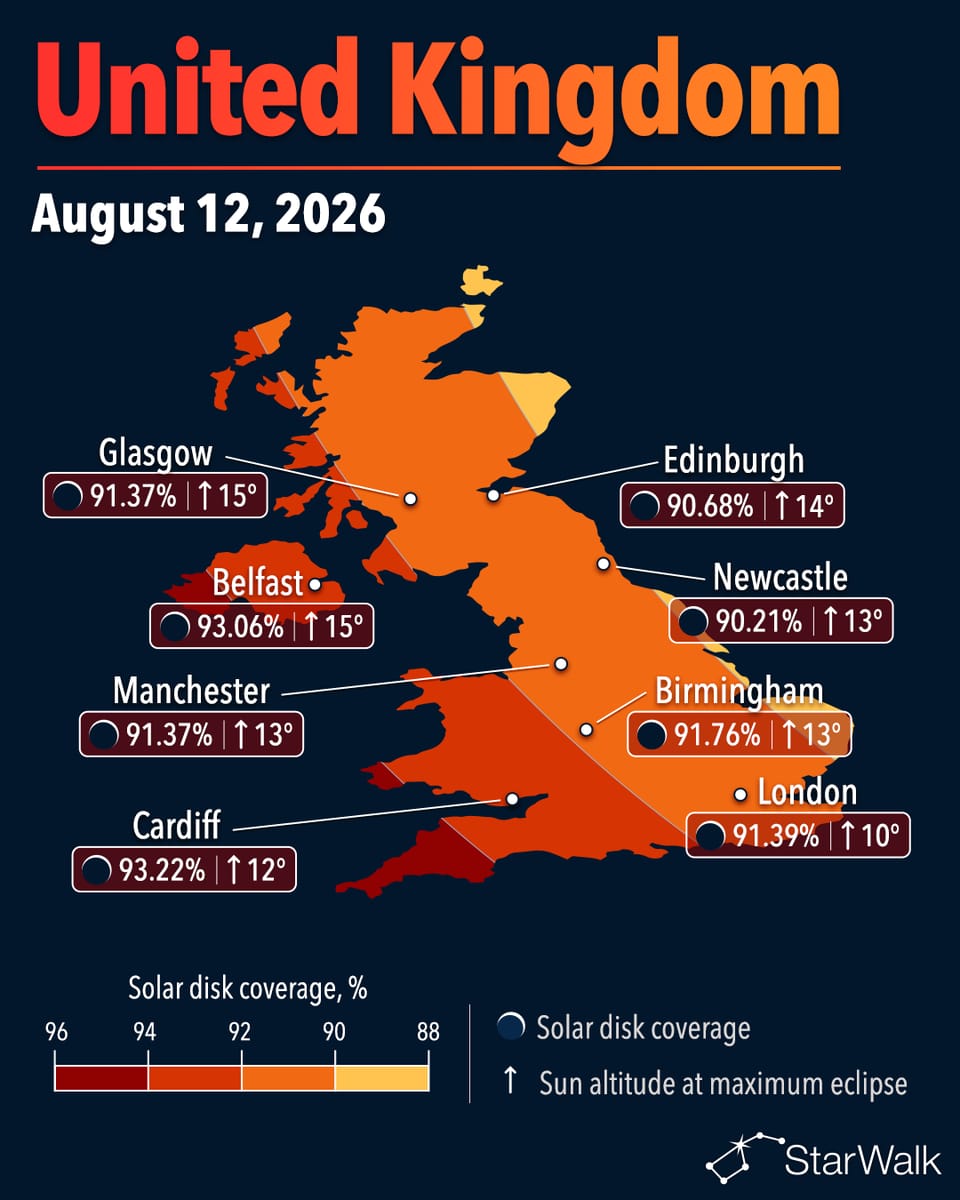
The Isles of Scilly and Cornwall will experience the deepest eclipse in the UK, with approximately 95% to 96.5% of the solar disc covered. Plymouth will see about 95% coverage, while Cardiff and Belfast will get around 93%. In London, Manchester, Glasgow, and Edinburgh, approximately 91% of the Sun will disappear.
Coverage will decrease toward northeastern Scotland and the Northern Isles, but the eclipse will remain impressive even there. In the far northeast of the UK, the Moon will still cover about 88% of the Sun.
At maximum eclipse, the Sun will be only about 10° to 15° above the horizon in most UK locations. Southern England will have some of the lowest views: the Sun will be approximately 10° above the horizon in London and 12° in Plymouth and Cardiff.
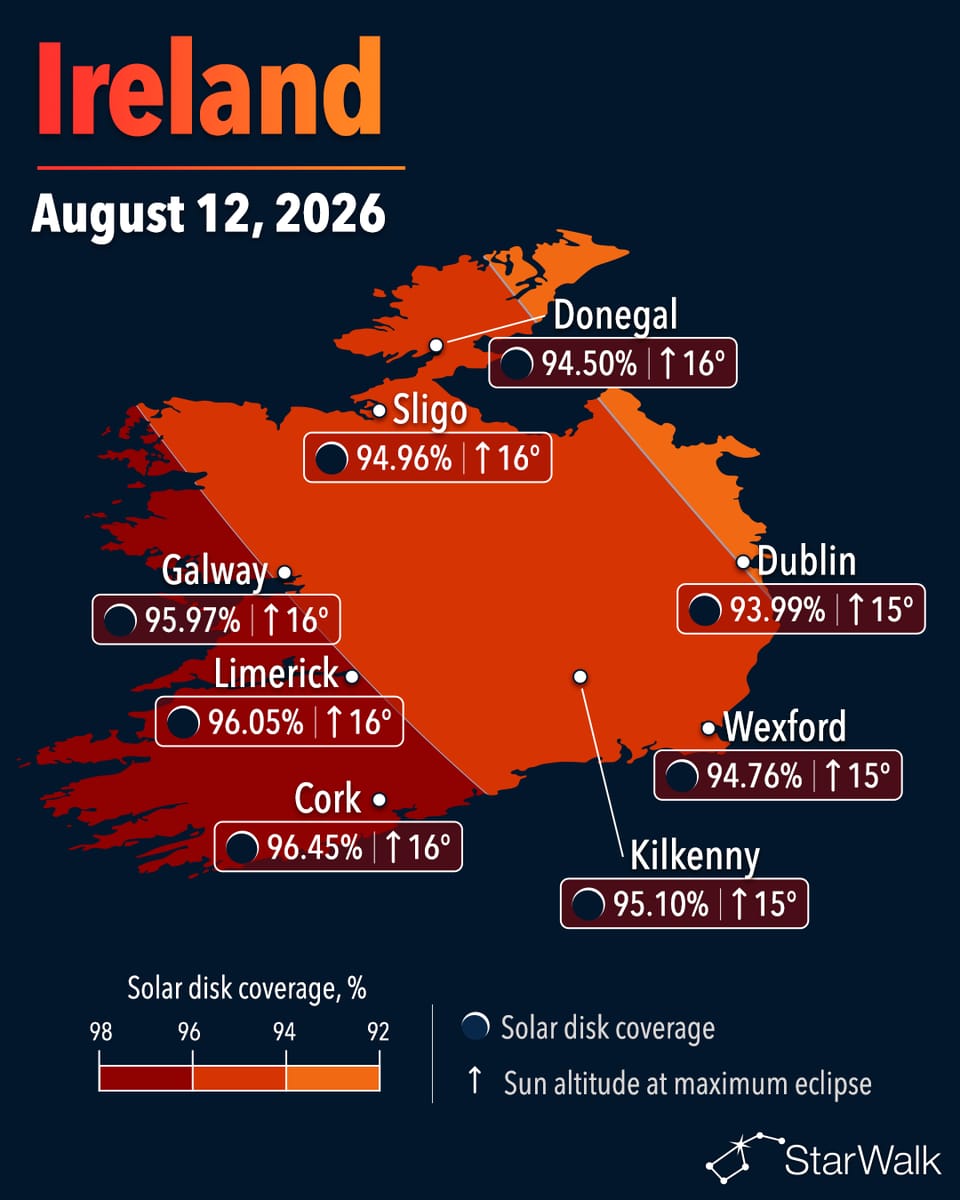
Ireland will generally see a deeper eclipse than most of the UK. The far southwest may experience approximately 97% coverage, while Cork, Galway, and Limerick will see about 96%. Coverage will decrease to around 95% in Sligo, Kilkenny, and Wexford, 94% in Dublin and Donegal, and 93% in Belfast.
The Sun will be slightly higher than in much of southern England, reaching approximately 14° to 16° above the horizon at maximum eclipse. Galway, Sligo, and Donegal will have some of the highest views, with the Sun about 16° above the western horizon.
Across both the UK and Ireland, a clear horizon will matter more than a small difference in coverage. Buildings, hills, trees, haze, or distant clouds could hide the low Sun, so choose an open viewing site and inspect it at the same time of day before the eclipse.
Where will there be fewer clouds in the UK and Ireland during the solar eclipse on 12 August 2026?
For eclipse watchers in the UK and Ireland, the Sun’s altitude and coverage are not the main problems. The clouds are.
Anyone who has ever planned an astronomical observation here will be familiar with the routine: choose the perfect location, check the exact time, prepare the equipment — and then stare at a featureless grey sky.
There is some good news. The partial eclipse will last for about two hours, so you do not necessarily need clear skies at the exact moment of maximum eclipse. Even a brief gap in the clouds could reveal the crescent Sun.
Now for the statistics — because optimism is not a forecasting method.
The estimates below are based on Eclipsophile’s August satellite data and CRU cloud-cover normals for the United Kingdom and Ireland. They are useful for comparing regions, but they do not predict the weather on 12 August 2026.
| Location | Typical August cloud cover | Overall outlook |
|---|---|---|
| Southern and south-eastern England | 60% to 70% | Best cloud prospects overall, although the Sun will be lower and the eclipse slightly less deep |
| The Midlands and eastern England | 65% to 75% | Relatively favourable UK option |
| Eastern and south-eastern Ireland | 65% to 75% | Best climatological option in Ireland |
| Southwest England, Wales and southern Ireland | 70% to 80% | Good balance between a deeper eclipse and cloud risk |
| Western Ireland, Northern Ireland, northern England and Scotland | 75% to 85%, locally close to 90% | Less reliable because of Atlantic cloud and upland weather |
Average August cloud cover is about 74% in both the UK and Ireland, so nowhere offers reliably clear skies. Southern and eastern England have the best statistical prospects in the UK, while eastern and south-eastern Ireland are the least cloudy options across Ireland.
Of course, there is a catch. The eclipse will be deepest over southwest England and southern and western Ireland — precisely where cloud is generally more likely. In other words, you can choose better weather odds or a slightly deeper eclipse. The weather on the British Isles isn’t for the weak.
What you’ll see during the August 2026 solar eclipse
Here is what the partial solar eclipse will look like from the UK and Ireland — assuming, of course, that the clouds agree to move aside.
At first contact, the Moon will appear to take a small “bite” from the right-hand side of the Sun. It will then move across the solar disc from right to left.
At maximum eclipse, only a thin part of the Sun will remain visible. From the UK and Ireland, this bright crescent will look like an inverted arc or a “frown”, with its horns pointing downwards.
The light may become noticeably softer, and the temperature may fall slightly, especially where coverage exceeds 95%. However, the sky will not become dark as it does during totality. Even a narrow uncovered part of the Sun remains intensely bright.
Can I see planets during the partial solar eclipse?
It’s possible to see planets during the partial eclipse, but only briefly around maximum eclipse, and the planets will be much harder to see than they would be during totality.
Brilliant Venus (mag −4.4) will lie east of the eclipsed Sun — far to its left in the sky — about 21° to 25° above the southwestern horizon. It is the planet most likely to become visible to the naked eye as the light fades.
Mercury (mag −1.0) and Jupiter (mag −1.8) will appear close together on the other side of the Sun, low in the west-northwest, with Jupiter slightly higher than Mercury. They may be barely detectable from places where coverage approaches 96% to 97%, such as southwestern Ireland, but they will probably remain lost in the bright sky elsewhere.
Do not look at the sky near the Sun with binoculars or a telescope. If you try to spot Venus, first turn fully away from the Sun, remove the eclipse glasses, and use your unaided eyes only. Put the glasses back on before turning toward the eclipsed Sun. Mercury and Jupiter will lie much closer to the Sun and are unlikely to be naked-eye targets during this partial eclipse.
12 August eclipse map for Europe
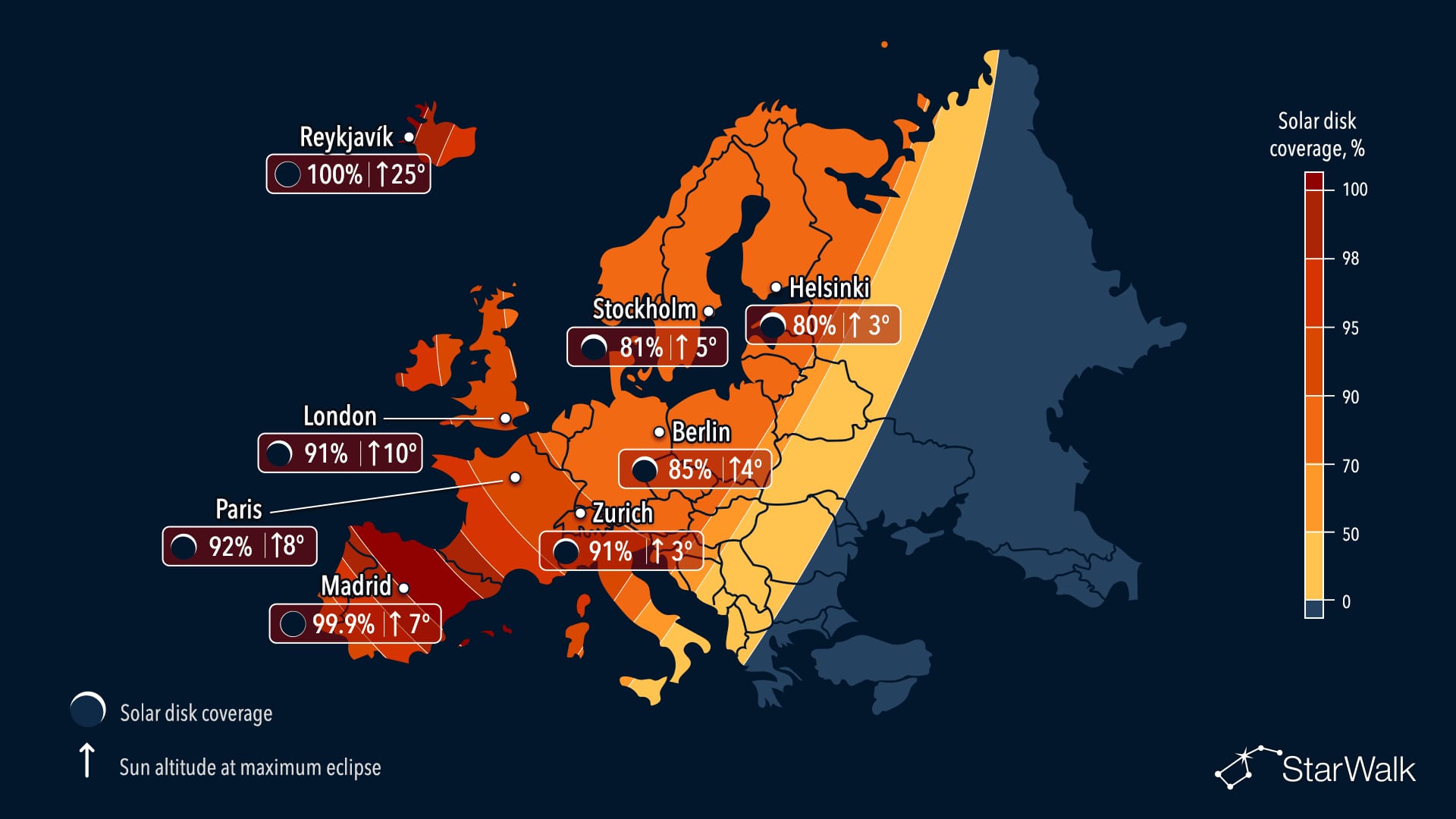
The total solar eclipse on August 12, 2026, will be the first total solar eclipse visible from mainland Europe since 1999. Spain and a small part of northeastern Portugal will be the lucky places to see the totality. There, the eclipse will occur during the golden hour, just before sunset, so the Sun will appear very low in the sky.
The rest of Europe will experience a partial solar eclipse, with a larger portion of the Sun covered closer to the path of totality. The UK and Ireland lie just north of it and will still get an impressive view: about 90% to 96% of the solar disc will disappear, with the deepest eclipse visible from south-western Ireland and south-western England.
Besides Spain and Portugal, the total solar eclipse will be visible over the Arctic Ocean, Greenland, and Iceland. Outside the narrow path of totality, observers will see a partial solar eclipse. Read on to learn the pros and cons of each viewing location.
Total solar eclipse on 12 August 2026: global timings and path
On 12 August 2026, the Moon will pass between the Earth and the Sun. Within the path of totality, it will obscure the entire solar disc for a few seconds or minutes, depending on the location. Outside this path, the eclipse will be partial.
Even with 99.9% coverage, the solar corona will not be visible. The rapid darkening of the sky, the Diamond Ring effect and Baily’s beads can only be seen within the path of totality.
Across the globe, the eclipse will last for more than four hours, and the path of totality will stretch from the Arctic to the Iberian Peninsula. Below are the global timings and the full path of the eclipse.
August 12, 2026 eclipse path
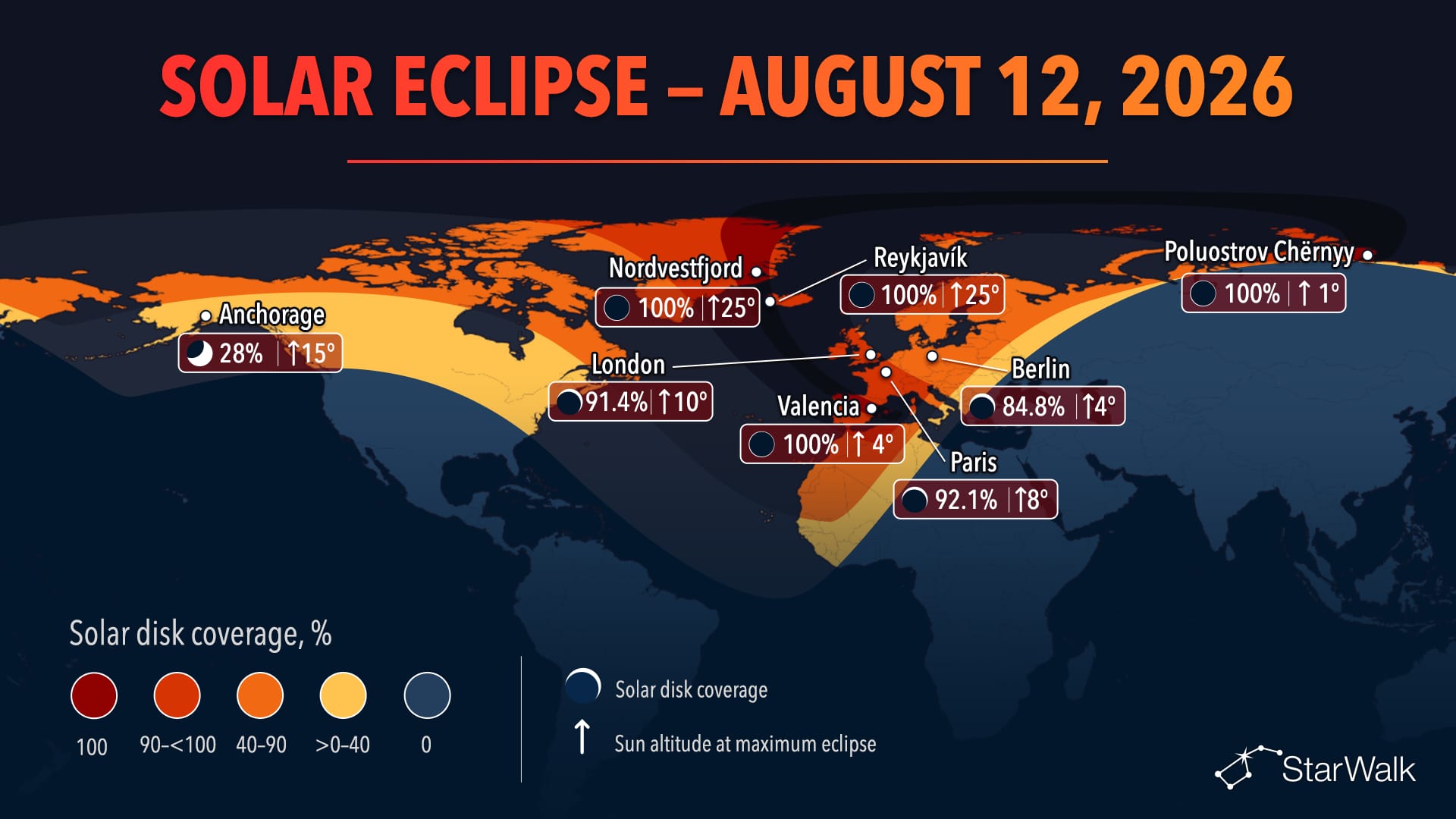
The total solar eclipse on 12 August 2026 will be the first total solar eclipse visible from mainland Europe since 1999. Spain and a small part of northeastern Portugal will be the lucky places to see the totality. There, the eclipse will occur during the golden hour, just before sunset, so the Sun will appear very low in the sky.
In addition to Spain and Portugal, the total solar eclipse will be visible over the Arctic Ocean, Greenland, and Iceland. Outside the narrow path of totality, observers will see a partial solar eclipse. Read on to learn the pros and cons of each viewing location.
What time is the solar eclipse on August 12 2026
- The eclipse begins as a partial eclipse at 15:34 GMT;
- Totality — the most spectacular part of the eclipse — begins at 16:58 GMT;
- The greatest eclipse occurs at 17:46 GMT;
- Totality ends at 18:34 GMT;
- The partial eclipse ends at 19:57 GMT.
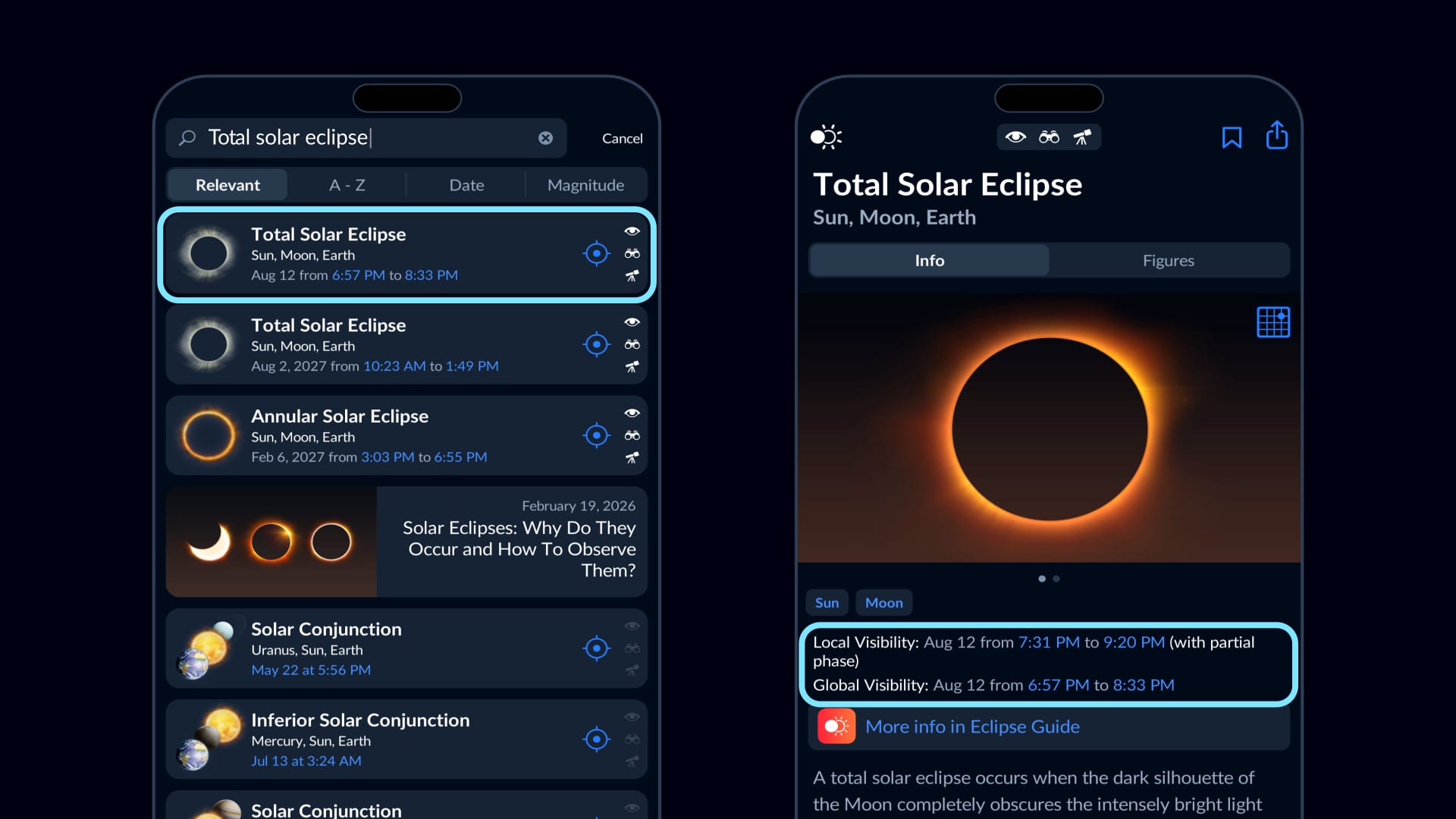
Exact local times depend on your location, so travelers should check city-specific eclipse times before choosing a viewing site. The exact times of the eclipse for your location can be found in the free Sky Tonight app.
Where will the 2026 total solar eclipse be visible?
The path of totality begins at sunrise over remote Arctic Russia near the Taymyr Peninsula and the Laptev Sea, then sweeps across the Arctic Ocean, passing close to the North Pole. It then crosses Greenland and reaches western Iceland before continuing across the Atlantic and crossing northern Spain. The path ends near the Balearic Islands. This path covers approximately 8,300 kilometers (5,157 miles) and takes 96 minutes to travel across the planet’s surface.
The main land-based regions for eclipse travelers are Greenland, Iceland, and Spain. Each offers a different viewing experience. Greenland has remote wilderness and potentially favorable weather conditions in Scoresby Sund; Iceland offers dramatic landscapes with the Sun relatively high in the sky; and Spain statistically has more hours of sunshine in August, but the Sun will be very low at sunset during the eclipse.
A tiny part of northeastern Portugal also lies inside the path of totality, but most of Portugal will see only a deep partial eclipse, so it is more of a technical edge case than a major travel destination.
Best places to see the August 2026 total solar eclipse
| Location | Totality duration | Time of maximum eclipse | Sun altitude |
|---|---|---|---|
| Nordvestfjord, Greenland | 2 min 16 sec | 4:32 p.m. EGST | 24.8° |
| Ella Island, Greenland | 1 min 45 sec | 4:31 p.m. EGST | 23.7° |
| Saxhóll Crater, Iceland | 2 min 8 sec | 5:45 p.m. GMT | 25.4° |
| Reykjavík, Iceland | 1 min | 5:48 p.m. GMT | 24.6° |
| Geirfuglinn, Reykjanes Peninsula, Iceland | 1 min 41 sec | 5:48 p.m. GMT | 25° |
| Mirador del Sablón, Asturias, Spain | 1 min 48 sec | 8:26 p.m. CEST | 10.7° |
| Becerril de Campos, Spain | 1 min 42 sec | 8:29 p.m. CEST | 8.9° |
| Castillo de Osma, Spain | 1 min 43 sec | 8:29 p.m. CEST | 7.5° |
| Segovia, Spain | 59 sec | 8:31 p.m. CEST | 7.9° |
| S’Arenal, Mallorca, Spain | 1 min 36 sec | 8:31 p.m. CEST | 2.4° |
Times are local. Exact timing, duration, and Sun altitude vary by precise viewing spot, so check your chosen location in Sky Tonight before traveling.
Spain: best overall weather, but a low Sun
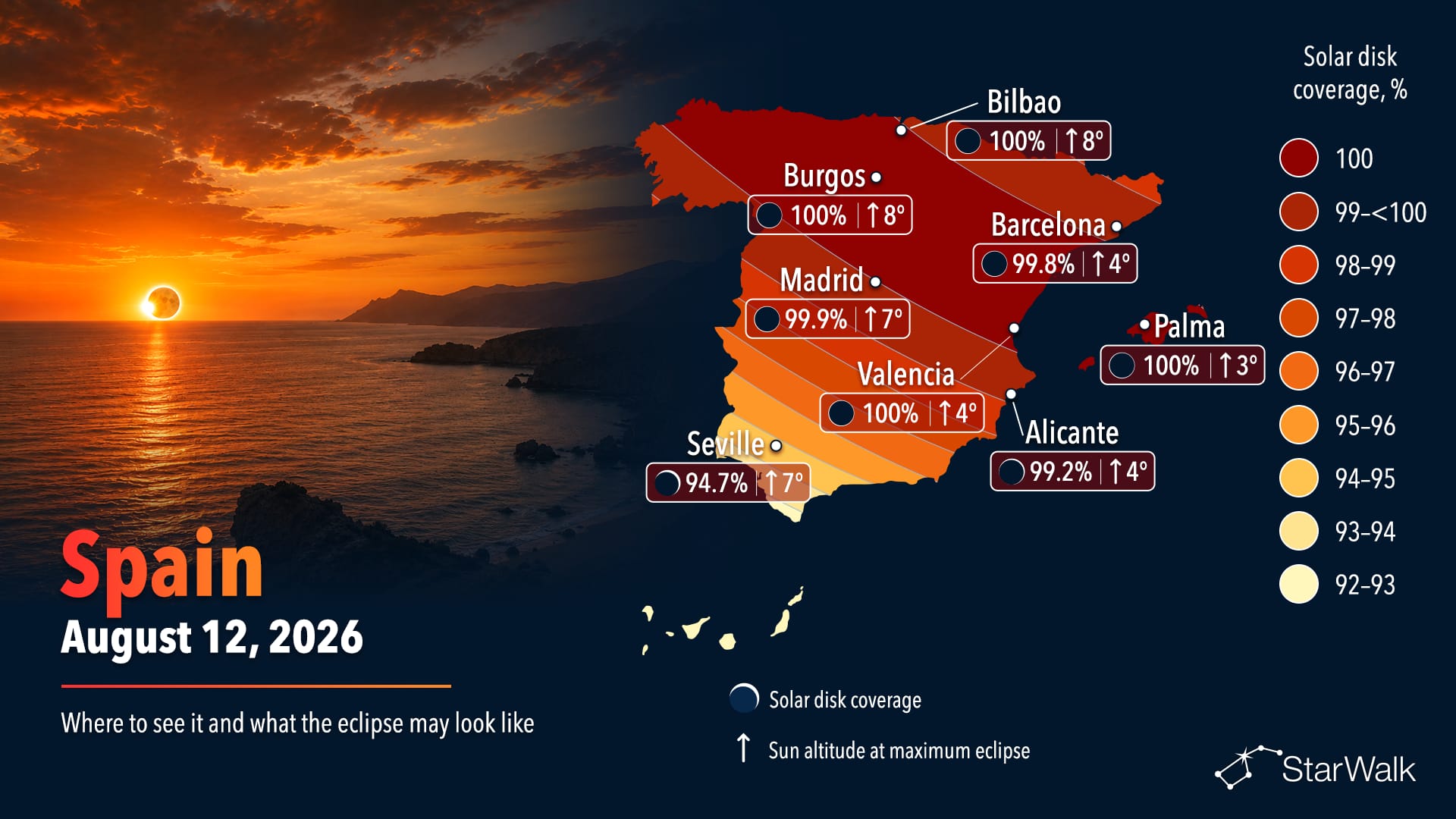
Spain is likely to be one of the most accessible places to view the total solar eclipse on August 12, 2026, offering the best balance of convenience for European travelers and clear-sky potential. The main issue in Spain is the altitude of the Sun. During totality, the Sun will be low above the western horizon throughout Spain, ranging from approximately 10° on the northern coast to a few degrees in the Balearic Islands. Therefore, choose a site with a clear west or west-northwest horizon and scout the location in advance at the same time of day.
-
Mirador del Sablón, Asturias — 1 minute 48 seconds of totality. Totality begins at about 8:26 p.m. CEST. This coastal viewpoint near Cudillero offers a dramatic view over the Cantabrian Sea, with the eclipsed Sun about 10° above the west-northwest horizon.
-
Muriel Viejo, Soria — 1 minute 44 seconds of totality. Totality begins at about 8:29 p.m. CEST. A strong inland option with high ground and open views; the Sun will be about 7° above the west-northwest horizon.
-
S’Arenal, Mallorca — 1 minute 36 seconds of totality. Totality begins at about 8:31 p.m. CEST. This is one of the most practical Balearic options, with a sea-level view toward the west-northwest, but the Sun will be only 2° above the horizon, so even small obstructions or haze could be a problem.
-
Arcos de las Salinas, Teruel — 1 minute 23 seconds of totality. Totality begins at about 8:31 p.m. CEST. It is a good option for those interested in astronomy, thanks to the Galactic Astronomy Center located in the village. However, the eclipsed Sun will sit low, at about 5° above the horizon.
-
Segovia / Zamarramala, Castile and León — 59 seconds of totality. Totality begins at about 8:31 p.m. CEST. Segovia offers an iconic backdrop, while nearby Zamarramala may be better for open sightlines; the Sun will be about 8° high.
Greenland: remote, dramatic, and best for expedition travel
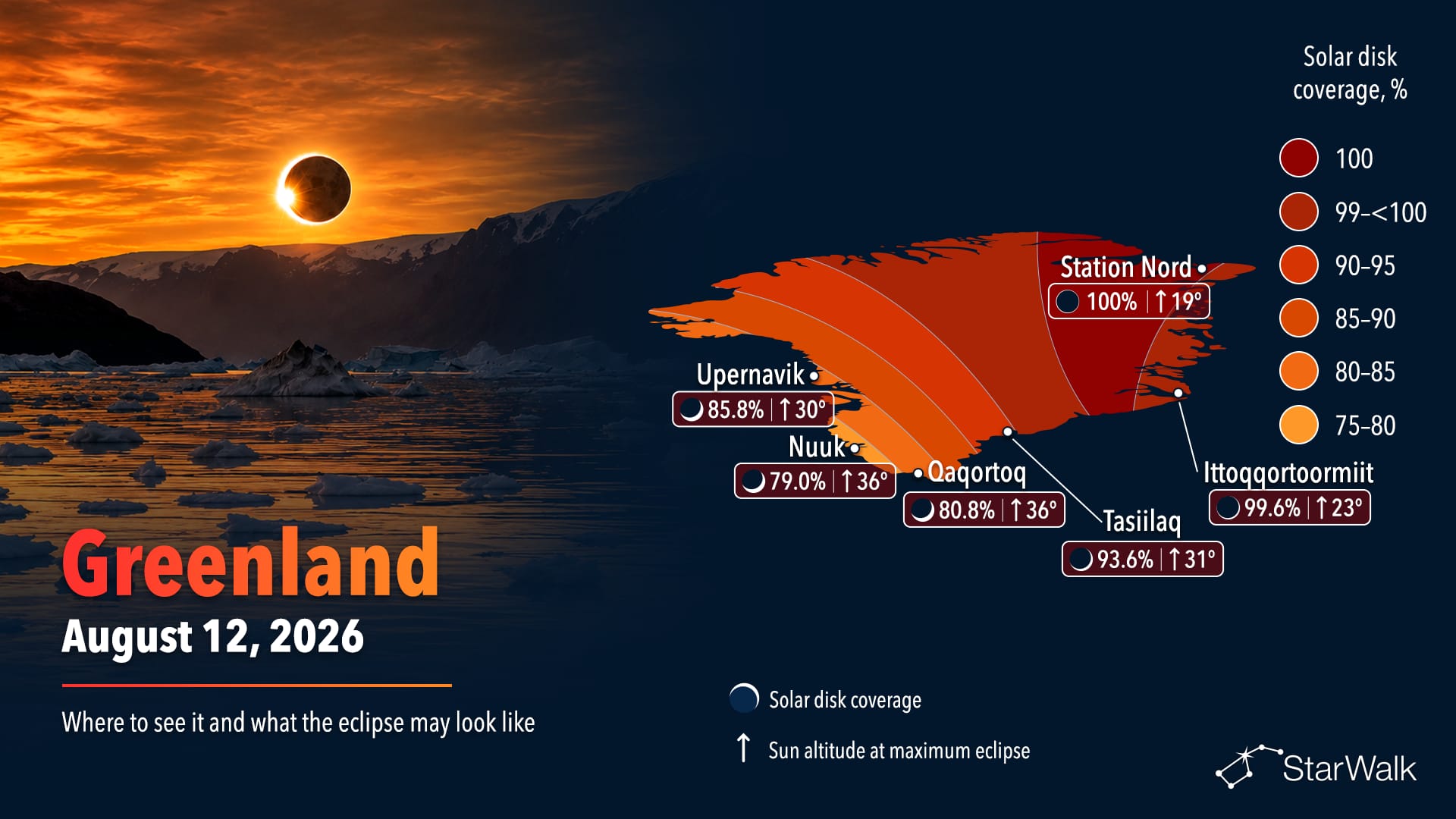
Greenland offers some of the most spectacular eclipse scenery, but it’s not an easy destination. The best sites are remote fjords, so most travelers will need to join an expedition cruise. For weather, the inner parts of Scoresby Sund look more promising than the coast, but eclipse-day forecasts will still be crucial.
-
Nordvestfjord, Scoresby Sund — 2 minutes 16 seconds of totality. Totality begins at about 4:32 p.m. EGST. This is one of the strongest Greenland options because it lies close to the centerline in the vast Scoresby Sund fjord system, but it will realistically require an expedition cruise.
-
Ella Island, King Oscar Fjord — 1 minute 45 seconds of totality. Totality begins at about 4:31 p.m. EGST. This is another Arctic option, located at the meeting point of several iceberg-filled fjords, but it is also accessible only by polar expedition cruise.
Iceland: beautiful landscapes, but cloud risk
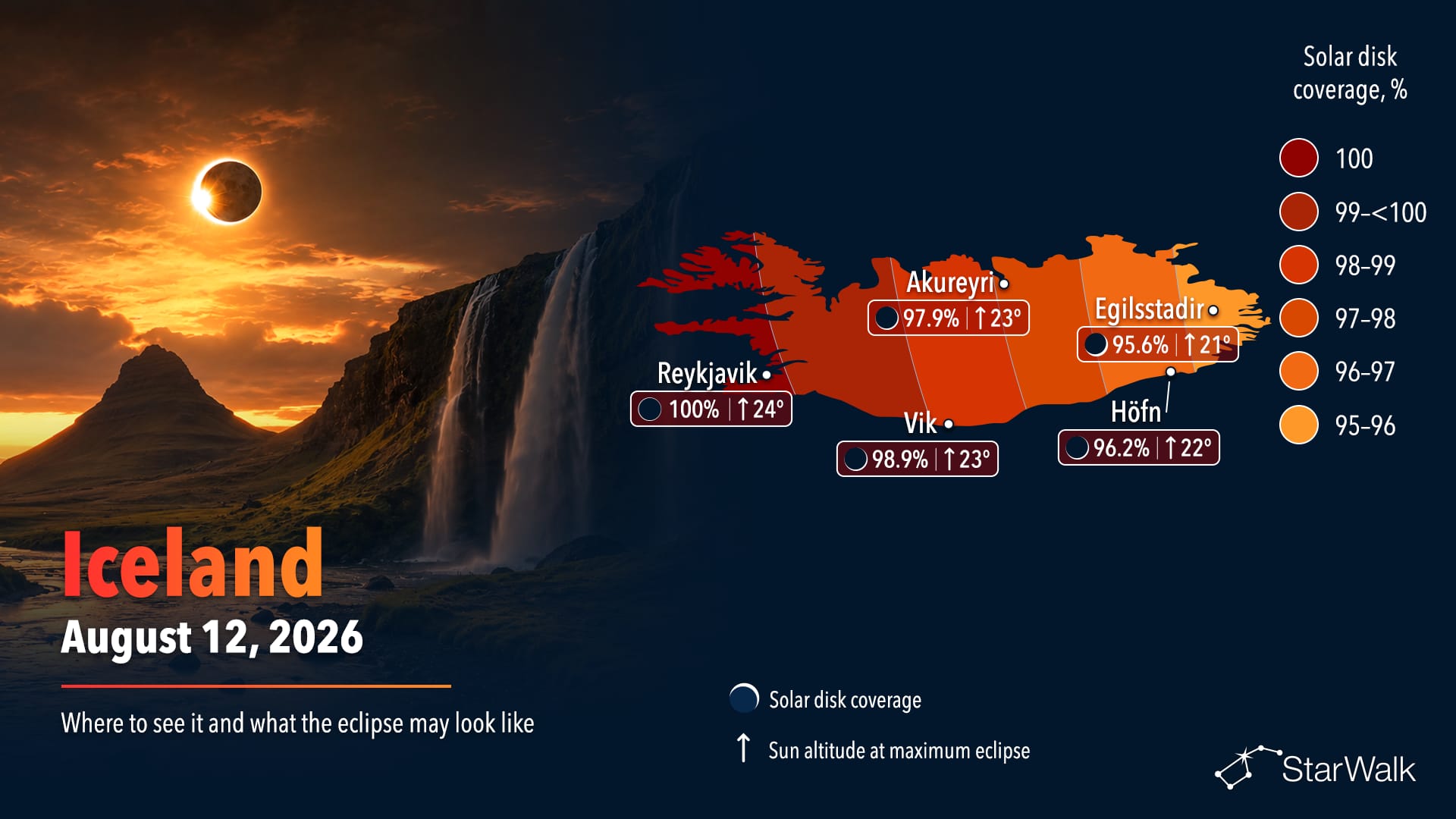
Iceland will be one of the most popular destinations for the 2026 total solar eclipse. Reykjavík, the capital of Iceland, lies within the path of totality, with about 1 minute of totality, and the Sun stays relatively high (roughly 25 degrees) above the western horizon, which is much more comfortable than the low-sunset view in Spain.
The main downside is the weather. Iceland is cloudy and frequently affected by North Atlantic weather systems, although local geography can create clearer areas on the leeward side of peninsulas. A flexible plan and the ability to move on eclipse day will be important.
-
Saxhóll Crater, Snæfellsnes Peninsula — 2 minutes 8 seconds of totality. Totality begins at about 5:45 p.m. GMT. This is one of the best Iceland options for duration, located near the western tip of the Snæfellsnes Peninsula inside Snæfellsjökull National Park.
-
Geirfuglinn / The Great Auk, Reykjanes Peninsula — 1 minute 41 seconds of totality. Totality begins at about 5:48 p.m. GMT. This spot near Reykjanes Lighthouse is a scenic coastal option and one of the last places in Iceland to experience totality.
-
Reykjavík Domestic Airport / Reykjavík coastline — 1 minute of totality. Totality begins at about 5:48 p.m. GMT. The airport is just 2 km from the city center and has the southwest-facing coastline, perfect for watching the eclipse.
-
Hallgrímskirkja church, Reykjavík — 57 seconds of totality. Totality begins at about 5:48 p.m. GMT. The church area offers a recognizable city landmark, though the totality is short, and access to the tower may be limited.
-
Mount Helgafell, Hafnarfjörður / Reykjanes Peninsula — 55 seconds of totality. Totality begins at about 5:48 p.m. GMT. This volcanic hill offers wide views over Reykjavík, Faxaflói Bay, and the Reykjanes Peninsula, but it requires a hike.
Weather: where are the best chances for clear skies?
| Location | Average August cloud coverage | Outlook |
|---|---|---|
| Ebro Valley, Spain | Below 30% in the clearest central areas | Best overall option |
| Central Meseta, Spain | Around 35% near the central line | Very good inland option |
| Balearic Islands, Spain | 30% to 40% across the islands | Good weather, risky horizon |
| Scoresby Sund, Greenland | 45–50% in the inner fjords; about 65% near Ittoqqortoormiit | Best Greenland option |
| Iceland | Around 70–80% average cloud cover | Scenic but risky |
| Northern Spain coast | Close to 60% | Less reliable |
Note: These numbers are climatological averages, not an eclipse-day forecast. For Spain, the overhead sky can look clear while the low Sun is still blocked by distant clouds, smoke, dust, terrain, or a tree line. Check high-resolution forecasts and satellite imagery close to the event, and be ready to move if conditions change.
Will there be a partial eclipse in August 2026?
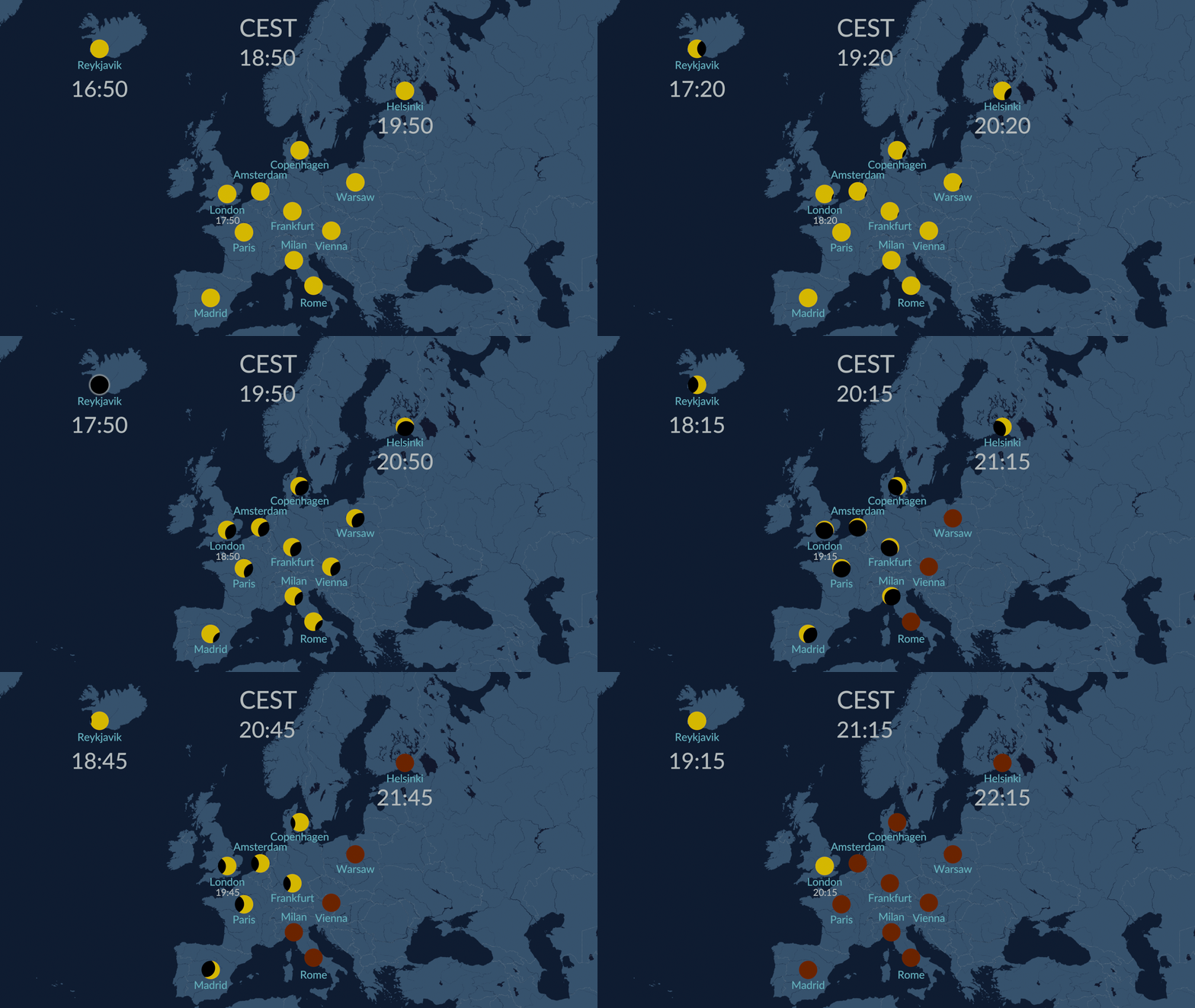
A partial solar eclipse will be visible across much of Europe, as well as parts of North America, Greenland, and North Africa. Some cities outside the path of totality will still see a very deep partial eclipse, but only locations inside the narrow path of totality will see the Sun completely covered.
| Location | Sun coverage | Eclipse starts | Maximum eclipse | Eclipse ends |
|---|---|---|---|---|
| New York City, USA | 9% | 1:07 p.m. EDT | 1:54 p.m. EDT | 2:38 p.m. EDT |
| St. John’s, Newfoundland, Canada | 53% | 2:28 p.m. NDT | 3:34 p.m. NDT | 4:37 p.m. NDT |
| Nuuk, Greenland | 79% | 3:30 p.m. WGST | 4:35 p.m. WGST | 5:39 p.m. WGST |
| Oslo, Norway | 83% | 7:02 p.m. CEST | 7:57 p.m. CEST | 8:49 p.m. CEST |
| Berlin, Germany | 84% | 7:15 p.m. CEST | 8:08 p.m. CEST | 8:38 p.m. CEST (sunset) |
| London, U.K. | 91% | 6:17 p.m. BST | 7:13 p.m. BST | 8:06 p.m. BST |
| Paris, France | 92% | 7:22 p.m. CEST | 8:17 p.m. CEST | 9:11 p.m. CEST (sunset) |
| Tangier, Morocco | 92% | 6:44 p.m. WEST | 7:40 p.m. WEST | 8:16 p.m. WEST (sunset) |
| Dublin, Ireland | 94% | 6:12 p.m. IST | 7:10 p.m. IST | 8:05 p.m. IST |
| Lisbon, Portugal | 94% | 6:39 p.m. WEST | 7:36 p.m. WEST | 8:29 p.m. WEST (sunset) |
| Nice, France | 95% | 7:30 p.m. CEST | 8:24 p.m. CEST | 8:39 p.m. CEST (sunset) |
| Madrid, Spain | 99.98% | 7:36 p.m. CEST | 8:32 p.m. CEST | 9:16 p.m. CEST (sunset) |
| Barcelona, Spain | 99.85% | 7:35 p.m. CEST | 8:29 p.m. CEST | 8:54 p.m. CEST (sunset) |
Where “sunset” is indicated, the Sun will set while the partial eclipse is still in progress, so the final stages will not be visible.
A partial eclipse is still worth watching, but it is not the same experience as totality. Even 99% coverage is still a partial eclipse: only locations inside the narrow path of totality will see the Sun’s corona appear around the Moon.
How to watch the 2026 solar eclipse safely
Never look directly at the Sun during the partial phases of a solar eclipse without proper eye protection. Use eclipse glasses or handheld solar viewers that comply with the ISO 12312-2 standard, and buy them directly from trusted manufacturers or authorized dealers. The American Astronomical Society warns that buying random eclipse glasses from online marketplaces or unverified sellers is not worth the risk to your eyes.
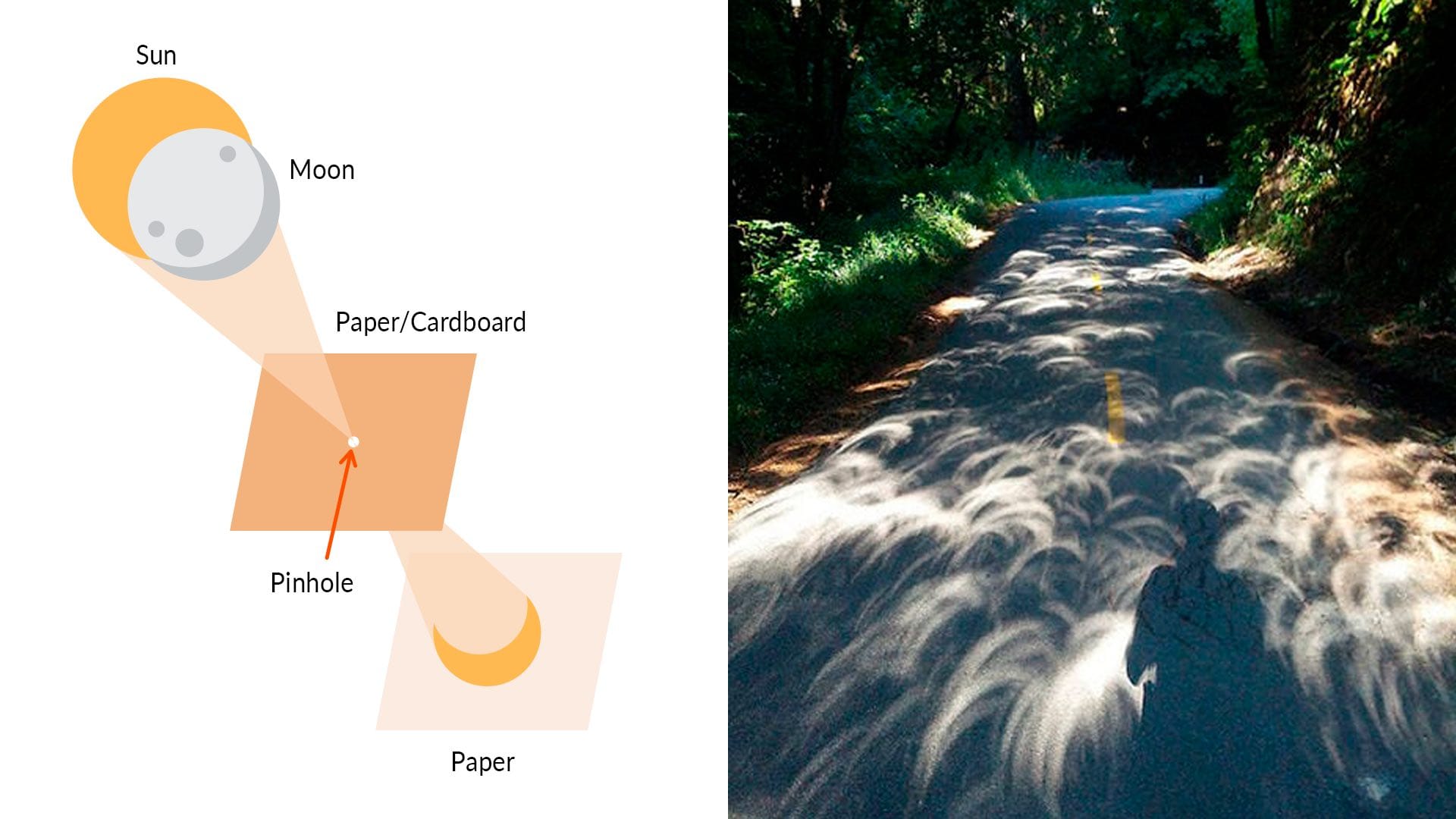
If you don’t have eclipse glasses, you can use indirect viewing methods like a pinhole projector — a simple device made by poking a hole in a piece of cardboard to project the Sun’s image onto a flat surface. You can also observe tree shadows, as small gaps between their leaves will naturally project crescent-shaped eclipse patterns on the ground.
Do not look at the Sun through an unfiltered camera, binoculars, telescope, or other optical device — even if you are wearing eclipse glasses. Magnifying optics need a proper solar filter mounted securely over the front of the lens.
What happens on August 12, 2026? Eclipse, planet parade and Perseid meteors
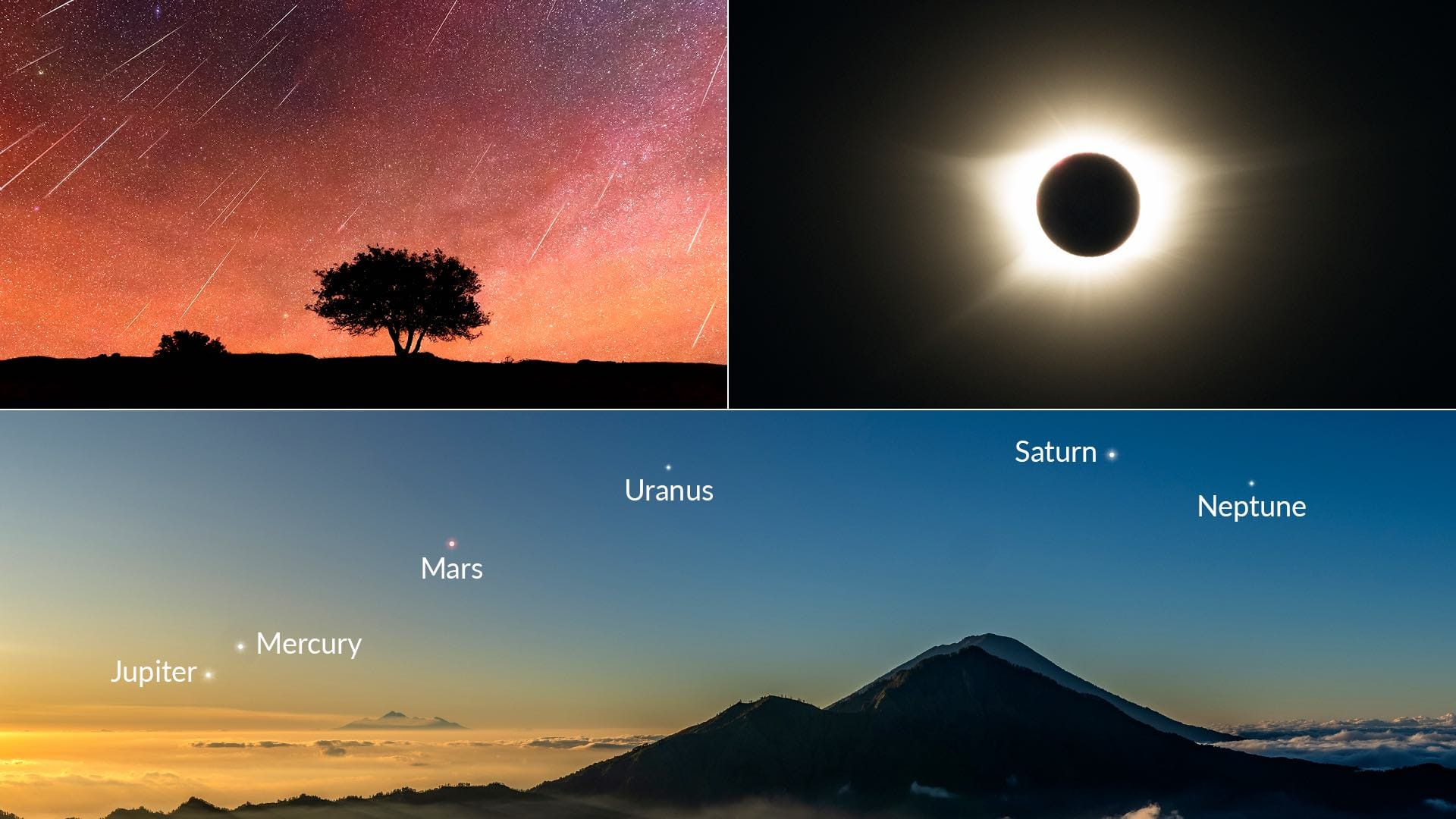
The total solar eclipse won’t be the only sky event on August 12, 2026. The day begins with a six-planet alignment before sunrise and ends with one of the best meteor showers of the year: the Perseids. See our complete guide to all three astronomy events on August 12, 2026 to plan the whole day.
Before dawn, Jupiter, Mercury, Mars, Uranus, Saturn, and Neptune will stretch across the sky in a long line from the east toward the southwest. Saturn and Neptune rise first, around midnight, followed later by Uranus and Mars. Shortly before sunrise, Jupiter and Mercury appear near the eastern horizon, completing the lineup. Jupiter, Mars, Mercury, and Saturn should be visible to the naked eye, while Uranus and Neptune will require binoculars or a small telescope.

After the eclipse, the night brings the Perseid meteor shower. In 2026, viewing conditions are excellent: the New Moon falls on August 12, so moonlight won’t wash out the meteors. The Perseids are active for several weeks, but the best viewing comes around August 12–13, especially from late night until dawn, when the radiant in Perseus climbs higher in the sky.
Under a dark, moonless sky, observers can often see around 80 meteors per hour or more near the peak. Many Perseid meteors are bright, colorful, and leave long-lasting trails, which makes this meteor stream one of the most popular annual sky events in the Northern Hemisphere. For the best view, get away from city lights, and let your eyes adapt to the dark.
FAQ: August 12, 2026 total solar eclipse
When is the next total solar eclipse?
The next total solar eclipse is on August 12, 2026. Totality will be visible from parts of the Arctic, Greenland, Iceland, Spain, and the Balearic Islands. The next total solar eclipse after this one will take place on August 2, 2027, and will be visible in southern Spain, North Africa (including Morocco, Algeria, Tunisia, Libya, and Egypt), Saudi Arabia, and Yemen.
Learn more: Check the upcoming eclipses schedule and learn where each eclipse will be visible.
How long will the 2026 total solar eclipse last?
The maximum duration of totality will be about 2 minutes and 18 seconds, near the Denmark Strait — a channel partially within the Arctic Circle, lying between Greenland and Iceland. The duration will be shorter in many densely populated viewing locations, such as Reykjavík, northern Spain, and the Balearic Islands.
Is Spain a good place to see the 2026 total solar eclipse?
Yes, Spain is one of the most practical places to see the eclipse because it has relatively favorable August weather and many accessible viewing locations. However, the Sun will be very low in the sky, so you must choose a site with a clear western horizon.
Is Iceland a good place to see the 2026 eclipse?
Iceland is a spectacular option, especially around Reykjavík, Reykjanes, and Snæfellsnes. The Sun will be higher there than in Spain. However, there is a risk of clouds, so flexibility and weather monitoring are essential.
Can I see the eclipse from London, Paris, or Berlin?
Yes, but it will only be a partial eclipse. There will be 91% solar coverage in London, 92% in Paris, and 84% in Berlin. To see a total eclipse, you must travel to the path of totality.
Is the 2026 solar eclipse visible in the US?
A partial solar eclipse will be visible from Alaska to New England, touching 26 U.S. states. While for observers in Europe, the August 12, 2026, solar eclipse will occur around sunset, in most of the US, it will take place in the afternoon. In Alaska, the eclipse will happen in the morning as the Sun is rising, making it a “sunrise solar eclipse.”
Is the 2026 solar eclipse visible in Canada?
A partial solar eclipse will be visible from Toronto, Montréal, Ottawa, Québec City, Calgary, Edmonton, Halifax, and St. John’s. It will be deepest in northern and eastern Canada, reaching about 53% coverage in St. John’s. Vancouver will miss the eclipse, and totality will not be visible anywhere in Canada. The eclipse will occur in the morning across western Canada, around midday in central regions, and during the afternoon in eastern Canada. Exact times and coverage will vary considerably by location.
Do I need eclipse glasses?
Yes — during every partial phase. If you are inside the path of totality, keep your eclipse glasses on until the Moon completely covers the Sun’s bright surface; then remove them to view totality. Put them back on immediately as soon as any bright sunlight reappears. Outside the path of totality, use proper solar protection whenever you look at the Sun.
Learn more: How to watch a solar eclipse safely
Is 99% solar eclipse the same as totality?
No. Even if 99% of the Sun is covered, it is still a partial solar eclipse. Only inside the path of totality can you experience totality itself and briefly see the solar corona, when the Moon completely covers the Sun’s bright disk.
What are the Diamond Ring and Baily’s Beads effect?
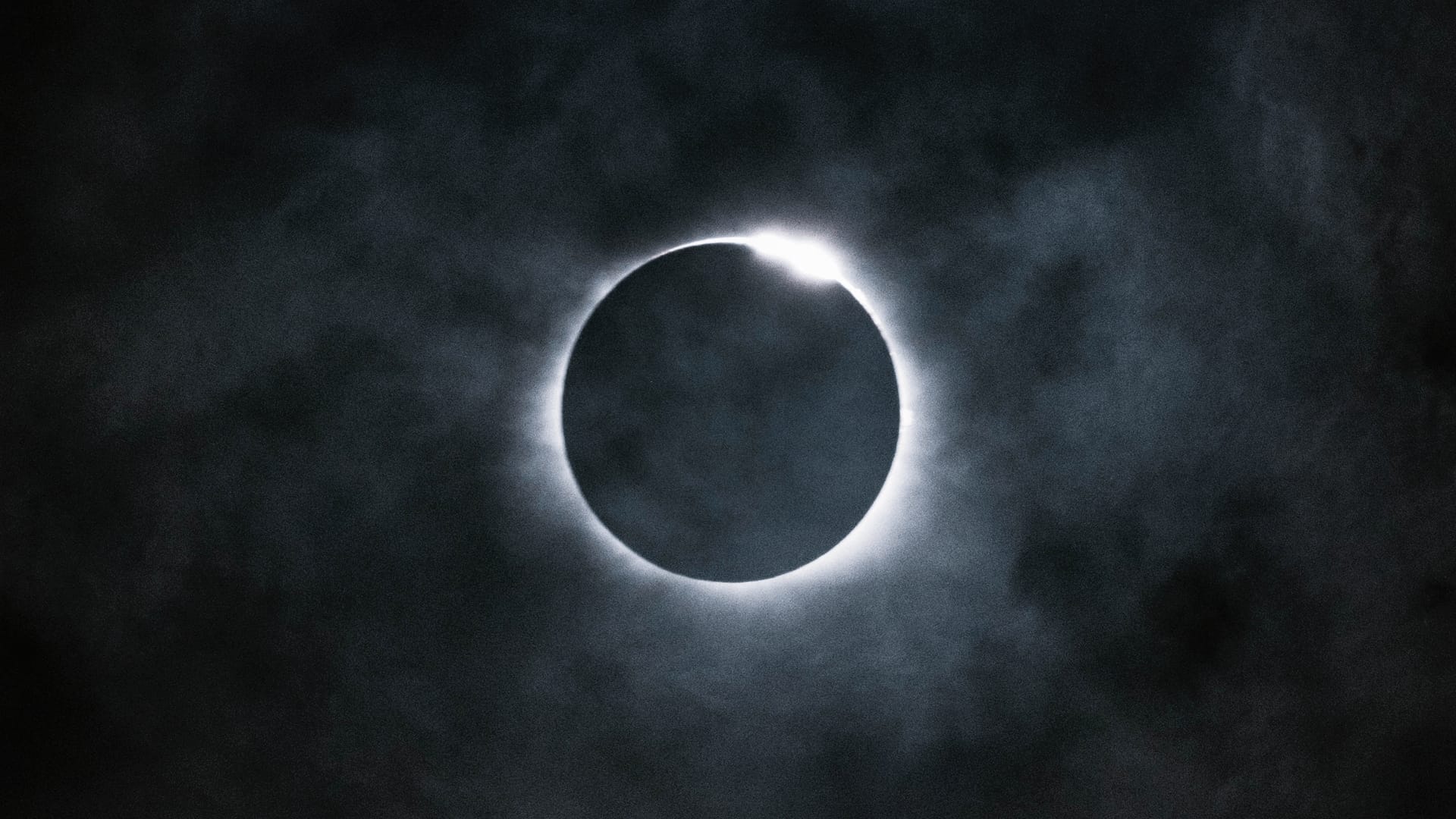
The Moon’s edge is rugged, with mountains and valleys. Just before the lunar disc completely covers the Sun, the last bits of sunlight pass through these valleys, creating bright spots that look like a string of beads. These are called Baily’s Beads, after English astronomer Francis Baily, who explained the phenomenon.
The diamond ring effect appears when only one “bead” remains, shining like a diamond set in the glowing ring of the solar corona.
Is the 12 August 2026 solar eclipse in Leo?
Astronomically, the Sun and Moon will be positioned against the background of the constellation Leo during the eclipse. Leo itself will not be visible because it lies in the daytime sky behind the Sun.
In astrology, the event is commonly described as a solar eclipse in Leo and is associated with themes such as confidence, creativity, and self-expression. These interpretations belong to astrology, which is a cultural belief system rather than a scientific method; they are not part of astronomical eclipse predictions.
12 August 2026 solar eclipse in the UK and Ireland: bottom line
On the evening of 12 August 2026, the UK and the entire island of Ireland will see an exceptionally deep partial solar eclipse — and nothing comparable will be visible here again until 2081. Between roughly 6:00 p.m. and 8:00 p.m., the Moon will cover about 88% to 97% of the Sun, leaving a thin, inverted crescent above the western horizon.
The deepest eclipse will occur over southwestern Ireland, Cornwall, and the Isles of Scilly. However, an extra percentage point of coverage matters far less than clear sky. The best observing site is the one with fewer clouds and an unobstructed view west to west-northwest — so prepare a backup location and be ready to move if the forecast demands it. British and Irish weather rarely rewards loyalty to a single postcode.
Use certified eclipse glasses throughout the entire event: there is no safe naked-eye viewing phase anywhere in the UK or Ireland. Check the exact times, Sun position, and coverage for your location in the Sky Tonight app.
And make a day of it. A six-planet alignment before sunrise, the eclipse in the evening, and the Perseid meteor shower after dark make 12 August one of the biggest skywatching dates of 2026 — provided, naturally, that the clouds have other plans.
12 August 2026 solar eclipse: key facts
- Date: Wednesday, 12 August 2026
- Eclipse type: Total solar eclipse (deep partial solar eclipse in the UK and Ireland)
- Maximum totality length: 2 minutes 18 seconds
- Greatest eclipse: 17:46 GMT
- Totality visible from: Arctic Russia, Greenland, Iceland, the northeastern tip of Portugal, northern Spain, the Balearic Islands
- Partial eclipse visible from: Much of Europe, parts of North America, and other Northern Hemisphere regions
- Main viewing challenge: Weather in Greenland/Iceland; low Sun and horizon obstructions in Spain
- Essential equipment: ISO 12312-2 certified eclipse glasses or another safe solar-viewing method