Full Moon Calendar 2026: When Is the Next Full Moon?
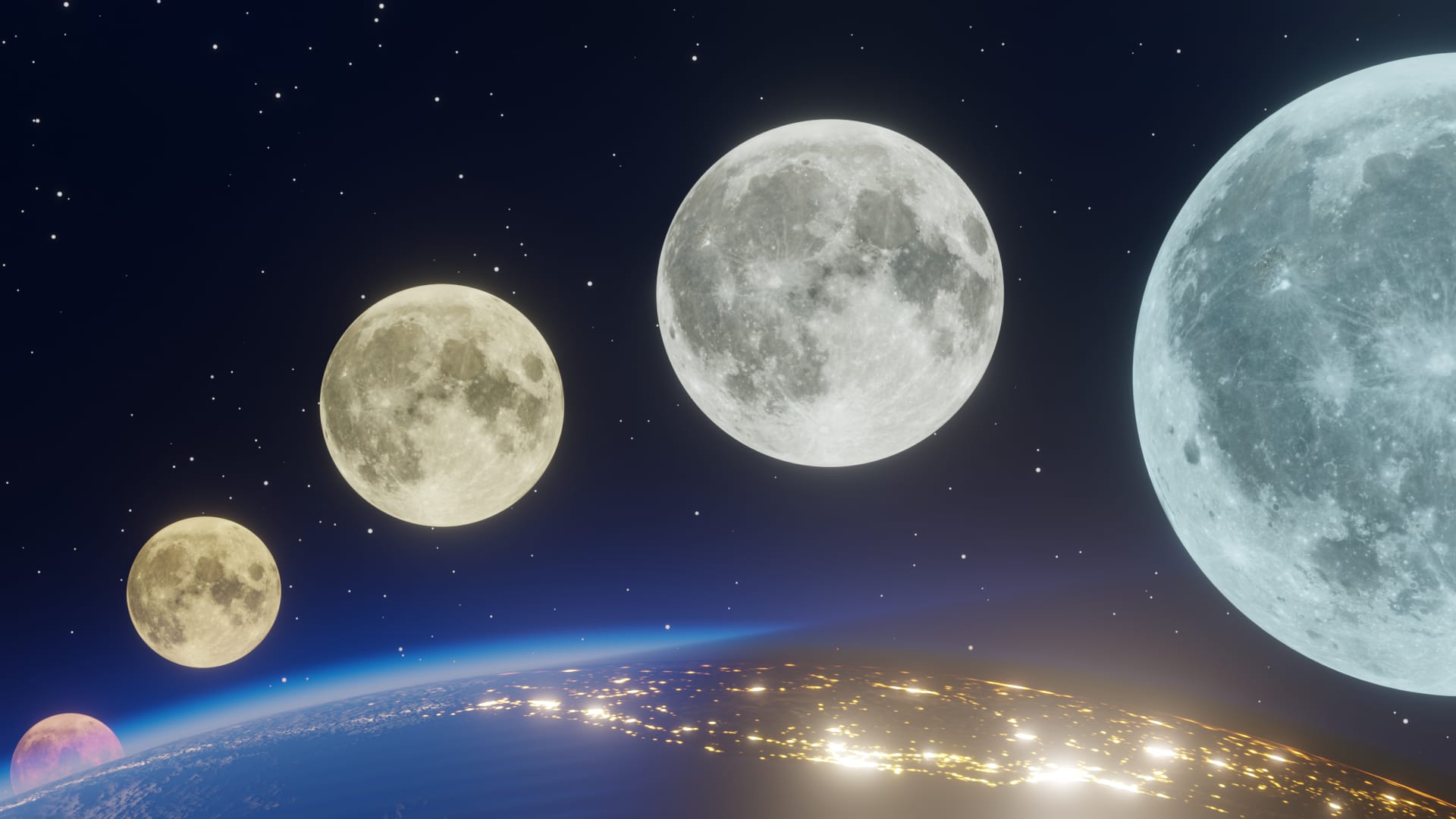
Explore the Full Moons of 2026! Here you'll find the exact dates of Full Moons, their traditional names, and the celestial events surrounding them that make every Full Moon special. Want to make sure you don't miss a moonrise? Check the Moon's local visibility in the free Sky Tonight app. Let's get started!
Contents
- Full Moon Schedule 2026
- Full Moon 2026 Names
- When Is the Next Full Moon 2026?
Full Moon Calendar 2026: A Detailed Guide to the Full Moons of 2026
- Full Moon on January 3, 2026: Wolf Moon, Supermoon
- Full Moon on February 1, 2026: Snow Moon
- Full Moon on March 3, 2026: Worm Moon + Total Lunar Eclipse (“Blood Moon”)
- Full Moon on April 2, 2026: Pink Moon
- Full Moon on May 1, 2026: Flower Moon, Micromoon
- Full Moon on May 31, 2026: Blue Moon, Micromoon
- Full Moon on June 29, 2026: Strawberry Moon, Micromoon
- Full Moon on July 29, 2026: Buck Moon
- Full Moon on August 28, 2026: Sturgeon Moon
- Full Moon on September 26, 2026: Harvest Moon
- Full Moon October 26, 2026: Hunter’s Moon
- Full Moon on November 24, 2026: Beaver Moon, Supermoon
- Full Moon on December 24, 2026: Cold Moon, Christmas Eve Supermoon
- 🌟 Top 5 Moon Events 2026: Why Observe the Moon in 2026?
Full Moons 2026: F. A. Q.
- What is a Full Moon?
- How often does a Full Moon occur?
- How long does a Full Moon last?
- How many Full Moons are there in 2026?
- Why do Full Moons have names?
- What is a Supermoon?
- When is the next Supermoon 2026?
- What is the biggest Full Moon of the year?
- What is the opposite of a Supermoon?
- What is a Blue Moon?
- Is there a Blue Moon in 2026?
- When is the next Blood Moon?
- Full Moon calendar 2026: to sum up
Full Moon Schedule 2026
- January Full Moon: Jan 3, 10:03 GMT
- February Full Moon: Feb 1, 22:09 GMT
- March Full Moon: Mar 3, 11:38 GMT
- April Full Moon: Apr 2, 02:12 GMT
- May Full Moon: May 1, 17:23 GMT
- May Blue Moon (the month’s second Full Moon): May 31, 08:45 GMT
- June Full Moon: Jun 29, 23:57 GMT
- July Full Moon: Jul 29, 14:36 GMT
- August Full Moon: Aug 28, 04:18 GMT
- September Full Moon: Sept 26, 16:49 GMT
- October Full Moon: Oct 26, 04:12 GMT
- November Full Moon: Nov 24, 14:53 GMT
- December Full Moon: Dec 24, 01:28 GMT
The Full Moon dates and times are based on AstroPixels’ Moon phases tables and indicate the exact moment the Moon reaches full phase in Universal Time. Depending on your location, the Moon may be below the horizon at that moment, but it will usually appear full for about a day before and after it.
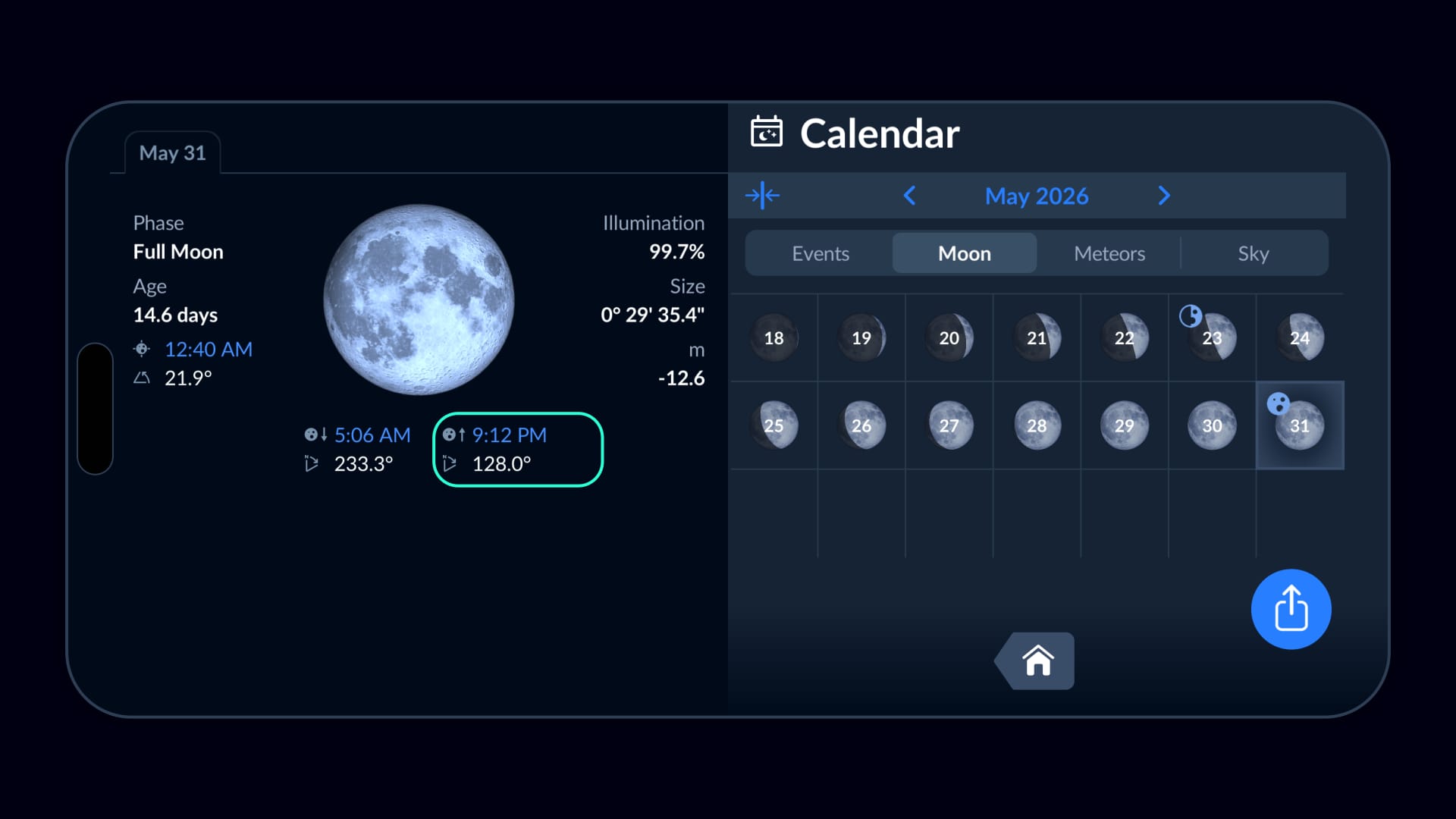
To check when the Moon rises where you live, open Sky Tonight, go to the Calendar, select the Moon tab, and use it as your personal lunar calendar. You can also access the lunar calendar online at starwalk.space.
Full Moon 2026 Names
- January Full Moon: Wolf Moon, Supermoon
- February Full Moon: Snow Moon
- March Full Moon: Worm Moon, Blood Moon
- April Full Moon: Pink Moon
- 1st May Full Moon: Flower Moon, Micromoon
- 2nd May Full Moon: Blue Moon, Micromoon
- June Full Moon: Strawberry Moon, Micromoon
- July Full Moon: Buck Moon
- August Full Moon: Sturgeon Moon
- September Full Moon: Harvest Moon
- October Full Moon: Hunter’s Moon
- November Full Moon: Beaver Moon, Supermoon
- December Full Moon: Cold Moon, Supermoon, Christmas Eve Moon
When Is the Next Full Moon 2026?
The next Full Moon, known as the Hunter’s Moon, will occur on October 26, 2026, at 04:12 UTC/GMT. It will shine in the constellation Aries.
Read more: Hunter’s Moon in October 2026
When Will the Full Moon Rise Tonight in Your City?
The Full Moon doesn’t rise at the same time every month – and it’s also different for every city. So to know exactly when the Full Moon will rise where you are, you’ll need a tool that uses your location and timezone.
That’s where the free Sky Tonight app comes in. It works like a smart lunar calendar in your pocket.
Here is how to check the local moonrise time in Sky Tonight:
- Open the Sky Tonight app.
- Allow location access, so the app can use your current position.
- Tap the Calendar icon.
- Go to the Moon tab.
- Select the Full Moon date – you’ll see the moonrise time for your city instantly.
You can also check the Moon's phase for any date, the time of its highest point in the sky, its moonset, its age, and a realistic view of how it looks in your sky right now.
Get Sky Tonight, your go-to celestial calendar!
Full Moon Calendar 2026: A Detailed Guide to the Full Moons of 2026
Full Moon on January 3, 2026: Wolf Moon, Supermoon

- Date: January 3
- Time: 10:03 GMT
- Constellation: Gemini
January Wolf Moon Meaning
Hearing the hungry wolves howling at the Moon during cold January nights, American and European villagers have dubbed this Full Moon the Wolf Moon. As the Full Moon in January 2026 is the first after winter solstice in the Northern Hemisphere, it may also be called Moon After Yule, according to European tradition.
The other names for the January Full Moon include:
- Chinese: Holiday Moon
- Celtic: Quiet Moon
- Cherokee: Cold Moon
- Southern Hemisphere: Hay Moon, Buck Moon, Thunder Moon, Mead Moon
What Makes the January Full Moon 2026 Special?
The January 2026 Full Moon is the first Supermoon of the year. After this, you’ll have to wait until the end of 2026 to see more Supermoons. And it doesn’t shine alone: on January 3, the Full Moon will appear close to Jupiter and Pollux in the night sky. Pollux is also one of the stars forming the famous Winter Hexagon asterism, which is made up of Sirius (Canis Major), Procyon (Canis Minor), Rigel (Orion), Aldebaran (Taurus), Pollux (Gemini), and Capella (Auriga). On the Full Moon night, the Moon and Jupiter will be beautifully framed by the Winter Hexagon, creating a striking, photo-worthy scene.
Read more: Full Moon on January 3, 2026.
Full Moon on February 1, 2026: Snow Moon
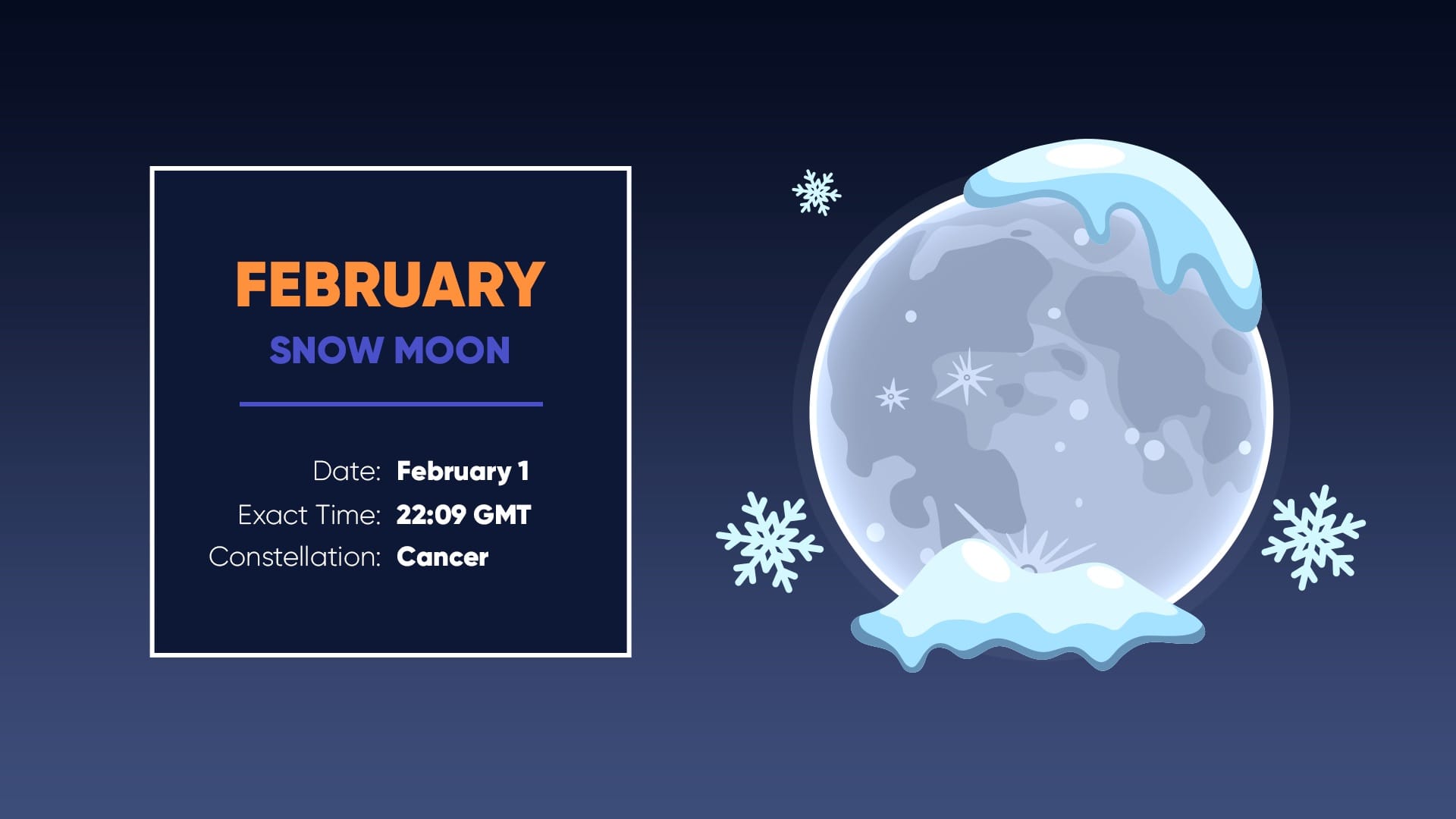
- Date: February 1
- Time: 22:09 GMT
- Constellation: Cancer
February Snow Moon Meaning
As February is the month of heavy snowfalls in North America, the February Full Moon was named Snow Moon. Some tribes also called it Hunger Moon, as the harsh weather conditions in February made hunting difficult, leading to scarce food sources.
Other cultures also have their own names for the February Full Moon:
- Chinese: Budding Moon
- Celtic: Ice Moon
- Cherokee: Bony Moon
- Southern Hemisphere: Grain Moon, Barley Moon, Red Moon, Dog Moon
Read more about Snow Moon meaning (spiritual & astrology).
What Makes the February Full Moon 2026 Special?
In most years, the February Full Moon appears in Leo, but 2026 is an exception. This time, the Full Moon will shine in Cancer, close to the Beehive Cluster (M44) – a beautiful star cluster that can be seen even with the naked eye.
Read more: Full Moon on February 1, 2026.
February’s New Moon is also noteworthy: it coincides with an annular solar eclipse. Take a look at our eclipse calendar infographic to see whether this “ring of fire” will be visible from your location.

Full Moon on March 3, 2026: Worm Moon + Total Lunar Eclipse (“Blood Moon”)
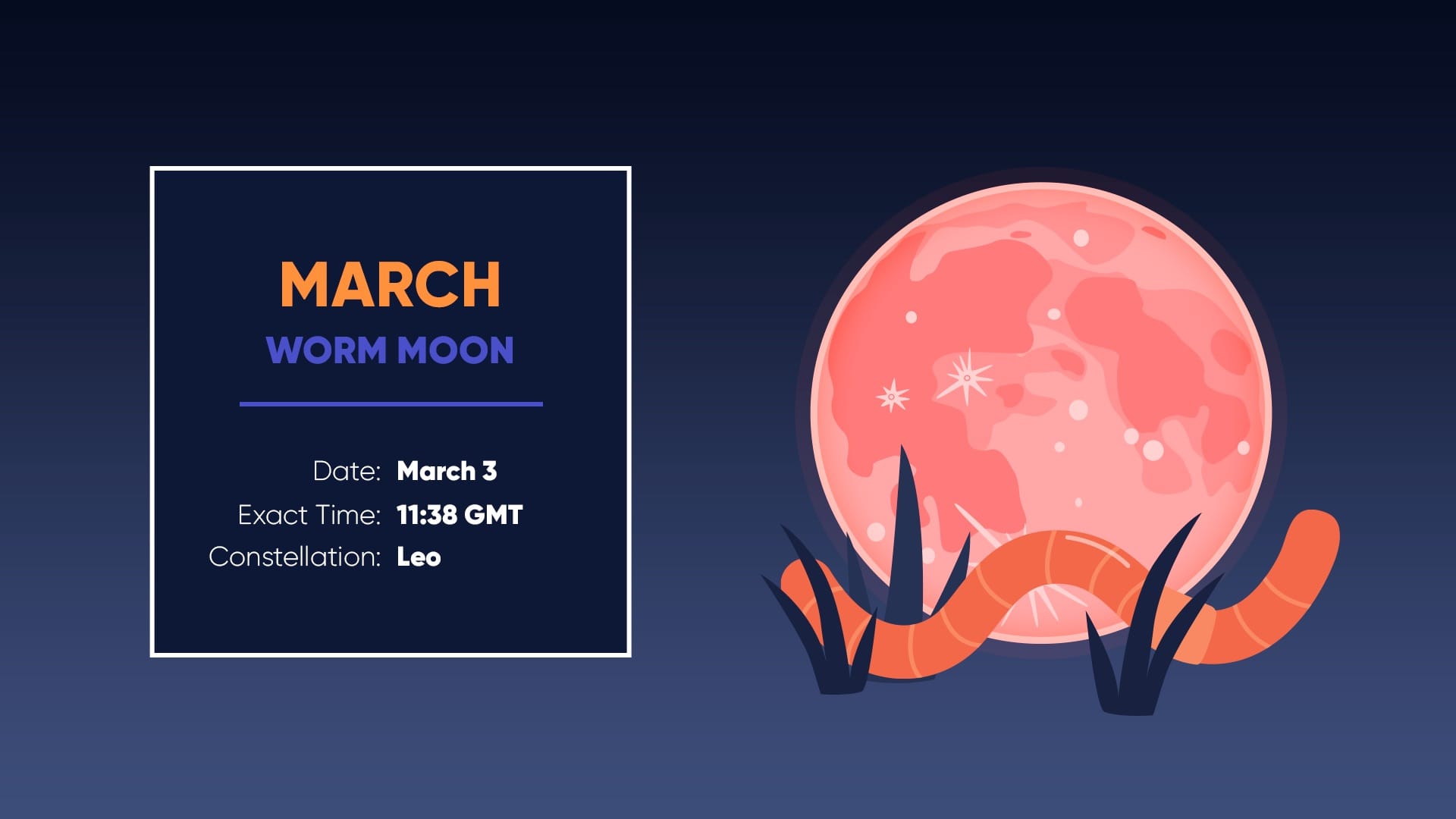
- Date: March 3
- Time: 11:38 GMT
- Constellation: Leo
Worm Moon meaning (and why it’s also called a Blood Moon in 2026)
Worm Moon was named after the earthworms that appeared as the ground thaws. Some tribes have dubbed this Moon the Snow Crust Moon, which refers to the unique weather conditions that occur during early spring. The days grow warmer, but the nights remain cold, so the snow thaws during daylight hours and then refreezes, forming a crust.
Read more about the Worm Moon meaning.
In 2026, the Full Worm Moon will coincide with a total lunar eclipse, during which the Moon will turn reddish for about an hour. Because of this reddish tint, the eclipsed Moon is colloquially known as the Blood Moon. Combined, you get the Blood Worm Moon – a quirky name for a truly spectacular Moon to observe!
Alternative Full Moon names for this month include:
- Chinese: Sleepy Moon
- Celtic: Moon of Winds
- Cherokee: Windy Moon
- Southern Hemisphere: Harvest Moon, Corn Moon
What Makes the March Full Moon 2026 Special?
The March Full Moon 2026 will coincide with a total lunar eclipse, making it one of the most impressive lunar events of the year. For the full schedule and visibility map, see our guide: Blood Moon on March 2–3, 2026. To learn whether it’s visible from your exact location, you can check the event details in the Eclipse Guide app.
On top of that, the March Full Moon will shine close to the bright, bluish star Regulus, also known as the “Little King.” Regulus marks the heart of Leo and is easily visible to the naked eye, creating a beautiful pairing with the eclipsed Moon.
Read more: March Full Moon 2026 (Worm Moon).
Full Moon on April 2, 2026: Pink Moon
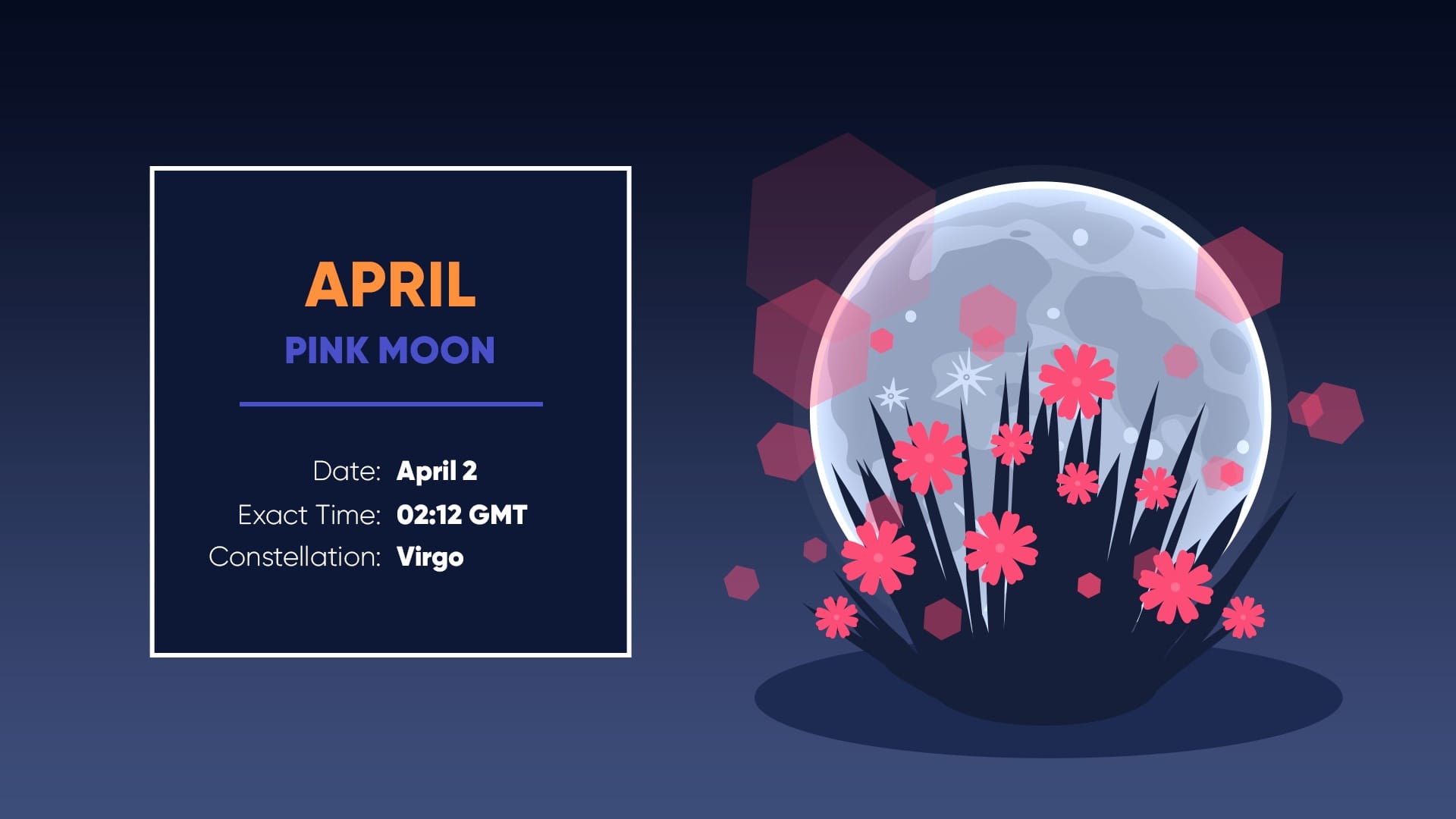
- Date: April 2
- Time: 02:12 GMT
- Constellation: Virgo
April Pink Moon Meaning
The name of the April Full Moon has nothing to do with the Moon’s color: it represents the hue of the wild ground phlox – one of the earliest flowers to bloom this month. As this Full Moon is the first after the spring equinox, it will also be the Paschal Moon. In the Christian ecclesiastical calendar, the first Sunday after the Paschal Moon is the date of Easter (in 2026, it will be April 5).
The other common April Full Moon names are:
- Chinese: Peony Moon
- Celtic: Growing Moon
- Cherokee: Flower Moon
- Southern Hemisphere: Harvest Moon, Hunter’s Moon
What Makes the April Full Moon 2026 Special?
On April 3, the Full Moon will pass within 2°30′ of the star Spica in the constellation Virgo. With a visual magnitude of 1.0, Spica is the 16th brightest star in the night sky, visible to the naked eye. However, finding it near the luminous Full Moon (mag -12.3) can be challenging. To pick out Spica, try using binoculars – you’ll see it as a sharp, pale-blue point close to the bright edge of the Full Moon.
Read more: Full Moon on April 2, 2026.
Full Moon on May 1, 2026: Flower Moon, Micromoon
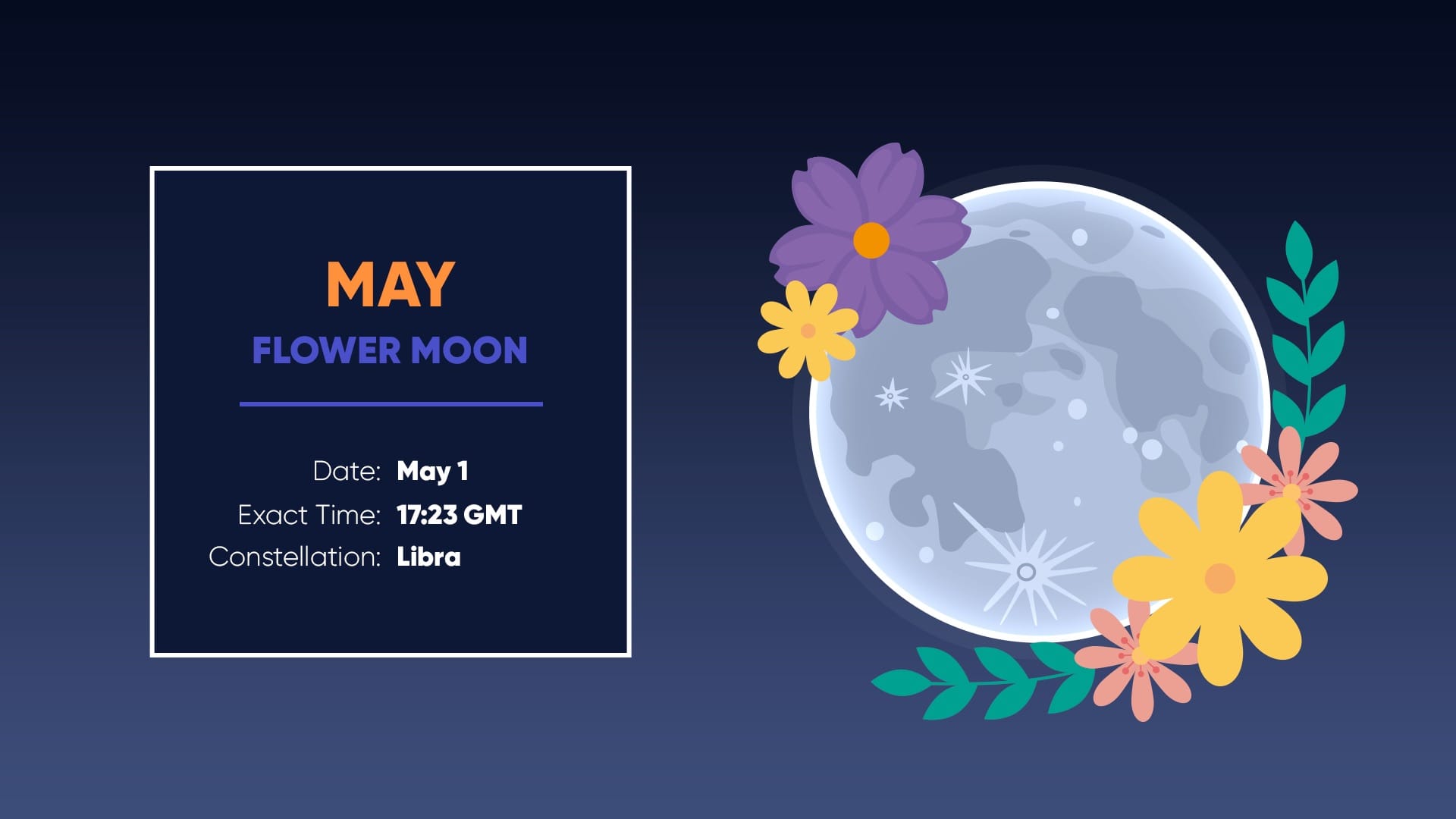
- Date: May 1
- Time: 17:23 GMT
- Constellation: Libra
May Flower Micromoon Meaning
As one might guess, May is the season for many flowers to bloom, hence the name for the May Full Moon. Some tribes call it after specific, regionally significant flowers and blooms (Mulberry Moon, Camas Blooming Moon).
The Full Moon in May 2026 will also be the first Micromoon of the year. It will be 4% smaller and 9% dimmer than an average Full Moon.
The May Full Moon is also referred to as:
- Chinese: Dragon Moon
- Celtic: Bright Moon
- Cherokee: Planting Moon
- Southern Hemisphere: Beaver Moon, Frost Moon
What Makes the May 1 Full Moon Special?
The Full Moon on May 1 is the first of two Full Moons that month. It’s also the first Micromoon of 2026, appearing a bit smaller and dimmer than an average Full Moon – but still well worth watching. Around the Full Moon date, the Moon will also pass near two bright stars: it comes closest to Spica on April 30 and then meets Antares by May 3.
Read more: Full Moon on May 1, 2026.
Full Moon on May 31, 2026: Blue Moon, Micromoon
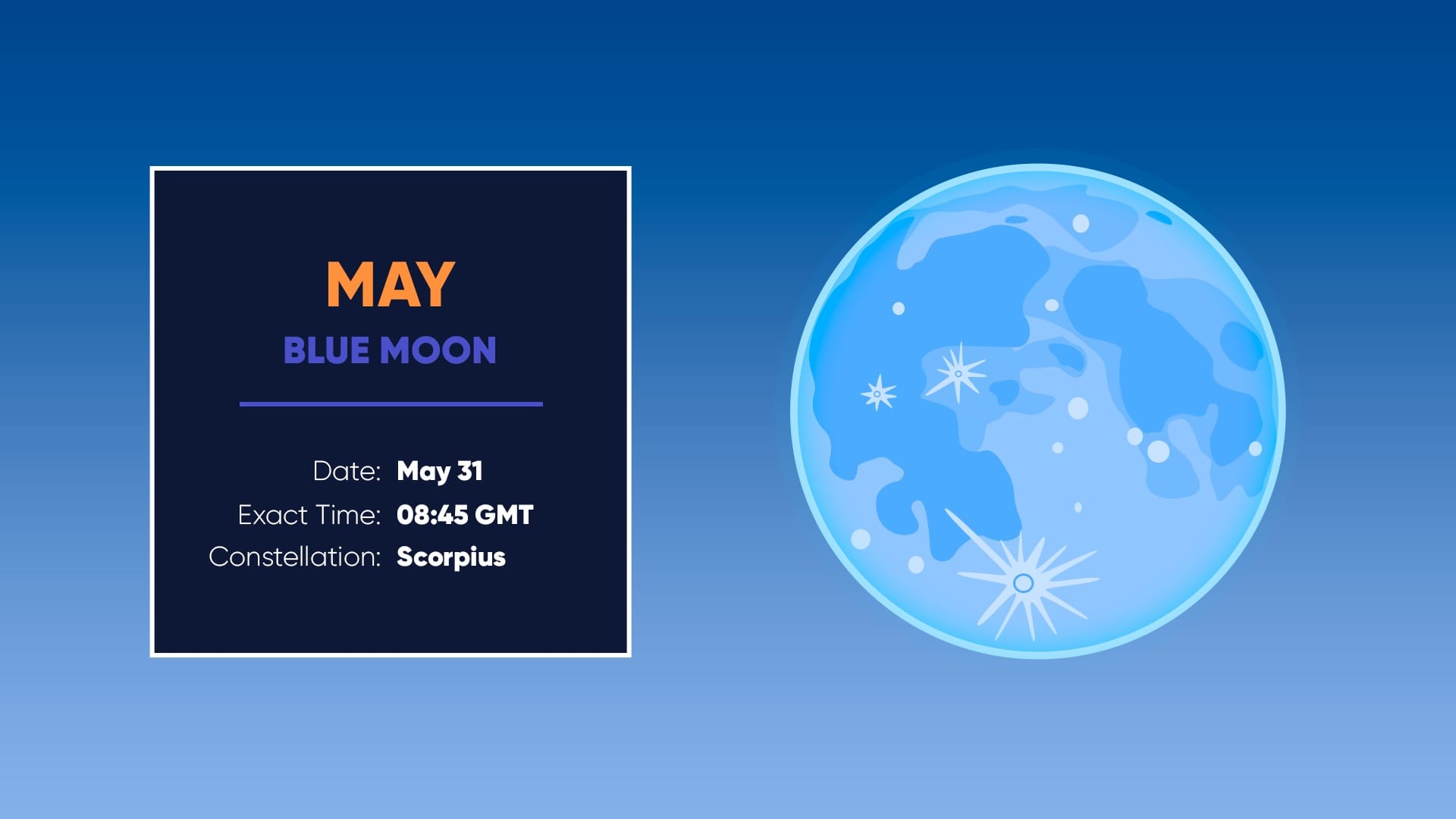
- Date: May 31
- Time: 08:45 GMT
- Constellation: Scorpius
May Blue Micromoon Meaning
The Full Moon on May 31, 2026, brings together two types of Full Moons in one night. First, it’s a monthly Blue Moon – not because the Moon turns blue, but because it’s the second Full Moon in the same calendar month. The exact origin of the term is unclear, but some trace it back over 400 years to the English phrase “once in a blue moon,” which means something that happens very rarely.
Second, this Blue Moon is also the year's smallest Micromoon. A Micromoon occurs when a Full or New Moon happens near apogee, the point where the Moon is farthest from Earth in its orbit. From this greater distance, the Moon appears slightly smaller and dimmer than usual. A Micromoon is the opposite of a Supermoon, which occurs when a Full or New Moon is closer to Earth and appears larger and brighter.
What Makes the May Blue Moon 2026 Special?
The Full Moon on May 31 is special because it’s the second Full Moon in a single month, making it a monthly Blue Moon. It’s also the smallest Micromoon of the year, appearing about 5.5% smaller and 10.5% dimmer than an average Full Moon. However, this difference is mostly technical – to the naked eye, the Moon will still look striking, and most observers won't notice a change in size.
The May Blue Moon will shine close to Antares, the bright red supergiant in the “heart” of the constellation Scorpius. In some regions, the Moon will pass in front of Antares, creating a brief lunar occultation. This event will be visible from parts of Antarctica, southern South America (including regions of Argentina, Chile, Bolivia), and nearby areas.
Read more: Full Moon on May 31, 2026.
Full Moon on June 29, 2026: Strawberry Moon, Micromoon
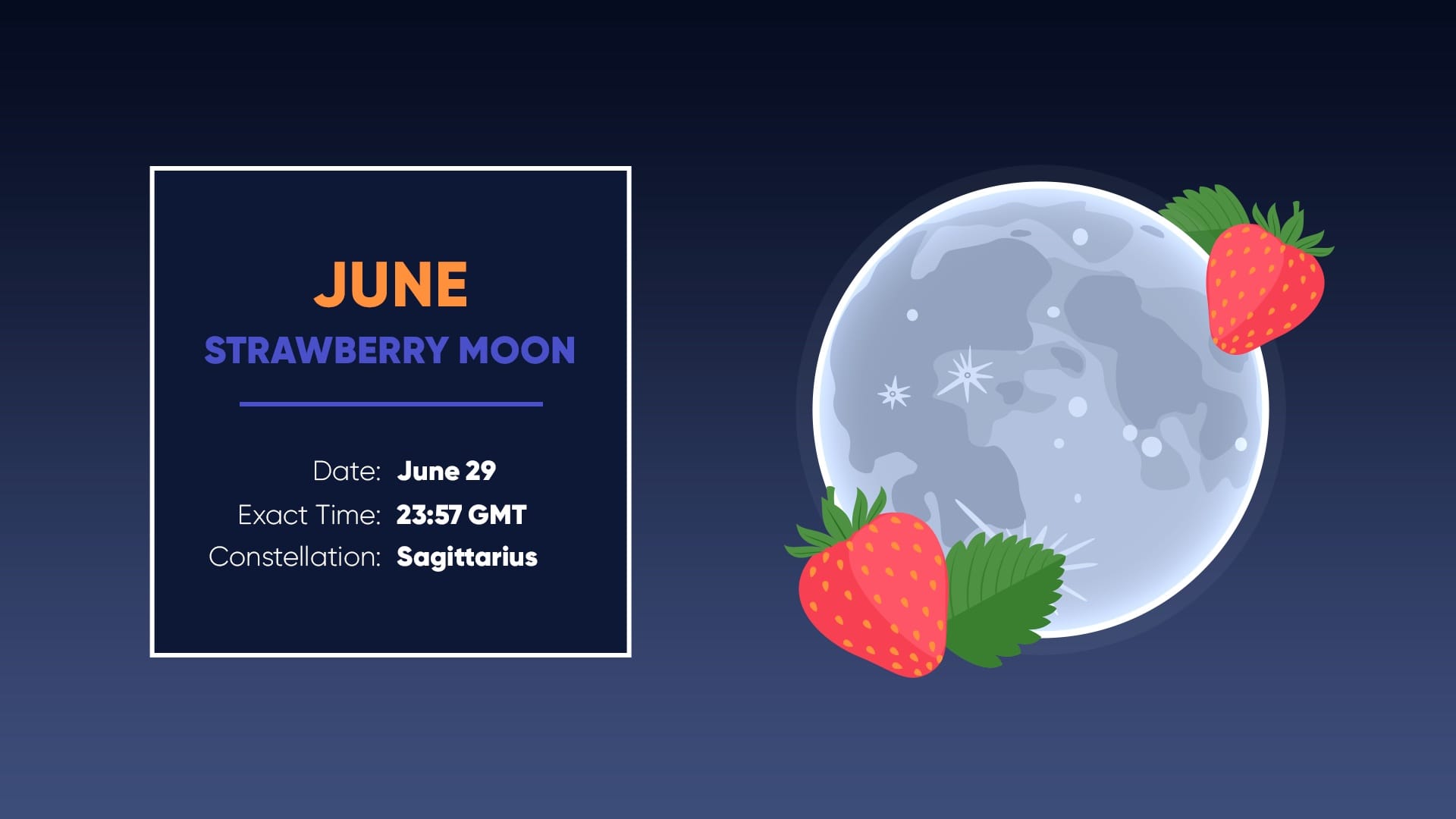
- Date: June 29
- Time: 23:57 GMT
- Constellation: Sagittarius
June Strawberry Micromoon Meaning
For the North American native tribes, June was the month of harvesting wild strawberries; that’s why the Full Moon in June became associated with these sweet red berries.
The Full Moon in June 2026 will also be the last Micromoon of the year. It will be 5% smaller and 10% dimmer than an average Full Moon.
Surprisingly, in 2009, the Moon naming tradition was joined by a rather unusual “tribe”: NASA employees. In June 2009, they launched the Lunar Reconnaissance Orbiter (LRO) mission to study the Moon. Since then, they have referred to the Full Moon in June as the LRO Moon.
Alternative June Full Moon names are:
- Chinese: Lotus Moon
- Celtic: Moon of Horses
- Cherokee: Green Corn Moon
- Southern Hemisphere: Oak Moon, Cold Moon, Long Night’s Moon
What Makes the June Full Moon 2026 Special?
The June Full Moon 2026 is the last Micromoon of the year, appearing a bit smaller and dimmer than an average Full Moon. It’s also the closest Full Moon to the June solstice. That makes it the lowest Full Moon of the year in the Northern Hemisphere and the highest Full Moon of the year in the Southern Hemisphere.
In the Northern Hemisphere, the Moon appears low on the horizon, shining through a thicker layer of the Earth's atmosphere. Because of this, it may look golden and seem unusually large thanks to the Moon illusion. In the Southern Hemisphere, the opposite occurs: the June Full Moon climbs high in the sky, providing an unobstructed view.
Read more: Full Moon on June 29, 2026.
Full Moon on July 29, 2026: Buck Moon
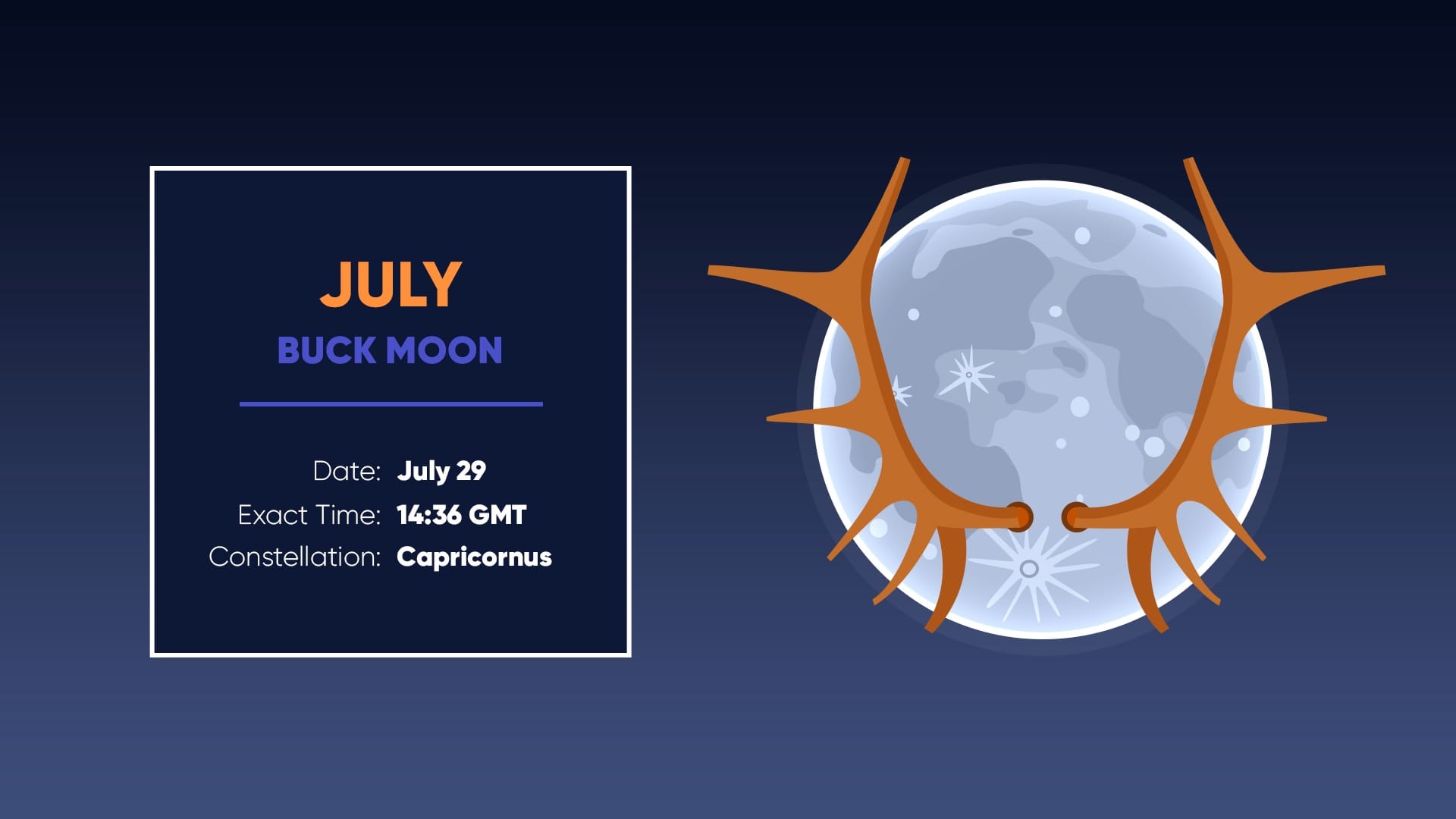
- Date: July 29
- Time: 14:36 GMT
- Constellation: Capricornus
July Buck Moon Meaning
The Full Moon in July is known as the Buck Moon as young male deer (also known as bucks) grow new antlers this month. In Celtic culture, the July Full Moon was sometimes named Wyrt Moon. Wyrt (or Wort, if you follow the modernized spelling) is an old English word meaning “plant,” and this name refers to the herbs and plants that are fully grown by this time of the year.
The other traditional July Full Moon names include:
- Chinese: Hungry Ghost Moon
- Celtic: Moon of Claiming
- Cherokee: Ripe Corn Moon
- Southern Hemisphere: Wolf Moon, Old Moon, Ice Moon
What Makes the July Full Moon 2026 Special?
The July Full Moon 2026 will appear low in the sky for observers in the Northern Hemisphere and higher in the sky for those in the Southern Hemisphere. For northern skywatchers, this means the Moon may take on a warm golden tint. In the south, the Moon will climb well above the tallest buildings. However, the effect won't be as extreme as it was for the June Full Moon.
Read more: Full Moon on July 29, 2026.
Full Moon on August 28, 2026: Sturgeon Moon
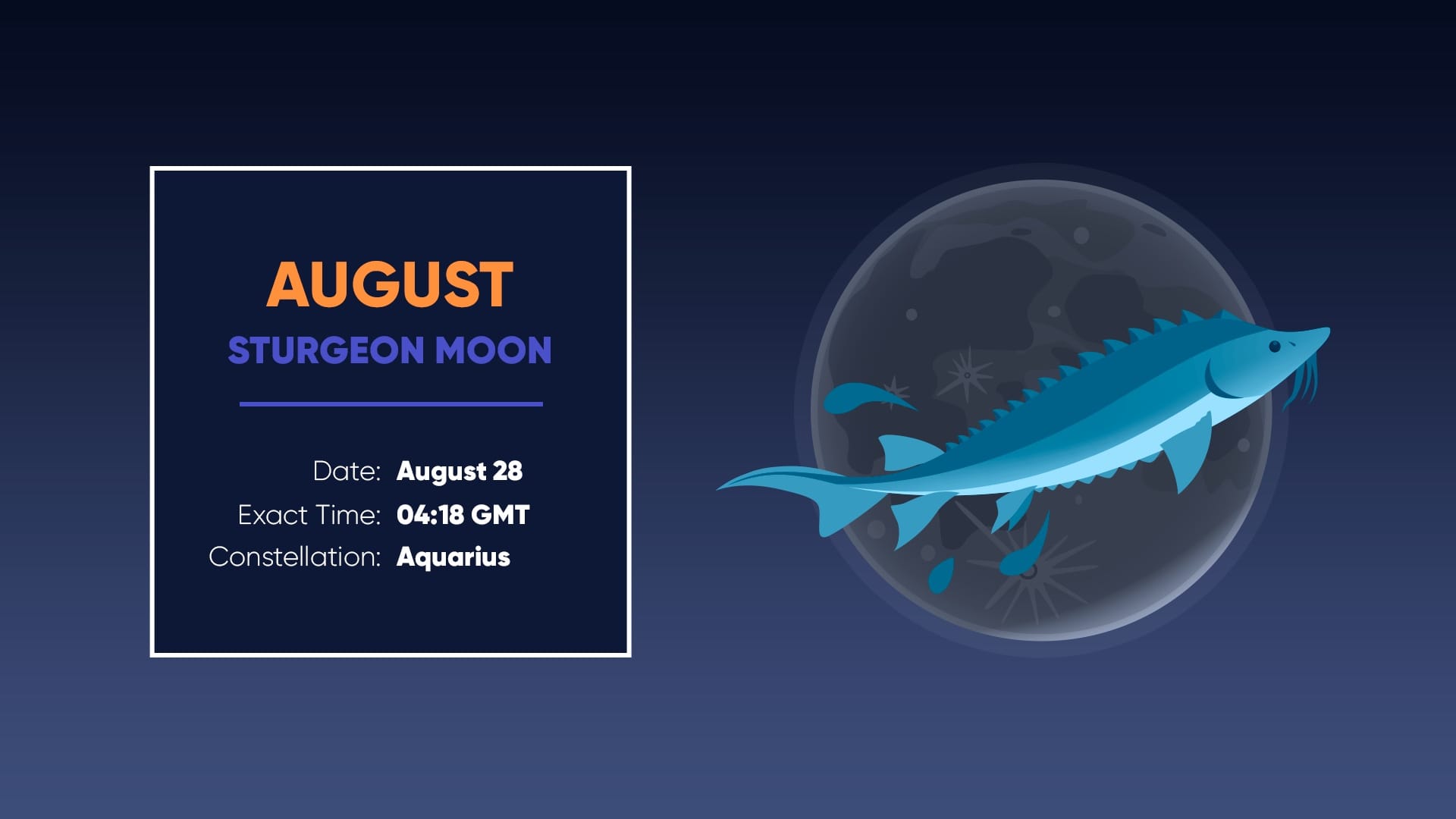
- Date: August 28
- Time: 04:18 GMT
- Constellation: Aquarius
August Sturgeon Moon Meaning
In August, Native American tribes used to fish for lake sturgeon, which can be abundant and easy to catch during late summer. Also, the Full Moon in August marked the start of the harvesting season in the Northern Hemisphere. Different Native American tribes referred to the August Full Moon as Corn Moon, Ricing Moon, and Black Cherries Moon. The Anglo-Saxons called it the Grain Moon.
The other traditional August Full Moon names include:
- Chinese: Harvest Moon
- Celtic: Dispute Moon
- Cherokee: Fruit Moon
- Southern Hemisphere: Snow Moon, Storm Moon, Hunger Moon, Wolf Moon
Read more: Full Moon on August 28, 2026.
What Makes the August Full Moon 2026 Special?
A partial lunar eclipse will coincide with the Full Moon on August 28, 2026. During this eclipse, about 96% of the Moon's surface will be covered by Earth’s shadow. The eclipse will be visible from 02:33 to 05:52 GMT across a large part of the world, including Europe, Western Asia, Africa, the Americas, the Pacific, Atlantic, Indian Ocean, and Antarctica. You won’t need any special equipment – just step outside and watch the darkened lunar disk with your own eyes.
Not sure if you can see it from your location? Do a quick check in Sky Tonight: open August 28 in the app’s calendar, tap the event, and you’ll see the local viewing times or a note that the eclipse isn’t visible from your area.
You may also want to take a look at the New Moon on August 12. This time, the New Moon will coincide with a total solar eclipse – one of the rare moments when you can actually see the New Moon’s silhouette against the Sun. This eclipse, the first total solar eclipse for mainland Europe since 1999, will be visible from parts of Russia, Greenland, Iceland, and Spain.
Get ready for these eclipses in a fun way! Try our quiz on lunar and solar eclipses and see how much you really know about these spectacular events.

Full Moon on September 26, 2026: Harvest Moon
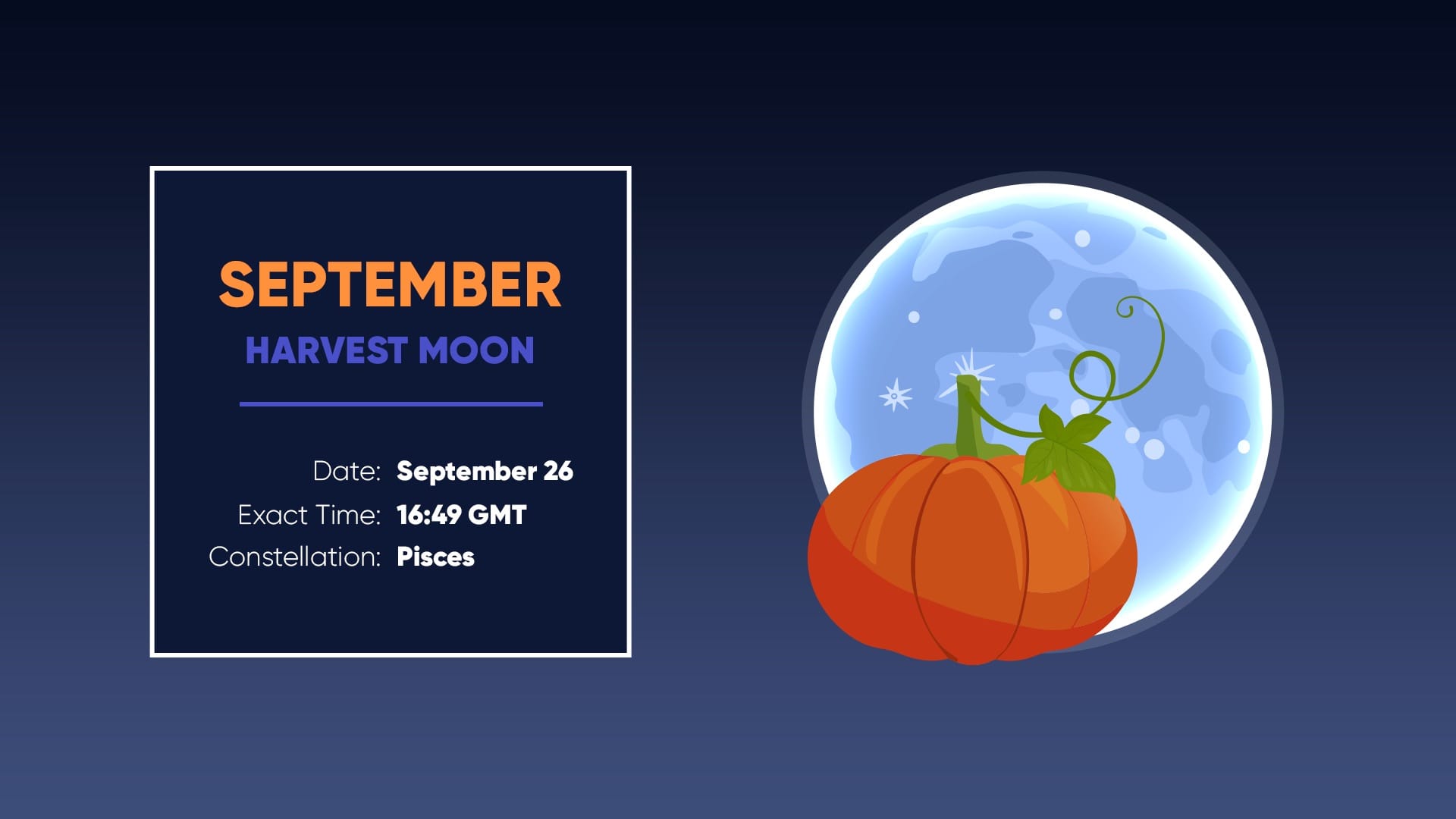
- Date: September 26
- Time: 16:49 GMT
- Constellation: Pisces
September Harvest Moon Meaning
The Harvest Moon is the name given to the Full Moon, which happens closest to the autumn equinox. This year, the equinox occurs on September 22, so the Full Moon on September 26 is the Harvest Moon. It got its name for a reason: the Harvest Moon rises soon after the Sun goes down. In the past, this gave farmers extra time for harvesting in the evening, under the moonlight.
The other traditional September Full Moon names are:
- Chinese: Chrysanthemum Moon
- Celtic: Singing Moon
- Cherokee: Nut Moon
- Southern Hemisphere: Worm Moon, Lenten Moon, Crow Moon, Sugar Moon, Chaste Moon
What Makes the September Full Moon 2026 Special?
On September 26, Saturn and Neptune will join the Full Moon. Neptune will be at opposition that same night, meaning it will reach its best visibility. Saturn will reach opposition on October 4, so it will also be well-placed in the sky for observation. Saturn (mag 0.4) can be seen with the naked eye, but Neptune (mag 7.7) requires at least a small telescope, especially near the bright Moon. All three objects will rise in the east around local sunset and set in the west around local sunrise, so you’ll have plenty of time to observe them.
Read more: Full Moon on September 26, 2026.
Full Moon October 26, 2026: Hunter’s Moon

- Date: October 26
- Time: 04:12 GMT
- Constellation: Aries
October Hunter’s Moon Meaning
Hunter’s Moon is the Full Moon that follows the Harvest Moon. Traditionally, farmers finished gathering crops under the bright light of the Harvest Moon, leaving the fields cleared by the time of the next Full Moon. That made it easier for hunters to spot animals searching for food in the open under the moonlight, which is how the following Full Moon became known as the Hunter’s Moon.
Depending on the equinox date, the Hunter’s Moon may occur in October or November in the Northern Hemisphere; this year, it falls in October.
Alternative October Full Moon names are:
- Chinese: Kindly Moon
- Wiccan: Blood Moon
- South African: Seed Moon
- Southern Hemisphere: Egg Moon, Fish Moon, Pink Moon, Waking Moon
What Makes the October Full Moon 2026 Special?
On October 26, the Full Moon will shine in a sky full of planets. Saturn (mag 0.5) will be closest to the Moon in Cetus and will be easily visible to the naked eye. Nearby in Pisces lies Neptune (mag 7.8), which requires a telescope to spot. Higher up in Taurus, Uranus (mag 5.6) can be seen with binoculars or a small telescope. Along the eastern horizon, you will also see reddish Mars (mag 0.9) and golden Jupiter (mag -2.0); both are visible to the naked eye.
Read more: Full Moon on October 26, 2026.
Full Moon on November 24, 2026: Beaver Moon, Supermoon
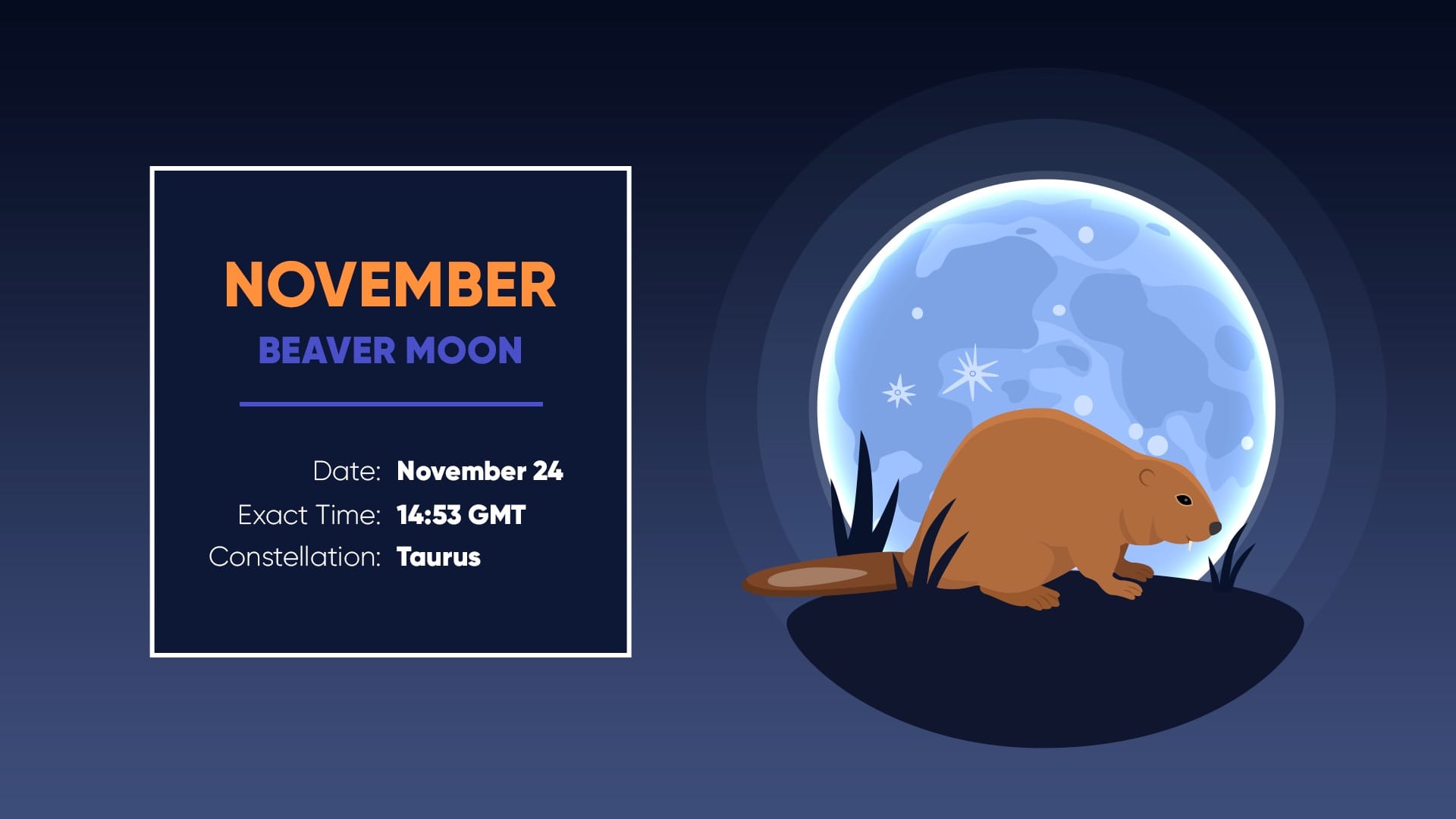
- Date: November 24
- Time: 14:53 GMT
- Constellation: Taurus
November Beaver Supermoon Meaning
In November, beavers complete their winter preparations and begin to hide in their lodges. For hunters, it is the last chance to hunt for their fur. That’s why the November Full Moon is referred to as the Beaver Moon.
The Full Moon in November is also a Supermoon. The word “super” indicates that this Full Moon occurs near perigee, appearing larger and brighter to observers. Put together, this gives us the playful name “Beaver Supermoon” for our bright November Full Moon.
The other traditional November Full Moon names are:
- Chinese: White Moon
- Cree: Frost Moon
- Celtic: Dark Moon
- Southern Hemisphere: Corn Moon, Milk Moon, Hare Moon
What Makes the November Full Moon 2026 Special?
The Full Moon in November 2026 will be a Supermoon, appearing about 6.5% larger and 13.5% brighter than an average Full Moon. It will shine in Taurus, close to the bright Pleiades star cluster. On a dark, clear night, the Pleiades are visible to the naked eye, but the nearby Full Moon’s glare will make them harder to see. Use binoculars to pick out the delicate stars of the Seven Sisters near the lunar disk. Adding to the scene, the fiery red “eye of the Bull,” Aldebaran, will also glow nearby.
Read more: Full Moon on November 24, 2026.
Full Moon on December 24, 2026: Cold Moon, Christmas Eve Supermoon
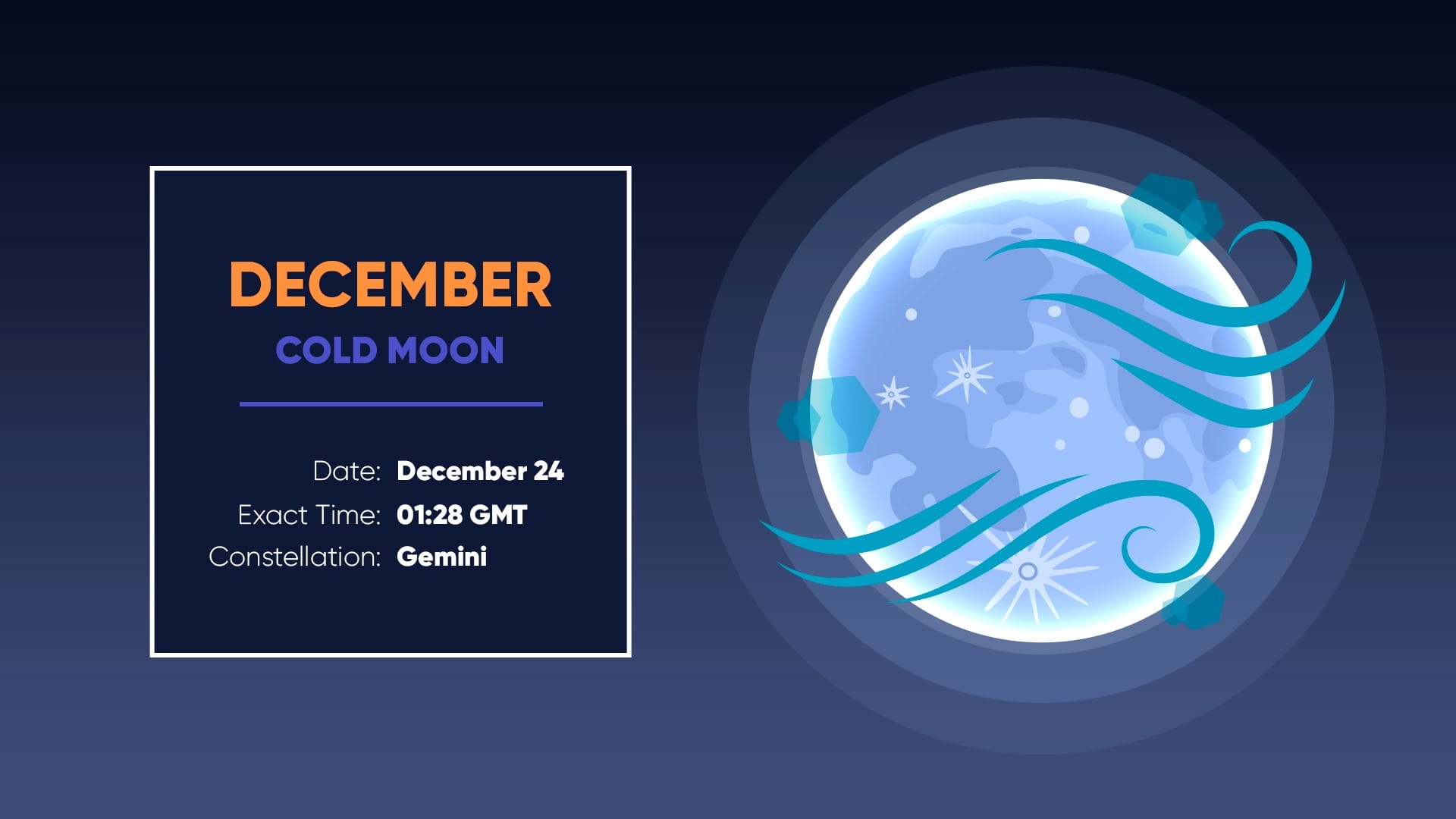
- Date: December 24
- Time: 01:28 GMT
- Constellation: Gemini
December Cold Christmas Eve Supermoon Meaning
The Full Moon in December is traditionally called the Cold Moon, marking the time of the longest and coldest nights in the Northern Hemisphere. In 2026, it becomes even more special: the Full Moon falls exactly on Christmas Eve in the Western Christian tradition. That doesn’t happen often – the last December 24 Full Moon was in 1996.
And this time, it’s not just any Full Moon, but the biggest Supermoon of the year, appearing about 8% larger and 16% brighter than a typical Full Moon – a real Christmas gift in the sky.
Because this Full Moon is also the last one before the winter solstice, it can be called the Moon Before Yule in European tradition.
In other cultures, it’s also called:
- Chinese: Bitter Moon
- English Medieval: Oak Moon
- Cherokee: Snow Moon
- Southern Hemisphere: Strawberry Moon, Honey Moon, Rose Moon.
What Makes the December Full Moon 2026 Special?
The Full Moon on December 24 is the biggest Supermoon of the year, so it will appear slightly larger and brighter than an average Full Moon. Some observers say they can see the size difference, but in reality, the change is quite subtle – remember that you can cover the entire lunar disk with your pinky at arm’s length. The best way to decide for yourself is simple: go outside and look up. Whether you notice the size change or not, the year’s biggest Supermoon will be a beautiful sight.
Read more: Full Moon on December 24, 2026.
🌟 Top 5 Moon Events 2026: Why Observe the Moon in 2026?
The Full Moon is always a good excuse to look up, but the Moon has much more in store. In 2026, it will take part in several truly eye-catching events, and here we’ve gathered the very best of them. Check out our article on Moon conjunctions to know when the Moon meets the planets next, and turn on push notifications in the Sky Tonight app so you never miss a spectacular moment with the Moon or any other celestial object.
March 3 – Total Lunar Eclipse
On March 3, from 11:04 to 12:02 GMT, the Moon will pass fully into Earth’s shadow, creating a total lunar eclipse. The event will be visible from large parts of the world, including the USA, Canada, New Zealand, Australia, and Asia. During totality, the Moon will take on a deep reddish glow, often called a Blood Moon, caused by sunlight filtering through Earth’s atmosphere. This phase will last for about an hour, giving observers plenty of time to enjoy the sight. No equipment is required – the eclipse is easily visible to the naked eye.
August 28 – Partial Lunar Eclipse
On August 28, from 02:33 to 05:52 GMT, a partial lunar eclipse will take place, with roughly 96% of the Moon's surface veiled by Earth's shadow. Although it is not a total eclipse, the darkened portion of the lunar disk will be striking to observe. The eclipse will be visible across much of the globe, including Europe, Western Asia, Africa, the Americas, and the surrounding oceans. Millions of observers will have the opportunity to witness this dramatic event. No telescope is needed – just step outside!
September 14 – Lunar Occultation of Venus
On September 14, from 09:26 to 13:42 GMT, the Moon will pass directly in front of Venus, temporarily hiding the brilliant planet from view. This event, called a lunar occultation, will be visible from Asia, Africa, Europe, and western Russia.
If you’re outside this visibility zone, you can still enjoy a stunning close pairing. Look toward the western horizon from local sunset to see the waxing crescent Moon with dazzling Venus (mag -4.7) shining beside it.
November 3 – Moon Aligned with Regulus, Jupiter, and Mars
On November 3, the Moon will line up with Regulus, Jupiter, and Mars in the constellation Leo. All four will be easily visible to the naked eye: Mars (mag 0.9) rises first, then Jupiter (mag -2.0) and the Moon (37% illuminated), and majestic Regulus (mag 1.4) at last. The objects will be visible for the second part of the night. It’s a perfect night for stargazing and photography.
December 24 – The Year’s Biggest Supermoon on Christmas Eve
The largest Supermoon of 2026 will rise on December 24, which is Christmas Eve according to the Western Christian tradition. At its closest point to Earth, the Moon will appear 8% larger and 16% brighter than the average Full Moon. Although the size difference is subtle, the glowing lunar disk on this holiday night will be an unforgettable sight. This is a rare and beautiful treat – the next December 24 Full Moon won't happen until 2045!
Full Moons 2026: F. A. Q.
What is a Full Moon?
A Full Moon is a lunar phase that occurs when the Earth is positioned between the Sun and the Moon. In this alignment, the entire visible surface of the Moon is illuminated by the Sun's light, making it appear as a bright, round disk in the night sky. Visit the lunar calendar on our website to learn more about the celestial mechanics behind the Moon phases.
How often does a Full Moon occur?
The lunar cycle is 29.5 days, so a Full Moon occurs roughly every month, but sometimes there can be two Full Moons in a month – the second one is called a Blue Moon.
How long does a Full Moon last?
From an astronomical perspective, a Full Moon is an event that lasts just a brief moment. However, to the unaided eye, the Moon appears full for several days around this exact moment.
How many Full Moons are there in 2026?
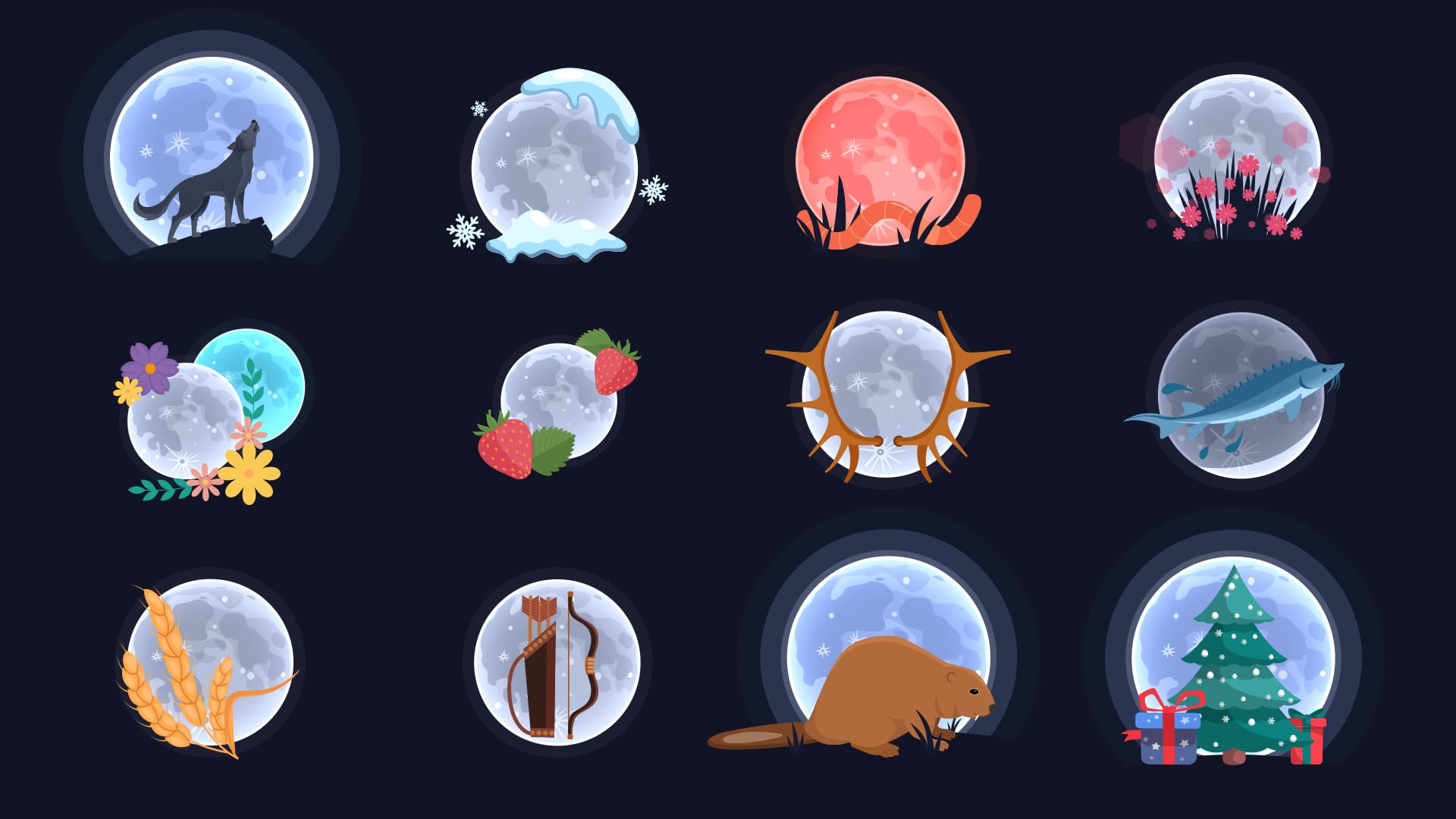
Normally, a year has 12 Full Moons (one each month), but 2026 has 13! The extra one is a Blue Moon, occurring on May 31, 2026. Explore all the Full Moons of 2026 in our colorful infographic.
Why do Full Moons have names?
The tradition of naming Full Moons has been around for centuries, a practice that spans many cultures worldwide. Before the widespread use of calendars, people used the lunar cycles to keep track of time and to plan their activities. Naming the Full Moons helped to identify and remember specific times of the year. Many Full Moon names are associated with seasonal events and agricultural practices, like the Harvest Moon. Certain Full Moons are named after natural events that typically occur during that time of year, such as the Wolf Moon in January and the Strawberry Moon in June.
What is a Supermoon?
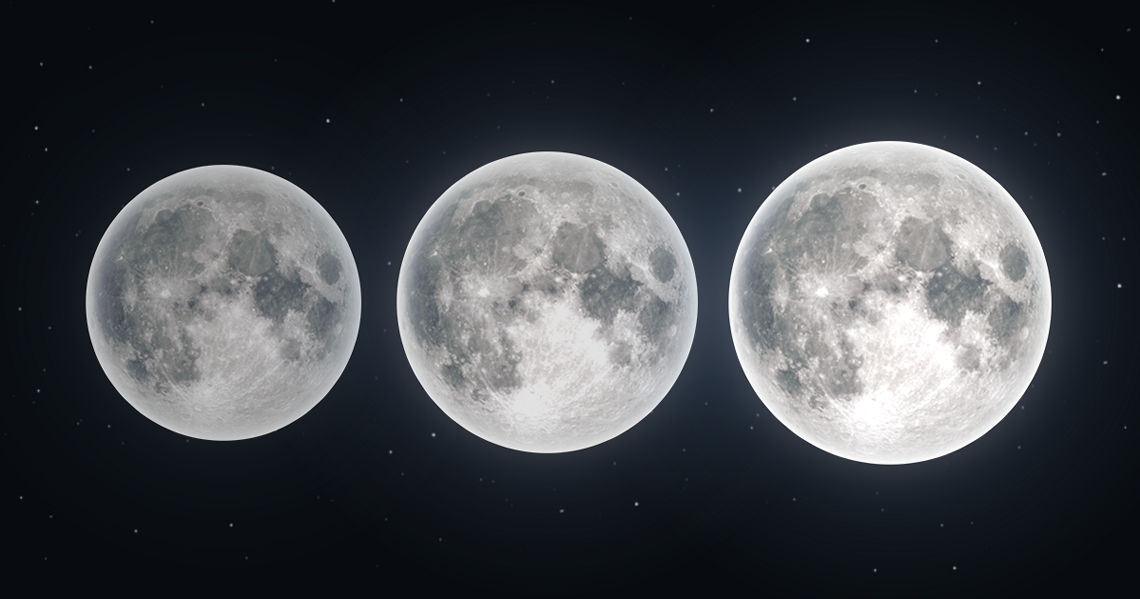
The prefix “super” indicates that the Full Moon aligns closely with our Moon's nearest point to the Earth, known as perigee. Consequently, such a Full Moon appears larger and brighter than the typical ones. Visit our article about Supermoons to learn more about this celestial event.
When is the next Supermoon 2026?
The next Supermoon will occur on November 24, 2026, — it will be a Beaver Supermoon. The November Supermoon will appear 6.5% larger and 13.5% brighter than an average Full Moon.
In 2026, according to the Supermoon calendar by NASA astrophysicist Fred Espenak, we’ll have three Supermoons: on January 3, November 24, and December 24. Check our infographic to learn more about Supermoons and discover their dates for the next few years.
What is the biggest Full Moon of the year?
The largest Full Moon of 2026 is the Cold Moon, which occurs on December 24. It will appear 8% larger and 16% brighter than an average Full Moon.
What is the opposite of a Supermoon?
The opposite of a Supermoon is a Micromoon. It occurs when the Full Moon closely coincides with the apogee (when the Moon is the farthest from the Earth). Consequently, such a Full Moon appears smaller and dimmer than the typical ones. In 2026, according to the Micromoon calendar by NASA astrophysicist Fred Espenak, we’ll see the Micromoons on May 1, May 31, and June 29.
What is a Blue Moon?
A Blue Moon is not about the Moon’s color – it’s about timing. Traditionally, there are two main definitions:
- Calendrical Blue Moon: the second Full Moon in a single calendar month.
- Seasonal Blue Moon: the third Full Moon in a season that has four Full Moons (instead of the usual three).
Learn more about Blue Moons in our dedicated article.
Is there a Blue Moon in 2026?
Yes, there is a Blue Moon in 2026. It occurs on May 31, 2026, and it’s a monthly (calendrical) Blue Moon because it’s the second Full Moon in May (the first one is on May 1). Want all the details? Read our dedicated article on the May Blue Moon to learn what makes this one special.
When is the next Blood Moon?
The next total lunar eclipse (commonly known as a Blood Moon) will occur on December 31, 2028. You can read more about upcoming lunar eclipses in our dedicated article: Lunar Eclipses Guide.
Full Moon calendar 2026: to sum up
In 2026, 13 Full Moons will take place, including 3 Supermoons, 3 Micromoons, 1 Blue Moon, and 2 eclipsed Full Moons. Quite a line-up! Use this calendar to explore them all, and check when the Moon rises in your exact location with the free Sky Tonight app.
Happy Moon-gazing!