October Full Moon 2026 (Hunter’s Moon): Date, Time & Meaning
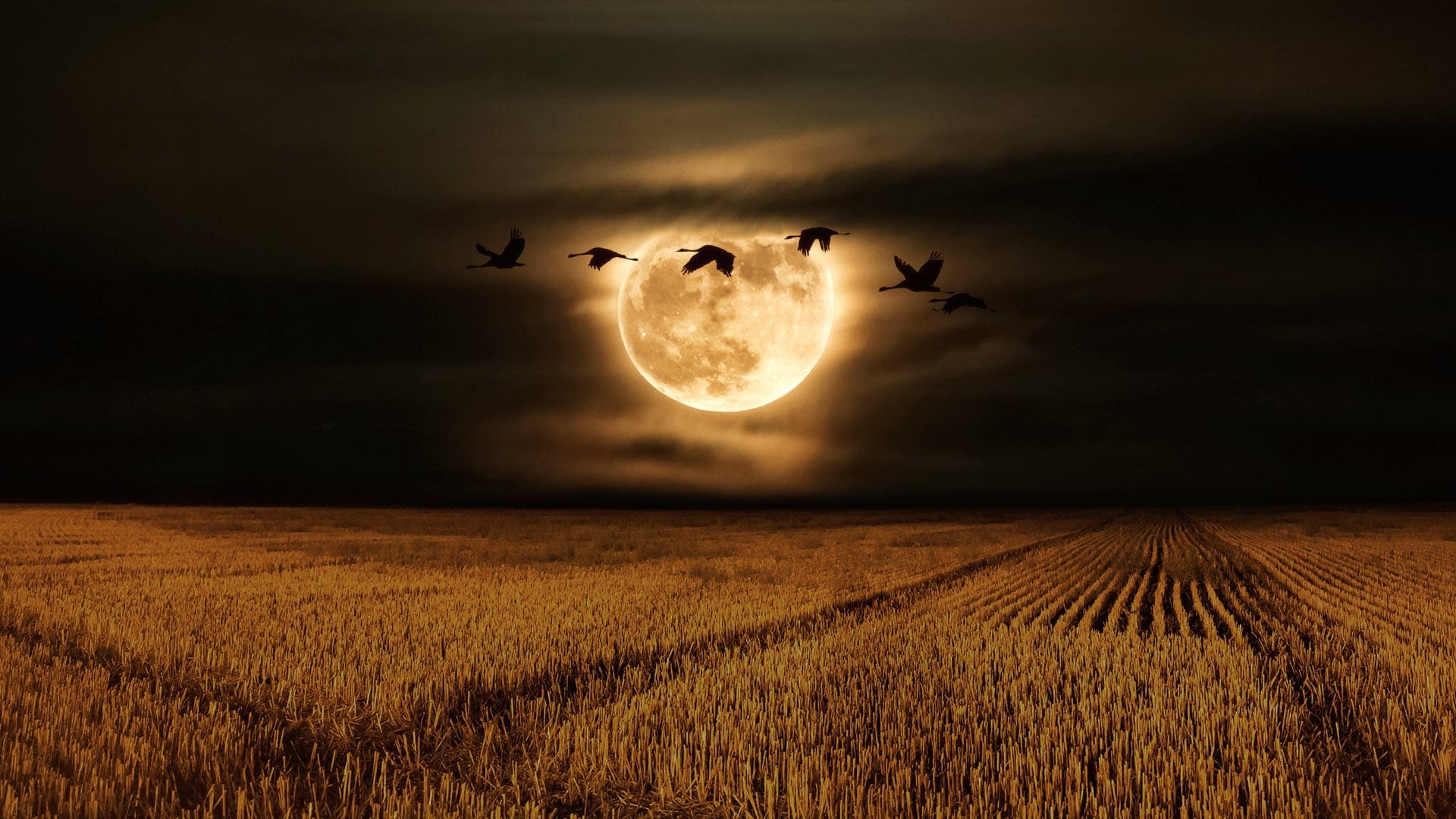
The Full Moon in October 2026 — known as the Hunter’s Moon in the Northern Hemisphere — occurs on Monday, October 26, 2026, at 04:12 GMT/UTC (12:12 AM EDT). The Moon will shine in the constellation Aries, near the stars Sheratan and Hamal. It will look bright and round for several nights from around October 25 to 27.
Want to know exactly when the Hunter’s Moon rises in your city and what other celestial objects are nearby? Use the free astronomy app Sky Tonight. Read on to learn when to see the October Full Moon, why it’s called the Hunter’s Moon, and what phase the Moon will be in on Halloween night.
Contents
- October Full Moon 2026 at a glance
- Moon phases in October 2026: dates and times
- What constellation is the October Full Moon in?
- What is near the October Full Moon?
- October Full Moon meaning: why is it called the Hunter’s Moon?
- What will the Moon look like on Halloween 2026?
October Full Moon 2026: Frequently asked questions
- What time is the Hunter’s Moon in 2026?
- Why is the October 2026 Full Moon called the Hunter’s Moon?
- Does the Hunter’s Moon always fall in October?
- Is the October 2026 Full Moon a supermoon?
- Is there a Full Moon on Halloween 2026?
- When is the next Full Moon after October 2026?
- When is the next Hunter’s Moon?
- October Full Moon 2026: key takeaways
October Full Moon 2026 at a glance
- Date: October 26, 2026
- Peak time: 04:12 GMT/UTC (12:12 AM EDT)
- Looks full: October 25–27
- Name & meaning: Hunter’s Moon — the first Full Moon after the Harvest Moon
- Where in the sky: constellation Aries
- Path across the sky: the Moon will rise near the eastern horizon around sunset and set near the western horizon around sunrise
- Nearby stars: Sheratan and Hamal in Aries
- Notable event: the Moon, Saturn, and Algenib form a nearly equilateral triangle on October 25–26
Moon phases in October 2026: dates and times
You can track the Moon throughout October with the Sky Tonight app. Open the Calendar, switch to the Moon tab, and see the lunar phase for each day, along with the Moon’s apparent size and orientation as seen from your location.
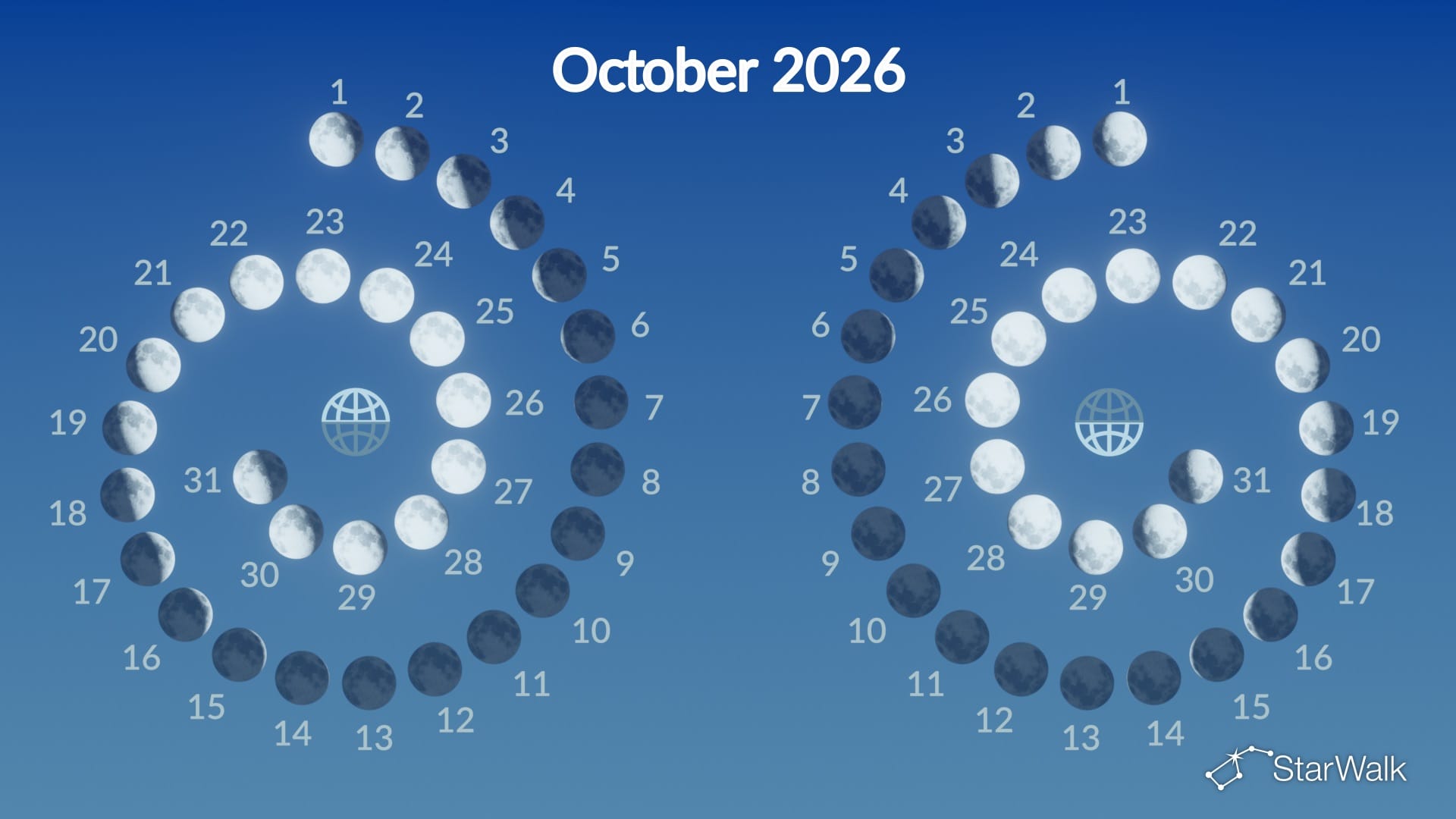
Here are the exact dates and times for the key lunar phases in October 2026:
- Last quarter: October 3, 13:25 GMT/UTC (9:25 AM EDT)
- New moon: October 10, 15:50 GMT/UTC (11:50 AM EDT)
- First quarter: October 18, 16:13 GMT/UTC (12:13 PM EDT)
- Full Moon: October 26, 04:12 GMT/UTC (12:12 AM EDT)
Explore every lunar phase, along with daily moonrise and moonset times, in the interactive Moon Calendar on our website.
When is the new moon in October 2026?
The Moon reaches its new phase on October 10 at 15:50 GMT/UTC (11:50 AM EDT). It will be positioned close to the Sun in the sky, with its illuminated side facing away from Earth, so it won’t be visible.
The absence of moonlight makes this part of the month particularly useful for deep-sky observing. October targets include the Andromeda Galaxy, the Saturn Nebula, and other objects listed in our October deep-sky guide. Open the Visible Tonight section (the telescope icon) in Sky Tonight to see which targets are favorably placed above you.
When is the Full Moon in October 2026?
The precise Full Moon moment is October 26 at 04:12 GMT/UTC (12:12 AM EDT). The change in illumination is too gradual to notice without careful measurements, however, so the Moon will look full on the nights around the event as well.
The peak falls on October 26 across Europe, Africa, Asia, and eastern North America. Farther west across the Americas, the local date is still October 25: Los Angeles, for example, gets the Full Moon at 9:12 PM PDT. The corresponding times are 04:12 in London, 05:12 in Paris, 12:12 in Beijing, 13:12 in Tokyo, and 15:12 in Sydney on October 26.
Best time to see the October Full Moon 2026
Plan your observation for moonrise on October 25 or 26. Either evening will show an almost completely illuminated Moon; choose the one nearest the peak in your local time zone or the one with the better weather forecast.
Moonrise offers the most photogenic view. Near the horizon, the Moon may turn gold, orange, or reddish because its light travels through more of Earth’s atmosphere. It can also seem unusually large beside trees, buildings, or distant hills. This apparent enlargement is the Moon illusion, not a physical change in the lunar disk.
The table compares the instant of the Full Moon with the nearest moonrise and moonset for seven cities:
| City | Time zone | Exact Full Moon | Closest moonrise | Closest moonset |
|---|---|---|---|---|
| New York, US | EDT (UTC−4) | October 26, 12:12 AM | October 25, 5:26 PM | October 26, 7:56 AM |
| Los Angeles, US | PDT (UTC−7) | October 25, 9:12 PM | October 25, 5:39 PM | October 26, 7:46 AM |
| London, UK | GMT (UTC+0) | October 26, 04:12 | October 26, 16:21 | October 26, 07:16 |
| Paris, France | CET (UTC+1) | October 26, 05:12 | October 26, 17:20 | October 26, 07:56 |
| Beijing, China | CST (UTC+8) | October 26, 12:12 | October 26, 17:00 | October 26, 06:32 |
| Tokyo, Japan | JST (UTC+9) | October 26, 13:12 | October 26, 16:34 | October 26, 05:46 |
| Sydney, Australia | AEDT (UTC+11) | October 26, 15:12 | October 26, 19:32 | October 26, 05:31 |
All times are local. The exact rise and set times for an observer may differ slightly because of elevation, coordinates, and obstructions along the horizon.
What constellation is the October Full Moon in?
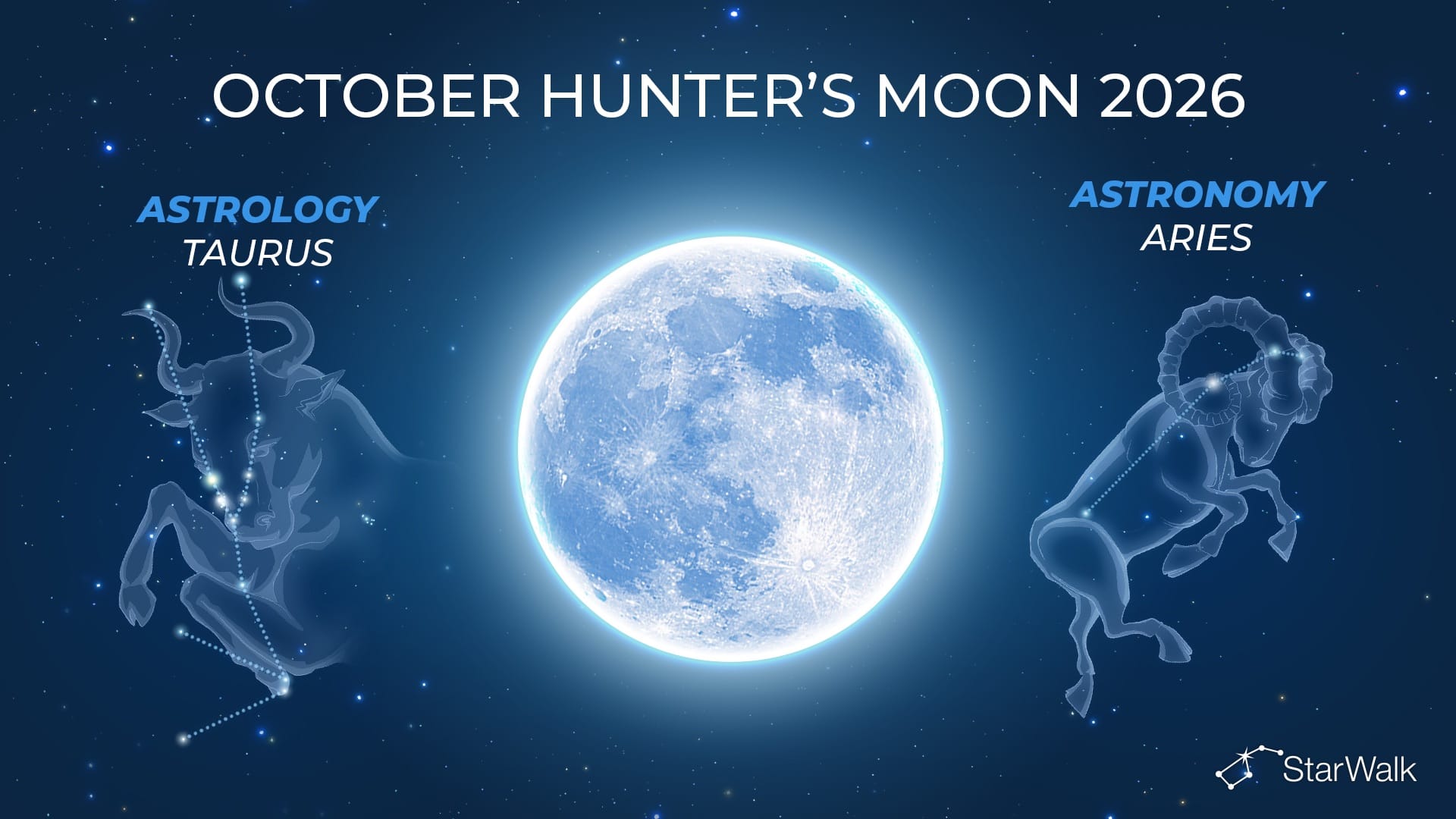
At 04:12 GMT/UTC on October 26, the Full Moon will be located in Aries. It crosses into this constellation from Pisces shortly before reaching the full phase.
In astrology, the Hunter’s Moon is described as a Full Moon in Taurus. This difference is expected: astrological signs divide the ecliptic into twelve fixed sectors, whereas astronomical constellations are irregular regions with official boundaries. See our infographic about zodiac signs and ecliptic constellations for a visual comparison.
What is near the October Full Moon?
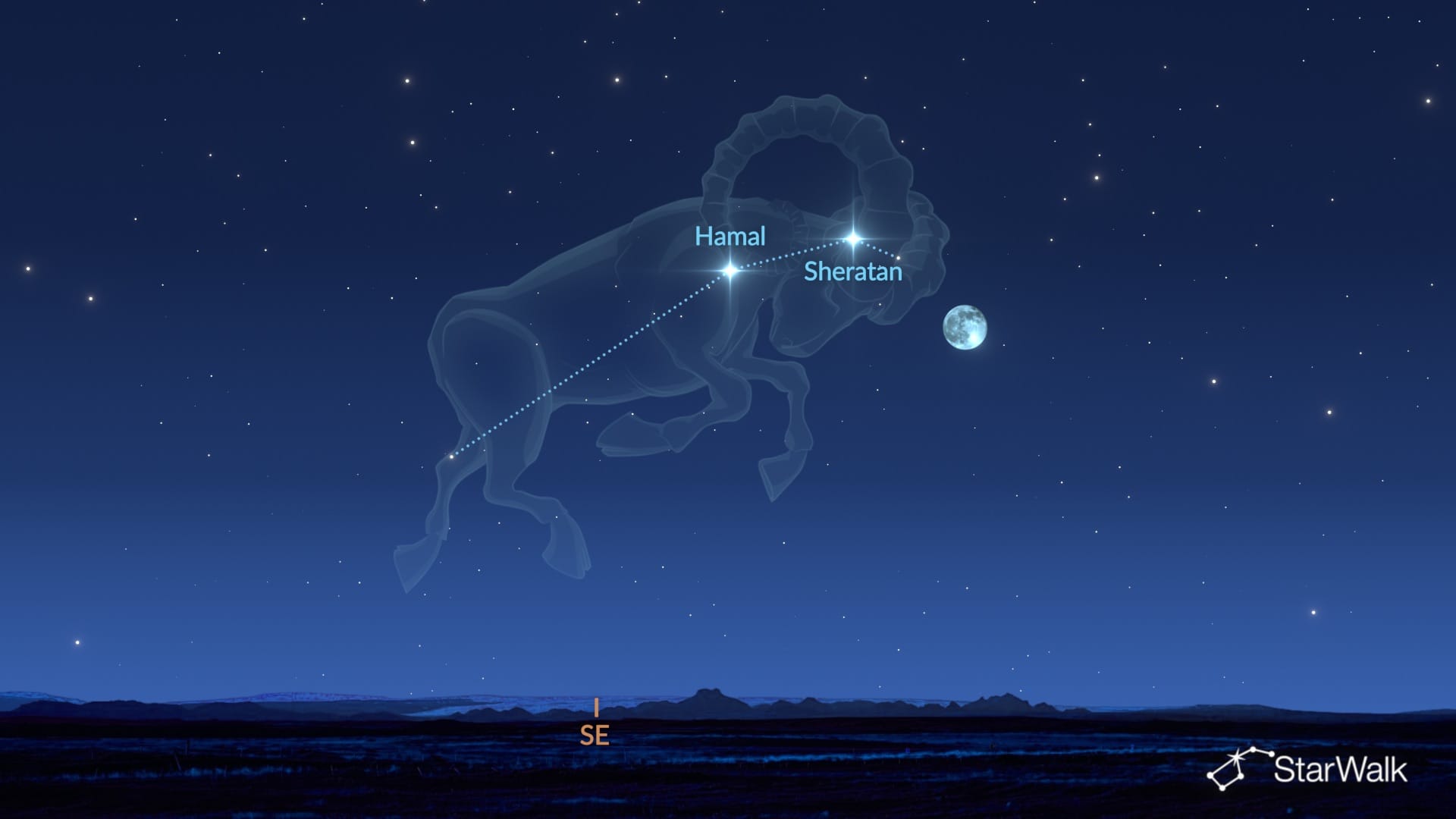
On October 26, two of Aries’ best-known stars will appear near the bright lunar disk. At the exact moment of the Full Moon, Sheratan (mag 2.6) will be roughly 4° from the Moon, while Hamal (mag 2.0) will be about 7° away. The Moon’s glare may wash out stars of this brightness, especially through urban haze. Block the Moon with a wall, roof, or tree while searching for them, or scan the area with binoculars.
October 25–26: The Moon, Saturn, and Algenib form a triangle
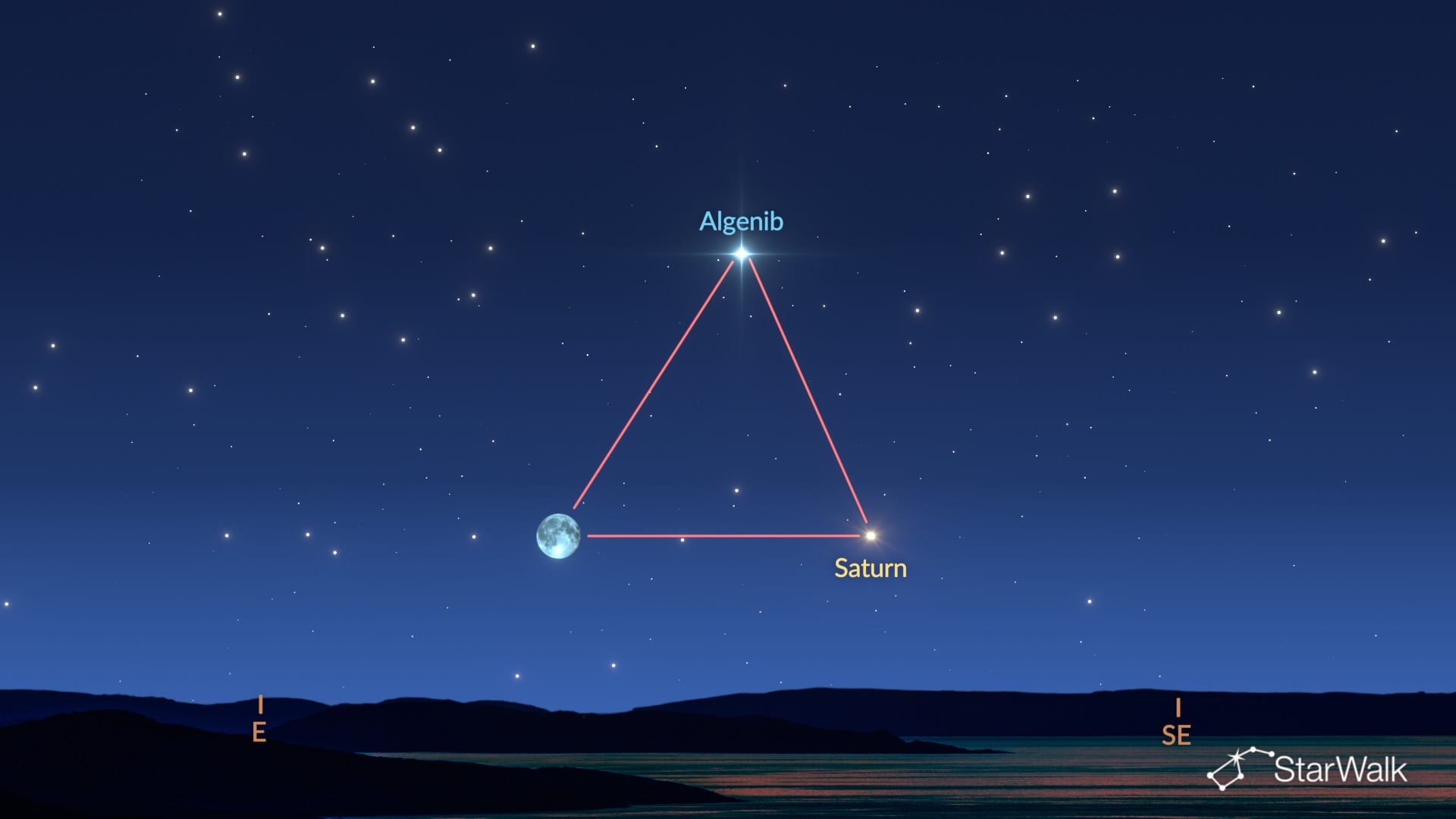
On the evening of October 25 and into the night of October 25–26, the nearly full Moon, Saturn (mag 0.4), and Algenib (mag 2.8) will form a large, nearly equilateral triangle. The Moon and Saturn will be easy to spot with the naked eye, but bright moonlight may make Algenib more difficult to see. Binoculars will help reveal the star.
For more detailed information about the event, read our Saturn observing guide.
October Full Moon meaning: why is it called the Hunter’s Moon?
The name Hunter’s Moon comes from the traditional autumn hunting season in the Northern Hemisphere. By this time of year, the harvest was largely complete, leaving fields more open and making game easier to spot. The bright Full Moon also provided extra evening light for hunting and preparing food for the coming winter.
Hunter’s Moon is a seasonal title rather than a permanent name for every October Full Moon. It belongs to the first Full Moon after the Harvest Moon. Since the Harvest Moon falls on September 26 in 2026, the October 26 Full Moon is the year’s Hunter’s Moon in the Northern Hemisphere.
The Hunter’s Moon usually falls in October, but not without exception. When the Full Moon closest to the September equinox occurs in October, it takes the Harvest Moon title, and the following Full Moon in November becomes the Hunter’s Moon. This will next happen in 2028.
Other names for the October Full Moon
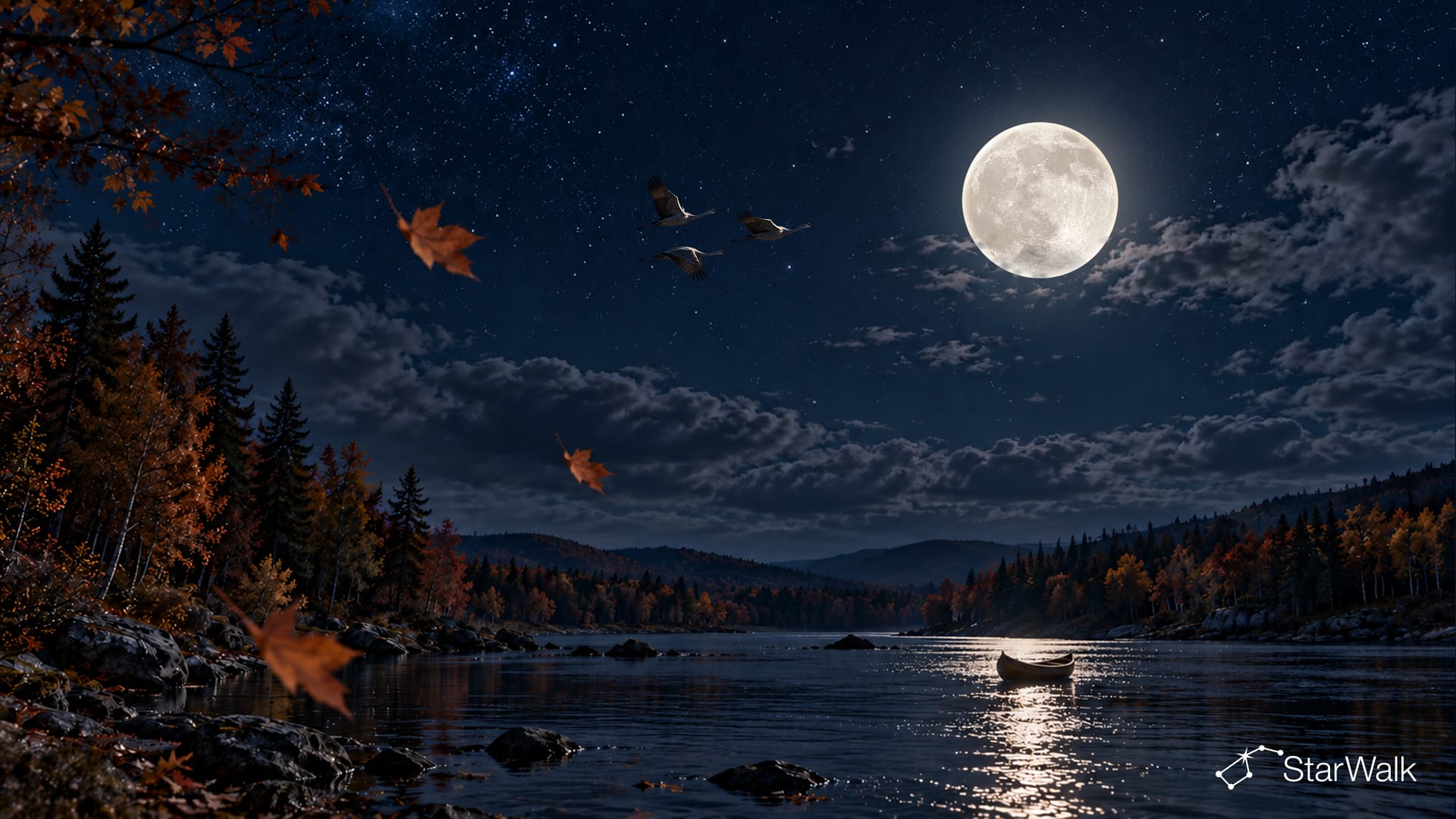
The October Full Moon has many traditional names across cultures. Most of them reflect harvesting, migration, falling temperatures, and other seasonal changes in the Northern Hemisphere.
- Moon When the Wind Shakes Off Leaves — a Lakota name inspired by windy autumn weather
- Big Chestnut Moon — a Creek name associated with the chestnut harvest
- Moon the Birds Fly South — a Cree name referring to the seasonal migration of birds
- White Frost on Grass Moon — an Algonquin name referring to the first visible autumn frost
- Time When the Corn Is Taken In — an Apache name associated with gathering the corn harvest
- Travel in Canoes Moon — a Wishram name connected with seasonal travel by canoe
- Freeze Begins on Stream’s Edge — a Cheyenne name marking the first ice forming along waterways
- Heading to Winter Moon — a Comanche name reflecting the approach of winter
- Wilted Moon — a Shawnee name describing the fading vegetation
- Rutting Moon — a Shoshone name referring to the autumn mating season of certain animals
- Big Wind Moon — a Zuni name inspired by the windy weather of the season
- Moon When Sagittaria Roots Are Gathered — a Kalapuya name referring to the seasonal gathering of edible roots
- Bears Hibernate Moon — a Haida name reflecting the time when bears begin their winter sleep
October marks the middle of spring in the Southern Hemisphere, where names such as Egg Moon, Fish Moon, Pink Moon, Seed Moon, and Waking Moon are used.
Hunter’s Moon spiritual meaning
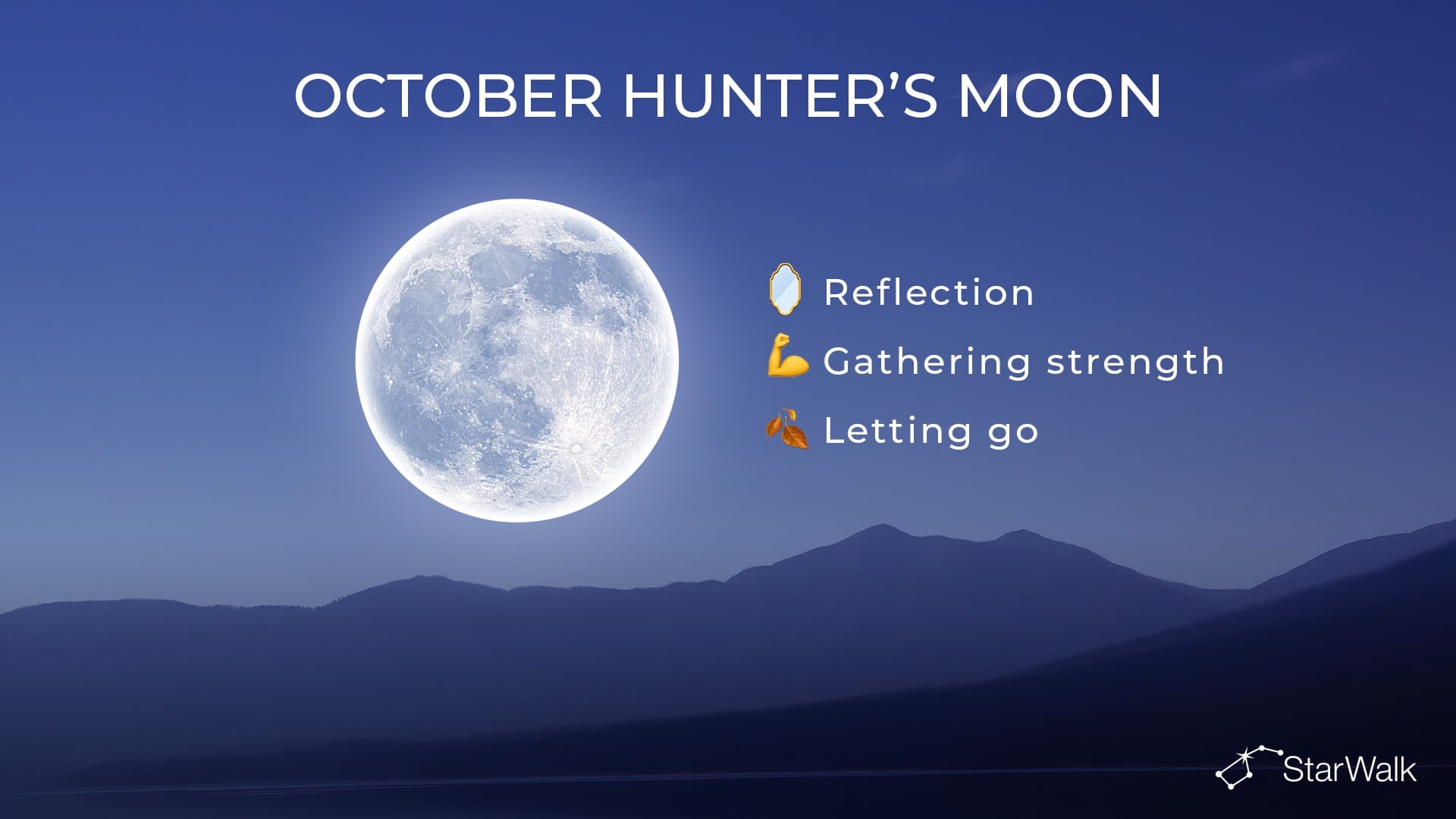
Contemporary spiritual interpretations present the Hunter’s Moon as a time for reflection, gathering your strength, and letting go of what no longer serves you. This symbolism loosely draws on the Moon’s traditional seasonal associations with taking stock and preparing for winter. These meanings belong to modern cultural and spiritual practices; they are not properties of the astronomical event.
What will the Moon look like on Halloween 2026?
By October 31, 2026, five days will have passed since the Full Moon. The Moon will be a waning gibbous, roughly two-thirds illuminated.
It will rise well after sunset, with the exact hour varying by location. This will leave many observers with darker skies early in the evening. After moonrise, look for Pollux, the brightest star in Gemini: at 16:57 GMT/UTC (12:57 PM EDT), the Moon will pass about 4° south of it. Check our guide to Halloween stargazing for more objects to find throughout the night.
Despite the Full Moon’s strong connection with Halloween imagery, a Full Moon on Halloween itself is uncommon. The next one will occur on October 31, 2039, at 22:36 GMT/UTC.
October Full Moon 2026: Frequently asked questions
What time is the Hunter’s Moon in 2026?
Full phase occurs at 04:12 GMT/UTC on October 26 (12:12 AM EDT). Locations west of the EDT time zone experience the same instant on the evening of October 25. The Moon will look essentially full on October 25–27.
Why is the October 2026 Full Moon called the Hunter’s Moon?
It is the first Full Moon after the Harvest Moon. The traditional name evokes the period when cleared fields and moonlit evenings helped hunters find game and prepare for winter.
Does the Hunter’s Moon always fall in October?
No. It usually occurs in October in the Northern Hemisphere, but its date depends on the Harvest Moon. If the Harvest Moon is in October, the Hunter’s Moon moves to November. The next November Hunter’s Moon comes in 2028.
Is the October 2026 Full Moon a supermoon?
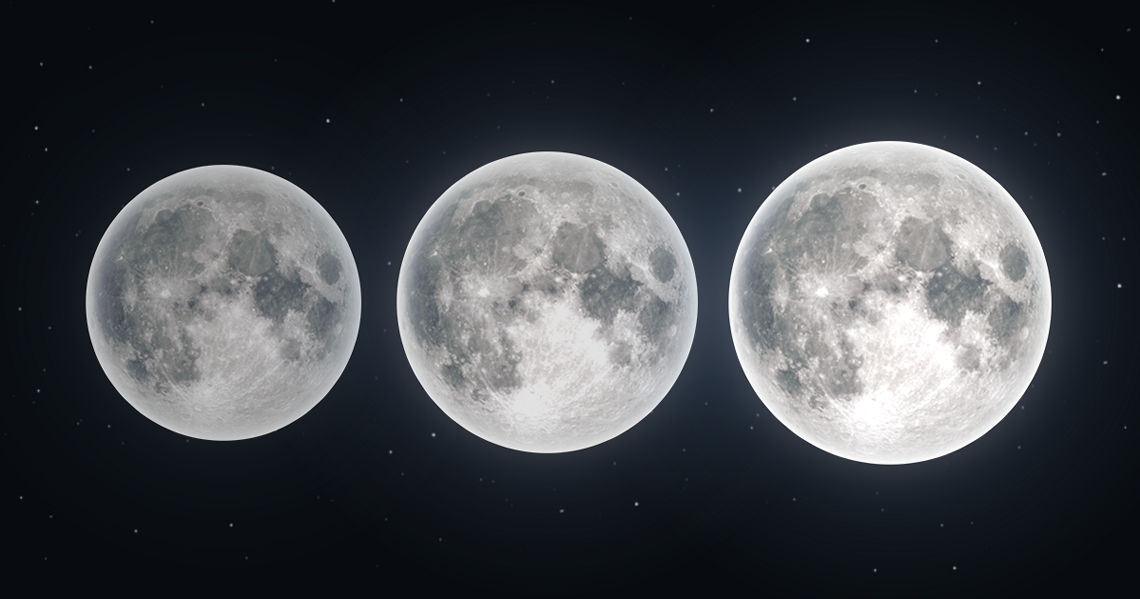
No. The October Hunter’s Moon does not meet the supermoon criteria. The next supermoon will be the Beaver Moon on November 24, 2026. You can learn more about this phenomenon in our supermoons and micromoons infographic.
Is there a Full Moon on Halloween 2026?
No. The October Full Moon occurs on October 26, so by Halloween on October 31, the Moon will already be a waning gibbous.
When is the next Full Moon after October 2026?
The next Full Moon is the Beaver supermoon, which peaks on November 24, 2026, at 14:53 GMT/UTC (9:53 AM EST).
When is the next Hunter’s Moon?
In the Northern Hemisphere, the next Hunter’s Moon arrives on October 15, 2027, at 13:47 GMT/UTC (9:47 AM EDT).
In the Southern Hemisphere, the 2026 Hunter’s Moon fell on May 1. The next one will peak on April 20, 2027, at 22:27 GMT/UTC (6:27 PM EDT), which is April 21 in many Southern Hemisphere time zones.
October Full Moon 2026: key takeaways
The Moon reaches full phase on October 26 at 04:12 GMT/UTC (12:12 AM EDT). At that time, it will be in the constellation Aries, near the stars Sheratan and Hamal. This Full Moon is called the Hunter’s Moon because it directly follows September’s Harvest Moon. For the most impressive view, watch it rise above the horizon, where it may appear warmer in color and unusually large beside foreground objects.
For a location-specific forecast, open Sky Tonight, tap the Calendar icon, and select the Moon tab. You’ll see the phase and rise time calculated for your observing site.
Clear skies!