Vernal Equinox 2027: When Is the First Day of Spring 2027?

Spring begins at a precise moment: the spring equinox. In the Northern Hemisphere, the next vernal equinox occurs on March 20, 2027, at 20:25 GMT, marking the beginning of astronomical spring. Want to know the exact equinox time where you live? Check it in the Sky Tonight astronomy app.
Contents
- Upcoming Spring Equinox 2027 (Northern Hemisphere): Quick Facts
- What Is the Spring Equinox?
- When Is the Next Vernal Equinox?
- When Is the First Day of Spring 2027?
- Equal Day and Night: Debunking the Most Popular Myth
Vernal Equinox 2027: F.A.Q.
- When Does Spring Start in 2027?
- When Is the First Day of Spring 2027 in the USA?
- When Is the First Day of Spring 2027 in Canada?
- When Is the First Day of Spring 2027 in the UK?
- When Is the First Day of Spring 2027 in Europe?
- What Is the First Full Moon After the Spring Equinox 2027?
- When Does Daylight Saving Time Start in 2027?
- When Is the Spring Solstice 2027?
- Does the Spring Equinox Mean Warmer Weather Starts?
- Spring Equinox 2027: Key Facts
- What Is an Equinox? Dive Deeper
Upcoming Spring Equinox 2027 (Northern Hemisphere): Quick Facts
- Date: March 20, 2027
- Exact time: 20:25 GMT – 4:25 PM EDT / 3:25 PM CDT / 2:25 PM MDT / 1:25 PM PDT / 8:25 PM GMT / 9:25 PM CET / 10:25 PM EET
- What it marks: The astronomical first day of spring in the Northern Hemisphere – and the first day of autumn (the autumn equinox) in the Southern Hemisphere
- What happens in the sky: The Sun crosses the celestial equator moving northward
What Is the Spring Equinox?
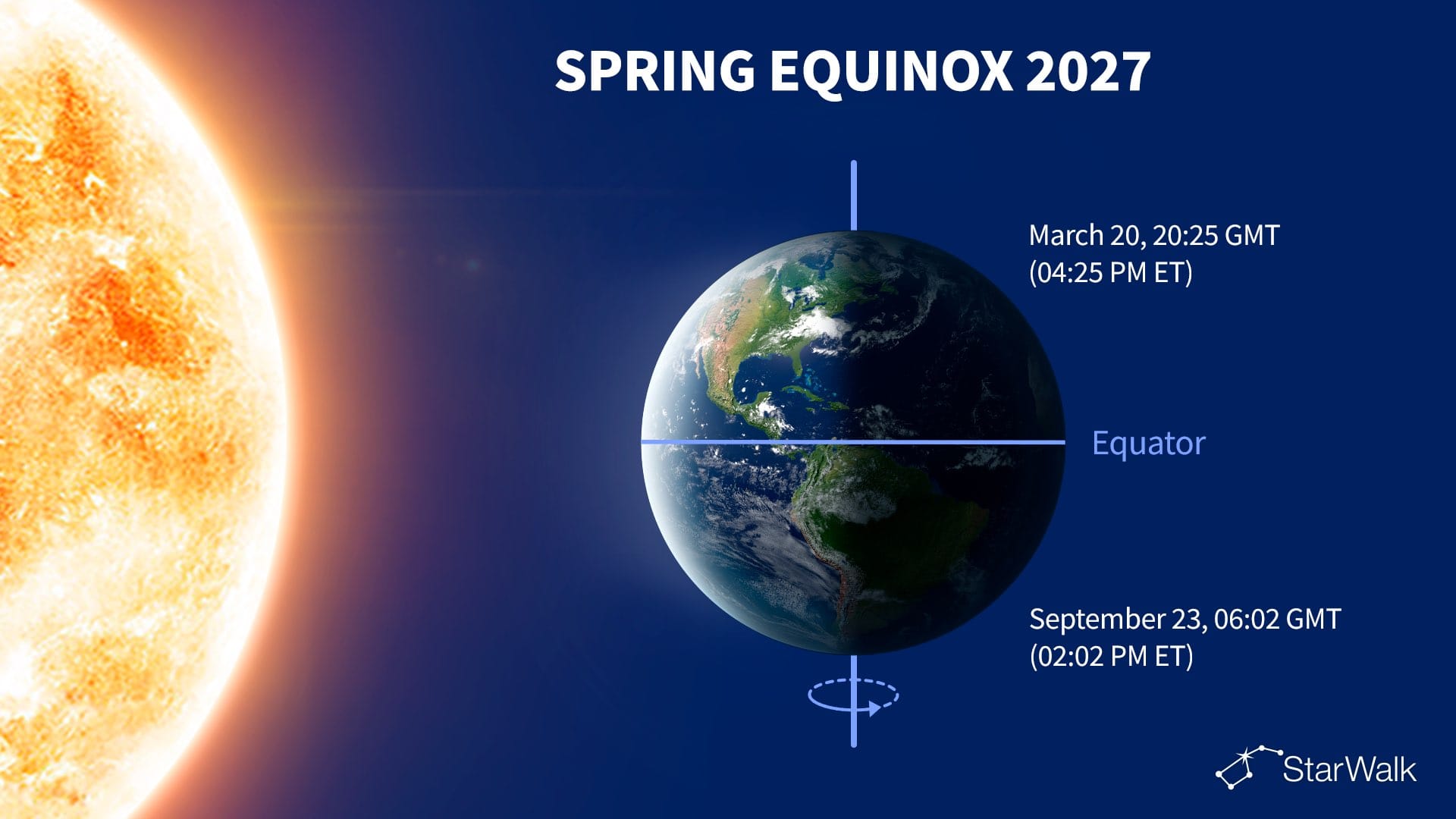
The spring equinox (as well as the autumnal equinox) is the moment when neither of the Earth’s hemispheres is inclined towards or away from the Sun.
As a result, the Sun is located directly above the equator, and both hemispheres receive an almost equal amount of sunlight. After the spring equinox, the relevant hemisphere (the northern one in March and the southern one in September) tilts closer to the Sun, resulting in more hours of daylight and earlier sunrises and later sunsets.
At the moment of the equinox, the Sun crosses one of the two points where the ecliptic intersects the celestial equator (here is a short video to help visualize how it works). The ecliptic is the Sun’s apparent annual path across the sky; the celestial equator is an imaginary line extending from the Earth’s equator into the celestial sphere. They are inclined to each other at 23.4°. If there were no inclination between them, there would be no seasons and solstices, and we would have the equinox all year round.
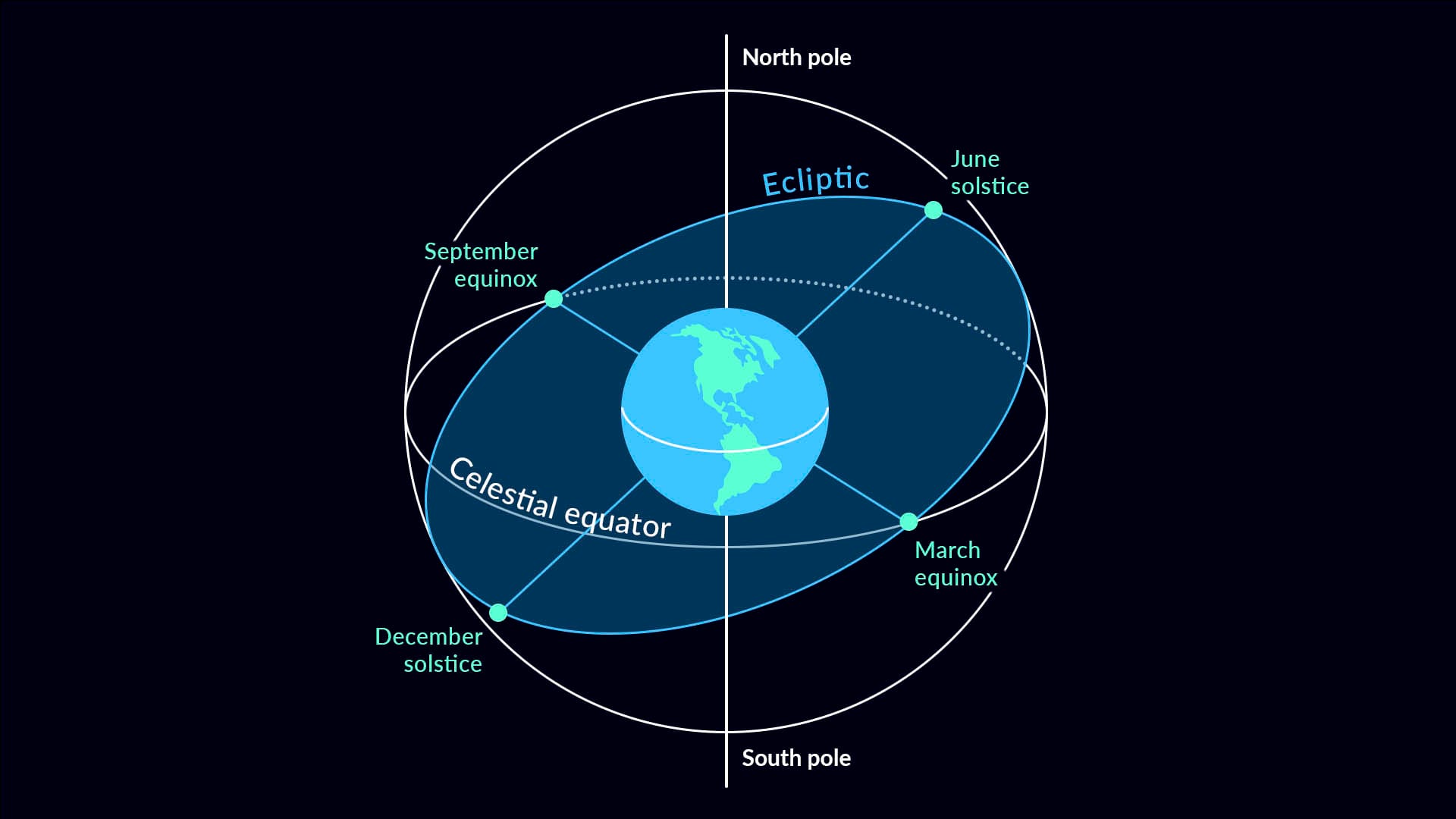
The spring equinox occurs in March or September. It depends on which hemisphere you live in. How come? Let’s figure it out.
What Are March Equinox & September Equinox?
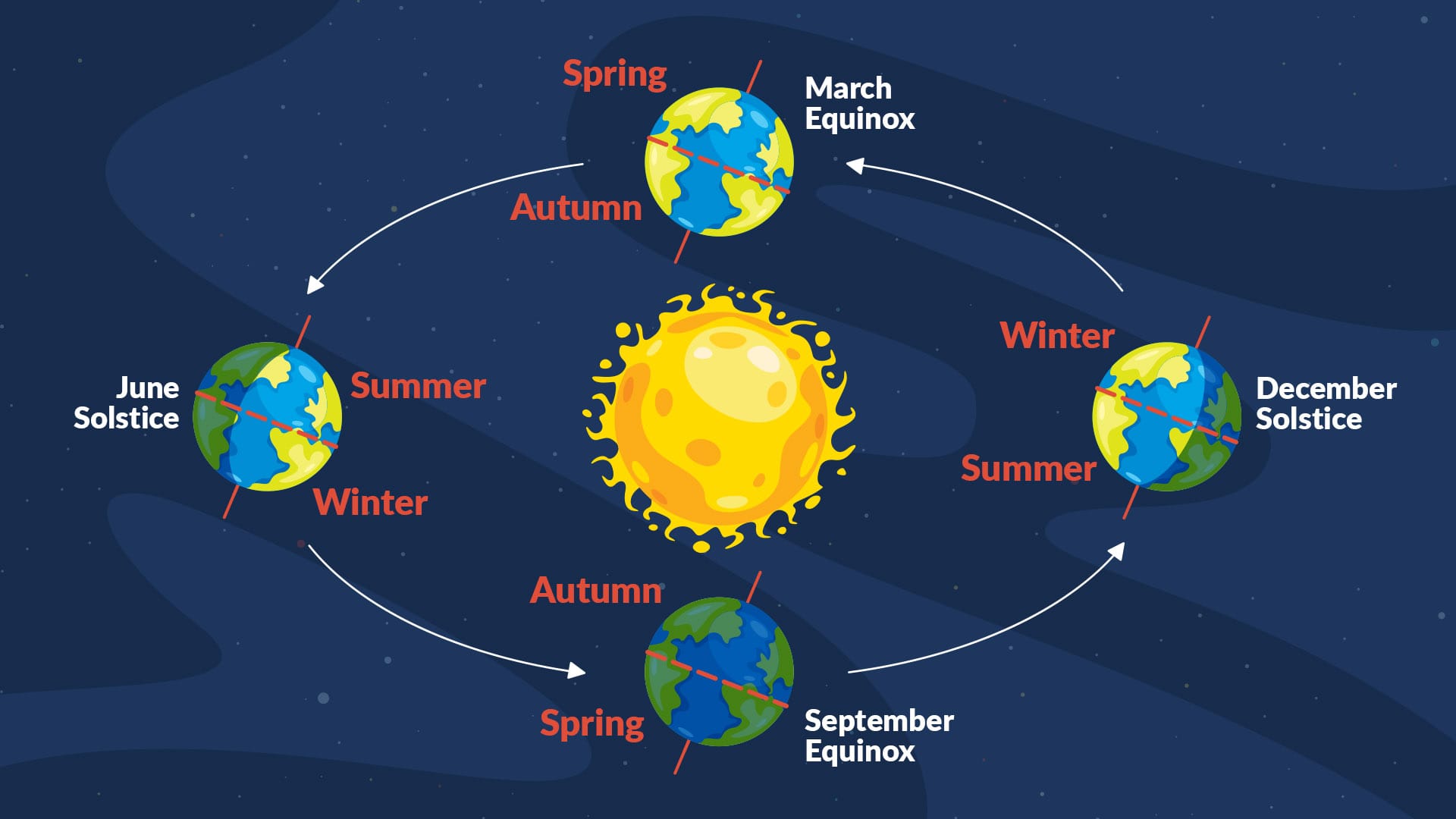
If you live in the Northern Hemisphere, you probably use the terms "March equinox" and "spring equinox" interchangeably because, in this region, the March equinox marks the beginning of spring and all the seasonal changes that come with it.
In the Southern Hemisphere, however, the seasons are reversed. That's why the March equinox there symbolizes the beginning of autumn and, therefore, is called the autumnal equinox.
To avoid confusion between the different hemispheres, astronomers use the terms "March equinox" and "September equinox". In general usage, however, people are more likely to say “spring” and “autumnal” equinox.
If you want to dive deeper into the mechanics of equinoxes, head to our full guide “What Is an Equinox?”

When Is the Next Vernal Equinox?
In the Northern Hemisphere, the next spring equinox will occur on March 20, 2027, at 20:25 GMT.
In the Southern Hemisphere, the next spring equinox will arrive on September 23, 2027, at 06:02 GMT.
Note that an equinox happens at the same instant worldwide, but the local date can differ depending on your time zone. In some Asian locations, for example, the March 2027 equinox will already fall on March 21.
Here are the March 2027 spring equinox times for major time zones in the Northern Hemisphere:
| Time zone | Example cities | Spring equinox date & time |
|---|---|---|
| Eastern Daylight Time (EDT, GMT−4) | New York, Washington, D.C., Toronto | March 20, 4:25 PM |
| Central Daylight Time (CDT, GMT−5) | Chicago, Dallas, New Orleans | March 20, 3:25 PM |
| Mountain Daylight Time (MDT, GMT−6) | Denver, Calgary, Albuquerque | March 20, 2:25 PM |
| Pacific Daylight Time (PDT, GMT−7) | Los Angeles, San Francisco, Vancouver | March 20, 1:25 PM |
| Central European Time (CET, GMT+1) | Paris, Berlin, Rome | March 20, 21:25 |
| Eastern European Time (EET, GMT+2) | Athens, Bucharest, Helsinki | March 20, 22:25 |
| India Standard Time (IST, GMT+5:30) | New Delhi, Mumbai, Bengaluru | March 21, 01:55 |
| China Standard Time (CST, GMT+8) | Beijing, Shanghai, Shenzhen | March 21, 04:25 |
| Japan Standard Time (JST, GMT+9) | Tokyo, Osaka, Sapporo | March 21, 05:25 |
To find out the exact equinox time for your city, open the Sky Tonight app. Go to the search window and enter "Equinox" in the search field. You'll see the exact time of the event in your location in the corresponding search result.
Spring Equinox Dates 2027-2031
In the Southern Hemisphere, the dates of the spring equinox vary between September 21 and 24. In the 21st century, the most common equinox date is September 22 – it occurs on this day 76 times. Meanwhile, the next equinox on September 24 will take place only in 2303.
In the Northern Hemisphere, the spring equinox dates vary between March 19 and 21. In this century, 78 equinoxes fall on March 20, and only two occur on March 21. The other 20 equinoxes this century occur on March 19.
Note that the dates above are given in Greenwich Mean Time (GMT), and the equinox date may vary in different time zones.
Here are the spring equinox dates for five years:
Northern Hemisphere
- 2027: March 20, 20:25 GMT/UTC (4:25 PM ET)
- 2028: March 20, 02:17 GMT/UTC (March 19, 10:17 PM ET)
- 2029: March 20, 08:02 GMT/UTC (4:02 AM ET)
- 2030: March 20, 13:52 GMT/UTC (9:52 AM ET)
- 2031: March 20, 19:41 GMT/UTC (3:41 PM ET)
Southern Hemisphere
- 2027: September 23, 06:02 GMT/UTC
- 2028: September 22, 11:45 GMT/UTC
- 2029: September 22, 17:38 GMT/UTC
- 2030: September 22, 23:27 GMT/UTC
- 2031: September 23, 05:15 GMT/UTC
When Is the First Day of Spring 2027?
Spring in the Northern Hemisphere begins at the March equinox – on March 20, 2027. Spring in the Southern Hemisphere begins on September 23, 2027. This is consistent with the astronomical approach, which suggests that the equinoxes mark the transition from winter to spring and from summer to autumn. These dates depend on Earth’s position relative to the Sun and can change from year to year.
The meteorological approach suggests that spring starts on March 1 in the Northern Hemisphere (and on September 1 in the Southern Hemisphere). Such an approach is based on annual temperature cycles. It also follows the Gregorian calendar and has fixed dates that divide a year into equal quarters, making it easier to compare monthly and seasonal statistics.
When Is the First Day of Spring in Australia?
In Australia, spring begins on September 1 under the meteorological calendar, or at the September equinox (September 23 in 2027) under the astronomical calendar. However, the familiar four-season system does not describe the entire country equally well. In tropical northern Australia, the year is often better understood in terms of wet and dry seasons, which more closely reflect local rainfall and climate patterns. Australia also has many Indigenous seasonal calendars, developed from long-term observations of changes in plants, animals, weather, water, and Country. These calendars vary between regions and language groups, and some recognize more than four seasons.
Equal Day and Night: Debunking the Most Popular Myth
Despite the common misconception, the length of day and night at the equinox is almost equal, but not exactly the same. There are two reasons for this: atmospheric refraction and the definition of sunset/sunrise.
Atmospheric Refraction
The Earth’s atmosphere refracts sunlight, affecting the apparent position of the Sun and the length of daylight. Because the atmosphere's density gradually decreases with altitude, sunlight bends as it passes through it, making the Sun appear slightly higher in the sky than its true geometric position when it is near the horizon. To imagine how it works, think of a pencil in a glass of water – the pencil appears to bend when viewed from certain angles.

We know that our atmosphere uplifts the Sun by about 0.6 degrees from its true position whenever the Sun is near the horizon. This means that when you see the Sun near the horizon, in reality, it's already below the line. However, the atmosphere bends the light upwards, making the Sun appear in a different place.
Regarding the daylight length, atmospheric refraction advances sunrise and delays sunset, adding several minutes of sunlight.
Sunset/Sunrise Definition
If sunset and sunrise were defined as the moments when the geometric center of the Sun passes over the horizon, we would have exactly 12 hours of day and 12 hours of night. But this isn't the case. Sunrise and sunset are defined as the exact moments when the upper edge of the Sun touches the horizon. So the time it takes for the Sun to disappear completely below the horizon (which can be several minutes) makes the day slightly longer than the night on the equinox.
Daylight Length on the Vernal Equinox 2027
Here are a few examples of daylight length on the March 20, 2027 vernal equinox in the Northern Hemisphere. Although day and night are often said to be equal on the equinox, most locations actually get slightly more than 12 hours of daylight, with the exact duration depending mainly on latitude.
- New York, USA: about 12 hours 8 minutes
- London, UK: about 12 hours 9 minutes
- Paris, France: about 12 hours 8 minutes
- Tokyo, Japan: about 12 hours 7 minutes
- North Pole: about 24 hours*
*Around the March equinox, the Sun stays close to the horizon at the poles. At the North Pole, polar night gives way to polar day, beginning a period of continuous daylight that lasts for about six months. At the South Pole, the opposite happens: polar day gives way to polar night.
Equilux: Equal Day and Night
Although day and night aren't exactly equal at the equinox, there is the equilux. This word is used to describe days when day and night are equal. Equiluxes happen a few days before the spring equinox (and a few days after the autumnal equinox). On such a day, we experience as close to 12 hours of daylight as possible (give or take a few tens of seconds). The exact day of equilux depends on latitude.
Vernal Equinox 2027: F.A.Q.
When Does Spring Start in 2027?
In the Northern Hemisphere, astronomical spring begins on March 20, 2027, at the March equinox. Meteorological spring begins earlier, on March 1. In the Southern Hemisphere, March marks the beginning of autumn, while spring begins at the September equinox.
Astronomers count the solstices and equinoxes as the transition points between the seasons, while meteorologists consider the seasons to begin on the first day of the months that include the equinoxes and solstices. For more information, read our dedicated article.
When Is the First Day of Spring 2027 in the USA?
In most of the United States, the astronomical first day of spring is March 20, 2027. The equinox occurs at 4:25 PM EDT, 3:25 PM CDT, 2:25 PM MDT, and 1:25 PM PDT.
When Is the First Day of Spring 2027 in Canada?
Astronomical spring begins in Canada with the March equinox on March 20, 2027. In the Eastern Time Zone, including Toronto, the equinox occurs at 4:25 PM EDT.
When Is the First Day of Spring 2027 in the UK?
In the UK, astronomical spring begins on March 20, 2027, at 8:25 PM GMT. The country will still be on Greenwich Mean Time because British Summer Time begins later in March.
When Is the First Day of Spring 2027 in Europe?
Across Europe, astronomical spring begins at the same global moment on March 20, 2027, but the local clock time varies. The equinox occurs at 9:25 PM CET in cities such as Paris, Berlin, and Rome, and at 10:25 PM EET in cities such as Athens, Bucharest, and Helsinki.
What Is the First Full Moon After the Spring Equinox 2027?
The first Full Moon after the March equinox occurs on March 22, 2027. This Full Moon is special because it determines the date of Easter in the Western Catholic tradition. This is why it is often called the Paschal Full Moon. Learn more about the March Full Moon in our dedicated article.
When Does Daylight Saving Time Start in 2027?
Daylight Saving Time (DST) begins around the start of spring in many parts of the world. However, it does not begin exactly on the spring equinox. In most of the United States and Canada, clocks move forward on March 14, 2027, six days before the equinox. In the UK and most of Europe, the clock change occurs later, on March 28, 2027. DST rules vary by country and region, and some places do not observe it at all.
When Is the Spring Solstice 2027?
There is no such thing as a “spring solstice” – the correct term is spring equinox. In the Northern Hemisphere, the spring equinox occurs on March 20, 2027, at 20:25 GMT. Remember: solstices occur in June and December; equinoxes – in March and September. To ensure you know the difference between these two events, take our quiz on equinoxes and solstices.
Does the Spring Equinox Mean Warmer Weather Starts?
Not necessarily. The spring equinox is an astronomical event, not a weather switch: it marks the point when days continue getting longer, but temperatures don’t rise instantly. Land and oceans take time to warm after winter, so seasonal temperatures usually lag behind changes in sunlight.
Spring Equinox 2027: Key Facts
The spring equinox in the Northern Hemisphere occurs on March 20, 2027, at 20:25 GMT – 4:25 PM EDT / 3:25 PM CDT / 2:25 PM MDT / 1:25 PM PDT / 8:25 PM GMT / 9:25 PM CET / 10:25 PM EET. At this moment, the Sun crosses the celestial equator moving northward, marking the astronomical beginning of spring in the Northern Hemisphere and autumn in the Southern Hemisphere.
Want to know the exact time of the equinox in your area? Check it instantly with the Sky Tonight app!
What Is an Equinox? Dive Deeper
So you’ve learned about the spring equinox – nice! But what about its autumn twin? And how do equinoxes relate to solstices? If you’re curious to really understand how seasons work, these resources will take you further:
- Fall Equinox
- What Are Equinoxes?
- What Are Solstices?
- Quiz: Can You Tell an Equinox From a Solstice? (It’s trickier than it sounds, unless you’ve done your reading!)