Cosmic Dogs: Dog Constellations, Stars & Space Pioneers
Dogs appear throughout astronomy and space history. Three of the 88 official constellations represent dogs. The brightest star in the night sky is the Dog Star, and its faint companion is nicknamed the Pup. Even an asteroid looks like a giant dog bone. Real dogs also became some of the earliest space travelers. International Dog Day is celebrated on August 26, making it a good time to explore these cosmic dogs.
Use the astronomy app Sky Tonight to search for any constellation, star, cluster, nebula, or asteroid mentioned below. The app’s sky map adjusts to your location, so you can check whether each object is above your horizon and find the best time to observe it.
Contents
- Dog Constellations and Stars You Can See
- Dog Lookalikes in Space
- The Real Dogs Who Pioneered Spaceflight
- Cosmic Dogs FAQ
- Cosmic Dogs: Key Facts
Dog Constellations and Stars You Can See
Start with the dog constellations and their brightest stars, which are visible without a telescope. Canis Major and Canis Minor are best seen in the evening alongside Orion from December through March. Canes Venatici is best seen from March through June and is easier to observe from the Northern Hemisphere.
Canis Major: The Great Dog
Canis Major is the easiest dog constellation to recognize because it contains Sirius, the brightest star in the night sky. It is one of the classical constellations listed by Ptolemy in the 2nd century and is usually depicted as one of Orion's hunting dogs. Its brightest stars – Sirius, Mirzam, Adhara, Wezen, and Aludra – form a recognizable body, legs, and tail.
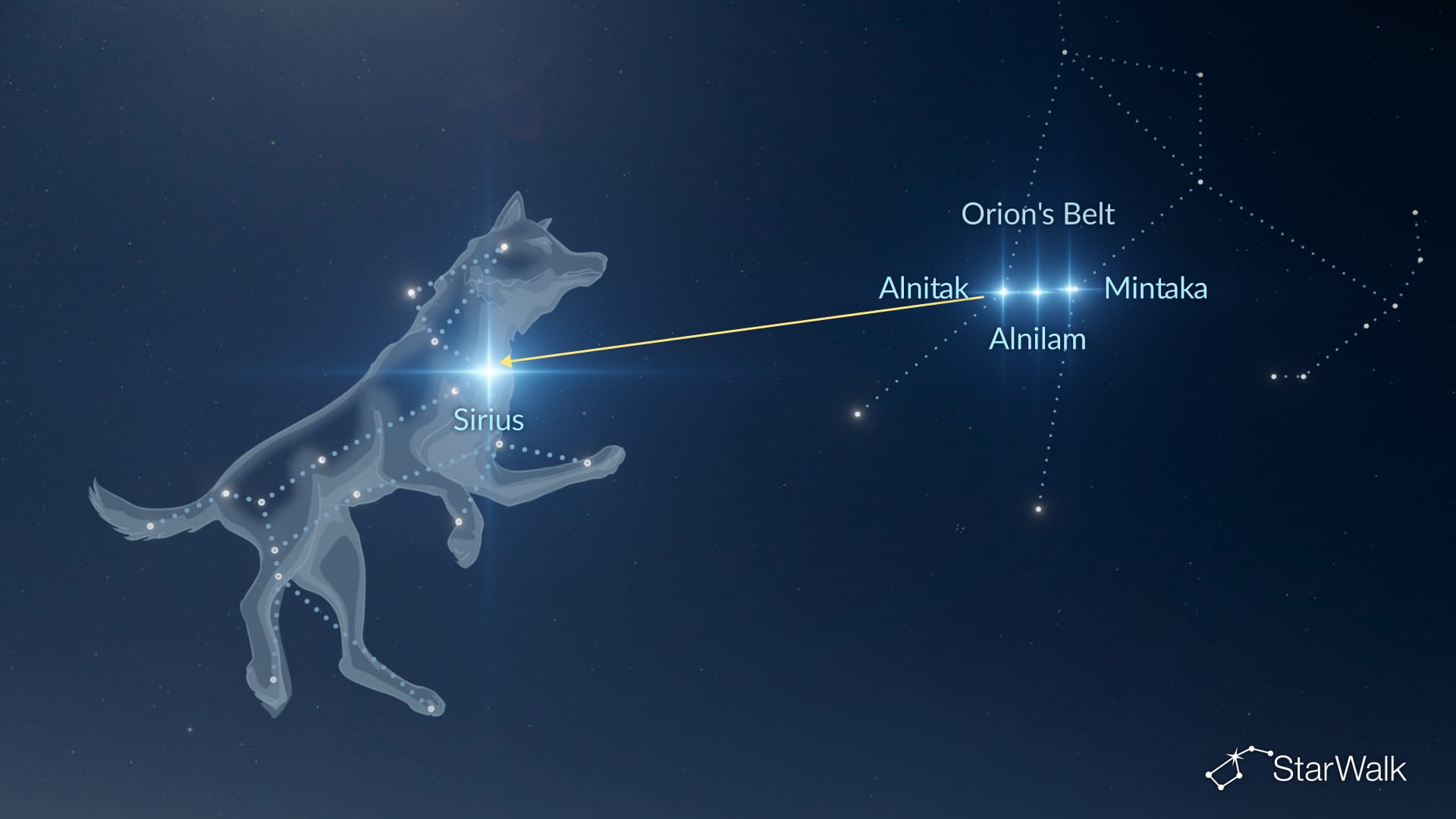
To find Canis Major, first locate the three stars of Orion's Belt. Extend the line from Mintaka through Alnilam and Alnitak until you reach brilliant Sirius. At mid-northern latitudes, the Great Dog stays fairly low in the south; from the Southern Hemisphere, it climbs much higher. The constellation is easiest to observe in the evening from December through March, especially in January and February. It is visible from about 60°N to the South Pole, although the entire constellation becomes increasingly difficult to observe near the northern limit. See our detailed guide to Canis Major to learn more about its stars and mythology.
Sirius: The Dog Star and Its "Pup"
Sirius (Alpha Canis Majoris) shines at a magnitude of -1.46 and lies only 8.6 light-years away. Its common name, the Dog Star, comes from its position in Canis Major. In ancient Mediterranean traditions, the star's heliacal rising – its first appearance in the dawn sky after a period near the Sun – became associated with the hottest part of summer and helped give us the phrase "dog days." Because of precession, the date of Sirius's heliacal rising has changed over time. The date also varies with latitude.
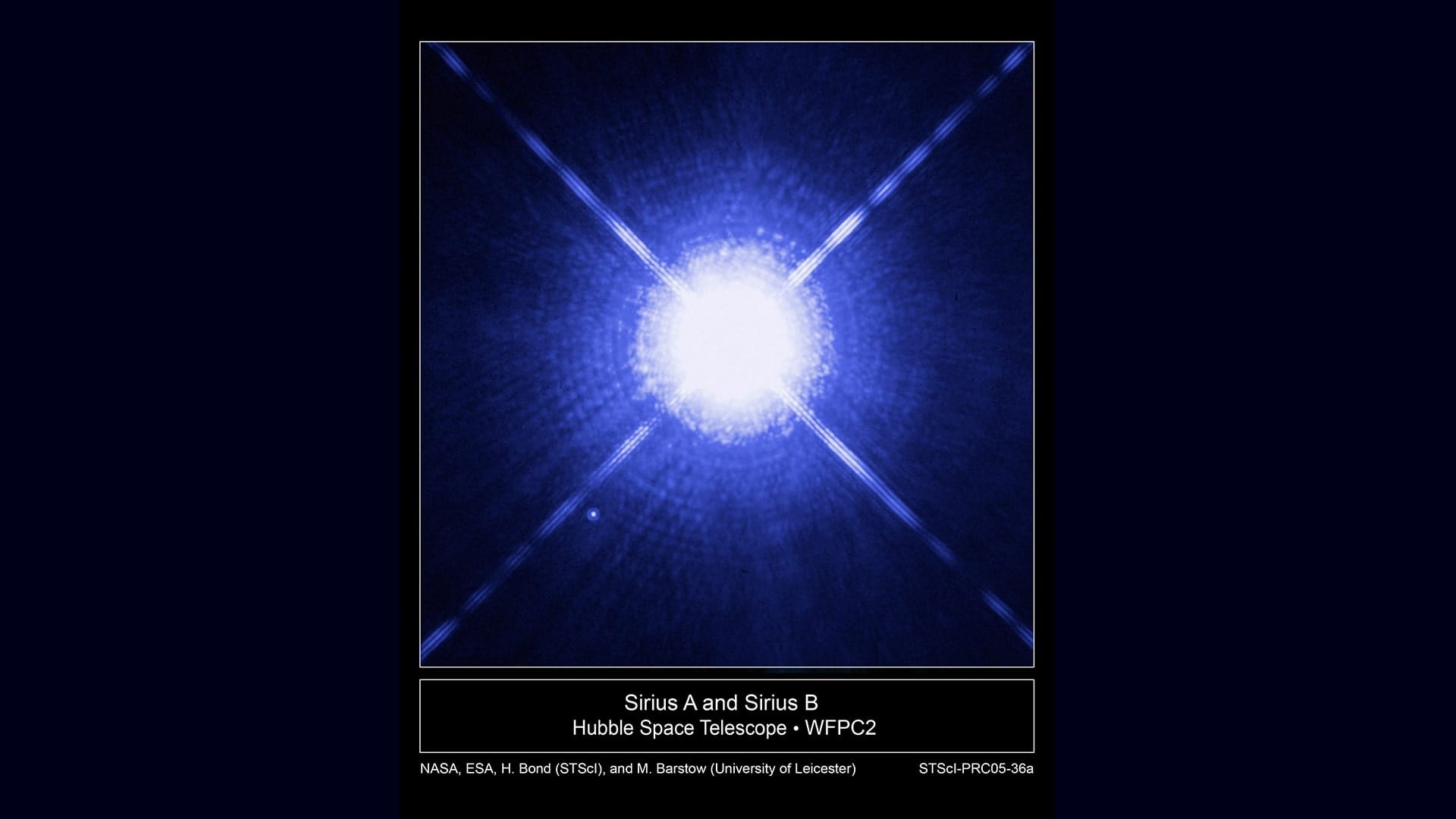
The light we see comes mainly from Sirius A, but the system also contains a white dwarf, Sirius B, informally called the Pup. Sirius B has a magnitude of about 8.4, yet it is roughly 10,000 times fainter than Sirius A. The Pup is therefore a difficult telescopic target: Sirius A's glare and atmospheric turbulence are greater obstacles than Sirius B's magnitude itself. Experienced observers can resolve Sirius B with a well-collimated 4- to 6-inch telescope under very steady atmospheric conditions. A larger telescope and high magnification increase the chances of seeing it. Observe Sirius when it is as high above the horizon as possible, and keep the optics clean. Through a telescope, the Pup will not resemble the detailed Hubble images. Read more in our Sirius guide.
Canis Minor: The Little Dog
Canis Minor is also one of Ptolemy's classical constellations, but its visible pattern is very simple: it is essentially a line between bright Procyon and fainter Gomeisa. The constellation is visible from almost all inhabited latitudes and is best seen in the evening from January through March.
Procyon, at a magnitude of 0.3, is the eighth-brightest star in the night sky and lies about 11.5 light-years from Earth. Its name comes from Greek words meaning "before the dog" and refers to Procyon rising before Sirius as seen from ancient Greece. Like Sirius, Procyon is a binary system with a faint white-dwarf companion, but most amateur telescopes cannot resolve the two stars.
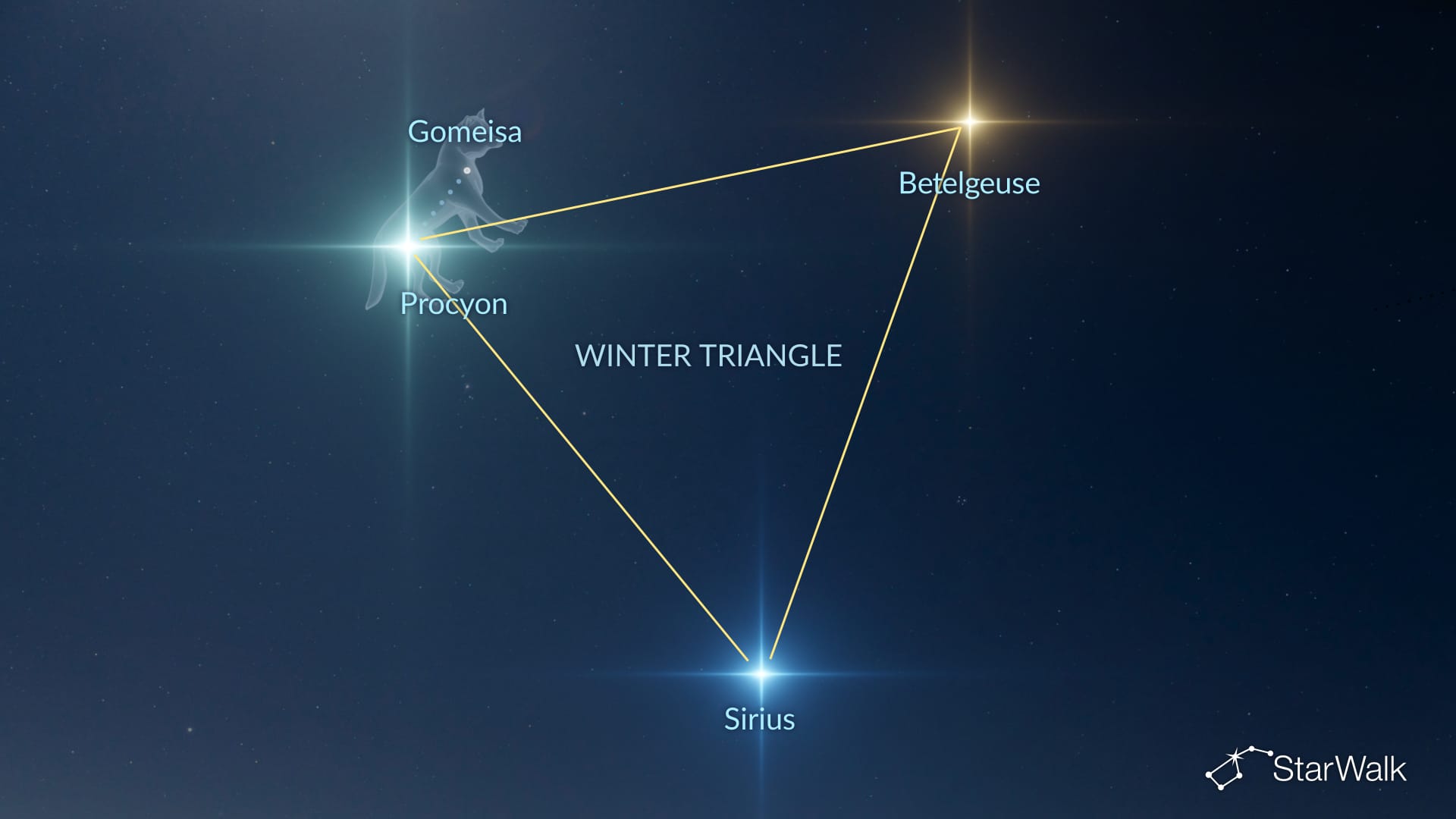
The easiest way to find Procyon is to use the Winter Triangle: Sirius, reddish Betelgeuse, and Procyon form its three corners. After finding Procyon, look about 4° away for Gomeisa, a magnitude 2.9 blue-white star. Procyon and Gomeisa are the only stars in Canis Minor that are easy to see with the naked eye. Read more in our Canis Minor guide.
Canes Venatici: The Hunting Dogs
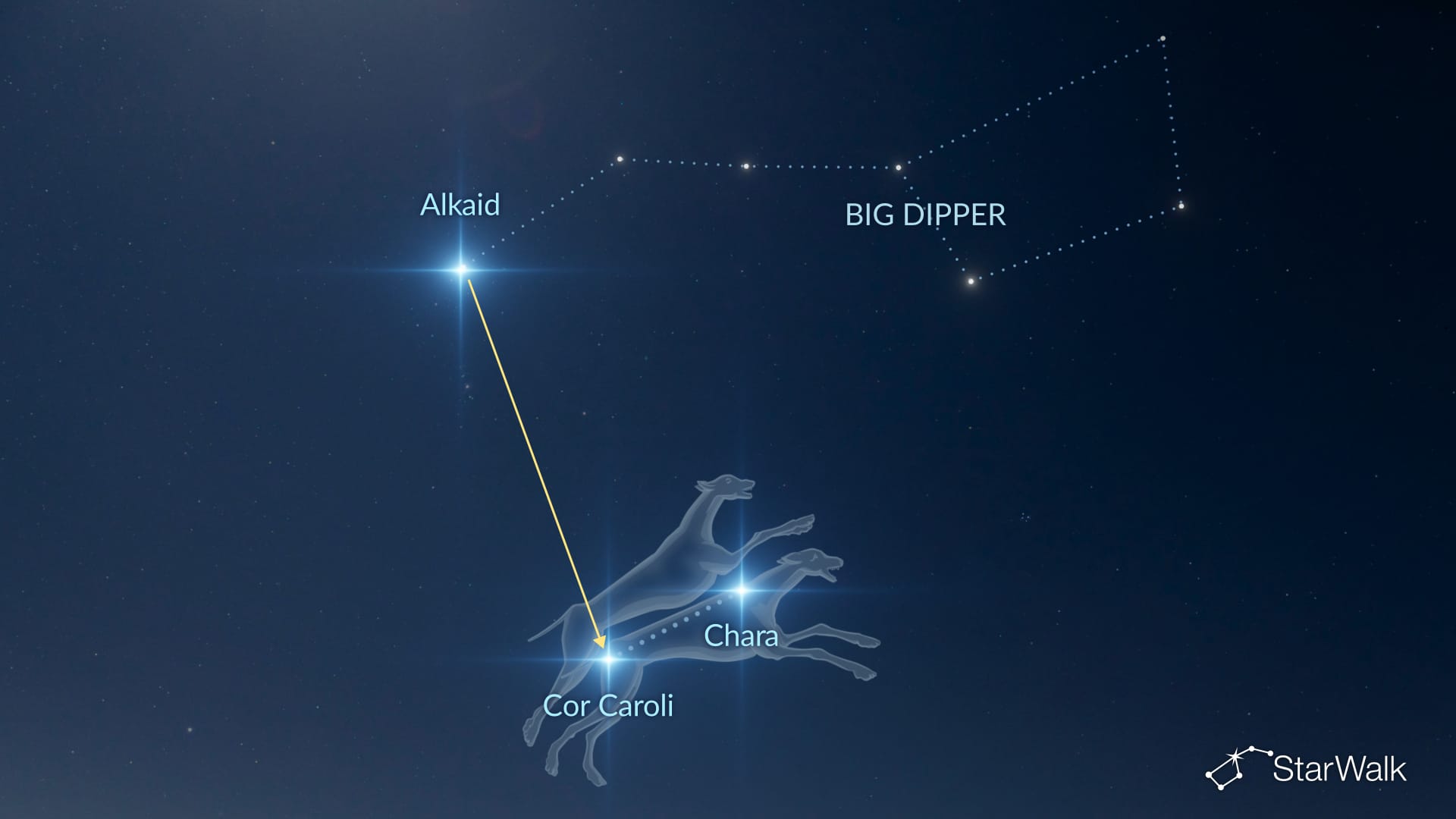
Canes Venatici means "Hunting Dogs" in Latin. Johannes Hevelius established it as a separate constellation in the 17th century, depicting two dogs named Asterion and Chara on a leash held by Boötes. Unlike Canis Major and Canis Minor, this is not an ancient constellation. Its two-star pattern does not look like two dogs unless an illustration is added.
Look for Canes Venatici south of the Big Dipper's handle, between Ursa Major and Boötes. Its brightest star, Cor Caroli (magnitude 2.9), lies about 15° south-southwest of Alkaid, the end star of the Big Dipper's handle. Chara (magnitude 4.3) is about 5° northwest of Cor Caroli and requires a darker sky to see. Cor Caroli is also a double star: a small telescope readily separates its components, which are about 20 arcseconds apart.
Canes Venatici is best seen in the evening from March through June, especially in April and May in the Northern Hemisphere. It is visible from northern latitudes down to roughly 40°S, but southern observers see it low above the northern horizon. Its stars are relatively faint, but the constellation contains many galaxies and star clusters.
Cerberus: The Dog Constellation That Disappeared
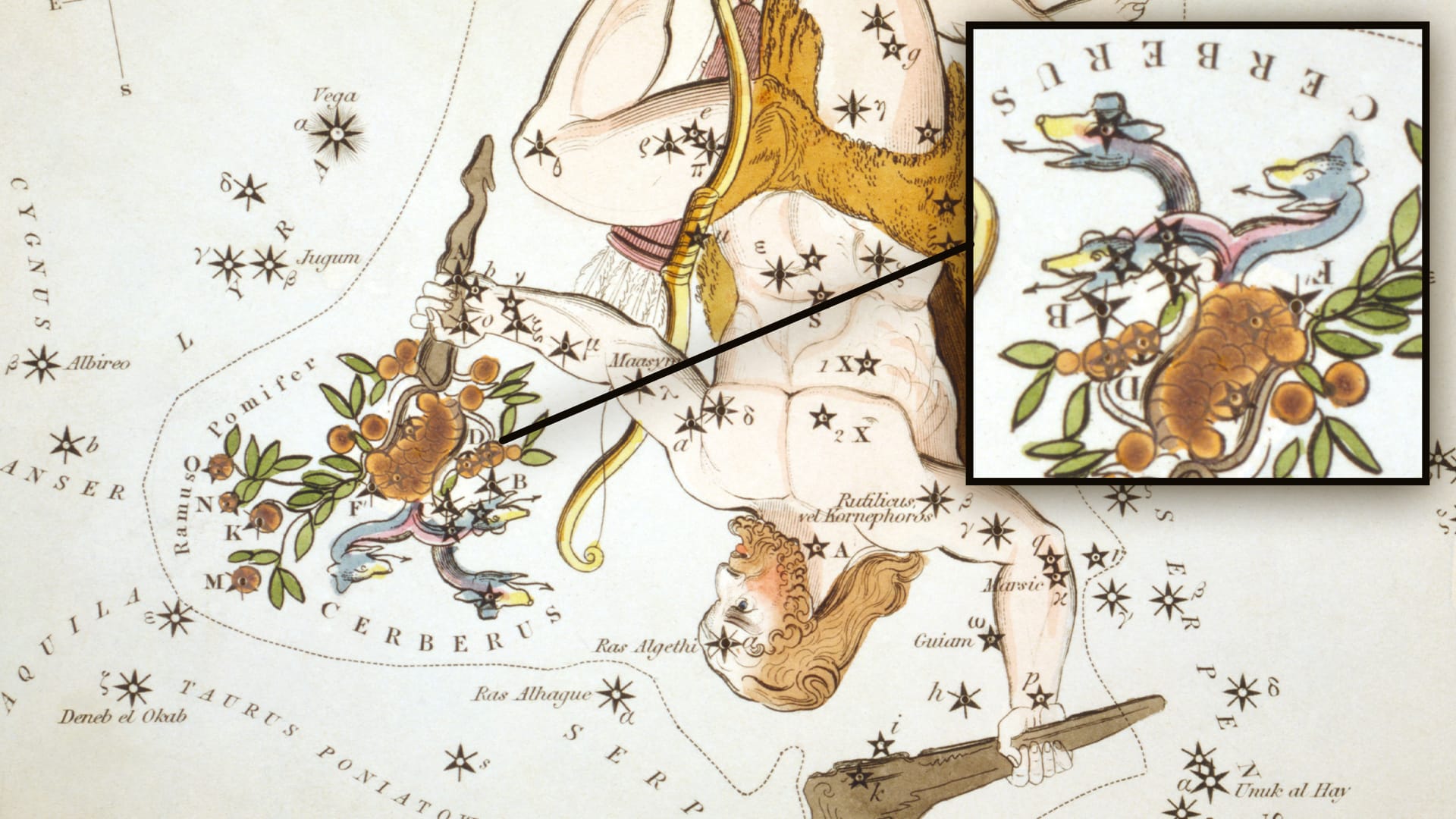
Modern astronomy recognizes three official dog constellations, but some historical atlases included another. Hevelius introduced Cerberus in 1687 near the hand of Hercules. It represented the three-headed guardian of the underworld, although old charts usually show a three-headed serpent rather than a recognizable dog.
Cerberus never became one of the 88 official constellations. Its four faint naked-eye stars are now cataloged as 93, 95, 102, and 109 Herculis. The constellation is obsolete, but its stars remain visible. You can learn about other extinct constellations in our quiz.
Dog Lookalikes in Space
Some astronomical objects resemble dogs because people recognize familiar shapes in their images. These dog-like shapes are informal interpretations and are easiest to recognize in high-resolution or long-exposure images.
216 Kleopatra: The Dog-Bone Asteroid
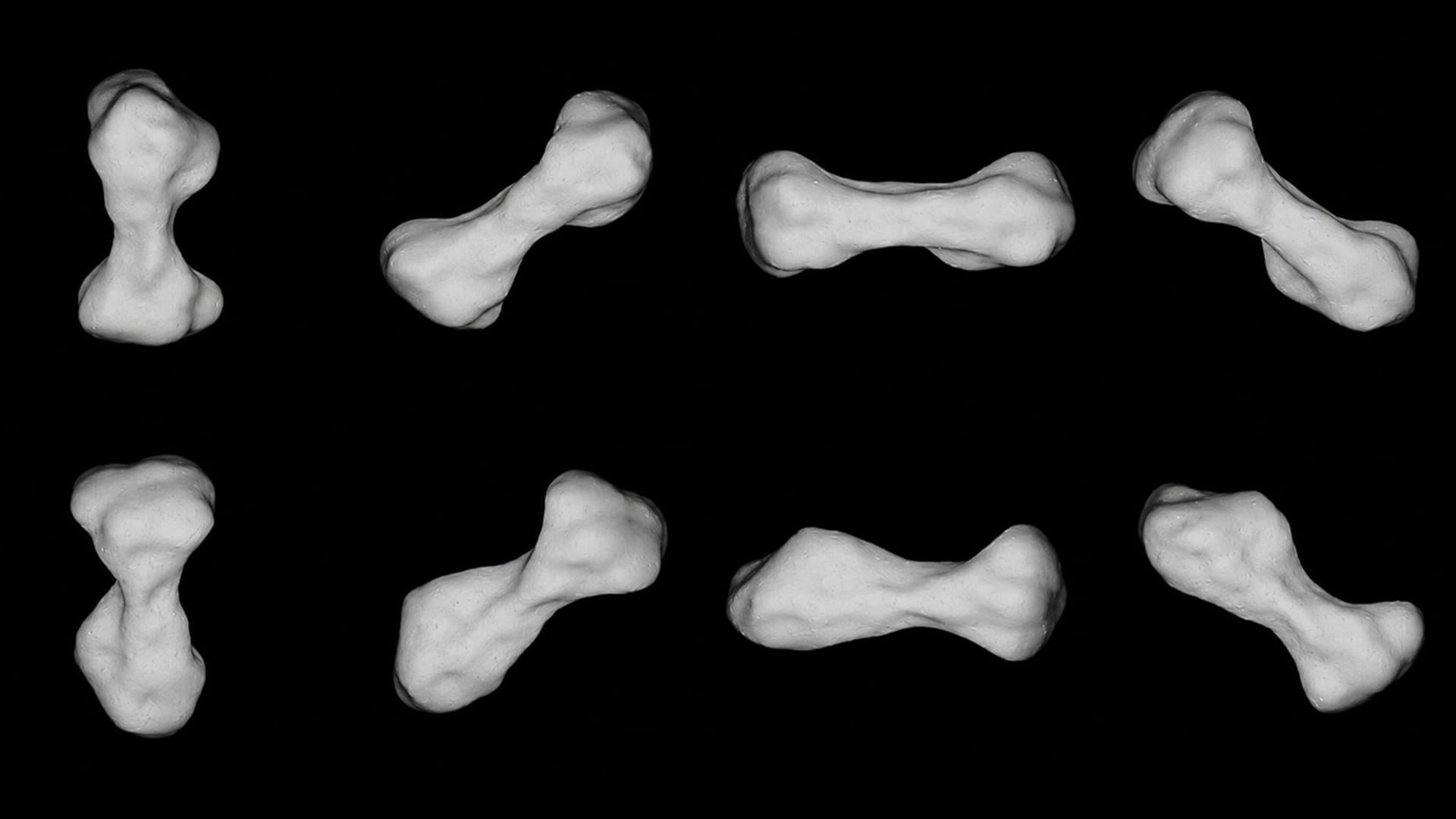
Asteroid 216 Kleopatra, located in the main asteroid belt, is about 270 km long and has two large lobes joined by a thick neck. Radar observations and high-resolution images from the Very Large Telescope revealed its unusual shape, which inspired the nickname "dog-bone asteroid." Kleopatra also has two small moons, AlexHelios and CleoSelene.
Even when Kleopatra is bright enough for an amateur telescope, it appears only as a point of light. Seeing its dog-bone shape requires professional radar or adaptive-optics imaging. Learn more about unusual bodies in our asteroid belt guide.
Heart Nebula: A Running Dog in Photographs
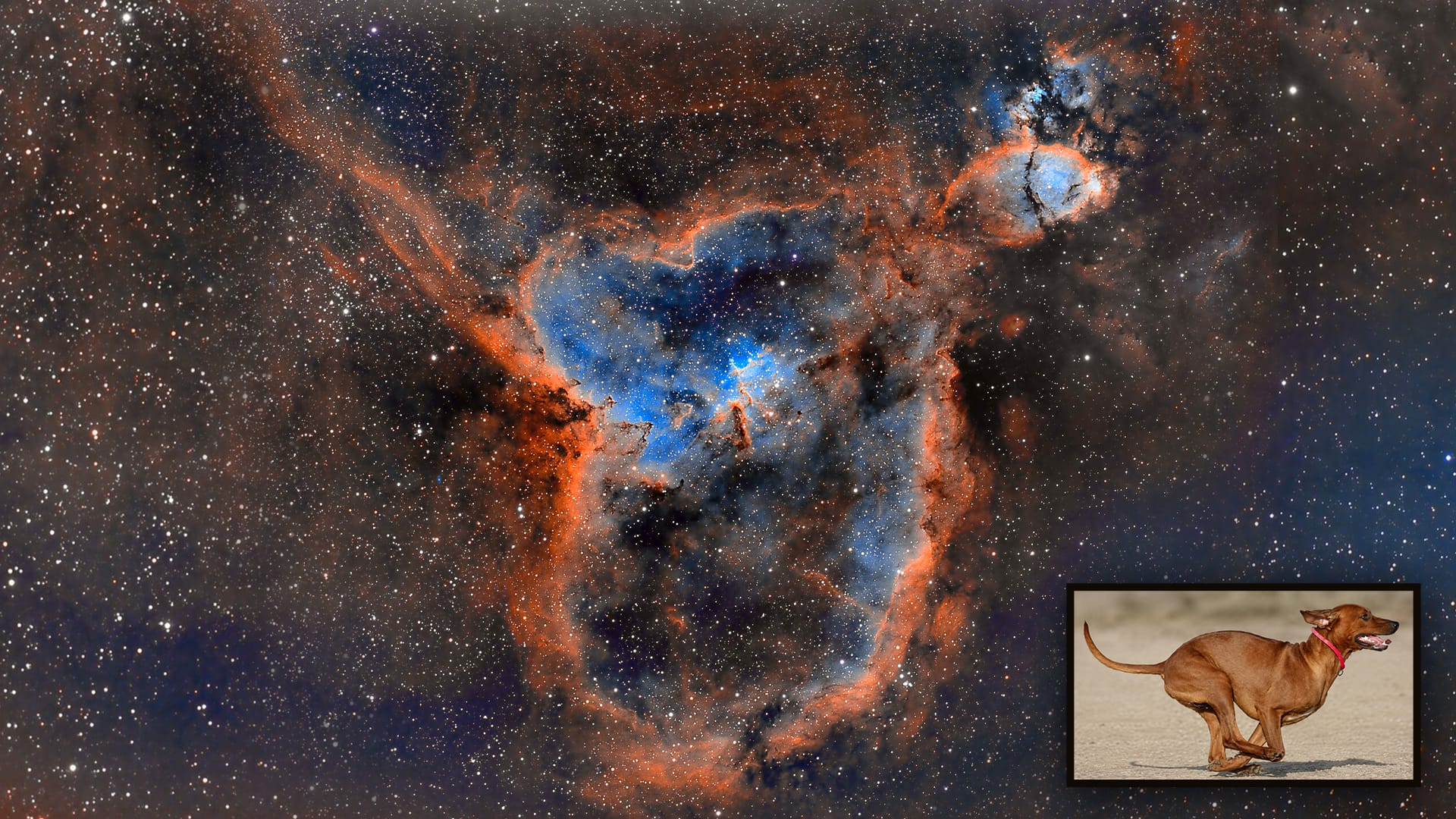
The Heart Nebula (IC 1805, Sh2-190) in Cassiopeia can resemble a running dog in some long-exposure images, depending on how the image is oriented. The nickname is informal, and the resemblance is clearer in some images than in others. The nebula spans about 2° to 2.5° – four to five Full Moons across – and lies around 7,500 light-years away.
At the center of the nebula is the young open cluster Melotte 15, commonly listed at an integrated magnitude of about 6.5. The surrounding emission nebula has very low surface brightness, so it is difficult to see even with a large telescope and a nebula filter. The complete heart or running-dog outline is best captured in photographs. A small refractor or telephoto lens combined with long exposures and narrowband filters can capture the broad structure. Northern observers have the best views from autumn through early winter. See it among our November deep-sky targets.
The Real Dogs Who Pioneered Spaceflight
The earliest canine rocket flights were experiments conducted before human orbital missions. These flights provided important biomedical data, but some animals were injured or died during the program.
Dezik and Tsygan: The First Dogs to Make a High-Altitude Rocket Flight
On July 22, 1951, Soviet dogs Dezik and Tsygan flew aboard an R-1V rocket to an altitude of about 88.7 km and returned alive. The flight remained below the 100 km Kármán line. However, some definitions place the beginning of space at 80 km, so whether the flight counts as spaceflight depends on the boundary used. Dezik and Tsygan are often described as the first dogs in space, but they did not orbit Earth.
Laika: The First Dog in Orbit
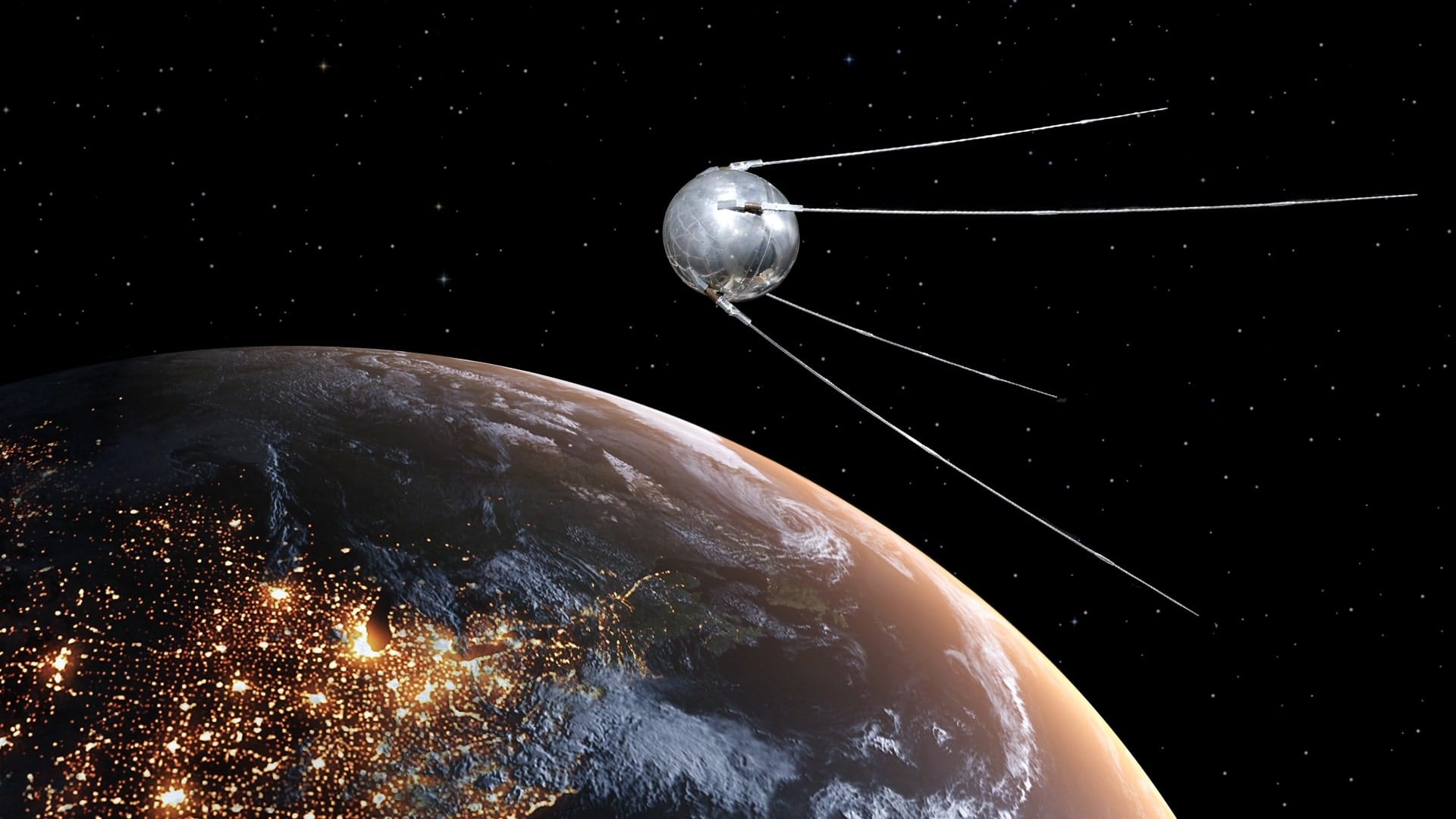
On November 3, 1957, Laika launched aboard Sputnik 2 and became the first animal to orbit Earth. Sputnik 2 had no return system, so the mission could not bring her back to Earth. Laika died from overheating within hours of launch. The true circumstances were not publicly acknowledged for decades.
Belka and Strelka: The First Dogs to Orbit and Return
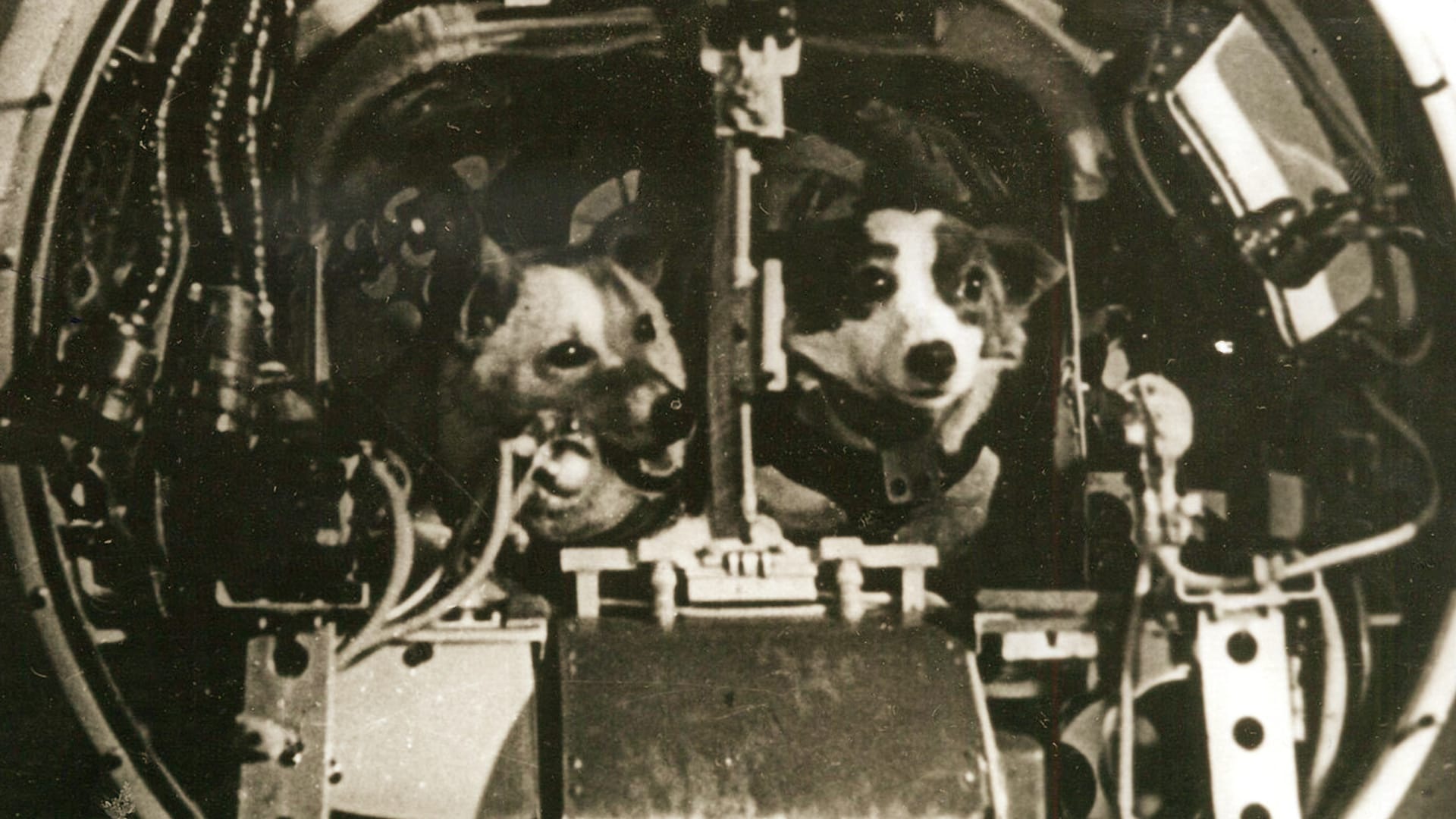
On August 19, 1960, Belka and Strelka launched aboard Korabl-Sputnik 2, commonly called Sputnik 5. They completed 17 orbits, spent more than 25 hours in space, and returned safely on August 20. Their flight helped demonstrate that living organisms could survive launch, weightlessness, reentry, and landing. The mission also provided important data before Yuri Gagarin's orbital flight in 1961. Read the full story of Belka and Strelka.
Do you know which animals, spacecraft, and people set other records beyond Earth? Test yourself with our Famous Firsts in Space quiz.
Cosmic Dogs FAQ
How many dog constellations are there?
There are three official dog constellations: Canis Major (the Great Dog), Canis Minor (the Little Dog), and Canes Venatici (the Hunting Dogs). Cerberus was a historical constellation, but it is not included among the 88 modern constellations.
Which star is called the Dog Star?
Sirius is called the Dog Star because it is the brightest star in Canis Major. At magnitude -1.46, it is also the brightest star in the entire night sky.
What is the Pup star?
Sirius B, the white-dwarf companion of Sirius A, is informally called the Pup. Its apparent magnitude is about 8.4, but it is very difficult to see because of the glare from Sirius A.
When is the best time to see the dog constellations?
Canis Major and Canis Minor are best seen in the evening from December through March. Canes Venatici is a northern spring constellation and is best seen from March through June. Exact visibility depends on latitude, local horizon, and time of night.
Who were the first dogs in space?
Dezik and Tsygan made the first canine high-altitude rocket flight in 1951, reaching about 88.7 km and returning alive. They are often called the first dogs in space when the 80 km boundary is used, although they remained below the 100 km Kármán line. Laika became the first dog – and the first animal – to orbit Earth in 1957. Belka and Strelka were the first dogs to orbit Earth and return safely in 1960.
Cosmic Dogs: Key Facts
The easiest cosmic dog to find is Canis Major: follow Orion's Belt to Sirius, the Dog Star. Use the Winter Triangle to find Procyon in Canis Minor. In northern spring, look for the fainter Canes Venatici, which contains many deep-sky objects. The Heart Nebula is mainly a photographic target, while Kleopatra's dog-bone shape requires professional imaging. For every target, Sky Tonight can show whether it is visible from your location and guide you to the correct part of the sky.