Moon, Jupiter, Mars, and Regulus: A Rare Sky Gathering on Nov 30, 2026
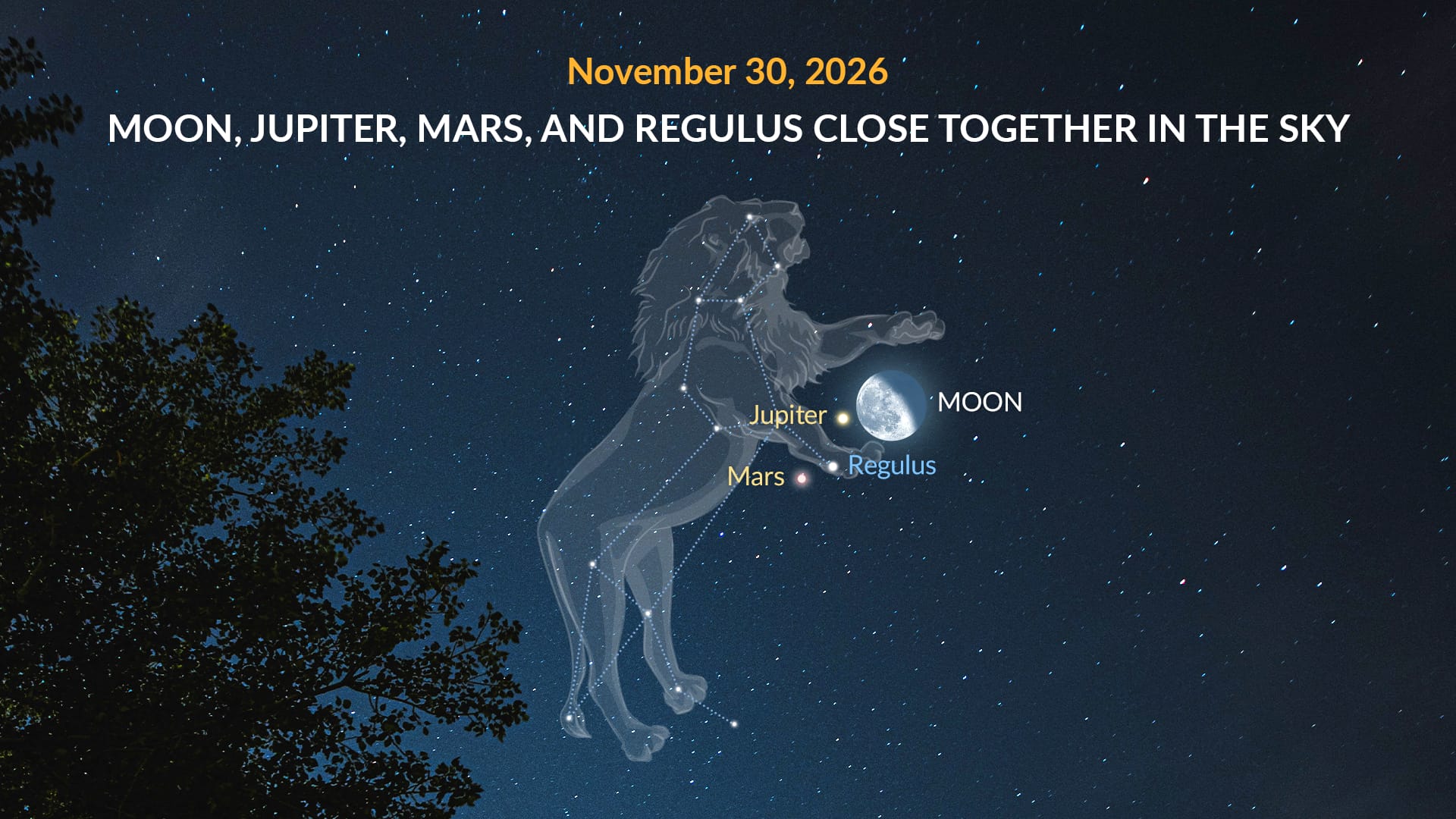
Seven times in 200 years — and the next one is coming this November. At the end of the month, Jupiter, Mars, Regulus, and the waning Moon group into a circle just 5.2° across. Comparable gatherings are extremely rare — there are only seven between 1900 and 2099.
And you can see the whole thing with the naked eye. Depending on your location, the best time to see it may be before dawn on November 30 or December 1. Use the free Star Walk 2 app to preview the gathering in your sky.
Contents
- How to See the Event in November 2026
- Why Is It a Special Event?
- When and Where to See the Event From Your Location
- The Moon Covers Jupiter and Regulus
- What Binoculars and a Telescope Can Show
- Photograph the Whole Group
- Moon, Jupiter, Mars, Regulus in November 2026: Key Points
How to See the Event in November 2026
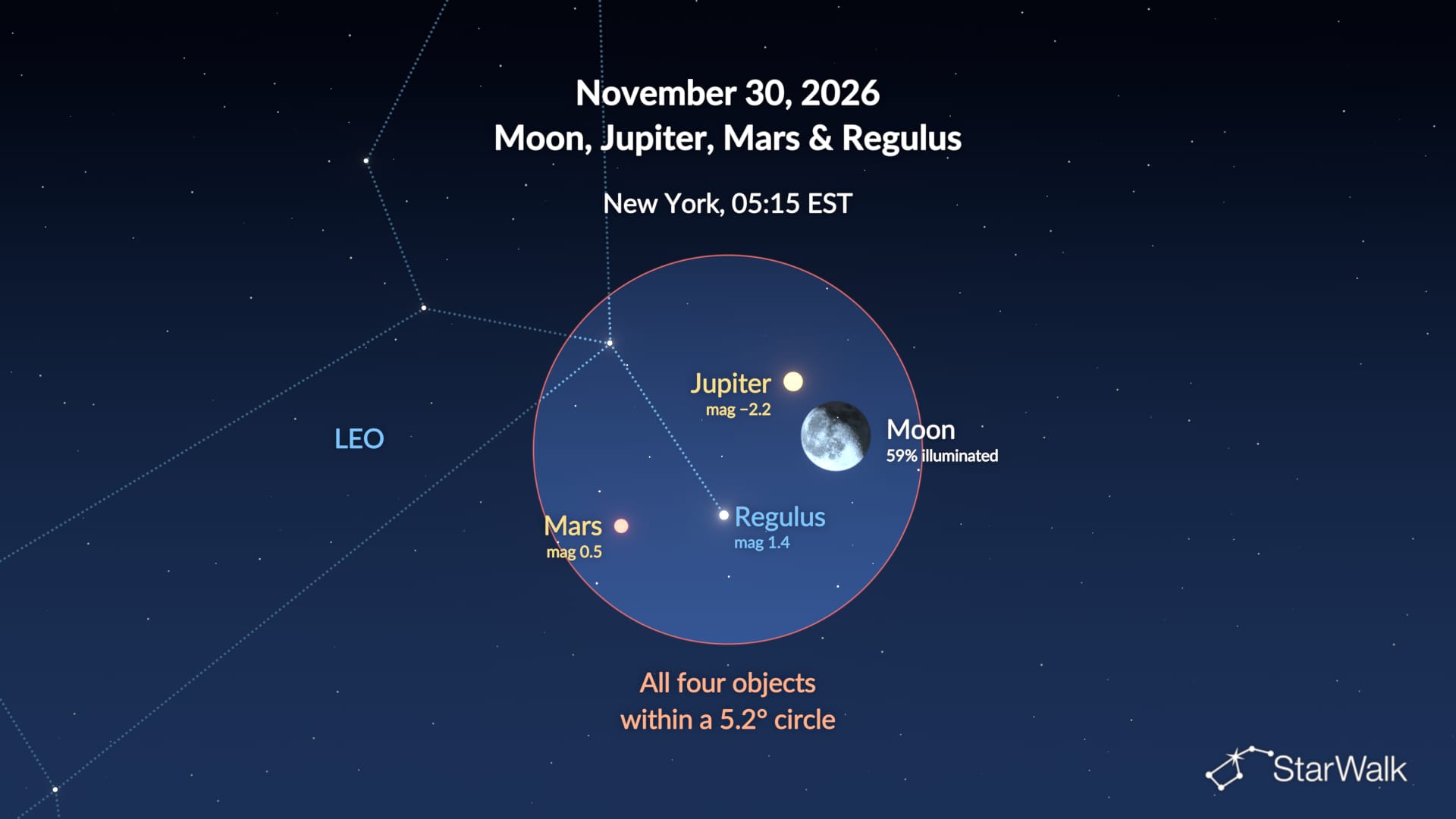
Find the Moon first. Around November 30, about 60% of its disk will be lit, so once it rises, it will be an easy starting point. Look nearby for three bright dots.
The brightest dot is Jupiter (mag −2.2). You won’t mistake it for anything else; right now, it’s the third-brightest object in the night sky after the Moon and Venus. Mars is the reddish one (mag 0.5), fainter than Jupiter.
Regulus is the bluish-white one (mag 1.4). It is the brightest star in Leo. It will be the least prominent object in the gathering, but we can’t judge the star. After all, Regulus’s light has spent nearly eight decades traveling to reach your eyes.
At their closest, all four will fit inside a circle about half the width of your fist held at arm’s length. The shape of this gathering will change throughout the night as the Moon moves past them.
While you are exploring this part of the sky, see whether you can trace a backward question mark near Regulus. This is the Sickle of Leo. Regulus marks the dot; the curve outlines the Lion’s head and mane. The Moon will make the fainter stars harder to see, but finding even part of the pattern helps you picture the Lion around this bright little group.
Why Is It a Special Event?
You might think: the Moon passes bright dots every month, so what’s the big deal? What caught our attention this time was how much had to come together: the Moon, two planets this bright, and a star as bright as Regulus, all within a circle only 5.2° across.
We checked 1900–2099 for gatherings where the brighter of the two planets was at least as bright as November’s Jupiter, and the fainter one at least as bright as November’s Mars. The star had to be at least as bright as Regulus, and the Moon could be in any phase. Turns out, there are only 7 comparable gatherings in 200 years! Here are all of them:
| Date | Two planets and their magnitudes | Star | Minimum group diameter |
|---|---|---|---|
| Jul 23, 1925 | Venus (mag −3.9); Mercury (mag 0.2) | Regulus | 4.6° |
| Jun 20, 1963 | Venus (mag −3.9); Mercury (mag 0.0) | Aldebaran | 4.7° |
| Sep 24, 1968 | Venus (mag −3.9); Mercury (mag 0.2) | Spica | 4.5° |
| Apr 24, 1980 | Jupiter (mag −2.2); Mars (mag 0.0) | Regulus | 2.8° |
| Jul 17, 2001 | Venus (mag −4.1); Saturn (mag 0.1) | Aldebaran | 4.4° |
| Nov 24, 2022 | Venus (mag −3.9); Mercury (mag −0.7) | Antares | 4.5° |
| Nov 30, 2026 | Jupiter (mag −2.2); Mars (mag 0.5) | Regulus | 5.2° |
Calculated using JPL DE440s. Dates are UTC; diameters describe the smallest circle containing all four object centers as seen from Earth’s center (geocentric coordinates). Your local view can differ.
Look at April 24, 1980: the Moon, Jupiter, Mars, and Regulus — exactly the same four we are about to see. That was their previous meeting inside 5.2° with both planets at least as bright, and the group was even tighter then.
Not all these events are equally easy to observe: in November 2022, the objects were close to the Sun, with the group’s nearest member only about 6° away from it. This November, the whole group will be more than 90° from the Sun, so we can enjoy it in a dark sky from many parts of the world.
When will it happen again?
After November 2026, our search found no more gatherings meeting the same brightness limits within 5.2° through the end of 2099. Widen the circle to 6°, though, and four more dates appear:
| Date | Companions of the Moon | Minimum group diameter |
|---|---|---|
| Oct 5, 2051 | Mercury, Venus, and Spica | 5.4° |
| Nov 18, 2052 | Venus, Jupiter, and Spica | 5.6° |
| Sep 15, 2080 | Mercury, Venus, and Spica | 5.7° |
| Sep 17, 2088 | Venus, Jupiter, and Spica | 5.9° |
The 2051 group will again be close to the Sun. The next one in this list that can be seen against a dark sky from suitable locations is November 18, 2052. That is a long wait, unfortunately.
If we relax the brightness requirements, we’ll find other beautiful gatherings along the way. For example, the same four objects will gather even more tightly on September 30, 2062, within about 1.5°. However, Jupiter and Mars will appear fainter.
Of course, these are just numbers and statistics. In a sense, almost any alignment of three or more objects by certain criteria is a once-in-a-lifetime event.
But how cool is it that, during your lifetime, two planets completely different from ours, our own Moon, and a blazing star several times wider than the Sun line up in just the right way to appear together in one small patch of the night sky, as seen from Earth? All you need to see this is to step outside and look up.
When and Where to See the Event From Your Location
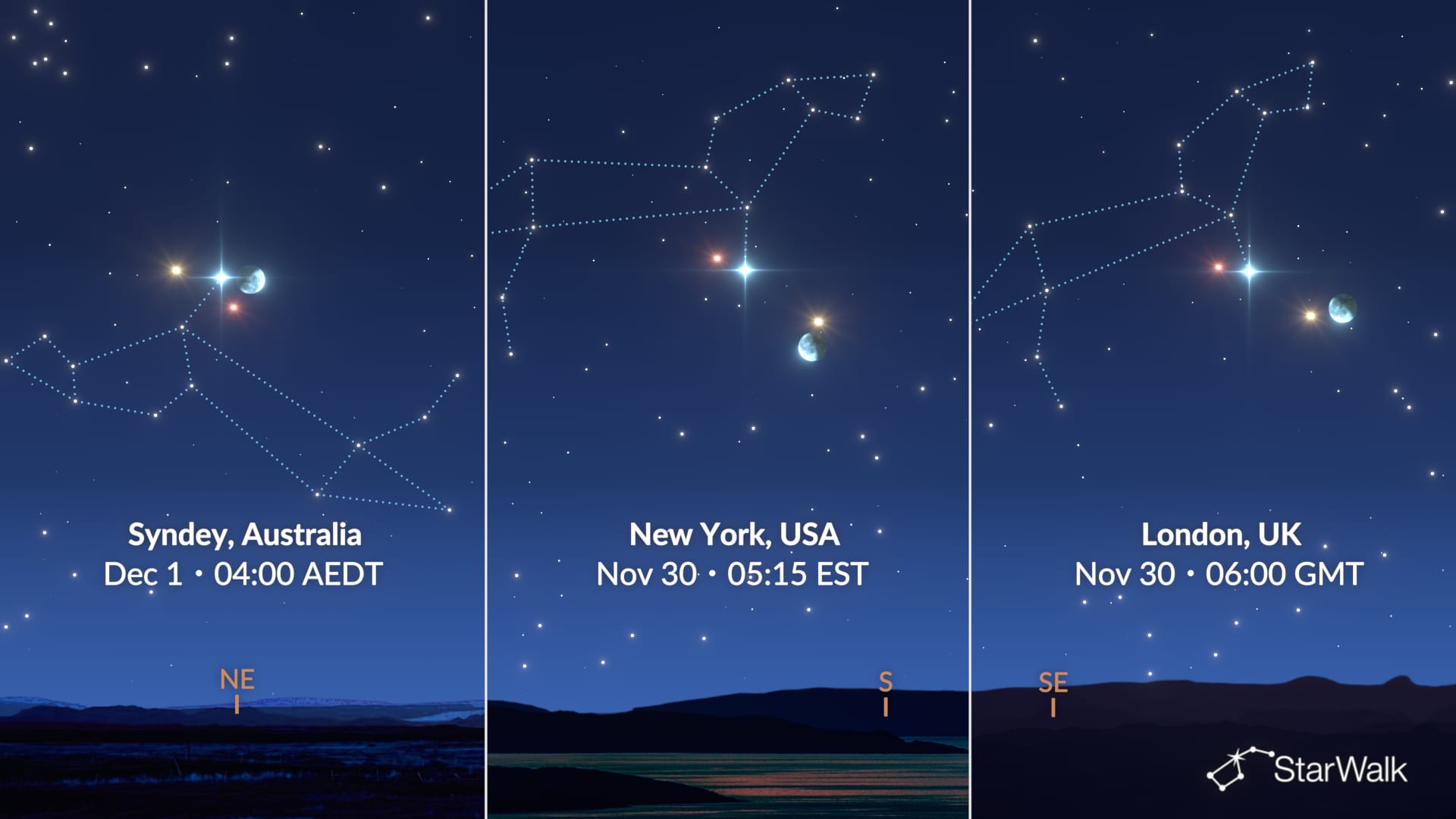
To see the group at its best, it’s important to choose the right time — the Moon moves noticeably hour to hour, and its apparent position also changes depending on your location. By "best," we mean striking a balance between the objects’ height in the dark sky and the group’s compactness.
North America gets the best view before dawn on November 30. From Los Angeles and New York, the four objects will fit within about 5.2°, high in the southern part of the sky.
In Europe, look before dawn on November 30 high above the southern horizon too, but expect a wider grouping. For example, from London, the four objects will span about 7° while the sky is still dark.
In East Asia and Australia, useful viewing times fall during the night of November 30–December 1. From Sydney, look northeast around 04:00 local time. The objects will sit lower than they do from mid-northern latitudes.
| City | Time zone | Visibility start | Best time | Visibility end | Group diameter | Lowest object | Altitude of the lowest object |
|---|---|---|---|---|---|---|---|
| Los Angeles | PST (UTC−8) | Nov 29, 23:48 | Nov 30, 05:00 | Nov 30, 05:41 | 5.2° | Moon | 66.4° |
| New York | EST (UTC−5) | Nov 29, 23:45 | Nov 30, 05:15 | Nov 30, 05:55 | 5.2° | Moon | 61° |
| London | GMT (UTC+0) | Nov 29, 23:40 | Nov 30, 06:00 | Nov 30, 06:20 | 7.0° | Moon | 49° |
| São Paulo | BRT (UTC−3) | Nov 30, 00:55 | Nov 30, 04:00 | Nov 30, 04:15 | 6.0° | Mars | 45° |
| Tokyo | JST (UTC+9) | Nov 30, 23:35 | Dec 1, 02:00 | Dec 1, 05:30 | 5.9° | Moon | 38° |
| Sydney | AEDT (UTC+11) | Dec 1, 02:05 | Dec 1, 04:00 | Dec 1, 04:35 | 5.3° | Mars | 30° |
How to read the table:
- Visibility start / end: the period when all four objects are at least 10° above the horizon and the Sun is at least 12° below it.
- Best time: a suggested observing time that balances the group’s height above the horizon, sky darkness, and compactness within the visibility window.
- Group diameter: the angular diameter of the smallest circle containing the centers of the Moon, Jupiter, Mars, and Regulus, as seen from the listed city at Best time.
- Lowest object / Altitude of the lowest object: which of the four sits closest to the horizon, and how high it is, at Best time.
To preview the sky from your location, open Star Walk 2. Search for Jupiter, then tap the clock icon to open Time Machine. Set the date and move the time forward to see how the Moon approaches the other three objects. Compare November 30 and December 1, looking for a time when the group is above your horizon, and the sky is dark.
The Moon Covers Jupiter and Regulus
Some observers will see one of those bright dots disappear behind the Moon. This is a lunar occultation: the Moon moves directly between you and the more distant object. Two are visible around this gathering, from different parts of the world.
Lunar occultation of Jupiter on November 30 in Chile and Argentina
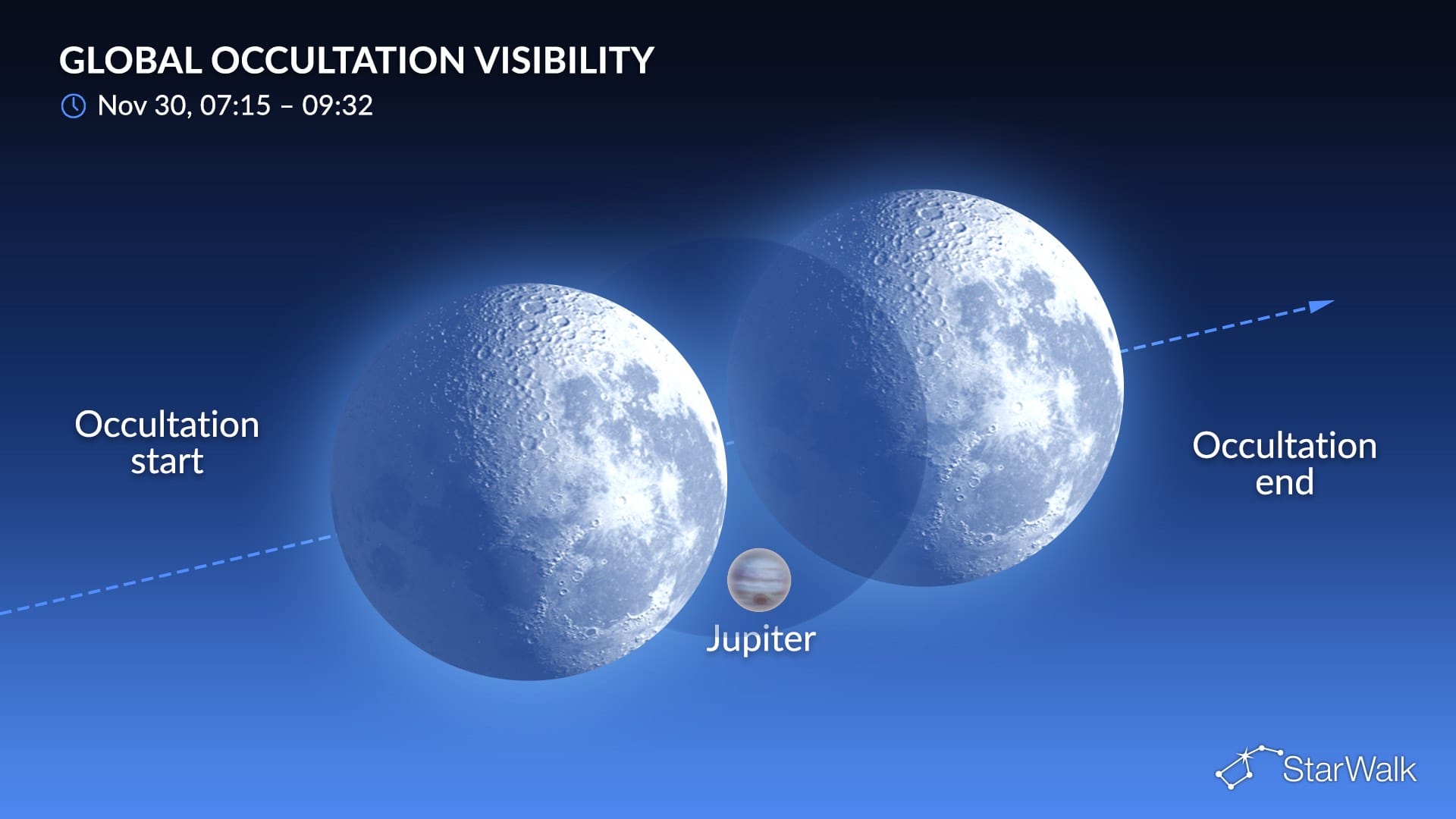
Observers in parts of Chile and Argentina, the Falkland Islands, and Antarctica will see the Moon cover Jupiter on November 30. Some locations get the event in twilight or daylight, so check the local prediction before making plans. For example, in Lebu, Chile, Jupiter will hide behind the Moon at 04:59 CLST and reappear at 05:38 CLST.
This is the fourth of eight lunar occultations of Jupiter between September 8, 2026, and May 12, 2027. After November 30, there is a break in December and January. The next occultation is on February 20, 2027, and the places that can see it will change from one event to the next.
Lunar occultation of Regulus on November 30–December 1 in New Zealand
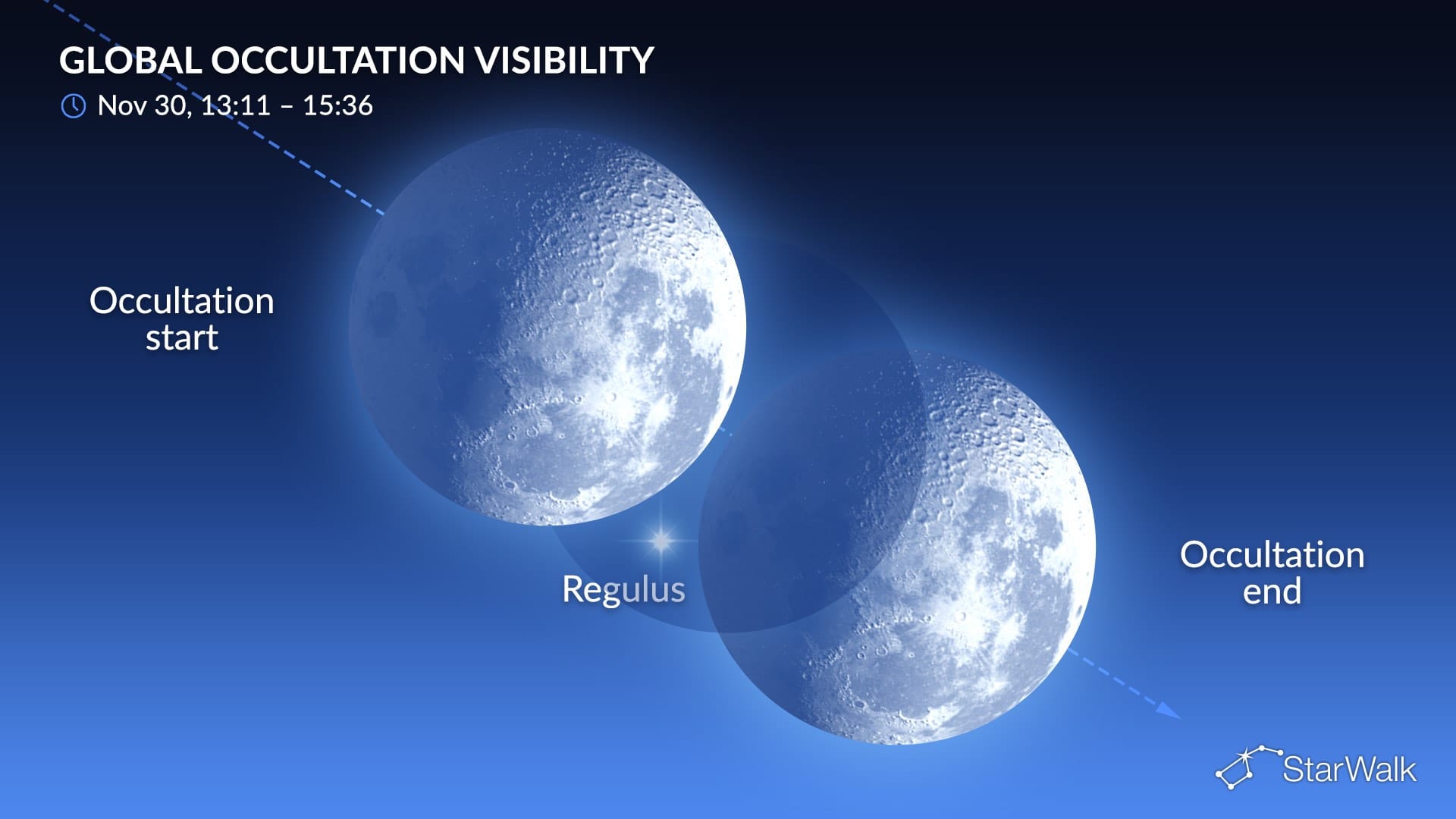
In New Zealand and on Norfolk Island, the Moon will cover Regulus. The global time (UTC) of the event falls on November 30, but in New Zealand it will happen in the early hours of December 1 local time. The Moon will be low in the east to northeast, so find a place with an open horizon.
Through a telescope, Regulus will appear to blink out as the Moon’s edge reaches it. Jupiter has a larger apparent disk and disappears more gradually. It is worth starting a few minutes early so you are already watching when it happens.
What Binoculars and a Telescope Can Show
Start with your eyes and see whether you can identify all four objects. Then, if you have binoculars, take a closer look.
A pair with a 6° true field of view could fit the compact New York group into one view, but it would be too narrow for the London view at the time listed above. Check the field of view of your binoculars before you go.
Look carefully at Jupiter. With the binoculars held steady, you may see tiny points of light beside it. Those are some of its four large Galilean moons. A small telescope makes them easier to pick out. You will not necessarily see all four: some may be behind Jupiter, in its shadow, or passing across its disk.
The Moon has plenty to show you, too. Follow the line between its bright and dark sides — the terminator — where long shadows make craters and mountains stand out. Higher magnification helps you explore those details; use your eyes or wide-field binoculars for the whole gathering.
Photograph the Whole Group
Try getting the Moon, two planets, and Regulus in the same photo. A camera on a tripod is a good starting point. You can also try a phone held steady on a support, using manual or night settings.
Expect to take a few test shots. The Moon is much brighter than its companions: an exposure that shows Mars and Regulus clearly may turn the lunar disk completely white. Take shorter exposures for the Moon’s surface and longer ones for the surrounding objects, then compare the results.
If you stay out for a while, take another photo an hour later. Look at how the Moon has moved relative to Regulus. You may be able to record the group changing shape over the course of your morning.
Learn more: Astrophotography for Beginners: How to Take Pictures of the Night Sky
Moon, Jupiter, Mars, Regulus in November 2026: Key Points
Around November 30, 2026, Jupiter, Mars, Regulus, and the waning Moon will gather in Leo, spanning about 5.2° at their most compact — roughly half the width of your fist at arm’s length. All four are bright enough to see with the naked eye. Over 200 years (from 1900 to 2099), only seven comparable gatherings occur, so don’t miss this opportunity!
Depending on your location, your best view may come before dawn on November 30 or during the night of November 30–December 1. Check the free Star Walk 2 app to preview the group in your sky and choose your viewing time.
