Canis Minor Constellation: How to Find the Little Dog in the Sky
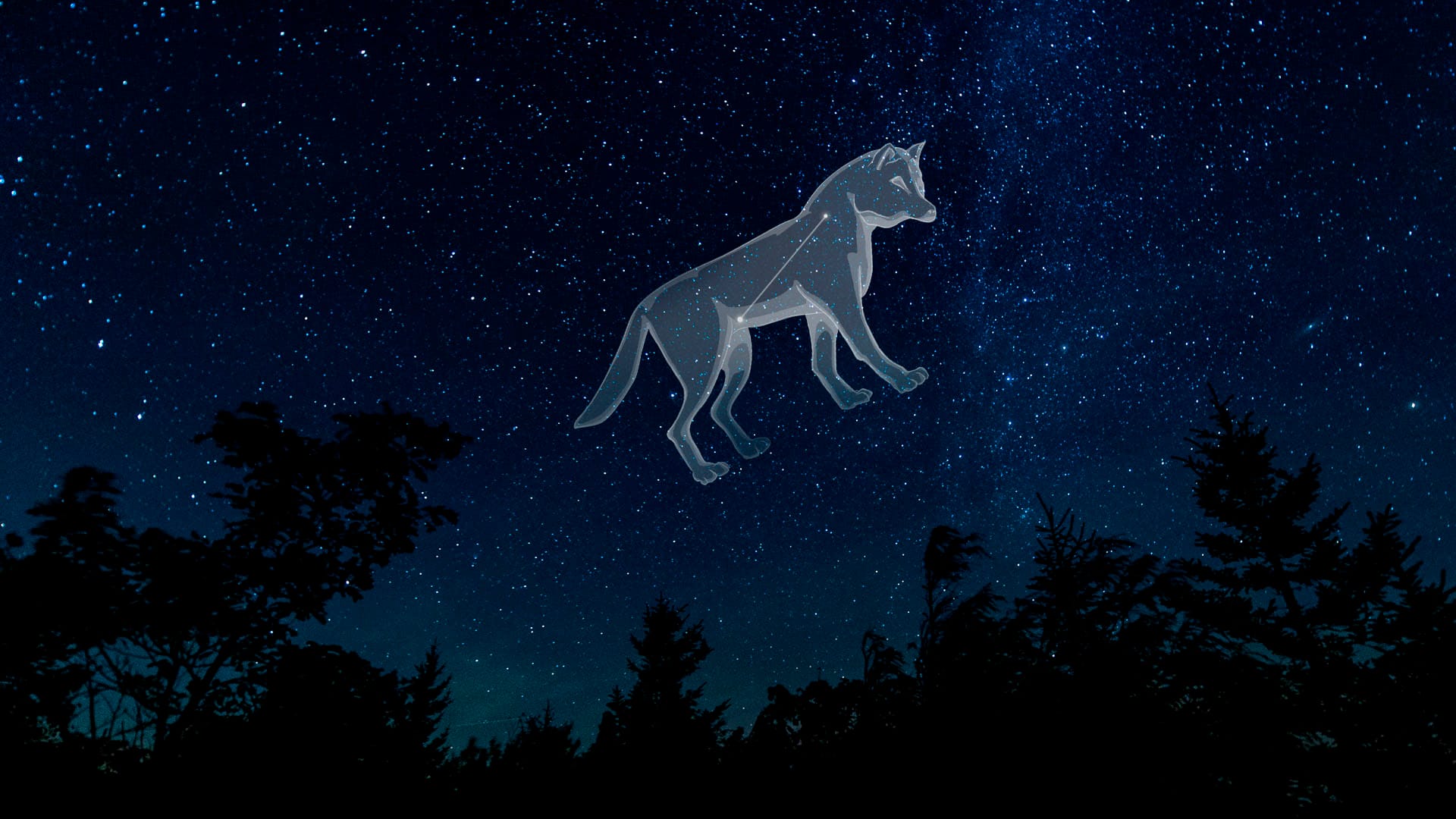
Canis Minor, the Lesser Dog, is a small northern constellation near Orion. Its stick figure is simple – essentially a line between Procyon, the eighth-brightest star in the night sky, and Gomeisa. Canis Minor is easiest to see on evenings in February and March. The constellation has no Messier objects, but telescope users and astrophotographers can attempt to spot the spiral galaxy NGC 2485 and the faint planetary nebula Abell 24.
Canis Minor's position in the sky depends on your location, date, and time. Use Sky Tonight to check when the constellation is above your horizon and when Procyon reaches its highest point.
Contents
- Canis Minor: Constellation Facts
- Where Is the Canis Minor Constellation?
- How to Find Canis Minor in the Sky
- Brightest and Most Interesting Stars in Canis Minor
- Deep-Sky Objects in Canis Minor
- Canis Minor Mythology
- Canis Minor FAQ
- Canis Minor Constellation: Key Facts
Canis Minor: Constellation Facts
- Name: Canis Minor (the Lesser Dog)
- Abbreviation: CMi
- Size: 183 square degrees (71st-largest constellation)
- Approximate center: RA 8 h, Dec +5°
- Visible between: about 90°N and 77°S; near the southern limit, only part of the constellation rises
- Celestial hemisphere: Northern
- Best evening visibility: December to April, especially February and March
- Brightest star: Procyon (Alpha Canis Minoris)
- Other bright star: Gomeisa (Beta Canis Minoris)
- Messier objects: 0
- Bordering constellations: Gemini, Cancer, Hydra, Monoceros
Where Is the Canis Minor Constellation?
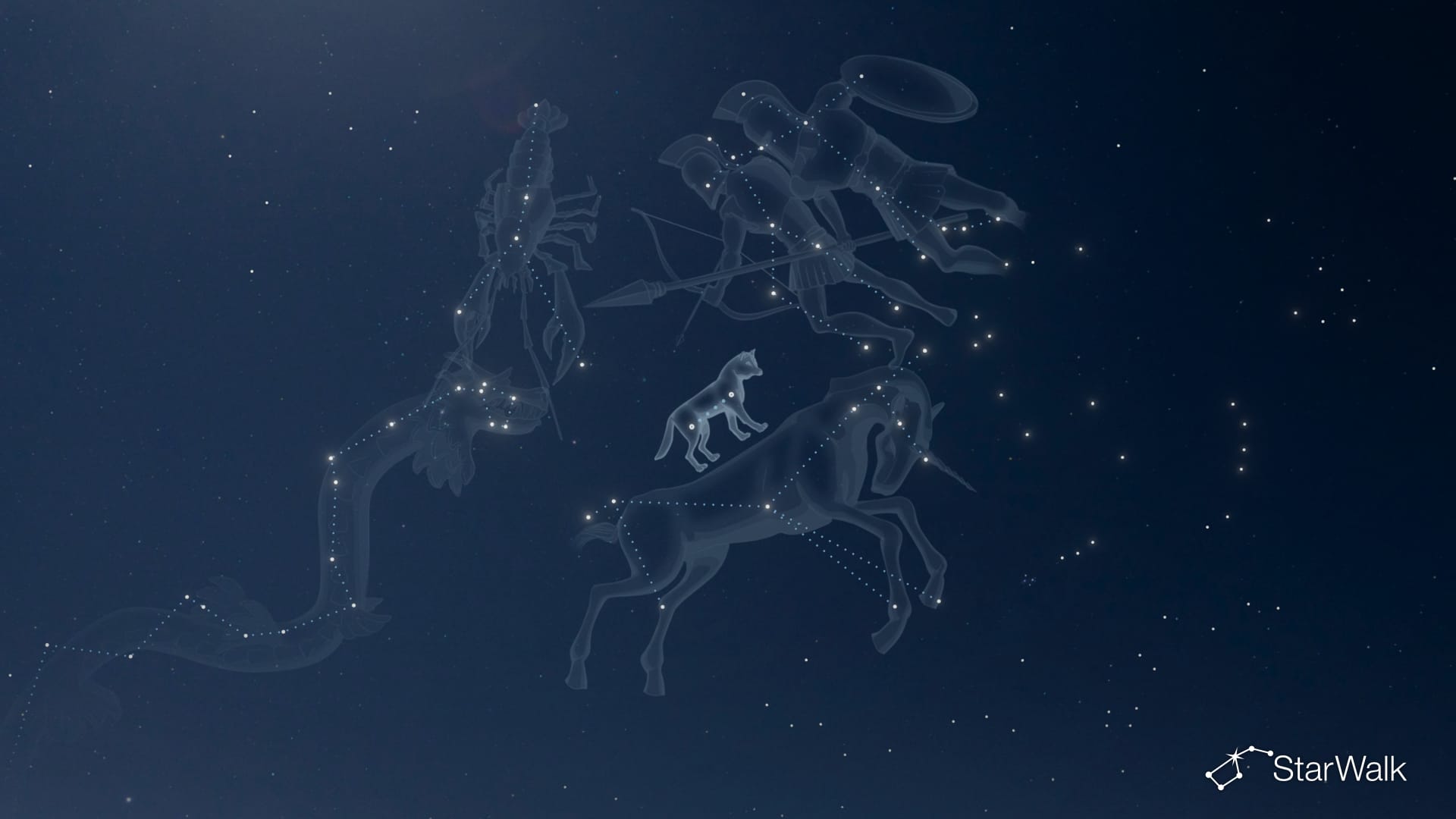
Canis Minor lies east of Orion, south of Gemini, west of Cancer, north of Hydra, and northeast of Monoceros. Canis Minor and Canis Major do not share a border: Monoceros lies between the two celestial dogs.
When Is Canis Minor Visible?
Northern Hemisphere: Canis Minor is visible in the evening from roughly December through April and is best placed in February and March. From mid-northern latitudes, look toward the south. At 50°N, Procyon reaches about 45° above the southern horizon at this time of the year, while at 60°N it still reaches about 35°. In early March, the constellation is near its highest point around 9 p.m. local time.
Southern Hemisphere: The same months bring the best summer and early-autumn evening views. Face north to find Canis Minor. At 40°S, Procyon culminates about 45° above the northern horizon; at 60°S, it reaches about 25°. Farther south, the constellation stays very low, and near 77°S only part of it rises. Its orientation changes with latitude and time, so it will not always look like a fixed upside-down version of a northern chart.
How to Find Canis Minor in the Sky
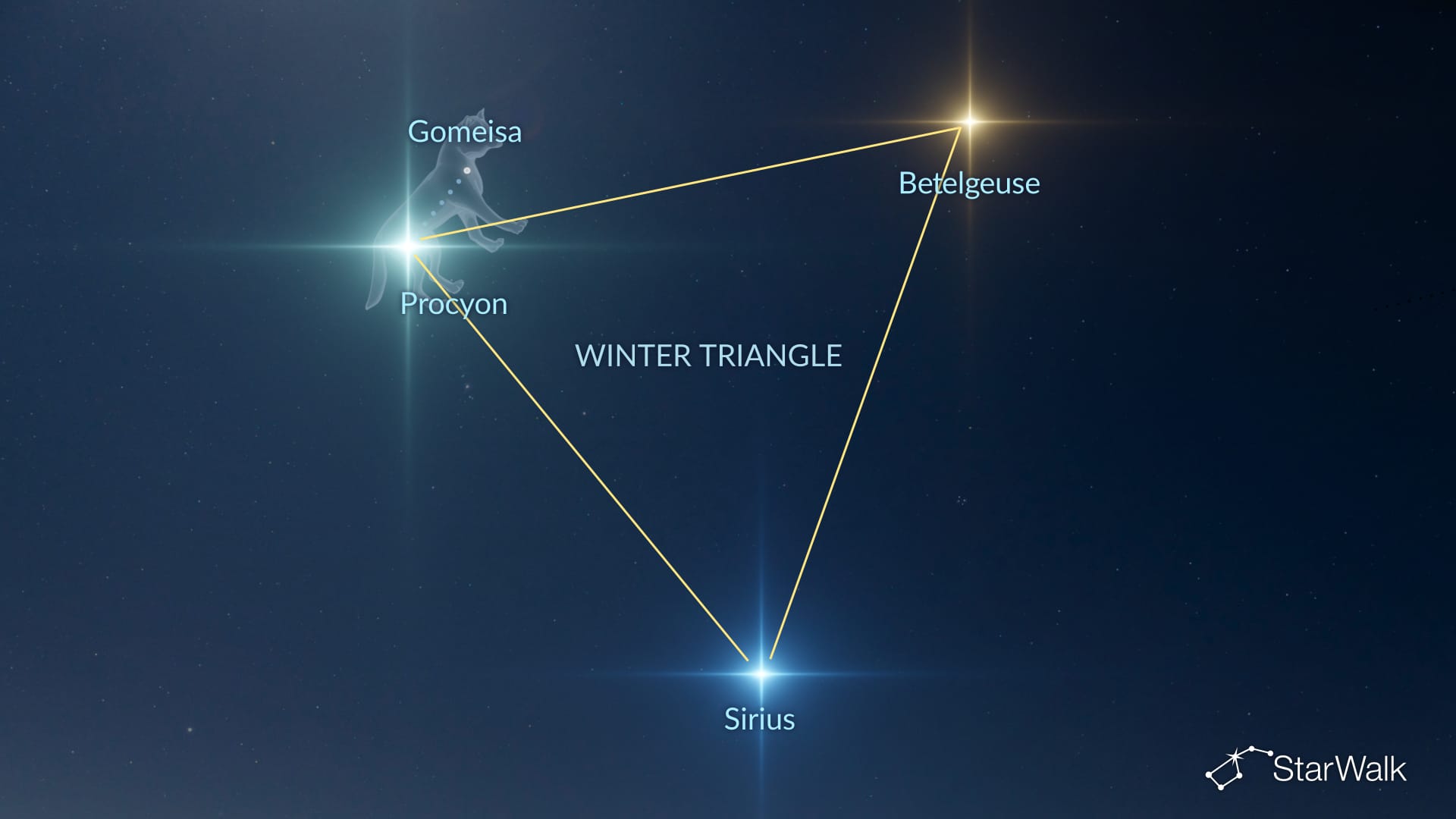
The easiest guide is the Winter Triangle, formed by Procyon, Sirius, and Betelgeuse. First find Orion. Use Orion's Belt to locate Sirius, then identify reddish Betelgeuse at one of Orion's shoulders. Procyon is the third bright vertex of the large triangle, about 26° from both Sirius and Betelgeuse.
Once you’ve found Procyon, look about 4.3° northwest of it to find Gomeisa. The two stars fit in a typical binocular field of view and form the most recognizable line of Canis Minor. Procyon is much brighter, while magnitude 2.9 Gomeisa may be harder to pick out in haze or strong light pollution.
How to Find Canis Minor with Stargazing Apps
The easiest way to locate the constellation is by using a stargazing app. In Sky Tonight or Star Walk 2, search for Canis Minor, tap the matching result or target icon, and follow the on-screen arrow to align the map with the real sky. The apps use your location and selected time to show the constellation's correct orientation and altitude.
You can also search directly for Procyon, Gomeisa, NGC 2485, Abell 24, or GJ 273. Before attempting a faint target, check its position in the sky, the Moon illumination, and the stargazing conditions for your location.
Brightest and Most Interesting Stars in Canis Minor
Canis Minor contains only two stars brighter than magnitude 4: Procyon and Gomeisa. They are not a physical pair – they only appear close together as seen from Earth. The constellation also contains Luyten's Star, a nearby red dwarf with a confirmed exoplanet.
Procyon – Alpha Canis Minoris
- Name origin: from the Greek Prokyon, meaning “before the dog”
- Other name: Alpha Canis Minoris
- Type: binary system consisting of an F-type star and a white dwarf
- Combined apparent magnitude (V): 0.34
- Distance: about 11.5 light-years
Procyon is the brightest star in Canis Minor and the eighth-brightest star in the night sky. To the naked eye it looks like one pale yellow-white point, but the system contains Procyon A and the faint white dwarf Procyon B. They orbit each other in about 40.8 years. Procyon B is overwhelmed by the primary star's glare and is a difficult target even for experienced observers with large telescopes.
The name Procyon (“before the dog”) appeared because it rose before Sirius, the famous Dog Star, as seen from ancient Greece. Procyon is a vertex of both the Winter Triangle and the larger Winter Hexagon, making it one of the most useful landmarks in the seasonal sky.
Gomeisa – Beta Canis Minoris
- Name origin: from the Arabic al-ghumaisā', meaning “the bleary-eyed woman”
- Other name: Beta Canis Minoris
- Type: rapidly rotating B-type emission-line star
- Apparent magnitude (V): about 2.84 to 2.92
- Distance: about 162 light-years
Gomeisa is the second-brightest star in Canis Minor. It lies about 4.3° northwest of Procyon and shines with a blue-white light. Together, Procyon and Gomeisa form the constellation’s simple two-star pattern. Both are visible to the naked eye, while binoculars make their color difference easier to see.
Gomeisa is a Be star: it rotates rapidly and is surrounded by a disk of gas that produces emission lines in its spectrum. Its brightness varies only slightly, so the change is not obvious to the naked eye.
Luyten's Star – GJ 273
- Name origin: named after the Dutch-American astronomer Willem Jacob Luyten
- Other names: GJ 273, HIP 36208
- Type: red dwarf
- Apparent magnitude (V): about 9.9
- Distance: about 12.4 light-years
Luyten's Star is one of the nearest stars within Canis Minor's boundaries, but it is too faint to see with the naked eye; it can be spotted with binoculars under dark skies or with a small telescope. Search for GJ 273 in a stargazing app rather than trying to identify it from the constellation's two-star outline.
The red dwarf hosts GJ 273 b, a confirmed super-Earth discovered by the radial-velocity method. The planet orbits its star every 18.6 days. “Super-Earth” describes the planet's mass range, not its surface conditions or habitability.
Deep-Sky Objects in Canis Minor
Canis Minor has no Messier objects or bright star clusters for binoculars. Its deep-sky objects are much more challenging: NGC 2485 requires a telescope, while Abell 24 is best captured with long-exposure imaging. Because faint and diffuse objects can be difficult to see even when their magnitude seems favorable, choose a clear, moonless night and use the Bortle scale to check how dark your sky really is.

Spiral Galaxy NGC 2485
- Type: spiral galaxy
- Integrated apparent magnitude (V): about 12.2
- Distance: roughly 200 million light-years
- Equipment: 250 mm telescope or larger under a dark sky; better suited for imaging
NGC 2485 lies about 4.9° northeast of Procyon. In a 250 mm telescope under a dark, transparent sky, it may appear as a very small, faint oval with a brighter center; visual observers should not expect to distinguish obvious spiral arms. A tracked camera or electronically assisted telescope reveals it more readily.
Planetary Nebula Abell 24
- Type: evolved planetary nebula
- Integrated apparent magnitude (V): about 13.9
- Distance: about 2,250 light-years
- Equipment: long-exposure narrowband imaging recommended; extremely difficult visually
Abell 24 lies about 3.8° southeast of Procyon. It is a shell of gas released by a dying Sun-like star, whose hot exposed core makes the surrounding material glow. Although the nebula spans about 6 arcminutes, its light is spread over a large area, giving it an extremely low surface brightness.
Long-exposure images taken with H-alpha and O III filters reveal its uneven shell and reddish glow. Visually, however, Abell 24 is very difficult to see even with a large telescope, dark skies, and an O III filter. The red color visible in photographs is usually not noticeable through an eyepiece because human night vision is much less sensitive to color in very faint objects.
Canis Minor Mythology
Canis Minor in Greek Mythology
Canis Minor was already part of the classical sky map described by Ptolemy, but ancient authors did not attach one universal story to it. The most familiar interpretation treats it as the smaller dog following Orion, alongside Canis Major. The Greek name Prokyon means “before the dog,” referring to Procyon rising before Sirius, as seen from ancient Greece.
In another tradition recorded by Hyginus, Procyon represented Maera, the faithful dog of Icarius. After Icarius was killed, Maera led his daughter Erigone to the body; versions of the story then place Icarius, Erigone, and the dog among the stars. A separate telling identifies Canis Minor with the Teumessian fox, eternally pursued by the magical dog Laelaps. These are alternative traditions, not parts of a single consistent myth.
Canis Minor in Other Cultures
In early Mesopotamian star lists, Procyon and Gomeisa were associated with a pair called the Twins, although the names and figures applied to this region changed over time.
In traditional Chinese astronomy, Procyon, Gomeisa, and Epsilon Canis Minoris formed Nanhe, the Southern River. It was paired with Beihe, the Northern River marked by stars in Gemini.
Canis Minor FAQ
When was Canis Minor discovered?
Canis Minor was not discovered on one date. Procyon and nearby stars were recorded in ancient sky traditions. Claudius Ptolemy listed the pattern among his 48 constellations in the 2nd century CE. The International Astronomical Union standardized the constellation's name and abbreviation in 1922 and approved its modern boundaries in 1928; the boundaries were published in 1930.
How far is Canis Minor from the Earth?
A constellation has no single distance because its stars lie at different distances and only appear close together in the sky. Procyon is about 11.5 light-years away, Luyten's Star about 12.4 light-years, and Gomeisa about 162 light-years away. The much more distant galaxy NGC 2485 lies roughly 200 million light-years away.
What are the best months to see Canis Minor?
February and March offer the best evening views, with the constellation especially well placed in early March around 9 p.m. local time. The broader evening viewing season runs from December through April. Northern observers should look south, and southern observers should look north.
Can you see Canis Minor with the naked eye?
Yes. Procyon is very bright, and Gomeisa is visible without optical aid under ordinary clear skies. Most of the other stars are much fainter, so the recognizable pattern often looks like a short line rather than a detailed dog.
Are Canis Major and Canis Minor next to each other?
No. Monoceros lies between them, so the two dog constellations do not share a border. They appear in the same broad seasonal region because both are traditionally associated with Orion.
Is Canis Minor the Little Dipper?
No. Canis Minor is the Lesser Dog constellation that contains Procyon and lies near Orion. The Little Dipper is an asterism in Ursa Minor around Polaris, close to the north celestial pole.
Canis Minor Constellation: Key Facts
Canis Minor is easiest to see on February and March evenings. The constellation itself is easy to identify, but its deep-sky targets are much more challenging: NGC 2485 requires a large telescope, while Abell 24 is best suited to long-exposure narrowband imaging.
Find Canis Minor by tracing the Winter Triangle from Sirius and Betelgeuse to bright Procyon. Then look about 4.3° northwest of Procyon for Gomeisa; the two stars form the Lesser Dog's simple main line. To locate the constellation in a few taps, use the free Sky Tonight app. Happy stargazing!