Canes Venatici Constellation: Stars, Galaxies & How to Find It
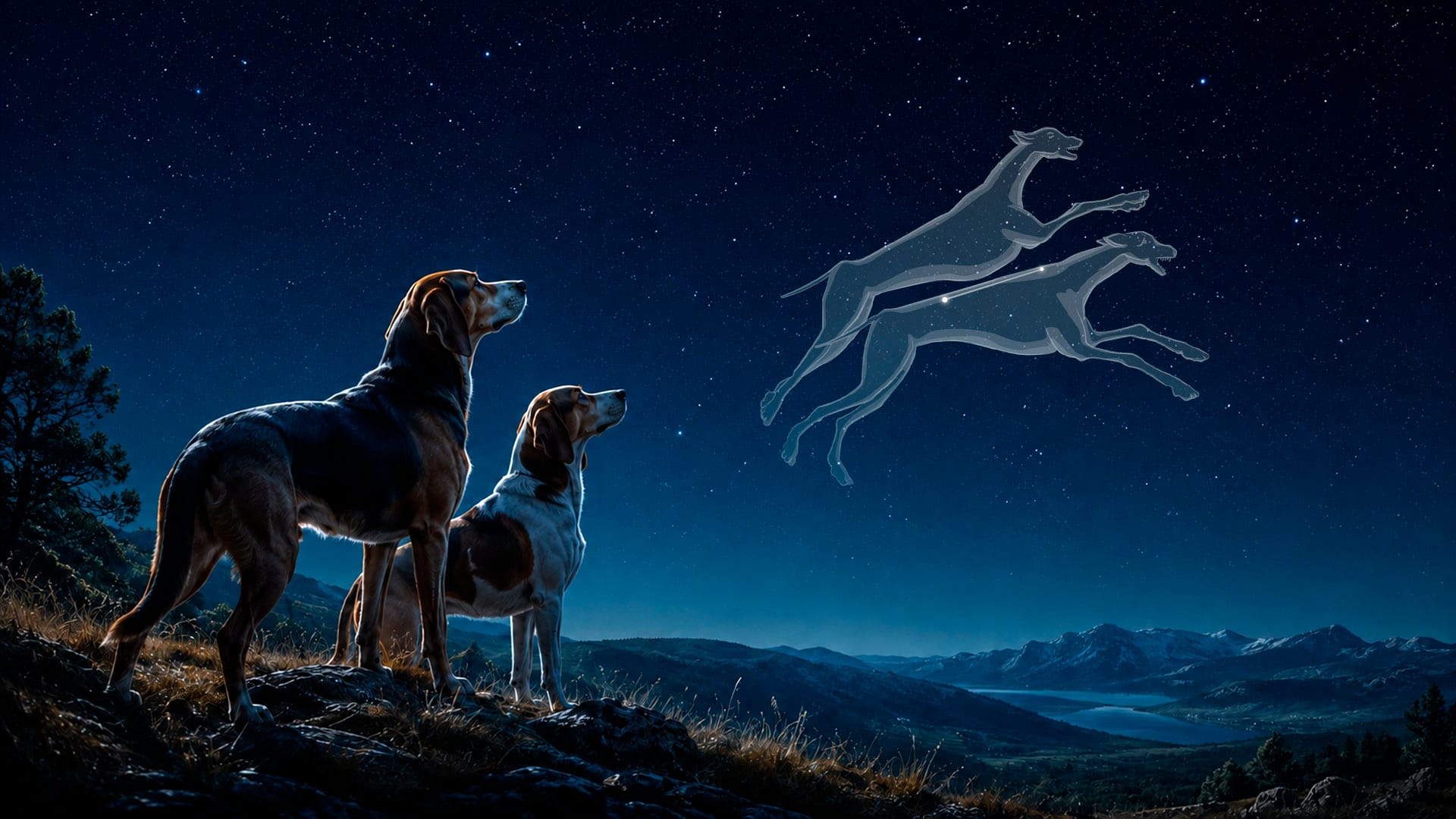
Canes Venatici, the Hunting Dogs, is a small northern constellation below the Big Dipper's handle. Its faint outline hides excellent targets: the double star Cor Caroli, the deep-red variable star La Superba, the globular cluster M3, and four Messier galaxies, including the Whirlpool Galaxy. Use the free Star Walk 2 app to find the constellation in the sky above you, and follow the guide to uncover the best facts about it.
Contents
- Canes Venatici: Constellation Facts
- Where Is Canes Venatici in the Sky?
- When Is the Best Time to See Canes Venatici?
- How to Find Canes Venatici
- Bright Stars in Canes Venatici
- Best Deep-Sky Objects in Canes Venatici
- History and Meaning of Canes Venatici
- Canes Venatici FAQ
- Canes Venatici: Key Facts
Canes Venatici: Constellation Facts
- Name: Canes Venatici
- Meaning: the Hunting Dogs
- Abbreviation: CVn
- Size: about 465 square degrees (38th largest constellation)
- Visible between: about 90°N and 40°S
- Brightest star: Cor Caroli (Alpha2 Canum Venaticorum), magnitude 2.9; about 2.8 for the unresolved Alpha pair
- Messier objects: M3, M51, M63, M94, and M106
- Bordering constellations: Ursa Major, Boötes, and Coma Berenices
- Best visibility: April and May evenings
Canes Venatici does not form a striking naked-eye pattern, but it becomes far more interesting through binoculars or a telescope.
Where Is Canes Venatici in the Sky?
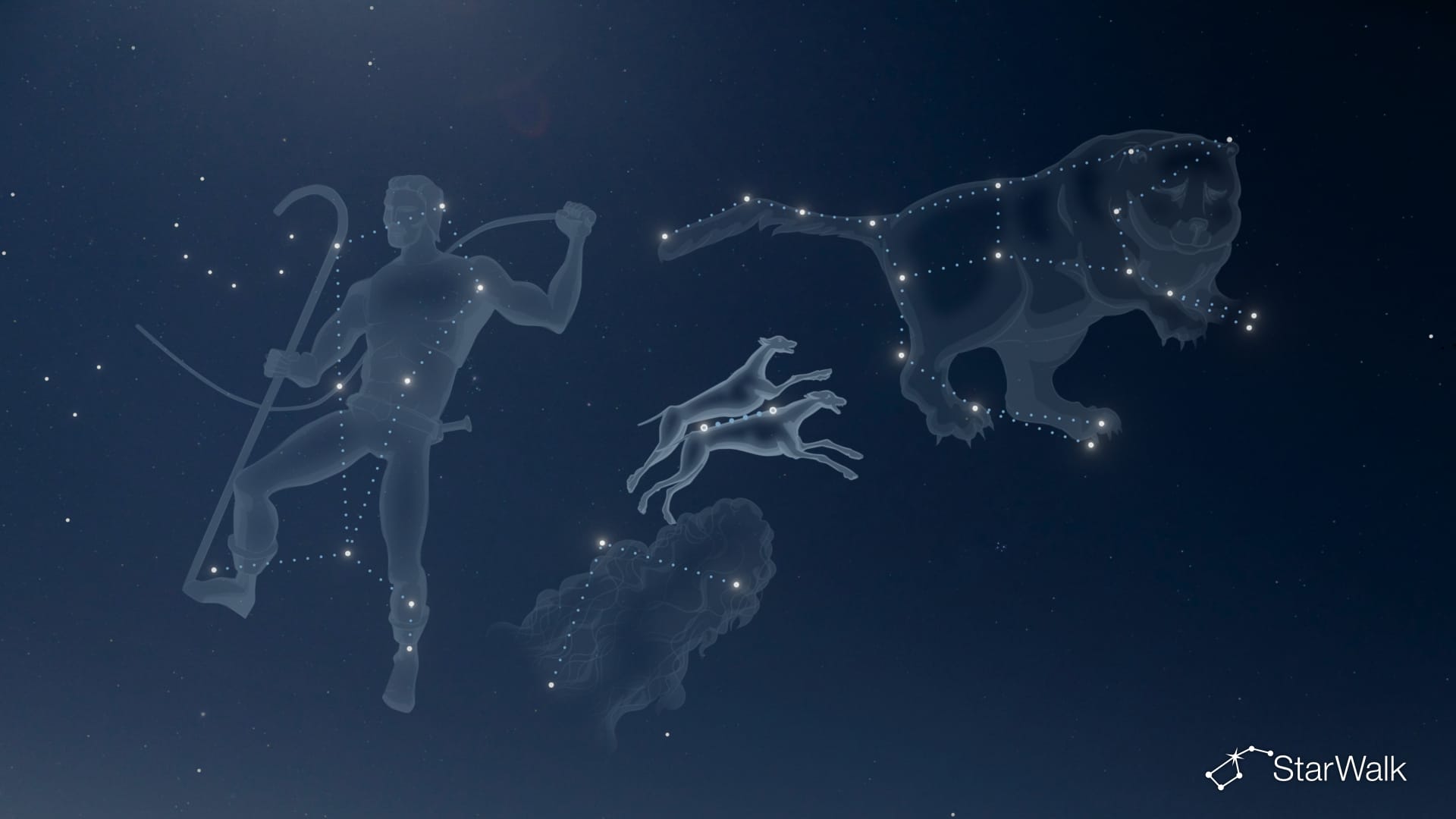
Canes Venatici lies between Ursa Major to the north, Boötes to the east, and Coma Berenices to the south. Its boundaries span roughly +28° to +52° in declination. The constellation is best placed for the Northern Hemisphere and northern tropics. From mid-southern latitudes, it remains low above the northern horizon, and its northernmost part may not rise at all.
When Is the Best Time to See Canes Venatici?
In the Northern Hemisphere, look on spring evenings, especially in April and May, when Canes Venatici is high and conveniently placed. In the Southern Hemisphere, the same months bring the best autumn evening views; from mid-southern latitudes, the constellation stays low in the north. Moonless, transparent nights matter most for the galaxies; the constellation’s brightest star, Cor Caroli, is visible even under urban skies.
How to Find Canes Venatici
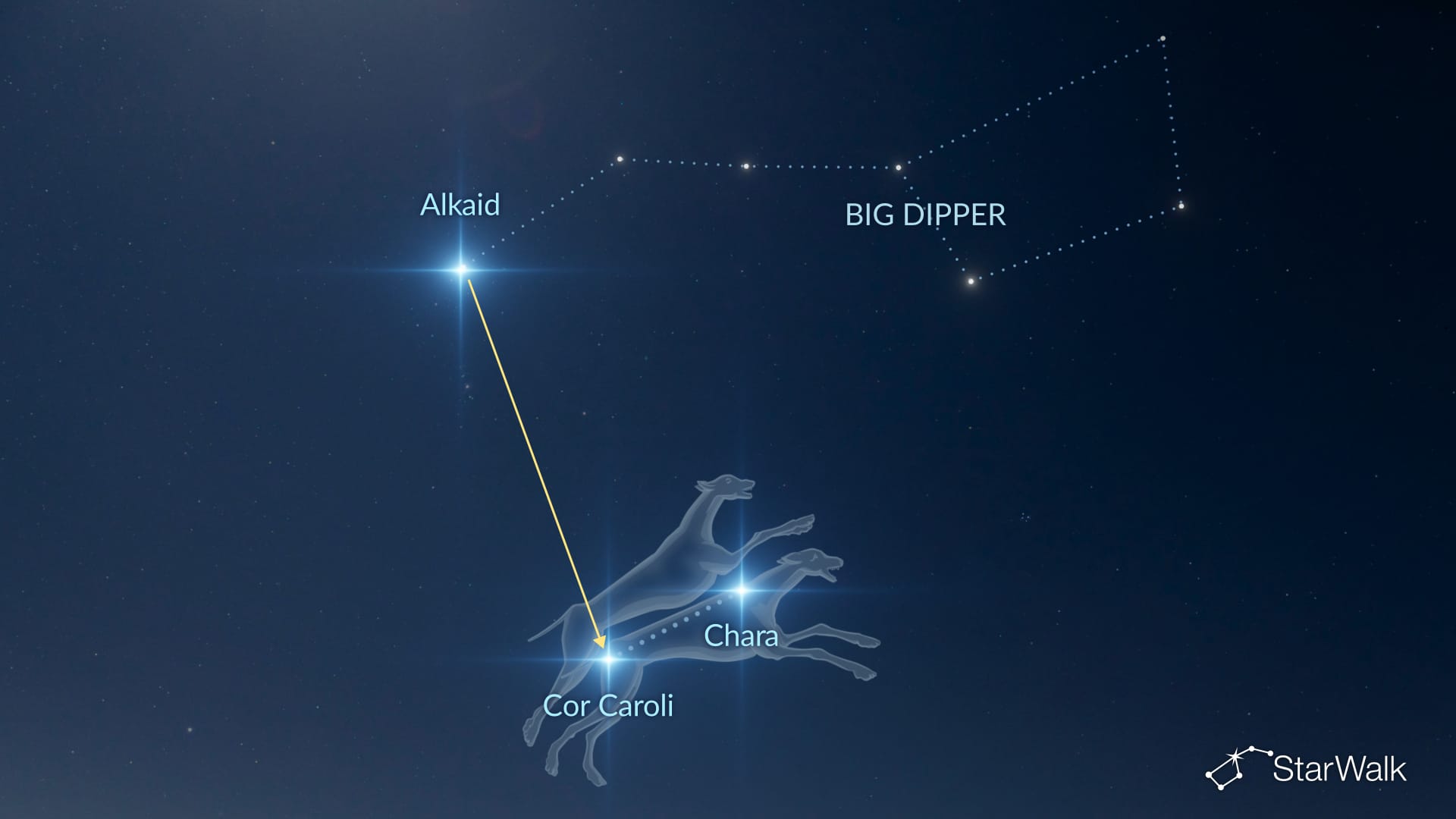
Start with Alkaid, the star at the tip of the Big Dipper's handle. Cor Caroli lies about 14° away, in the open area below the handle and toward bright Arcturus. That is a little under one and a half fists held at arm's length. Chara lies about 5° northwest of Cor Caroli, roughly one field in typical 10x50 binoculars.
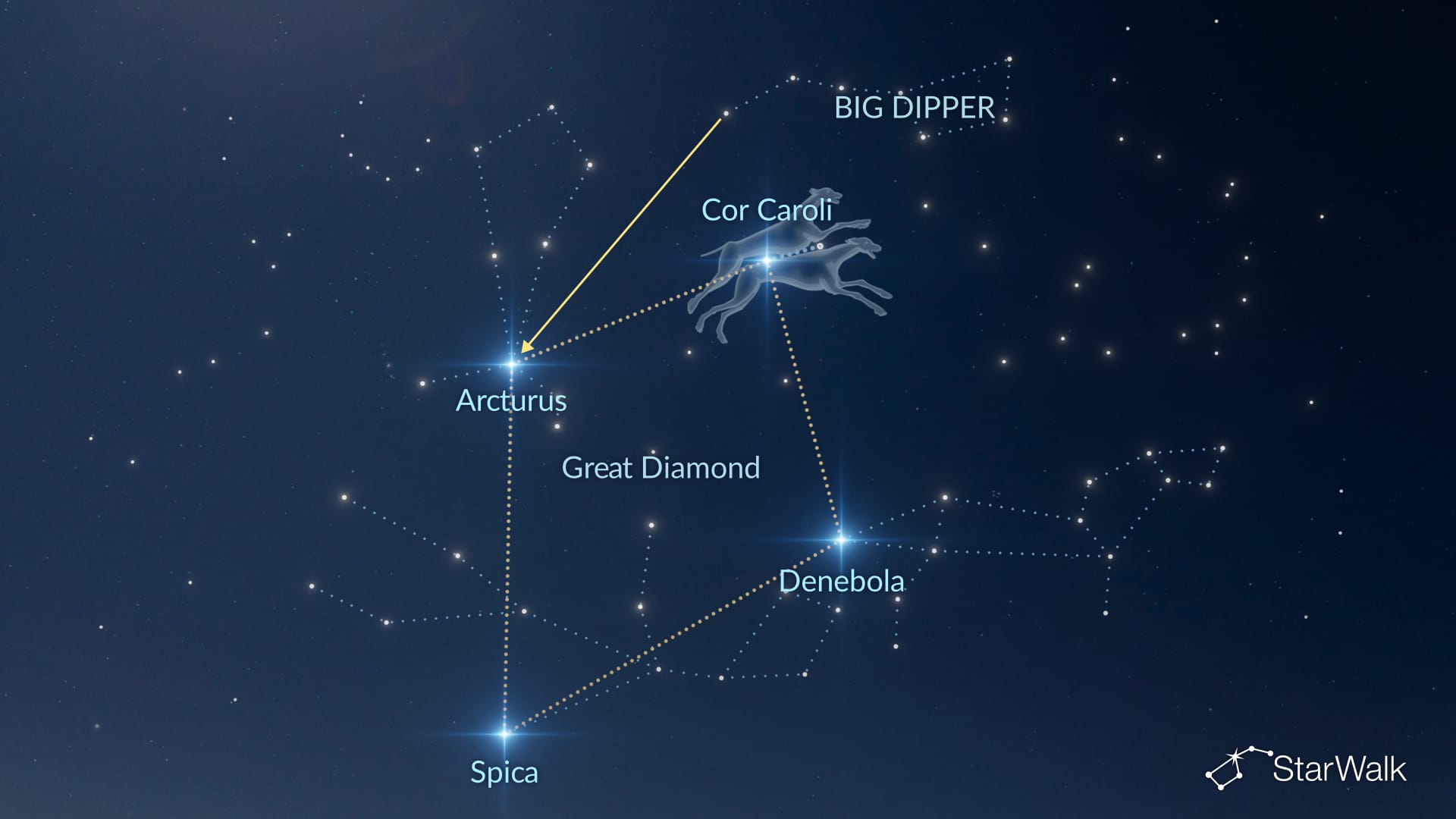
You can also follow the curve of the Dipper's handle to orange Arcturus, then look about 25° back toward the Dipper for Cor Caroli. It forms the Great Diamond with Arcturus, Spica, and Denebola.
For a quick check, search for Canes Venatici or any target below in Star Walk 2. The app will show its position from your location and when it will be highest in the sky.
Bright Stars in Canes Venatici
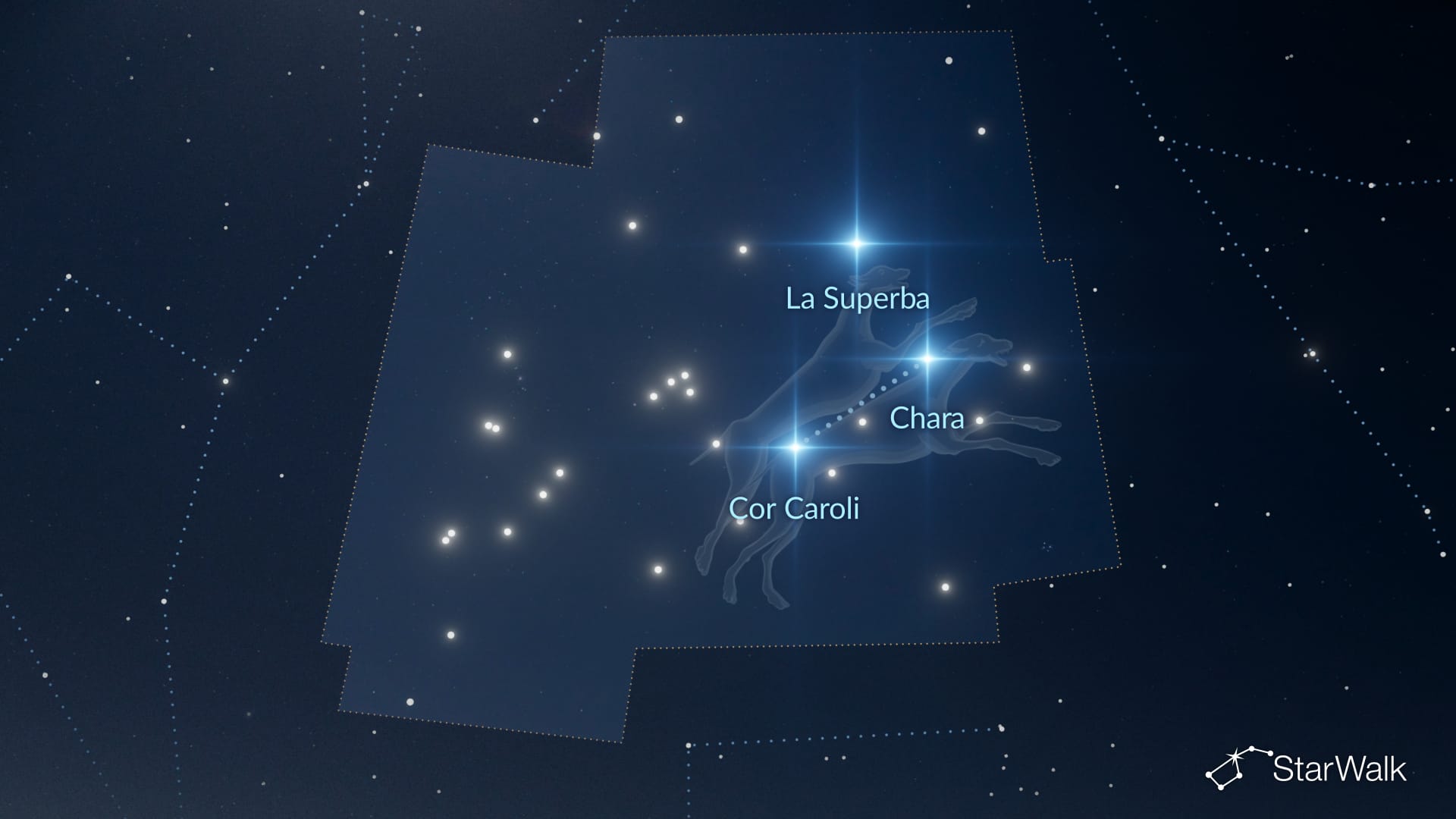
Cor Caroli: The Brightest Star
Cor Caroli is the constellation's easiest landmark. To the naked eye, the unresolved Alpha Canum Venaticorum pair appears at about magnitude 2.8. A small telescope at around 40× separates it into Alpha² (magnitude 2.9) and Alpha¹ (near magnitude 5.6); the stars are about 19 arcseconds apart.
The official name Cor Caroli belongs to Alpha2. This magnetic, chemically peculiar star is the prototype of the Alpha2 Canum Venaticorum variables. It changes slightly in brightness over 5.47 days, but not enough to notice by eye. Its name means "Heart of Charles" and originally referred to King Charles I of England.
Chara: A Nearby Solar-Type Star
Chara, or Beta Canum Venaticorum, is a magnitude 4.2 G-type main-sequence star about 28 light-years away. It is visible without optical aid from a reasonably dark site and easy to see in binoculars. Look about 5° northwest of Cor Caroli.
La Superba: A Deep-Red Variable Star
La Superba, or Y Canum Venaticorum, is a carbon-rich red giant and one of the reddest stars accessible to amateur observers. It varies from about magnitude 4.8 to 6.3 over roughly 160 days, with additional longer-term changes. Near maximum, it may be barely visible without optical aid under a dark sky, but binoculars show its orange-red color more reliably. Look about one-third of the way from Chara toward Mizar and Alcor.
Best Deep-Sky Objects in Canes Venatici
Canes Venatici contains the globular cluster M3 and four Messier galaxies. None of them can be easily seen without optical aid. The quoted magnitudes are approximate integrated visual magnitudes: galaxies spread that light over an area, so surface brightness, transparency, and light pollution strongly affect what you see. Check the Bortle scale to understand how dark your sky is and choose a moonless night for better viewing conditions.

M3: Bright Globular Cluster

M3 is a magnitude 6.2 globular cluster about 34,000 light-years away. Look between Cor Caroli and Arcturus, slightly closer to Arcturus. In 10×50 binoculars, it appears as a compact round haze. A small telescope shows a bright, grainy ball, and a 100-150 mm telescope can begin to resolve stars around its edge under good conditions.
M51: Whirlpool Galaxy

M51 is a magnitude 8.4 grand-design spiral interacting with NGC 5195. Look for it about 3.5° southwest of Alkaid. Large binoculars may show a faint patch from a dark site, while a small telescope reveals two hazy centers. Hints of the spiral arms usually require a dark, transparent sky, averted vision, and around 200 mm of aperture or more.
M63: Sunflower Galaxy

M63 is a magnitude 8.5 flocculent spiral, meaning its arms look patchy rather than continuous. It lies about 5° northeast of Cor Caroli. Large binoculars may catch it as a faint smudge under excellent skies; a small telescope shows an elongated glow with a brighter center. The sunflower-like structure appears in astrophotography.
M94: Bright-Centered Galaxy

M94 is a magnitude 8.2 spiral with a compact, high-surface-brightness center, making it one of the easier galaxies for a small telescope. Look about 3° east of Chara. Under an exceptionally dark sky, 10x50 binoculars may show its core as a tiny fuzzy spot; the rings and faint outer structure need larger aperture or a camera.
M106: Galaxy With an Active Core

M106 is a magnitude 8.4 spiral with an active nucleus. It lies about 6.5° northwest of Chara. Large binoculars can reveal a faint patch from a dark site, while a small telescope shows an elongated haze with a brighter center. Its unusual hot-gas arms are not a visual feature in amateur telescopes.
For more targets and imaging advice in this part of the sky, see the guides to April deep-sky objects and May deep-sky objects.
History and Meaning of Canes Venatici
Canes Venatici was not one of Ptolemy's 48 constellations. In his catalog, the stars in this area were unformed stars below Ursa Major. During the Middle Ages, a translation tradition transformed the club or hooked staff of Boötes into dogs, and European mapmakers began drawing hounds beside the Herdsman.
Johannes Hevelius introduced Canes Venatici as a separate constellation in 1687; his atlas appeared posthumously in 1690. He named the northern dog Asterion and the southern dog Chara. Today, Chara is the IAU-approved name of Beta Canum Venaticorum; Asterion remains a historical dog name, not an official stellar proper name.
Canes Venatici FAQ
What Does Canes Venatici Mean?
Canes Venatici is Latin for "the Hunting Dogs." The dogs, Asterion and Chara, belong to Boötes the Herdsman in later European star lore.
Where Is Canes Venatici Located?
Canes Venatici lies below the Big Dipper's handle, between Ursa Major and Boötes and north of Coma Berenices. Cor Caroli, about 14° from Alkaid, is the easiest marker.
When Is Canes Venatici Best Visible?
April and May offer the best evening views: spring in the Northern Hemisphere and autumn in the Southern Hemisphere. Southern observers should look low toward the north when the constellation reaches its highest point.
Can You See Canes Venatici With the Naked Eye?
Yes, but do not expect a prominent shape. Cor Caroli is easy to see without optical aid, Chara needs reasonably dark skies, and La Superba may become barely visible near maximum. The Messier objects require binoculars or a telescope for realistic observation.
How Many Messier Objects Are in Canes Venatici?
Canes Venatici contains five Messier objects: M3, M51, M63, M94, and M106. M3 is the easiest in binoculars; among the galaxies, M94's bright center makes it one of the most accessible in a small telescope.
Canes Venatici: Key Facts
Canes Venatici is a faint constellation with an unusually rich observing list. Find Cor Caroli about 14° from Alkaid, then explore Chara, La Superba, and the five Messier objects. Northern observers get the best views on spring evenings; southern observers should choose autumn evenings and a clear northern horizon. The free Star Walk 2 app can guide you to each target and help you plan a dark, moonless observing window.