What Planets Are Visible Tonight? August 2026 Sky Guide
Want to know which planets are visible tonight? Here’s a regularly updated guide to the visibility of Mercury, Venus, Mars, Jupiter, Saturn, Uranus, and Neptune. Below, you’ll find which planets can be seen now, when to look for them, and how to identify them in the sky.
👉 To locate each planet from where you are, open the free Star Walk 2 app and use the Planet Walk mode.
Contents
- What planets are visible tonight? (August 1–15, 2026)
- Best planet-watching dates: August 1–15, 2026
- Evening planet: Venus
- Morning planets: Saturn, Mars, Mercury, Jupiter, Uranus, and Neptune
- What is the bright star in the west after sunset?
- What is the bright planet before sunrise?
- Planets visible tonight FAQ
- Tips on how to see the planets: bottom line
What planets are visible tonight? (August 1–15, 2026)
From August 1 to 15, 2026, Venus dominates the evening sky. Look west after sunset for a brilliant, steady dot. It is low in the twilight from northern latitudes but much higher from the tropics and Southern Hemisphere.
The morning sky is busier. Saturn is the easiest planet to see, with reddish Mars farther east. Mercury is best around its greatest western elongation on August 2. Uranus and Neptune are also up there, but you’ll need binoculars or a telescope to see them.
Jupiter slowly emerges from the Sun’s glare but remains extremely low in bright dawn twilight. Around August 12, Jupiter, Mercury, Mars, Uranus, Saturn, and Neptune form a six-planet alignment. Four planets are potentially visible to the naked eye, but Jupiter may be too low to catch from many locations. Uranus and Neptune require optical aid.
For the most accurate result, check your local sky in Star Walk 2: planet visibility depends on your location, horizon, and weather conditions.
| Observing details | Mercury | Venus | Mars | Jupiter | Saturn | Uranus | Neptune |
|---|---|---|---|---|---|---|---|
| When to look | Before dawn, best August 1–7 | After sunset | Before dawn | August 10–15 just before sunrise | Late evening to dawn | Late night to dawn | Late evening to dawn |
| Viewing method | Naked eye, difficult | Naked eye | Naked eye | Naked eye, extremely difficult | Naked eye | Binoculars or telescope | Binoculars or telescope |
| 60–66°N | Extremely low or below horizon | Extremely low in bright twilight | Low | Below horizon or extremely low | Moderate | Moderate | Moderate |
| 50–60°N | Very low | Very low | Moderate | Extremely low | High | High | High |
| 40–50°N | Very low | Low | High | Extremely low | High | High | High |
| 30–40°N | Low | Moderate | High | Extremely low | High | High | High |
| 30°N–30°S | Low | High | High | Extremely low | High | High | High |
| 30–40°S | Very low | High | Moderate | Extremely low | High | High | High |
| 40–50°S | Extremely low | High | Moderate | Not visible | High | Moderate | High |
| 50–60°S | Extremely low or below horizon | High | Low | Not visible | High | Low | High |
Note:
- Below horizon: less than 0°
- Extremely low: 0–5°
- Very low: 5–10°
- Low: 10–20°
- Moderate: 20–30°
- High: more than 30°
- Not visible: no practical observing window; the planet remains below the horizon or is lost in the Sun’s glare.
The latitude rows show each planet's approximate height at the recommended observing time. Actual visibility varies with the exact location, date, horizon, twilight, weather, and light pollution. Uranus is best seen with optical aid, and Neptune requires it; at 60–66°N, persistent twilight can make both planets impractical to observe. For locations north of 66°N or south of 60°S, use a location-specific sky map because polar observing conditions vary rapidly.
Quick regional notes
-
Northern Europe: Venus is very low in bright evening twilight. Saturn and Mars are the best morning planets; Mercury and Jupiter are difficult horizon targets.
-
Southern Hemisphere: Venus is well placed in the evening. Saturn is excellent late at night and before dawn; Mars is lower, while Mercury and Jupiter are difficult.
-
Tropics: Venus is easy after sunset. Mercury is best in early August, and the full six-planet morning lineup is easier to fit above the horizon than it is from far-northern or far-southern latitudes.
Planets visible tonight from the US
Across the US, Venus is the easiest evening planet from August 1 to 15. Look low above the western horizon after sunset. Before sunrise, Saturn and Mars are the best naked-eye planets; Uranus and Neptune are also in the morning sky but require binoculars or a telescope.
Mercury is best around August 2 but stays low. It is a difficult target from New York and Seattle and a little easier from Miami, Houston, Phoenix, or Los Angeles. A clear eastern horizon is essential.
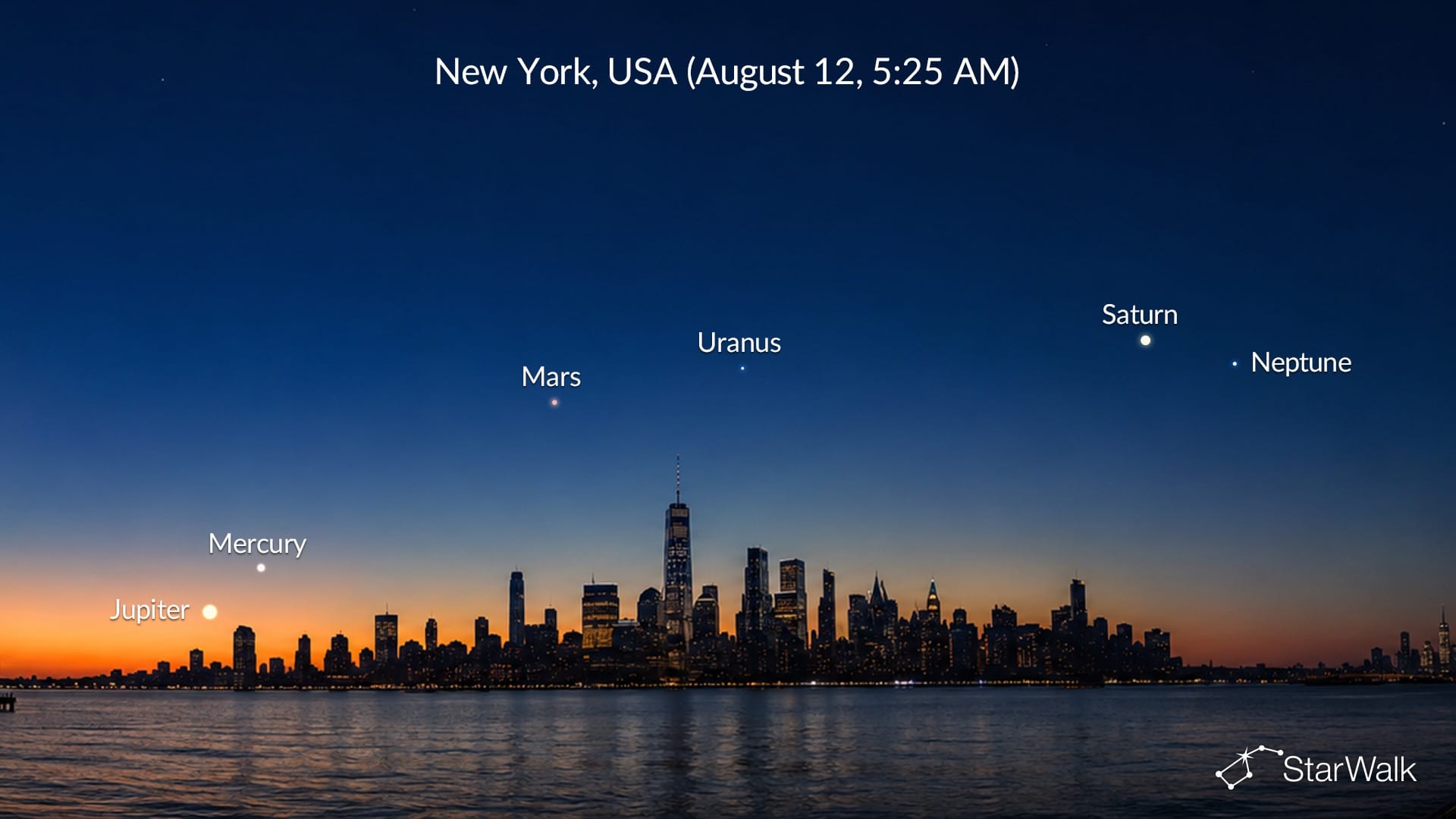
By August 12, six planets stretch across the morning sky. Saturn and Mars are easy; Uranus and Neptune need optical aid. Mercury is low, while Jupiter sits closest to the sunrise and may be lost in the glare, especially from northern states.
Best planet-watching dates: August 1–15, 2026
August 2: Mercury reaches greatest western elongation, 19°28′ from the Sun. This is when Mercury reaches its farthest apparent distance from the Sun in the sky, though the planet remains low above the eastern horizon.
August 3–4: The Moon passes Neptune and then Saturn. Saturn is visible to the naked eye; Neptune requires binoculars or a telescope.
August 7: The Moon crosses Taurus near Uranus, the Pleiades, and the Hyades. The star clusters are easy binocular targets, but moonlight will make faint Uranus harder to see.
August 9: The waning crescent Moon passes about 4° from Mars before sunrise. Look for the planet’s reddish color.
August 11–12: The Moon passes Mercury and then Jupiter as six planets line up before sunrise. Mercury and Jupiter are the toughest naked-eye targets because both sit low in dawn twilight.
August 15: Venus reaches its greatest eastern elongation, appearing as far as 45°53′ from the Sun. This elongation brings better viewing conditions to the Southern Hemisphere, where Venus will rise higher above the horizon during the darker part of twilight. In the Northern Hemisphere, Venus will be relatively low above the western horizon during civil twilight.
August 15–16: A young crescent Moon appears near Venus after sunset.
Evening planet: Venus
Venus: the easiest planet to see tonight
From August 1 to 15, 2026, Venus is the only easily visible evening planet. Look west after sunset. If you see a brilliant "star" shining steadily, it is almost certainly Venus.
The planet brightens from about magnitude –4.3 to –4.5 during the period. A young crescent Moon joins it on August 15–16, creating a naked-eye pairing in the evening twilight.
Venus remains low for observers at far-northern latitudes, where it may set before the sky becomes fully dark. It is much better placed in the tropics and Southern Hemisphere.
Morning planets: Saturn, Mars, Mercury, Jupiter, Uranus, and Neptune
Saturn: the best planet before sunrise
Saturn is the easiest morning planet in the first half of August 2026. Look toward the southern sky from the Northern Hemisphere or high in the northern sky from the Southern Hemisphere. It shines at about magnitude 0.5 and looks like a yellowish dot.
You don’t have to wait until dawn. Saturn rises in the late evening and remains visible for the rest of the night. The Moon passes nearby on August 4.
Mars: visible before dawn
Mars is visible in Taurus before sunrise at about magnitude 1.3. Its reddish color helps it stand out, although Mars is dimmer than Saturn and much dimmer than Venus.
On August 9, the waning crescent Moon passes about 4.4° from Mars. Look east before sunrise for the red planet beside the Moon.
Mercury: best in early August
Mercury reaches greatest western elongation on August 2, when it lies 19°28′ from the Sun. This is the best date of the period to catch it low above the eastern horizon before sunrise.
Mercury brightens quickly, from about magnitude 0.3 on August 1 to –1.2 on August 15. Yet it becomes harder to see after the first week because it moves back toward the Sun. Look 30–60 minutes before sunrise and find a clear, unobstructed eastern horizon. The Moon passes close to Mercury on August 11, although this event will be difficult to see.
If you use binoculars, make sure the Sun is safely below the horizon, and stop observing well before sunrise. Never sweep the horizon with binoculars once the Sun is close to rising.
Uranus: a morning target for binoculars
Uranus is in Taurus before sunrise, but you’ll need binoculars or a telescope to see it. It shines at about magnitude 5.7 and looks like a faint blue-green dot.
On August 7, the Moon passes Uranus near the Pleiades and Hyades. It is a beautiful binocular field, but moonlight may hide Uranus. Use Star Walk 2 to identify the planet’s exact position.
Neptune: optical aid required
Neptune rises in the evening in Pisces and remains visible for the rest of the night. At magnitude 7.8, it is too faint to see with the naked eye. You’ll need binoculars or a telescope and a dark sky; a stargazing app will help you locate the planet.
Brighter Saturn can guide you to the right part of the sky: the two planets remain about 10.5° apart. The Moon passes near Neptune on August 3. Through binoculars, Neptune looks like a faint star; a telescope at moderate magnification is needed to show its tiny bluish disk.
Jupiter: emerging from the Sun’s glare
Jupiter returns to the morning sky in the first half of August after its solar conjunction on July 29. It is bright at magnitude –1.8, but brightness is not the problem: the planet stays extremely low in dawn twilight.
Jupiter joins Mercury, Mars, Uranus, Saturn, and Neptune in the six-planet alignment around August 12. Look just above the eastern horizon shortly before sunrise. From many locations, especially at high northern or southern latitudes, Jupiter may remain hidden by haze or glare. Do not use binoculars or a telescope when the Sun is close to rising.
What is the bright star in the west after sunset?
The bright “star” in the west after sunset is most likely Venus. It is the brightest planet and the only easy evening planet during the first half of August 2026.
On August 15–16, a young crescent Moon appears close to Venus, making the planet even easier to identify.
What is the bright planet before sunrise?
The most obvious planet before sunrise is Saturn, a steady yellowish point that is already well above the horizon. Mars is farther east in Taurus and has a reddish tint. Mercury and Jupiter are brighter on paper but much lower in dawn twilight, so they are harder to see.
How to find and identify planets in the sky
Most novice astronomers believe that astronomy is an expensive hobby requiring a fancy telescope. But the irony is that beginner-level astronomy is not only inexpensive but actually free.
Five planets — Mercury, Venus, Mars, Jupiter, and Saturn — can be seen with the naked eye, often even from a city. Equipment only deepens your experience; it’s not required to recognize the dots in the sky. In the next few minutes, you’ll learn exactly how to find Solar System planets tonight — no gear needed.
Look for bright dots
Venus and Jupiter are usually the brightest dots in the sky, easily visible to the naked eye; Mars sometimes outshines stars, too. Bright planets may even look larger than stars because their intense light creates a noticeable glow. So, if you see an exceptionally bright dot in the sky, there’s a good chance it’s a planet.
Astronomers use a magnitude scale to measure an object’s apparent brightness. On this scale, brighter objects have lower or even negative numbers. For example:
- Sun: about mag –26.7
- Full Moon: about mag –12.7
- Sirius: mag –1.46 (the brightest star in the night sky)
Unlike stars, the brightness of planets changes depending on their position relative to Earth and the Sun. Here are the magnitude ranges for the Solar System planets:
- Venus: from mag –4.9 to –3.0
- Jupiter: from mag –2.9 to –1.7
- Mars: from mag –2.9 to 1.9
- Mercury: from mag –2.5 to 7.2
- Saturn: from mag –0.5 to 1.2
- Uranus: from mag 5.4 to 6.0 (usually requires binoculars)
- Neptune: from mag 7.7 to 8.0 (requires binoculars or telescope)
If it twinkles, it’s not a planet
Earth’s turbulent atmosphere makes distant starlight shimmer and twinkle, whereas planets — being much closer — shine with a steady light. So, a bright non-twinkling point in the sky near the ecliptic is almost certainly a planet.
For the full explanation of why stars twinkle, see our detailed article.
Look for planets near the Moon
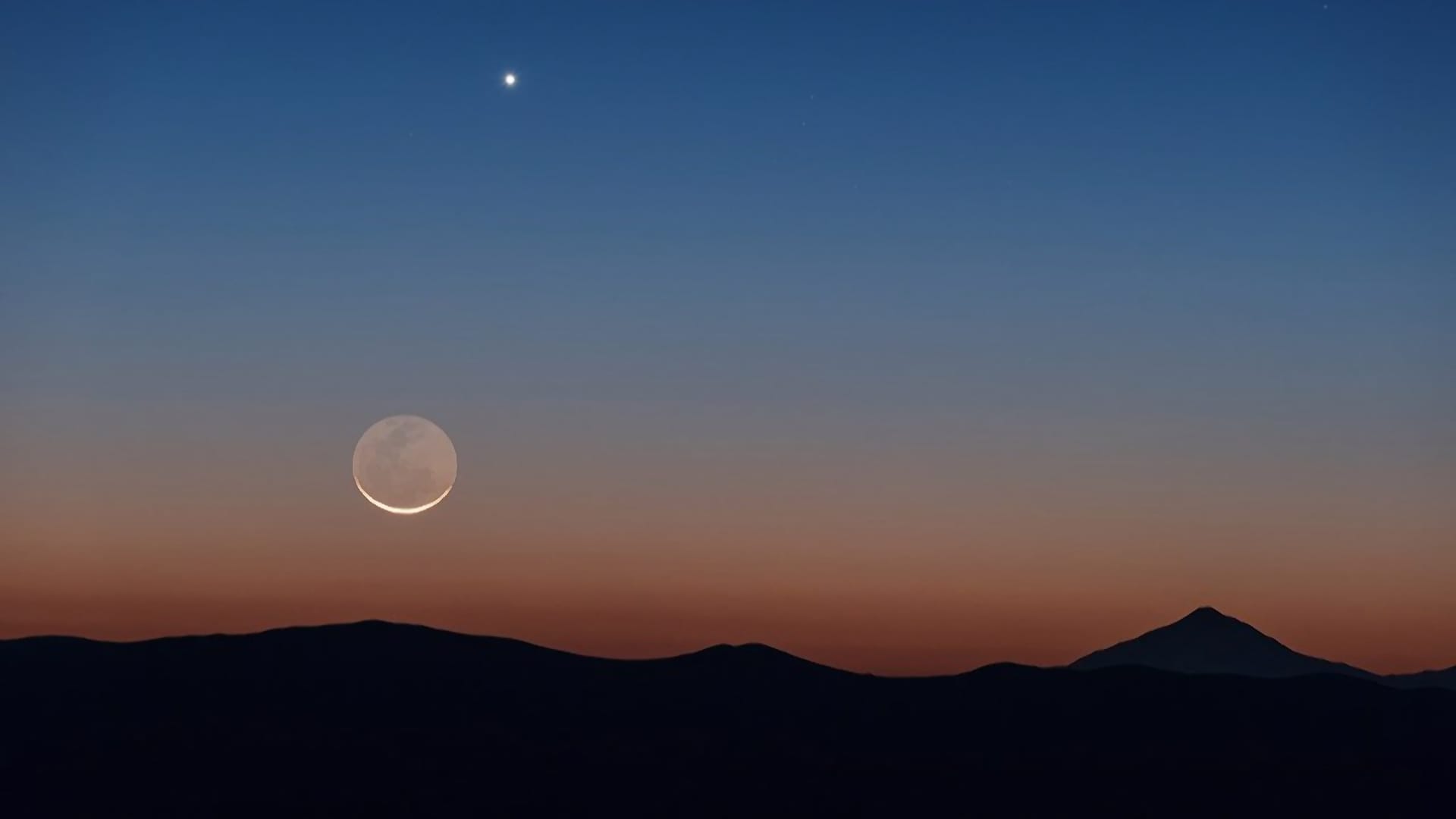
One of the easiest ways to locate a planet is to use a bright guide that everyone can easily find in the sky — the Moon. Each month, our natural satellite passes close to planets in the sky — astronomers call this a close approach. So, a bright, not twinkling “star” near the Moon is most likely a planet!
To learn when a planet passes near the Moon the next time, check our regularly updated article.
Aim for planetary pairings or planetary alignments
From time to time, planets appear very close together in the sky. A bright planet can become your guide to a fainter one, like when Venus passes close to Uranus. But when both planets are bright, it becomes a spectacular sight to the naked eye.
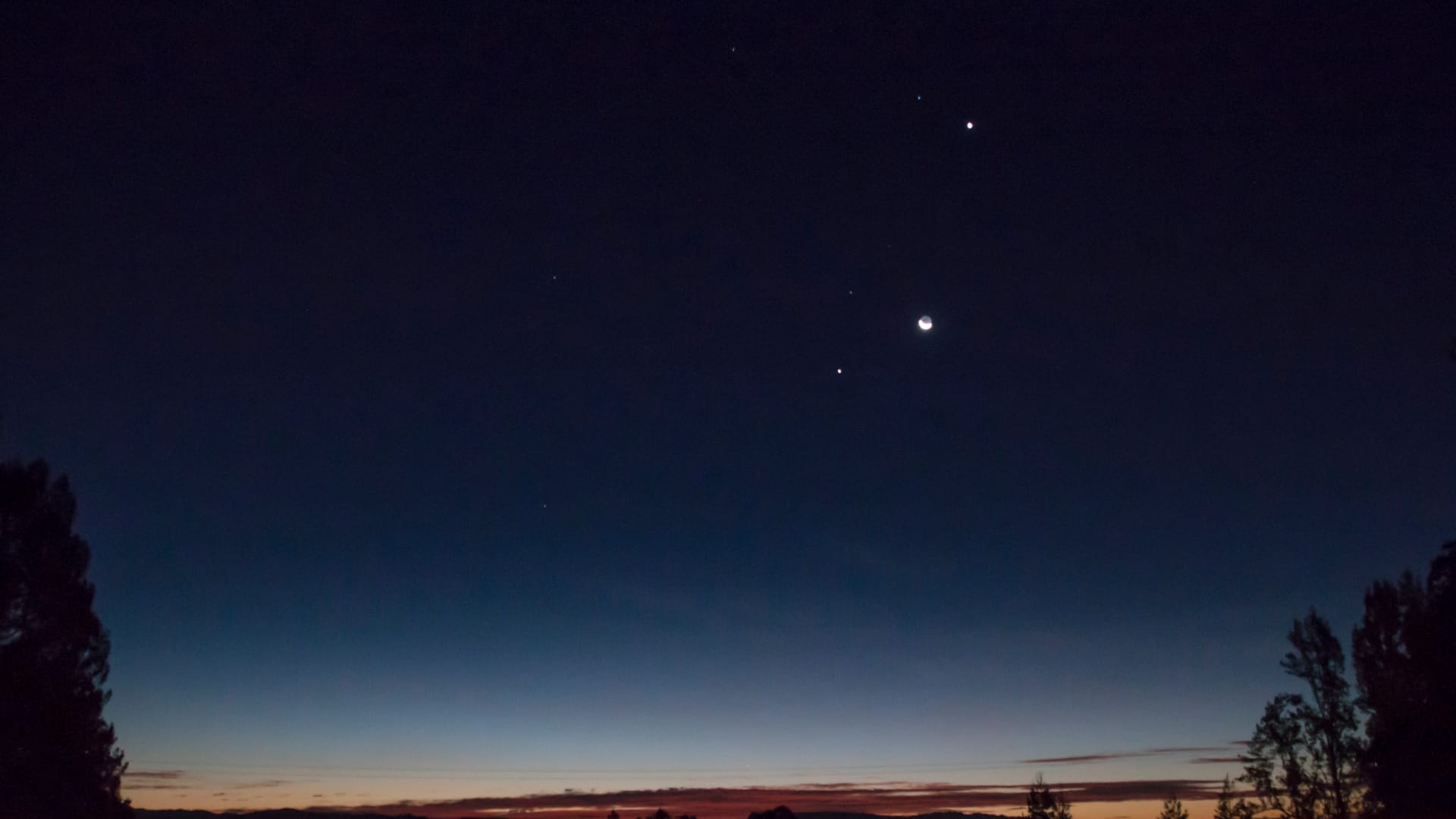
Even more striking are planetary alignments, which happen when three or more planets gather on one side of the Sun. They may span a broad arc rather than cluster tightly, but alignments still offer a good opportunity to find several planets in one observing session.
A planetary alignment was last visible in June 2026, and another will occur in August 2026. Around August 12, six planets — Jupiter, Mercury, Mars, Uranus, Saturn, and Neptune — will appear across the morning sky.
Learn more: Planetary Alignment in August 2026
To find planets, look along the Sun’s path
All planets roughly follow the same path the Sun takes across the sky each day — it’s represented by the ecliptic.
Here's how to easily find it:
- Notice where the Sun rises and sets and the path it follows across the sky.
- Use your imagination to connect these points to form an imaginary line.
At night, look along this line — planets always appear close to it. Mercury and Venus always stay relatively close to the Sun in the sky, so you can find them near sunrise or sunset (we’ll explain why later in the section dedicated to the planets).
Important: Never look directly at the Sun — it can permanently damage your eyes!
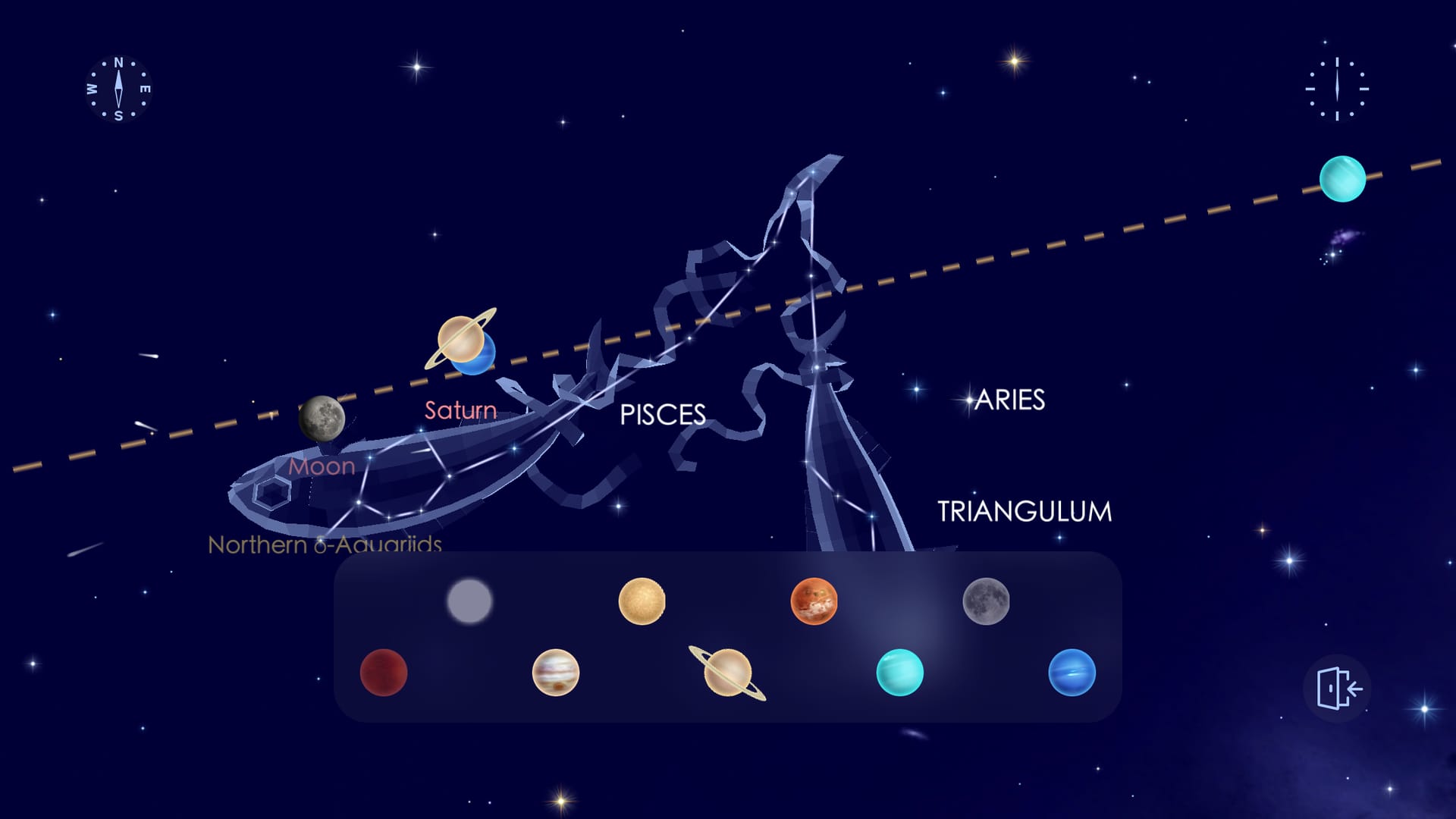
Remember, the ecliptic shifts during the year, appearing higher in summer and lower in winter.
Planets are “wanderers”
Another way to confirm whether you are looking at a planet or a star is to observe its position over several successive nights. You’ll see how the positions of the planets change relative to the backdrop of the fixed stars from night to night.
Use an interactive star map
After you’ve practiced spotting planets on your own, an app can confirm your finds. The free Star Walk 2 features a Planet Walk mode that highlights every planet and makes it easier to distinguish them from stars. Simply open Settings, choose Planets, then tap Planet Walk. You’ll get a live map with every planet highlighted, plus a bottom panel that lets you jump straight to each planet.
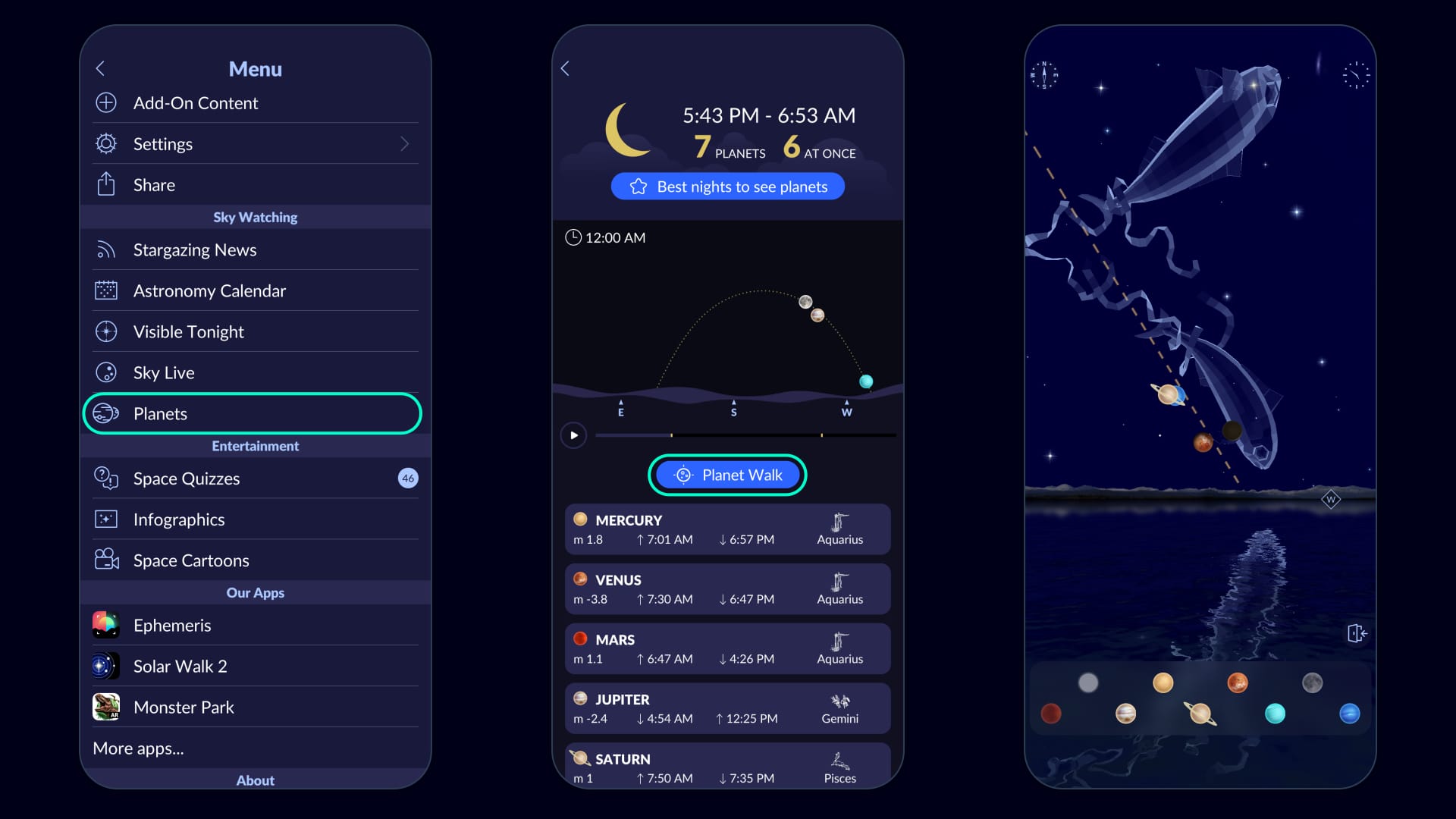
If you’d like alternatives, try Night Sky, SkySafari, or Stellarium. Some apps are entirely free, others require payment upfront, and many offer extra features via in-app purchases. For a quick comparison of what each app offers at no charge, see our article about Top Astronomy Apps 2026.
Planet-by-planet observing tips
Mercury: the elusive planet
Mercury is an inner planet that orbits closer to the Sun than the Earth. This means that in our sky, this planet is never far from the Sun; the maximum distance between them ranges from 18° to 28°. In astronomy, this is called a greatest elongation, and it’s the best time for viewing inner planets. Counting both eastern and western elongations, Mercury reaches greatest elongation six or seven times per year.
To find Mercury, look low on the western horizon just after sunset or low in the east just before sunrise. To find out whether it is currently a morning object, an evening object, or not visible at all, check the free Star Walk 2 app that shows the daily visibility of the planet.
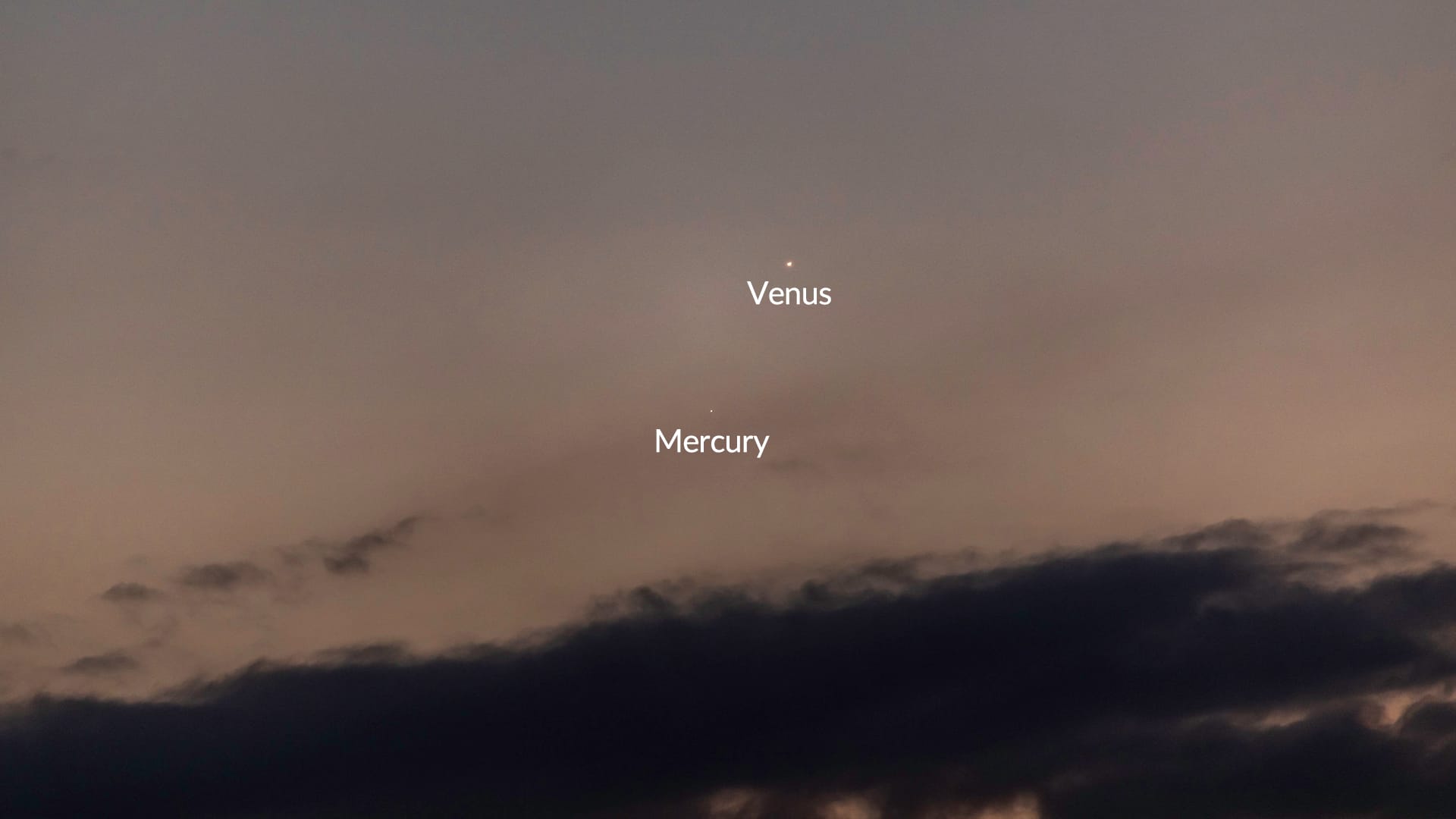
Begin observing as soon as Mercury appears; follow it through its peak separation; and watch until it slips back into the Sun’s glare. You’ll have a short observation window — probably about 30 minutes (depends on your latitude and time of the year). A small telescope will reveal Mercury’s tiny disk and its phases — just be sure the Sun has fully set before aiming your optics.
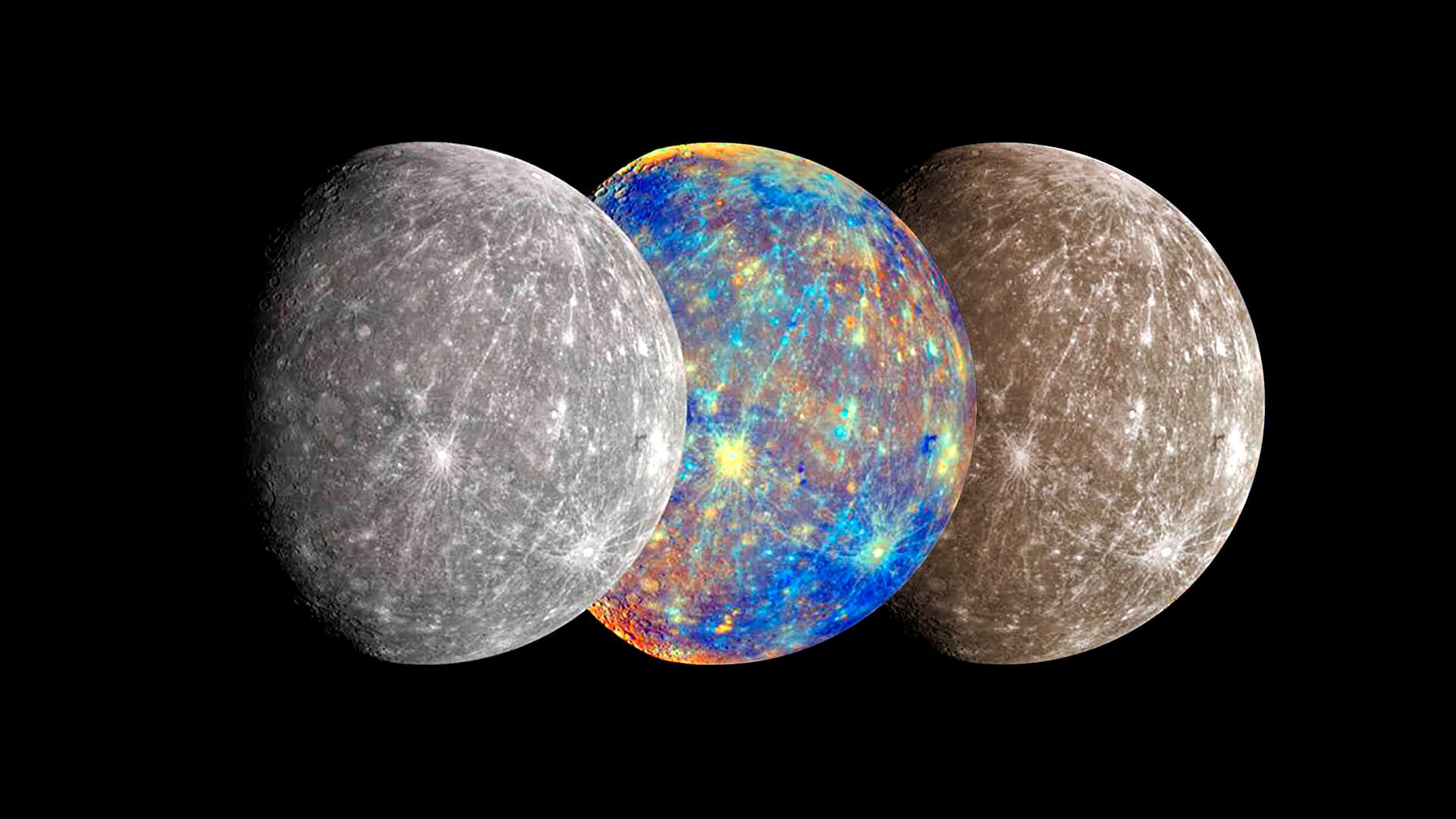
Mercury is often overlooked, but it’s one of the most surprising planets in the Solar System. Take the quiz and see how much you really know about this mysterious small planet!
Venus: the evening and morning star
Venus is the brightest planet you can see with the naked eye. Blanketed by highly reflective clouds, Venus appears exceptionally bright in our sky, visible even in daytime around its peak brightness.
By the way, like the Moon, Venus goes through phases, and reaches its peak brightness around the crescent phase. This is because in this phase Venus is much closer to Earth than at other times and reflects more sunlight our way. You can see phases of Venus through binoculars (typically 10×50 or with higher magnification).
Like Mercury, Venus is an inner planet and also never appears very far from the Sun in our sky. For comparison, Mercury's maximum apparent distance from the Sun is about 28°, while Venus can reach about 48°. Outer planets can appear 180° from the Sun at opposition.
Venus is the brightest planet in the sky. When it appears close to the Moon — the brightest object in the night sky — they create a stunning sight, even in light-polluted city skies. To find the next Moon-Venus pairing, see our regularly updated article.
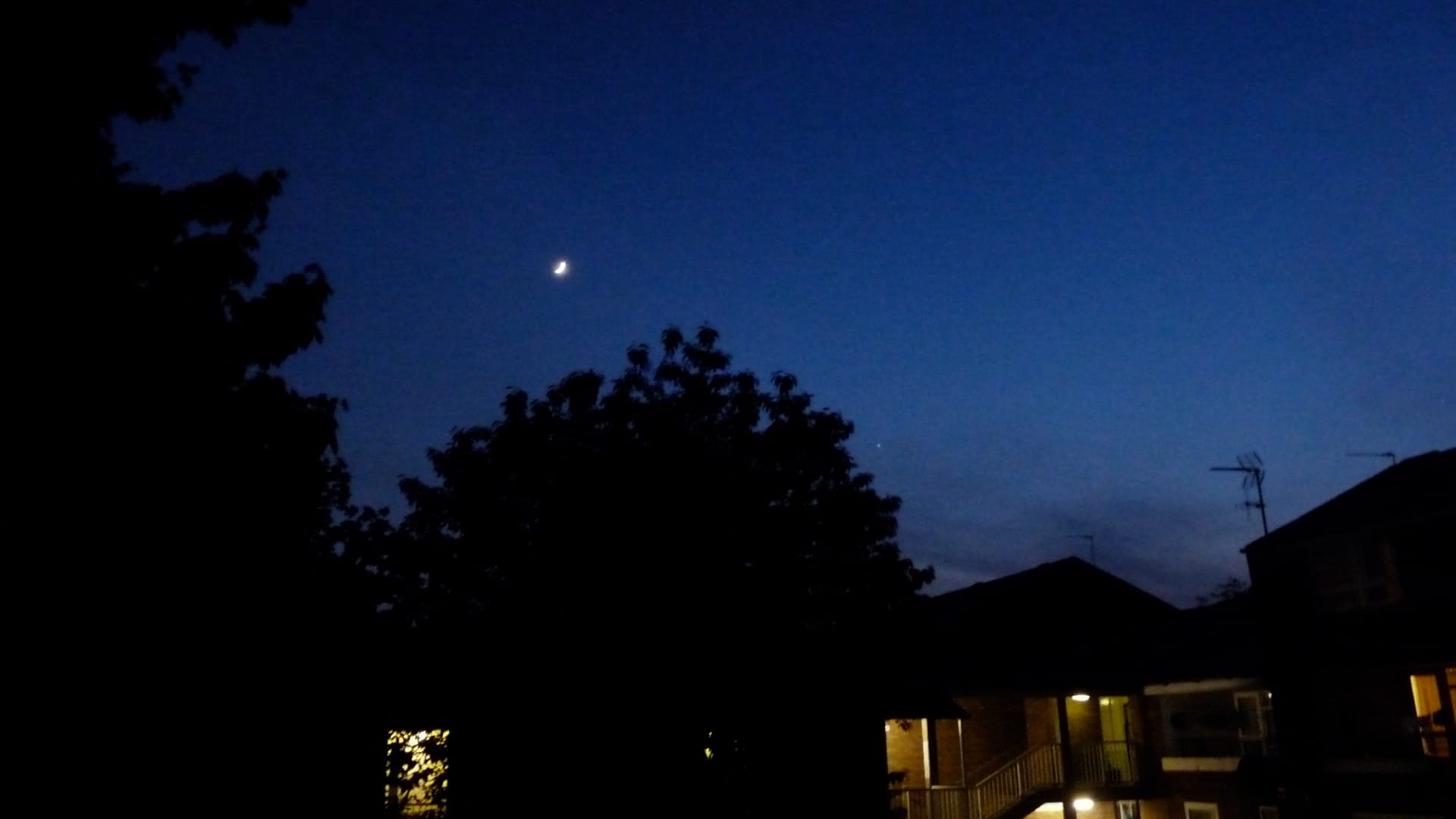
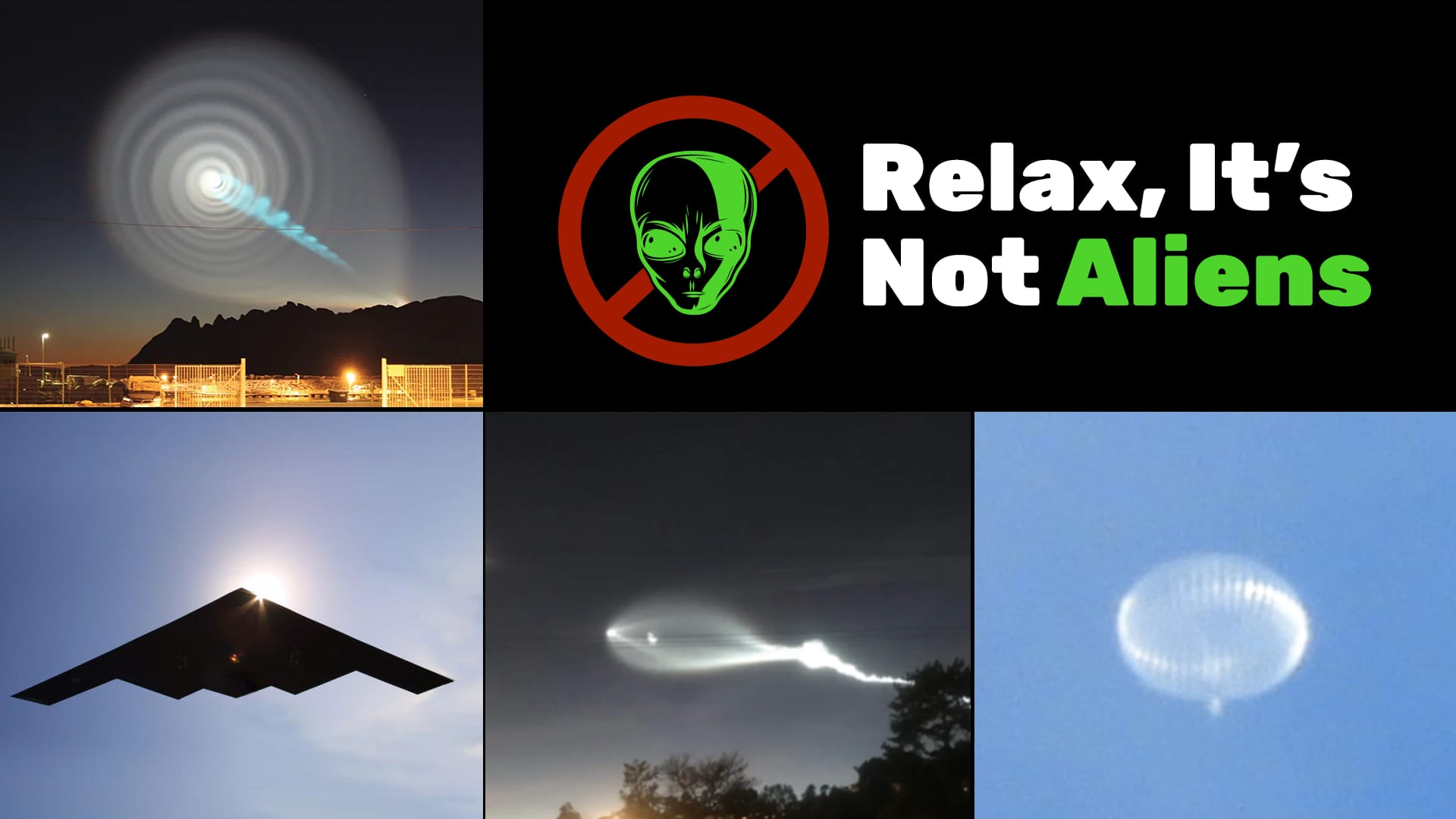
Because Venus is so brilliant, many people mistake it for an airplane — or even a UFO. However, people in general have a rich imagination and often mistake many objects for aliens. Check out our infographic to see some man-made objects that have been mistaken for UFOs!
Mars: the red planet
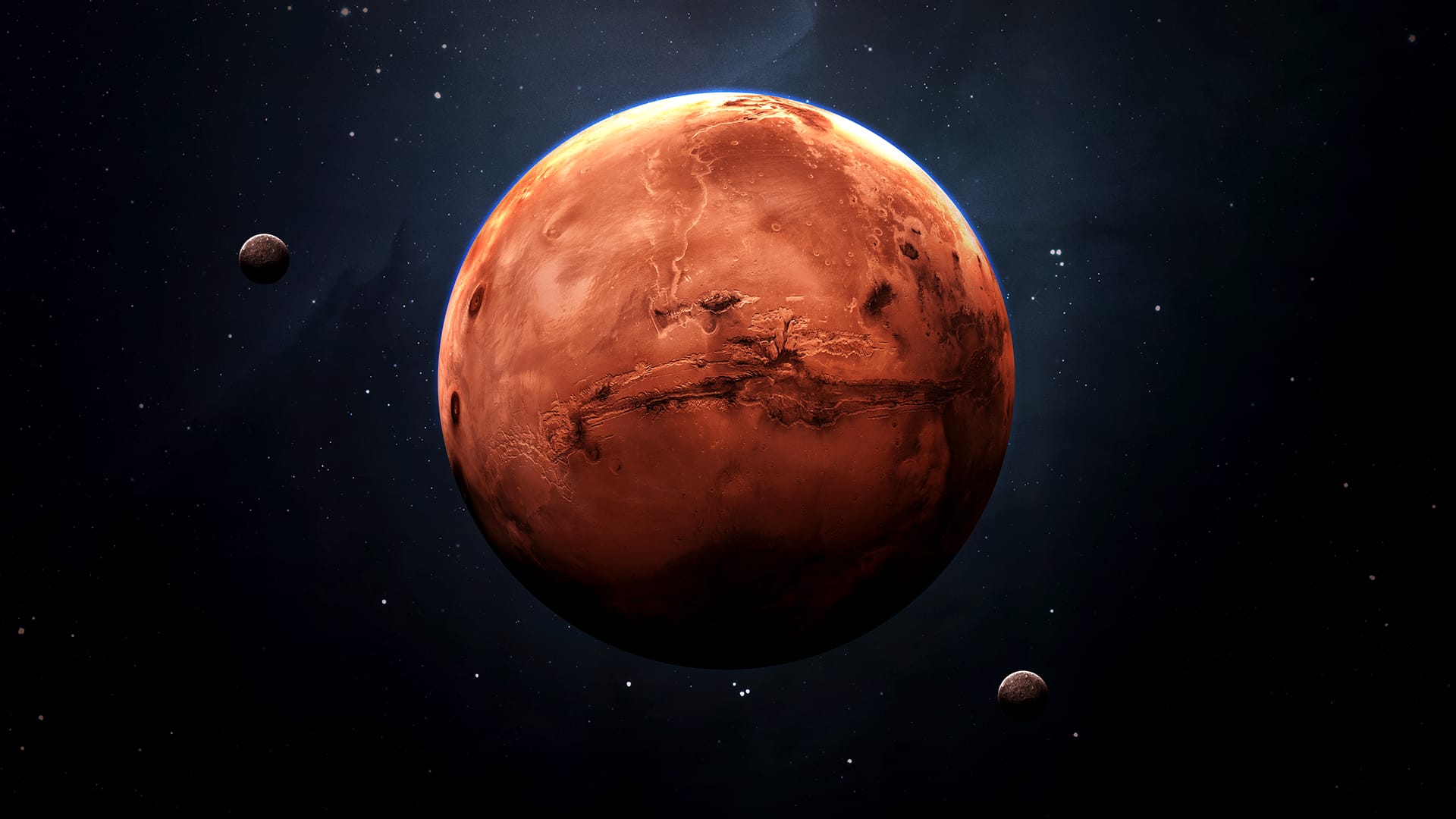
Mars’ rusty glow makes it hard to miss — even from a brightly lit city. Its apparent brightness changes with its position in the Solar System, peaking at opposition, which occurs roughly every 27 months when Earth lies directly between Mars and the Sun.
Around its next opposition on February 19, 2027, Mars will reach its peak brightness and largest apparent size. By July 2027, it will be about nine times fainter and only 40% of its size around opposition.
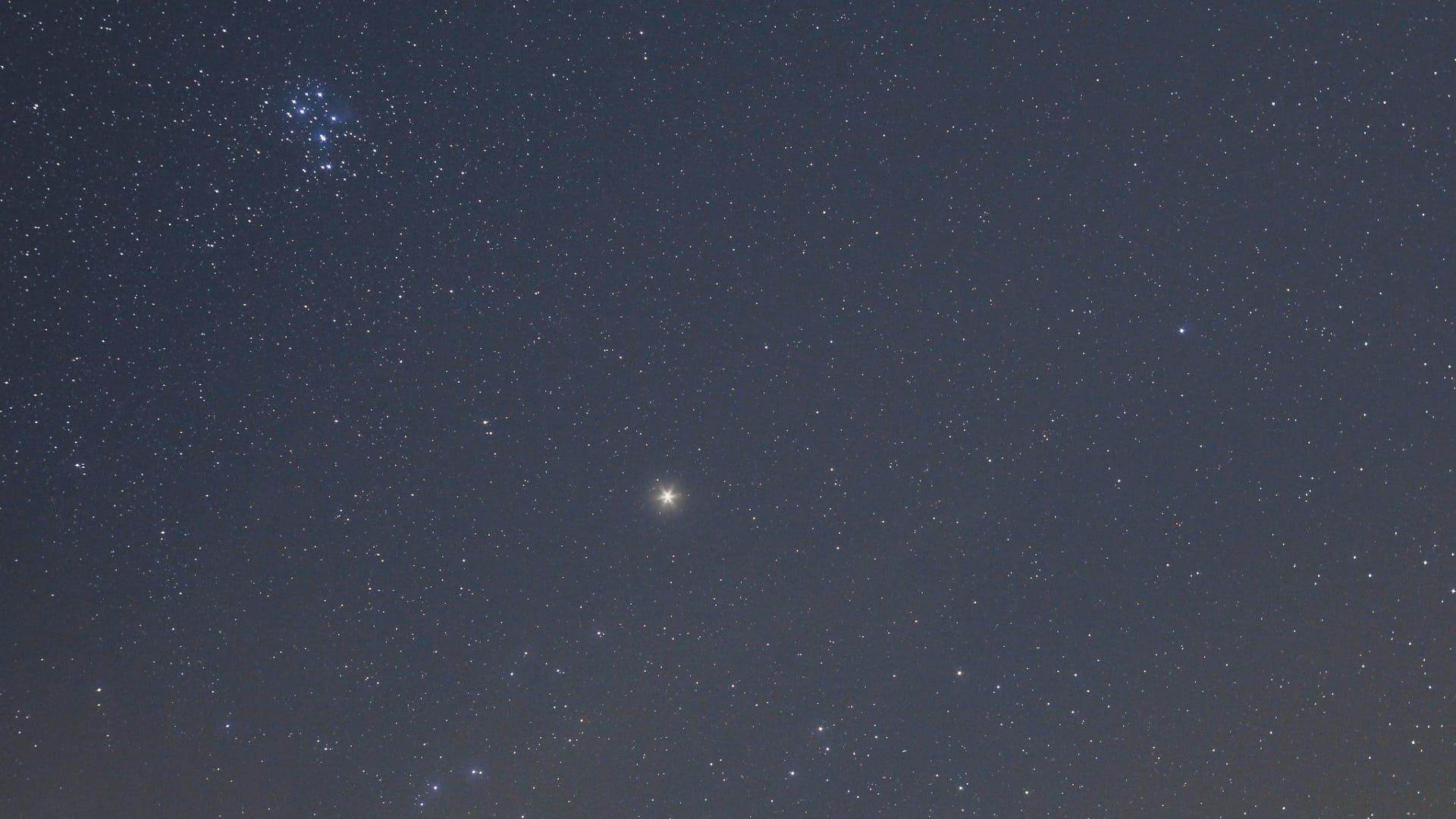
With binoculars mounted on a tripod, you’ll see a small, round orange disk. A telescope will reveal surface details, most notably the white polar caps.
Want to take a closer look at Mars? Of all the planets, it’s considered the best suited for colonization. Take our quiz to find out how much you know about the planet where your descendants might live!
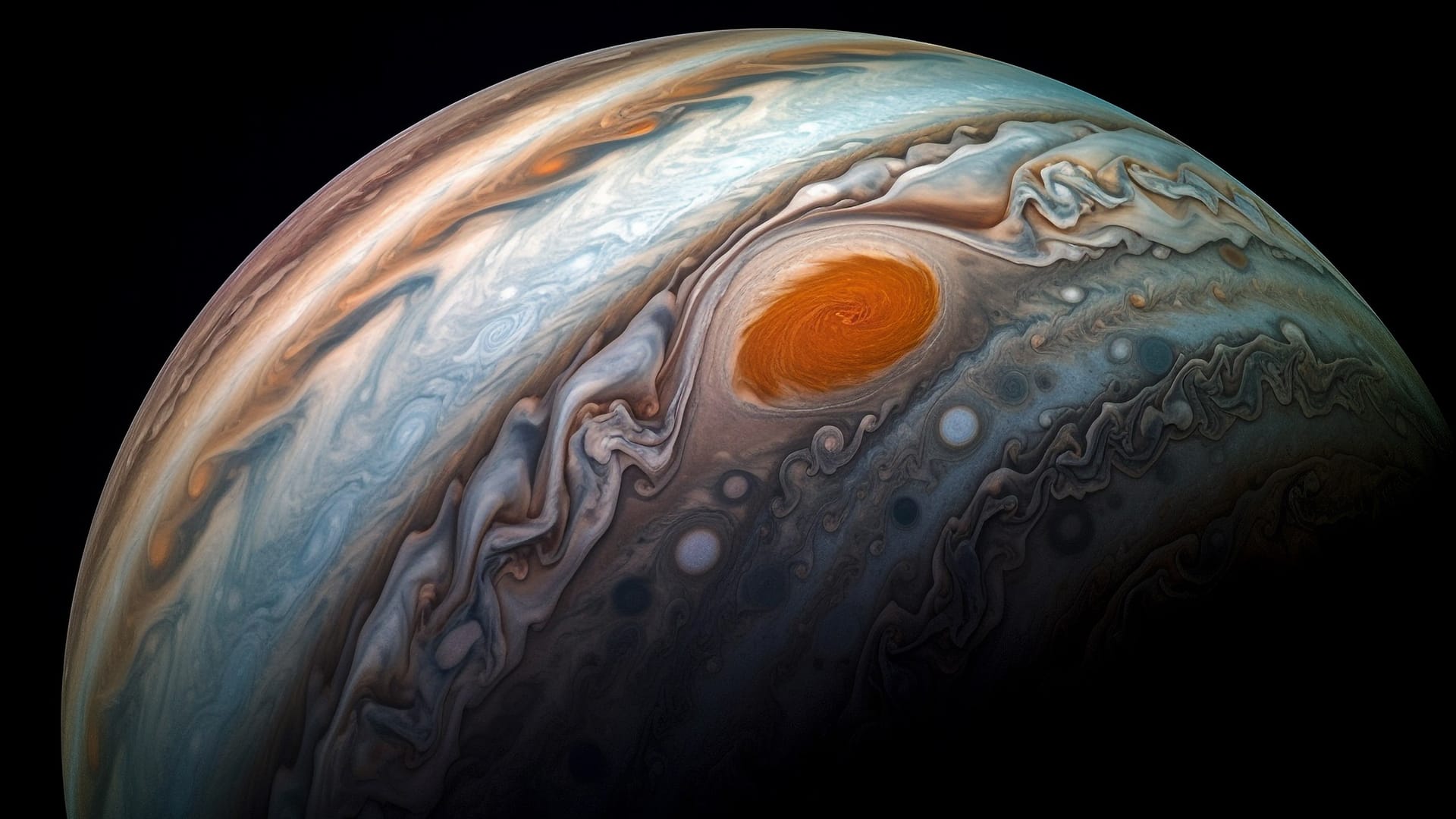
Jupiter: the largest planet with visible moons
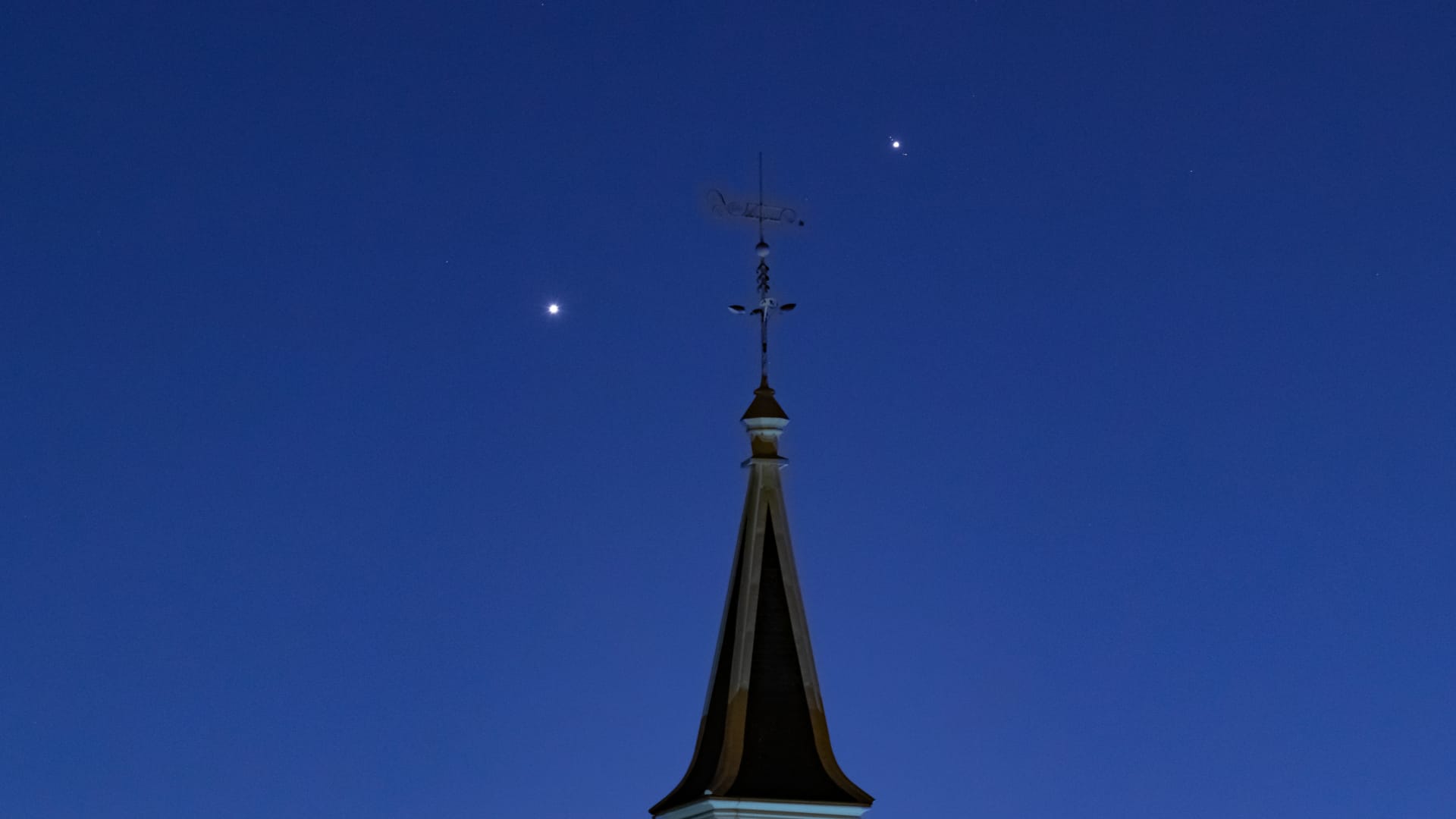
Jupiter is the biggest planet in our Solar System and one of the brightest objects in the night sky. After Venus, it usually ranks the second-brightest planet — once Venus sets, Jupiter becomes the brightest one, making it easy to spot with the naked eye, binoculars, or a small telescope. Jupiter will become brighter by the end of 2026 as it approaches opposition on February 11, 2027.
Even a small telescope or a pair of binoculars lets you feel like Galileo Galilei as you observe Jupiter and its four largest satellites — Io, Europa, Ganymede, and Callisto — known as the Galilean moons. To locate them on any given evening, try the Star Walk 2 app (requires an in-app purchase for this object type) or the Sky Tonight app, where all space objects are available for free.
In the Northern Hemisphere, Jupiter can sometimes be mistaken for Sirius, the brightest star in the night sky. From December to March, Sirius rises particularly high in the sky, so it’s no surprise that some confuse these two bright dots. But don’t make the same mistake and remember: stars twinkle, and planets do not! Besides, Sirius lies far from the ecliptic.
To see the Great Red Spot — a vast storm on Jupiter — use a telescope at roughly 100× magnification or more, wait for steady atmospheric conditions, and check that the spot is facing Earth at the time of observation.
As you know, Jupiter is the largest planet in our Solar System. But just how big is it? How many Earths would fit inside this gas giant? Take our quiz and find out!
Saturn: the golden king of the rings and moons
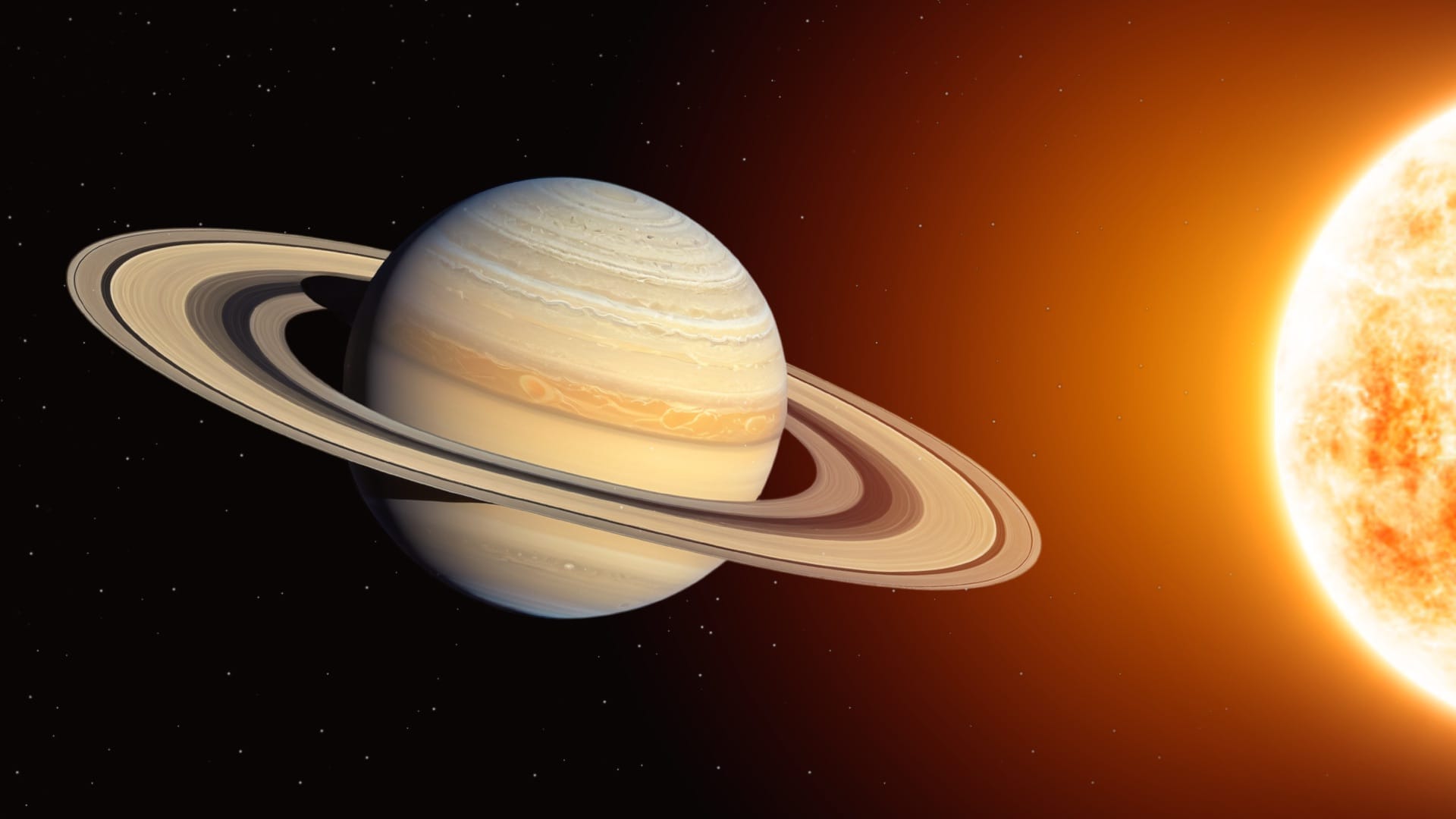
Saturn, the fifth-brightest planet in our sky, glows with a distinctive yellow-gold hue that makes it a standout even before you use a telescope. To find it, look for a steady yellowish point of light (fainter than Venus or Jupiter).
With any small telescope, Saturn’s famous rings are unmistakable. Even at low magnification, you’ll see the broad banding of the rings and the dark Cassini Division. When Saturn reaches quadrature — when it’s 90° from the Sun — you can even spot the planet’s shadow cast onto its rings.
Through a telescope, you can also glimpse Titan, Saturn’s brightest moon. With larger apertures, additional moons — Rhea, Dione, Tethys, and Enceladus — come into view, each appearing as tiny, steady points of light close to the planet.
We think that the true king of the rings and moons hides many secrets that you definitely don't know yet. Take this quiz to prove us wrong!
Uranus: a pale blue dot
Uranus is extremely faint, and spotting it without a telescope is rather difficult. Even through a small telescope, it appears as a tiny, pale blue circle that blends into the background stars. Under exceptionally dark skies — Bortle 5 or darker — observers with excellent eyesight may just detect it with the naked eye if they know its exact position.
The most convenient way to hunt Uranus is when it lies near a bright reference object, like the Moon or Venus. Keep in mind, though, that the nearby Moon can easily wash out Uranus’s faint glow.
Most amateur telescopes cannot resolve Uranus’s rings or surface details. However, medium to large instruments may reveal the planet’s two largest moons — Titania and Oberon — as faint, separate points of light.
Neptune: the farthest planet from the Sun
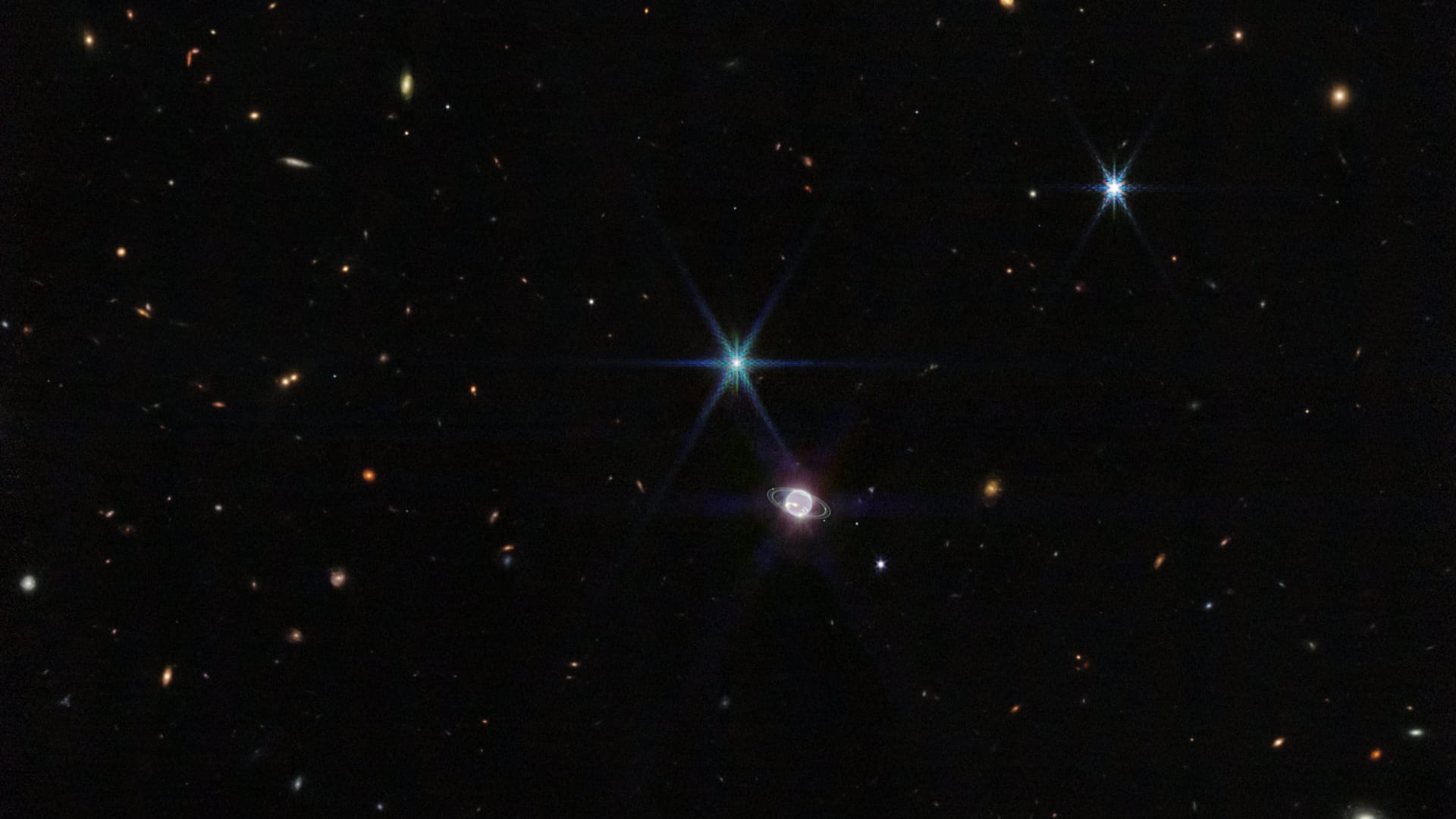
Neptune is the most challenging planet to observe. You need binoculars or a telescope, as well as a bright guide, such as Venus, to locate it. When Neptune is close to a well-known object, you can use it to spot Neptune as a small, pale dot (obviously, you will need binoculars). Its rings and surface details are beyond the reach of amateurs. You can distinguish its color with binoculars if you have keen eyesight, or with an amateur telescope. With a medium-to-large telescope and excellent viewing conditions, you may be able to glimpse its largest moon, Triton, as a faint point of light.
Planets visible tonight FAQ
Which planets are visible tonight?
From August 1–15, 2026, Venus is the easiest evening planet — look west after sunset. Saturn and Mars are the best morning planets. Mercury is low but best around August 2; Jupiter is extremely low, while Uranus and Neptune require optical aid. For your exact location, use Star Walk 2 to check what is above your horizon right now.
Why don’t planets twinkle like stars?
Planets usually shine with steadier light than stars because they are much closer to Earth and appear as tiny disks rather than pinpoints. If a bright object near the ecliptic does not twinkle much, it may be a planet.
Can I see Uranus or Neptune with the naked eye?
Uranus is technically visible to the naked eye under very dark skies, but it is extremely faint and easy to miss. You’ll need excellent observing conditions and a clear idea of exactly where to look. Neptune is too faint to see with the naked eye and requires binoculars or a telescope.
How do I know if I’m looking at Venus or Jupiter?
Venus is usually much brighter than Jupiter and often appears low above the horizon shortly after sunset or before sunrise. Jupiter is also very bright, but it can stay visible for a longer part of the night and may appear higher in the sky, depending on the season. Both shine with a steady light and don’t twinkle much like stars.
To identify them with certainty, point your phone at the object using Star Walk 2.
Why does planet visibility depend on my location?
Planet visibility depends on your location because the sky looks different in different parts of the Earth. Your latitude affects how high planets rise above the horizon, while your longitude determines when they rise and set. Local conditions also matter: buildings, mountains, trees, light pollution, and weather can hide a planet even when it is technically above the horizon.
Tips on how to see the planets: bottom line
You don't need expensive equipment to explore our Solar System — just step outside and look for the brightest "dots" in the sky. Most of the time, Venus, Jupiter, Saturn, and Mars are easily visible to the naked eye, and Mercury's visibility depends on the time of day and your location. You can also use the Moon or the planets' pairings as a guide. Remember, planets shine with a steady light, unlike stars. For extra help, use the free Star Walk 2 app to instantly identify planets in real time.
More planet events
Want more upcoming planet events? See also: