Constellation Centaurus: Stars, Location & How to Find It

Centaurus (the Centaur) is a large southern constellation. It is best known for Alpha Centauri, the star system closest to the Sun, which contains Proxima Centauri. It is also home to Omega Centauri, a spectacular globular cluster. Visible mainly from the Southern Hemisphere and from low northern latitudes, Centaurus sits beside the Southern Cross. We’ll show you how to quickly locate Centaurus (with the free Star Walk 2 app or by classic star-hopping), what to observe once you find it, and the stories it holds. Let's get started!
Contents
- Constellation Centaurus Facts
- Where Is the Constellation Centaurus Located?
- Alpha Centauri and Beta Centauri – Major Stars of Centaurus
- Notable Deep-Sky Objects in the Constellation Centaurus
- Centaur Constellation Myth
- Constellation Centaurus Fun Facts
- Constellation Centaurus: key facts
Constellation Centaurus Facts
- Name: Centaurus
- Abbreviation: Cen
- Size: 1,060 sq. deg.
- Right ascension: 11h to 15h
- Declination: -30° to -65°
- Visible between: 25°N – 90°S
- Brightest star: Alpha Centauri (α Cen)
- Main stars: 11
- Bordering constellations: Antlia, Carina, Circinus, Crux, Hydra, Libra (corner), Lupus, Musca, Vela
Where Is the Constellation Centaurus Located?
The constellation Centaurus is located next to the well-known constellation Crux. If you've ever seen the Southern Cross, you've probably also caught sight of the two brightest Centaurus stars: Alpha and Beta Centauri. Now, let's explore how to locate the entire Centaurus constellation.
How to find Centaurus in the night sky?
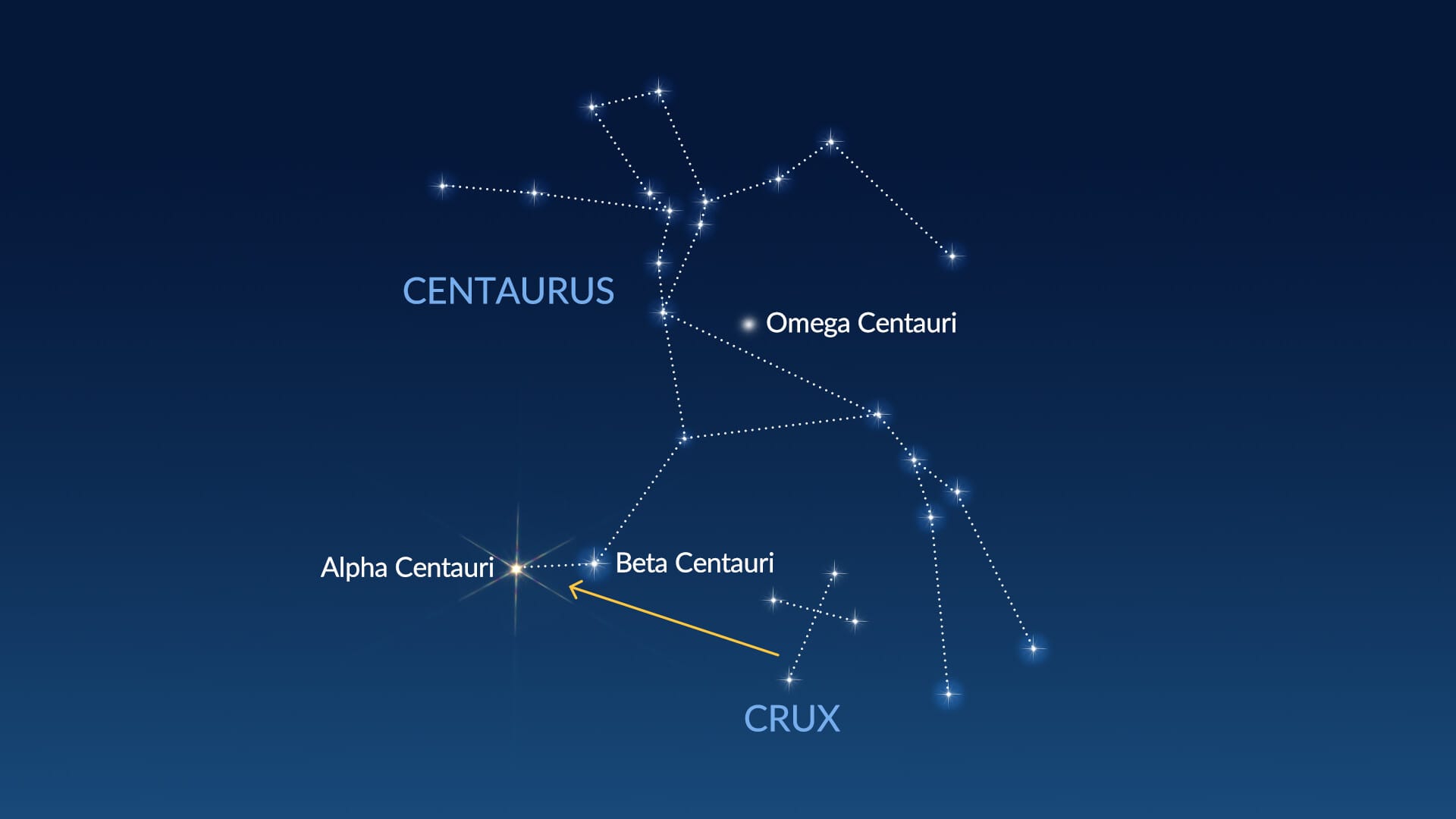
To find Centaurus in the sky, start with an easy landmark: the Southern Cross (Crux). Once you’ve found it, look nearby for the two bright stars – these are Alpha Centauri and Beta Centauri. They are easy to spot, even under a light-polluted sky, and mark the lower part of the Centaur’s leg.
From here it gets a little trickier, but under a dark sky you can pick out the Centaur’s body as a triangle of stars above the Southern Cross and the two pointer stars (Alpha and Beta Centauri). If you’re unsure you’ve got the right triangle, there’s a very helpful giveaway: on the Centaur’s back sits a standout “star” that is actually a star cluster – Omega Centauri.
The human half of the Centaur is the hardest section to trace. It stretches upward from the highest point of that triangle.
If you’d rather skip the guessing entirely, there’s a shortcut: open the Star Walk 2 app, search for Centaurus, tap on it, and then point your phone at the sky – the app will guide you to the constellation in real time.
Where Is the Constellation Centaurus Visible?
Centaurus is best seen from the Southern Hemisphere and is easiest to observe around May.
In the Northern Hemisphere, Centaurus is visible only from the southernmost latitudes (roughly south of 25°N), and even there it sits low on the southern horizon. You will likely see only the upper part of Centaurus, if you see it at all – it’s worth checking your exact visibility in the Star Walk 2 app.
What Is the Best Time to See Centaurus?
The constellation Centaurus is easiest to observe from March through May, with May offering the best views. Around May, it climbs to its highest point in the sky at about 8:00-10:00 p.m. local time, making evening observing especially convenient. If you’re in the far south of the Northern Hemisphere, May is when you have the best shot at spotting Centaurus low over the horizon, while observers in the Southern Hemisphere can enjoy the constellation high and complete in the sky.
Alpha Centauri and Beta Centauri – Major Stars of Centaurus
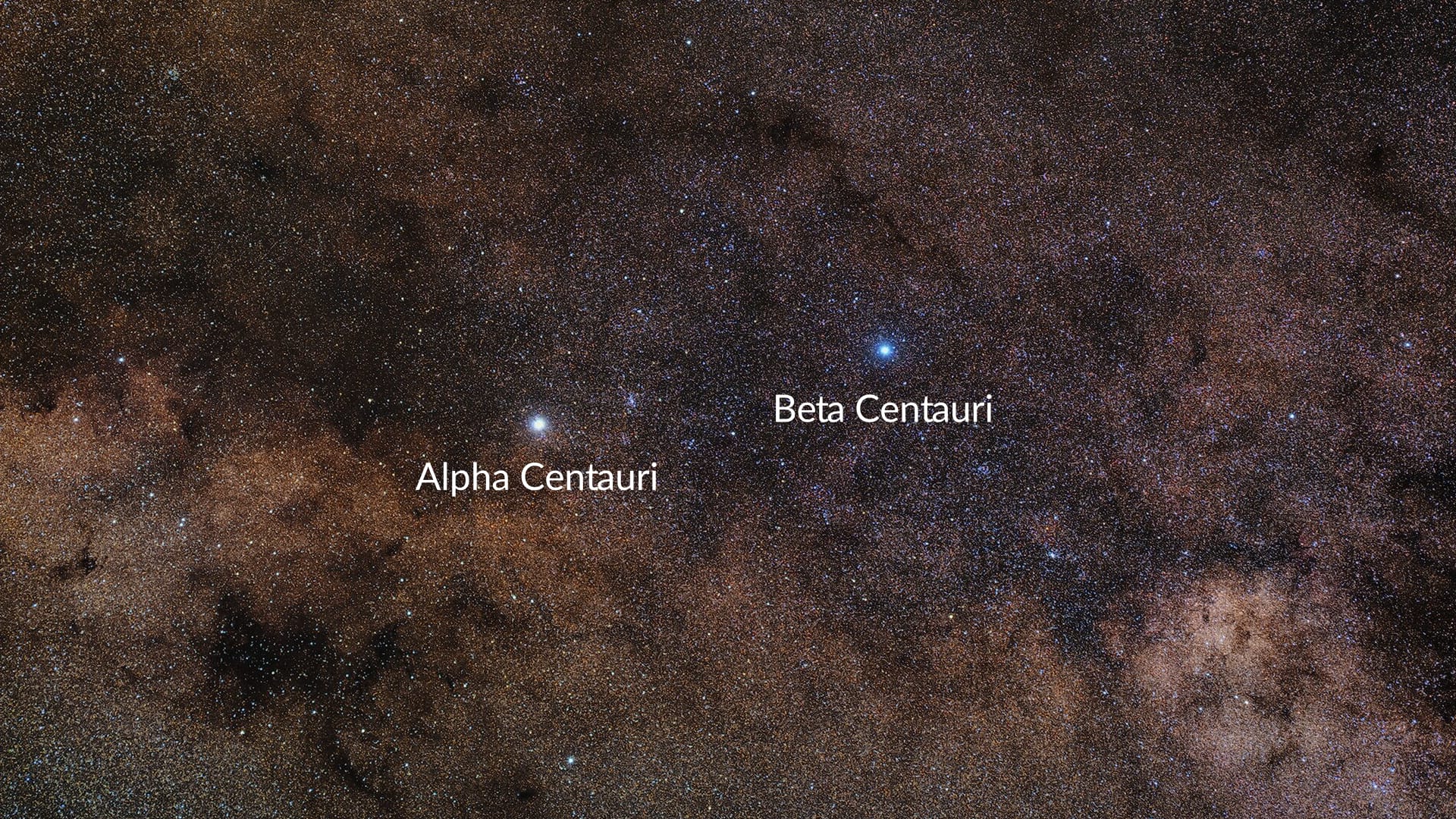
Alpha Centauri and Beta Centauri are the brightest stars of the constellation, shining close to the Southern Cross. Once you spot them, you’ve already found the most famous part of the constellation – now let’s explore them in more detail.
.jpg)
Alpha Centauri – The Brightest Centaurus Star
Alpha Centauri is the brightest star in Centaurus and the third-brightest star in the night sky, after Sirius and Canopus. What looks like a single star is actually a triple system: a close binary system of Alpha Centauri A and B, orbited by a more distant (and much more famous) companion, Proxima Centauri.
Alpha Centauri A (also known as Rigil Kentaurus, meaning “the foot of the Centaur”) is a G2V-type main-sequence star, similar to our Sun. It is slightly more massive and about 1.5 times more luminous than the Sun. It has a yellowish hue and an apparent magnitude of -0.01.
Alpha Centauri B (known as Toliman, meaning “the ostriches”) is an orange-yellow K1V star with an apparent magnitude ranging from 1.33 to 1.35. It is slightly less massive and half as bright as the Sun. The two stars are gravitationally bound and orbit their common center of mass about every 80 years. Under steady atmospheric conditions, you can distinguish the two with binoculars or a small telescope.
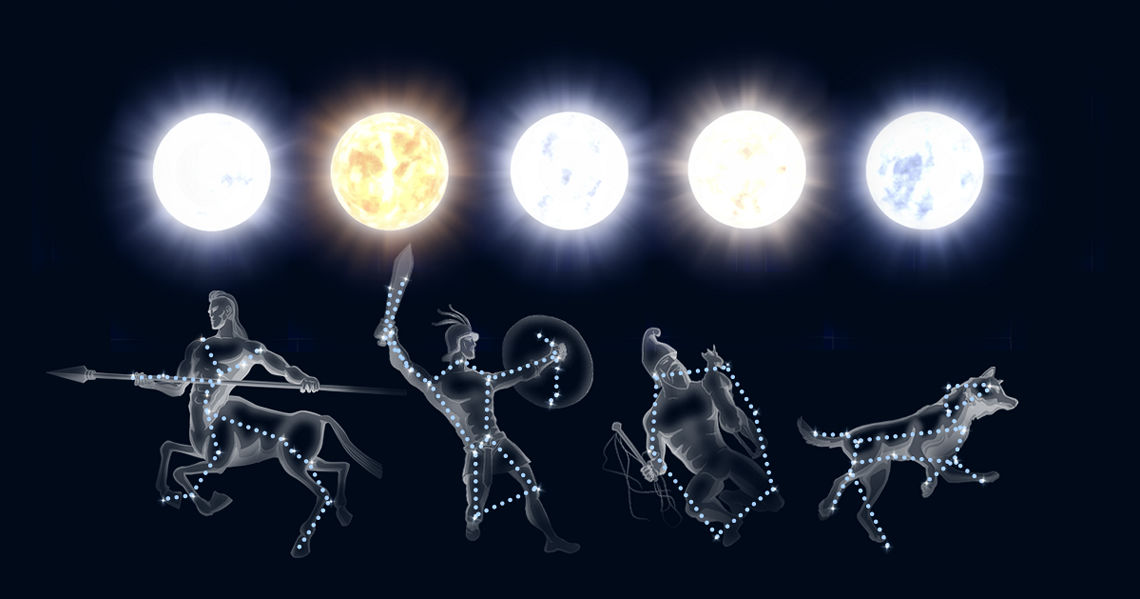
Want to find more bright stars in the sky? Check out our infographic on the brightest stars and their constellations. Learn to identify them all and impress your friends!
Proxima Centauri – The Closest Star to Earth
A red dwarf, Proxima Centauri, is a third member of the Alpha Centauri system. It’s much dimmer than Alpha Centauri A and B, and can be distinguished only with a medium-sized telescope (at least 6–8 inch aperture) in a dark, clear sky.
Despite its visual modesty, Proxima Centauri gathers everyone's attention. Here are some of the reasons:
- It’s the closest star to Earth, located at just 4 light-years away.
- Proxima Centauri has three confirmed planets, known as Proxima Centauri b, c, and d. These are the nearest known exoplanets outside our Solar System.
- Proxima Centauri b orbits Proxima Centauri within the habitable zone. While it’s not confirmed, it's possible that liquid water – and potentially even life – could exist there. And being so close, this exoplanet is comparatively easy to study.
Beta Centauri (Hadar) — The Second-Brightest Centaurus Star
Beta Centauri, also called Hadar, is the second-brightest star in Centaurus. It shines at about magnitude 0.6 and is a triple-star system, made up of Beta Centauri Aa, Ab, and B. All three stars are thought to have the same spectral type B1, appearing blue-white in color.
Notable Deep-Sky Objects in the Constellation Centaurus
Omega Centauri

Omega Centauri (NGC 5139) is a globular star cluster that can look like a bright “star” to the naked eye, but it’s actually a swarm of about 10 million stars! It’s the largest known globular cluster in the Milky Way, spanning roughly 150 light-years and significantly more massive than typical globular clusters.
You’ll find Omega Centauri on the “back” of Centaurus. With an integrated magnitude of about 3.7, it can be visible even under heavily light-polluted sky skies. Through binoculars, it stops looking like a point of light and starts to reveal its true nature – a glow of myriads of stars. It’s a perfect target for amateur deep-sky fans!
Lambda Centauri Nebula – The Running Chicken Nebula
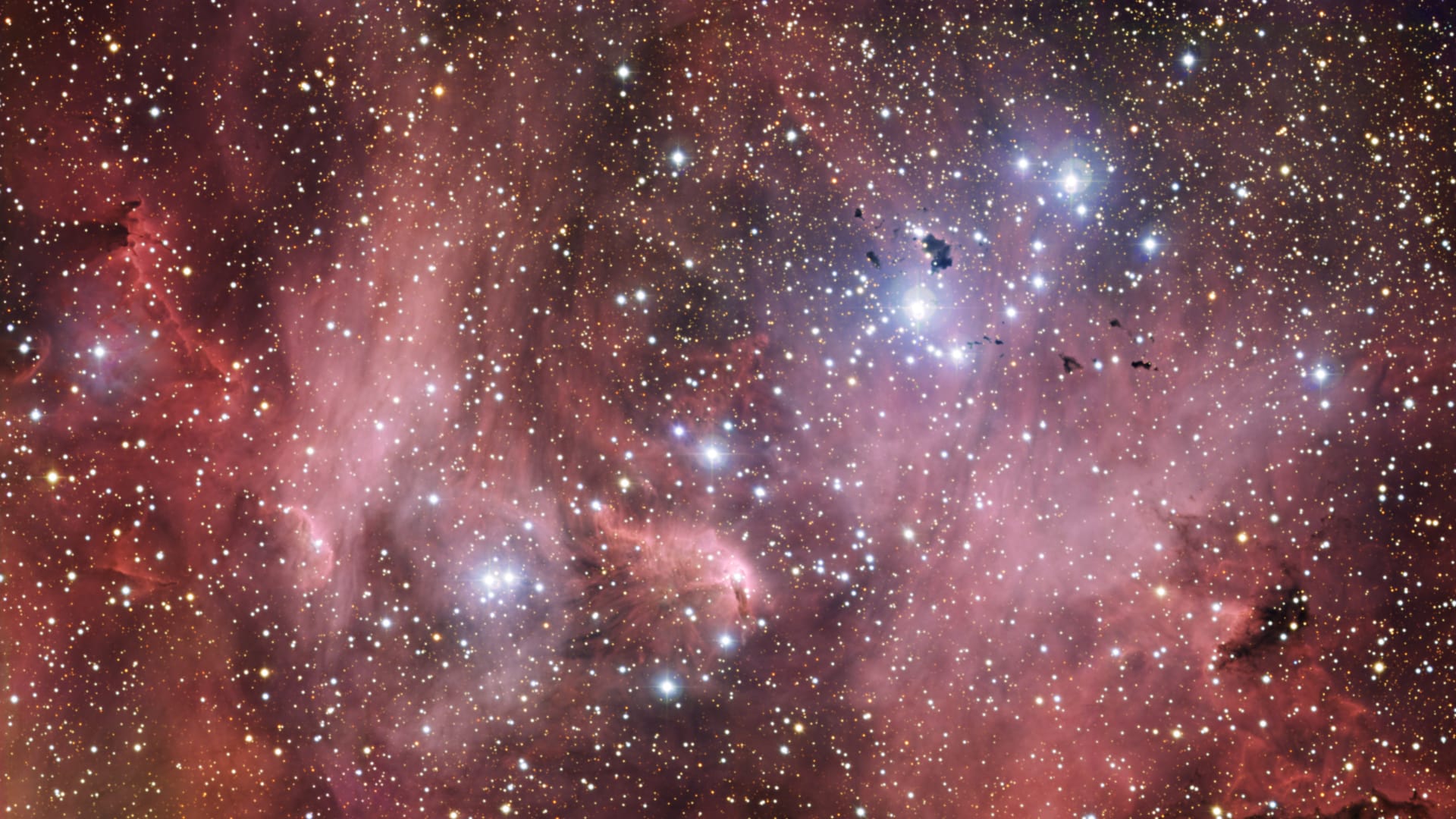
The Lambda Centauri Nebula (IC 2944, Caldwell 100, or the Running Chicken Nebula) is an emission nebula wrapped around an open cluster. It lies roughly 6,000–6,500 light-years away and spans ~75 arcminutes (about 2.5 full Moons wide), so it’s best viewed with binoculars or a low-power, wide-field telescope. With an overall brightness of around magnitude 4.5, it can be seen with the naked eye under dark skies. Astrophotographers love it for the dramatic dark blobs known as Bok globules (“Thackeray’s Globules”), which look like ink drops against the bright hydrogen glow.
Pearl Cluster
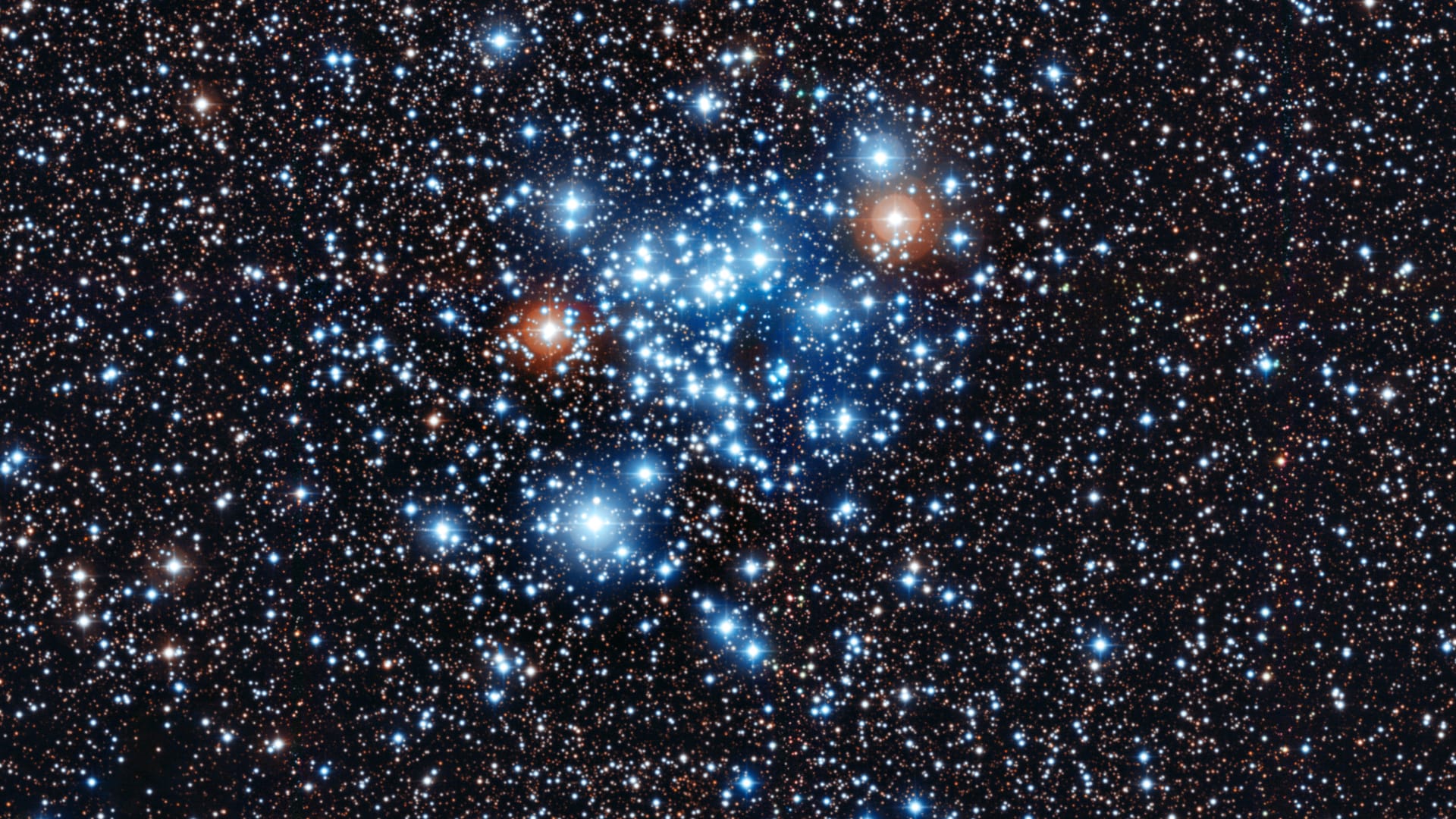
The Pearl Cluster (NGC 3766, Caldwell 97) is a bright open cluster with an integrated magnitude of about 5.3, located around 5,500 light-years away. The cluster is young (about 14.4 million years is childish in space-time measures!), so it looks crisp and "sparkly" in a telescope, with lots of blue-white stars. The cluster is located near the Running Chicken Nebula, on the border with the constellation Carina. Under dark, clear skies, it can be seen without optics.
Centaurus A

Centaurus A (NGC 5128, Caldwell 77) is a starburst galaxy, the fifth-brightest galaxy visible from Earth. Deep inside it lies a supermassive black hole, 50-60 million times the Sun’s mass, and the galaxy has also been home to at least two supernovae. At about magnitude 6.8, it can show up in binoculars as a dim, oval glow. With a telescope under good conditions, you may catch the famous dust lane running across its center that gives the galaxy its signature look.
Centaur Constellation Myth
The constellation Centaurus can be traced back to a Babylonian constellation known as Bison-man (MUL.GUD.ALIM). The Bison-man appeared in two main forms: either a four-legged bison with a human head, or a hybrid with a man’s head and torso joined to the hind legs and tail of a bull or bison. It was closely linked to the Sun god Utu-Shamash. By the late 3rd millennium BCE, that older sky-figure had largely been replaced in Babylonian lore by a different constellation known as the Wild Boar.
The Greeks imagined the constellation as a centaur and gave it its current name. A centaur is a creature that is half human and half horse – often identified with Chiron, the most renowned centaur among his brethren. Chiron was famed as a healer and teacher, mentoring heroes such as Achilles, Jason, and Hercules. In a twist of fate, Hercules accidentally wounded Chiron with a poisoned arrow, and the pain was so terrible that even immortality felt like a curse. The gods finally granted Chiron release, and to honor him, placed his figure among the stars as Centaurus.
Constellation Centaurus Fun Facts
-
A “diamond” star hides in Centaurus. One of the Centaurus stars, white dwarf BPM 37093, is believed to have a crystallized carbon interior, essentially making it a massive diamond-like structure. The star has been nicknamed “Lucy” after the Beatles song “Lucy in the Sky with Diamonds.”
-
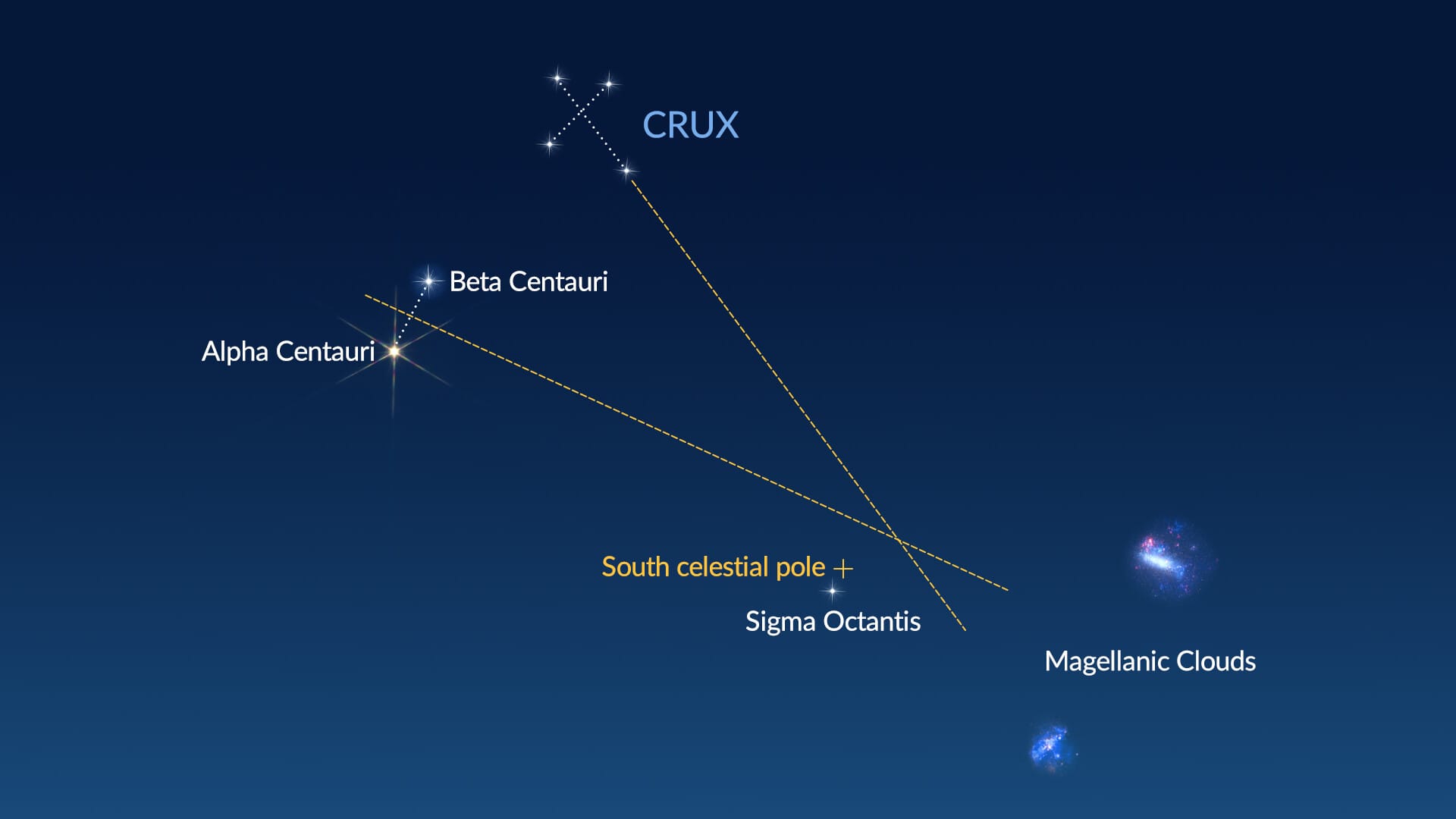
It’s a built-in sky compass. The two bright stars Alpha and Beta Centauri, also known as the Southern Pointers, when paired with the Southern Cross, can help you determine the direction of the south celestial pole.
-
Centaurus used to be well-seen from both hemispheres. In antiquity, Centaurus was an equatorial constellation, but Earth’s axial precession has been shifting it southward over millennia. Now, the Northern Hemisphere observers will have to wait a little over 7,000 years for the best views of the constellation!
-
Centaurus isn’t the only centaur in the sky. The zodiac constellation Sagittarius is also portrayed as a centaur, so the night sky features more than one half-human, half-horse character. If you’re into “full” horses too, check out our guide to horse-like constellations for the complete lineup.
Constellation Centaurus: key facts
Centaurus is best visible from the Southern Hemisphere, but it can also be spotted from lower latitudes of the Northern Hemisphere – especially around its prime season in May. Use the Southern Cross as your starting point, follow the bright “pointer” stars Alpha and Beta Centauri, then confirm the body triangle with the easy-to-spot glow of Omega Centauri. For the fastest, frustration-free way to locate Centaurus, use the free Star Walk 2 app.