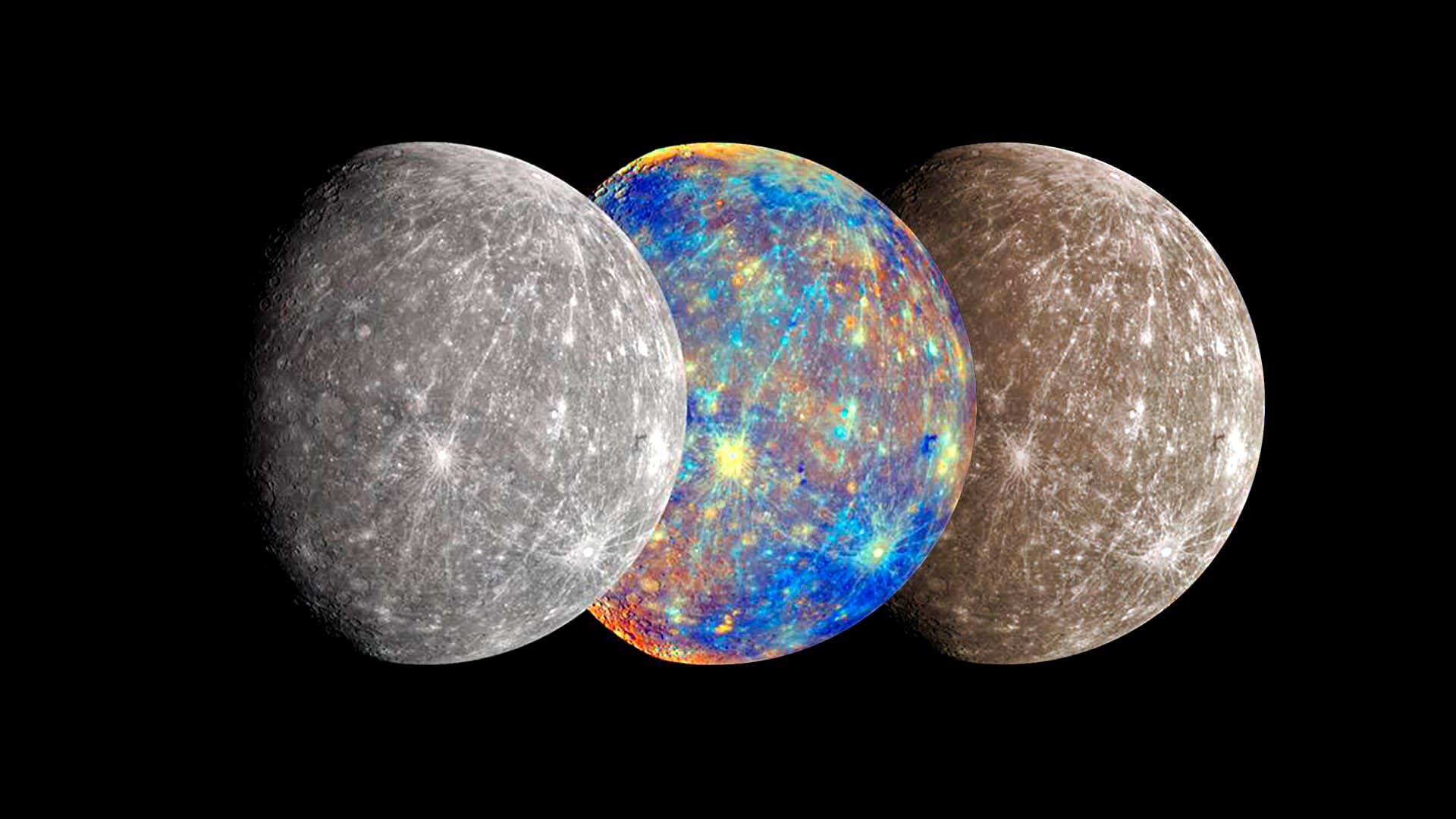
Greatest Elongations of Mercury and Venus in 2026–2027
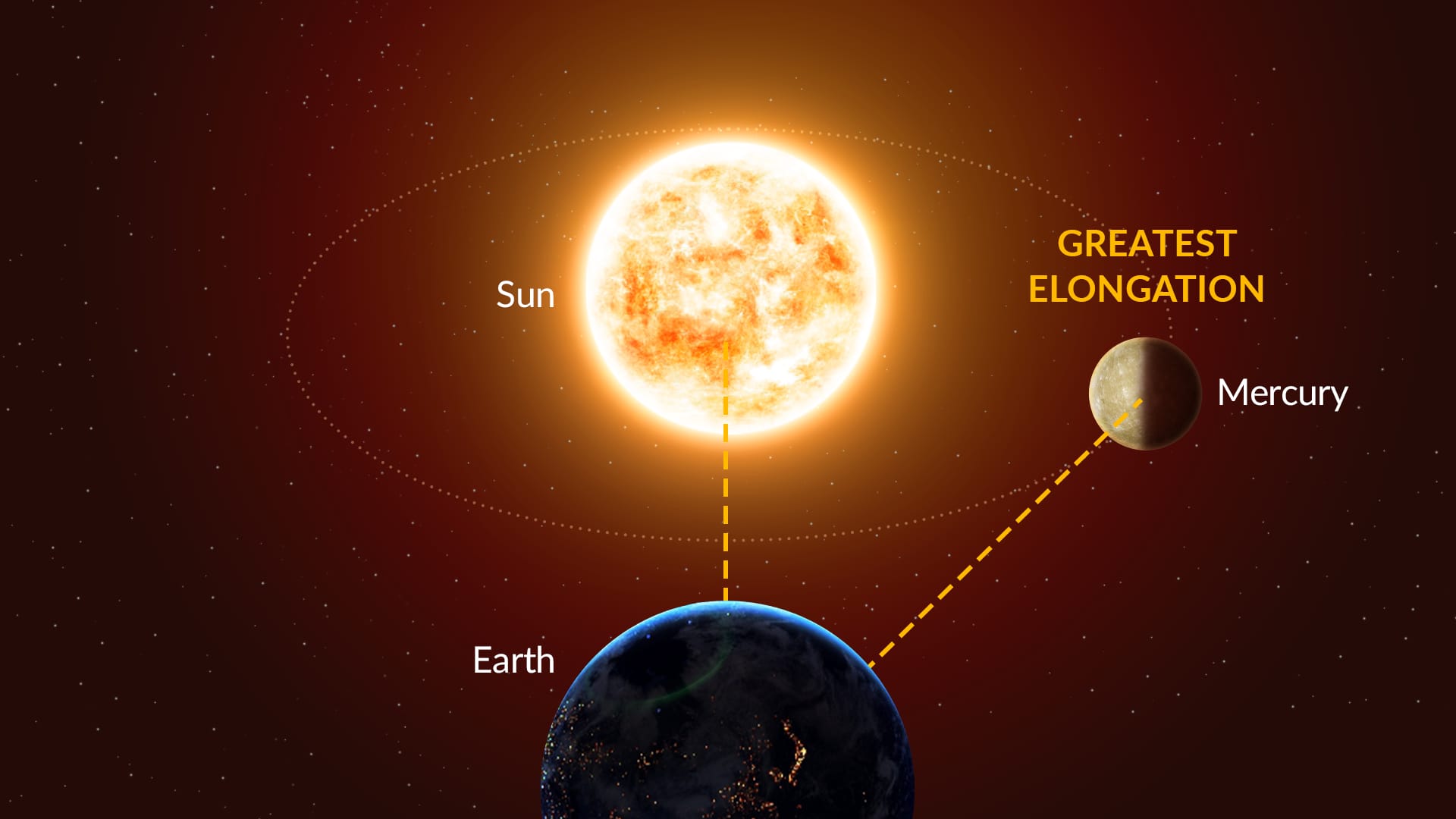
Timing is everything in astronomy, and elongation is the key to catching the elusive planet Mercury. The planet reaches its next greatest elongation on November 20, so don’t miss the opportunity. Let the Sky Tonight app guide you to the perfect viewing moments: download it now and explore the night sky like never before! Plus, dive into our article on elongation and uncover the celestial mechanics behind these events.
Contents
- Venus and Mercury Greatest Elongation Dates 2026–2027
- What Is Elongation?
- Inferior and Superior Planets’ Configurations
- Greatest Elongation of Mercury and Venus: Upcoming Events
- Elongation and Phases of the Planets
FAQ: Elongation in Astronomy
- How often is Mercury in greatest elongation?
- What is the maximum elongation of Mercury? Is it 28 degrees?
- How often does Venus reach its greatest elongation?
- Greatest eastern vs. greatest western elongation — what’s the difference?
- When is Mercury visible in the night sky?
- Why are some Mercury elongations “better” than others?
- Is the greatest elongation the same as the greatest brilliancy?
- Elongation of Planets: To Sum Up
👉At greatest elongation, Mercury and Venus appear farthest from the Sun in our sky — which usually improves your chances to spot them. Elongation is the angular distance between a planet and the Sun as seen from Earth, measured in degrees.
Venus and Mercury Greatest Elongation Dates 2026–2027
Use the table below to find the next greatest eastern elongation (best in the evening sky) and greatest western elongation (best in the morning sky) for Mercury and Venus.
Tip: A larger elongation separation does not always mean a better view. Planets’ altitude during twilight, their brightness, and the angle of the ecliptic also affect visibility.
| Date | Planet | Greatest elongation | Separation |
|---|---|---|---|
| Nov 20, 2026 | Mercury | Western (morning) | 19°37′ |
| Jan 3, 2027 | Venus | Western (morning) | 46°57′ |
| Feb 3, 2027 | Mercury | Eastern (evening) | 18°18′ |
| Mar 17, 2027 | Mercury | Western (morning) | 27°37′ |
| May 28, 2027 | Mercury | Eastern (evening) | 22°55′ |
How to spot elusive Mercury at greatest elongation (quick guide):
- Look 30–60 minutes before sunrise (western elongation) or after sunset (eastern elongation).
- Choose a location with a clear horizon (sea, field, rooftop).
- Remember that western elongations of Mercury are best on autumn mornings, and eastern elongations are best on spring evenings. This is true for mid-latitudes in either hemisphere.
Safety tip: never sweep binoculars near the Sun; wait until the Sun is fully below the horizon (evening) or stay well before it rises (morning).
What Is Elongation?
In astronomy, elongation is the angular distance between a planet (or other solar system body) and the Sun as seen from Earth — measured in degrees. For example, an elongation of 90° means the object appears 90 degrees away from the Sun in our sky.
As the brightest object in the sky, the Sun can obscure any other star or planet. Knowing the Sun’s position, you can choose the best time for observations (when the object is high enough above the horizon in a sufficiently dark sky). Let’s look at what elongation is, using the solar system planets as an example.
Key takeaways:
- Elongation distance matters mostly for Mercury and Venus, because they are never far away from the Sun.
- Greatest eastern elongation = best after sunset (evening).
- Greatest western elongation = best before sunrise (morning).
- For Mercury, “in the night sky” usually means twilight near the horizon, not late-night hours.
Inferior and Superior Planets’ Configurations
The superior planets (planets that are farther from the Sun than Earth), which include Mars, Jupiter, Saturn, Uranus, and Neptune, can range in elongation from close to 0 to nearly 180 degrees. For the inferior planets (planets that are closer to the Sun than Earth), which include Mercury and Venus, the maximum elongation is about 28 degrees for Mercury and about 48 degrees for Venus. That’s why bright Mercury is so difficult to see — even at its best elongations, it stays relatively close to the Sun compared to Venus.
Some of the elongation values have specific names. Let’s go over them.
Solar conjunction
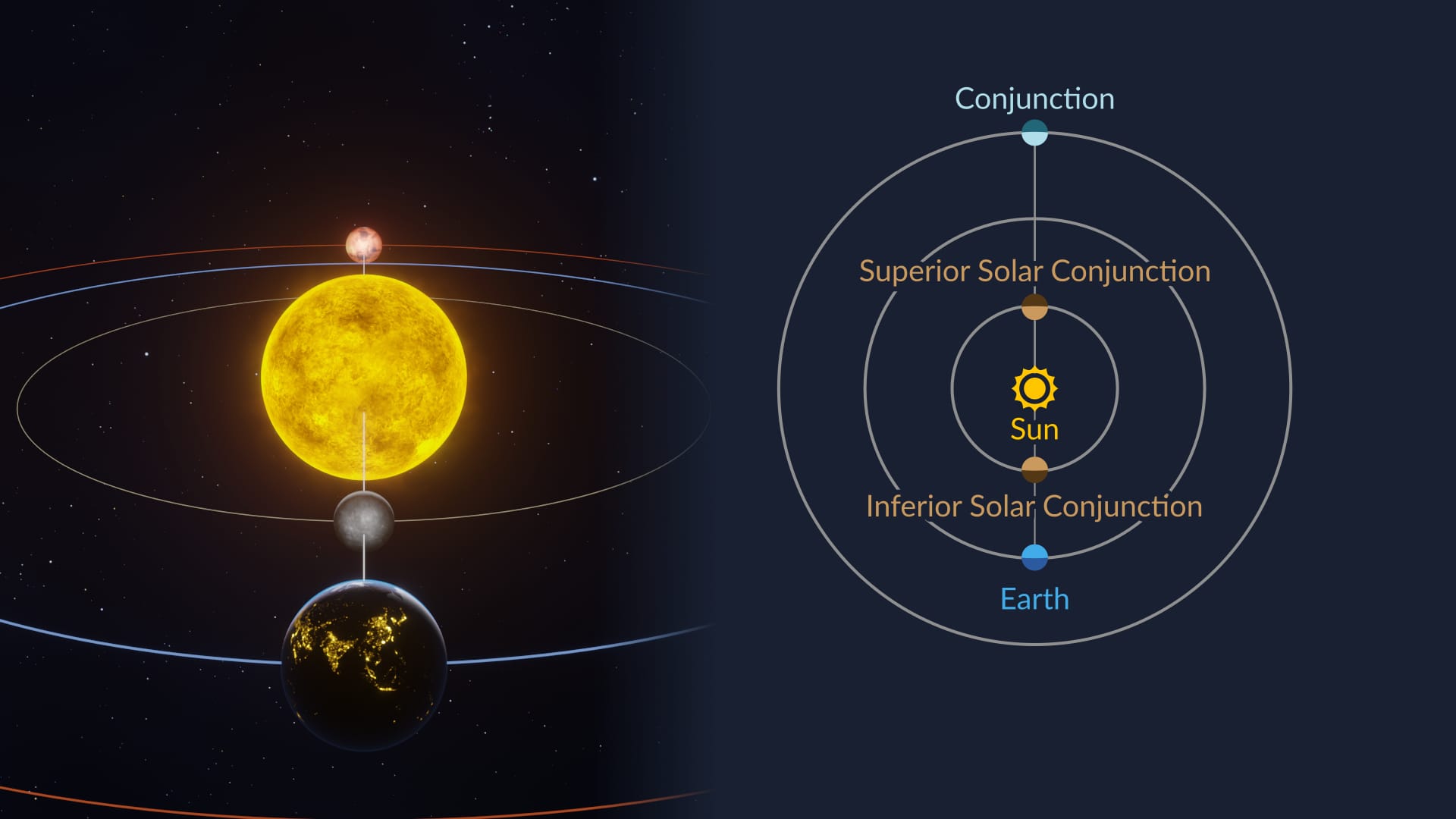
Solar conjunction is an event in which an object aligns with the Sun from Earth’s perspective. As a result, the object has an elongation close to 0 degrees, meaning it is at the same ecliptic longitude as the Sun, appearing very close to it in the sky. This alignment results in the object being obscured by sunlight, making it almost impossible to observe directly¹. Both superior and inferior planets can reach solar conjunction.
The terms inferior solar conjunction and superior solar conjunction are used in particular for Mercury and Venus. At inferior solar conjunction, the planet is between Earth and the Sun. At superior solar conjunction, the planet is passing behind the Sun as seen from Earth.
¹In rare cases, an inner planet can still be observed at inferior conjunction during a transit, when it crosses the Sun’s disk as a tiny black dot. The next transit of Mercury is on November 13, 2032, and the next transit of Venus is on December 11, 2117. Remember to never point your optics at the Sun without special solar filters! Doing so can cause permanent eye damage.
Quadrature
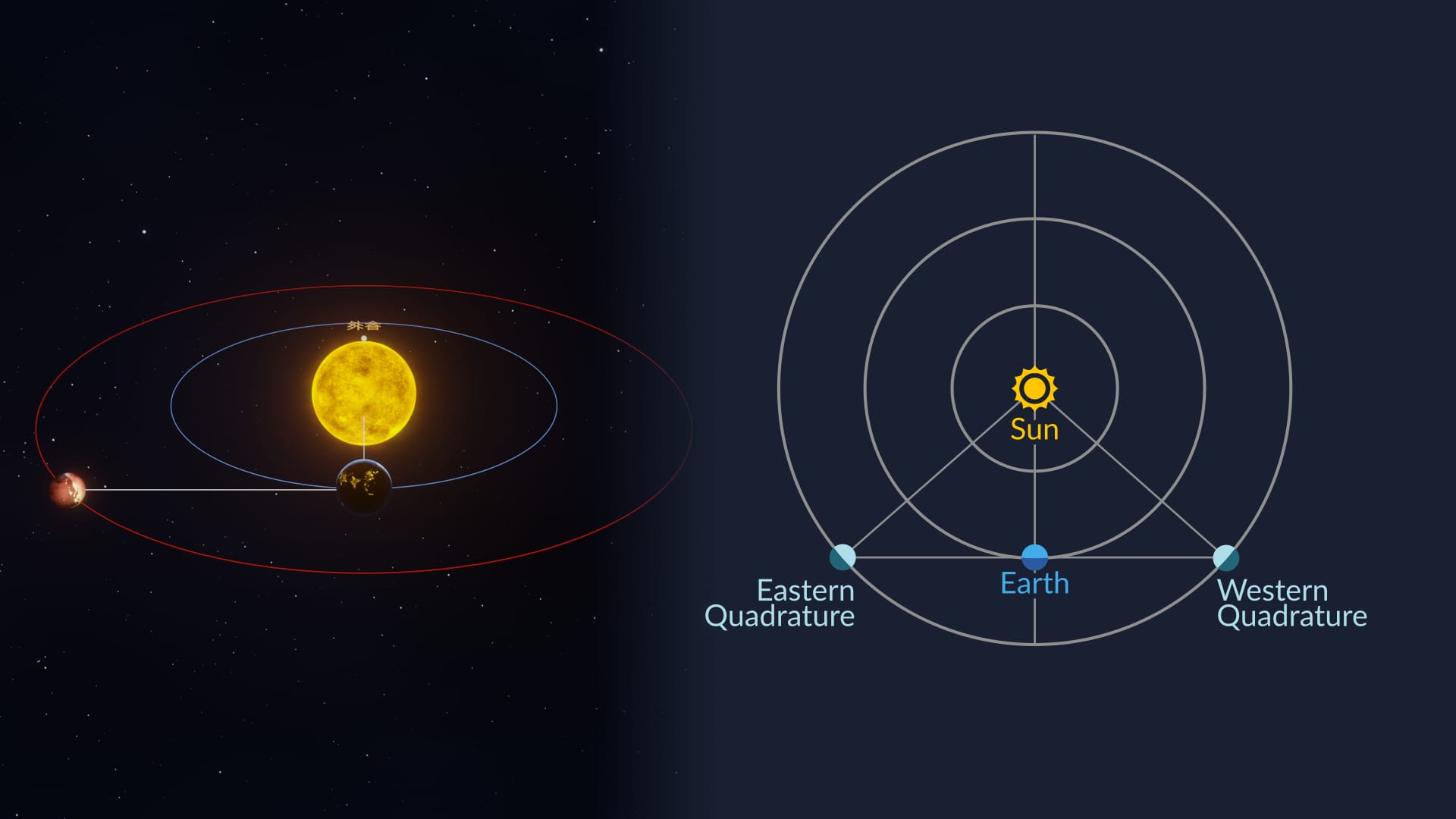
Quadrature is a position where the Sun, Earth, and a celestial object form a right angle. As a result, the Sun and a celestial object appear 90° apart as seen from Earth. At eastern quadrature, a planet is generally highest in the evening; at western quadrature, it is generally highest in the morning. A good example of quadrature is the First Quarter Moon, as this phase occurs when the Moon is at a 90-degree angle from the Sun. The Moon, outer planets, and many other solar system bodies can reach quadrature. Mercury and Venus cannot, because they orbit closer to the Sun than Earth does; they are physically too close to the Sun to ever appear at a 90-degree angle from our viewpoint.
Opposition
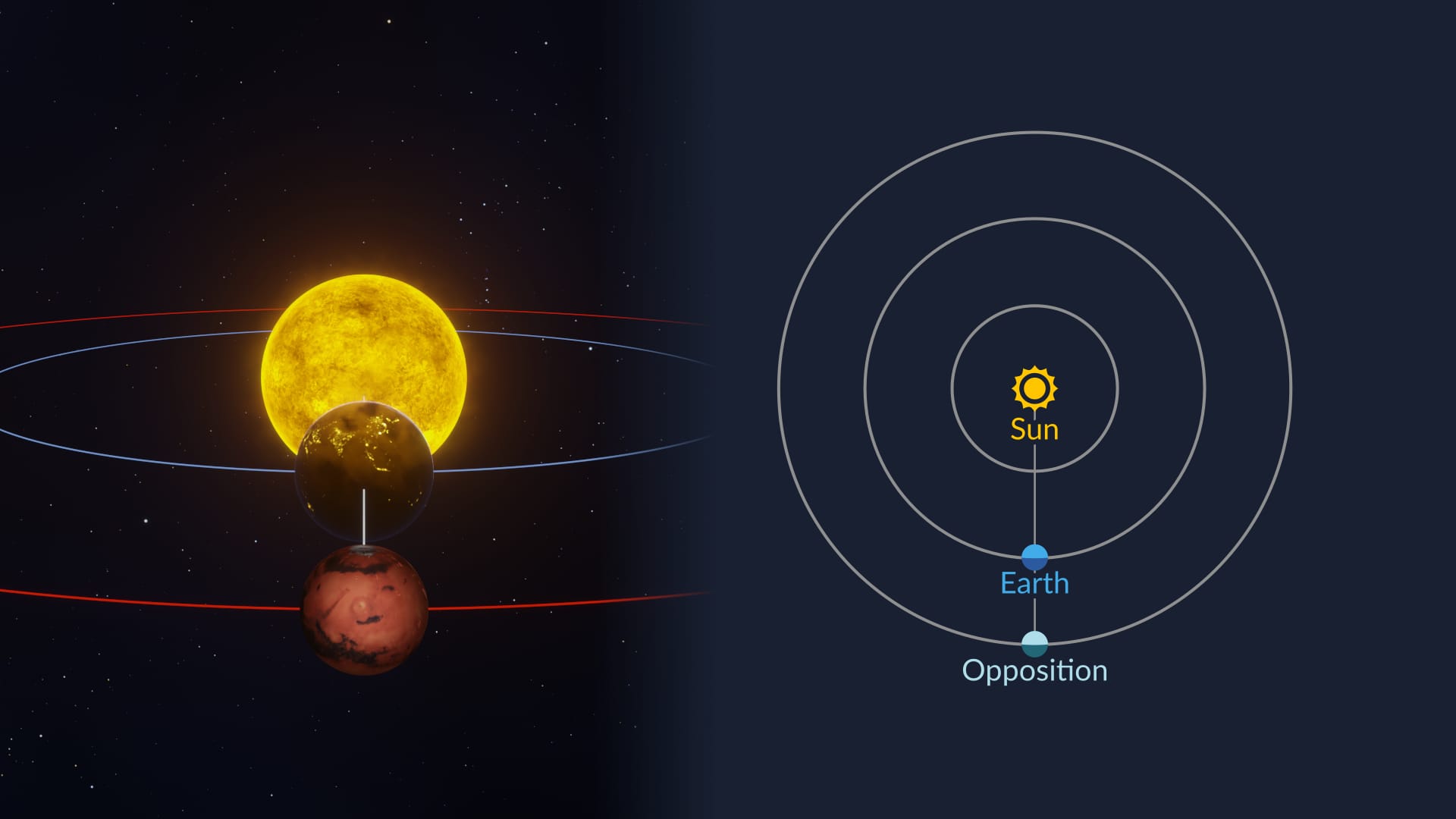
Opposition is a celestial alignment where an object lies opposite the Sun in ecliptic longitude and appears in roughly the opposite direction in the sky. This is also the greatest elongation for the superior planets. During opposition, the object and the Sun lie on opposite sides of Earth, so the object is fully illuminated by sunlight and visible throughout the night. Opposition is considered to be the best time for observing a superior planet. In the dedicated article, we have a list of celestial bodies — planets, dwarf planets, and asteroids — that will reach opposition soon.
Greatest Elongation of Mercury and Venus: Upcoming Events
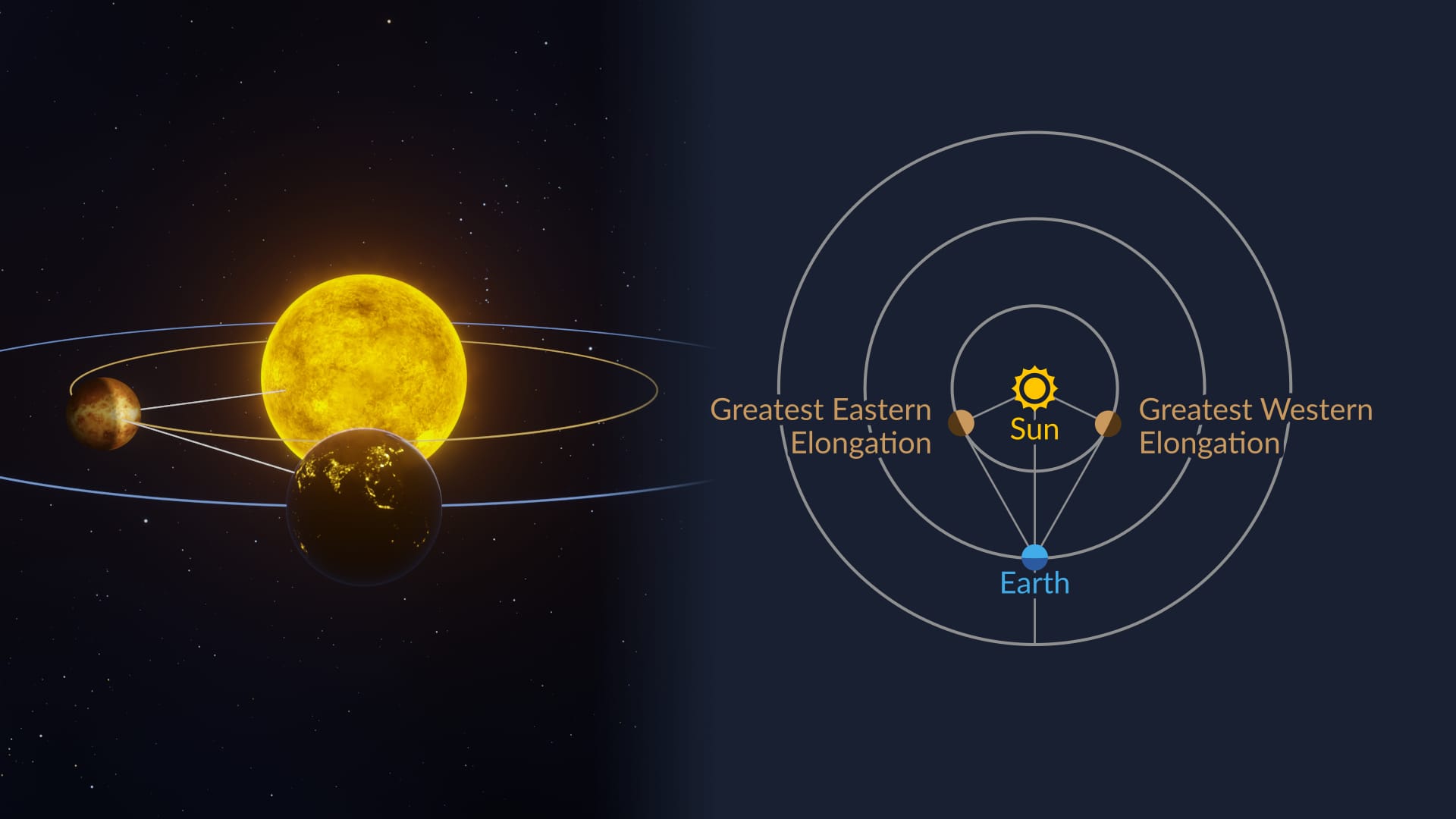
The inferior planets, Venus and Mercury, cannot reach quadrature and opposition because their orbits lie inside Earth’s orbit around the Sun. The greatest elongation possible for them is about 28 degrees for Mercury and 48 degrees for Venus. At greatest elongation, they are farthest from the Sun in the sky, so skywatchers get a great opportunity to spot the planets. At greatest eastern elongation, Mercury and Venus are visible as evening objects. At greatest western elongation, they are visible as morning objects. Here’s a list of the upcoming greatest elongations for Venus and Mercury.
November 20, 2026: Mercury at greatest western elongation
On November 20, at 23:29 GMT (18:29 EST), Mercury (mag −0.5) will reach its greatest western elongation, appearing 19°37′ from the Sun. The planet will be in the constellation Libra, visible in the morning sky.
This apparition favors observers at northern mid-latitudes. On the mornings around November 20–21, start looking low in the east to southeast about 30–60 minutes before sunrise. Choose a place with a clear horizon: even a bright planet can disappear behind trees, buildings, or a layer of haze. At southern mid-latitudes, Mercury will be much lower during twilight, so the observing window there will be shorter.
Brilliant Venus (mag −4.8) will serve as a useful reference point. It will shine higher in the morning sky, roughly 15° from Mercury. Look closer to the horizon for the fainter planet. While you’re there, try to spot Spica, the brightest star in Virgo, about 2° from Venus. Venus and Spica will make a striking pair before the sky brightens.
Mercury and Venus are also part of the November 2026 four-planet parade, along with Mars and Jupiter. The alignment is visible before sunrise from November 13–22, with November 20–22 offering especially good conditions for spotting Mercury.
A telescope adds another reason to get up early: Mercury and Venus will show very different phases. Mercury will appear as a tiny disk with slightly more than half its face illuminated, while Venus will show a much larger, slender crescent. Venus’s phase will be easier to distinguish.
January 3, 2027: Venus at greatest western elongation
On January 3, at 17:58 GMT (12:58 EST), Venus (mag −4.5) will reach its greatest western elongation, appearing 46°57′ from the Sun. It will shine in the constellation Libra as a brilliant “Morning Star.”
Look southeast to south-southeast from northern mid-latitudes, or east from southern mid-latitudes, about 60–90 minutes before sunrise. Venus will be easy to recognize by its brightness, even from a light-polluted city. At mid-latitudes in both hemispheres, it will already be well above the horizon during this interval; tropical observers will see it higher. By the way, you can enjoy the planet in the mornings around that date, so you don’t need to wait for January 3.
On the morning of January 3, a waning crescent Moon will share this part of the sky. The two will appear roughly a fist’s width apart at arm’s length, with the exact arrangement depending on your location and observing time. They will make a lovely sight with the naked eye or in a wide photograph. Before twilight gets too bright, look for earthshine: a faint glow on the Moon’s unlit portion, caused by sunlight reflected from Earth.
Through a small telescope, Venus will look approximately half illuminated, like a miniature quarter Moon. Return over the following weeks to watch its illuminated portion grow while its apparent disk becomes smaller as the planet moves farther from Earth.
February 3, 2027: Mercury at greatest eastern elongation
On February 3, at 06:13 GMT (01:13 EST), Mercury (mag −0.5) will reach its greatest eastern elongation, appearing 18°18′ from the Sun. It will be an evening object in the constellation Aquarius.
This is a good opportunity for observers at northern mid-latitudes, despite the relatively small elongation. The planets’ path meets the evening horizon at a steep angle, helping Mercury stay above the horizon as the sky darkens. Start looking 30–45 minutes after sunset, toward the southwest to west-southwest at northern mid-latitudes. At southern mid-latitudes, Mercury will stay much lower in the bright twilight and will be harder to spot.
Start watching a few evenings before February 3. Mercury will be brighter then and will fade as it heads toward its next solar conjunction. If you wait too long after greatest elongation, both its fading brightness and its shrinking separation from the Sun will make the search harder.
If you have a telescope and steady viewing conditions, look for Mercury’s tiny, roughly half-illuminated disk. Its apparent diameter will be only about 7 arcseconds, so spotting the planet with the naked eye is a much easier goal than resolving its phase.
March 17, 2027: Mercury at greatest western elongation
On March 17, at 06:49 GMT (02:49 EDT), Mercury (mag 0.3) will reach its greatest western elongation, appearing 27°37′ from the Sun. This will be Mercury’s widest elongation of 2027, close to its maximum possible separation. The planet will be in the constellation Aquarius.
The best views will be from southern mid-latitudes and tropical regions. From these locations, look east to east-southeast about 45–60 minutes before sunrise. Mercury will be high enough for a useful view before dawn becomes too bright. At northern mid-latitudes, the planets’ path makes a shallow angle with the morning horizon, so Mercury will remain much lower. Observers in northern Europe may find it extremely difficult to see, despite its large angular distance from the Sun.
Use Venus to help locate Mercury. The much brighter planet will shine roughly 10° away, about the width of a fist held at arm’s length. From favorable southern locations, Venus will be higher in the sky, with Mercury closer to the eastern horizon. Their brightness difference should make them easy to tell apart once you find both.
Try several mornings around and after March 17. Mercury will gradually brighten as more of its sunlit side turns toward Earth, so a clear morning a few days later can still be rewarding.
May 28, 2027: Mercury at greatest eastern elongation
On May 28, at 09:56 GMT (05:56 EDT), Mercury (mag 0.5) will reach its greatest eastern elongation, appearing 22°55′ from the Sun. The planet will be in the constellation Taurus, visible in the evening sky.
Look toward the west-northwest to northwest, starting about 30–45 minutes after sunset. Tropical locations offer a good balance between Mercury’s altitude and a sky that darkens quickly. Many observers at northern mid-latitudes will also have a useful view, but farther north, long late-spring twilight will make the planet harder to pick out. At southern mid-latitudes, Mercury will be lower, so begin searching early while it is still clear of the horizon.
Don’t wait for complete darkness. By then, Mercury may be too low or may already have set. Watch the same patch of sky as twilight fades: the planet can become easier to see for a while, before its decreasing altitude starts to work against you. Try clear evenings before May 28 as well, when Mercury will be somewhat brighter.
With a telescope and steady air, look for Mercury’s small crescent, with only about 40% of its disk illuminated. Greatest elongation doesn’t always coincide with a half-lit disk. Over the following evenings, the crescent will become thinner, and the planet will dim, even as its apparent size increases.
Elongation and Phases of the Planets
Just like the Moon, planets have phases. Although in space, half of a planet is always illuminated by the Sun, the portion of the illuminated side that we can see from Earth changes depending on the planet’s elongation. These phases can be observed through a telescope, and Venus, the brightest planet, can even show its phases when viewed through binoculars.
Phases of the inferior planets
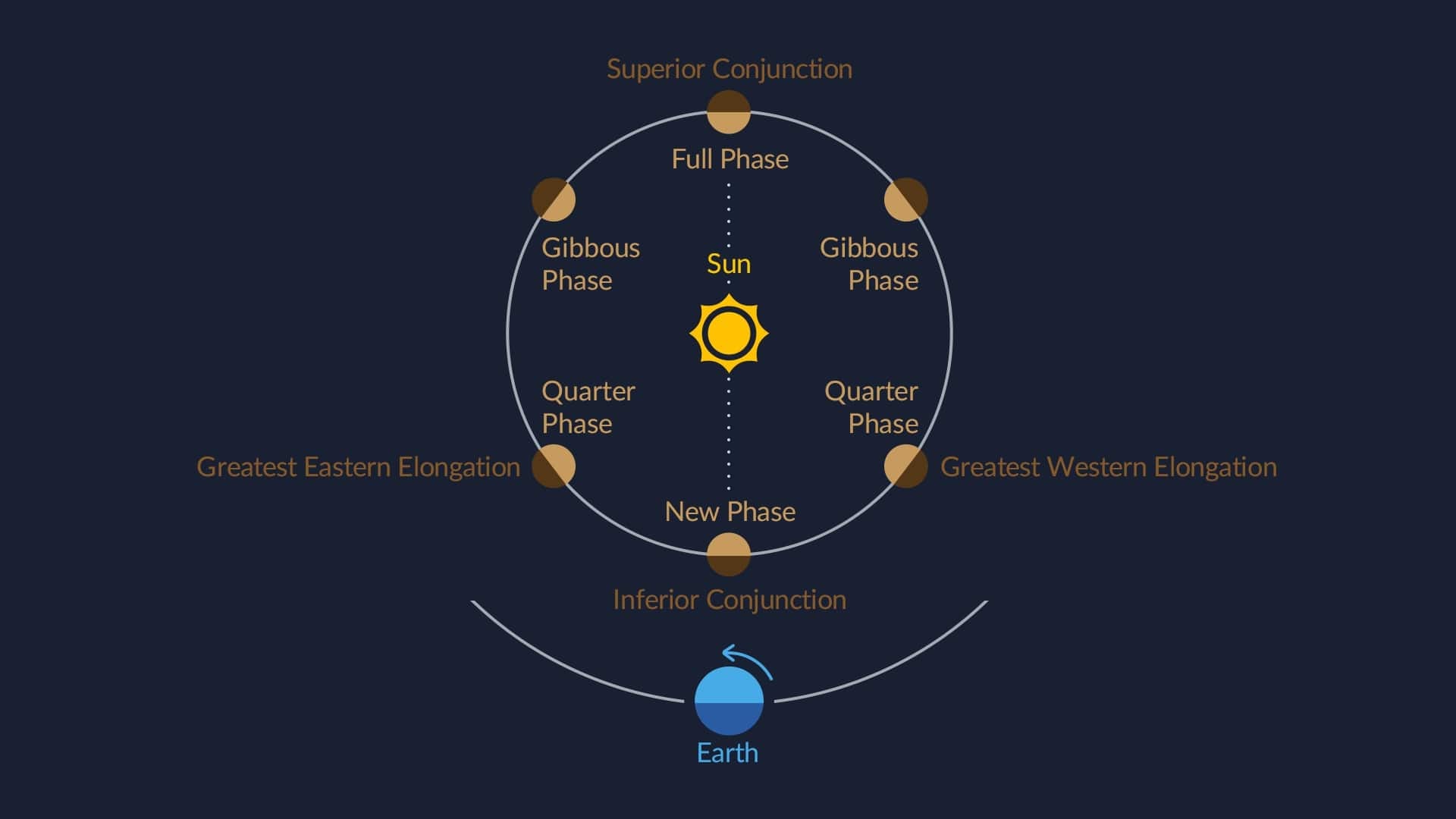
As shown in the image above, inferior planets go through a full cycle of phases: from a new phase at inferior conjunction to quarter phases near greatest elongations and a full phase at superior conjunction. However, observing the full and new phases is extremely challenging because during these phases, the planets are lost in the Sun’s glare. Thus, the visible phases range from crescent to gibbous.
Phases of the superior planets
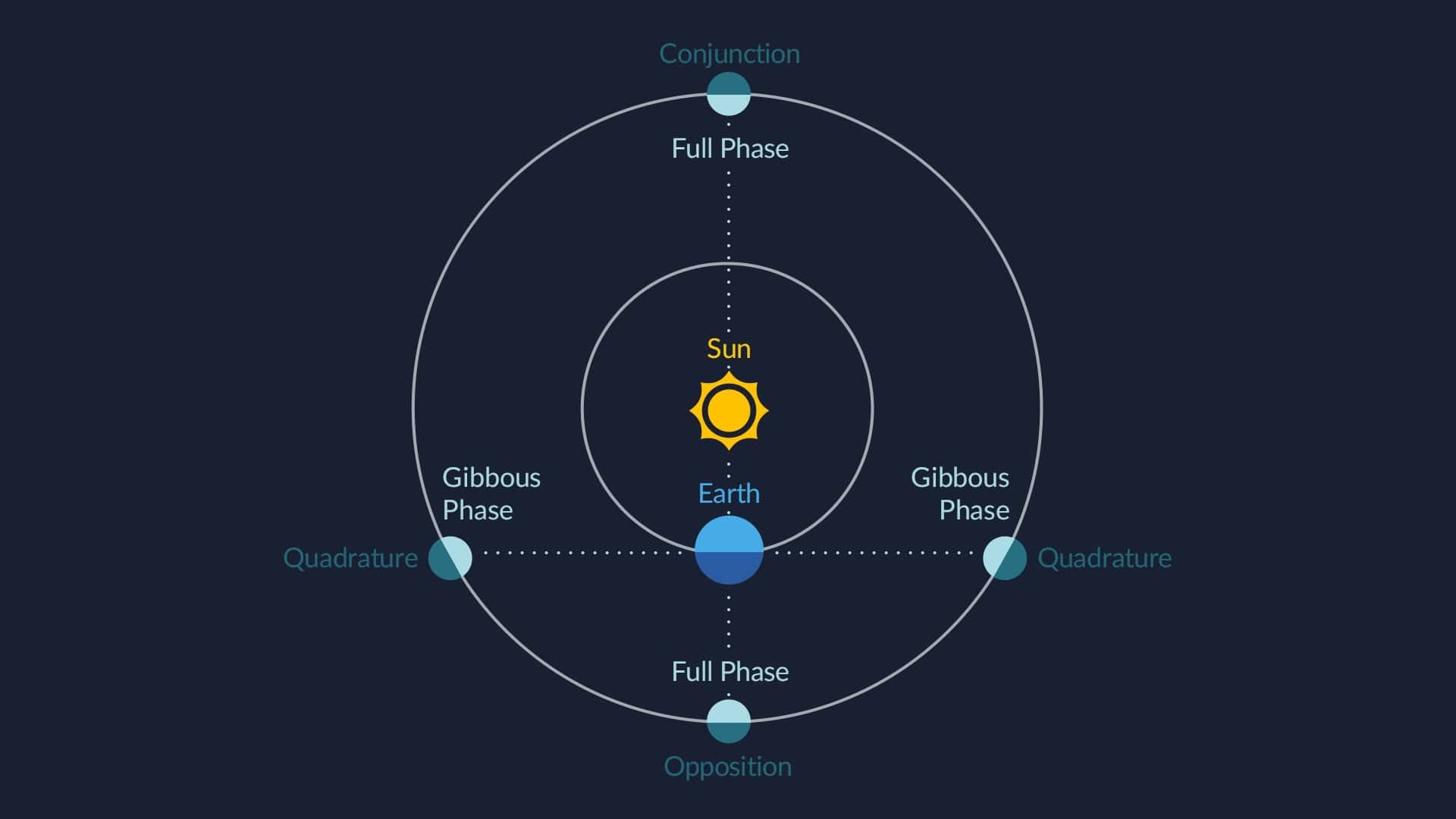
Superior planets do not display a full range of phases, but only subtle transitions between gibbous and full phases. They appear fully illuminated during oppositions, which is the best time to observe them.
FAQ: Elongation in Astronomy
The answers below explain how elongation affects planetary visibility and how it differs from greatest brilliancy.
How often is Mercury in greatest elongation?
Mercury reaches greatest elongation six or seven times a year, alternating between greatest eastern elongation in the evening sky and greatest western elongation in the morning sky. Each type repeats about every 116 days on average, giving observers a greatest elongation roughly every two months.
What is the maximum elongation of Mercury? Is it 28 degrees?
The maximum value of Mercury’s greatest elongation is about 28°. For Venus, the maximum value can reach 48°.
How often does Venus reach its greatest elongation?
Venus reaches greatest elongation twice during each cycle of about 584 days (19 months): once at greatest eastern elongation in the evening sky and once at greatest western elongation in the morning sky. The events are not evenly spaced. An eastern elongation is followed by a western one roughly five months later, then about 14–15 months pass before the next eastern elongation.
Greatest eastern vs. greatest western elongation — what’s the difference?
Eastern elongation means the planet is best seen after sunset; western elongation means best before sunrise.
When is Mercury visible in the night sky?
Mercury is usually easiest to find during evening or morning twilight and most of the time stays near the horizon; the planet rarely rises high above the horizon in a fully dark sky. Your best chances to see Mercury are around the greatest elongation.
Why are some Mercury elongations “better” than others?
Besides elongation, visibility of Mercury depends on the tilt of the ecliptic and your latitude — some elongations place Mercury higher above the horizon than others.
Is the greatest elongation the same as the greatest brilliancy?
No, greatest elongation is not the same as greatest brilliancy:
- Greatest elongation is the moment when a planet is farthest from the Sun in the sky, meaning it has the maximum angular separation from the Sun as seen from Earth.
- Greatest brilliancy occurs when the planet reaches its maximum apparent brightness.
For example, Venus typically reaches its greatest brilliancy between inferior conjunction and greatest elongation — after greatest eastern elongation in an evening apparition, and before greatest western elongation in a morning apparition.
Elongation of Planets: To Sum Up
Elongation is the angular distance between a planet (or other solar system body) and the Sun in the sky. It is measured in degrees. Planetary phases and visibility depend on elongation, which is especially noticeable for inferior planets — Venus and Mercury. Want to find out when Mercury or Venus is visible from your location (tonight or this week)? Use the free Sky Tonight app. To learn the best times for viewing the superior planets, check out our article on opposition in astronomy.