What Planet Is Retrograde Right Now (November 2026)? Retrograde Motion Explained
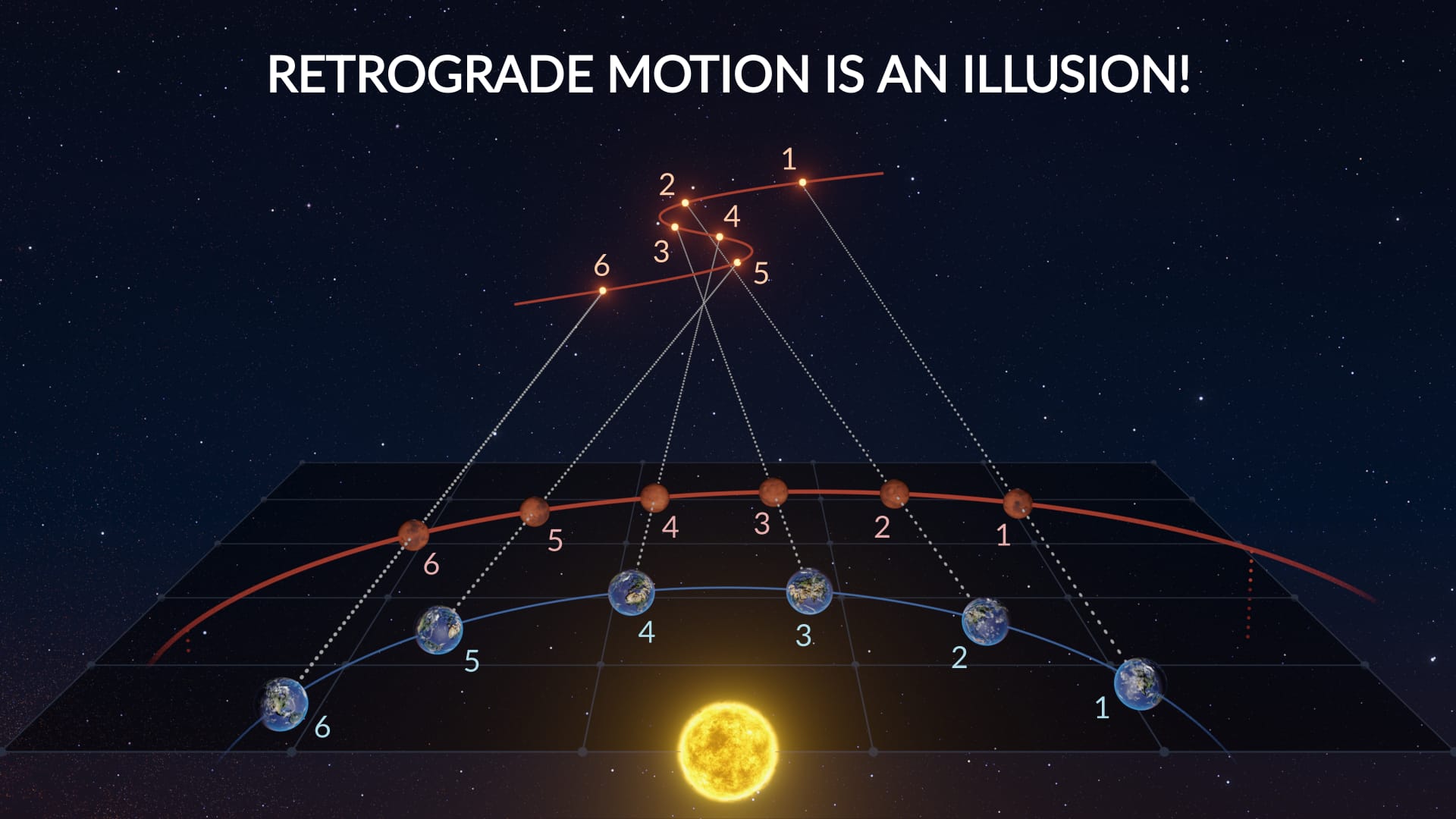
Why do planets sometimes seem to move “backward”? Is such a motion even real? Should you fear Mercury retrograde? Here, we’ll explain the celestial mechanics behind the retrograde motion and show you how to see it with Sky Tonight.
Contents
- Is Mercury Retrograde Right Now?
- What Is in Retrograde Right Now?
- What Is Retrograde Motion in Astronomy?
- What Causes the Apparent Retrograde Motion of the Planets?
- The Meaning of Retrograde Motion: Astrology, Myths, and Reality
- Planets Retrograde in 2026 — Current and Upcoming Retrograde Periods
- How to See the Retrograde Motion: Retrograde Loops
- How Do Planets in Retrograde Affect Us?
- Retrograde Motion: Frequently Asked Questions
- Retrograde Motion of Planets: To Sum Up
Is Mercury Retrograde Right Now?
No, Mercury is not retrograde right now. Its latest retrograde period ran from October 24 to November 13, 2026. The next one begins on February 9, 2027 and ends on March 2, 2027.
Mercury is now a morning-sky target. On November 20, 2026, it reaches its greatest western elongation, appearing 19°37′ from the Sun. Around November 20–21, observers at mid-northern latitudes can try spotting it low above the east-southeastern horizon roughly 30–60 minutes before sunrise. Use Venus as a reference point — it will be shining about 15° apart, much brighter and better visible. Mercury also joins Venus, Mars, and Jupiter in the November 2026 morning planet parade.
Learn more about Mercury and its upcoming events in our dedicated article.
What Is in Retrograde Right Now?
Right now, three planets are retrograde: Saturn, Uranus, and Neptune.
- Saturn remains retrograde until December 11, 2026.
- Neptune remains retrograde until December 13, 2026.
- Uranus remains retrograde until February 8, 2027.
Mercury returned to direct motion on November 13, while Venus did so on November 11.
What Is Retrograde Motion in Astronomy?
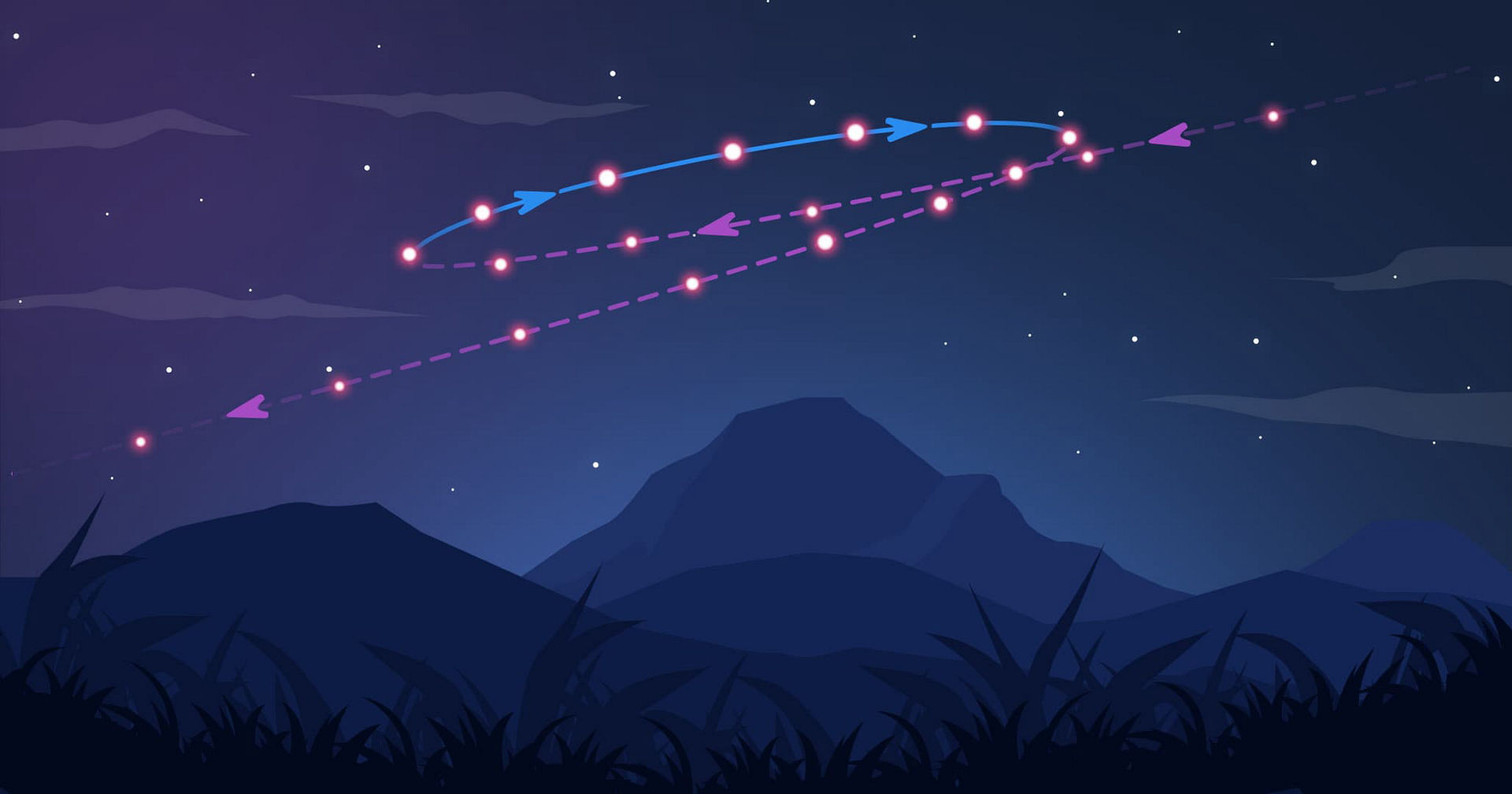
Retrograde motion is when a planet appears to reverse its usual direction in the sky relative to the background stars and begins to move “backward” for a while (from the Latin retrogradus, meaning “going backward”).
Day to day and week to week, as the Earth revolves around the Sun, the planets usually drift from west to east against the background of stars. Astronomers call it direct or prograde motion. This motion shouldn’t be confused with the daily motion of the planets and the Sun in the sky, which goes from east to west and is caused by the Earth’s rotation on its axis.
At specific periods of time, a planet can start moving “backward” — from east to west. This westward movement is called apparent retrograde motion.
What Causes the Apparent Retrograde Motion of the Planets?
The apparent retrograde motion is caused by the relative motion of Earth and other planets as they travel around the Sun at different speeds and distances.
Let’s use Mars as an example. Mars is a superior planet, meaning its orbit is farther from the Sun than Earth’s. Because of this, Mars moves more slowly in its orbit than Earth. When we pass Mars, it seems to be moving “backward” because we’re moving faster than it is. The same thing happens when you pass by a slower-moving car on the highway — for a moment, it appears to move in the opposite direction.
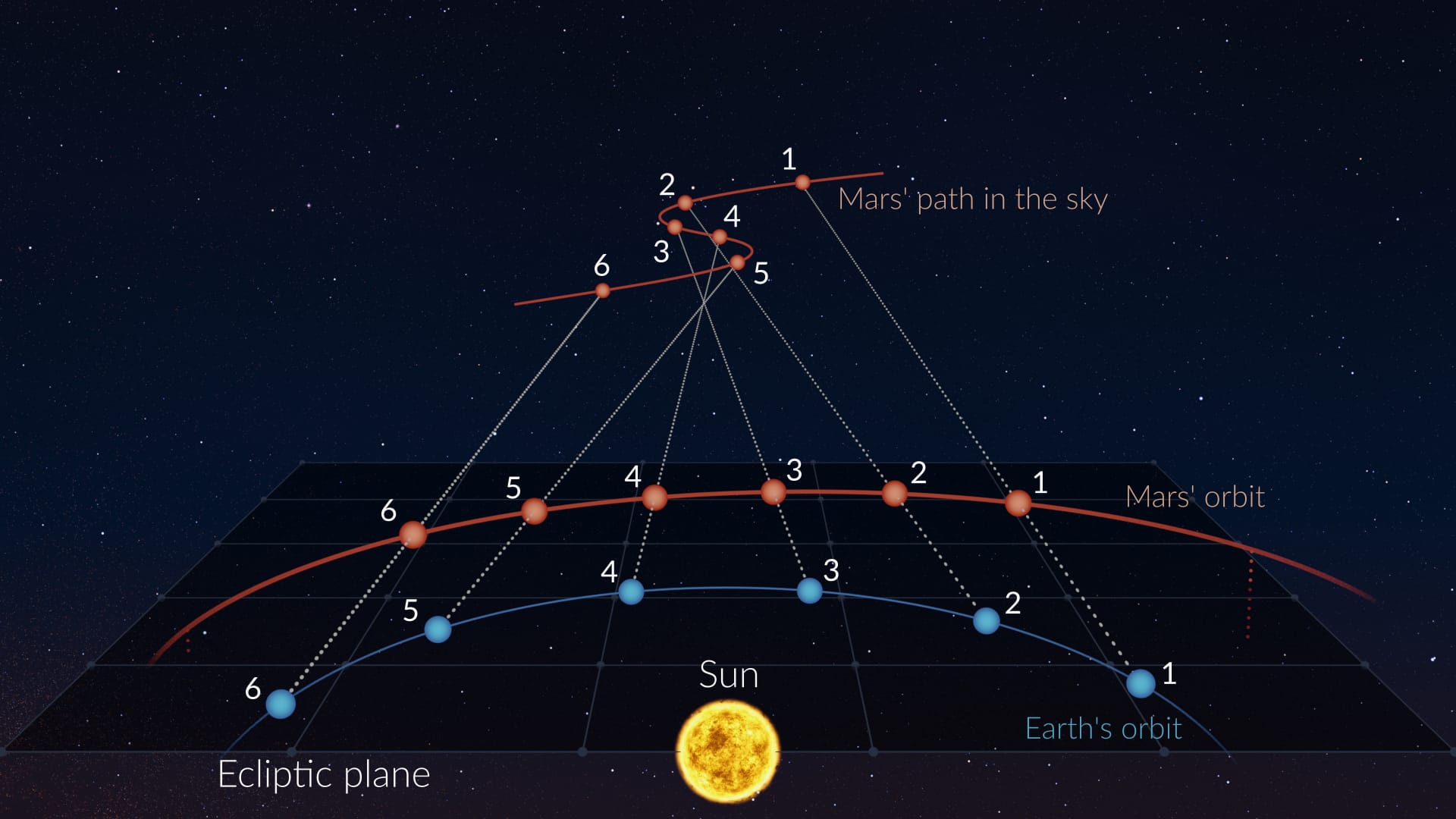
This mechanism works for all the superior planets. Each retrograde period of a superior planet includes an opposition, when Earth passes approximately between the planet and the Sun. Around opposition, the planet appears opposite the Sun in our sky, shines near its brightest, and is generally visible for much of the night.
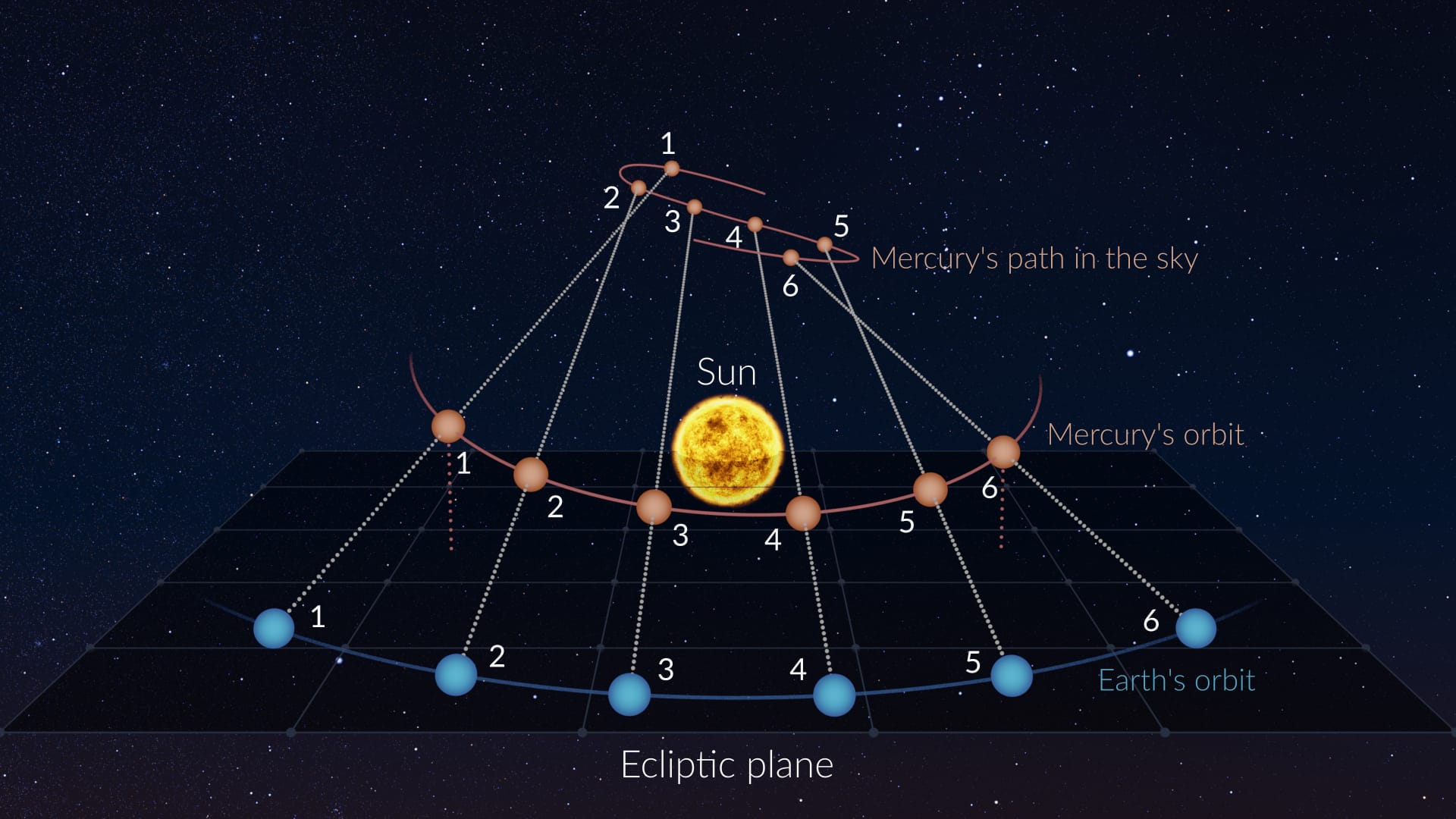
The inferior planets, Mercury and Venus, orbit closer to the Sun than Earth and move faster along their orbits. As their positions relative to Earth change, they periodically appear to move “backward” against the stars. Retrograde periods occur when the inferior planets appear near the Sun in our sky, making their motion hard to observe. Mercury is particularly easily lost in the Sun’s glare, while brighter Venus can be seen for longer around sunrise or sunset.
Each retrograde period of an inferior planet includes an inferior conjunction, when the planet passes approximately between Earth and the Sun. Before conjunction, the planet is generally an evening object. Around conjunction itself, it is usually lost in the Sun’s glare. Afterward, it becomes a morning object, growing easier to spot as its apparent distance from the Sun increases.
Ancient astronomers were rather puzzled by the phenomenon of retrograde motion, especially those who believed that the Earth was at the center of the Universe. In the 16th century, Nicolaus Copernicus used his heliocentric model to explain retrograde motion as an apparent effect caused by the Earth and other planets orbiting the Sun. Initially, his idea faced resistance, but it was later accepted and became the foundation of modern astronomy.
The Meaning of Retrograde Motion: Astrology, Myths, and Reality
From an astronomical perspective, retrograde motion does not foreshadow anything — it is simply a perspective effect. However, throughout history, people have attributed special meaning to such movements. In ancient times, “wandering” celestial bodies were associated with gods and supernatural forces. For example, the Babylonians believed that planetary movements could influence the fates of kings and states. This is how astrological and mythological interpretations of celestial phenomena arose. However, Mesopotamian astrology was practiced alongside other forms of divination. Examining an animal’s liver, for example, could be used to confirm astrological observations. Isn't it strange that we focused on retrograde planets but skipped the animal part?..
In astrology, each planet has its own “area of responsibility,” so retrograde periods are usually interpreted as important moments for the corresponding themes. Retrograde Mercury is particularly well known in popular culture: it is blamed for misunderstandings, communication breakdowns, schedule confusion, and problems with documents or agreements. For other planets, popular astrological tradition usually assigns the following meanings:
- Venus retrograde — “reassessment” of love, relationships, attachments, pleasures, and money.
- Mars retrograde — action, energy, conflict, ambition.
- Jupiter retrograde — internal reassessment of beliefs, growth, luck, learning, worldview.
- Saturn retrograde — return to responsibility, limitations, debts, discipline, “life lessons.”
- Uranus retrograde — internal changes, rebellion, liberation, surprises.
- Neptune retrograde — illusions, intuition, dreams, self-deception.
There are also meanings associated with Pluto retrograde — hidden transformation, control, crises, power, and internal shifts.
The zodiac sign a planet occupies during retrograde motion is also thought to shape the themes people may revisit. For example, Mercury retrograde in Virgo is often associated with reviewing routines and details, while Venus retrograde in Libra is linked to reassessing relationships and balance. These interpretations use astrological signs, which differ from the astronomical constellations — learn more in our guide to zodiac signs and constellations.
This is a generalization based on the modern popular astrological scheme; different schools formulate nuances differently. However, it is important to emphasize that there is no scientific basis for such interpretations. We have no known physical mechanism linking the positions of the planets to personality or everyday events, and numerous tests have shown that astrology lacks predictive power. So there is no need to fear retrogrades: for astronomers, this is not a “cosmic warning,” but simply the beautiful geometry of the Solar System.
Planets Retrograde in 2026 — Current and Upcoming Retrograde Periods
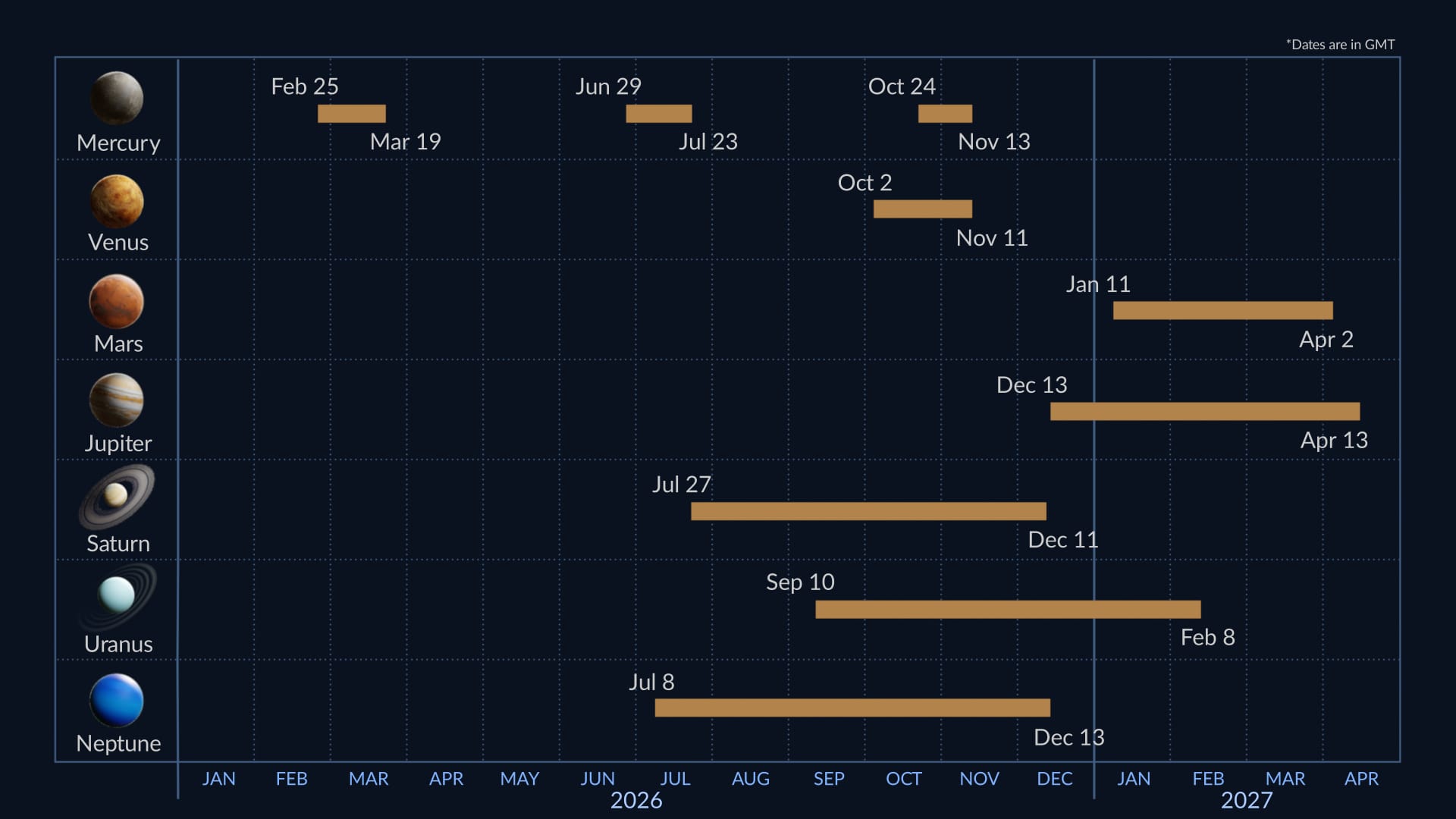
Below you’ll find the dates of ongoing and upcoming retrograde periods of planets for late 2026 and early 2027.
Why do retrograde dates differ between calendars?
Retrograde motion can be defined using either of two celestial coordinates:
- Right ascension measures the east–west position of an object along the celestial equator.
- Ecliptic longitude measures the east–west position of an object along the ecliptic, the Sun’s apparent yearly path. It is also used for counting astrological zodiac positions.
A retrograde period begins when the chosen coordinate starts decreasing and ends when it starts increasing again. Because the two coordinate grids are tilted relative to one another, these turning points can occur at different times. Both methods describe the same apparent planetary path.
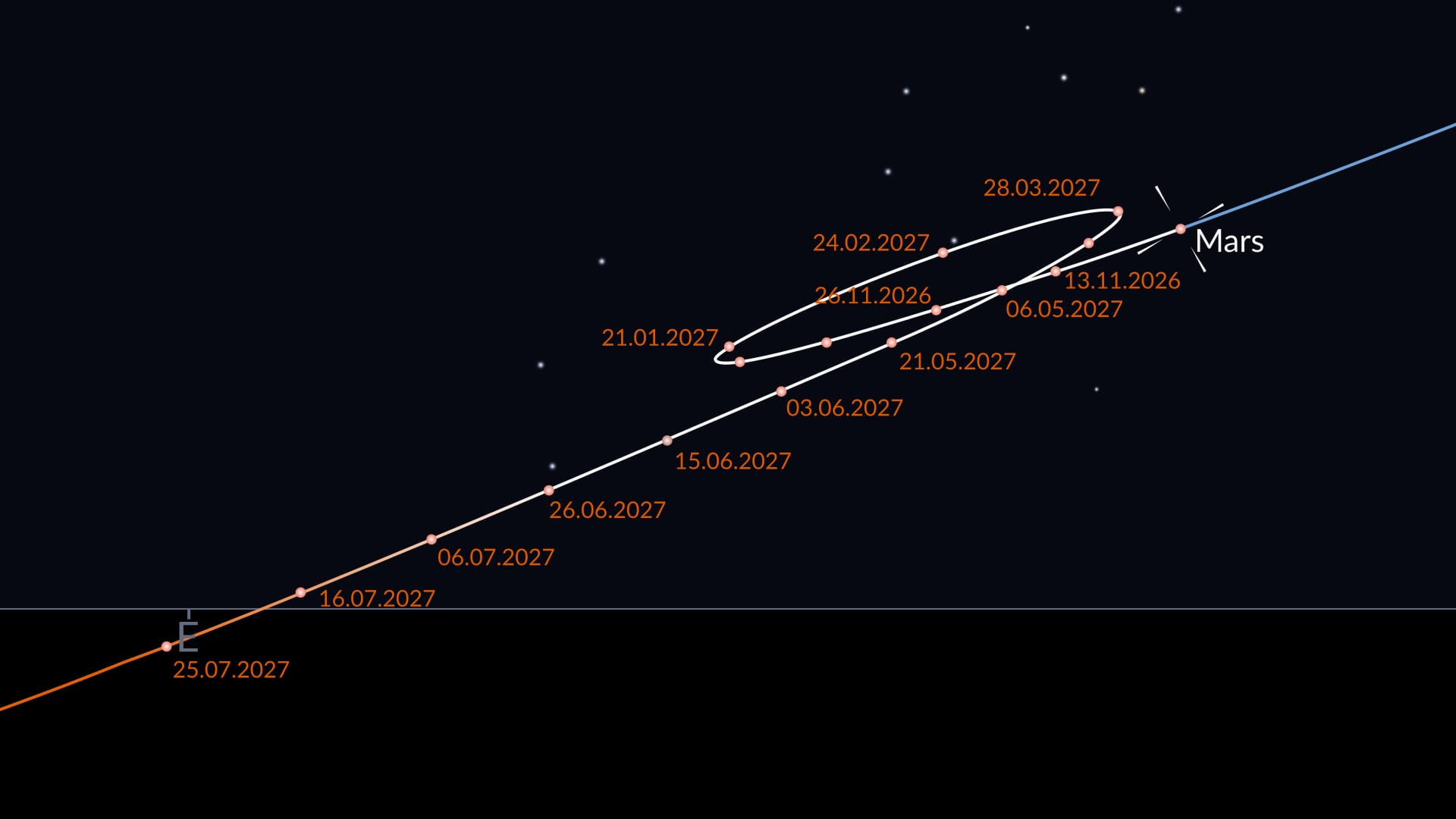
For example, in 2027, Mars is retrograde from January 11 to April 2 in right ascension, but from January 10 to April 1 in ecliptic longitude. Both ranges use UTC; compare the right-ascension station dates with the Mars apparition calendar.
The calendar and “right now” summaries in this article use apparent geocentric right ascension (the view from Earth’s center) and UTC. A different time zone can also shift an event’s calendar date.
Mercury retrograde in 2026
Mercury goes retrograde three to four times a year because its position relative to Earth and the Sun repeats roughly every 116 days — this is known as Mercury’s synodic cycle.
Mercury’s final retrograde period of 2026 ran from October 24 to November 13. Its next retrograde period runs from February 9 to March 2, 2027.
Other retrograde planets
Several other planets go retrograde this year. Unlike Mercury, each of them turns retrograde only once in 2026. As of November 2026, the following planets are still retrograde or will begin their retrograde periods before the end of the year:
- Neptune: July 8–December 13, 2026
- Saturn: July 27–December 11, 2026
- Uranus: September 10, 2026–February 8, 2027
- Jupiter: December 13, 2026–April 13, 2027
Mars is the only planet that won’t go retrograde in 2026. Its next retrograde period begins on January 11, 2027, and ends on April 2, 2027.
How to See the Retrograde Motion: Retrograde Loops
To observe retrograde motion, record a planet’s position relative to the background stars every few days. If you take photos, keep the same orientation and image scale so the positions are easy to compare. Over time, the changing positions can reveal a loop or a bend in the planet’s apparent path.
Track the retrograde motion in 3 steps with Sky Tonight
You can track a retrograde planet manually (but it’ll take at least several weeks), or do it in 3 steps with the stargazing app Sky Tonight. It has a special feature that lets you instantly plot a curve showing the annual motion of any planet. Here’s how to see the retrograde motion of a planet via Sky Tonight:
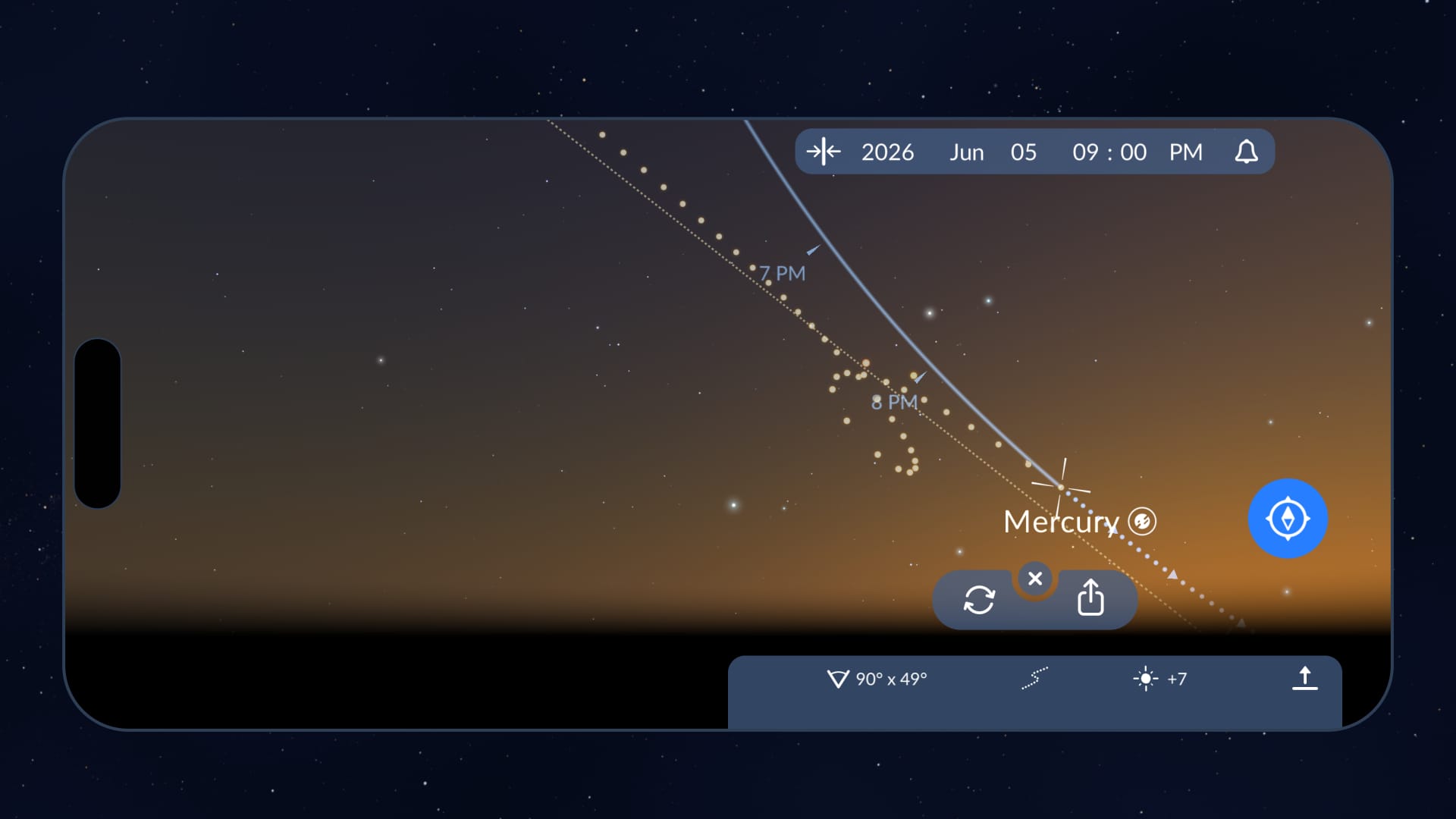
- Tap the magnifier icon at the bottom of the screen and type the name of a planet (e.g., Mercury) into the search field.
- Tap the blue target icon opposite the name of the planet and see its current position on the sky map.
- Tap the small white camera icon at the bottom part of the screen to enable the curve-building feature. You’ll see the planet’s apparent path across the sky over several months and will be able to clearly see how the planet “changes direction” at certain moments.
How Do Planets in Retrograde Affect Us?
Astrologers may warn you against signing contracts during Mercury retrograde or buying metal tools during Mars retrograde. It’s your choice to believe them or not.
However, you now know that retrograde motion is just an illusion that can’t possibly affect your everyday life – at least from the scientific point of view.
A celestial body that can really affect our lives is an asteroid heading to our home planet. Learn when the next asteroid will hit Earth and what we can do about it.
Retrograde Motion: Frequently Asked Questions
Does a stationary planet stop moving?
No, the planet continues to orbit the Sun as usual. From Earth, however, it appears to briefly stop moving eastward or westward against the background of the stars before changing its apparent direction. This is an optical illusion caused by the changing relative positions of Earth and the planet as they orbit the Sun.
Is Mercury retrograde a real thing?
Mercury’s retrograde motion is a real astronomical phenomenon, but it’s not Mercury literally reversing direction in space. In astronomy, “Mercury retrograde” means that the planet appears to move backward against the background stars because it “overtakes” the Earth in its orbit.
Does Mercury retrograde affect us?
Mercury retrograde doesn’t affect us in any physical or scientific way. Mercury doesn’t suddenly “send” extra energy to Earth or cause problems – it’s the same planet on the same orbit, and the retrograde motion is just a matter of perspective.
When is the next Mercury retrograde?
Mercury’s next retrograde period takes place from February 9 to March 2, 2027. Its previous period ended on November 13, 2026.
What planets are retrograde right now?
Right now, Saturn, Uranus, and Neptune are retrograde. Saturn will remain retrograde until December 11, Neptune until December 13, and Uranus until February 8, 2027.
What sign is in retrograde right now?
Zodiac signs don’t go retrograde — planets do. Right now, Saturn and Neptune are retrograde in Aries, while Uranus is retrograde in Gemini, according to the tropical zodiac used in Western astrology.
Retrograde Motion of Planets: To Sum Up
Retrograde motion is an apparent reversal of planetary motion. From Earth, it appears that the planets in the sky move “backward” at certain times. Right now, three planets are retrograde: Saturn, Uranus, and Neptune.
We hope this article helped you understand what retrograde motion really is. If you enjoyed it, please share it with your friends! And get Sky Tonight to easily track any planet (including Mercury) in the sky.
Still have questions? Watch our video showing retrograde motion of Mercury and see what happens to the planet in space versus how it looks in our sky.
For more interesting facts about retrograde motion, have a look at our dedicated infographic!