Spring Triangle: How to Find This Bright Spring Asterism
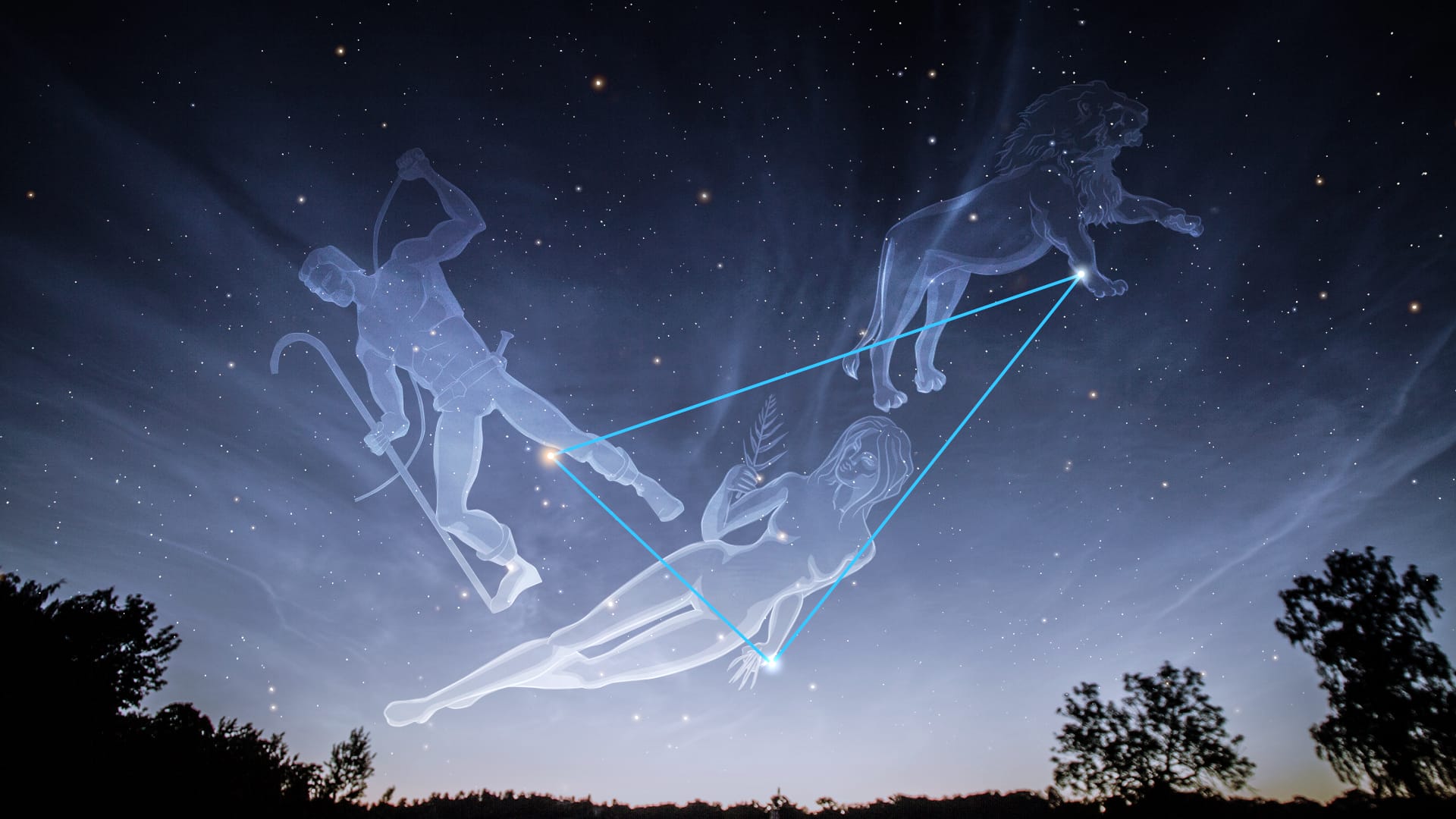
The Spring Triangle is a bright asterism made of three stars — Arcturus, Spica, and Regulus — that forms a large triangle in the spring night sky. It’s one of the easiest star patterns to recognize in spring, both for beginners and experienced stargazers. Try spotting it tonight and check whether you found the Spring Triangle correctly with the free Sky Tonight app. Read on to learn how to spot the Spring Triangle and explore some night sky wonders along the way.
Contents
- Spring Triangle: basic facts
- Observing the Spring Triangle
- Spring Triangle stars
- Deep-sky objects in the Spring Triangle
- Spring Triangle: F.A.Q
- Spring Triangle: to sum up
Spring Triangle: basic facts
- Right ascension: 10h 09m to 14h 17m
- Declination: +19°06' to –11°15'
- Area: 880 sq. deg.
- Apparent size: 60°
- Brightest star: Arcturus
- Best seen in: April
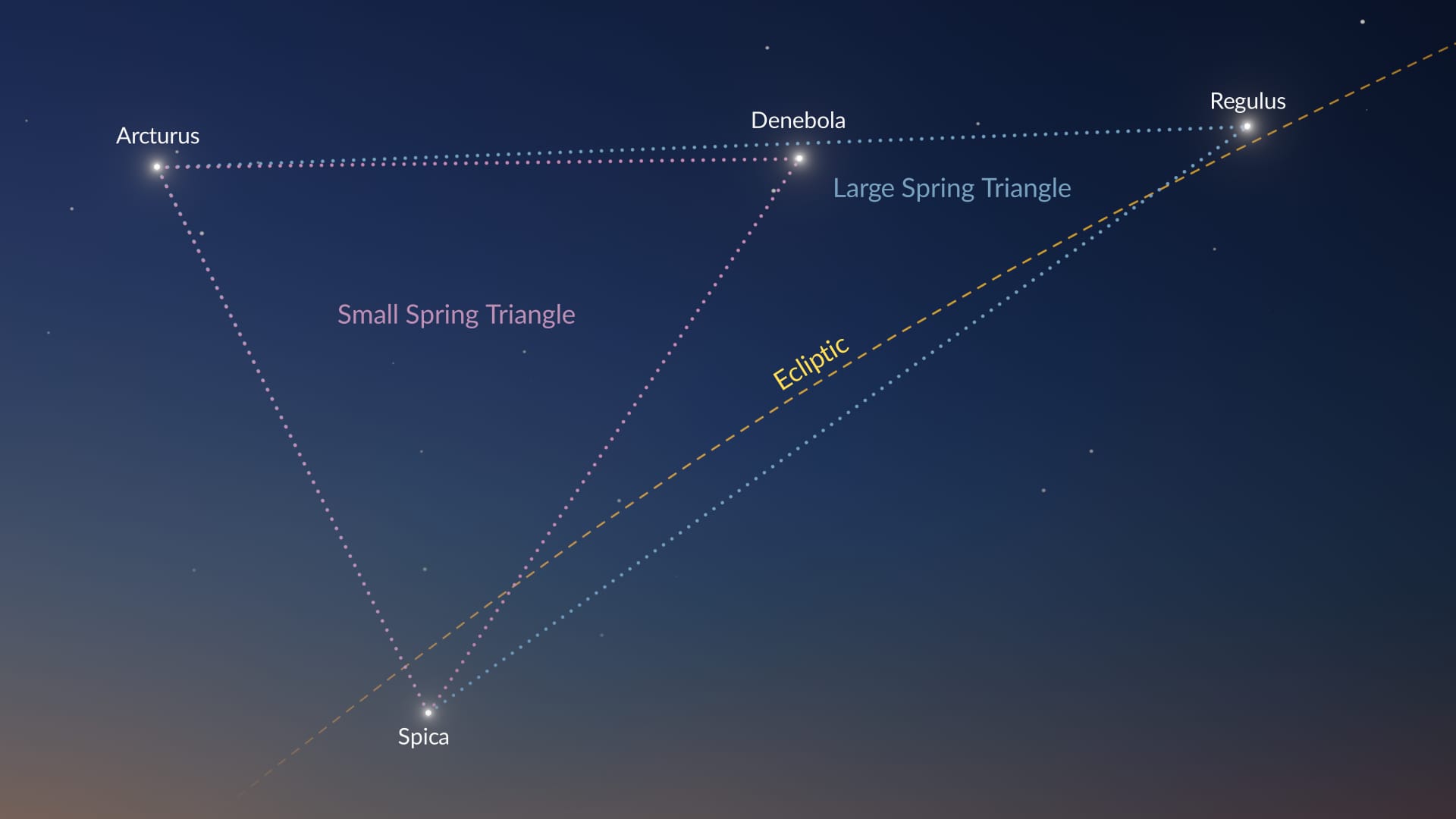
The Spring Triangle is an asterism formed by Arcturus in Bootes, Spica in Virgo, and Regulus in Leo. Some observers use Denebola instead of Regulus to outline a smaller version of the pattern. The ecliptic crosses this part of the sky, so the Moon and planets often pass through it.
The Spring Triangle is larger than the Summer Triangle and nearly as wide as the Winter Hexagon. Despite its size and brightness, it is much less well known than other seasonal star patterns.
Is the Spring Triangle a constellation?
The Spring Triangle is not a constellation but an asterism – a prominent star pattern that doesn’t belong to the official 88 constellations.
Astronomers often use seasonal star patterns to navigate the sky. Besides the Spring Triangle, other well-known seasonal asterisms include:
- Winter Hexagon, visible in winter evenings;
- Summer Triangle, prominent in summer;
- Great Square of Pegasus, a key pattern of the autumn sky.*
Note: the seasons for these asterisms are reversed in the Southern Hemisphere.
Observing the Spring Triangle
How to find the Spring Triangle in the sky?
-
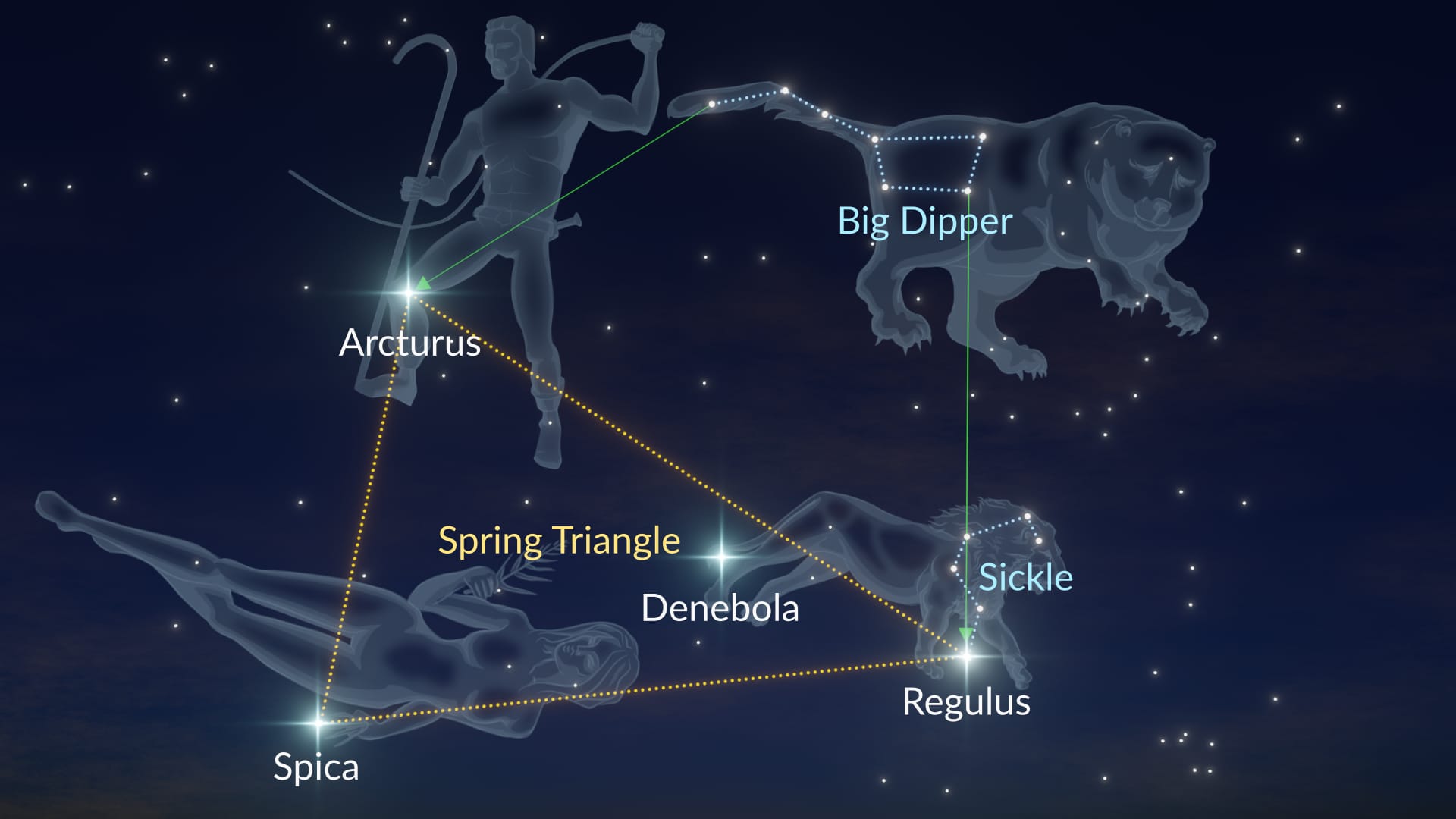
Start with Arcturus: if you’re trying to identify a triangle-shaped star pattern in the sky, Arcturus is the best place to begin. It is the brightest star in the Spring Triangle and one of the brightest stars in the sky. To locate it, first find the Big Dipper, an asterism in the constellation Ursa Major. Then, follow the curve of the Big Dipper’s handle. This will guide you directly to Arcturus.
-
Find Spica: Once you’ve spotted Arcturus, follow a straight line from it to Spica. Spica is the brightest star in the constellation Virgo and is located southeast of Arcturus.
-
Locate Regulus: The third star in the Spring Triangle is Regulus, located in the constellation Leo. To find it, look westward from Arcturus and Spica. You’ll see the Sickle asterism in Leo, which resembles a backward question mark. Regulus marks the bottom of this shape.
-
To the east of Regulus, you can spot Denebola, marking the tail of the Lion. While it's not part of the official Spring Triangle, it can be used as an alternative to Regulus in a smaller version of the asterism.
To check if you identified all the stars correctly, open the Sky Tonight app and go to the search window. Start typing “Spring Triangle” in the search bar, and once the corresponding result appears, tap the blue target icon next to it. The app will show you the Spring Triangle’s location in your sky. Point your device up, and the map on the screen will match your sky.
When to see the Spring Triangle?
The Spring Triangle can be found in the sky around the March equinox, making it a harbinger of spring in the Northern Hemisphere – hence its name. It is the easiest to spot in April when it reaches its highest point in the night sky.
Where is the Spring Triangle visible?
It’s visible from both the Northern and Southern Hemispheres, but it is especially easy to spot in the Northern Hemisphere during spring months.
Spring Triangle stars
The Spring Triangle stars are Arcturus, Spica, and Regulus. Sometimes, Denebola is used instead of Regulus to form a smaller version of the asterism. These three bright stars create one of the most recognizable triangle patterns in the spring sky. In this section, we'll explore the details of each star, including their types, magnitudes, and what makes them stand out. All of them are bright enough to be seen with the naked eye.
Arcturus star
- Other names: HIP 69673, HR 5340, HD 124897
- Type: red giant
- Magnitude: –0.1
- Constellation: Bootes
- Name meaning: guardian of the bear (Greek)
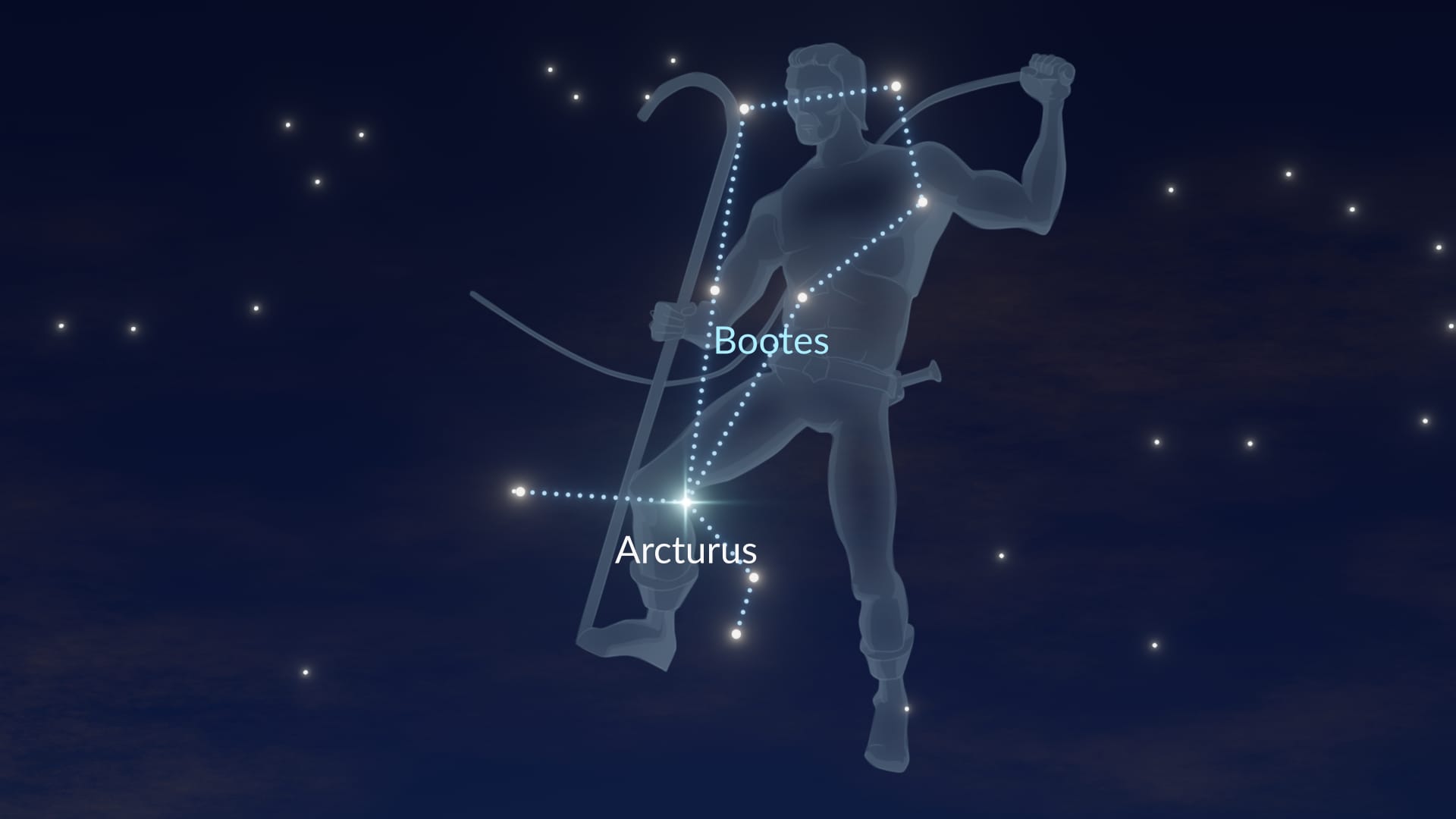
- Description: Arcturus is the brightest star in the constellation Bootes and one of the brightest stars in the night sky. It is a red giant, about 36 light-years away from Earth, and it shines with a reddish-orange hue. Its warm, amber color makes it one of the most recognizable stars in the night sky.
Spica star
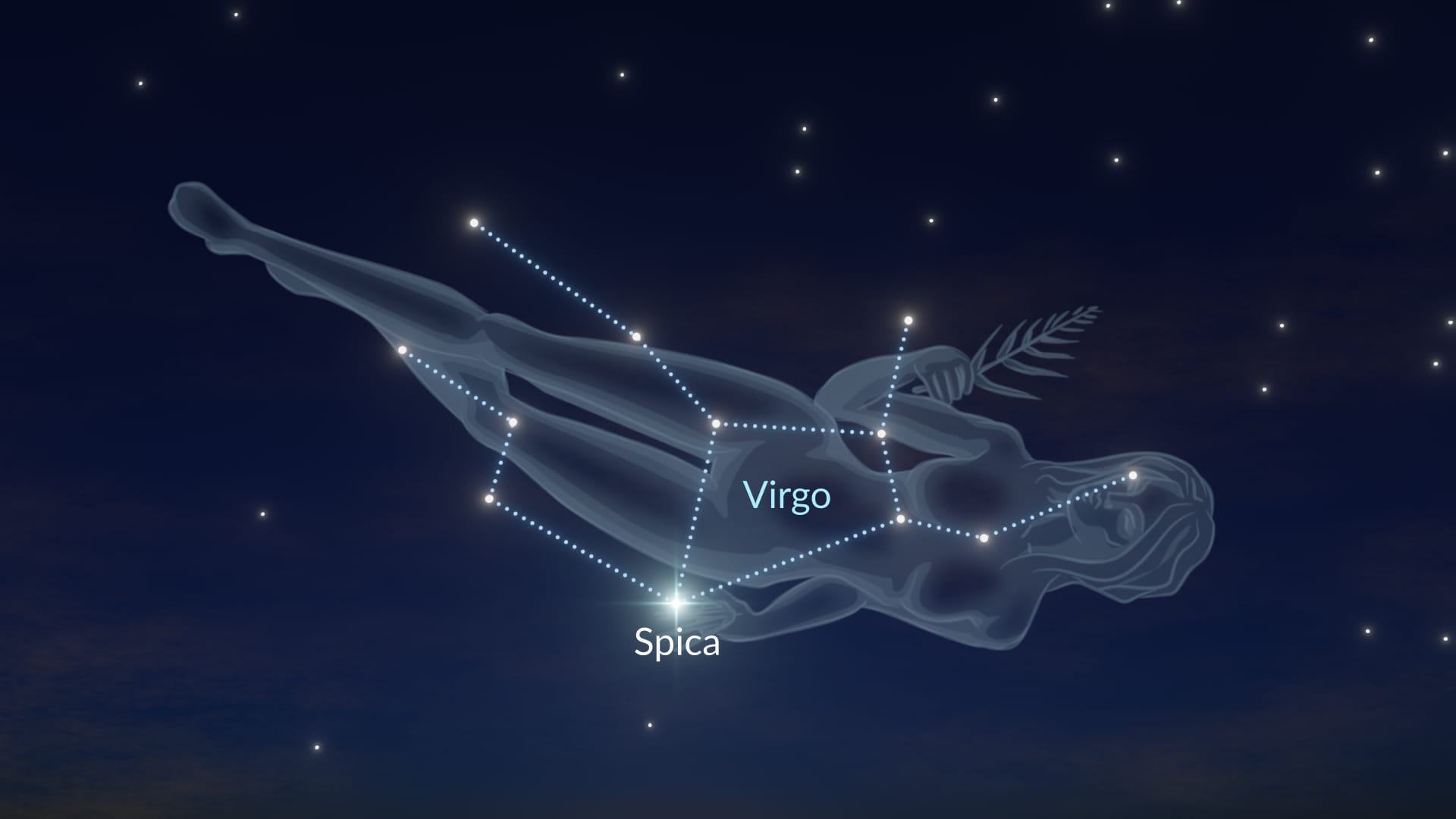
- Other names: HIP 65474, HR 5056, HD 116658
- Type: binary star
- Magnitude: 1.0
- Constellation: Virgo
- Name meaning: ear of grain (Latin)
- Description: Spica is the brightest star in the constellation Virgo and the 15th brightest star in the night sky. It is a binary star system comprising Spica A (a massive blue giant) and Spica B (a blue-white main-sequence star that is much smaller and harder to detect). Spica A emits a bluish-white color, making it appear faintly blue to the naked eye.
Regulus star
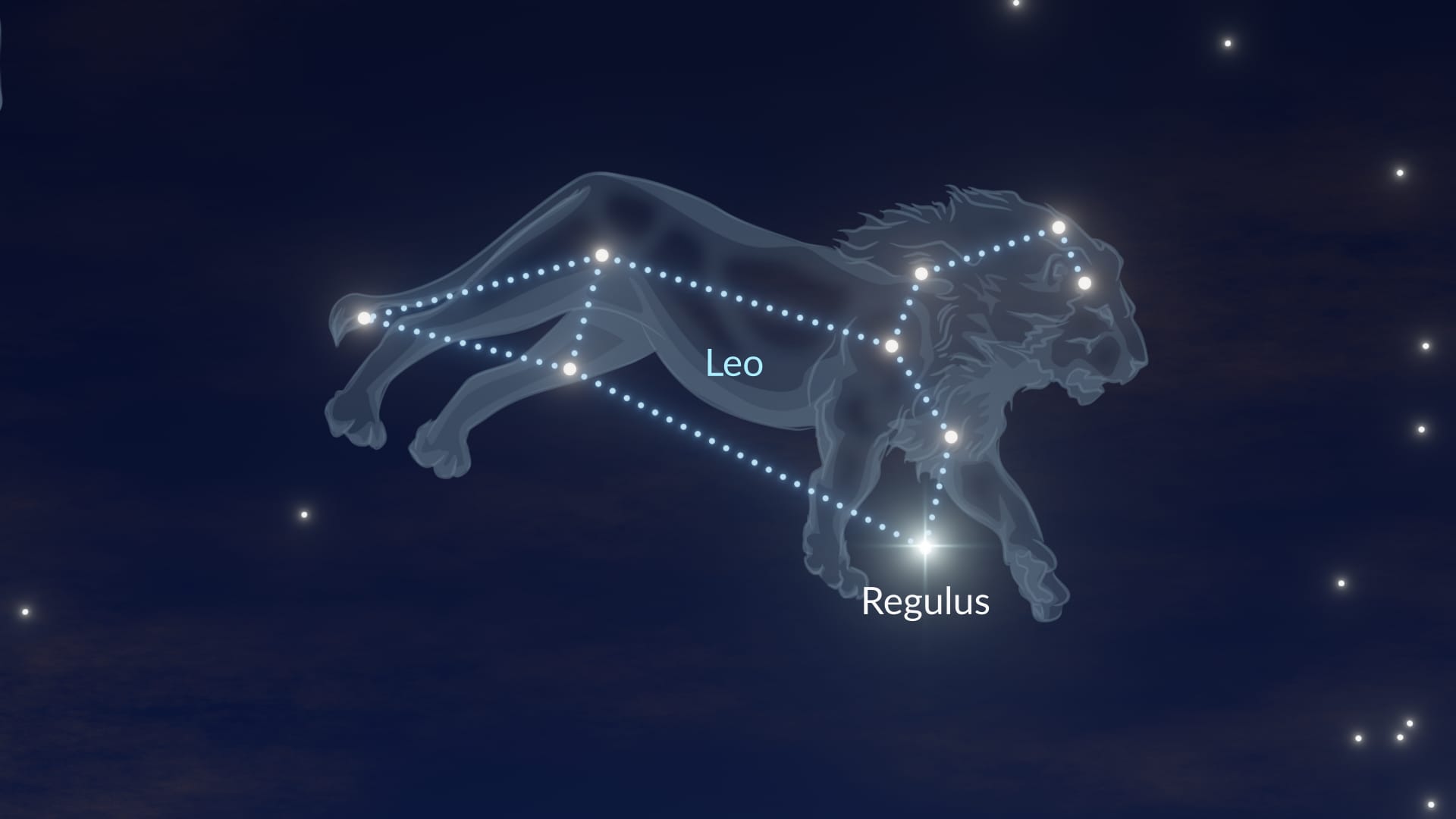
- Other names: HIP 49669, HR 3982, HD 87901
- Type: quadruple star system
- Magnitude: 1.4
- Constellation: Leo
- Name meaning: little king (Latin)
- Description: Regulus is the brightest star in the constellation Leo. It marks the Lion’s heart and shines with a bluish-white hue. It is actually a multiple-star system, with at least four stars in total. The primary star, Regulus A, is a binary star that consists of the blue main-sequence star of the spectral type B8 and a presumed main-sequence white dwarf.
Denebola star (an alternative to Regulus)
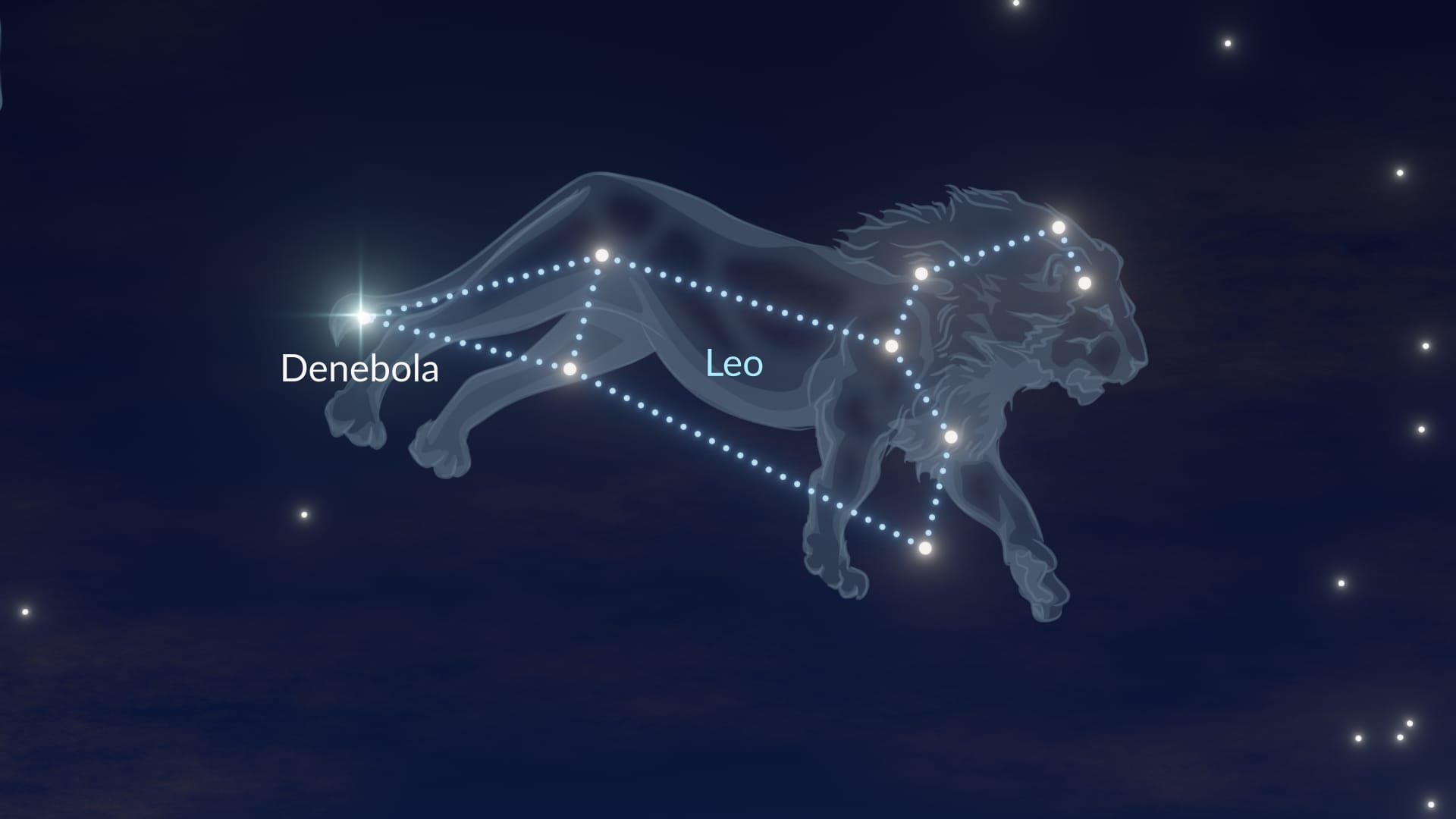
- Other names: HIP 57632, HR 4534, HD 102647
- Type: A-type main-sequence star
- Magnitude: 2.1
- Constellation: Leo
- Name meaning: tail of the lion (Arabic)
- Description: Denebola is the second-brightest star in Leo and marks the Lion’s tail. It is a hot A-type star that is significantly hotter and more luminous than our Sun. The star emits a pale white color, making it easily distinguishable in the night sky.
Deep-sky objects in the Spring Triangle
The Spring Triangle is a gateway to some notable deep-sky objects. In our dedicated article, you’ll find more deep-sky objects best-visible in April.
Leo Triplet
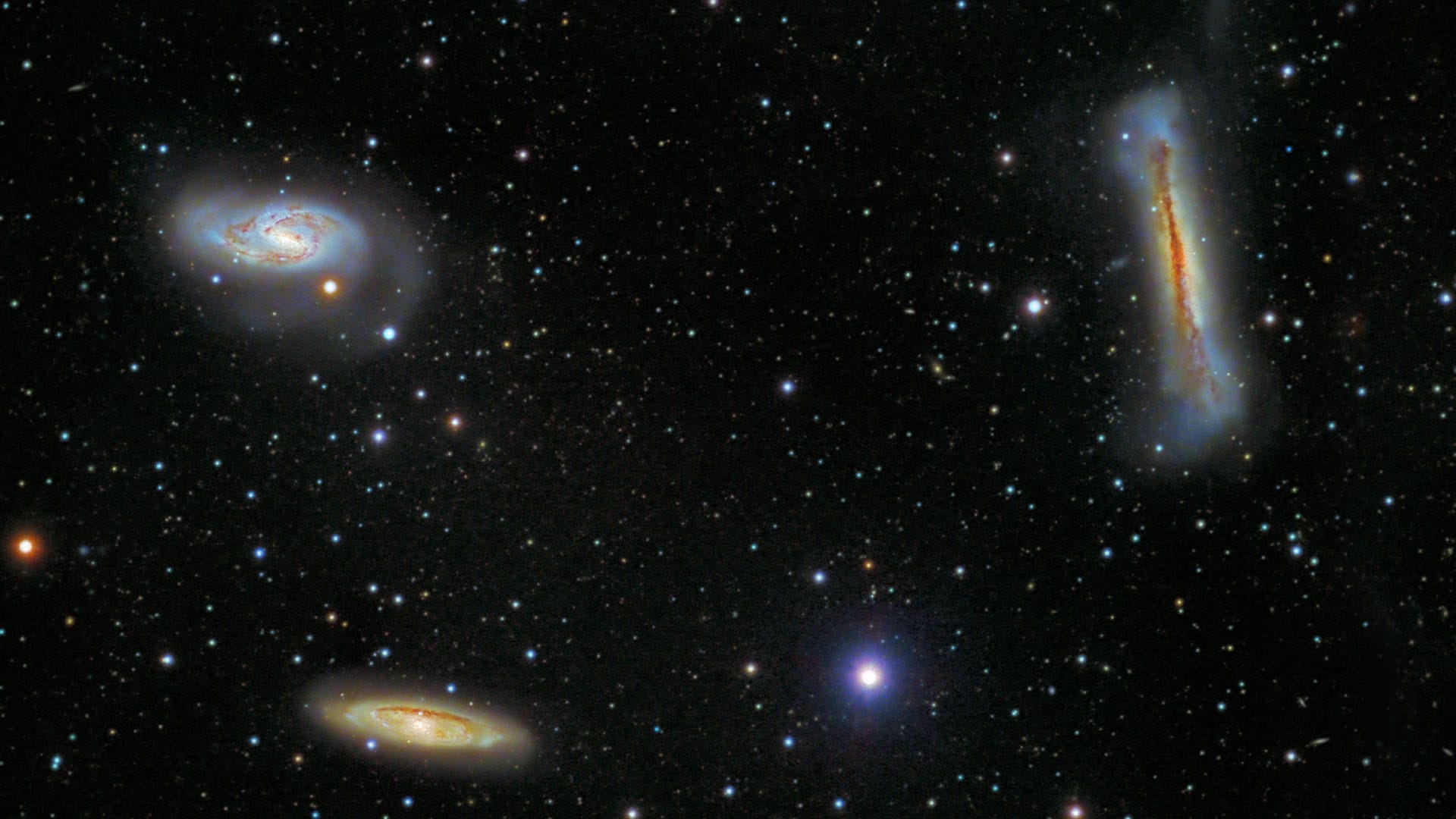
The Leo Triplet is a group of three spiral galaxies (M65, M66, and NGC 3628, also called the Hamburger Galaxy) gravitationally interacting with one another. When viewed from Earth, these galaxies are tilted at different angles. NGC 3628 looks like a thin line, while M65 and M66 show their spiral shapes. To view all three galaxies together, you'll need at least a 4-inch telescope. With 10x50 binoculars, you’ll typically be able to spot only M65 and M66, which will appear as faint, blurry patches, while NGC 3628 usually requires a telescope.
Virgo Cluster objects
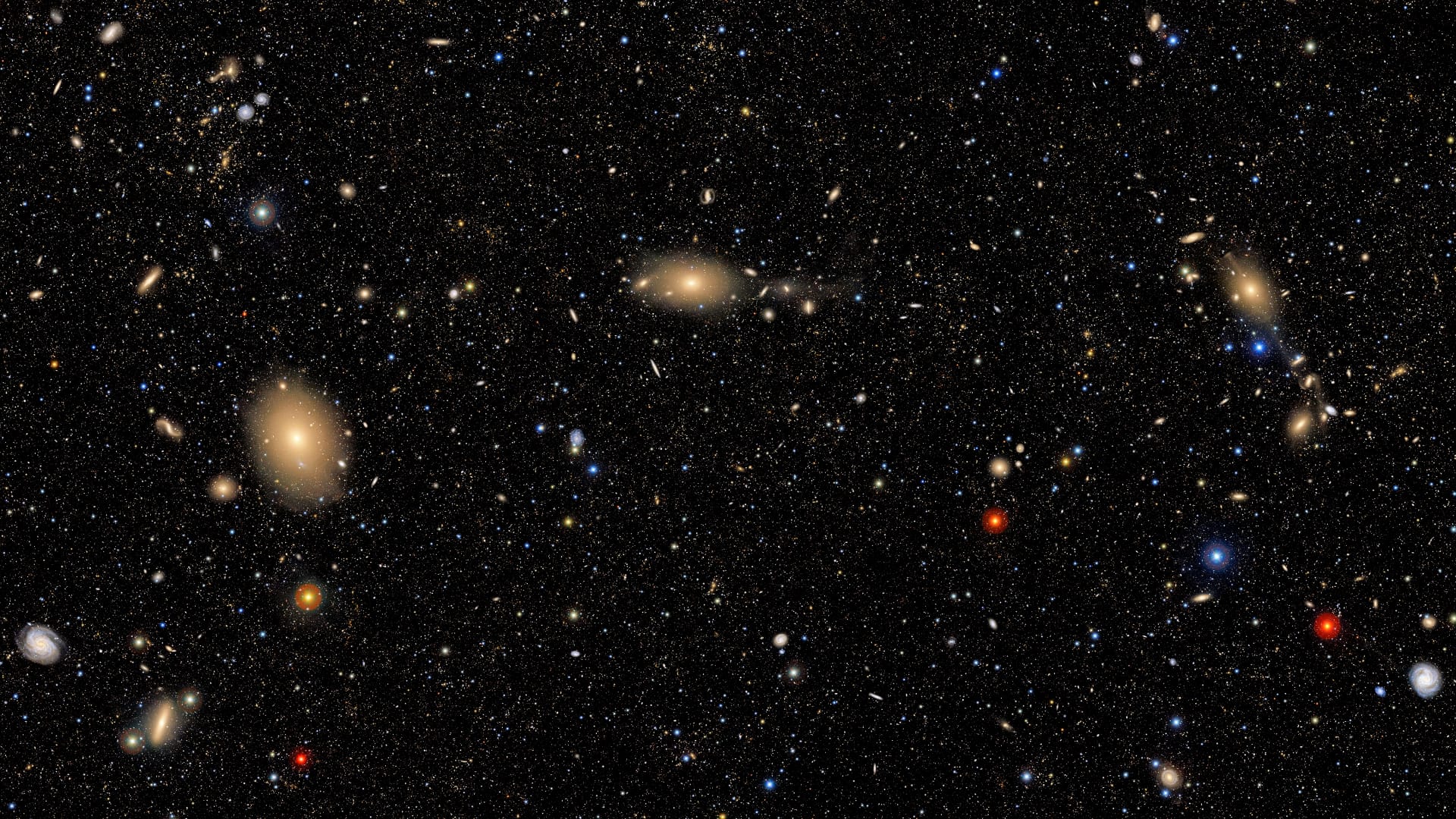
One of the reasons the Spring Triangle is important for observers is that it points toward the Virgo Cluster — one of the richest galaxy regions visible from Earth.
The Virgo Cluster contains more than a thousand galaxies and lies about 55 million light-years away. Many of its brightest members can be found between the stars Spica and Denebola.
For amateur astronomers, this region is often called the “Realm of the Galaxies”. With a small telescope under dark skies, observers can see several galaxies in a single field of view.
Virgo A (M87 galaxy)
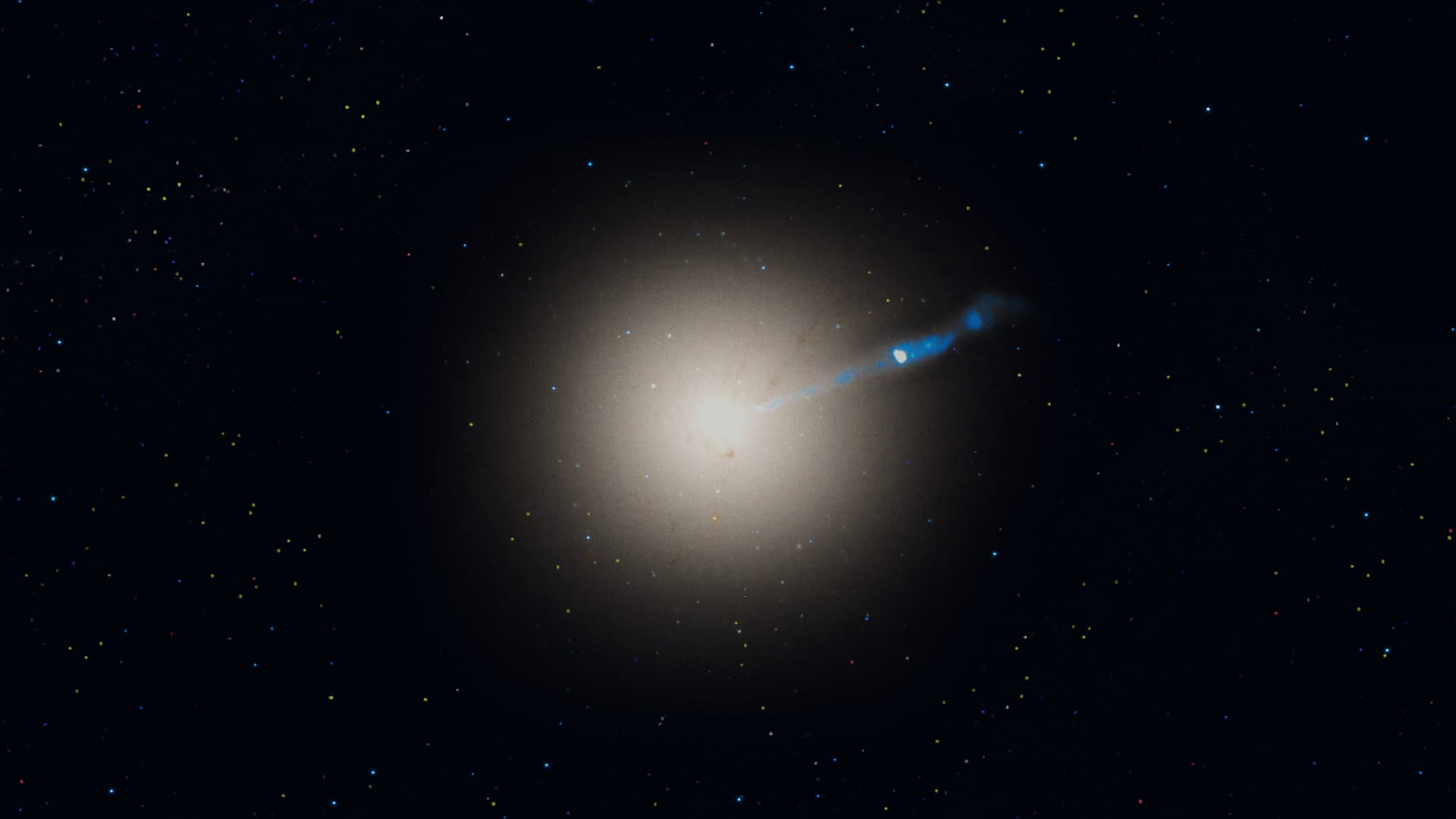
Another famous object in this region is the supergiant elliptical galaxy M87, located in the Virgo Cluster about 55 million light-years away. M87 became widely known in 2019 when astronomers captured the first-ever image of a black hole at its center using the Event Horizon Telescope. Through amateur telescopes, M87 appears as a bright elliptical glow.
Siamese Twins Galaxies (NGC 4567 and NGC 4568)
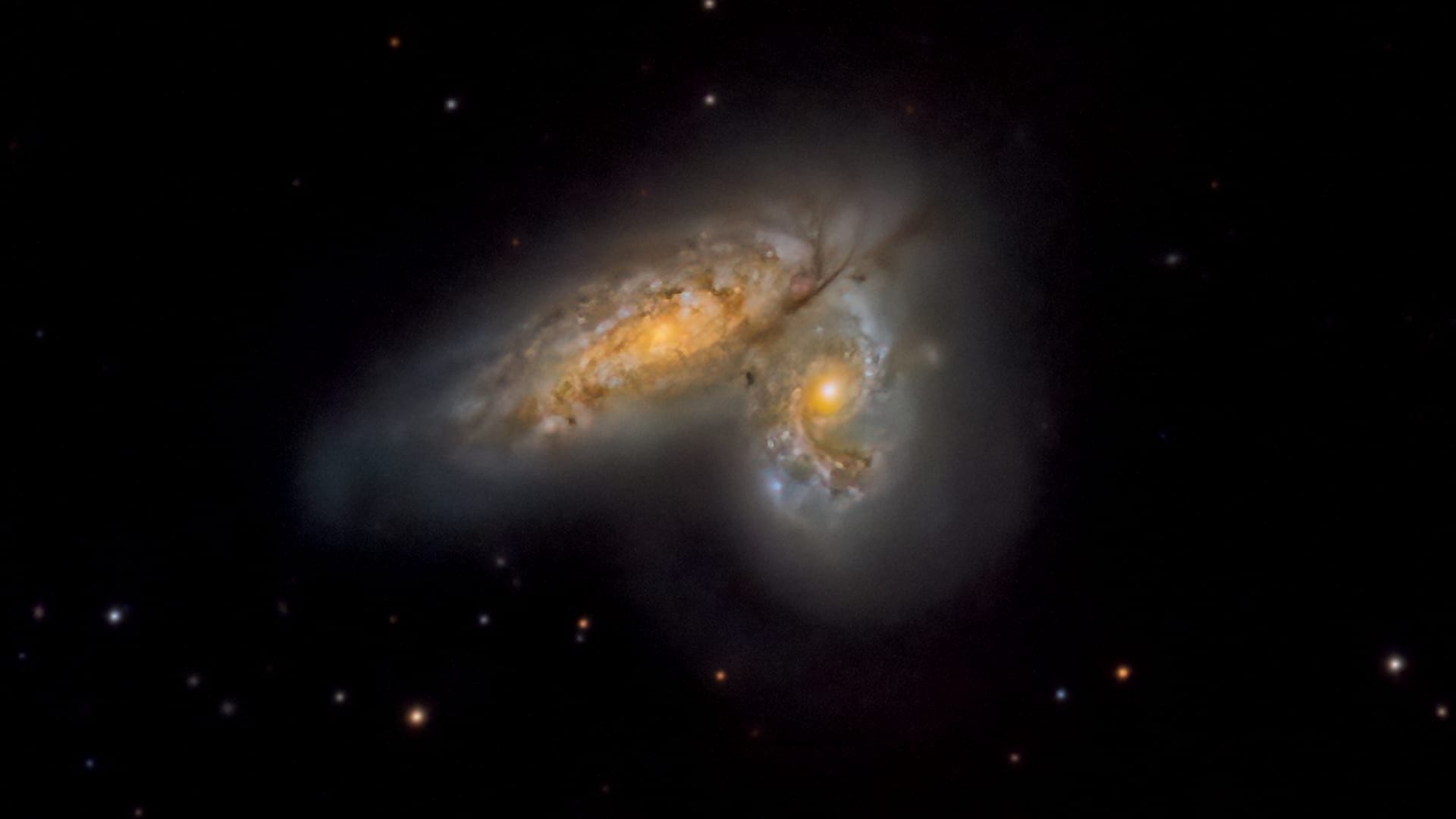
The Siamese Twins Galaxies, also nicknamed the Butterfly Galaxies, are the interacting spiral galaxies NGC 4567 and NGC 4568 in Virgo. These galaxies are in the process of merging with each other. NGC 4567 and NGC 4568 are both located in the constellation Virgo and are around 60 million light-years away from Earth. With binoculars, you might spot the pair as faint, hazy smudges, but the full detail of the galaxies is best seen through a telescope.
Eyes Galaxies
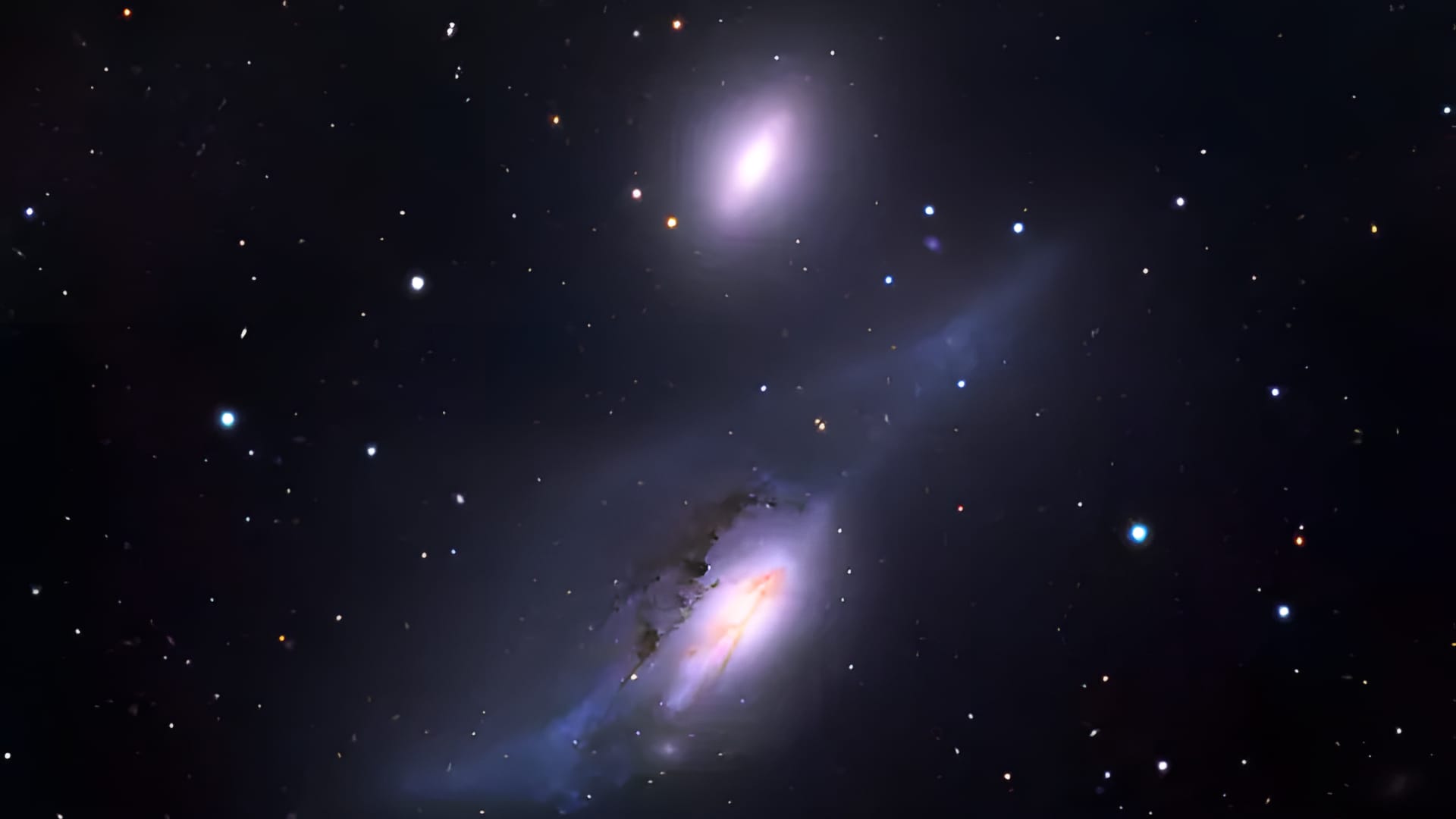
The Eyes Galaxies refer to two spiral galaxies, NGC 4435 and NGC 4438, located close together in the constellation Virgo. NGC 4435 and NGC 4438 are about 50 million light-years away from Earth and are part of the larger Virgo Cluster of galaxies. With binoculars, you can often spot NGC 4435, but NGC 4438 might be too faint to see clearly without a telescope.
These galaxies are often called the “Eyes” because of their appearance – they resemble two bright eyes looking at you from the night sky. Many other deep-sky objects also owe their names to their unusual shape, while with others, the “name-shape” connection might not be that obvious. Can you guess the name of a nebula by its photo? Pass our quiz and see!

Spring Triangle: F.A.Q
What is the Spring Triangle?
The Spring Triangle is a seasonal asterism formed by the bright stars Arcturus, Spica, and Regulus.
Is the Spring Triangle a constellation?
No. The Spring Triangle is not an official constellation but an asterism — a recognizable pattern made of stars from different constellations.
What stars make up the Spring Triangle?
The Spring Triangle stars are Arcturus in Bootes, Spica in Virgo, and Regulus in Leo. Some observers replace Regulus with Denebola to form a smaller triangle.
When can you see the Spring Triangle?
The Spring Triangle is easiest to see during spring in the Northern Hemisphere and autumn in the Southern Hemisphere. The asterism is especially well-placed in April.
How big is the Spring Triangle?
The distance between two extreme points of the Spring Triangle (Regulus – Arcturus) is 60 degrees. It’s about three distances between your pinky finger and thumb, stretched as wide as possible (held at arm's length). The distances between the other stars are also quite large:
- Arcturus – Spica: about 30°
- Spica – Regulus: about 50°
Spring Triangle: to sum up
The Spring Triangle is one of the easiest star patterns to spot in the spring night sky. It consists of three bright stars — Arcturus, Spica, and Regulus — and appears around the March equinox, reaching its best visibility in April. To easily spot this celestial pattern and the deep-sky objects within it, use the Sky Tonight app.