Planetary Alignment in June 2026: Mercury, Venus & Jupiter After Sunset
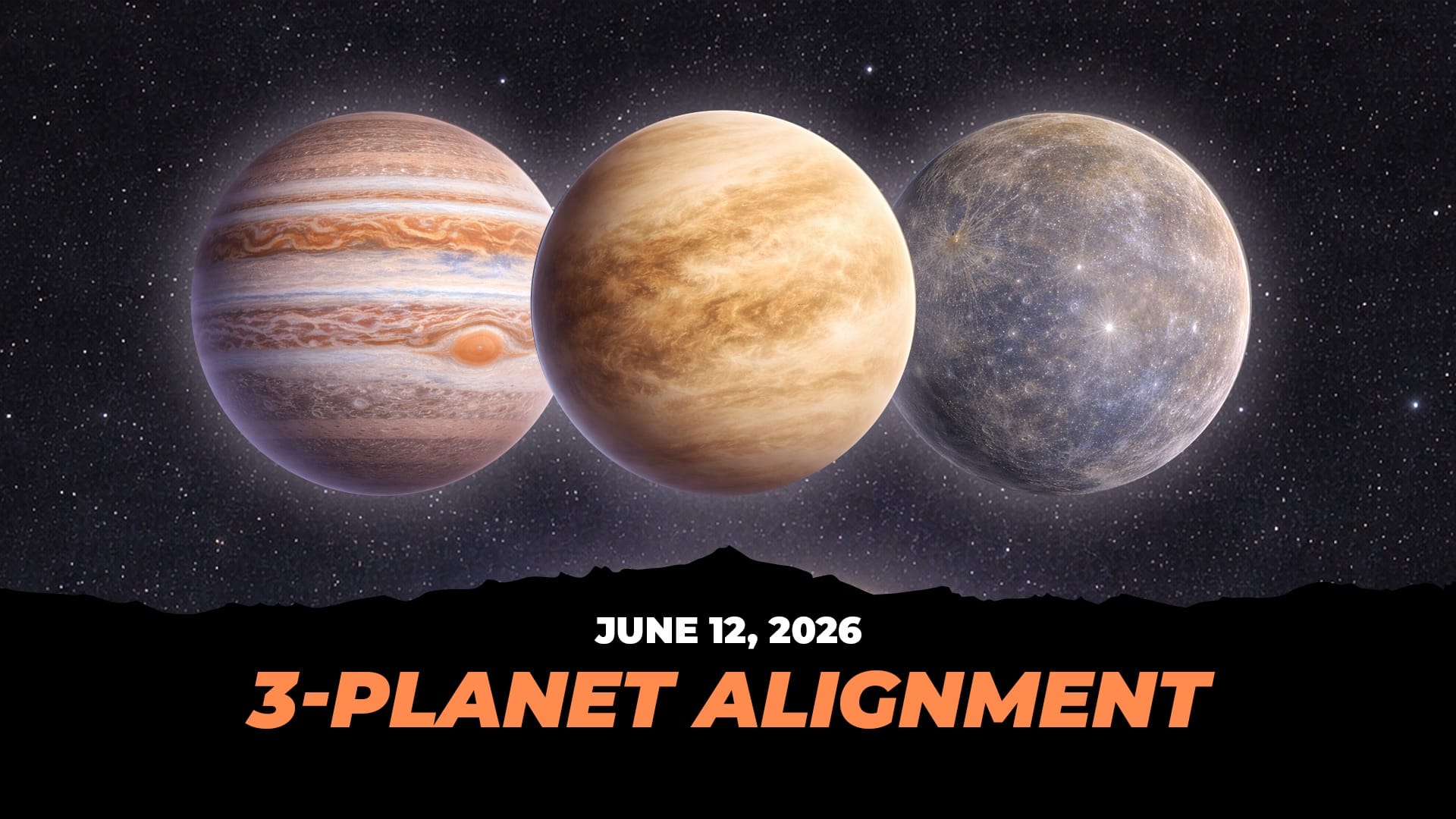
Around June 12, 2026, look west after sunset to see a bright little planet parade: Mercury, Venus, and Jupiter will gather in the evening sky. This is a mini planetary alignment — only three planets are involved — but it’s also one of the easiest planet alignments of 2026 because all three planets can be seen with the naked eye. Use the Star Walk 2 app to quickly find all three planets in the sky from your exact location.
Contents
- 3-planet alignment around June 12, 2026: key details
- Viewing Times for the June 2026 Planetary Alignment
- Quick viewing times: Northern Hemisphere — June 12
- Quick viewing times: Southern Hemisphere — June 12
- Where is the June 2026 alignment easiest to see?
- What happens during the June 2026 planet parade?
- When to see the June 2026 planetary alignment
- June 2026 planet parade: where to look in the sky
- Which planets will be visible during the June 2026 alignment?
- Can you photograph the planet parade in June 2026?
FAQ: June 2026 planet parade
- What time should I see the planet parade around June 12, 2026?
- Where should I look to see the planet parade around June 12, 2026?
- Can I see Mercury, Venus, and Jupiter with the naked eye?
- Do I need binoculars or a telescope to see the June 2026 planet parade?
- Is this a rare planetary alignment?
- Will the planets form a perfect straight line in space?
- What if I miss June 12?
- When will the Moon join the June 2026 planet alignment?
- When is the next planet parade after June 2026?
- Planetary alignment around June 12, 2026: bottom line
3-planet alignment around June 12, 2026: key details
- Main date: June 12, 2026
- Planets: Mercury, Venus, Jupiter
- Type: Mini planetary alignment / mini planet parade
- Best time to watch: About 30 minutes to 1 hour after local sunset
- Where to look: Low above the west-northwestern horizon
- Visibility: All three planets are visible to the naked eye
- Bonus: A thin crescent Moon joins the alignment a few days later, around June 16–17
Note: This alignment is not a one-time event. The planets will be worth watching for several evenings around the main date, from early to mid-June.
New to planetary alignments? Read our guide: Planetary Alignment Explained.
Viewing Times for the June 2026 Planetary Alignment
We calculated the best viewing window from the end of civil twilight, when the Sun is 6° below the horizon, until Mercury drops to 5° above the horizon. At the end of civil twilight, the sky is dark enough for bright planets to stand out, while Mercury is still high enough to be seen above a clear horizon. You can learn more about different twilight types from our dedicated article: Understanding Twilight.
Quick viewing times: Northern Hemisphere — June 12
| City | Local sunset | Best time to see all 3 planets |
|---|---|---|
| Los Angeles, USA | 8:05 PM | 8:35–9:23 PM |
| Mexico City, Mexico | 19:16 | 19:40–20:37 |
| Toronto, Canada | 9:00 PM | 9:36–10:13 PM |
| New York, USA | 8:28 PM | 9:00–9:43 PM |
| London, UK | 21:18 | 22:05–22:24 |
| Paris, France | 21:55 | 22:37–23:03 |
| Berlin, Germany | 21:30 | 22:20–22:34 |
| New Delhi, India | 19:20 | 19:47–20:39 |
| Tokyo, Japan | 18:58 | 19:28–20:15 |

Tip: The viewing window is shortest in high northern cities, where June twilight lasts longer. If you’re in London, Berlin, or another northern location, start looking as soon as the window opens and choose a place with a flat, unobstructed western or west-northwestern horizon.
Quick viewing times: Southern Hemisphere — June 12
| City | Local sunset | Best time to see all 3 planets |
|---|---|---|
| Santiago, Chile | 17:41 | 18:10–18:53 |
| Buenos Aires, Argentina | 17:50 | 18:18–19:01 |
| São Paulo, Brazil | 17:28 | 17:53–18:45 |
| Cape Town, South Africa | 17:44 | 18:12–18:56 |
| Johannesburg, South Africa | 17:24 | 17:49–18:39 |
| Jakarta, Indonesia | 17:45 | 18:10–19:05 |
| Perth, Australia | 5:19 PM | 5:46–6:32 PM |
| Brisbane, Australia | 5:01 PM | 5:27–6:15 PM |
| Melbourne, Australia | 5:08 PM | 5:37–6:16 PM |
| Sydney, Australia | 4:53 PM | 5:20–6:03 PM |
| Auckland, New Zealand | 5:11 PM | 5:40–6:20 PM |
| Wellington, New Zealand | 4:58 PM | 5:30–6:01 PM |

Where is the June 2026 alignment easiest to see?
The alignment is easier to observe from places where twilight is shorter and Mercury stays higher after sunset. In general, lower-latitude locations get a more comfortable viewing window than far-northern cities.
Some good locations for this alignment include Sydney, Jakarta, Mexico City, New Delhi, São Paulo, Johannesburg, and Buenos Aires. In these places, Mercury remains visible for longer after the sky gets dark enough, giving observers more time to spot all three planets.
The most challenging locations are high northern cities such as London and Berlin, where June twilight lasts longer and Mercury is already low by the time the sky gets dark enough. If you’re observing from these cities, start looking shortly after sunset and choose a place with a completely clear western or west-northwestern horizon.
What happens during the June 2026 planet parade?
On and around June 12, 2026, three planets — Mercury, Venus, and Jupiter — will appear close together in the evening sky. They won’t form a perfect straight line in space. Instead, they will line up from our point of view on Earth, along the ecliptic — the path the Sun, Moon, and planets appear to follow across the sky.
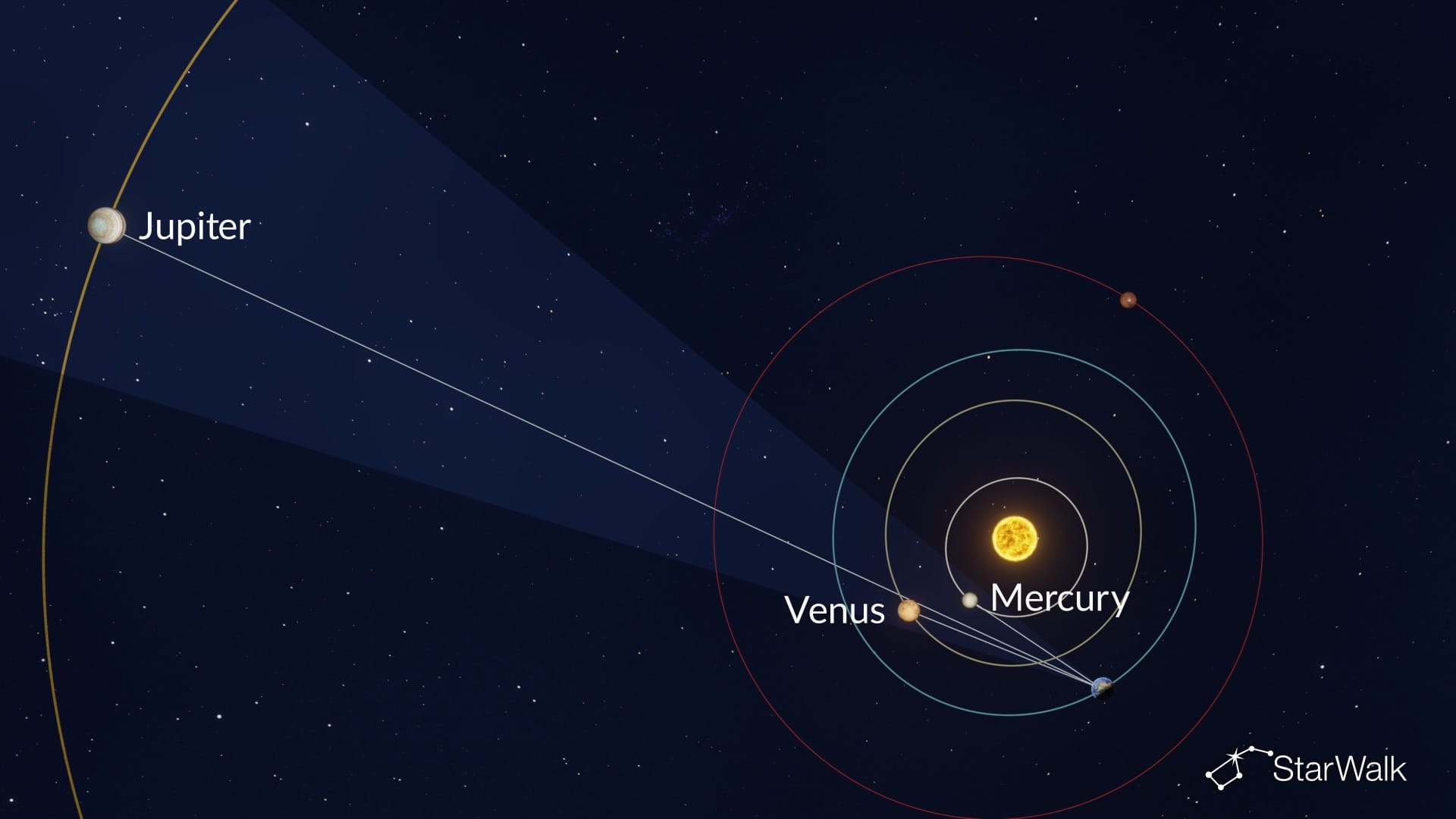
This is why planetary alignments often look like a line or arc. The planets all orbit the Sun in nearly the same plane, so from Earth they tend to appear along the same sky path. During the June 2026 alignment, the planets will gather in a small sky sector, making the view compact, bright, and easy to see even for beginners.
Want to see how planetary alignments work? Check out our planet parade infographic.
When to see the June 2026 planetary alignment
The best global date for this planetary alignment in June 2026 is June 12, but the view will be good on several nearby evenings. Start looking about 30 minutes to 1 hour after sunset, when the sky is darker but the planets have not yet sunk too low.
Here’s the simple observing plan:
- 30 minutes after sunset: Venus and Jupiter may already be visible; Mercury may still be hard to see in twilight.
- About 1 hour after sunset: Best balance — the sky is darker, and all three planets should be easier to spot.
- Later in the evening: Mercury will become harder or impossible to see as it sinks toward the horizon.
Your exact viewing window depends on your location, latitude, local sunset time, and horizon. If trees, buildings, hills, or haze block the western horizon, Mercury will be the first planet you lose.
Best dates to watch the June 2026 planet parade
| Date | What to see | Why it matters |
|---|---|---|
| Early June | Venus and Jupiter move closer together | Good warm-up for the alignment |
| June 8–9 | Venus and Jupiter at their closest | Both planets will fit in the same binocular field of view |
| June 12 | Mercury, Venus, and Jupiter form the main alignment | Best date to see all 3 planets |
| June 15 | Mercury reaches greatest elongation | Good chance to spot Mercury |
| June 16–17 | Crescent Moon joins the planets | Best photo opportunity |
The June 2026 alignment is not limited to one evening. The view changes from night to night, so it’s worth checking the sky several times from early to mid-June.
Early June: Venus and Jupiter move closer together in the western evening sky. This is a great time to start following the alignment.

June 8–9: Venus and Jupiter appear especially close — only about 1°40′ apart. Both objects will fit into the field of view of binoculars. Even without Mercury, this bright pairing will be eye-catching after sunset.
Around June 12: Mercury, Venus, and Jupiter form the main three-planet alignment. This is the best date to treat as the peak of the mini planet parade. If it’s cloudy on June 12, don’t give up. Try again the next clear evening.
June 15: Mercury reaches its greatest eastern elongation, appearing at its farthest apparent distance from the Sun (24°31′) in the evening sky. This makes mid-June one of the best times to catch elusive Mercury.
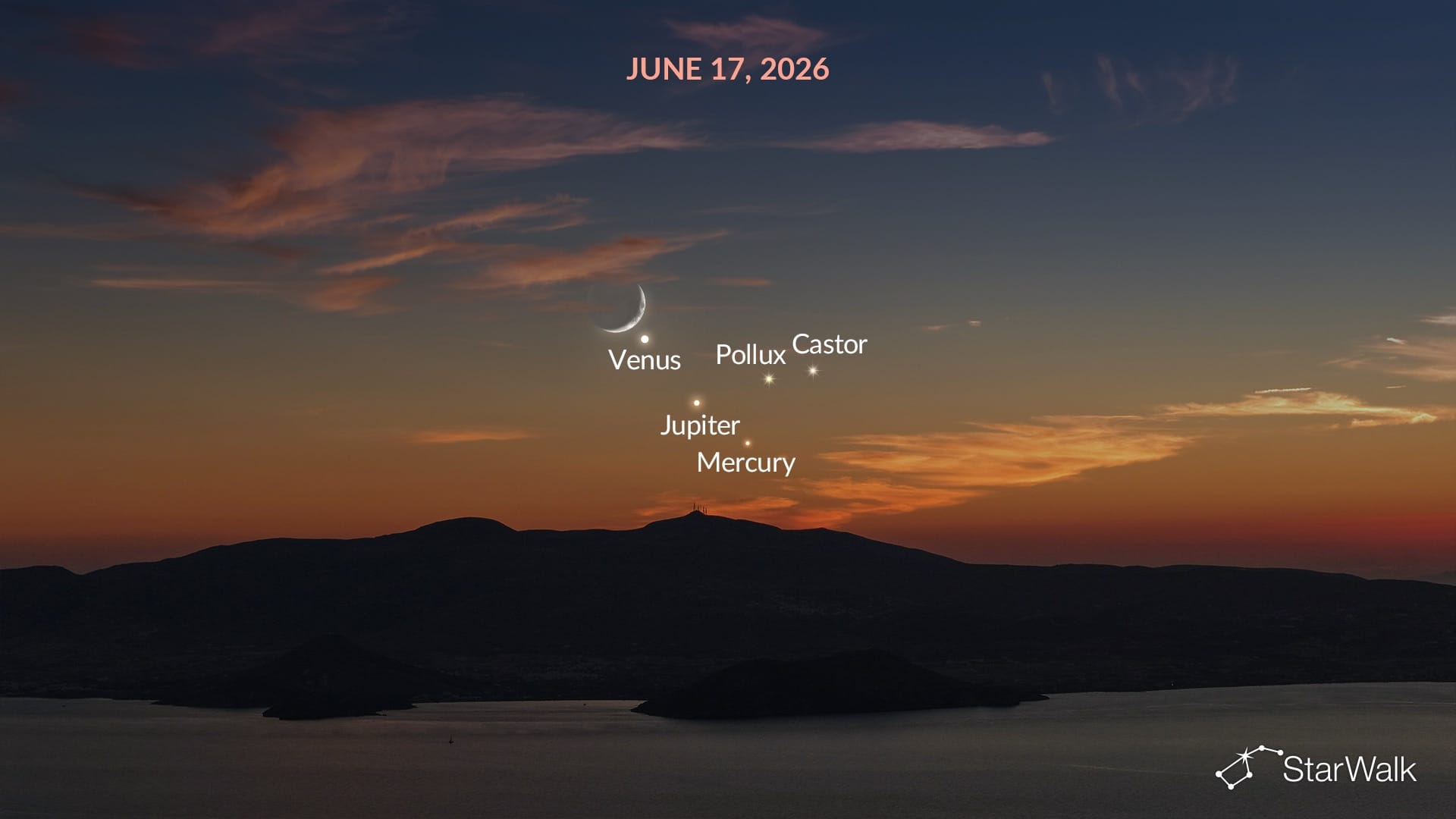
June 16–17: A thin crescent Moon joins the view, creating a beautiful Moon-and-planets scene shortly after sunset. The bright stars Pollux and Castor from Gemini will also be nearby.
June 2026 planet parade: where to look in the sky
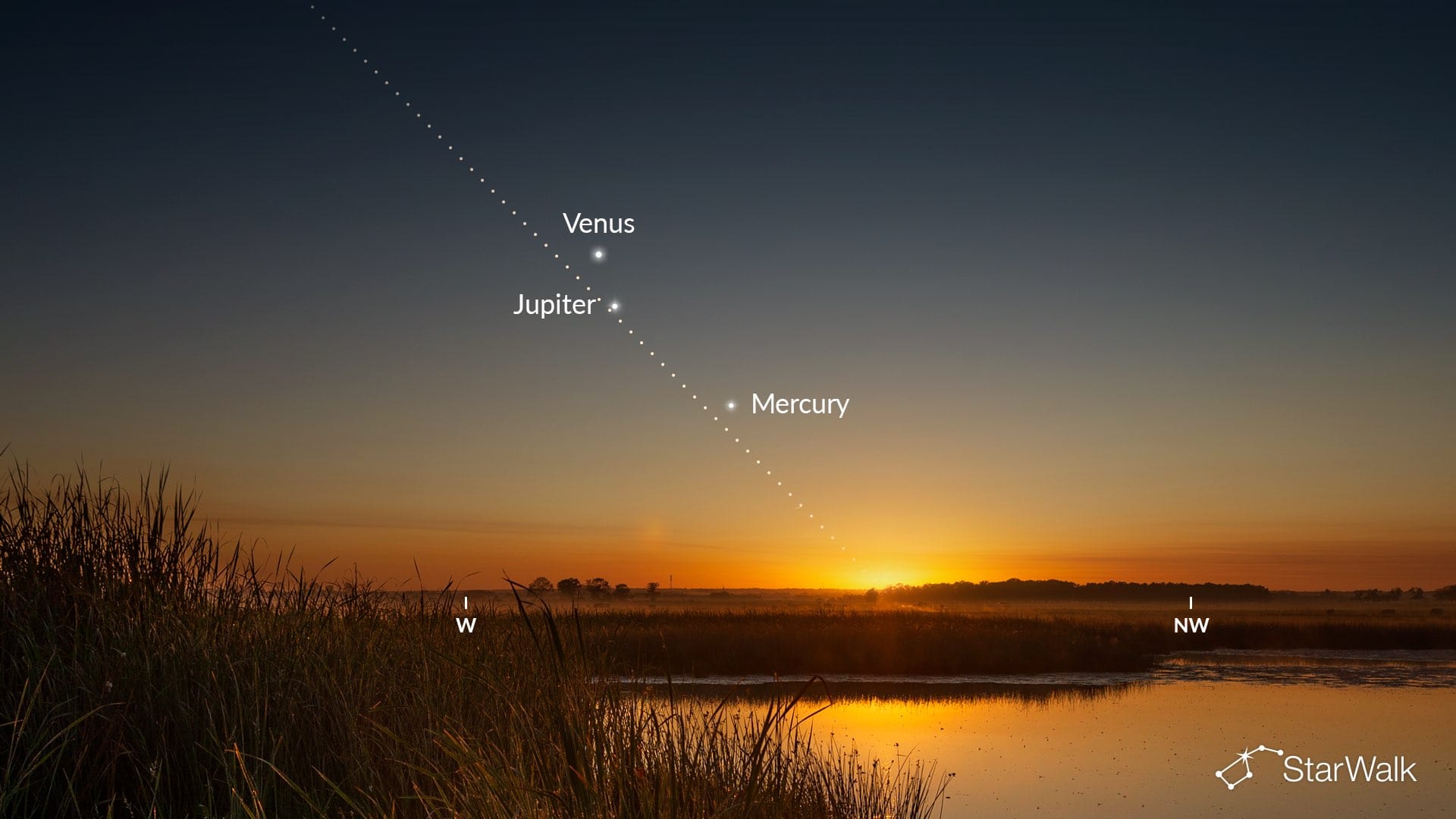
Look low above the west-northwestern horizon, in the direction where the Sun has just set. The planets will not be scattered across the whole sky — they will appear in the same general area, making this planet parade compact and beginner-friendly.
The easiest way to find the lineup:
- Find Venus first. It will be the brightest “star-like” object in the west after sunset. You can quickly identify Venus using the Star Walk 2 app.
- Look near Venus for Jupiter. Jupiter will be bright, though not as dazzling as Venus.
- Search lower for Mercury. Mercury will sit closer to the horizon and may be harder to see in twilight.
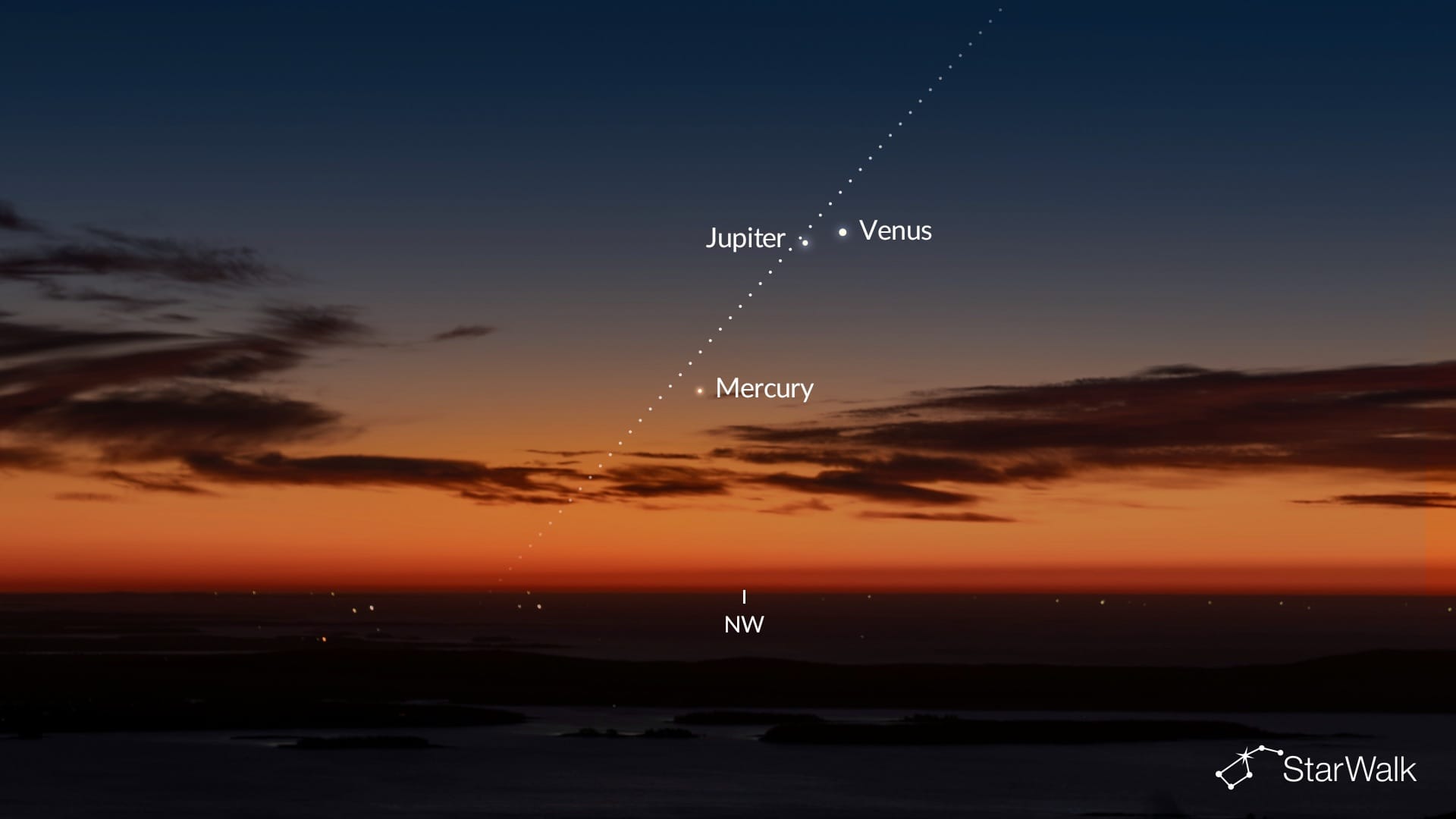
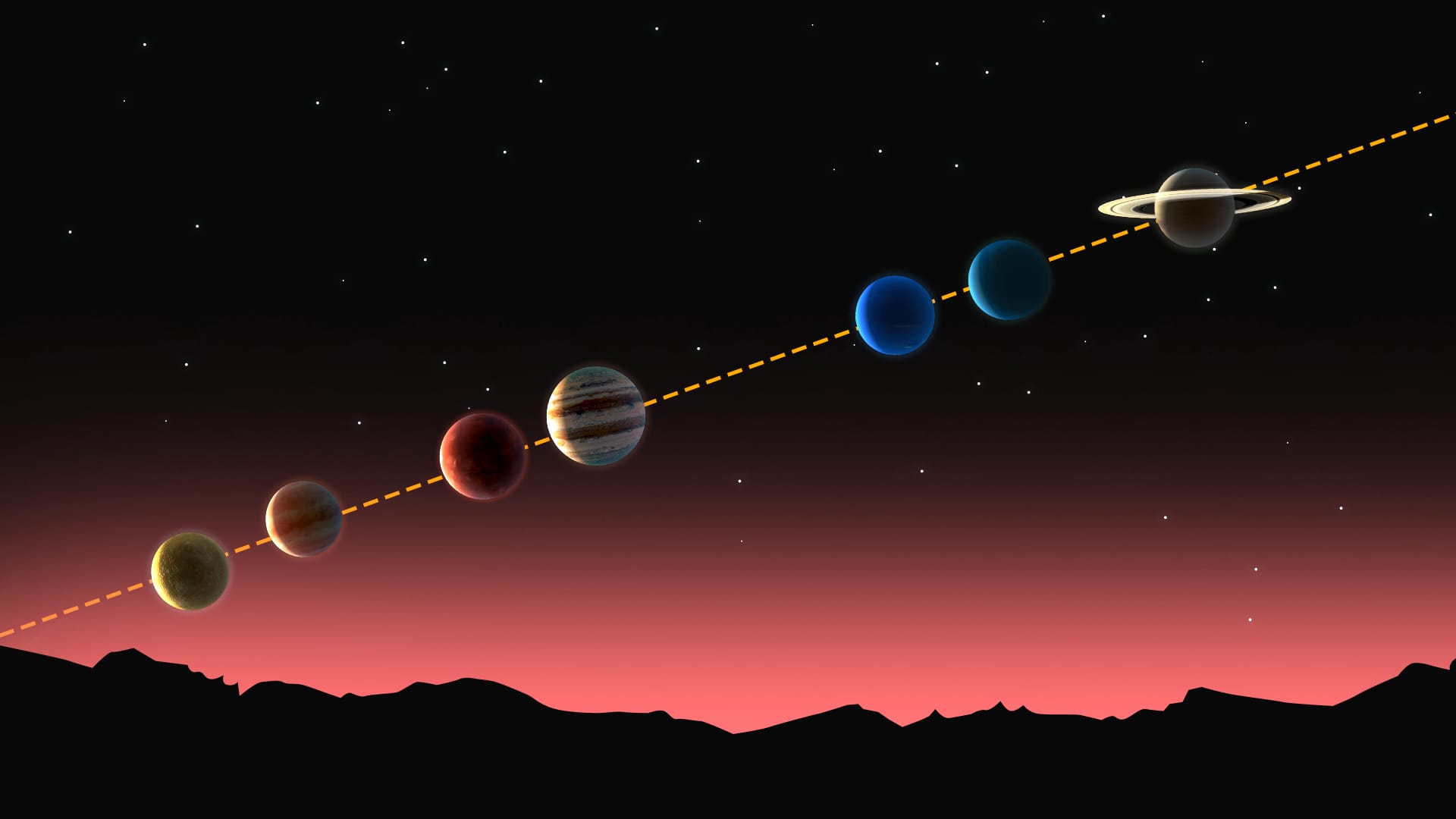
The three planets should form a slanted line. The angle and altitude can differ depending on the hemisphere you’re in. Either way, use the sunset direction as your starting point and let Star Walk 2 guide you to Mercury, Venus, and Jupiter.
Which planets will be visible during the June 2026 alignment?
Venus: the bright guidepost

Venus (mag -4.0) will be the easiest planet to see. It shines brighter than any star and will stand out even before the sky is fully dark. During this alignment, use Venus as your anchor point: once you find it, the rest of the lineup becomes much easier to follow.
To the naked eye, Venus looks like an intensely bright white point. Through a telescope, it won’t show cloud details like Jupiter, but it may reveal a small disk or phase depending on your equipment and observing conditions.
Jupiter: the second-brightest planet

Jupiter (mag -1.8) will also be easy to see without optical aid. It will be less brilliant than Venus but still much brighter than most stars. Around early June, Venus and Jupiter will appear especially close together, creating one of the prettiest parts of the whole event.
If you have binoculars, point them at Jupiter after the Sun is safely below the horizon and the sky is dark enough. You may spot some of Jupiter’s four largest moons as tiny points of light lined up near the planet.
Mercury: the low-horizon challenge

Mercury (mag 0.3) is the planet that makes this alignment more exciting — and more time-sensitive. Because Mercury orbits close to the Sun, it never strays far from sunset or sunrise glare. In this planet parade, it will appear low in the west after sunset.
You don’t need a telescope to see Mercury, but you do need a clear horizon. A flat open area, hilltop, coastline, field, or balcony with a clean western view will help a lot. If Mercury is hidden by haze, buildings, or trees, you may still enjoy a beautiful two-planet pairing of Venus and Jupiter.
Can you photograph the planet parade in June 2026?
The June alignment is a good event for beginner-friendly sky photos because the planets will be bright and close to the horizon, where you can include trees, buildings, mountains, or water in the frame.
For a phone photo, try night mode if your phone has it, hold the device steady, and tap on Venus to focus. A tripod or stable surface will help. For a camera, use a wide-angle lens, keep the exposure short enough that the planets stay sharp, and include the western horizon for context.
The most photogenic dates may be June 16 and 17, when the thin crescent Moon joins Mercury, Venus, and Jupiter.
FAQ: June 2026 planet parade
What time should I see the planet parade around June 12, 2026?
Start looking about 30 minutes after local sunset. You can begin earlier if the sky is very clear, but Mercury may be difficult in bright twilight. Don’t wait too long, because Mercury will be low and will set first.
Where should I look to see the planet parade around June 12, 2026?
Look low in the west-northwest, toward the sunset direction. Venus will be the brightest planet and the easiest starting point. Jupiter will be near Venus, and Mercury will be closer to the horizon.
Can I see Mercury, Venus, and Jupiter with the naked eye?
Yes. All three planets are naked-eye objects during this alignment. Mercury is the only challenging one because it appears low in the twilight sky.
Do I need binoculars or a telescope to see the June 2026 planet parade?
No. You can see the June 2026 planetary alignment without optical aid. Binoculars may help you find Mercury, but use them only after the Sun has fully set.
Safety note: Never point binoculars, a telescope, or a camera with a zoom lens toward the sky near the Sun. Wait until the Sun is completely below the horizon before using any optical equipment.
Is this a rare planetary alignment?
A three-planet alignment is not as rare as a five- or six-planet parade, but this one is still worth watching because it features three naked-eye planets in the convenient evening sky. Venus and Jupiter are especially bright, making the event easy for beginners.
Will the planets form a perfect straight line in space?
No. The planets might appear along a line from your viewpoint on Earth, but they won’t be perfectly lined up in space. The “line” is a visual effect caused by the planets appearing near the ecliptic.
What if I miss June 12?
Try the evenings around it. The lineup will be visible for several days, and the scene changes nicely from night to night. June 8–9 are great for Venus and Jupiter, June 12 is the main three-planet alignment, and June 16–17 add the crescent Moon to the view.
When will the Moon join the June 2026 planet alignment?
A thin crescent Moon will appear near Mercury, Venus, and Jupiter around June 16–17, 2026. These evenings may be the best dates for photos, because the Moon will make the planet lineup look even more beautiful.
When is the next planet parade after June 2026?
The next notable planet parade will occur around August 12, 2026. It will be a large morning alignment of Jupiter, Mercury, Mars, Uranus, Saturn, and Neptune. Some of these planets will require binoculars or a telescope, so the June alignment is easier for casual observers.
Planetary alignment around June 12, 2026: bottom line
The June 12, 2026 planetary alignment is a bright, easy evening sky event featuring Mercury, Venus, and Jupiter. Look low in the west-northwest about an hour after sunset, find dazzling Venus first, then use it to spot Jupiter and Mercury nearby.
This is a mini planet parade, but it has everything beginners love: bright planets, convenient evening timing, no optics required, and a beautiful changing view over several nights. To easily identify all three planets in the sky in real time, use the Star Walk 2 app.
Clear skies!