Pegasus: the Winged Horse Constellation
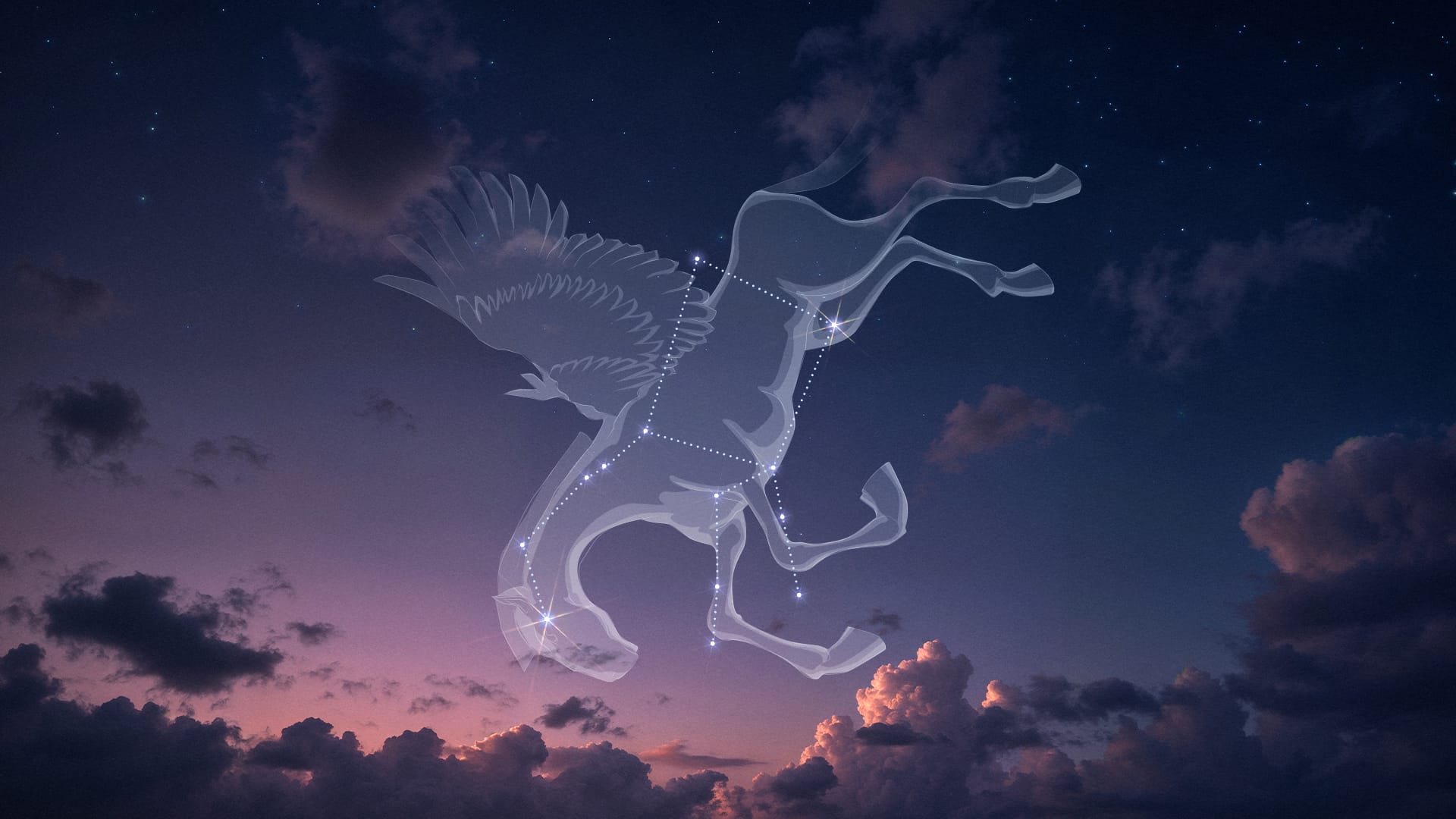
According to the Chinese zodiac, 2026 is the year of the Horse, which is a perfect time to turn your gaze to the sky and discover Pegasus – the legendary winged horse of Greek mythology. A symbol of strength, freedom, and inspiration, Pegasus has fascinated skywatchers for thousands of years. From ancient myths and bright stars to famous deep-sky objects like the Great Pegasus Cluster, this constellation offers plenty to explore. Want to see where Pegasus is right now? Use the Sky Tonight app — simply point your phone at the sky and follow the guide to find the winged horse among the stars.
Contents
- Constellation Pegasus facts
- Constellation Pegasus on the sky map
- Brightest stars in the constellation Pegasus
- Notable deep-sky objects in the constellation Pegasus
- Who is Pegasus: the myths about the winged horse
- Constellation Pegasus: to sum up
Constellation Pegasus facts
- Name: Pegasus
- Abbreviation: Peg
- Size: 1121 sq. deg.
- Right ascension: 21h to 00h
- Declination: 2.33° to 36.61°
- Visible between: 90°N – 54°S
- Brightest star: Enif (ε Peg)
- Main stars: 13
- Messier DSO: 1
- Bordering constellations: Andromeda, Lacerta, Cygnus, Vulpecula, Delphinus, Equuleus, Aquarius, Pisces
Fun facts about the constellation Pegasus
- It is generally agreed that Pegasus’ outline only depicts the upper half of the horse. The hind legs are absent.
- Pegasus features the Great Square of Pegasus, one of the largest and most recognizable star patterns in the sky. However, not all its stars belong to it: one corner of the Great Square, Alpheratz, officially belongs to the neighboring constellation Andromeda, not Pegasus.
- The constellation Pegasus is famous for hosting the first exoplanet ever found around a Sun-like star. In 1995, astronomers discovered a gas giant called Dimidium (or 51 Pegasi b), which orbits the main-sequence, G-type star 51 Pegasi.
- In traditional Chinese astronomy, Pegasus was not seen as a single constellation. Instead, its stars were divided among several smaller asterisms in the northern sky, within the region of the Black Tortoise of the North.
Constellation Pegasus on the sky map
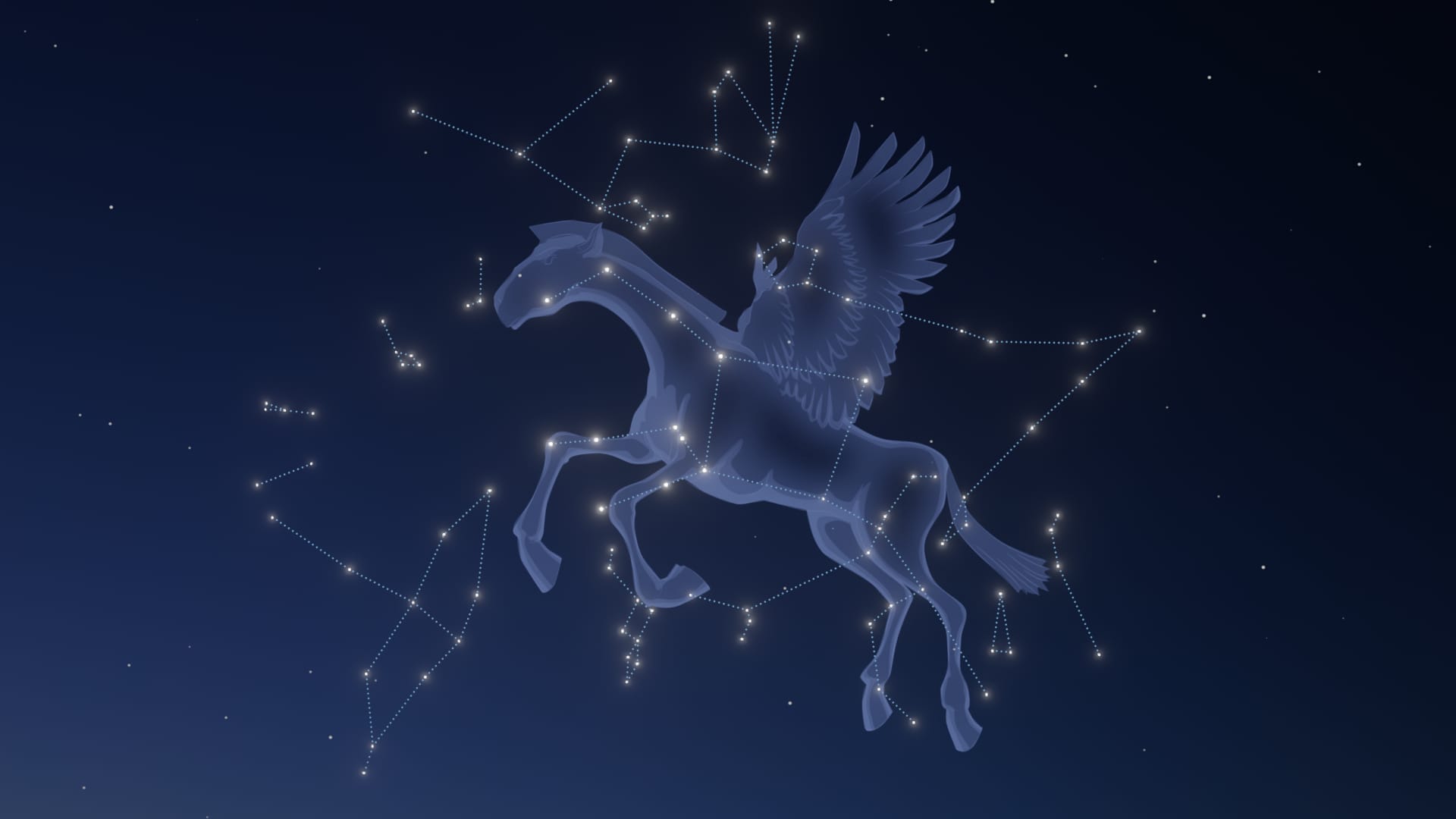
Pegasus spans 1121 square degrees of the sky, ranking as the 7th-largest among the 88 modern constellations.
The constellation is bordered by 8 others: Andromeda to the north and east, Lacerta to the north, Cygnus to the northwest, Vulpecula, Delphinus, and Equuleus to the west, Aquarius to the south, and Pisces to the south and east.
It belongs to the Perseus family of constellations, which also includes Perseus, Andromeda, Cassiopeia, Cepheus, and Cetus. With the exception of Cetus, all members of this group lie north of the ecliptic.
Where and when is the constellation Pegasus visible?
Pegasus is a large constellation located close to the celestial equator, allowing it to be observed from both hemispheres, except from most of Antarctica. It is best visible from September to November, with October offering the best viewing conditions.
How to find the constellation Pegasus?
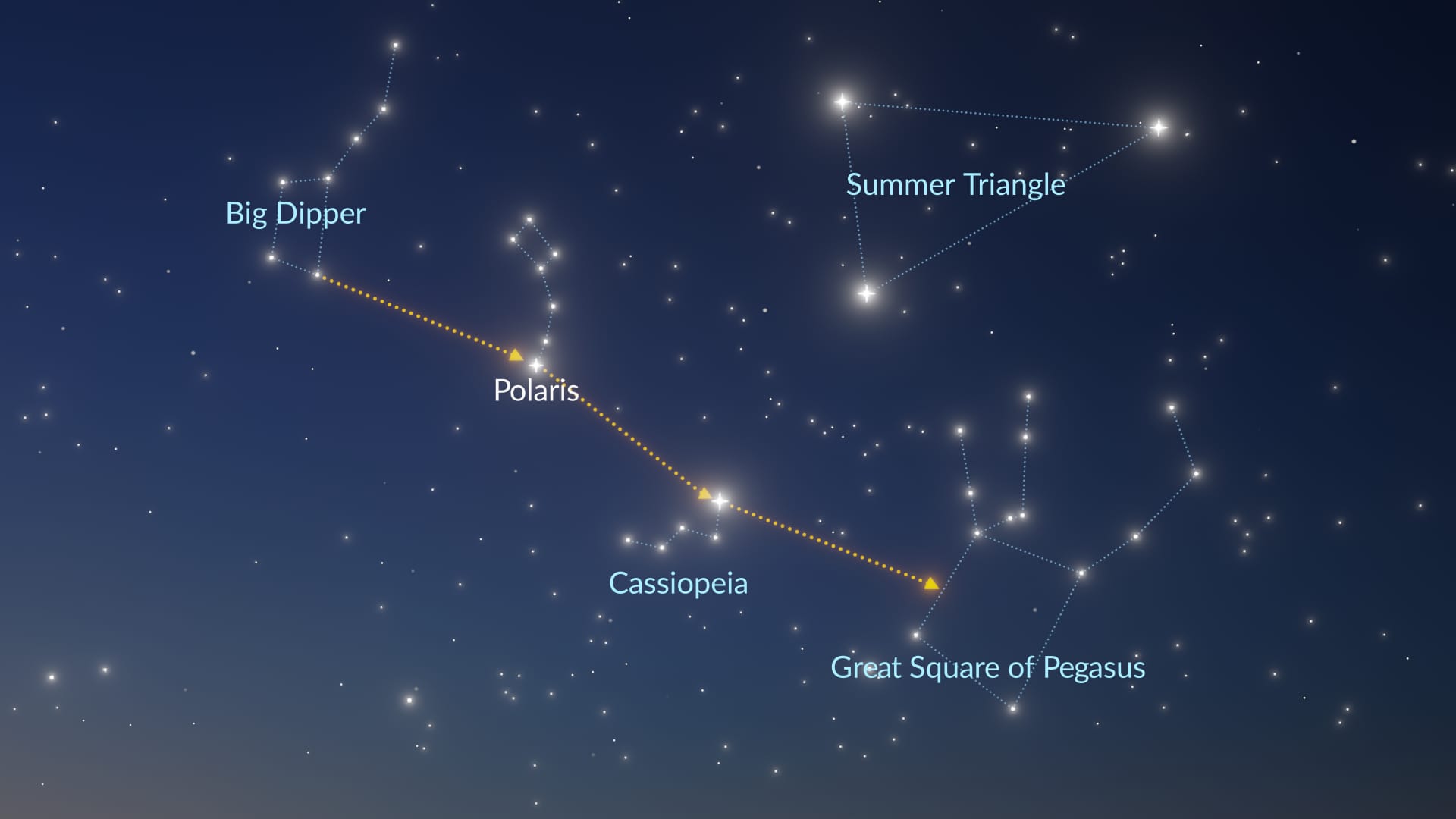
Pegasus features the Great Square of Pegasus, a large asterism formed by bright stars of roughly magnitude 2.1–2.9, readily visible to the naked eye. To make sure you have identified the correct square, you can use two other, even more prominent asterisms as guides:
- Start with the Big Dipper and use it to find Polaris, the North Star.
- Next, look for Cassiopeia, a bright zigzag that resembles a W or M.
- From Cassiopeia, keep moving in the same direction away from Polaris, and you’ll arrive at Pegasus.
Another easy reference is the Summer Triangle formed by Vega, Deneb, and Altair: Pegasus sits just to the east of it.
Where is the constellation Pegasus right now?
To find the exact location of the constellation Pegasus in the sky above you, try using a stargazing app. These apps show the constellation’s position in real time. Below is how to find Pegasus using the Star Walk 2 and Sky Tonight apps:
- Launch the app and tap the magnifier icon (lower-left corner in Star Walk 2 / bottom bar in Sky Tonight);
- Type “Pegasus” in the search bar;
- Tap the corresponding search result in Star Walk 2, or the blue target icon next to the object's name in Sky Tonight;
- You’ll see the constellation’s current position in the sky;
- Point your device up and follow the arrow to find the constellation in the real night sky above you.
Need extra help? Watch the video tutorials on Star Walk 2 and Sky Tonight and follow the steps given there.
Brightest stars in the constellation Pegasus
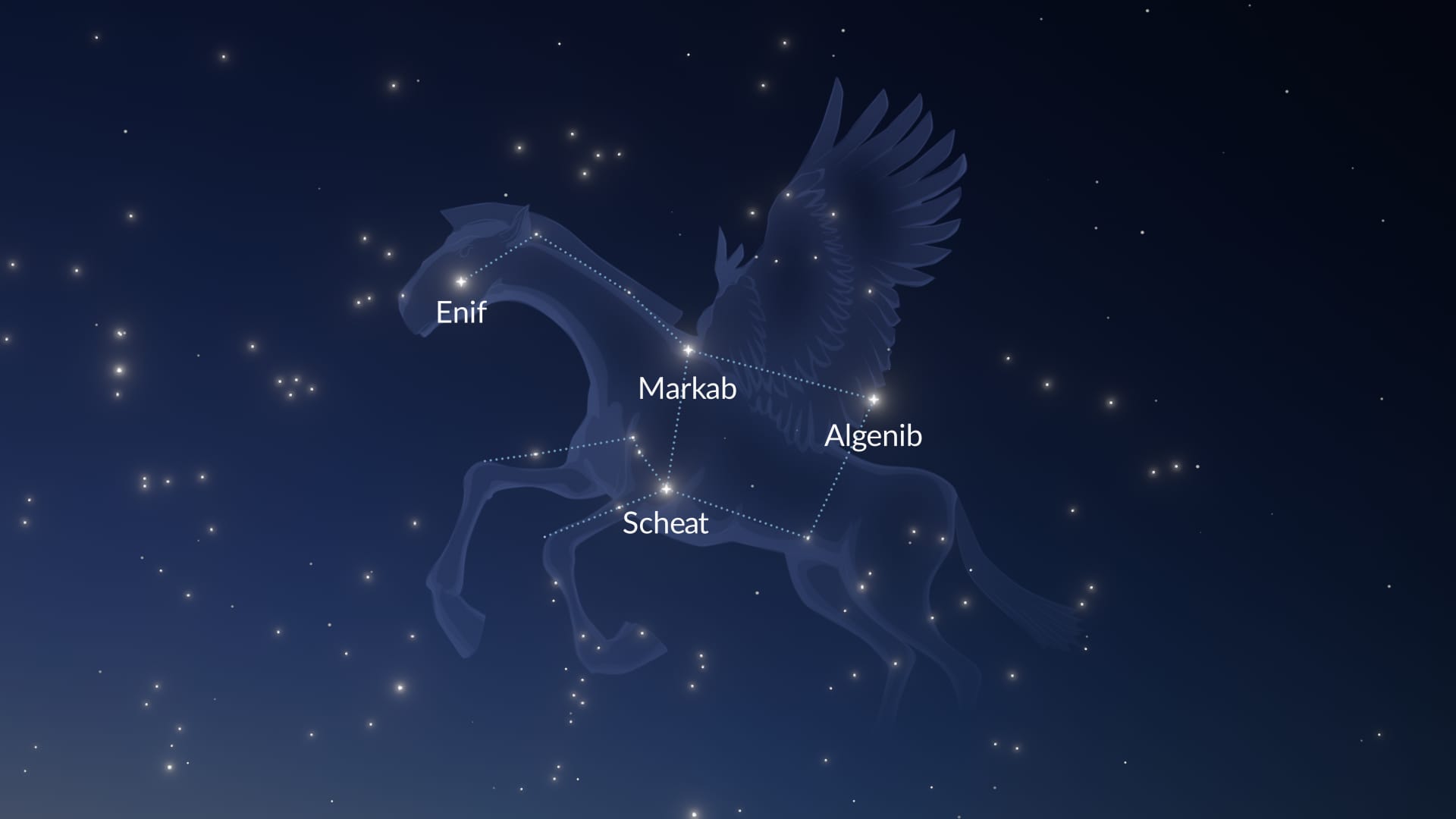
This section explores the four brightest stars of Pegasus. Enif is the brightest, while Sheat, Markab, and Algenib form three corners of the Great Square of Pegasus. Enif, Sheat, and Markab also rank among the top 100 brightest.
Enif
- Other names: Epsilon Pegasi, ε Peg, 8 Pegasi, HD 206778, HIP 107315, HR 8308
- Type: K-type (orange) supergiant
- Magnitude: 2.38
- Name’s origin: “nose” (Arabic)
- Description: Enif is the brightest star in the constellation Pegasus, which marks the muzzle of the winged horse. It is located at a distance of about 690 light-years from the Solar System. Enif is a slow irregular variable star, typically shining at magnitude 2.37–2.45, but it has shown rare extreme outbursts, appearing as bright as magnitude 0.7 and as faint as 3.5.
The Great Square of Pegasus
The Great Square of Pegasus is a well-known asterism representing the main body of Pegasus. It consists of Markab, Scheat, and Algenib, along with Alpheratz (Alpha Andromedae) – a star once known as Delta Pegasi before being permanently assigned to Andromeda. In the Sky Tonight app, the Great Square is clearly highlighted, making it easy to identify.
Scheat
- Other names: Beta Pegasi, β Peg, 53 Pegasi, HR 8775, HD 217906, HIP 113881
- Type: red giant
- Magnitude: 2.44
- Name’s origin: “the upper arm” (Arabic)
- Description: Scheat is the second-brightest star in the constellation Pegasus. It forms the upper right corner of the Great Square of Pegasus, and marks the upper foreleg area of the horse. It is located at a distance of about 196 light-years from the Sun.
Markab
- Other names: Alpha Pegasi, α Peg, Marchab, 54 Pegasi, HR 8781, HD 218045, HIP 113963
- Type: subgiant
- Magnitude: 2.49
- Name’s origin: “saddle of the horse” (Arabic)
- Description: Markab is the third-brightest star in the constellation Pegasus, forming the lower right corner of the Great Square of Pegasus. It is located at a distance of about 133 light-years from the Sun.
Algenib
- Other names: Gamma Pegasi, γ Peg, 88 Pegasi, HD 886, HIP 1067, HR 39
- Type: binary star
- Magnitude: 2.83
- Name’s origin: “the side/the wing” (Arabic)
- Description: Algenib is a multiple star system that appears as a single star to the naked eye and ranks as the fourth-brightest in Pegasus. It marks the base of the Pegasus’ wing, and is located in the lower left corner of the Great Square of Pegasus. Algenib lies at a distance of roughly 470 light-years.
Notable deep-sky objects in the constellation Pegasus
Pegasus contains a rich variety of deep-sky objects, and here we spotlight a selection that stands out for its structure, uniqueness, and visual appeal.
Great Pegasus Cluster
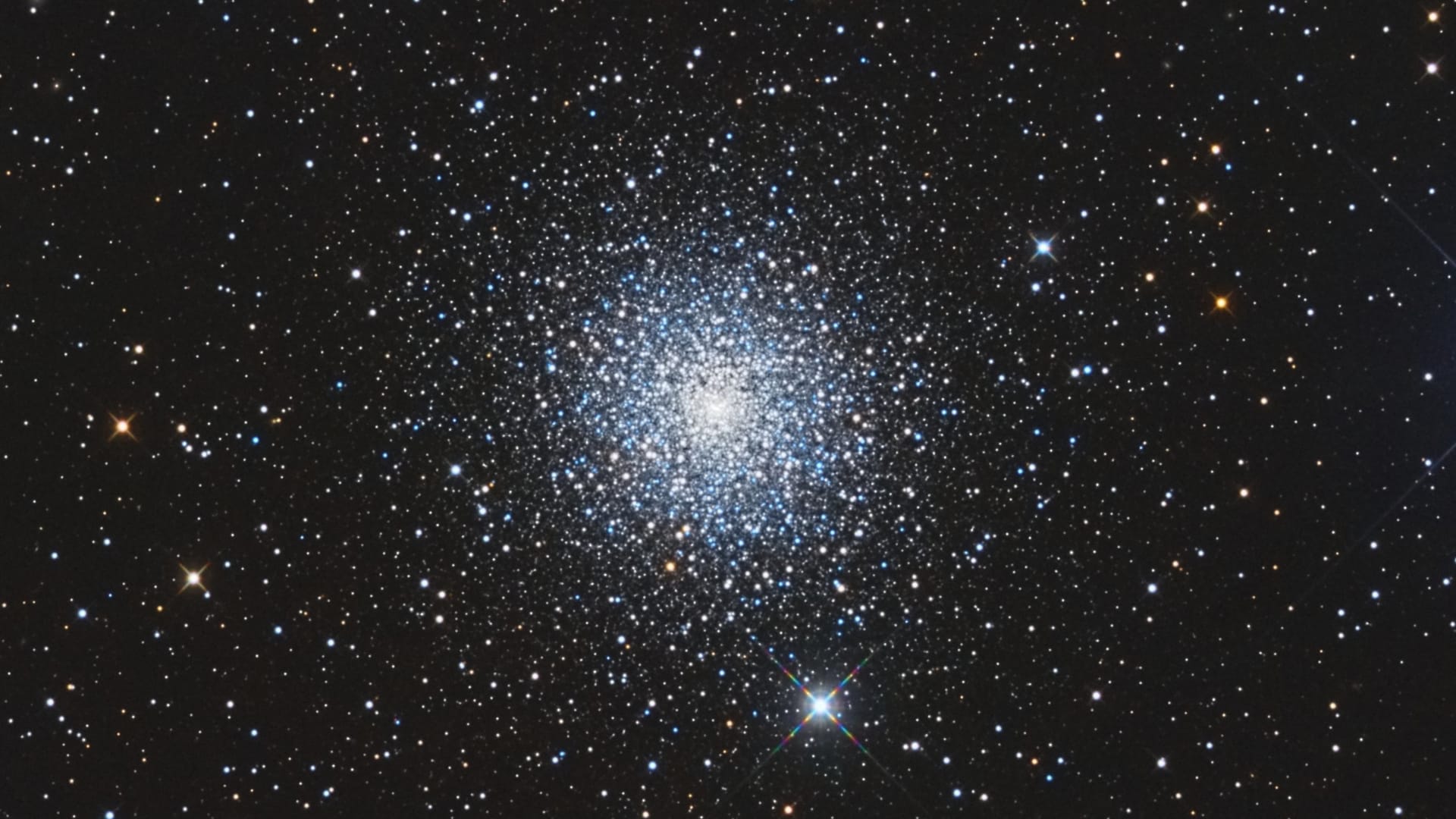
The Great Pegasus Cluster (M15, NGC 7078) is the only Messier object in the constellation Pegasus. It is a globular star cluster located about 35,000 light-years from Earth. Roughly 13 billion years old, it is one of the oldest and most densely packed globular clusters in the Milky Way. It may be glimpsed with the naked eye under exceptionally dark skies. Through binoculars or a small telescope, it appears as a fuzzy “star”. Medium to large telescopes resolve individual stars.
Stephan’s Quintet
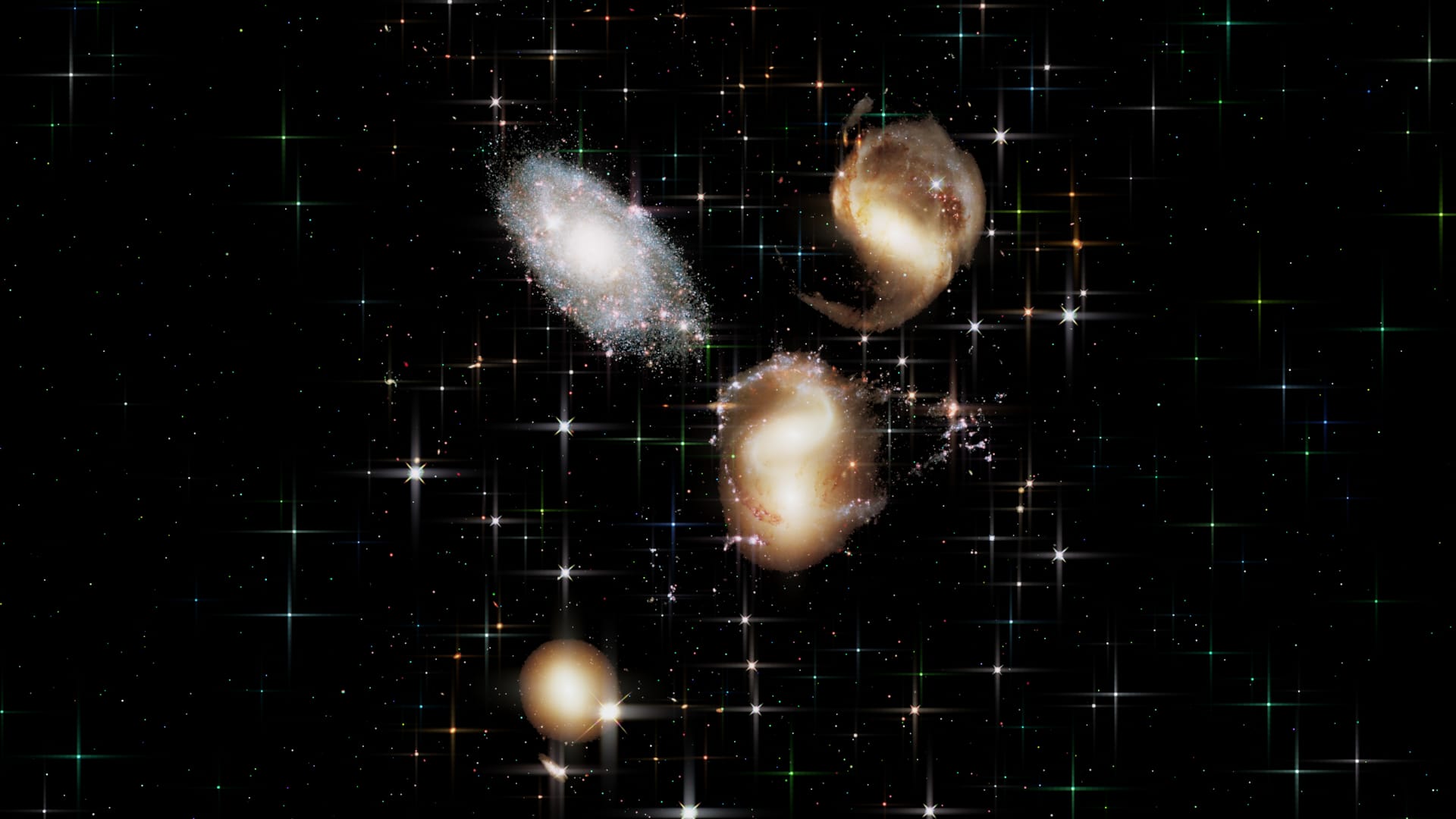
Stephan’s Quintet is a compact group of five galaxies. One member, NGC 7320, lies much closer to us at about 40 million light-years, while the other four (NGC 7317, NGC 7318A, NGC 7318B, and NGC 7319) are located roughly 290 million light-years away and are physically interacting. The group is very faint and difficult to observe visually, requiring a large-aperture telescope and dark skies. Long-exposure astrophotography is the best way to reveal all five galaxies.
Fried Egg Galaxy
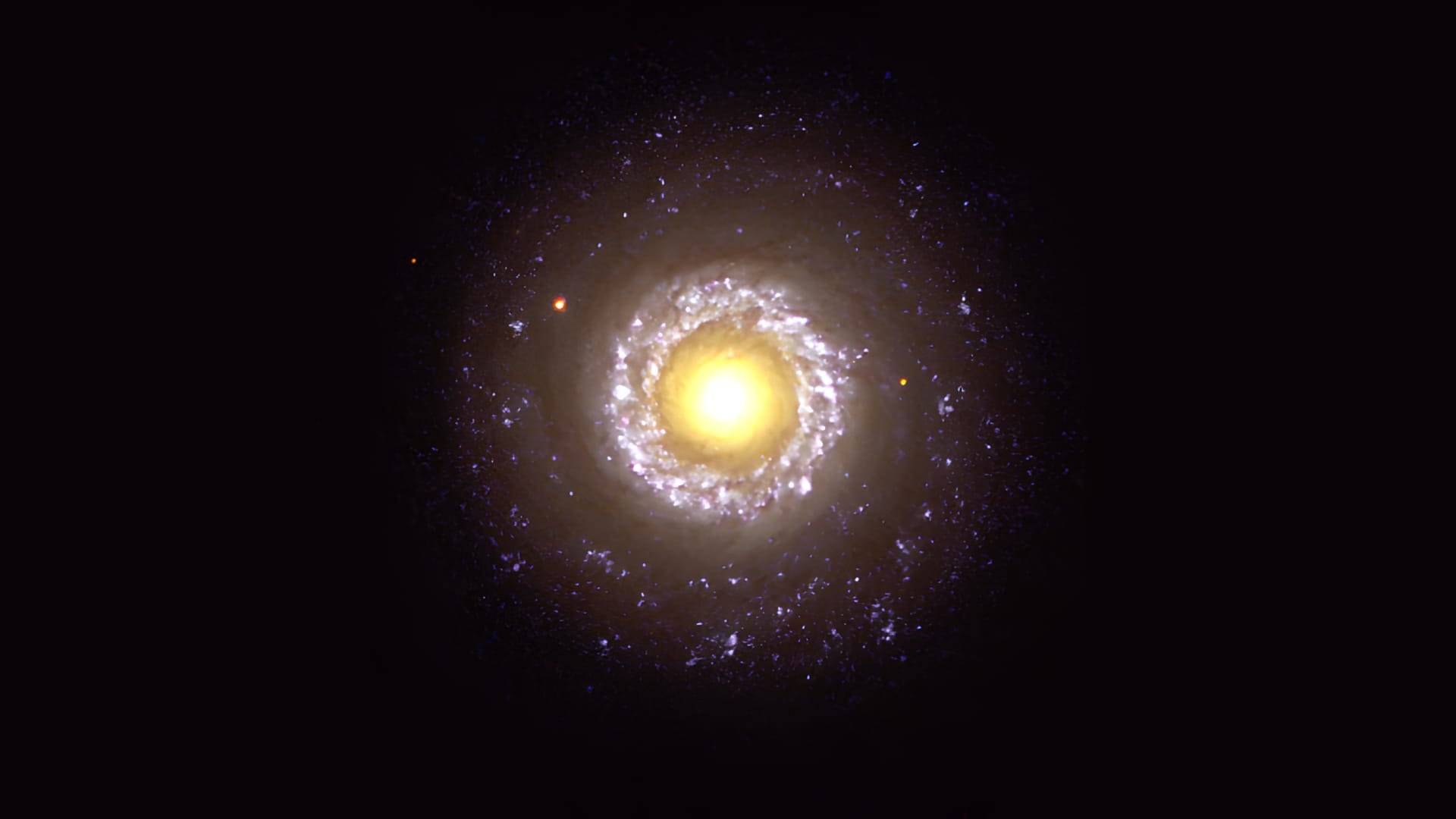
The Fried Egg Galaxy (NGC 7742) is a face-on spiral galaxy located about 72 million light-years away. It is best known for its bright central core surrounded by a smooth, symmetrical ring of stars, giving it the appearance of a fried egg. Unusually, the galaxy has no central bar, even though such bars are typically responsible for forming ring structures in spiral galaxies. This makes the origin of NGC 7742’s ring especially intriguing. Visually faint, it is best observed with medium to large telescopes.
Who is Pegasus: the myths about the winged horse
Pegasus is an ancient constellation linked to the Greek myths of Perseus and Andromeda. In legend, Pegasus was a magnificent winged horse born from the blood of the Gorgon Medusa when she was slain by the hero Perseus. As her blood touched the earth, Pegasus sprang forth, already able to fly. Perseus later rode Pegasus while rescuing Andromeda from a sea monster. This myth is reflected in the sky by a group of neighboring constellations that share a common story. You can see Pegasus, Perseus, Andromeda, and Cassiopeia together in our Instagram video, where their shapes and legends are woven into a short poem that brings their stories to life.
Pegasus then became central to the legend of the hero Bellerophon, whom he helped defeat the fearsome Chimera – a fire-breathing creature with the body of a lion, a goat’s head, and a serpent’s tail. After this victory, Bellerophon attempted to ride Pegasus to Mount Olympus. Offended by the hero’s arrogance, Zeus sent a gadfly to sting Pegasus, causing it to buck and throw Bellerophon back to Earth.
After that, Pegasus was stabled with other steeds belonging to Zeus. It became the god’s loyal steed, carrying his thunderbolts during battle. As a reward for the winged horse’s loyalty and bravery, Zeus placed Pegasus in the sky as a constellation.
Constellation Pegasus: to sum up
Pegasus is the 7th-largest constellation in the night sky and is best seen from September to November. It is best known for the Great Square of Pegasus asterism and is surrounded by other bright star patterns, making it relatively easy to locate. For an even easier way to find the constellation and explore its most interesting objects, try using the Sky Tonight app!