The Equuleus Constellation Guide: Find the Little Horse in the Night Sky
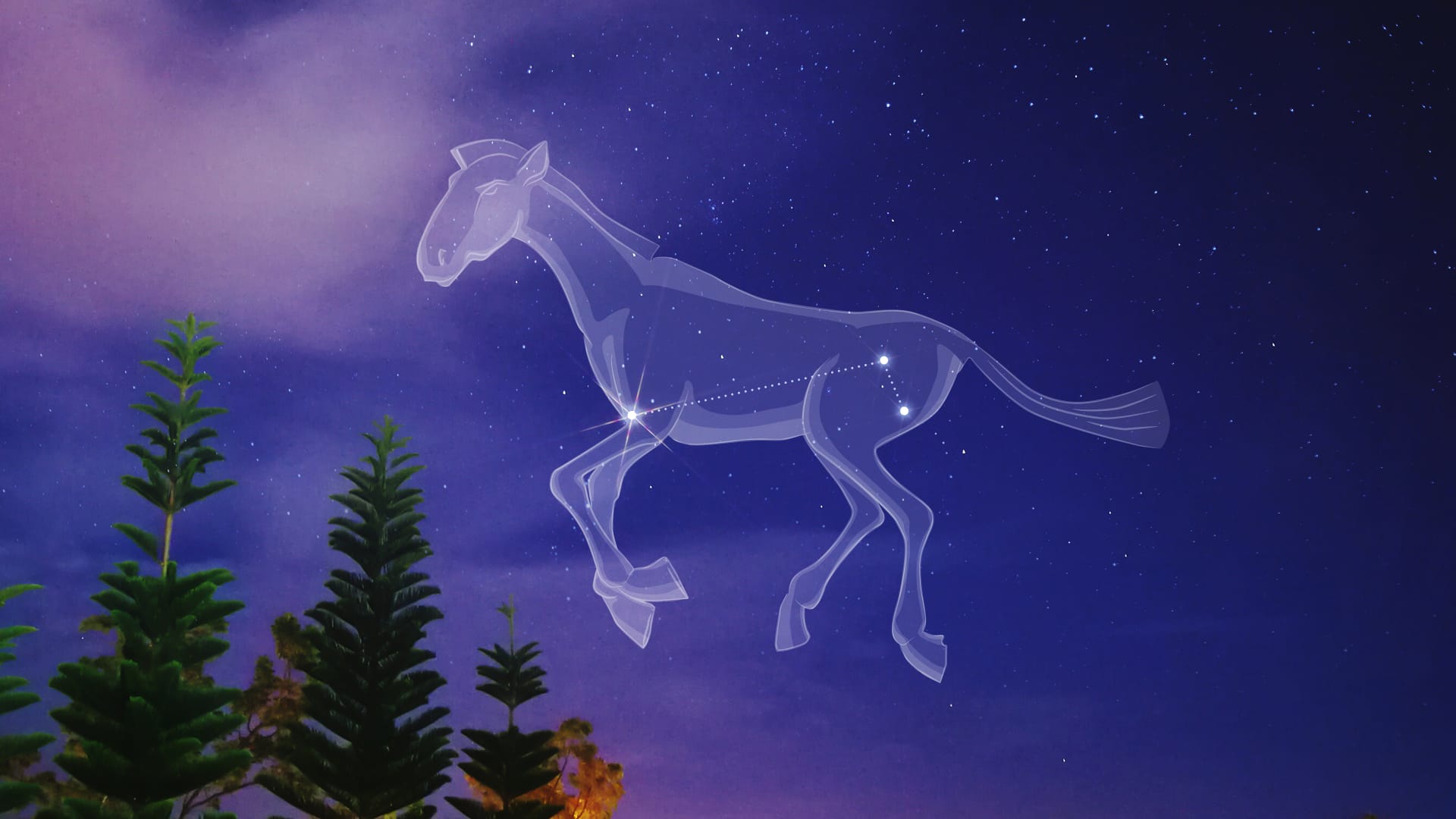
Get to know the Little Horse! In this guide, you’ll learn when the constellation Equuleus is best visible, where to look for it, and what stories it holds. Want the easiest way to find it from your exact location? Open the free Star Walk 2 app, type “Equuleus” in search, and find the tiny constellation in no time!
Contents
- Equuleus Constellation Facts
- Equuleus Location & Visibility
- Major Stars of Equuleus
- Deep-Sky Objects of Equuleus
- Equuleus Constellation Myth – The Story of the Little Horse Constellation
- What Is the Equuleus Constellation?
Equuleus Constellation Facts
- Name: Equuleus (the Foal)
- Abbreviation: Equ
- Size: 72 sq. deg.
- Right ascension: 20h 56m - 21h 26m
- Declination: from 13° to 2°
- Visible between: 90°N – 80°S
- Brightest star: Kitalpha (Alpha Equ)
- Main stars: 3
- Bordering constellations: Aquarius, Delphinus, Pegasus
Equuleus Location & Visibility
Equuleus lies just north of the celestial equator, visible from most of the world, but only if you’re determined enough to find it. It’s the second-smallest constellation in the sky after Crux, so it’s easy to overlook. In this guide, we’ll show you exactly where Equuleus is and the simplest way to find it.
How to find Equuleus?
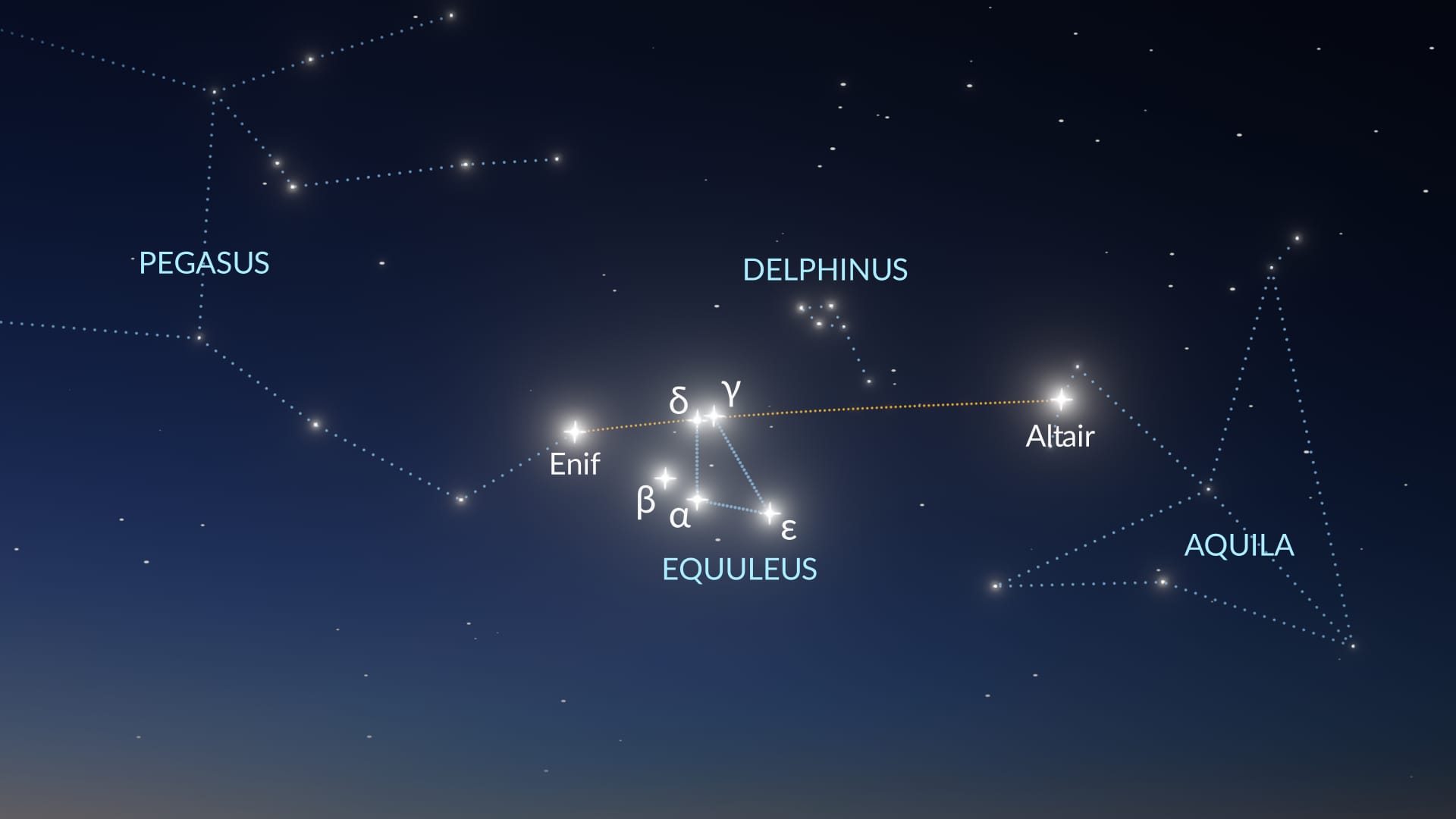
Equuleus isn’t especially hard to locate on a star map, but its faint stars can make it tricky to see from light-polluted areas. Look for it between Enif (the brightest star in Pegasus) and Altair (the brightest star of Aquila), near the small, diamond-shaped pattern of the constellation Delphinus.
Enif is easy to find – it lies west of the Great Square of Pegasus – a large, prominent asterism within the constellation Pegasus. Altair is one of the brightest stars in the night sky and forms a corner of the Summer Triangle, alongside Vega and Deneb. The Summer Triangle shines high overhead during Northern Hemisphere summer and autumn nights. You can also identify Altair by its two “companions,” the fainter stars Tarazed and Alshain, which flank it on either side.
Once you’ve found Enif and Altair, imagine a line connecting them: Delta and Gamma Equulei, the stars forming the head of the Little Horse, sit on that line. The constellation’s brightest star, Kitalpha (Alpha Equulei), along with Beta Equulei, lies a bit south of the line.
Not sure if you’re looking in the right direction? Open the free Star Walk 2 app, point your device at the sky, and it will instantly show which constellation you’re seeing. You can also search for Equuleus right in the app to find the constellation with no hassle.
Where and when is Equuleus visible?
The Little Horse constellation is easiest to spot in the Northern Hemisphere in autumn, with the best views around October. Look toward the southern sky in the late evening, when the constellation climbs higher. Located in the fourth quadrant of the northern celestial hemisphere, Equuleus is visible from latitudes 90° to −80°. This means it can be seen from places like Canada and the USA, Europe, and also from the northern parts of Australia, Chile, and Argentina.
Major Stars of Equuleus
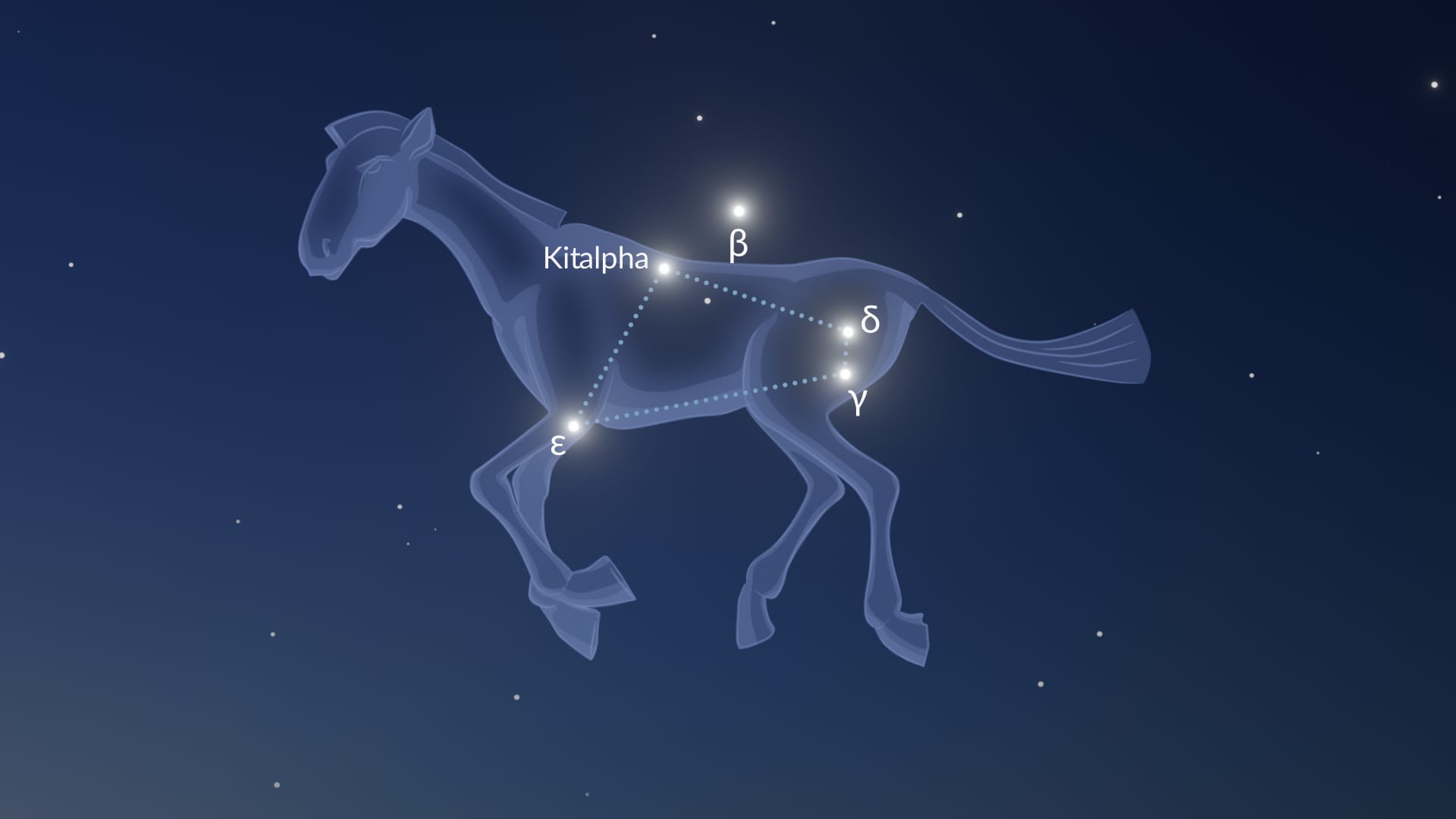
Equuleus is a faint constellation with no stars brighter than magnitude 3. Its brightest star is Kitalpha (Alpha Equulei) at magnitude 3.9. It’s also the only star in Equuleus with the traditional name, officially recognized by the International Astronomical Union (IAU).
Kitalpha – α Equulei (Alpha Equulei)
Kitalpha, the brightest star in Equuleus with a magnitude of 3.9, is located about 190 light-years away. It is a spectroscopic binary. The primary star is a yellow giant of the G7III spectral type, paired with a hotter, smaller white main-sequence star. The name Kitalpha comes from the Arabic phrase qiṭ‘a(t) al-faras, meaning “a piece of the horse.”
δ Equulei (Delta Equulei)
Delta Equulei, the second-brightest star in the constellation (combined magnitude 4.5), lies about 59 light-years away. It is a binary system of two similar F7V main-sequence stars that orbit each other every 5.7 years. Both stars are slightly more massive and larger than the Sun.
γ Equulei (Gamma Equulei)
Gamma Equulei is a double star about 118 light-years away that varies between magnitude 4.58 and 4.77. The primary star is a rare rapidly oscillating Ap (roAp) star with unusual chemical abundances and tiny brightness changes occurring approximately every 12 minutes. Its faint companion (magnitude 8.69) sits about 1.26 arcseconds away.
β Equulei (Beta Equulei)
Beta Equulei is a white main-sequence star of spectral class A3V with an apparent magnitude of 5.2. It is located approximately 289 light-years from Earth. It is several times the radius of the Sun and 78 times more luminous. Several nearby “companion” stars are visible in the same area, but they are not physically related to Beta Equulei.
ε Equulei (Epsilon Equulei)
Epsilon Equulei is a multiple-star system with a combined magnitude of 5.2, located around 180 light-years away. Its two main stars, A and B, are F-type stars slightly more massive than our own Sun, and they orbit each other every 101.5 years. A fainter component (mag 7.35) lies about 10″ from the main pair.
Deep-Sky Objects of Equuleus
Because Equuleus lies well away from the Milky Way’s bright star fields, it doesn’t offer any standout deep-sky objects. Its galaxies are very faint, so you’ll need a large telescope and dark skies to see more than a smudge – these targets are often better suited to an observatory night.
Near the constellation’s center is the spiral galaxy NGC 7040 (mag 14.9), about 257.5 million light-years away, discovered by Mark Harrington in 1882. Less than 2° from Gamma Equulei, you can find another spiral, NGC 7015 (mag 13.25), roughly 203.2 million light-years away and discovered by Édouard Stephan in 1878. In the southern part of Equuleus lies the barred spiral NGC 7046 (mag 13.75), about 193 million light-years from Earth, discovered by William Herschel in 1790.
Equuleus Constellation Myth – The Story of the Little Horse Constellation
Equuleus literally means “Little Horse” (or Foal) in Latin. In Greek myth, the constellation is often linked to Celeris, a swift foal whose name translates as “speed” – said to be the offspring of Pegasus and a gift from Mercury to Castor.
Another interpretation connects Equuleus to a horse that sprang forth when Neptune struck the ground with his trident during his contest with Athena. Because this small group of stars rises before Pegasus, it was sometimes called Equus Primus – the “First Horse.”
Equuleus is also linked to Hippe, Chiron’s daughter, who became pregnant by Aeolus and fled to the mountains to hide her shame. When Chiron searched for her, Hippe begged the gods to keep her concealed, and they transformed her into a mare, with Artemis placing her in the sky. In this telling, she still seems to “hide” from Centaurus: only her head appears, peeking out from behind Pegasus.
What Is the Equuleus Constellation?
Equuleus may be tiny and faint, but it’s a rewarding find once you know where to look – tucked between Pegasus, Delphinus, and Aquarius. Its highlight is Kitalpha, the constellation’s brightest (and only officially named) star, while its deep-sky objects are mostly dim galaxies best left for large telescopes and dark skies. To spot Equuleus without guesswork, open Star Walk 2, search for “Equuleus,” follow the on-screen guide, and enjoy the view of the Little Horse galloping across the sky!
If you like hunting unusual constellations, try our quiz on obsolete and strange constellations. Learn which ones are real!