Mir Space Station – From Its 1986 Launch to 2001 Deorbiting
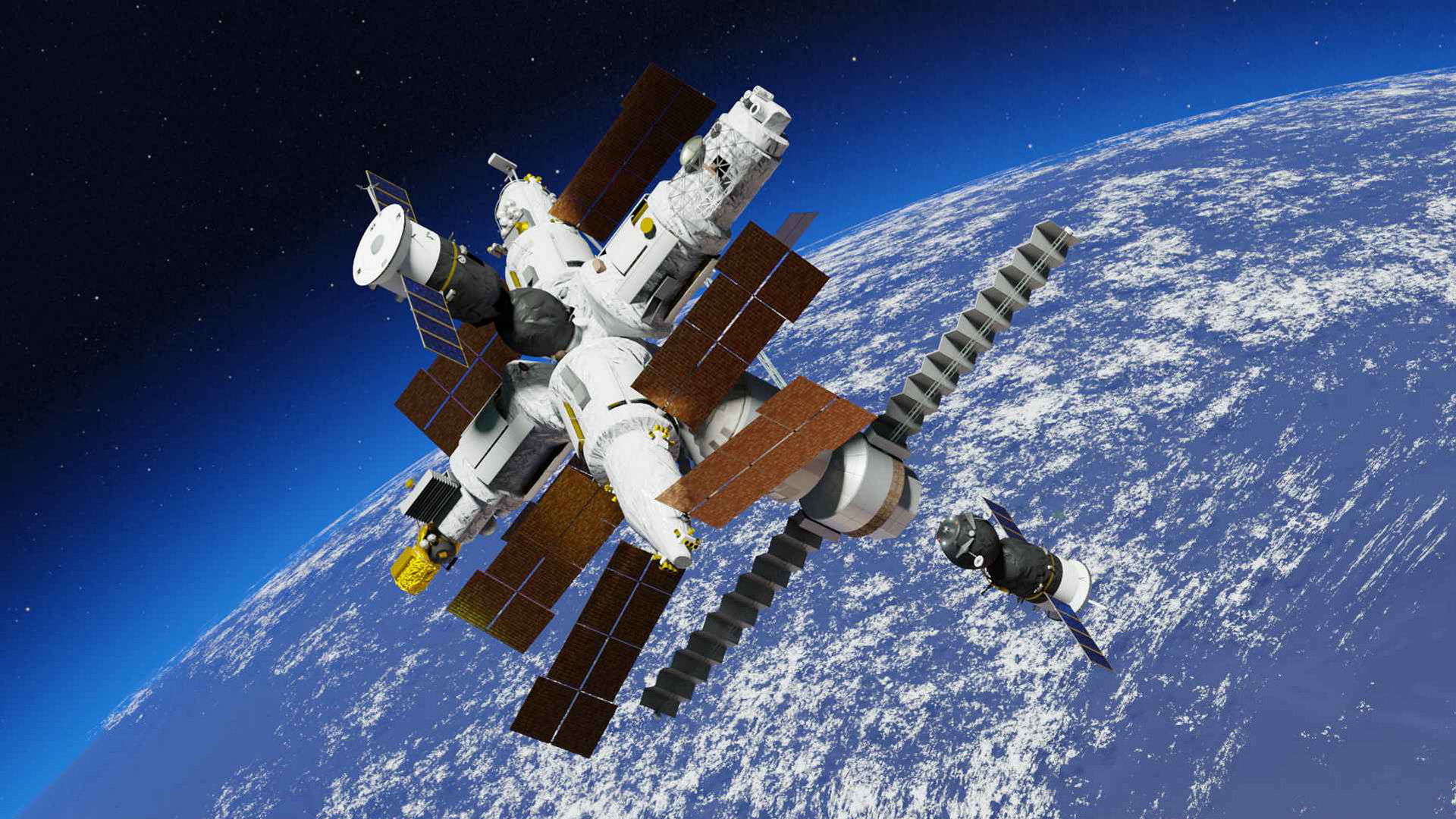
On February 20, 1986, the Soviet Union launched the core module of the Mir Space Station into orbit. Mir was the first space station specifically designed as a modular, long-duration orbital complex. This guide covers Mir’s history and its contribution to our knowledge about space.
Contents
- Quick facts: Mir Space Station
- When did the construction of the Mir Space Station start?
- What was Mir used for?
- What happened to the Mir Space Station?
- Mir Space Station FAQ
- What was the successor to Mir?
- Soviet Space Station Mir: summary
Quick facts: Mir Space Station
- Type: modular space station
- In orbit: 1986–2001
- Launch date and time (core module): February 20, 1986, 00:28 Moscow Time (February 19, 21:28 GMT)
- Meaning of the name: “Mir” means “peace” and also “world/community” in Russian.
- Main operator: Soviet space program; later the Russian space agency (Roscosmos).
- Why it matters: Mir pioneered long-duration living in space and helped shape the International Space Station (ISS).
- Biggest incidents: A major fire (February 23-24, 1997, depending on the timezone) and a collision with the Progress cargo ship (June 25, 1997)
- End of mission: intentionally deorbited on March 23, 2001.
You can also watch our video about the Mir space station for a quick visual recap.
When did the construction of the Mir Space Station start?
The idea of the Mir Space Station emerged in the late 1970s. Having already launched a series of single-module orbital stations named Salyut, the USSR began considering building a multi-module station for long-term use.
The construction process started in 1976. In total, 280 organizations worked on this ambitious project. In 1986, the Soviet Union successfully launched the core module into orbit, and over the next 10 years, six additional modules were added to it. The core module provided the astronauts' main living quarters, while other modules primarily housed scientific equipment. With its seven modules, Mir weighed about 130 tons and was the largest artificial satellite in Earth’s orbit at that time.
What was Mir used for?
Mir was primarily used as a space laboratory for scientific research. The crew conducted about 23,000 experiments and studies in biology, physics, astronomy, and meteorology. The main goal was to develop technologies required for living in space. A notable example of an experiment conducted on Mir is growing the first crop of wheat grown from seed to seed in outer space.
The Mir crew also set records for the longest single stay in space. Russian astronaut Valeri Polyakov lived aboard Mir for a single stay of 437 days, 17 hours, and 38 minutes. NASA astronaut Shannon Lucid set the record for women, having spent 188 days and 4 hours in orbit. The astronauts’ experiences had large scientific value and contributed greatly to the biomedical studies of long-term human spaceflight.
The station was also used as a place for international cooperation. Over its lifetime, Mir hosted 125 astronauts from 12 different countries, including the United States, France, Germany, and Japan. In 1995, during the collaborative space program called Shuttle-Mir, the American shuttle Atlantis docked with the Mir station for the first time. It became the first US spacecraft to dock with a Soviet spacecraft since the Apollo-Soyuz Test Project in 1975.
What happened to the Mir Space Station?
Unfortunately, Mir’s history was not only about achievements and world records. The station survived multiple accidents, including a fire and a crash with the Progress supply vehicle in 1997, which threatened the crew's safety.
Also, by 2001, the station’s systems were in a relatively poor condition and could fail at any time. It’s not surprising, since initially Mir was supposed to have a lifespan of only five years. However, the station was used for fifteen years and outlived the country in which it was designed and constructed.
Due to several dangerous accidents and technical and financial constraints, Mir was deorbited on March 23, 2001. Most of the station’s parts burned in the Earth’s atmosphere; the unburned fragments fell into the “spacecraft cemetery” in the southern Pacific Ocean.
Although Mir is no longer functioning, it made a great contribution to the progress of the world’s space science. The station’s modular design formed the technological basis of its immediate successor – the ISS. The cross-cultural collaboration that is now the norm on the ISS began on the Mir station.
Mir Space Station FAQ
Is the Mir space station still in orbit?
No, the Mir space station is not in orbit now. It was intentionally deorbited on March 23, 2001, and broke up during a controlled reentry over the South Pacific Ocean.
What happened to the Mir space station when the Soviet Union collapsed?
When the Soviet Union collapsed in December 1991, the Mir space station didn’t shut down, but funding and program control shifted to the new authorities, and budgets became tight.
A famous symbol of that chaotic transition was cosmonaut Sergei Krikalev, who was aboard Mir during the dissolution and became known as the “last Soviet citizen.” Because flights were reorganized and replacements were harder to fund and schedule, his planned return was delayed, and he stayed in orbit for 311 days, twice as long as originally planned. While orbiting, he reportedly relied on radio contacts to piece together news of the changing world below.
What caused the fire aboard the Mir space station?
The fire aboard the Mir space station on February 23-24, 1997 (depending on the time zone), was caused by the malfunction of a solid-fuel oxygen-generating canister. The canister burned uncontrollably for about 14 minutes, spraying molten metal and producing thick smoke. The exact cause of the malfunction could not be definitively determined because the device was largely destroyed by the fire. However, investigations suggested that it might have been contaminated by a piece of latex glove introduced during manufacturing. Fortunately, no one was killed, and the station's hull was not compromised.
What was the successor to Mir?
The successor to Mir was the International Space Station (ISS) – the next long-term orbital outpost, which began continuous crewed operation in 2000, before Mir was deorbited in 2001. Want to test what you know about the ISS? Tap the link and take the International Space Station Quiz!

Soviet Space Station Mir: summary
Mir was the first operational long-term modular space station and remained in orbit for 15 years, from 1986 to 2001. The core module was launched on February 20, 1986 (local time), and the station was intentionally deorbited on March 23, 2001, with surviving fragments falling into the South Pacific.
If you want to learn more about the Mir Space Station, download the Solar Walk 2 app. It includes an interactive model of the Solar System and information about famous space missions. Launch the app, tap the magnifier icon, and type “Mir” in the search field. You will see a realistic 3D model of the station and have access to more historical facts about it.
Thanks for reading this article. Please share it with your friends if you liked it!