Where Are the Pleiades Tonight? Meet the Seven Sisters Star Cluster
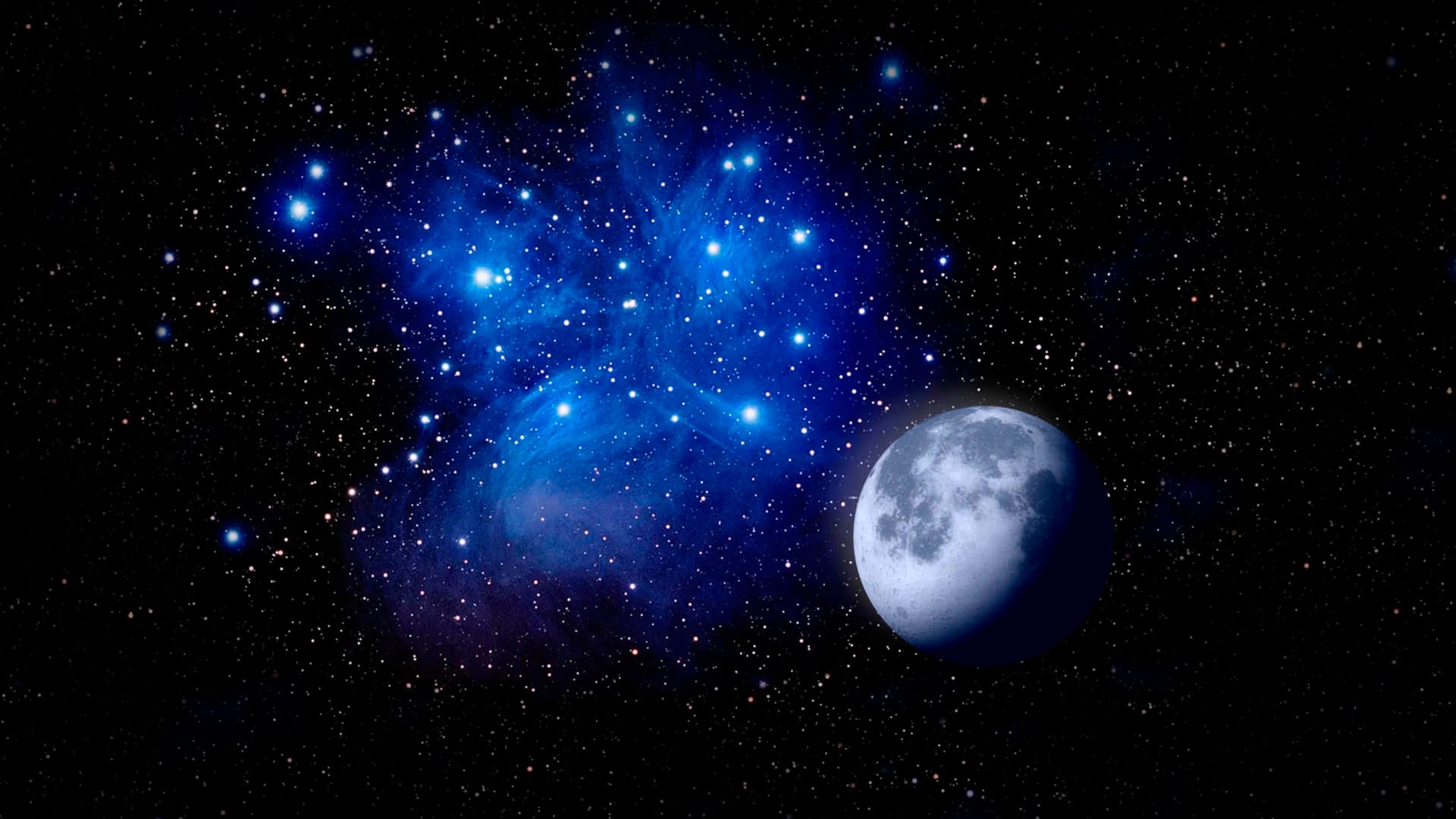
The Pleiades are a prominent, easy-to-spot deep-sky object. This hazy “dipper” is so bright you can see it with the naked eye! To quickly find the Pleiades in the sky from your location, use the free Sky Tonight app. Now, let’s learn more about this fascinating star cluster.
Contents
- Pleiades Star Cluster: Quick Facts
- Where Is the Pleiades Star Cluster Tonight?
- Why Are the Pleiades Not a Constellation but a Star Cluster?
- Moon And the Pleiades Tonight: Next Events 2026
- How to Photograph the Pleiades Tonight?
- How Big Is the Pleiades Star Cluster?
- Stars of the Pleiades Cluster
- Pleiades Star Cluster in Myths And Legends
- The Life Cycle of the Pleiades
- 4 Fun Facts About the Pleiades
- F.A.Q.
- Pleiades star cluster: to sum up
Pleiades Star Cluster: Quick Facts
- What it is: a bright open star cluster, also known as the Seven Sisters, M45, or Subaru
- Where it is: in the constellation Taurus, near the ecliptic
- How big it is: ~2° across (four times the Moon’s diameter)
- Best time to see it in the Northern Hemisphere: October–February
- Best time to see it in the Southern Hemisphere: November–March
- How to find it tonight: look for Orion’s Belt, then follow the line toward Taurus, or use Sky Tonight to locate it instantly
- Visibility: under dark skies, most observers can see six stars with the naked eye

Where Is the Pleiades Star Cluster Tonight?
The Pleiades can be found in the constellation Taurus. In the Northern Hemisphere, they are best seen from late autumn through winter (roughly October to February). In the Southern Hemisphere, the cluster is well placed from about November to March.
Pleiades Location & Visibility
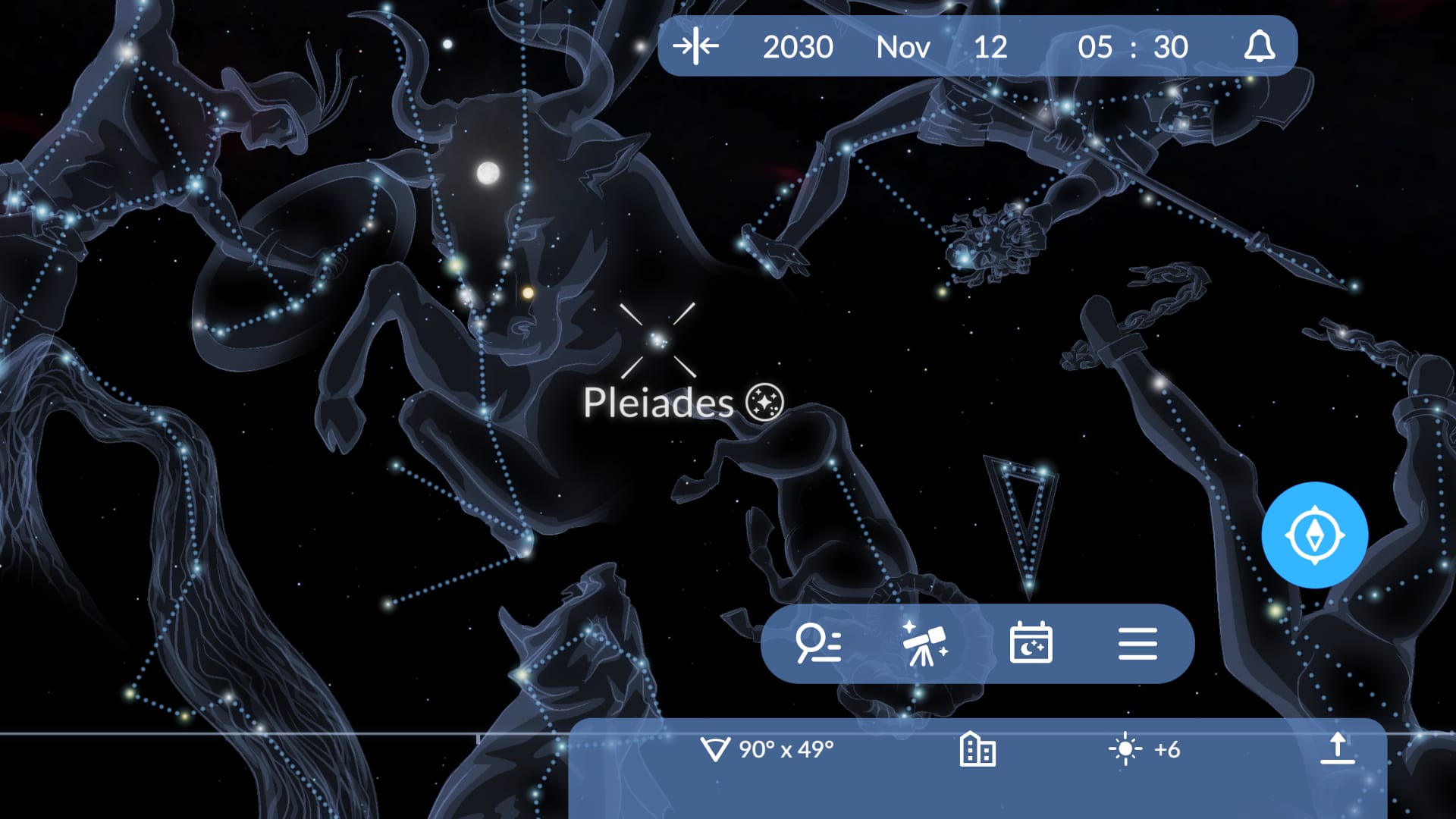
Since the Pleiades sit in the northern half of the sky (about 24° N in declination) and near the ecliptic, they’re visible from essentially all inhabited latitudes; they fail to rise only south of ~66°S. To check the position of the star cluster, use the stargazing app Sky Tonight: launch the app, and tap the magnifier icon at the lower part of the screen. Then type “Pleiades” in the search bar and tap on the target icon opposite the corresponding search result. The app will show the cluster’s current position in the sky, so you can see if it is visible now from your location.
Finding the Pleiades From Orion’s Belt
-
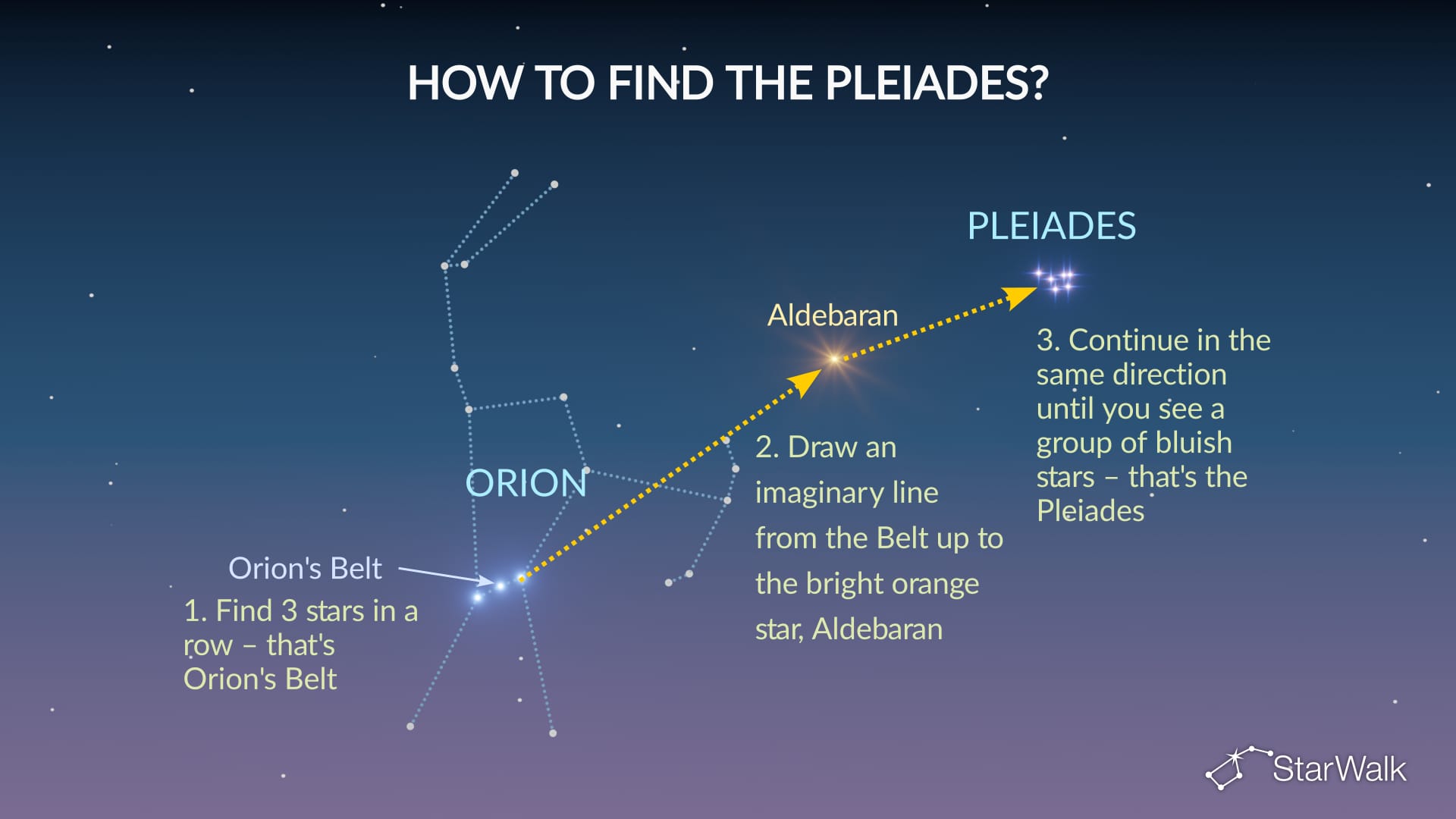
Look for Orion’s Belt — the three bright stars in a straight line.
-
Draw an imaginary line through them toward the bright yellowish star – this is Aldebaran in Taurus.
-
Extend the line from Aldebaran in the same direction, and you will see a small, blue-white cluster — that’s the Pleiades. They appear about four times the diameter of the Full Moon across the sky and resemble a tiny version of the Big Dipper.
Why Are the Pleiades Not a Constellation but a Star Cluster?
The Pleiades are not a constellation – they are an open star cluster in the constellation Taurus. An open star cluster is a loosely bound group of a few dozen to a few thousand young stars that formed from the same giant molecular cloud at the same time.
People often mistakenly call the Pleiades a constellation because the cluster forms a recognizable pattern in the sky, resembling a small "dipper" of bluish stars. However, this is incorrect. A constellation is one of the 88 star patterns officially recognized by the International Astronomical Union (IAU). It is a large region of the sky used for mapping celestial objects. The stars in a constellation may appear close together from Earth, but they are usually not physically related and can lie at vastly different distances.
Moon And the Pleiades Tonight: Next Events 2026
The Pleiades form a tiny swarm of blue stars, their faint light scattered across a region four times wider than the Moon. Occasionally, the Moon drifts past the Pleiades and even glides right across the cluster, hiding its stars one by one — a fascinating event called a lunar occultation. You can use Sky Tonight to see whether the Moon and the Pleiades are visible in your sky during these encounters. And if the occultation isn’t observable from your area, switch your location in the app and zoom in on the Moon to watch how the event unfolds from other parts of the world.
May 16: Pleiades near the Moon; lunar occultation of the Pleiades
- Close approach time: May 17, 02:40 GMT (May 16, 10:40 PM ET)
- Close approach distance: 0°04'
- Occultation start: May 16, 23:34 GMT (7:34 PM ET)
- Occultation end: May 17, 04:41 GMT (12:41 AM ET)
On the night of May 16–17, the New Moon will pass near the Pleiades. But you likely won’t be able to see the scene: the Moon is essentially invisible at the New Moon phase, and both objects will be located too close to the Sun in the sky.
In some places, the Moon will even briefly cover the cluster, making it seem as if the stars “vanish” for a while, but the event happens too close to the Sun’s glare to be safely observed. Remember: never point binoculars or a telescope at or near the Sun without proper solar filters, as it may damage your optics and your eyes.
June 13: Pleiades near the Moon; lunar occultation of the Pleiades (best visible in the west!)
- Close approach time: 13:30 GMT (9:30 AM ET)
- Close approach distance: 0°56'
- Occultation start: 10:18 GMT (6:18 AM ET)
- Occultation end: 15:25 GMT (11:25 AM ET)
On June 13, the very thin waning crescent Moon will pass close to the Pleiades star cluster. The pair will be visible early in the morning, before sunrise. Since the Moon will be in its waning crescent phase, it won’t overshine the cluster, so both objects may be visible to the naked eye. For the best chance to spot them, find a place with a clear, unobstructed horizon.
In some regions, the Moon will pass in front of the Pleiades. This occultation is the year’s best for the western part of the world. The lunar occultation will be visible across central North America, Mexico, Central America, and the western regions of South America.
How to Photograph the Pleiades Tonight?
The Pleiades are one of the most rewarding deep-sky targets for beginner astrophotographers. Their bright blue stars and surrounding reflection nebulae look stunning in long-exposure images, even with basic equipment.
Use the Right Gear
A DSLR or mirrorless camera on a solid tripod is all you need to start. Use a 50–85 mm lens to capture the whole cluster, or 100–200 mm if you want to zoom in on its bright center. If you have a star tracker, it’ll help you take longer shots without the stars turning into streaks. A remote shutter or self-timer will keep the camera steady, and a dew heater helps if the lens fogs up.
Find a Dark Sky
The delicate blue glow around the Pleiades is easily washed out by light pollution. Choose a location far from city lights and shoot when the Moon is below the horizon or during its crescent phase.
Exposure Settings
Start with ISO 800–1600, f/2.8–f/4, and take short exposures (around 5–10 seconds) if you don’t have a tracker. With a tracker, you can go up to 30–120 seconds.
Take lots of shots and later stack them on a computer. This reduces noise and brings out more detail. Always shoot in RAW, and if possible, take a few dark and flat frames to help clean up your final image.
Focus Carefully
Pick a bright star, like Alcyone (brightest star in the Pleiades), zoom in using a live view, and focus until the star looks as small and sharp as possible. Then switch off autofocus and don’t touch the focus ring; you can even tape it in place.
Check focus from time to time, especially if the temperature changes, because as the night gets colder, the lens and camera parts slightly contract, and the focus may shift, making stars look blurry.
Plan Your Shot
You can use Sky Tonight to see when the Pleiades are highest in your sky and to plan the framing with the Moon or nearby constellations.
How Big Is the Pleiades Star Cluster?
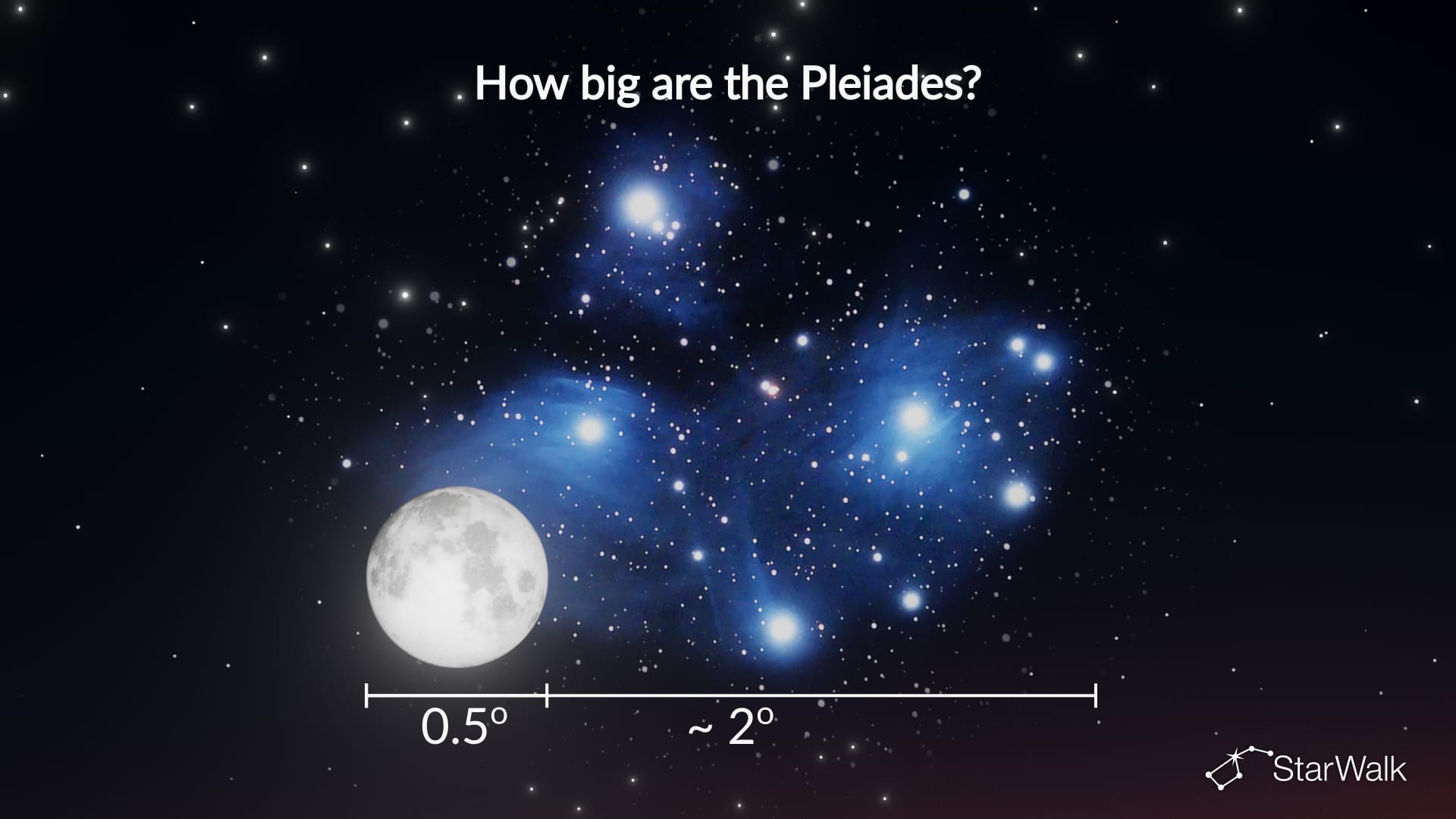
In the sky, the Pleiades look compact but still cover a surprisingly large area: the main visible group spans about 2 degrees across, or roughly four times the apparent width of the Full Moon.
In space, the familiar bright core of the Pleiades contains about 1,000 to 1,500 stars. However, the research published in late 2025 using NASA's TESS and ESA's Gaia data suggested that the Pleiades are actually the dense central part of a much larger stellar structure called the Greater Pleiades Complex. This extended complex contains more than 3,000 associated stars, spans about 1,900 light-years, and includes several known star clusters that likely formed from the same giant molecular cloud.
Stars of the Pleiades Cluster
The Pleiades, or the Seven Sisters, are an open star cluster, which means their stars are true stellar siblings: they formed from the same giant cloud of gas and dust and still travel through space together. The brightest members of the cluster are hot, blue-white stars that shine hundreds of times more brightly than the Sun. Because these massive stars burn through their fuel quickly, they will live for only a few hundred million years – far less than the Sun’s multi-billion-year lifetime.
The brightest stars in the cluster are named after figures from Greek mythology: the Seven Sisters — Alcyone, Electra, Maia, Merope, Taygeta, Celaeno, and Asterope/Sterope — and their parents, Atlas and Pleione. Here are the brightest Pleiades stars, sorted by apparent magnitude:
- Alcyone (25 Tauri): 2.87
- Atlas (27 Tauri): 3.63
- Electra (17 Tauri): 3.70
- Maia (20 Tauri): 3.87
- Merope (23 Tauri): 4.14
- Taygeta (19 Tauri): 4.30
- Pleione (28 Tauri): 5.05
- Celaeno (16 Tauri): 5.45
- Sterope I (Asterope, 21 Tauri): 5.76
- Sterope II (22 Tauri): 6.43
How Many Stars Are Visible in the Pleiades?
Most people can spot six Pleiades stars with the naked eye at a glance. However, the longer you look, the more stars you see, given an acute vision and clear skies without light pollution. An American astronomer Robert Burnham Jr. claimed to see 20; most people see no more than 14. Binoculars or a wide-field, low-power telescope give the best view of the whole cluster. Higher magnification can reveal fainter stars, but it will show only part of the Pleiades at once. All the brightest stars can be found within roughly a 1.5-2° core.
What Star Is Missing?
If most people see the cluster as a six-star pattern, why is it called the Seven Sisters? The reason is that they may have looked slightly different in ancient times when the name was coined. Back then, naked-eyed observers might have more easily distinguished seven stars in the cluster. Over time, one of them may have become harder to see individually. Our ancestors noticed and reflected it in myths, which we will discuss later.
The change was probably caused by Pleione, the seventh-brightest star of the cluster. It is a shell star that varies in brightness; it may have been somewhat more prominent but faded below naked-eye visibility. One more explanation is that over time, their proper motions brought Pleione and Atlas close enough to each other in the sky that they can appear as a single point to the naked eye.
Pleiades Star Cluster in Myths And Legends
Many cultures have similar stories about the origin of the Pleiades star cluster, possibly inspired by the disappearance of the seventh star. Some scientists believe they were made up 100,000 years ago! When the seventh star vanished, ancient people tried to explain that through myths.
Seven Sisters Star Cluster Could Be the Seven Brothers
For example, the Australian legend tells about the seven sisters who fled into the sky from the old man chasing them; one of the women was captured and saved later. Native Americans had various myths about the seven brothers who rose to the sky while running or dancing in a circle. According to the Cherokee version, one of the boys was caught by his mother and failed to make it to the sky.
The Pleiades And Orion: The Greek Myth
The Greek myth is the most popular version of the story. According to it, the Pleiades were daughters of the titan Atlas and the nymph Pleione. After a chance encounter with the sisters, the hunter Orion fell in love and started chasing them. Zeus decided to protect the girls from the unwanted attention and turned the sisters into doves, so they could fly up and become the stars. Before ascending to the sky, one of the sisters, Merope, was married to a mortal, King Sisyphus. When the gods condemned him to roll a boulder forever, she was so ashamed of him that she hid her face and disappeared from the night sky.
Interestingly, in the myth, it is Merope that is referred to as “the lost Pleiad”. But modern astronomers often point to Pleione (close to Atlas and known for its variable brightness) as a more likely "lost" star that inspired the myth.
The Life Cycle of the Pleiades
The Pleiades, also known as the Seven Sisters, are an open cluster — a family of stars born from the same colossal cloud of gas and dust.
How Were the Pleiades Born?
Their story began when a vast cloud of gas and dust collapsed under its own gravity, heating up until nuclear fusion ignited, giving birth to hundreds of young, brilliant stars, whose brightest members are hot B-type stars. These stars illuminate nearby reflection nebulae — clouds of dust that scatter their light and produce the cluster’s ethereal blue glow.
For a long time, astronomers believed this dust was the remnant of the cluster’s formation. Today, it’s thought that the Pleiades are simply passing through an unrelated cloud of interstellar dust. The cloud is a reflection nebula: dust scatters blue light from the cluster’s hot stars, rather than emitting its own light.
When Were the Pleiades Formed?
In the grand timeline of the Universe, the Pleiades are relatively young, estimated to be about 100-125 million years old. To put this in perspective, dinosaurs appeared on the Earth long before the Pleiades lit up our skies.
How Long Will the Pleiades Last?
The Pleiades are not destined to last forever. Astronomers estimate that the cluster will survive for about 200-400 million years, after which gravitational interactions will gradually disperse its stars.
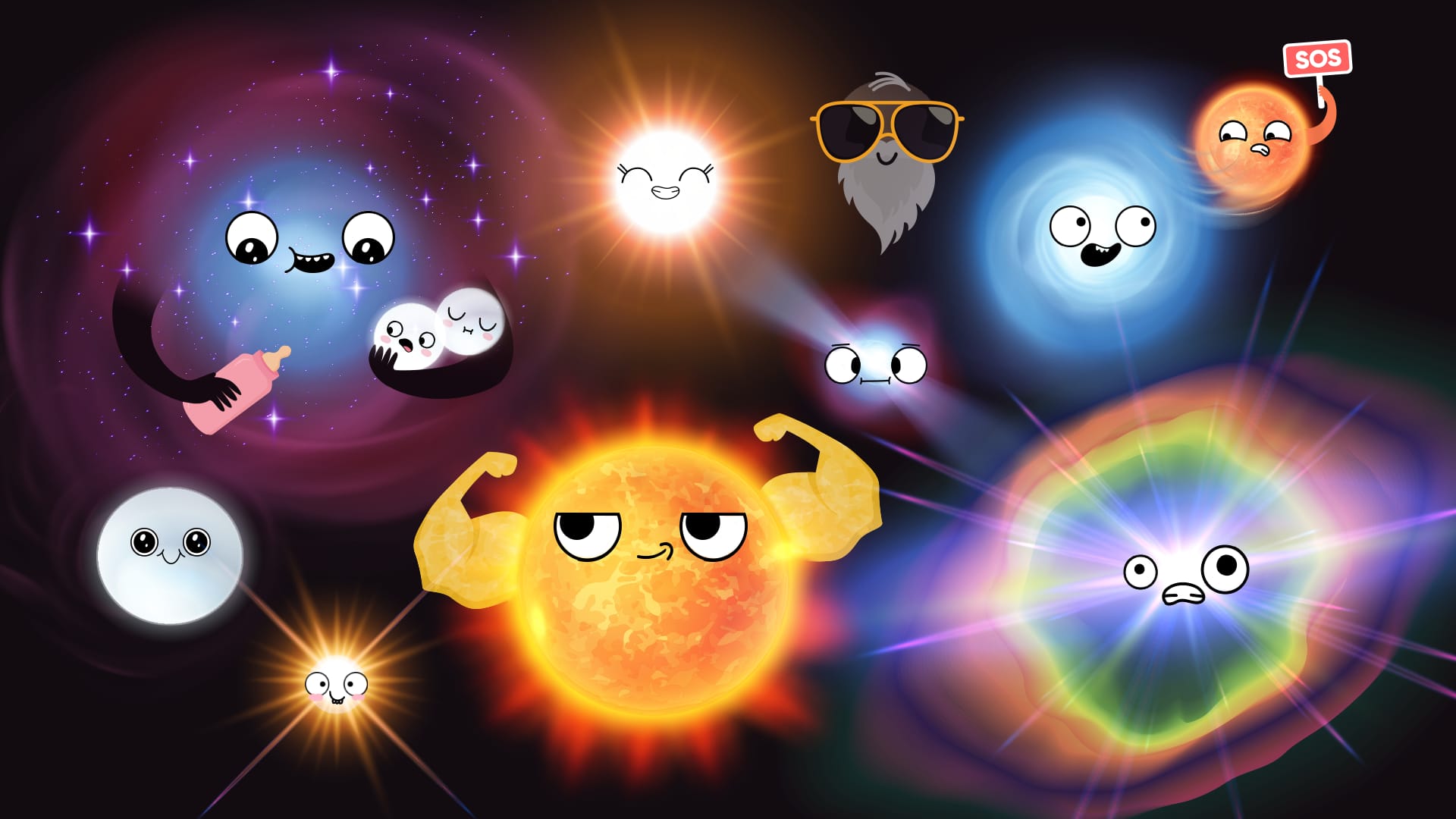
The Pleiades are at the early stage of the stellar life cycle. Their stars are still in the main sequence phase – steadily fusing hydrogen into helium and shining with intense blue light. In hundreds of millions of years, many of their stars will evolve into red giants and eventually fade into white dwarfs, leaving only a trace of their former brilliance. To explore this journey in more detail, see our stellar life cycle infographic.
4 Fun Facts About the Pleiades
-
The Pleiades were mentioned in the Bible three times – all three times along with the constellation Orion.
-
In ancient times, many cultures used the Pleiades as a calendar. By its appearance in the sky, the farmers knew when to start harvesting or planting crops, and the sailors understood when it was time to open the navigation season (the name “Pleiades” was possibly derived from the Greek word meaning “to sail”).
-
The cloud of interstellar dust surrounding the Pleiades is not a part of the cluster. It was believed to be the remnants of the material from which the stars were born. But it turned out that the nebulosity is independent and just happens to be near the Pleiades.
-
The Pleiades inspired the name and the six-star logo of the Japanese car-manufacturing company Subaru (the Japanese name for the cluster). You might have thought the creators wanted to be astronomically accurate and made it look like the Pleiades in the actual night sky. But in fact, the logo illustrates the company's history. In Japanese, “subaru” also means “united”, and the stars represent five small companies that merged into one big – Fuji Heavy Industries, Subaru’s parent company.
F.A.Q.
Are the Pleiades a constellation?
No, the Pleiades are a star cluster – a group of stars that are gravitationally bound and formed from the same molecular cloud. In contrast, a constellation is also a group of stars, but they are not physically bound to one another. There are 88 constellations officially recognized by the IAU.
Read our dedicated article to learn more about constellations and their particular features.
When are the Pleiades visible?
In the Northern Hemisphere, the Pleiades star cluster is best placed from approximately October to February. In the Southern Hemisphere, look from about November to March.
Can you see the Pleiades without a telescope?
The Pleiades are in the top 3 best naked-eye star clusters. Most people see it as a group of six stars, but if you have good eyesight and it's dark enough outside, you can spot up to 14 stars.
Can you see other open clusters near the Pleiades?
Yes! The Pleiades are not the only open cluster in this part of the sky. Just a short distance to the east, within the same constellation of Taurus, you’ll find the Hyades, a nearby open cluster that forms a bright “V” shape marking the bull’s face. Farther along the ecliptic, in the constellation Cancer, lies the Beehive Cluster (M44) — another beautiful open cluster visible to the naked eye under dark skies.
Who discovered the Pleiades?
Galileo Galilei was the first to observe the Pleiades through a telescope. However, the star cluster was known long before that: its “origin story” may date back to 100,000 BC. The name of the first person to see the Pleiades in the sky has not been preserved in history.
How old are the Pleiades?
The answer depends on the age-measuring method. For example, if we compare the Hertzsprung-Russell diagram for the Pleiades and theoretical models of stellar evolution, we get figures from 75 to 150 million years.
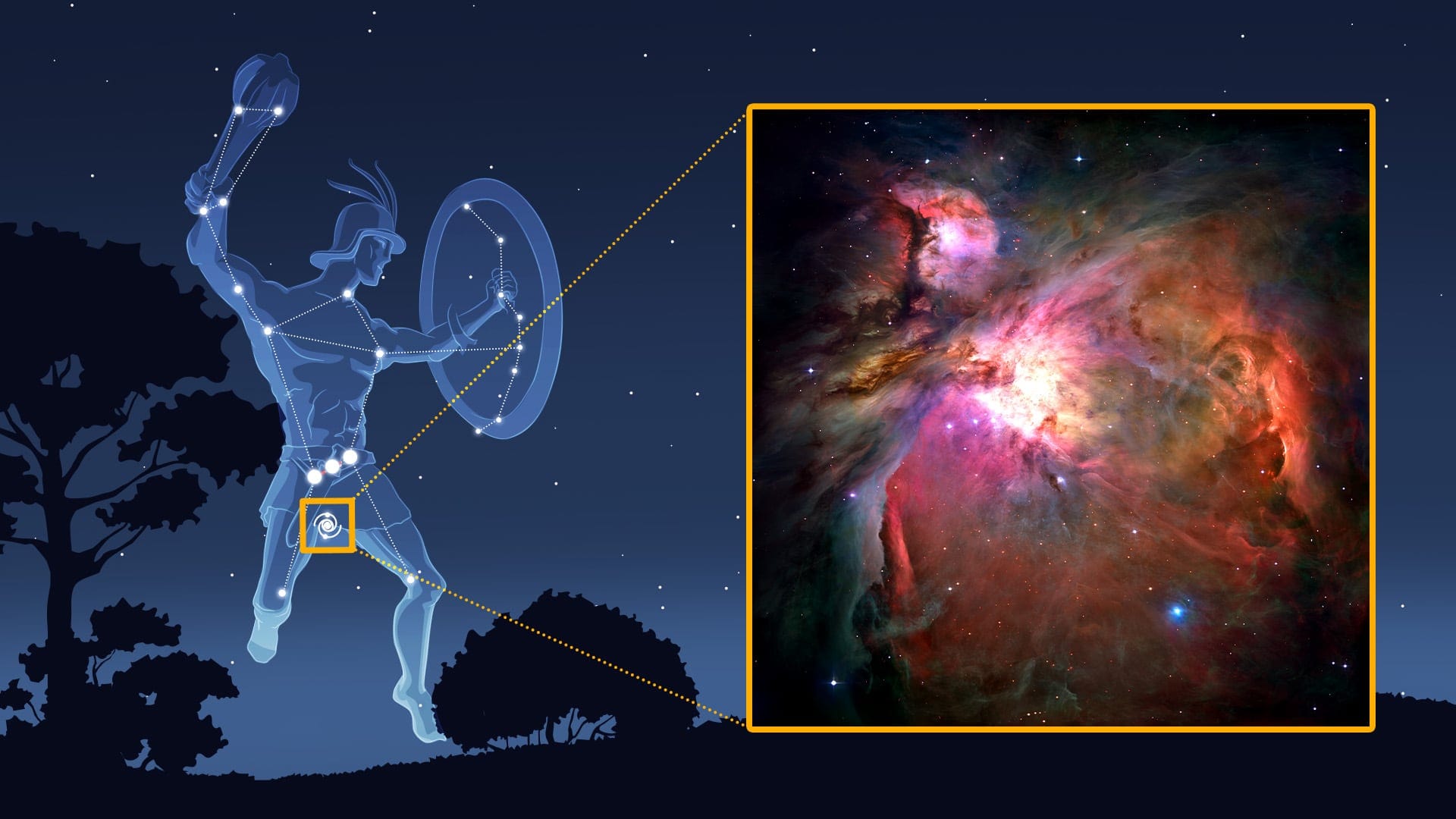
To explore even more easy-to-see star clusters, nebulae, and galaxies, check our infographic on the brightest deep-sky objects. It shows how to find them in the sky and gives tips on observing them.
Pleiades star cluster: to sum up
The Pleiades are an open star cluster and one of the brightest deep-sky objects. Under dark skies, they are visible to the naked eye: most observers can spot six stars resembling a smaller version of the Big Dipper. With the aid of optics, more stars become visible, along with a nebulosity that appears to envelop the star cluster. The Pleiades are a great target for amateur deep-sky observers as they’re bright and easy to see. The Sky Tonight app simplifies locating the Pleiades: with just a few taps, you can find it in the night sky.
We wish you clear skies and happy observations!