What Comet Is Visible Now? Best Comets to Watch in 2026
Looking for the next comet visible from Earth? In this article, we’ve gathered the most promising comets of 2026, with their visibility dates, expected brightness, and observing tips. For real-time comet tracking and visibility forecasts tailored to your location, use the free Sky Tonight app.
Contents
- Next comets visible from Earth in 2026
- Comet 220P/McNaught: unexpected outburst in August 2026
- Comet in late August 2026: 10P/Tempel 2
- Comet in August – September 2026: 169P/NEAT
- Comet in September – December 2026: 161P/Hartley–IRAS
- Comet in December 2026 – February 2027: 2P/Encke
- How to find a comet using Sky Tonight?
- Next comet visible from Earth: Bottom line
Next comets visible from Earth in 2026
In August 2026, two comets are currently worth looking for in the sky: 220P/McNaught and 10P/Tempel 2.
Comet 220P/McNaught unexpectedly brightened in early August and has continued to grow brighter ever since, reaching around magnitude 6. It is currently the brightest comet visible in the sky and can be spotted with binoculars on dark, clear nights, though a small telescope makes it easier to see.
Meanwhile, Comet Tempel 2 is now gradually fading after passing its peak. Its current brightness is around magnitude 9, so you will need at least a small telescope to see it.
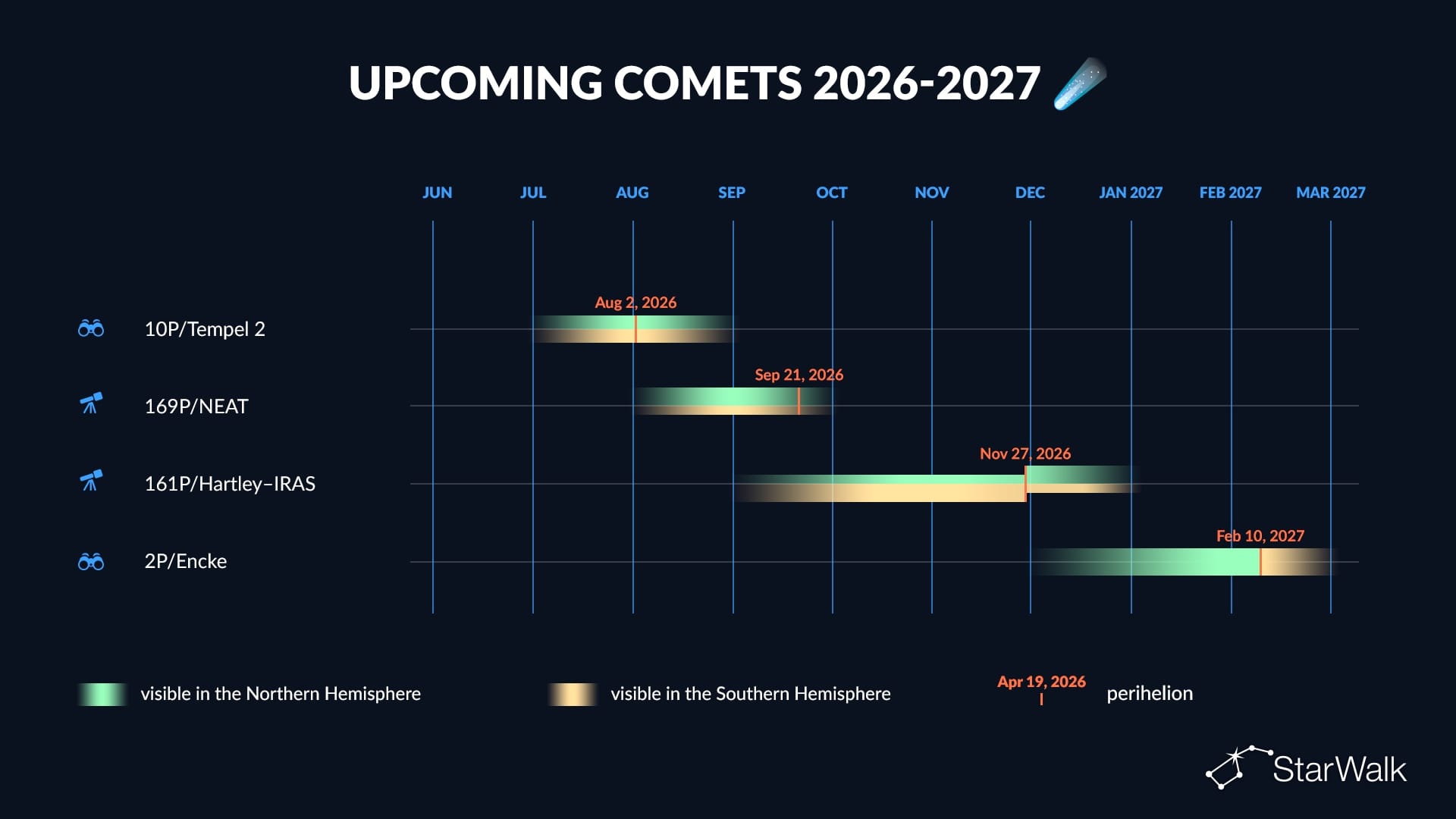
These comets are listed by when they’re actually visible from Earth, not by their perihelion or closest‐approach dates (some aren’t observable at those moments), so refer to each comet’s visibility window highlighted in the title.
Comet 220P/McNaught: unexpected outburst in August 2026
- Latest outburst: August 5, 2026 (~mag 7)
- Perihelion: June 14, 2026 (mag 9.9)
- Closest approach to Earth: October 12, 2026 (mag 10.0)
- Where to observe: Both hemispheres
Will 220P/McNaught be visible from Earth?
Comet 220P/McNaught experienced a major outburst in late May 2026, brightening from about magnitude 18 to magnitude 8.2 — by roughly 8,000 times. After the initial outburst, it began to fade and appeared to have passed its prime. However, on August 5 the comet unexpectedly brightened again and is now shining at around magnitude 6. The exact cause of this renewed activity remains unknown, but such brightenings may occur when a crack, surface collapse, or minor fragmentation exposes fresh volatile-rich material, triggering another release of gas and dust.
220P/McNaught can be observed with binoculars under dark, clear skies, while a small telescope will provide a more reliable view. Since comet outbursts are unpredictable and its brightness may change quickly, try to catch it as soon as possible.
Look for the comet before dawn in the constellation Cetus. In the Northern Hemisphere, the half-lit Moon rises almost simultaneously with the comet, and its glare may make the diffuse object harder to spot. Observers in the Southern Hemisphere have a better opportunity: there is a narrow window of about 30 minutes to search for the comet in a moonless sky, although it will remain low above the eastern horizon.
When was 220P/McNaught discovered?
220P/McNaught was discovered on May 20, 2004, by British-Australian astronomer Robert H. McNaught at Siding Spring Observatory in Australia. It is a Jupiter-family periodic comet that completes one orbit around the Sun in about 5.5 years.
Comet in late August 2026: 10P/Tempel 2
- Perihelion: August 2, 2026 (mag 8.7)
- Closest approach to Earth: August 3, 2026 (mag 8.7)
- Where to observe: Both hemispheres
Will 10P/Tempel 2 be visible from Earth?
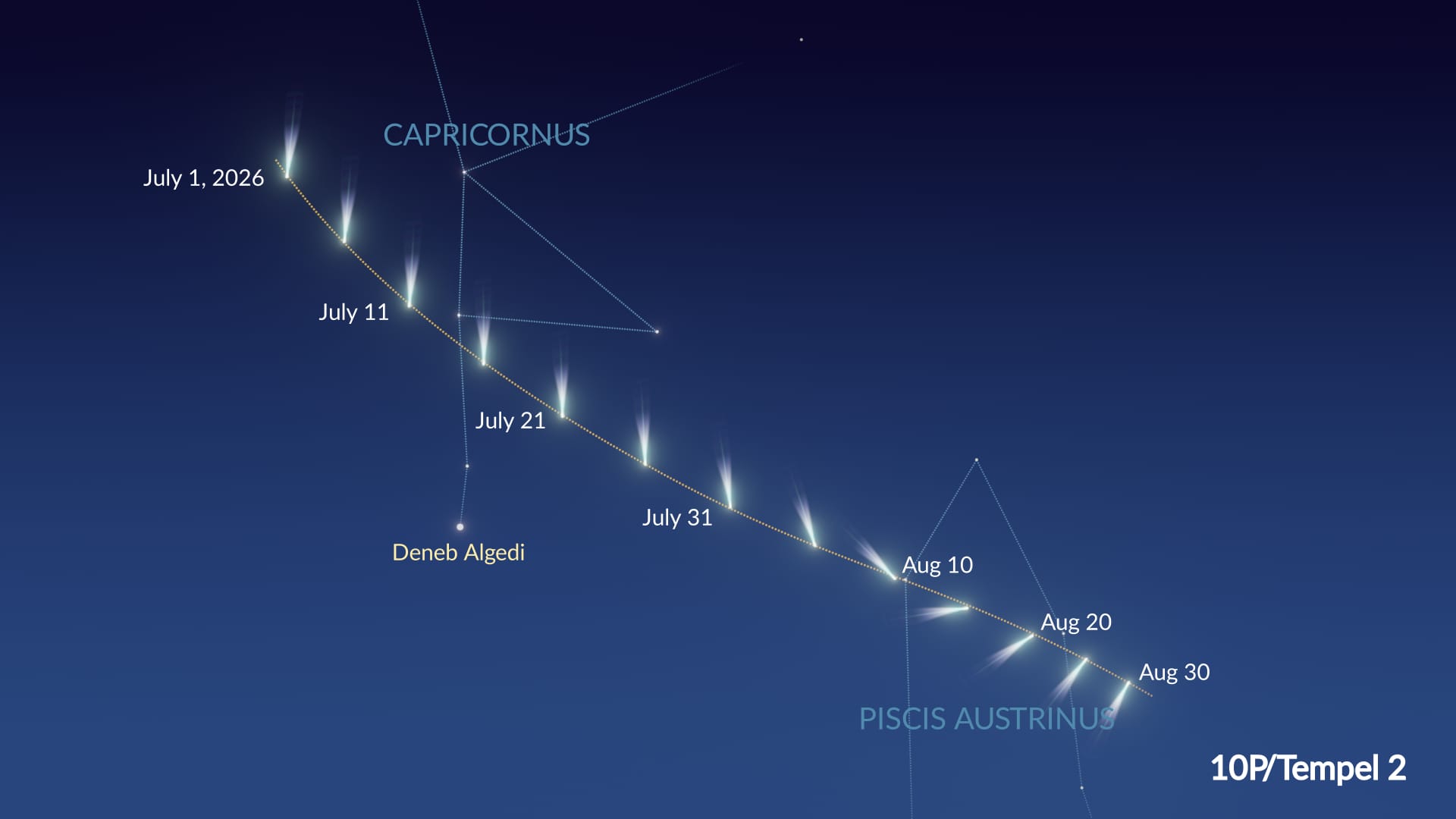
Since July 2026, 10P/Tempel 2 has been visible in the evening sky after sunset. The comet can be seen from both hemispheres; in the Southern Hemisphere, it climbs much higher above the horizon than it does in the Northern Hemisphere. Tempel 2 has already passed its peak brightness and is now gradually fading. Observe it with a small telescope under dark skies.
For a more detailed guide to its visibility from different locations, how its observing conditions will change over time, and what is happening with the comet right now, check out our dedicated article on Comet 10P/Tempel 2.
When was 10P/Tempel 2 discovered?
Discovered on July 4, 1873, by Wilhelm Tempel, 10P/Tempel 2 is a Jupiter-family periodic comet. It orbits the Sun every 1,960 days (≈5.37 years), traveling between 1.42 AU at perihelion and 4.71 AU at aphelion.
Comet in August – September 2026: 169P/NEAT
- Perihelion: September 21, 2026 (mag 12.0)
- Closest approach to Earth: August 11, 2026 (mag 13.9)
- Where to observe: Both hemispheres
Will 169P/NEAT be visible from Earth?
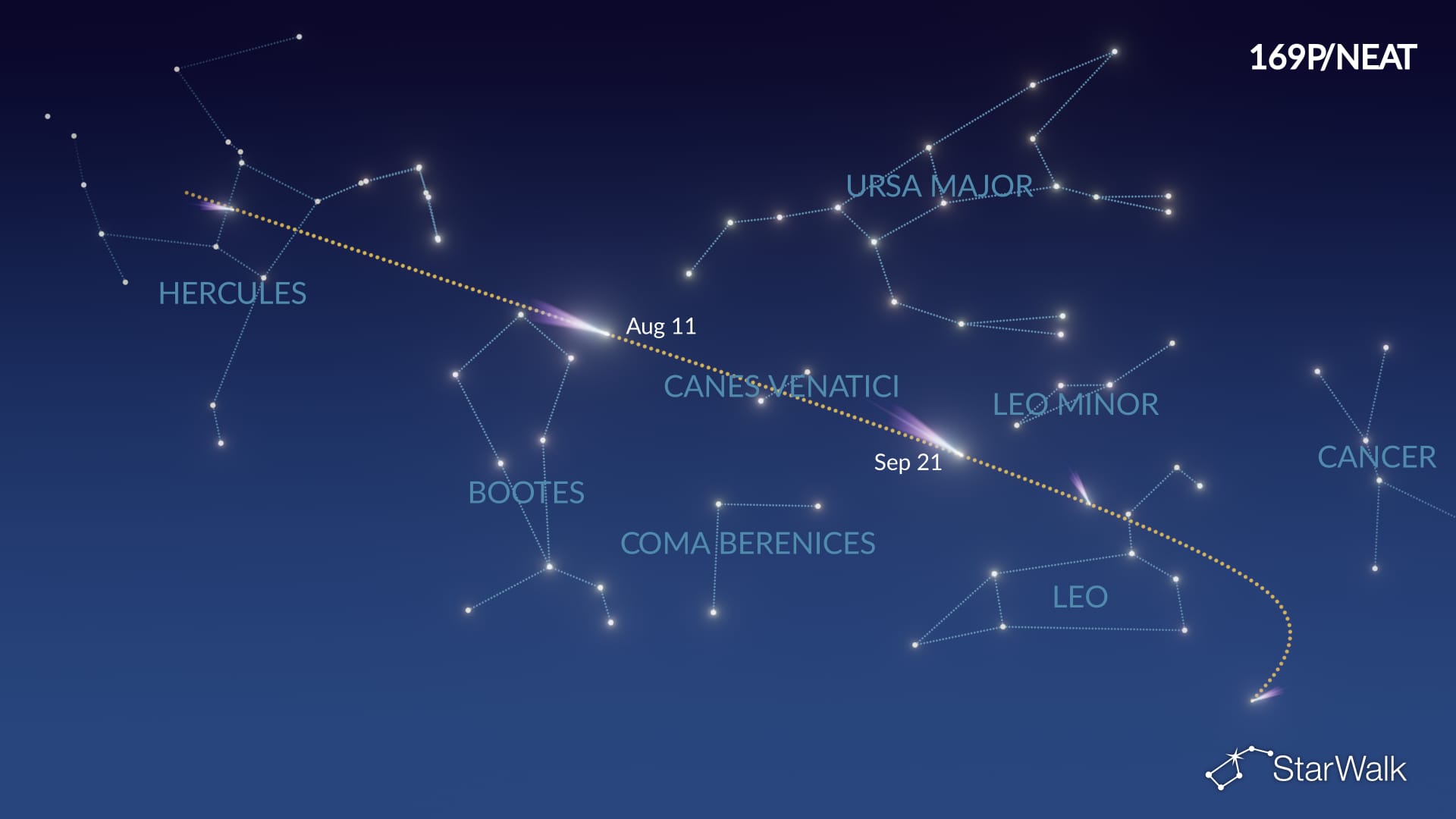
In August 2026, 169P/NEAT will appear in the evening sky after sunset. In the Northern Hemisphere, it will be seen fairly high above the horizon, while in the Southern Hemisphere, it will stay much lower and be harder to spot. As the month goes on, the comet will appear closer to the Sun in the sky; in September, it will move into the morning sky and start pulling away from the Sun again. The comet is expected to reach a brightness of about magnitude 10 to 12, making it a telescopic target.
When was 169P/NEAT discovered?
169P/NEAT was discovered on March 15, 2002, by the NEAT (Near-Earth Asteroid Tracking) survey. It has a relatively short orbital period of about 4.2 years, and astronomers have suggested that it may have originated in the main asteroid belt rather than in the distant outer Solar System. It is also the parent body of the Alpha Capricornid meteor shower, which peaks in late July.
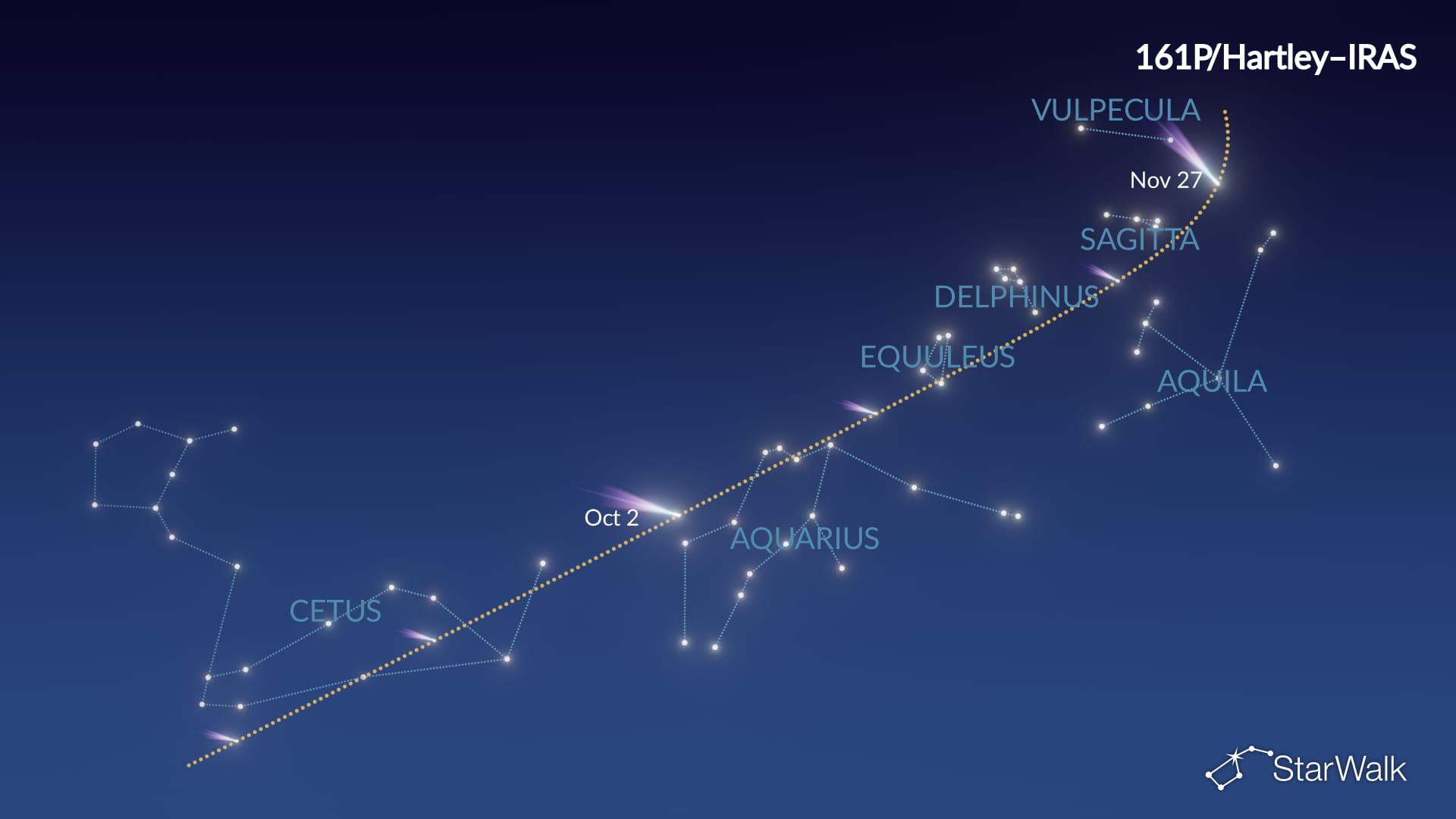
Comet in September – December 2026: 161P/Hartley–IRAS
- Perihelion: November 27, 2026 (mag 13.4)
- Closest approach to Earth: October 2, 2026 (mag 11.9)
- Where to observe: Both hemispheres
Will 161P/Hartley–IRAS be visible from Earth?
From September through late December 2026, Comet 161P/Hartley–IRAS will be on view in the evening sky. Observers in both hemispheres will have a chance to spot it, with the Southern Hemisphere getting the better view before perihelion and the Northern Hemisphere taking over afterward. The comet is expected to shine at around magnitude 10 to 14, so a telescope will be the best way to see it.
When was 161P/Hartley–IRAS discovered?
161P/Hartley–IRAS was discovered on November 4, 1983, using data from the IRAS infrared satellite and identified by Malcolm Hartley, which is reflected in its name. With an orbital period of about 21 years, 161P/Hartley–IRAS belongs to the Halley-type comets.
Comet in December 2026 – February 2027: 2P/Encke
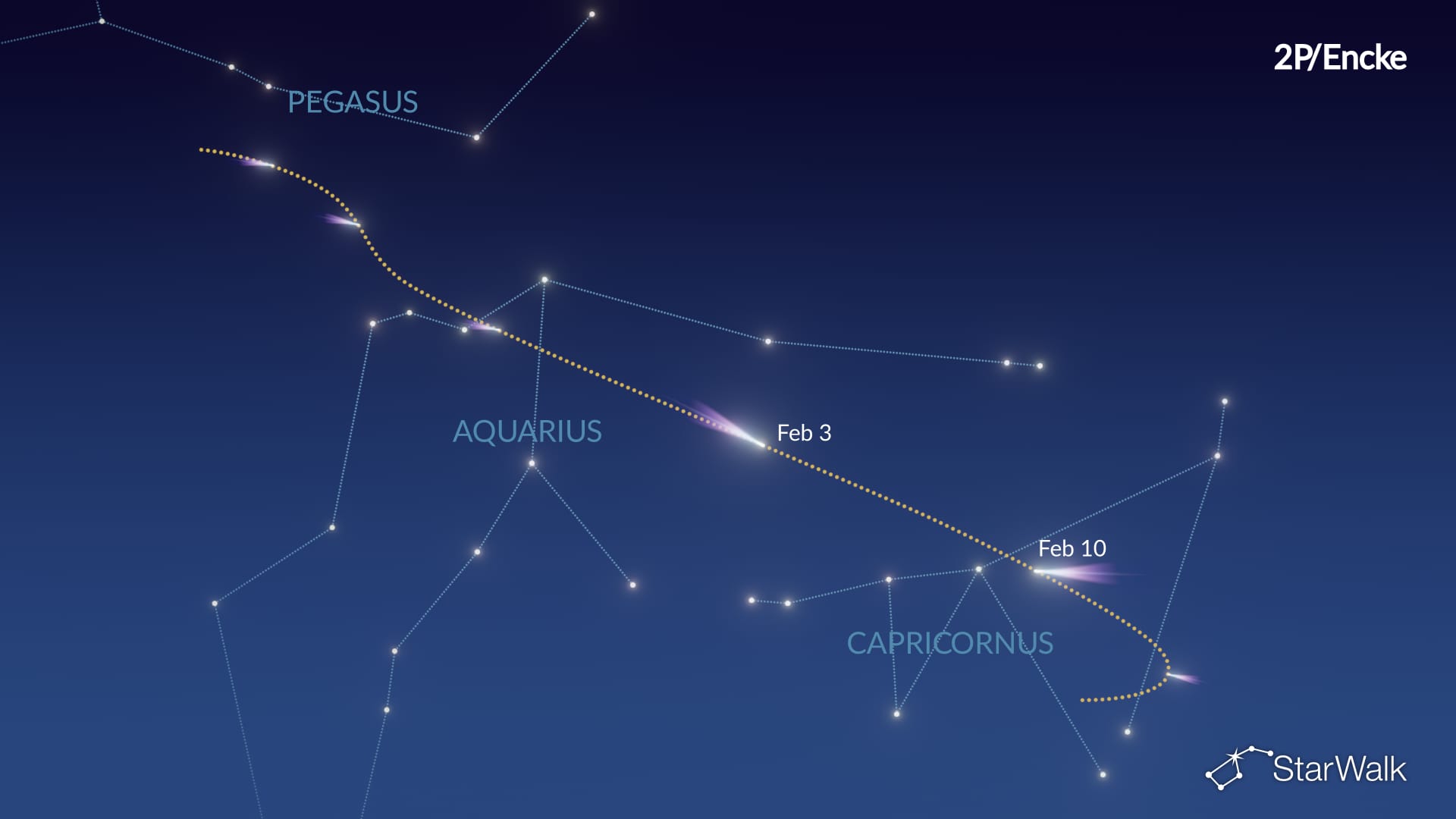
- Perihelion: February 10, 2027 (mag 5.9)
- Closest approach to Earth: February 3, 2027 (mag 6.2)
- Where to observe: Both hemispheres
Will 2P/Encke be visible from Earth?
Beginning in December 2026, 2P/Encke will steadily brighten, reaching its peak from late January to mid-February 2027. At its brightest, the comet may approach magnitude 6, making it a good binocular target, while a telescope will provide a better view at other times.
In both hemispheres, 2P/Encke will be visible in the evening sky from early December, appearing fairly high above the horizon at first. By early February, however, it will sink lower in the evening twilight. After that, observers in the Northern Hemisphere will find it lost in the Sun’s glare, while in the Southern Hemisphere it may briefly reappear in the morning sky around mid-February.
Want to know when and where to look for Encke? See our full observing guide to Comet 2P/Encke, with visibility details, tracking tips, and updates on the comet’s current status.
When was 2P/Encke discovered?
2P/Encke was first discovered on January 17, 1786, by the French astronomer Pierre Méchain. In 1819, Johann Franz Encke demonstrated that several earlier comet sightings were in fact returns of the same object, which is why the comet now bears his name. Orbiting the Sun once every 3.3 years, 2P/Encke has the shortest orbital period among well-observed comets.
How to find a comet using Sky Tonight?
Comets are faint and fuzzy objects that are hard to detect, so it’s best to know their location for certain. The Sky Tonight app will help you quickly find any bright comet in the sky. Here’s what you need to do:
- Tap the magnifier icon at the lower part of the screen;
- In the Search field, enter the comet’s name or designation;
- Find the comet in the search results and tap the blue target icon next to its name;
- The app will show the comet’s current location in the sky;
- Point your device at the sky and follow the white arrow to find the comet.
You can also tap the comet’s name in the search results and then go to the Events tab to view the events related to the comet: perihelion and closest approach to Earth. Tap the blue target icon next to the event to see the comet’s location at the time of perihelion or closest approach.
Next comet visible from Earth: Bottom line
That’s it for the most promising comets to watch in 2026. Comet brightness can change quickly, so check the latest visibility forecasts before planning your observations. Use Sky Tonight to find comets in the sky and see when they are best placed for your location.
Stay tuned for the latest comet updates! While we’re waiting for a bright comet to appear, let’s brush up on some astronomy basics in an easy, visual way. Learn how comets differ from meteors and asteroids with our All You Need to Know About Comets infographic.

While working on this article, we used data from the following sources:
- Comet Observation database;
- TheSkyLive;
- Astronomer Gideon van Buitenen;
- Astronomer Seiichi Yoshida.