Comet Tempel 2: Visibility and Brightness
Comet 10P/Tempel 2 has already passed its peak brightness and is now slowly fading — but it’s still within reach of amateur telescopes. Here’s when to look, what to expect, and how to find 10P/Tempel 2 in the sky. To check the comet’s position and visibility for your exact location, use the Star Walk 2 app.
Contents
- Comet 10P/Tempel 2 in 2026: at a glance
- Comet 10P/Tempel 2: visibility in 2026
- Comet 10P/Tempel 2 in 2026: finder charts
- How to observe and photograph Comet 10P/Tempel 2
- Comet 10P/Tempel 2: frequently asked questions
- Facts about Comet 10P/Tempel 2
- Comet 10P/Tempel 2 in 2026: bottom line
Comet 10P/Tempel 2 in 2026: at a glance
- Name: 10P/Tempel 2
- 2026 perihelion: August 2 (1.4 AU)
- 2026 closest approach to Earth: August 3 (0.4 AU)
- Best visibility: Southern Hemisphere — early to mid-August 2026; Northern Hemisphere — early August, very low above the southern horizon.
Comet 10P/Tempel 2: visibility in 2026
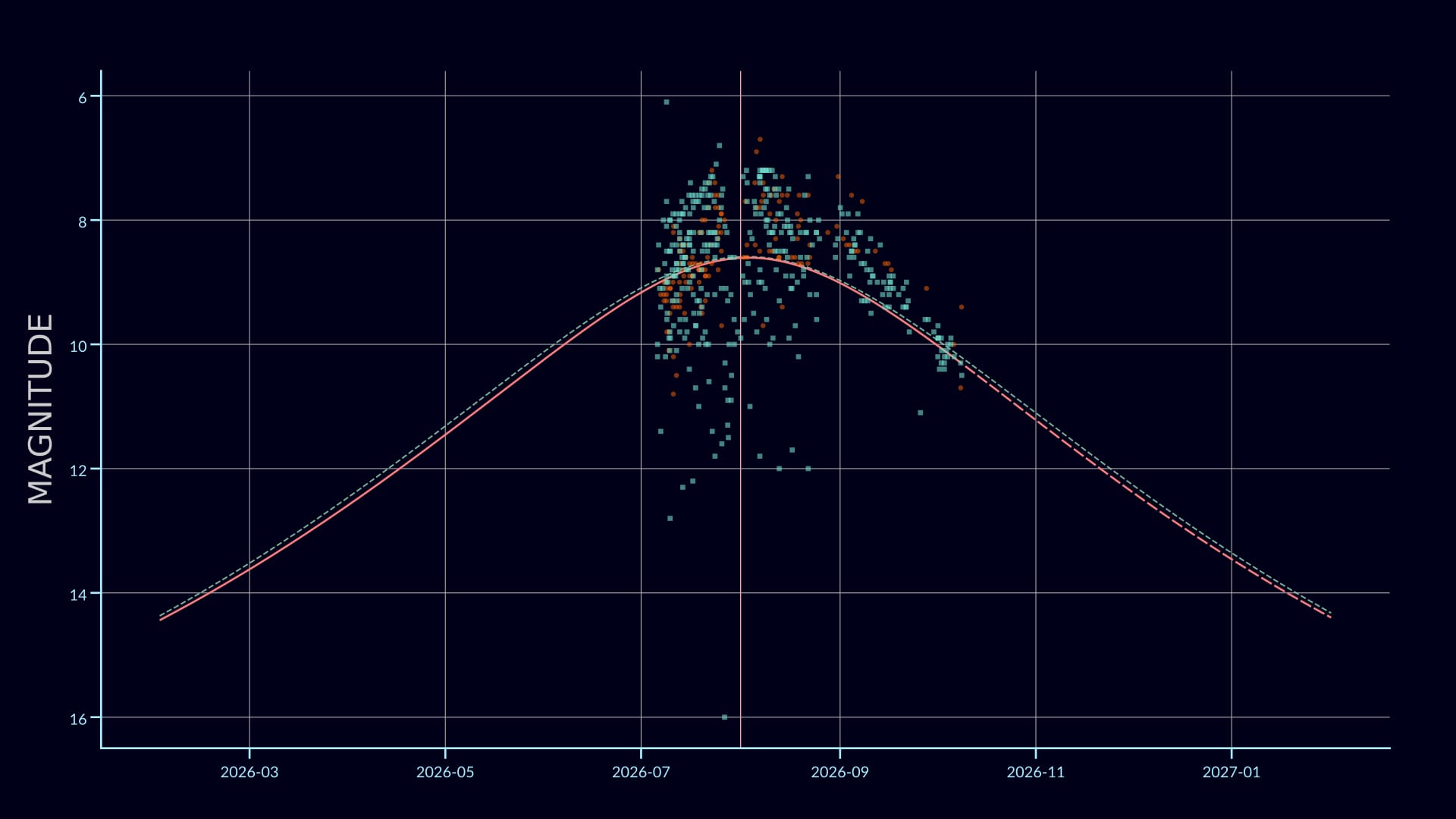
Comet 10P/Tempel 2 has passed its peak brightness and is now gradually fading, but it remains observable with amateur telescopes. Throughout August, observers can continue following the comet, although it will become progressively fainter and more challenging to spot.
The observing geometry favors the Southern Hemisphere, where Tempel 2 appears higher in the sky. From much of the Northern Hemisphere, it remains low above the southern horizon, where haze, light pollution, trees, and buildings may make it difficult to detect.
Comet 10P/Tempel 2: visibility in the Northern Hemisphere
- Early August 2026: The comet reaches perihelion on August 2 and comes closest to Earth around August 3. It may be near its brightest, but from northern latitudes it will be very low above the southern horizon. For the best chance, choose a dark site with a completely open southern horizon.
- Mid-August 2026: The New Moon on August 12 gives darker skies, but the comet will already be harder to observe from the north because of its low altitude. It may still be possible with a telescope, but it will not be an easy target.
- September 2026: Tempel 2 becomes impractical for many northern observers. It will be too low in the sky, even if it remains within reach of telescopes under good conditions.
Comet 10P/Tempel 2: visibility in the Southern Hemisphere
- Early August 2026: This is the key period for the Southern Hemisphere. Around August 2–3, the comet will be near both perihelion and closest approach to Earth. It may reach about mag 8, making it a realistic binocular or small-telescope target under dark skies.
- Mid-August 2026: Conditions remain better than in the Northern Hemisphere. The New Moon on August 12 gives another good dark-sky window, though the comet should gradually begin to fade after its peak.
- September 2026: Tempel 2 may remain observable from southern latitudes with telescopes and cameras, but it will become fainter and less impressive than in July–August.
Comet 10P/Tempel 2 in 2026: finder charts
Comet 10P/Tempel 2 in September-October 2026
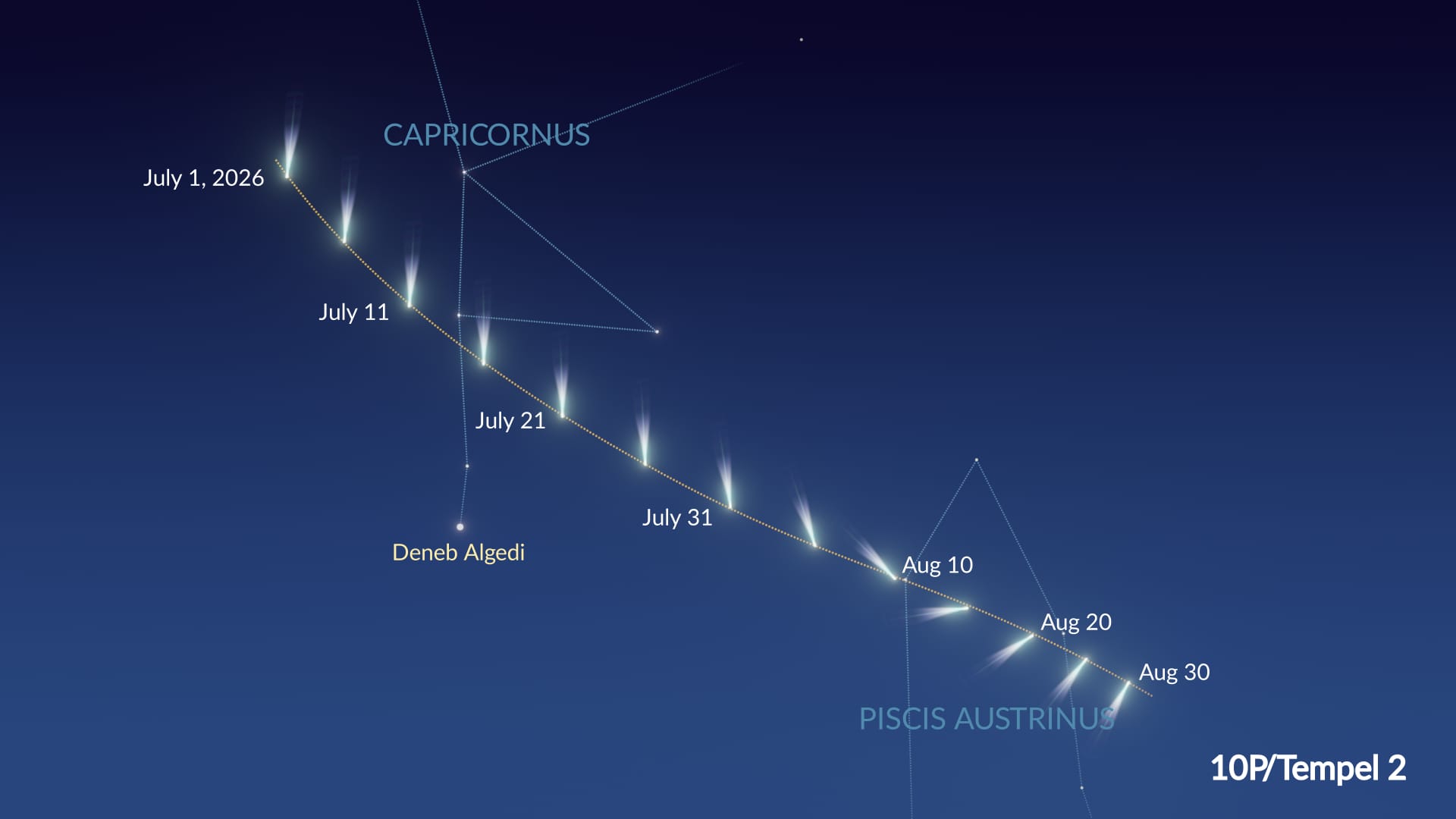
After August, the comet will fade and become a more difficult target. It spends all of September and most of October in Piscis Austrinus, then crosses into Sculptor around October 19. For northern observers, September is not a good observing window: Tempel 2 will be too low above the horizon. Southern observers may continue tracking it longer, but it will no longer be at its best.
Around October 16, the comet passes about 1.4° from Fomalhaut, one of the brightest stars in the southern sky. This could be an interesting imaging opportunity, but by then the comet will be much fainter and mostly telescopic.
How to observe and photograph Comet 10P/Tempel 2
What equipment do you need to see Comet 10P/Tempel 2?
Under dark skies, binoculars such as 10×50 or 15×70 may show the comet near its best dates. A small telescope of 80–100 mm will give a better chance, and larger telescopes of 150–250 mm will show the comet more reliably.
How to find Comet 10P/Tempel 2 in the sky?
The easiest way to find Comet 10P/Tempel 2 is to use the astronomy app Star Walk 2. Here’s how to do it:
- Tap the magnifying glass icon on the main screen.
- Type “Tempel 2” or “10P” in the search field and tap the corresponding search result. The app will show the comet’s current position on the sky map.
- Tap the small compass icon at the upper left corner of the screen, or simply point your device at the sky. Follow the on-screen arrow to find the comet in the sky above you.
Comet 10P/Tempel 2: frequently asked questions
When to see Comet 10P/Tempel 2?
Comet 10P/Tempel 2 should be near peak brightness on August 2–3, 2026, but moonlight may make it harder to see. The New Moon on August 12 will offer darker skies, especially for observers in the Southern Hemisphere, although the comet will already be fading.
Where to see Comet 10P/Tempel 2?
From mid-northern latitudes, look for Tempel 2 low in the southern sky late at night or before dawn. From much of the Southern Hemisphere, the comet will pass high in the northern sky or near overhead, depending on your latitude.
How bright will Comet 10P/Tempel 2 get in 2026?
Tempel 2 is expected to remain around magnitude 8–9 in early August. It will remain too faint for the naked eye but may be visible through large binoculars or a small telescope under dark skies.
What does Comet Tempel 2 look like?
Through a small telescope, Tempel 2 appears as a faint, fuzzy patch of light. Deep images made by stacking multiple exposures can reveal a brighter coma and a narrow dust trail extending on both sides of the nucleus along the comet’s orbital plane. This is a dust trail, not an ordinary comet tail.
Will Comet 10P/Tempel 2 be visible to the naked eye?
No. Tempel 2 is too faint for naked-eye viewing. You’ll need large binoculars, a small telescope, or a camera to see it.
When will Comet 10P/Tempel 2 return after 2026?
Tempel 2 has an orbital period of about 5.36 years, so after its 2026 return, it should come back to perihelion again in the early 2030s.
Facts about Comet 10P/Tempel 2
- Official designation: 10P/Tempel 2
- Common name: Tempel 2
- Type: Jupiter-family periodic comet
- Orbital period: About 5.36 years
- Perihelion distance: About 1.418 AU
- Nucleus diameter: About 10 km, with published estimates ranging up to roughly 12 km
- Discovered: July 4, 1873
- Discovered by: Wilhelm Tempel
- Rotation period: About 8.95 hours
- 2026 perihelion: August 2, 2026
Comet 10P/Tempel 2 is a periodic comet. If you want a quick refresher on comet types, tails, and orbits, read our guide to what comets are.

Why is it called Comet 10P/Tempel 2?
Comet 10P/Tempel 2 is named after its discoverer, German astronomer Ernst Wilhelm Tempel, who first spotted it on July 4, 1873. The “P” means it is a periodic comet, returning to the inner Solar System again and again, and “10” shows that it was the 10th periodic comet to receive an official number. The “2” distinguishes it from 9P/Tempel 1, another periodic comet discovered by Wilhelm Tempel.
Comet 10P/Tempel 2’s orbit
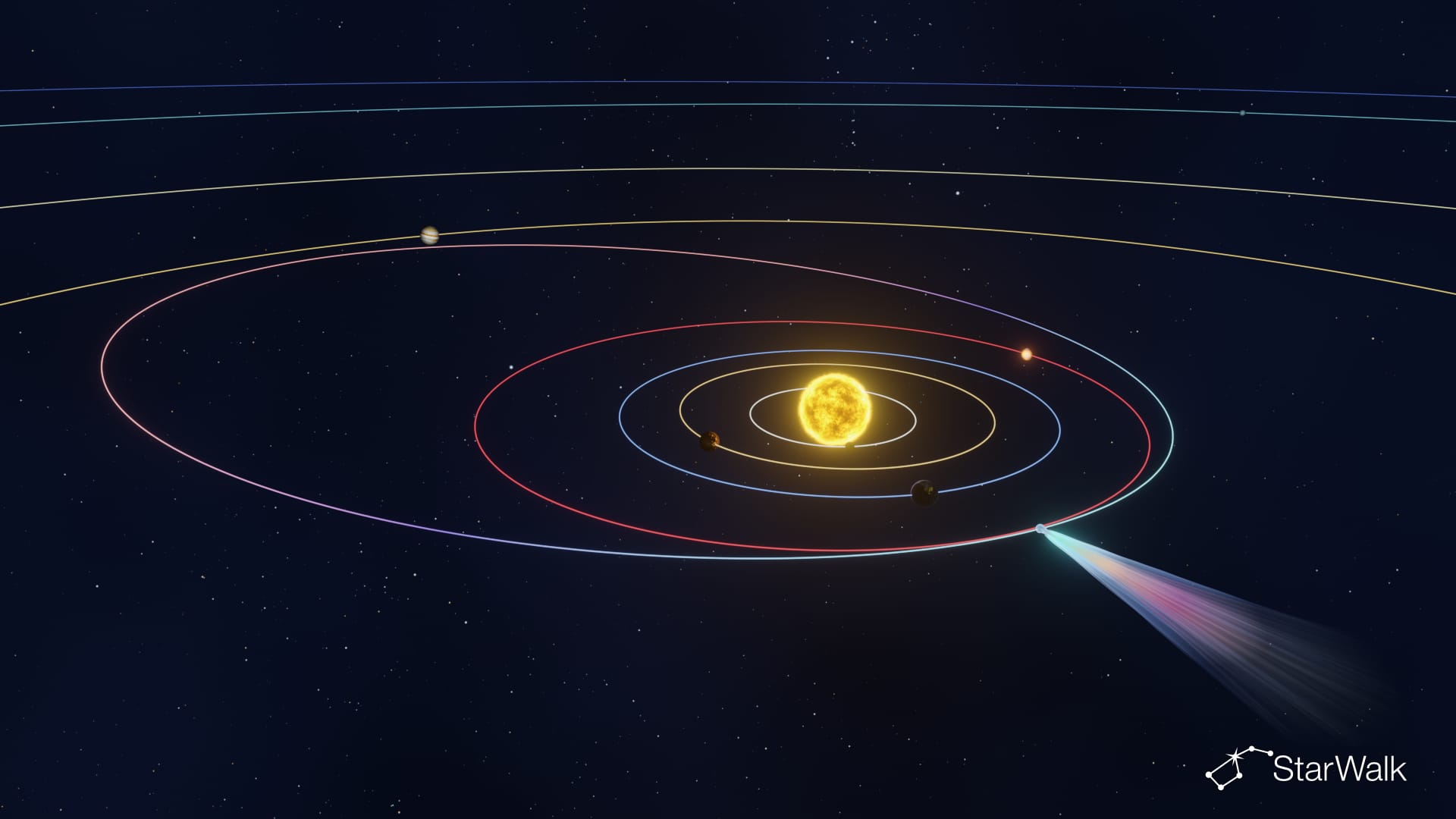
Comet 10P/Tempel 2 has an orbital period of about 5.36 years. Its perihelion distance is about 1.42 AU, which means it does not come as close to the Sun as some brighter comets do. This is one reason why it is not expected to become a spectacular naked-eye object in 2026.
Its orbit is controlled strongly by Jupiter, like many other short-period comets. These objects are valuable to astronomers because they return often and can be studied across many passages near the Sun.
Comet 10P/Tempel 2 in 2026: bottom line
Comet 10P/Tempel 2 has passed its peak, but there is still time to observe it. Check when the comet is highest above the horizon from your location with Star Walk 2.
When to see the next bright comet?
Tempel 2 is one of the comet highlights of 2026, but it won’t be the last one worth watching. Comets are notoriously unpredictable: even careful brightness forecasts can change as a comet approaches the Sun. For the latest observing prospects, see our regularly updated guide to upcoming comets visible from Earth, where we track the most promising comet targets, their expected peak brightness, and the best dates to look for them.
Next comet we’re waiting for: 2P/Encke
After Tempel 2, the next notable comet we’re especially watching is 2P/Encke, returning in 2027. It probably won’t become a dramatic naked-eye comet, but compared with many faint future comets, Encke is definitely one to mark on the calendar. We cover its next appearance in detail in our guide to Comet Encke’s 2027 return.