Giant Comet C/2026 C1 (Tsuchinshan): Will It Be Visible in 2028?
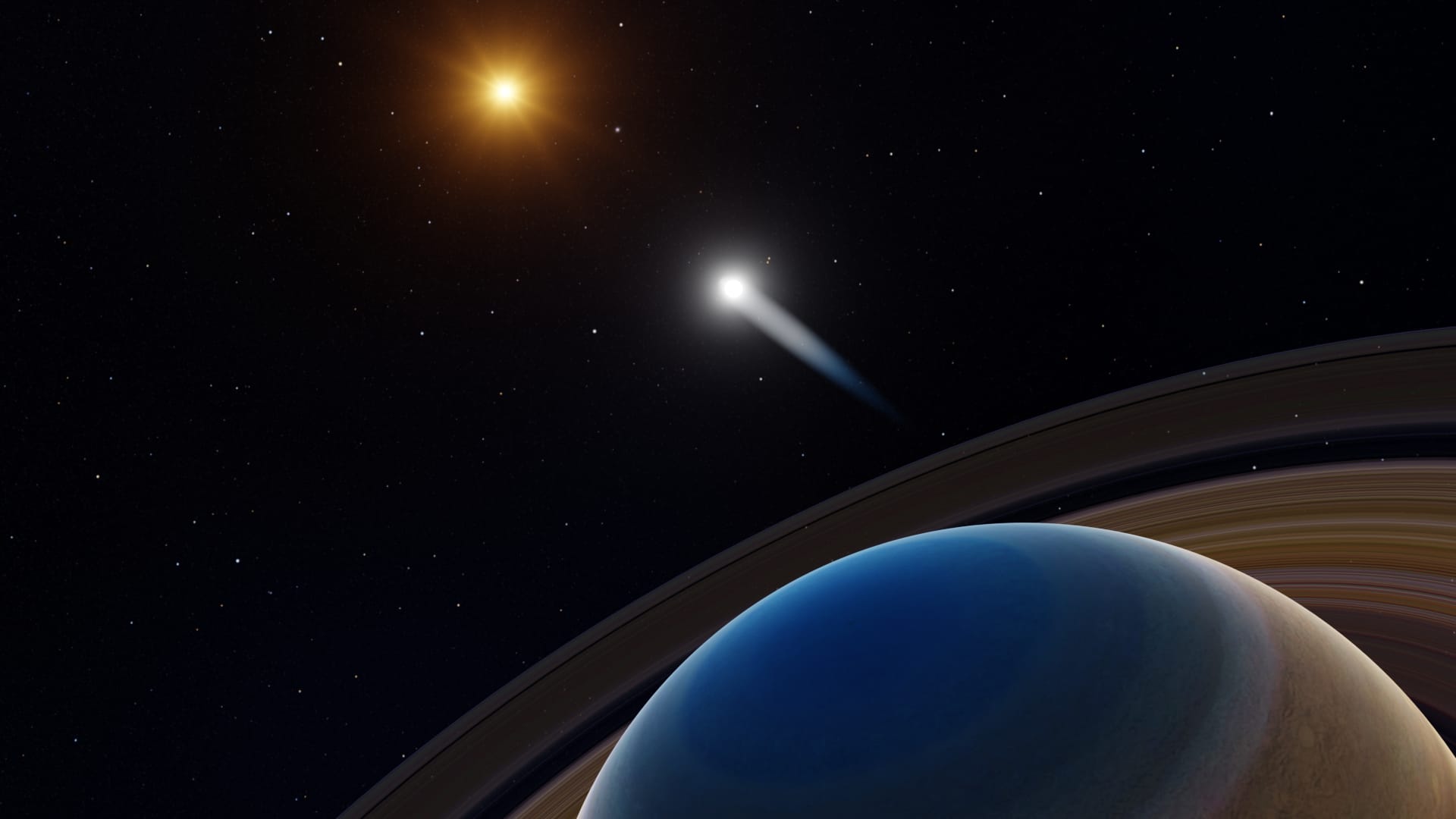
A comet that has already attracted astronomers’ attention is starting a new chapter. C/2026 C1 (Tsuchinshan), previously known as A11yzTN, appears to be surprisingly large, possibly the size of a city. Current estimates suggest it could brighten significantly as it heads toward the Sun in November 2028 — potentially becoming a good binocular target and perhaps even a borderline naked-eye object under dark skies. That is why C/2026 C1 is quickly turning from a faint dot in the data into one of the most intriguing objects to watch. And if you want to follow where it is in the sky and check whether it will be visible from your location, Sky Tonight makes it easy to keep track of the comet as the story unfolds.
Contents
- Comet C/2026 C1 (Tsuchinshan): basic facts
- What Is Comet C/2026 C1 (Tsuchinshan)?
- When and Where to See Comet C/2026 C1 (Tsuchinshan)?
- What Do We Know About Comet C/2026 C1 (Tsuchinshan) Orbit?
- How Was Comet C/2026 C1 (Tsuchinshan) Discovered?
- Bottom Line: Why Comet C/2026 C1 (Tsuchinshan) Is Worth Following
Comet C/2026 C1 (Tsuchinshan): basic facts
- Type: long-period comet
- Previously known as: A11yzTN
- Estimated perihelion date: November 7, 2028
- Estimated perihelion distance: about 1.1–1.2 AU
- Orbital inclination: close to 100°
- Nucleus size: ~20–40 km (very preliminary estimate)
- Possible brightness: current estimates suggest a peak around magnitude 5; this could make the comet visible in binoculars and possibly to the naked eye under dark-sky conditions
What Is Comet C/2026 C1 (Tsuchinshan)?
C/2026 C1 (Tsuchinshan) is a long-period comet that has already drawn attention because it was spotted far beyond Saturn’s orbit — at roughly 10 AU from the Sun — while still shining at about magnitude 19. That may sound faint, but for such a distant object, it is enough to suggest that the comet could be unusually large — which is exactly why astronomers are watching it so closely. Only a few comets have been discovered at even greater distances — for example, C/2014 UN271 (Bernardinelli–Bernstein), first detected nearly 30 AU from the Sun.
If early size estimates hold up, C/2026 C1 could still become one of the most interesting comets to follow in 2028, even if current brightness forecasts are more modest than some of the earliest expectations.
How Big Is Comet C/2026 C1 (Tsuchinshan)?
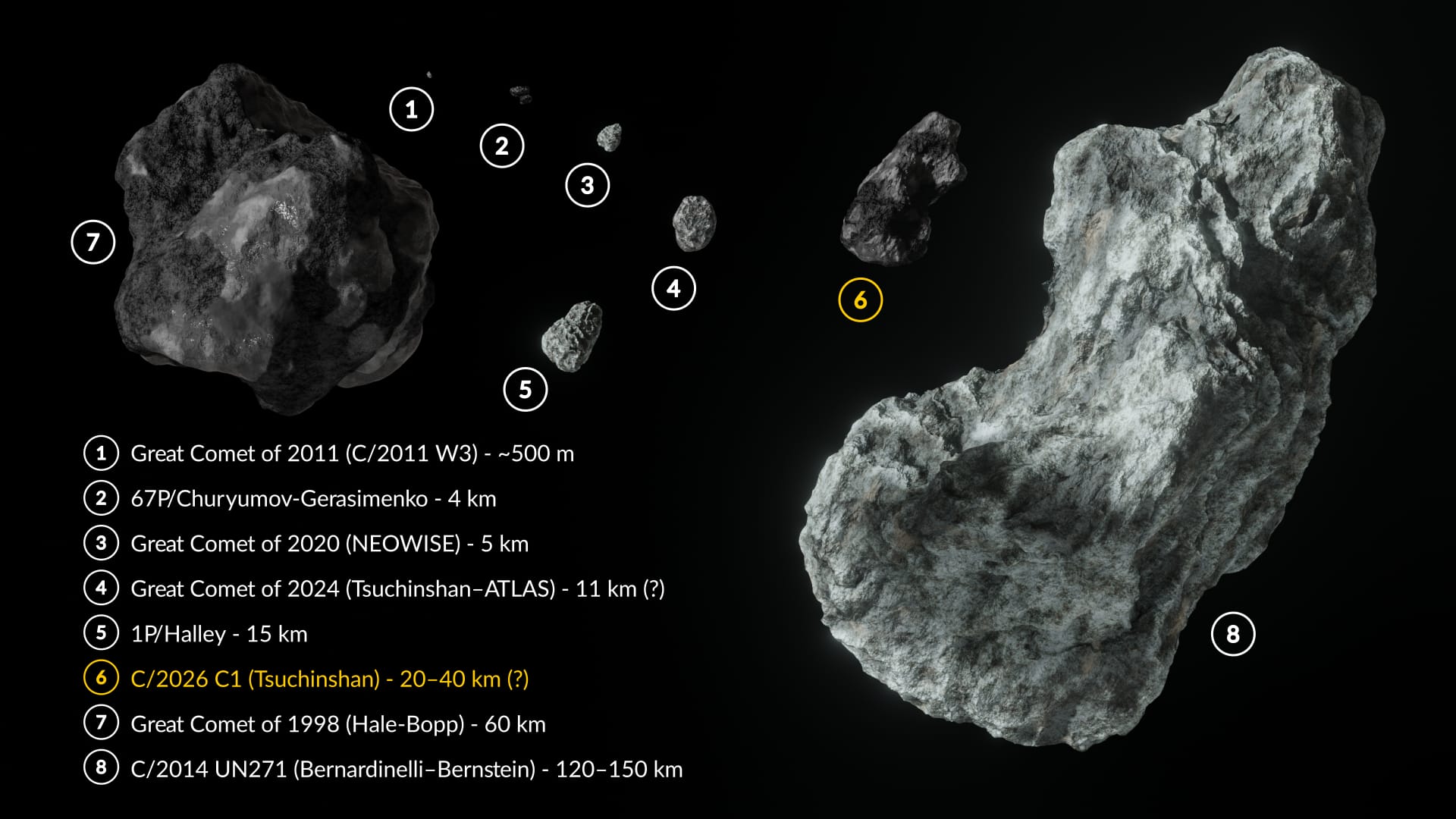
Astronomers cannot measure the exact size of Comet C/2026 C1 (Tsuchinshan) yet, but its brightness at such a huge distance hints that the nucleus could be very large — possibly around 20–40 kilometers across — roughly the width of a large city. For comparison, Comet 67P/Churyumov-Gerasimenko — the first comet ever visited and landed on by a spacecraft — has a nucleus about 4 km wide. Comet C/1995 O1 (Hale-Bopp), one of the most spectacular naked-eye comets of the late 20th century, is estimated to have had a nucleus about 60 km across. The largest known comet nucleus belongs to C/2014 UN271 (Bernardinelli–Bernstein), estimated to be roughly 120–150 km across (that giant will reach perihelion only in January 2031 and stay about 10.95 AU from the Sun — far too distant to put on the kind of bright show skywatchers usually hope for). So C/2026 C1 may not be the record-holder — but it could still be a genuinely big comet.
Will Comet C/2026 C1 (Tsuchinshan) Hit Earth?
Any unusually large object inevitably raises this question. So here is the answer: no, Comet C/2026 C1 (Tsuchinshan) is not expected to hit Earth. Current orbital calculations show that the comet will remain far from our planet throughout its passage through the inner Solar System. In other words, however big or bright it may turn out to be, it is interesting as a sky event — not as a threat.
Although comet impacts are theoretically possible, they are extremely rare on human timescales. So C/2026 C1 is interesting not because it poses any danger, but because comets themselves are among the Solar System’s most dramatic and mysterious visitors. To learn more about their nature, origins, and behavior, read our article on what comets are.
When and Where to See Comet C/2026 C1 (Tsuchinshan)?
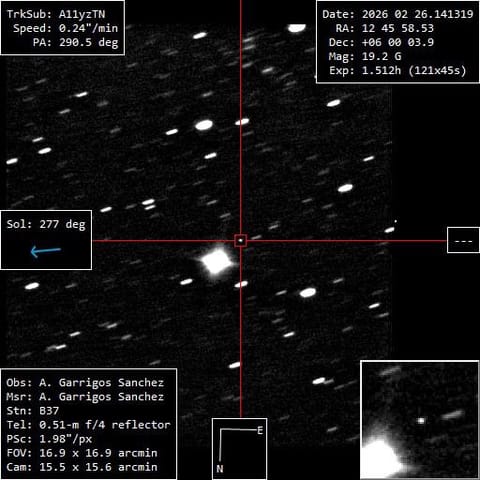
For now, Comet C/2026 C1 (Tsuchinshan) is far too faint for casual observing: at around magnitude 19, it remains a target for large professional telescopes rather than backyard stargazers. The real action is expected much later, as the comet moves inward toward its November 2028 perihelion.
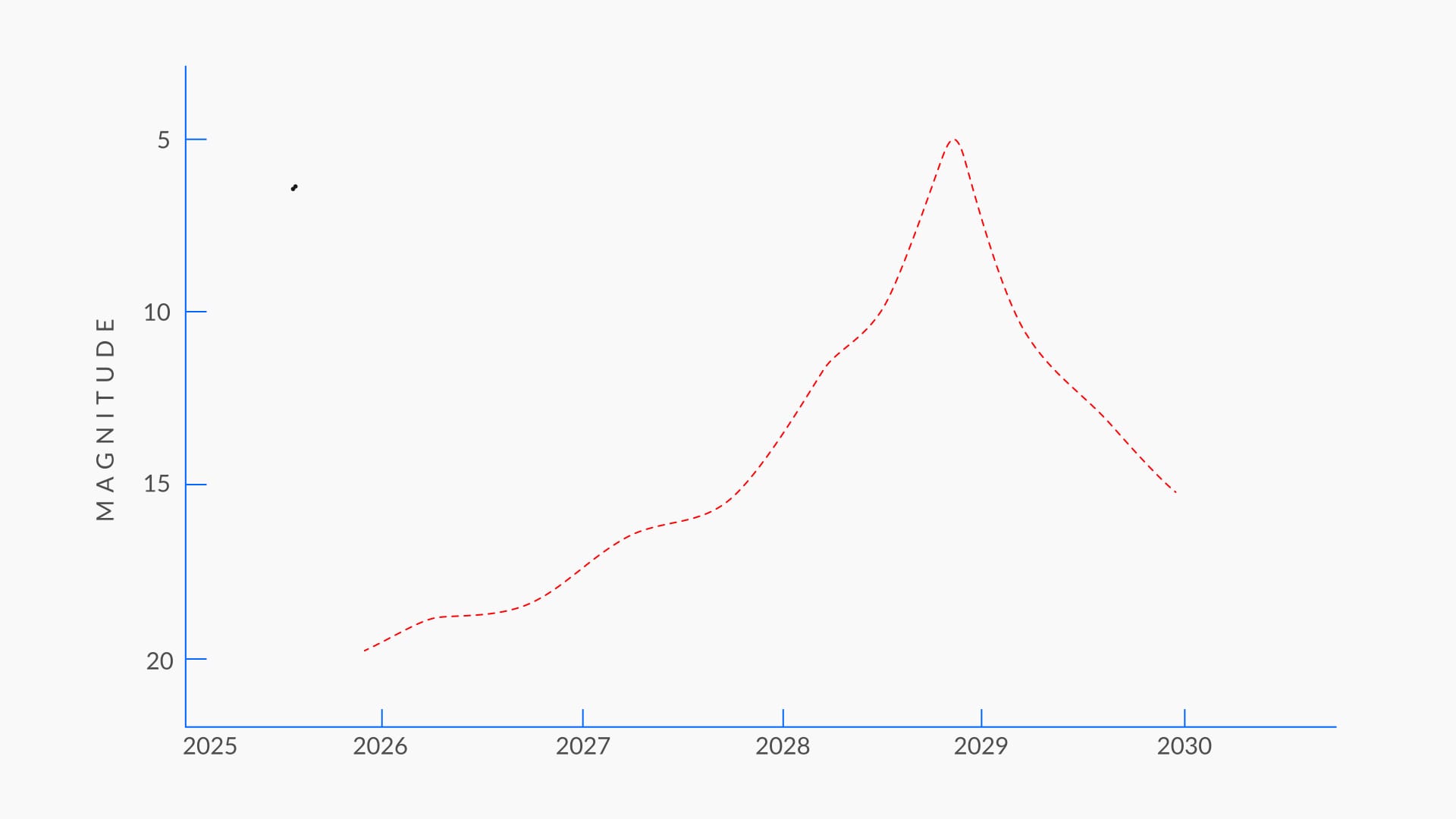
Current estimates suggest it could brighten to around magnitude 5, which would make it a promising target for binoculars and possibly a borderline naked-eye comet under favorable dark-sky conditions.
That is still an encouraging forecast, but it is more modest than the brightest early scenarios. Current projections also suggest that the best viewing conditions may favor the Southern Hemisphere, especially near peak brightness.
Will Comet C/2026 C1 (Tsuchinshan) Be Visible to The Naked Eye?
There are good reasons to think that C/2026 C1 (Tsuchinshan) could become visible to the naked eye:
- First, C/2026 C1 was detected at a huge distance — beyond Saturn’s orbit — while still shining at about magnitude 19, which hints that it could be a physically large comet.
- Second, early images do not show a dramatic coma, suggesting that the object may still be only weakly active for now. If so, that makes the size estimates more interesting: a large nucleus has more ice and dust to release as it warms up, giving the comet a better chance to brighten near the Sun.
- Finally, C/2026 C1 is expected to pass the Sun at a distance of about 1.1–1.2 AU, close enough for solar heating to increase its activity.
None of this guarantees a spectacular display — and current estimates are more cautious than some of the earliest projections. Right now, the comet looks more like a potentially strong binocular object than a guaranteed bright naked-eye show.
Could C/2026 C1 become the next truly great comet? It is too early to say — but the possibility is still part of the excitement. And while we wait for 2028, take our Great Comets quiz and revisit some of the most spectacular celestial visitors in history, including the unforgettable Hale-Bopp.

What Do We Know About Comet C/2026 C1 (Tsuchinshan) Orbit?
Current calculations suggest that C/2026 C1 (Tsuchinshan) is a long-period comet traveling on a highly elongated orbit that brings it in from the distant outer Solar System toward the inner planetary region.
Its orbit is also steeply tilted — with an inclination close to 100° — which means it does not move through space in the same relatively flat plane as the planets. Comets with this kind of trajectory are often thought to come from the Oort Cloud, a vast reservoir of icy bodies far beyond the known planets. That kind of orbit is typical of comets that spend most of their time far beyond the planets and only briefly visit the inner Solar System.
Right now, C/2026 C1 is expected to reach perihelion, its closest point to the Sun, in November 2028, passing at a distance of about 1.1–1.2 AU.
How Was Comet C/2026 C1 (Tsuchinshan) Discovered?
Comet C/2026 C1 (Tsuchinshan) was first identified in February 2026 in observations linked to the Purple Mountain Observatory (Tsuchinshan) and later picked up independently by the ATLAS survey. After the initial detection, astronomers found earlier “precovery” images of the object in archival observations dating back to December 2025, which helped refine its orbit. Then, after additional follow-up observations, the object was added to the comet confirmation page, drawing wider attention from astronomers around the world. It was later officially recognized as a comet and assigned the designation C/2026 C1 (Tsuchinshan).
Bottom Line: Why Comet C/2026 C1 (Tsuchinshan) Is Worth Following
Comet C/2026 C1 (Tsuchinshan), previously known as A11yzTN, was discovered beyond Saturn’s orbit in February 2026. Early estimates suggest it may have a very large nucleus — around 20–40 km across — making it much bigger than many ordinary comets. Current brightness estimates suggest it may reach around magnitude 5 as it approaches the Sun in November 2028, making it a potentially strong binocular target and possibly a borderline naked-eye object under favorable conditions. That does not mean a spectacular show is guaranteed — comets are famously unpredictable — but C/2026 C1 already looks like the kind of object that could turn into a major sky event. And if you want to follow its path and check whether it is visible from your location, Sky Tonight is an easy way to keep an eye on it as the story unfolds.
Comets to See Right Now
While we wait to see how Comet C/2026 C1 (Tsuchinshan) develops, there is no need to put comet watching on hold. Take a look at our article on upcoming comets to see which other visitors are heading our way and when to look for them.