Spica (Alpha Virginis): Brightest Star in Virgo
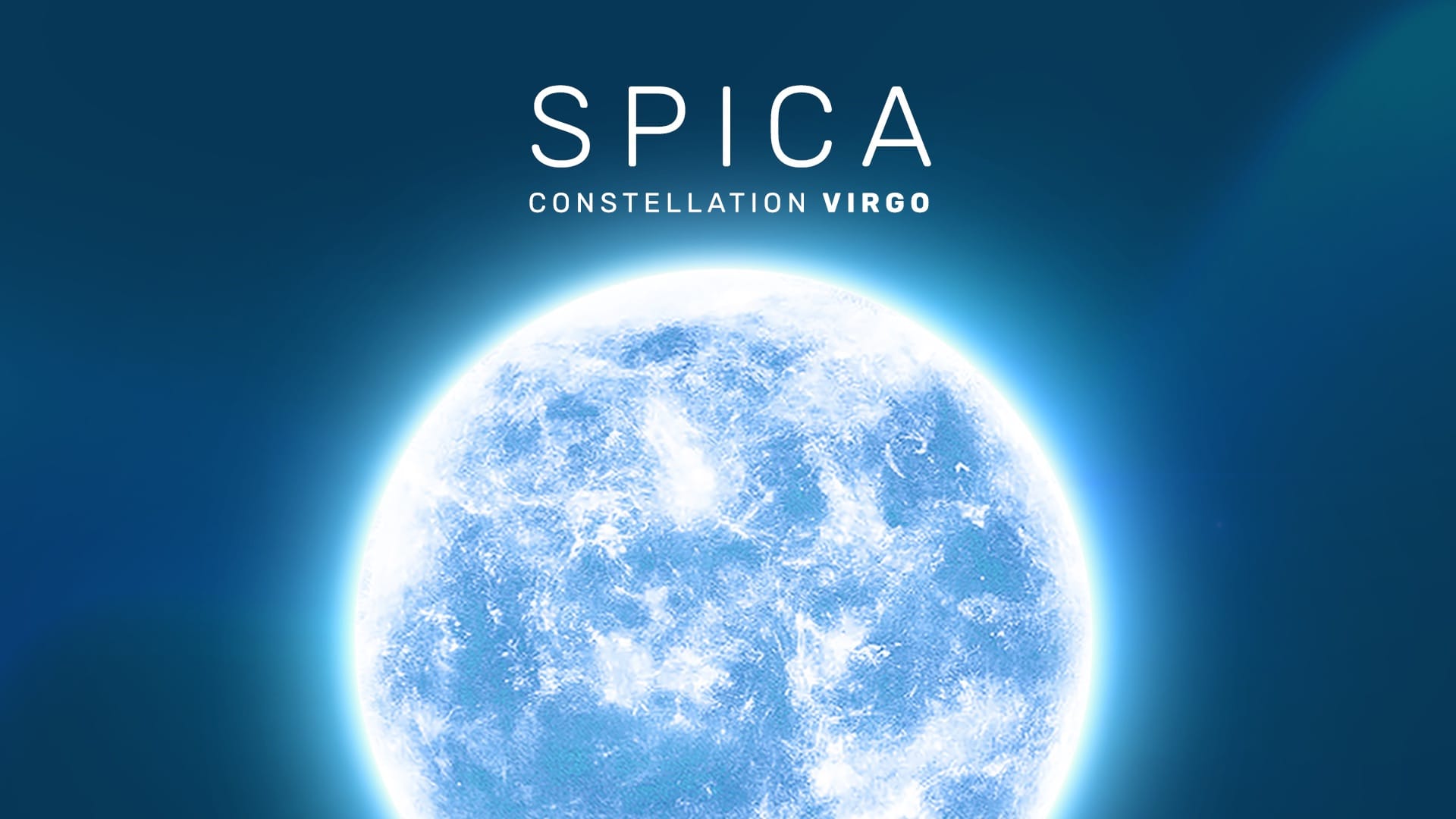
Spica is a blue-white star in the constellation Virgo, positioned about 250 light-years from Earth. Although it looks like a single star, it’s actually a close binary system. Want to find Spica in your sky? Open Sky Tonight, search for Spica, and follow the on-screen arrow to see exactly where to look.
Contents
- Spica Star Facts
- How to Find Spica in the Virgo Constellation
- When to See Spica
- What Type of Star Is Spica?
- Spica in Astrology: Meaning and Symbolism
- Spica: To Sum Up
Spica Star Facts
Spica is visible to the naked eye when it is sufficiently high in a dark sky. Its two hot stars orbit their common center of mass in about 4 days.
- Proper name: Spica
- Bayer designation: Alpha Virginis (α Virginis, abbreviated α Vir)
- Alternative names: Azimech, Spica Virginis
- Catalog designations: 67 Virginis, HD 116658, HIP 65474, HR 5056
- Constellation: Virgo
- Star type: spectroscopic binary with two B-type stars
- Color: blue-white
- Right ascension (J2000): 13h 25m 11.58s
- Declination (J2000): −11° 09′ 40.8″
- Apparent magnitude: about 1.0; slightly variable
- Distance from Earth: about 250 light-years
- Orbital period: about 4.0145 days
The table below compares the two stars that make up Spica, based on Tkachenko et al. (2016). The values are approximate.
| Property | Spica A | Spica B |
|---|---|---|
| Mass | 11.4 solar masses | 7.2 solar masses |
| Radius | 7.5 solar radii | 3.7 solar radii |
| Luminosity | 20,500 times the Sun’s | 2,250 times the Sun’s |
| Surface temperature | 25,300 K | 20,900 K |
How to Find Spica in the Virgo Constellation
Spica is bright enough to see with the naked eye, but finding it among other stars can be tricky. Here are two easy ways to locate it.
Use the Big Dipper
If you can see the Big Dipper, follow the curve of its handle to the orange star Arcturus, then continue the same curve until you reach blue-white Spica. Remember the phrase “Arc to Arcturus and spike to Spica.” This method is especially useful from the Northern Hemisphere; much of the Big Dipper stays below the horizon at southern latitudes.

The Big Dipper is one of the most recognizable star patterns in the sky, and it belongs to the constellation Ursa Major.
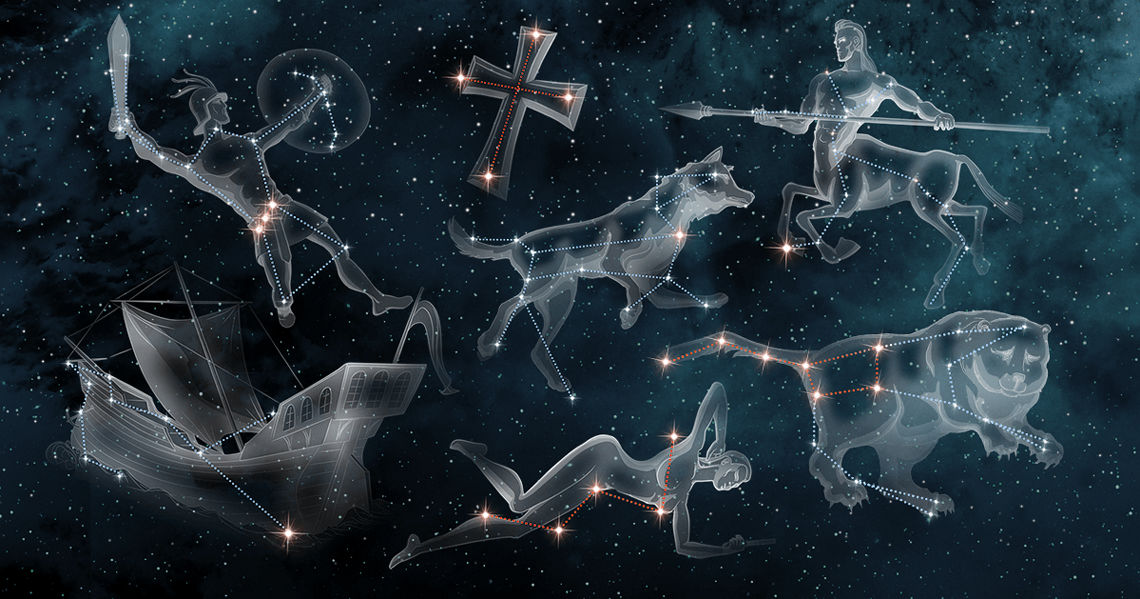
Use a star finder app
The easiest way to find Spica is with the free Sky Tonight app:
- Open the app and search for “Spica.”
- Tap the target icon next to the search result.
- Tap the blue compass icon on the main screen or point your device at the sky.
- Follow the on-screen arrow to locate Spica in the real sky.
If Spica isn’t visible yet, you can check when it rises and plan your observation for another time.

When to See Spica
March through June is generally the best time to see Spica in the evening sky from many locations in both hemispheres. This is spring in the Northern Hemisphere and autumn in the Southern Hemisphere. Spica can also be seen before dawn during other parts of the year.
Spica becomes difficult to observe around mid-October, when it appears too close to the Sun in the sky. The exact period of poor visibility depends on your latitude and local twilight conditions.
The events below bring Spica close to the Moon and planets. Conjunction means the objects share the same right ascension, one of the coordinates used to locate objects in the sky. Closest approach means their angular separation reaches a minimum. These moments need not coincide.
Global times are given in Coordinated Universal Time (UTC) and describe the view from Earth’s center. The tables give local observing windows and distances as seen from each city, so their separations can differ from the global values, especially for the nearby Moon.
November 3–10, 2026: Venus near Spica
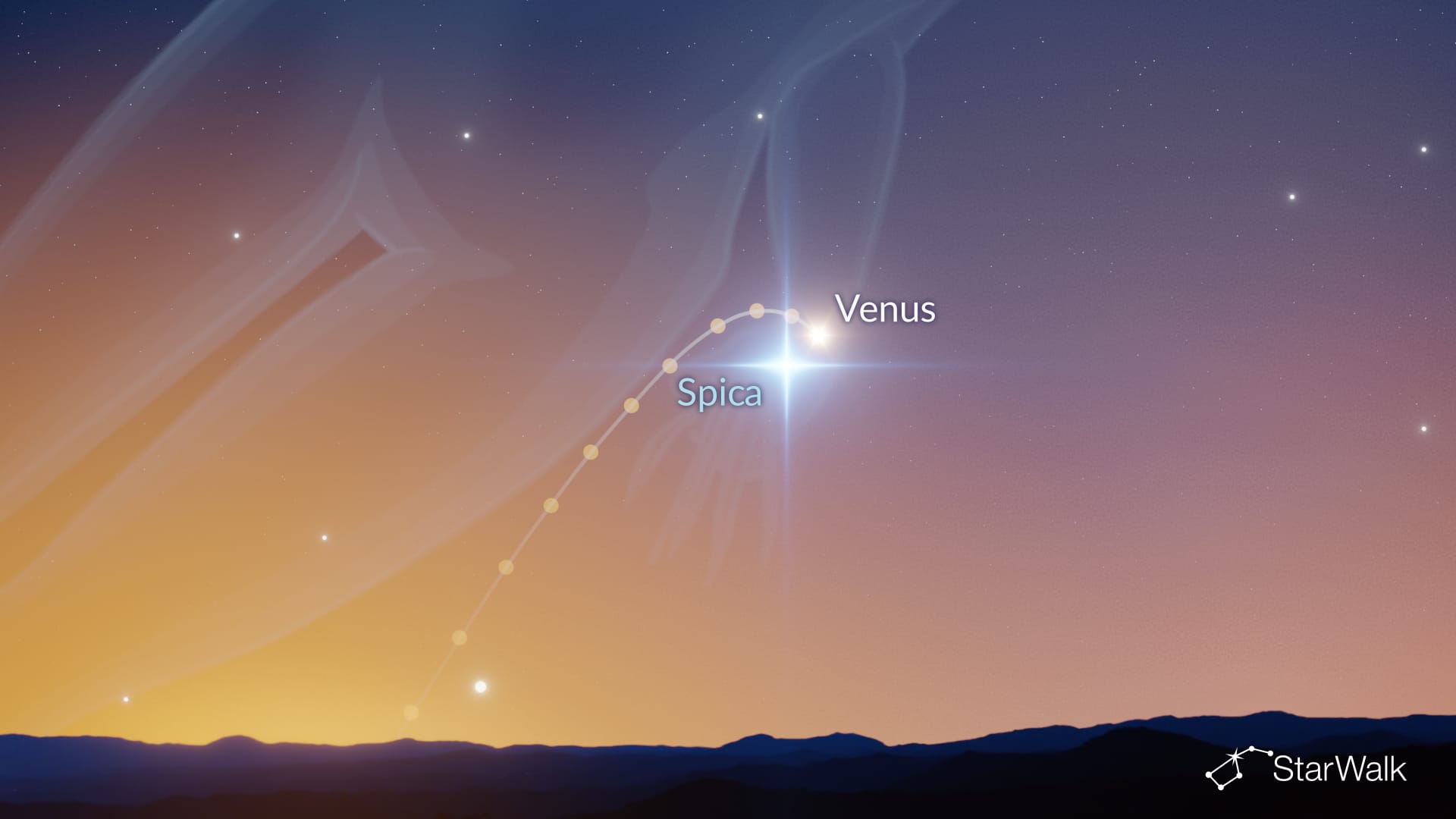
- Close approach time: November 9, 11:24 UTC (06:24 EST)
- Close approach distance: 1°10′
- Conjunction time: November 3, 12:59 UTC (07:59 EST)
- Conjunction distance: 2°21′
In early November, Venus will pass near Spica (mag 1.0) in Virgo. Venus will be moving retrograde relative to the background stars. The pair will reach conjunction on November 3 and appear closest together on November 9. In the listed Asian cities, the closest observable pairing within 24 hours of the global close approach falls on November 10. The pair looks nearly the same on both November 9 and 10, so choose the clearer morning.
Look for them before sunrise. Both objects are visible to the naked eye under clear conditions, but Spica is much fainter than Venus and more easily lost in twilight. Near closest approach, the pair will appear about 1.2° apart, a little more than twice the Moon’s apparent diameter. Binoculars can help identify Spica; choose a spot with an unobstructed horizon and finish observing before sunrise.
| City | Time zone | Visibility start | Visibility end | Best time | Separation | Venus altitude | Spica altitude |
|---|---|---|---|---|---|---|---|
| New York, USA | EST (UTC−5) | Nov 9, 05:45 | Nov 9, 06:05 | Nov 9, 05:45 | 1°09′ | 11° | 10° |
| New Delhi, India | IST (UTC+5:30) | Nov 10, 05:45 | Nov 10, 06:15 | Nov 10, 05:45 | 1°10′ | 11° | 10° |
| Singapore | SGT (UTC+8) | Nov 10, 05:55 | Nov 10, 06:25 | Nov 10, 05:55 | 1°09′ | 11° | 10° |
| São Paulo, Brazil | BRT (UTC−3) | Nov 9, 04:45 | Nov 9, 04:50 | Nov 9, 04:45 | 1°09′ | 11° | 10° |
| Nairobi, Kenya | EAT (UTC+3) | Nov 9, 05:25 | Nov 9, 05:50 | Nov 9, 05:50 | 1°09′ | 17° | 16° |
- Visibility window: both objects are at least 10° above the horizon, and the Sun is below −6°.
- Best time: the moment when Venus and Spica appear closest together from the listed city within the visibility window.
- Venus altitude / Spica altitude: each object’s height above the horizon at the best time.
- Separation: the angular distance between Venus and Spica as seen from the listed city.
- Rounding: local times are rounded to the nearest 5 minutes, altitudes to the nearest degree, and separations to the nearest arcminute. All dates refer to 2026.
November 7, 2026: Moon near Spica

- Close approach time: November 7, 11:31 UTC (06:31 EST)
- Close approach distance: 2°10′
- Conjunction time: November 7, 13:23 UTC (08:23 EST)
- Conjunction distance: 2°23′
On November 7, the thin waning crescent Moon will pass near Spica (mag 1.0) in Virgo. Brilliant Venus will also be nearby, making the planet a useful landmark for finding Spica.
Look for the trio before sunrise. All three objects are visible to the naked eye under clear conditions, but their low altitude and the approaching dawn make this a brief observing opportunity. Binoculars can help reveal Spica, although the full grouping may not fit within every binocular field of view. Choose a clear horizon and finish observing before sunrise.
| City | Time zone | Visibility start | Visibility end | Best time | Separation | Moon altitude | Spica altitude | Venus altitude |
|---|---|---|---|---|---|---|---|---|
| New York, USA | EST (UTC−5) | Nov 7, 06:00 | Nov 7, 06:05 | Nov 7, 06:00 | 2°35′ | 10° | 11° | 11° |
| Mexico City, Mexico | CST (UTC−6) | Nov 7, 06:00 | Nov 7, 06:15 | Nov 7, 06:00 | 2°27′ | 10° | 11° | 12° |
| Honolulu, USA | HST (UTC−10) | Nov 7, 06:10 | Nov 7, 06:15 | Nov 7, 06:10 | 4°00′ | 10° | 13° | 14° |
| Nairobi, Kenya | EAT (UTC+3) | Nov 7, 05:35 | Nov 7, 05:50 | Nov 7, 05:50 | 4°13′ | 18° | 14° | 15° |
| New Delhi, India | IST (UTC+5:30) | Nov 7, 05:55 | Nov 7, 06:15 | Nov 7, 06:15 | 5°23′ | 18° | 14° | 14° |
| Singapore | SGT (UTC+8) | Nov 7, 06:10 | Nov 7, 06:25 | Nov 7, 06:25 | 6°25′ | 20° | 14° | 15° |
- Visibility window: the Moon, Spica, and Venus are all at least 10° above the horizon, and the Sun is below −6°.
- Best time: the moment when the Moon and Spica appear closest together from the listed city within the visibility window.
- Moon altitude / Spica altitude / Venus altitude: each object’s height above the horizon at the best time.
- Separation: the angular distance between the Moon and Spica as seen from the listed city.
- Rounding: local times are rounded to the nearest 5 minutes, altitudes to the nearest degree, and separations to the nearest arcminute. All dates refer to 2026.
November 19–20, 2026: Venus near Spica
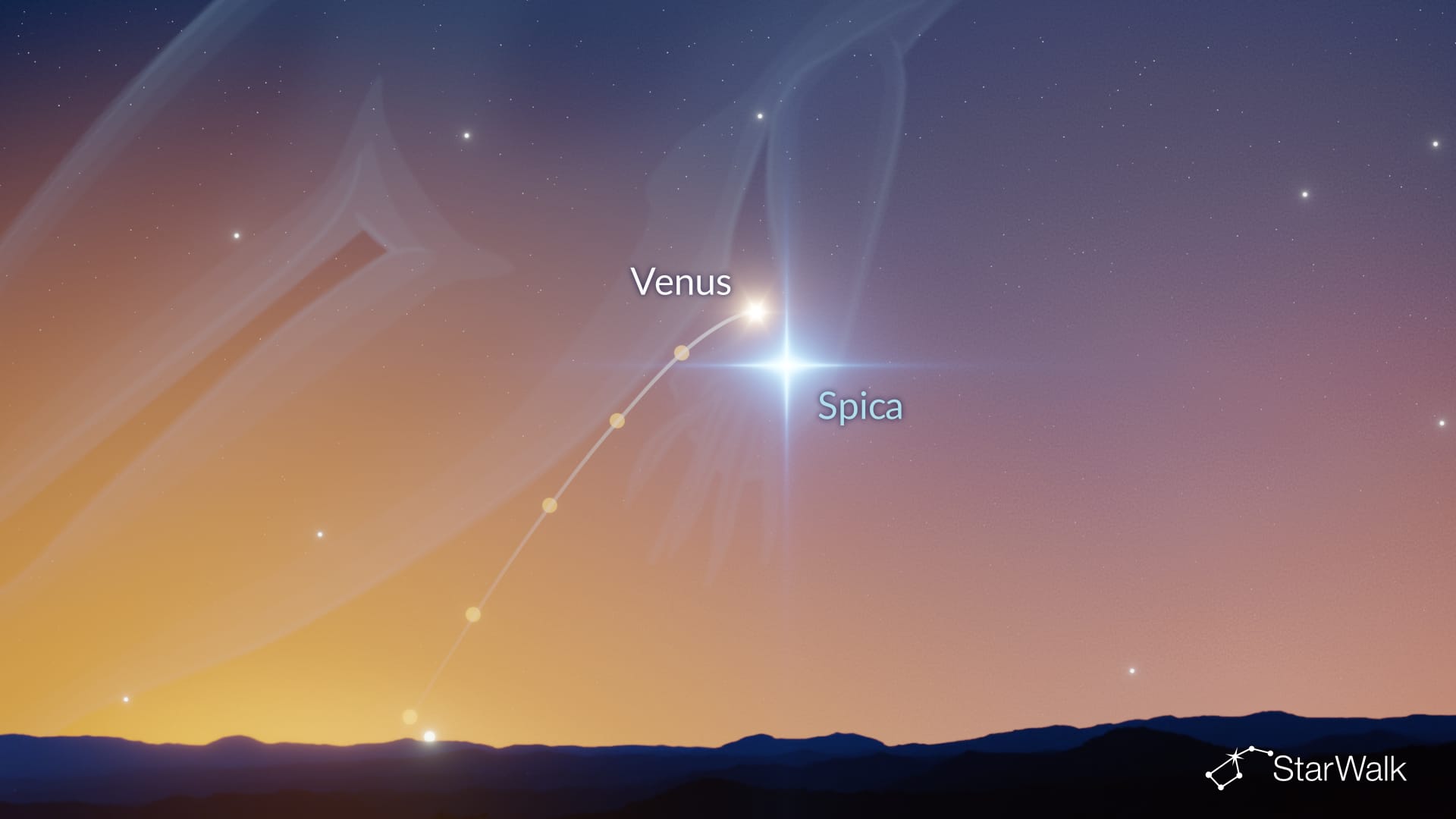
- Conjunction time: November 19, 22:45 UTC (17:45 EST)
- Conjunction distance: 1°48′
On November 19 (UTC), Venus (mag −4.9) will reach its second conjunction with Spica (mag 1.0) in Virgo. After ending its retrograde motion on November 14, Venus will once again move eastward relative to the background stars.
Look for the pair before sunrise, above the eastern to southeastern horizon. Both objects are visible to the naked eye under clear conditions, but Spica is much fainter than Venus. By this time, the pair will appear higher in the predawn sky, making it easier to spot than in early November.
The best viewing opportunity falls on November 19 in New York and Los Angeles, and on November 20 in Tokyo, Singapore, and Sydney. The pair will also be worth observing on nearby mornings. Binoculars can help identify Spica; choose a location with an unobstructed horizon and finish observing before sunrise.
| City | Time zone | Visibility start | Visibility end | Best time | Separation | Venus altitude | Spica altitude |
|---|---|---|---|---|---|---|---|
| New York, USA | EST (UTC−5) | Nov 19, 05:05 | Nov 19, 06:15 | Nov 19, 05:05 | 1°45′ | 11° | 10° |
| Los Angeles, USA | PST (UTC−8) | Nov 19, 04:45 | Nov 19, 06:00 | Nov 19, 04:45 | 1°46′ | 11° | 10° |
| Tokyo, Japan | JST (UTC+9) | Nov 20, 04:40 | Nov 20, 05:55 | Nov 20, 04:40 | 1°47′ | 11° | 10° |
| Singapore | SGT (UTC+8) | Nov 20, 05:20 | Nov 20, 06:25 | Nov 20, 05:20 | 1°48′ | 10° | 10° |
| Sydney, Australia | AEDT (UTC+11) | Nov 20, 04:50 | Nov 20, 05:15 | Nov 20, 04:50 | 1°47′ | 10° | 11° |
- Visibility window: both objects are at least 10° above the horizon, and the Sun is below −6°.
- Best time: the moment when Venus and Spica appear closest together from the listed city within the visibility window. Viewing windows within 24 hours before and after the conjunction are considered.
- Venus altitude / Spica altitude: each object's height above the horizon at the best time.
- Separation: the angular distance between Venus and Spica as seen from the listed city.
- Rounding: local times are rounded to the nearest 5 minutes, altitudes to the nearest degree, and separations to the nearest arcminute. All dates refer to 2026. Visibility thresholds are applied before rounding, so displayed boundary times may fall slightly outside them.
December 4–5, 2026: Moon near Spica

- Close approach time: December 4, 17:19 UTC (12:19 EST)
- Close approach distance: 2°20′
- Conjunction time: December 4, 19:19 UTC (14:19 EST)
- Conjunction distance: 2°33′
Around December 4, the waning crescent Moon will pass near Spica (mag 1.0) in Virgo, with bright Venus nearby. The best local opportunity falls on December 4 in the listed European and North American cities and on December 5 in the listed Asian and Australasian cities.
Look for the grouping before sunrise. The Moon, Spica, and Venus are visible to the naked eye under clear skies. Venus and the crescent Moon can help identify Spica; binoculars can make the star easier to spot, although the full grouping may be too wide for one field of view. Finish observing before sunrise.
| City | Time zone | Visibility start | Visibility end | Best time | Separation | Moon altitude | Spica altitude | Venus altitude |
|---|---|---|---|---|---|---|---|---|
| London, UK | GMT (UTC+0) | Dec 4, 05:00 | Dec 4, 07:10 | Dec 4, 07:10 | 5°42′ | 25° | 24° | 24° |
| New York, USA | EST (UTC−5) | Dec 4, 04:25 | Dec 4, 06:35 | Dec 4, 06:35 | 3°46′ | 31° | 31° | 30° |
| Los Angeles, USA | PST (UTC−8) | Dec 4, 04:10 | Dec 4, 06:15 | Dec 4, 06:15 | 2°56′ | 34° | 35° | 32° |
| Singapore | SGT (UTC+8) | Dec 5, 04:45 | Dec 5, 06:30 | Dec 5, 04:45 | 3°21′ | 15° | 17° | 10° |
| New Delhi, India | IST (UTC+5:30) | Dec 5, 04:30 | Dec 5, 06:35 | Dec 5, 04:30 | 4°36′ | 11° | 15° | 10° |
| Sydney, Australia | AEDT (UTC+11) | Dec 5, 04:20 | Dec 5, 05:10 | Dec 5, 04:20 | 1°40′ | 18° | 17° | 10° |
| Auckland, New Zealand | NZDT (UTC+13) | Dec 5, 04:45 | Dec 5, 05:25 | Dec 5, 05:05 | 1°36′ | 22° | 21° | 14° |
-
Visibility window: the Moon, Spica, and Venus are all at least 10° above the horizon, and the Sun is below −6°.
-
Best time: the moment when the Moon and Spica appear closest together from the listed city within the visibility window.
-
Moon altitude / Spica altitude / Venus altitude: each object’s height above the horizon at the best time.
-
Separation: the angular distance between the Moon and Spica as seen from the listed city.
-
Rounding: local times are rounded to the nearest 5 minutes, altitudes to the nearest degree, and separations to the nearest arcminute. All dates refer to 2026.
What Type of Star Is Spica?
Spica is a spectroscopic binary: its two closely orbiting stars can be distinguished through their spectra, although an ordinary telescope shows a single point of light. Their gravity distorts their shapes. The primary also pulsates, contributing to the system’s small brightness variations.
Spica A
Spica A is the larger, brighter component and supplies about 85% of the system’s visible light. It is commonly classified as B1 III–IV, between the subgiant and giant luminosity classes. This classification describes its spectrum and does not by itself establish whether core hydrogen fusion has ended.
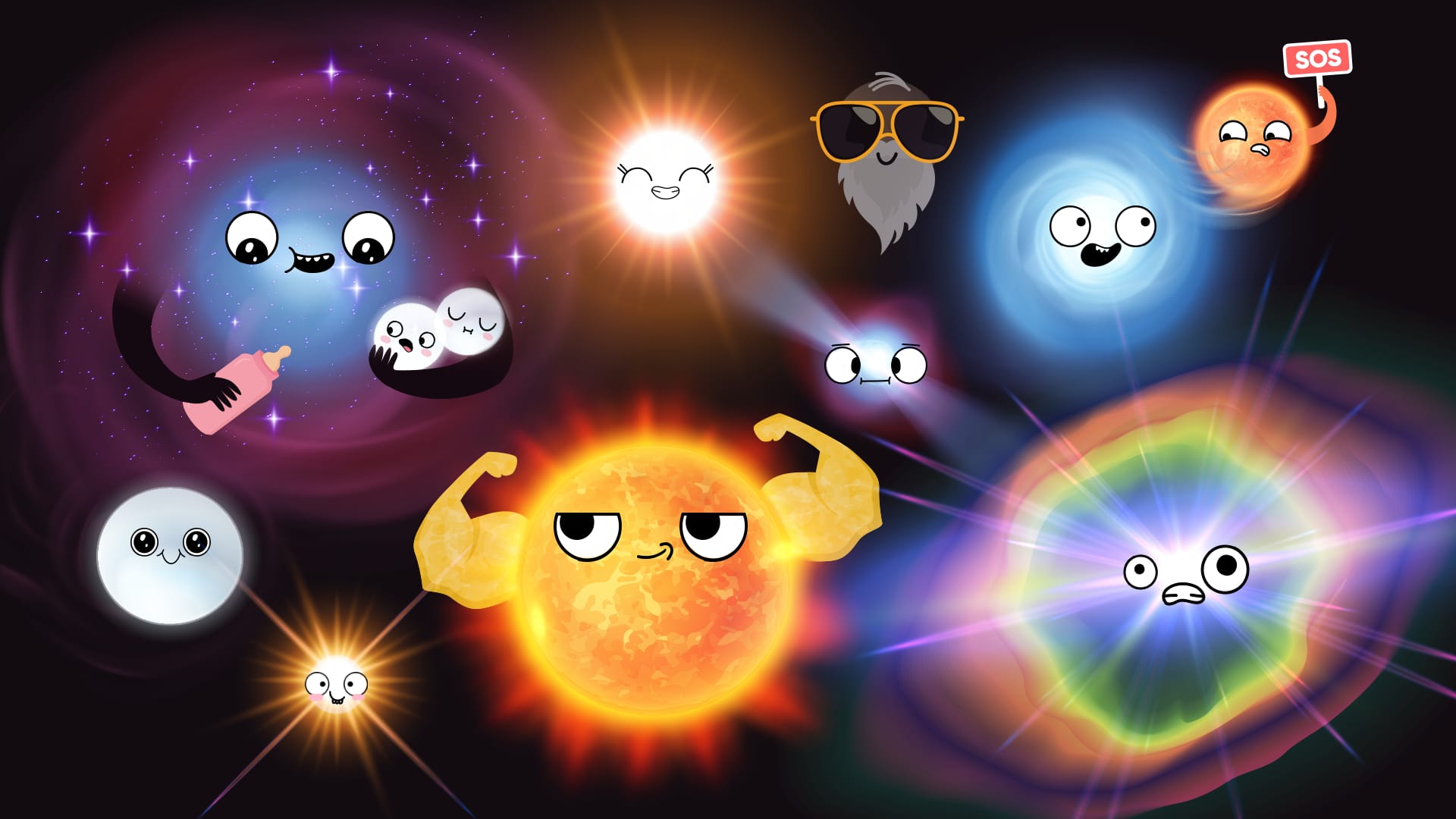
Explore how stars change in our star life cycle infographic.
Spica B: a main-sequence star
Spica B is a hot B-type main-sequence star that fuses hydrogen in its core. It is smaller and less luminous than Spica A, but substantially larger and hotter than the Sun.
More Facts About Spica
Spica is a landmark in several sky patterns and has played an important role in navigation, mythology, and traditional astronomy.
Brightest star in Virgo
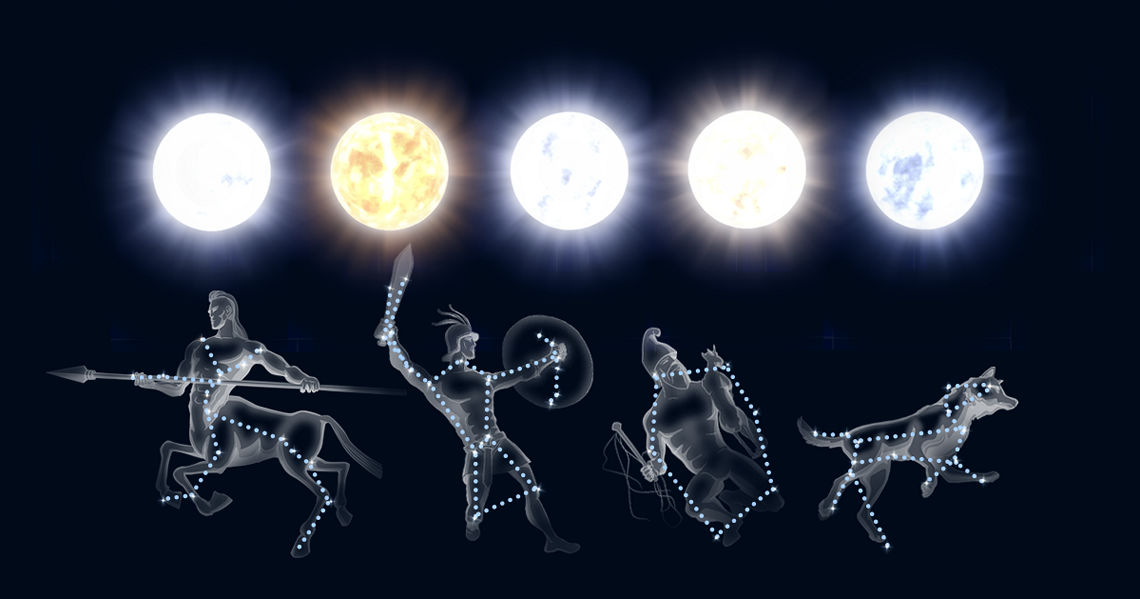
Spica outshines every other star in Virgo as seen from Earth. It is also among the 20 brightest stars in the night sky. Exact rankings depend on how multiple stars are counted and on the changing brightness of variable stars. See our brightest stars infographic for a broader comparison.
What does Spica mean?
The Latin name “Spica” means “ear of grain,” the seed-bearing head of a cereal plant. In traditional depictions, the star marks an ear of grain held by Virgo. Virgo has been associated with several mythological figures, including Demeter, the Greek goddess of agriculture, rather than a single universally agreed character.
Spica in Chinese astronomy: the Dragon’s Horn
Spica’s Chinese name is 角宿一 (Jiǎo Xiù Yī), meaning “First Star of the Horn.” It is the principal star of the Horn lunar mansion, one of the 28 traditional divisions of the sky. The Horn belongs to the Azure Dragon of the East. The name is recorded in the National Astronomical Observatories’ terminology database.
Guiding star
Spica is one of the 57 navigational stars used in the Air and Nautical Almanacs. Its brightness makes it useful for celestial navigation, in which measurements of celestial objects help determine an observer’s position.
What color is Spica?
Spica appears blue-white. Both components are much hotter than the Sun. Hotter stars generally emit a greater proportion of their visible light at blue wavelengths, although atmospheric conditions can affect the color seen by an observer.
Part of the Spring Triangle and the Great Diamond
Spica belongs to two asterisms, recognizable star patterns that are not official constellations. The Spring Triangle joins Spica, Arcturus in Boötes, and Regulus in Leo; another common version uses Denebola instead of Regulus. The Great Diamond joins Spica, Arcturus, Denebola, and Cor Caroli in Canes Venatici.
Lunar occultations of Spica come in cycles
A lunar occultation occurs when the Moon passes in front of a more distant object and temporarily hides it from some locations on Earth. Spica lies about 2° south of the ecliptic, the Sun’s apparent annual path, so the Moon can pass in front of it.
The Moon moves roughly 5° north and south of the ecliptic during each orbit. Meanwhile, the orientation of its orbital plane slowly changes: its nodes, where the orbit crosses the ecliptic, complete a cycle in about 18.6 years. This longer cycle changes the Moon’s track past Spica, producing series of occultations separated by years without them. Each individual occultation is visible only from a limited part of Earth.
Spica in Astrology: Meaning and Symbolism
In astrological tradition, Spica is associated with good fortune, talent, success, and abundance. These symbolic interpretations are connected with its imagery of grain, harvest, and prosperity.
Although Spica belongs to the astronomical constellation Virgo, its tropical zodiac longitude falls at approximately 24° Libra in 2026. Tropical signs are equal 30° divisions measured from the March equinox, while astronomical constellations have different boundaries. Earth’s axial precession gradually shifts the equinox relative to the stars. Our article on zodiac constellations and zodiac signs explains the distinction.
These associations are symbolic traditions; there is no scientific evidence that Spica influences people’s personalities, relationships, or fortunes.
Spica: To Sum Up
Spica is Virgo’s brightest star and one of the easiest stars to recognize once you know where to look. You can find it by following the curve of the Big Dipper’s handle past Arcturus, or simply use Sky Tonight to locate it in the sky. The app also lets you check when Spica will be visible from your location, so you can choose the best time to observe it.
