Regulus (Alpha Leonis): The Brightest Star in Leo
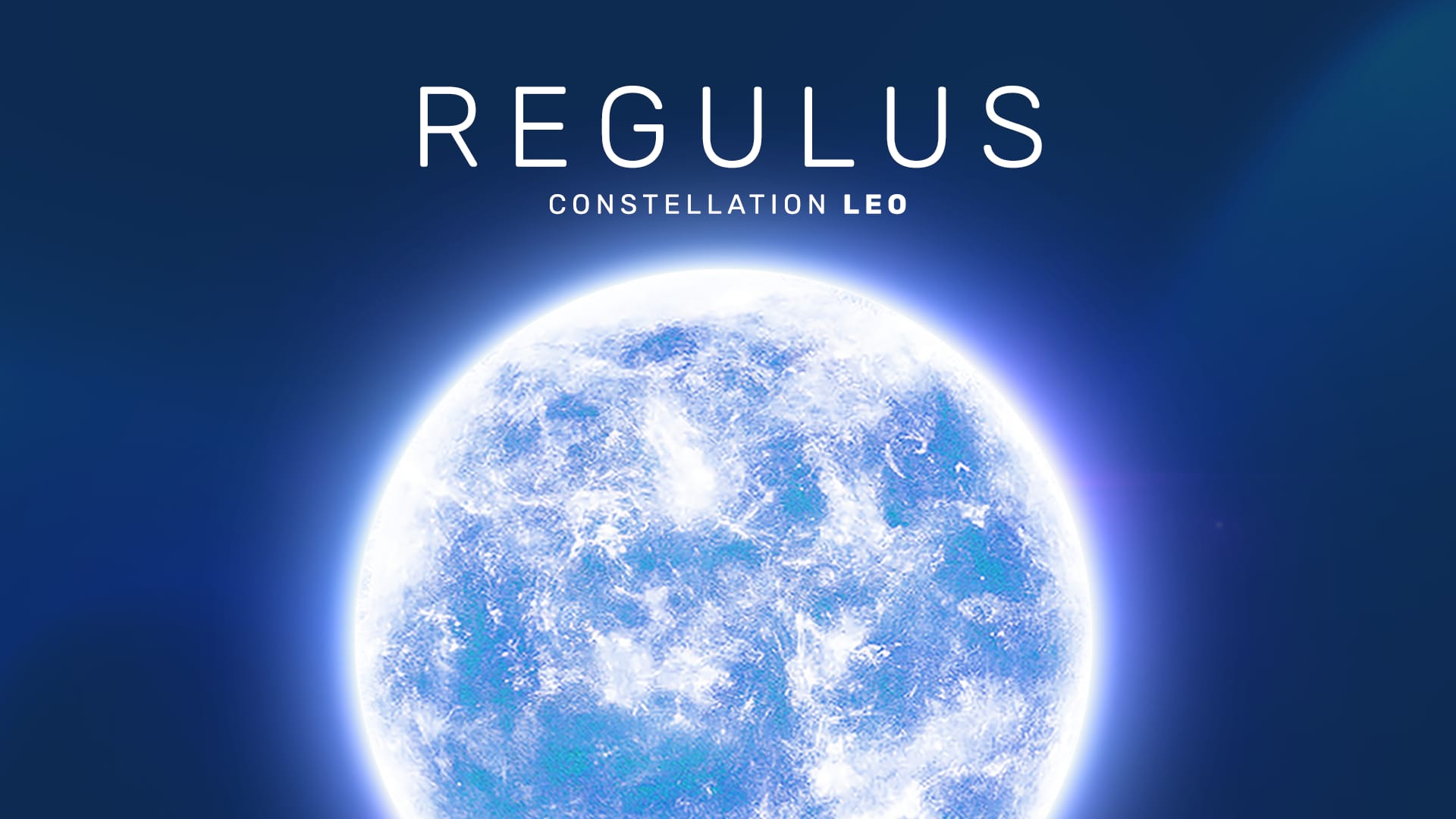
At magnitude 1.4, Regulus outshines every other star in Leo and is visible to the naked eye from both hemispheres. Use Sky Tonight to find Regulus in your sky, check when to observe it, and follow its encounters with the Moon and planets.
Contents
- What Is Regulus?
- Regulus Star Facts: Type, Color, Distance, and Temperature
- Where Is Regulus in the Sky?
- When Is Regulus Visible? Best Time and Upcoming Events
- Interesting Facts About Regulus
- Regulus in Astrology: Meaning of the Royal Star
- Regulus in Mythology and Culture
- Regulus: To Sum Up
What Is Regulus?
Regulus is a hot, blue-white main-sequence star located about 79 light-years from Earth. It marks the heart of the constellation Leo and sits at the base of the Sickle of Leo asterism. Although Regulus appears as a single point of light, it is actually part of a four-star system. Its extremely rapid rotation also gives it an unusual, flattened shape.
Regulus Star Facts: Type, Color, Distance, and Temperature
Here are the key characteristics of Regulus, including its stellar type, brightness, distance from Earth, and physical properties.
- Official name: Regulus, Alpha Leonis, Alpha Leo, α Leo
- Alternative names: Cor Leonis, Lion’s Heart, Basiliskos, Qalb al-Asad, Kabeleced, Rex
- Catalog designations: 32 Leonis, HIP 49669, HR 3982, HD 87901, TYC 833-1381-1
- Constellation: Leo
- Star type: class B8 main-sequence star
- Right ascension: 10 h 08 m 22.04 s
- Declination: +11° 58′ 02.1″
- Apparent magnitude: 1.4
- Absolute magnitude: −0.6
- Mass: 3.8 solar masses
- Luminosity: 341 solar luminosities
- Radius: about 4.2 solar radii at the equator
- Surface temperature: 12,460 K
- Distance from Earth: 79.3 light-years
- Rotation period: 16 hours
Regulus star system: Regulus A, B, and C
Although Regulus appears to be a single star, it is actually a system of four stars arranged in two pairs. The first pair, known as Regulus A, consists of a bright blue-white star with a spectral classification of B8 IVn and a faint companion believed to be a pre-white dwarf — a stellar remnant evolving into a white dwarf. The bright star is visible to the naked eye, but its companion has never been directly imaged. Astronomers first inferred its existence from the bright star’s motion and later identified signs of its light in spectroscopic observations.
Regulus B shines at about magnitude 8 and lies roughly 3 arcminutes from the bright primary. Under good conditions, try spotting it with steadily supported 10×50 binoculars. It’s a cool orange dwarf star that belongs to the spectral type K2 V. Regulus B has its own companion, Regulus C, which is a red dwarf of the spectral type M4V. You’ll need a powerful telescope to catch a glimpse of Regulus C.
Where Is Regulus in the Sky?
Regulus is the 21st brightest star in the sky, making it one of the brightest stars visible from Earth. It resides within the constellation Leo and is one of the three bright stars making up the Spring Triangle, a recognizable asterism. The star has an apparent magnitude of 1.4, which means it’s easily visible to the naked eye without any telescopes or binoculars.
How to find Regulus using the Sickle of Leo
A classic way to find Regulus in the night sky is to look at it in relation to other celestial objects. Regulus is part of the asterism called the Sickle of Leo, which resembles a backward question mark. To locate Regulus, start by searching for the Sickle in the band of the sky where you see the Moon and the planets (near the ecliptic).
If you live in the Northern Hemisphere, you can also use the famous Big Dipper, the asterism of Ursa Major, to locate the star. Find the two stars forming the side of the Big Dipper’s bowl closest to the handle. One is Megrez, where the handle meets the bowl; the other is Phecda. Draw an imaginary line from Megrez through Phecda, then extend it past Phecda by about ten times the distance between the two stars. This will lead you toward Regulus. Keep in mind that planets also move nearby, so if you don’t want to mix up Regulus with Venus, read our article on how planets and stars differ.

How to find Regulus with Sky Tonight
Exploring the night sky is exciting, and it can also be very easy with a proper astronomy app like Sky Tonight. To find Regulus with Sky Tonight, follow these steps:
- Open the app’s search bar and type “Regulus.”
- Tap the blue target button to the right of the matching result. The app will show you the star’s position on the sky map.
- Tap the blue compass button at the bottom right of the screen. The app will use your device’s location to align the screen image with the real sky above you.
- Move your device following the white arrow until you see Regulus on the screen and in the real sky.
In addition to bright Regulus, Sky Tonight offers thousands of other celestial objects to explore. Watch our video tutorials to get the most out of this app.

When Is Regulus Visible? Best Time and Upcoming Events
Regulus can be seen in the sky for most of the year, except for a brief period from early August to early September when the star is too close to the Sun. It returns to the morning sky in September, generally becoming visible in early September at northern mid-latitudes and later in the month at southern mid-latitudes. Then, around mid-February, it transitions to the night sky. Regulus is visible from both the Northern and Southern hemispheres. Note that the star’s home constellation Leo appears upside down in the southern latitudes.
Late March through May is a convenient time to observe Regulus, as it reaches its highest point in the sky during the evening.
Here’s a list of upcoming celestial events involving Regulus. The conjunction and close-approach summaries give geocentric times and separations; the city tables show the view from each location. Here, conjunction means equal right ascension, which does not necessarily coincide with the smallest separation. Check out the Sky Tonight calendar to see how they’ll look in the sky from your location, and set reminders so you don’t miss any of them.
November 22, 2026: Mars, Jupiter, and Regulus form a triangle
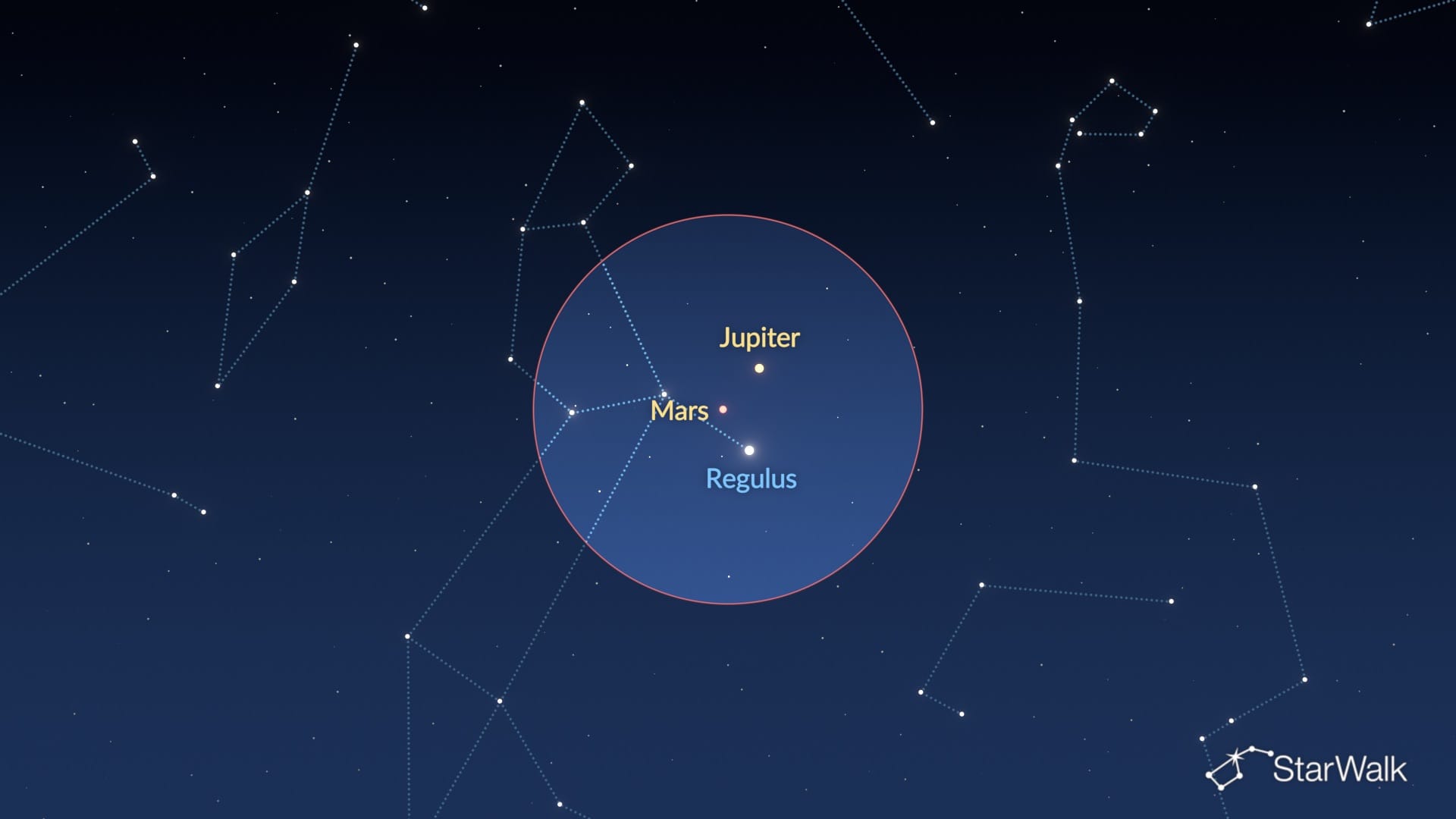
Before dawn on November 22, Mars (mag 0.6), Jupiter (mag −2.1), and Regulus (mag 1.4) will make a nearly isosceles triangle in Leo. The entire triangle fits easily in the field of view of typical binoculars and is visible to the naked eye.
Jupiter will be the brightest point, Mars will look reddish-orange, and Regulus will appear blue-white. The trio will stand higher in the sky for observers at northern mid-latitudes, although it is also visible from the Southern Hemisphere.
The November 22 triangle coincides with the final days of the November 2026 four-planet parade. Before sunrise, look lower toward the east-southeastern horizon for Venus and Mercury, which complete the four-planet lineup with Mars and Jupiter.
| City | Time zone | Visibility start | Visibility end | Best time | Lowest object | Altitude | Sun altitude |
|---|---|---|---|---|---|---|---|
| London, UK | GMT (UTC+0) | November 22, 00:10 | November 22, 06:50 | November 22, 00:10 | Regulus | 10° | −58° |
| New York, USA | EST (UTC−5) | November 22, 00:15 | November 22, 06:20 | November 22, 00:15 | Regulus | 10° | −68° |
| Los Angeles, USA | PST (UTC−8) | November 22, 00:15 | November 22, 06:05 | November 22, 00:15 | Regulus | 10° | −74° |
| Beijing, China | CST (UTC+8) | November 22, 00:35 | November 22, 06:35 | November 22, 06:35 | Regulus | 62° | −6° |
| Shanghai, China | CST (UTC+8) | November 22, 00:20 | November 22, 06:00 | November 22, 06:00 | Regulus | 71° | −6° |
| Tokyo, Japan | JST (UTC+9) | November 22, 00:05 | November 22, 05:55 | November 22, 05:55 | Regulus | 66° | −6° |
| Sydney, Australia | AEDT (UTC+11) | November 22, 02:25 | November 22, 05:10 | November 22, 05:10 | Mars | 36° | −6° |
| Auckland, New Zealand | NZDT (UTC+13) | November 22, 03:00 | November 22, 05:30 | November 22, 05:30 | Mars | 33° | −6° |
- Visibility criteria: All three objects are at least 10° above the horizon, and the Sun is below −6°.
- Best time: The moment within the listed viewing period when the absolute difference between the Mars–Jupiter and Mars–Regulus angular separations is smallest.
- Altitude: The height of the lowest of the three objects at Best time. Sun altitude refers to the same moment.
- Observing conditions: Where Best time falls near morning twilight, observing earlier provides a darker sky with only a small change in the triangle’s shape. The bright waxing gibbous Moon may reduce contrast where it is above the horizon.
- Table values: All times are local and rounded to the nearest five minutes. Altitudes refer to the exact calculated Best time before rounding and are rounded to 1°. Visibility thresholds are applied before rounding, so displayed boundary times may fall slightly outside them.
November 24–27, 2026: Mars passes close to Regulus
- Conjunction time: November 24, 22:03 UTC (5:03 PM EST)
- Conjunction distance: 1°48′
- Close approach time: November 26, 05:15 UTC (12:15 AM EST)
- Close approach distance: 1°43′
From November 24 to 27, Mars (mag 0.6) will pass close to Regulus (mag 1.4) in the constellation Leo. Both objects will be visible to the naked eye and will fit easily within a binocular field of view.
This is a good opportunity to compare the reddish-orange color of Mars with the blue-white color of Regulus. Look for the pair from around midnight until dawn. Observers in the Northern Hemisphere will see them higher in the sky, while those in the Southern Hemisphere will see them lower toward the northern part of the sky.
| City | Time zone | Visibility start | Visibility end | Best time | Mars altitude | Regulus altitude | Sun altitude |
|---|---|---|---|---|---|---|---|
| London, UK | GMT (UTC+0) | November 25, 23:55 | November 26, 07:00 | November 26, 05:55 | 52° | 50° | −16° |
| New York, USA | EST (UTC−5) | November 26, 00:00 | November 26, 06:25 | November 26, 00:00 | 11° | 10° | −70° |
| Los Angeles, USA | PST (UTC−8) | November 26, 00:00 | November 26, 06:10 | November 26, 00:00 | 10° | 10° | −76° |
| Beijing, China | CST (UTC+8) | November 26, 00:20 | November 26, 06:40 | November 26, 06:40 | 63° | 61° | −6° |
| Shanghai, China | CST (UTC+8) | November 26, 00:05 | November 26, 06:05 | November 26, 06:05 | 72° | 70° | −6° |
| Tokyo, Japan | JST (UTC+9) | November 25, 23:50 | November 26, 06:00 | November 26, 06:00 | 67° | 65° | −6° |
| Sydney, Australia | AEDT (UTC+11) | November 27, 02:15 | November 27, 05:10 | November 27, 02:15 | 10° | 12° | −31° |
| Auckland, New Zealand | NZDT (UTC+13) | November 27, 02:45 | November 27, 05:25 | November 27, 02:45 | 10° | 12° | −28° |
- Visibility criteria: Both objects are at least 10° above the horizon, and the Sun is below −6°.
- Visibility start and end: The boundaries of the viewing period containing Best time.
- Best time: The moment when Mars and Regulus appear closest together from the listed city while meeting the visibility criteria.
- Altitudes: The heights of Mars, Regulus, and the Sun at Best time.
- Observing conditions: Best time prioritizes minimum angular separation. Observing later can provide a higher view where Best time falls near the beginning of the viewing period; observing earlier can provide a darker sky where it falls near morning twilight. The separation changes very little during a single night.
- Table values: All times are local and rounded to the nearest five minutes. Altitudes refer to the exact calculated Best time before rounding and are rounded to 1°. Visibility thresholds are applied before rounding, so displayed boundary times may fall slightly outside them.
November 30–December 1, 2026: Moon near Regulus
- Close approach time: November 30, 14:23 UTC (9:23 AM EST)
- Close approach distance: 1°01′
- Conjunction time: November 30, 15:16 UTC (10:16 AM EST)
- Conjunction distance: 1°08′
On November 30, the waning gibbous Moon will pass very close to Regulus (mag 1.4) in the constellation Leo. The pair will be visible to the naked eye, although binoculars will help distinguish the blue-white star from the bright Moon.
Australia and East Asia will offer particularly close views of the Moon and Regulus during the late-night hours of November 30 and early December 1. In North America, the pair will appear close together before sunrise on November 30. Observers in Europe and Africa will also see the two objects, but they will appear farther apart.
| City | Time zone | Visibility start | Visibility end | Best time | Separation | Moon altitude | Sun altitude |
|---|---|---|---|---|---|---|---|
| New York, USA | EST (UTC−5) | November 29, 23:40 | November 30, 06:30 | November 30, 06:30 | 2.3° | 57° | −6° |
| Los Angeles, USA | PST (UTC−8) | November 29, 23:45 | November 30, 06:10 | November 30, 05:40 | 1.4° | 66° | −13° |
| Mexico City, Mexico | CST (UTC−6) | November 30, 00:35 | November 30, 06:30 | November 30, 06:30 | 1.7° | 79° | −6° |
| London, UK | GMT (UTC+0) | November 29, 23:40 | November 30, 07:05 | November 30, 07:05 | 4.6° | 45° | −6° |
| Johannesburg, South Africa | SAST (UTC+2) | December 1, 01:00 | December 1, 04:40 | December 1, 01:00 | 5.5° | 10° | −39° |
| Beijing, China | CST (UTC+8) | December 1, 00:10 | December 1, 06:45 | December 1, 00:10 | 2.3° | 10° | −72° |
| Tokyo, Japan | JST (UTC+9) | November 30, 23:35 | December 1, 06:05 | November 30, 23:35 | 1.6° | 10° | −76° |
| Sydney, Australia | AEDT (UTC+11) | December 1, 01:50 | December 1, 05:10 | December 1, 01:50 | 0.7° | 10° | −32° |
- Visibility criteria: Both objects are at least 10° above the horizon, and the Sun is below −6°.
- Visibility start and end: The boundaries of the viewing period containing Best time.
- Best time: The moment when the Moon and Regulus appear closest together from the listed city while meeting the visibility criteria.
- Separation: The topocentric angular distance between the Moon’s center and Regulus at Best time.
- Moon and Sun altitudes: Their heights relative to the horizon at Best time.
- Table values: All times are local and rounded to the nearest five minutes. Separations and altitudes refer to the exact calculated Best time before rounding and are rounded to 0.1° and 1°, respectively. Visibility thresholds are applied before rounding, so displayed boundary times may fall slightly outside them.
November 30–December 1, 2026: Lunar occultation of Regulus in New Zealand
- Global occultation start: November 30, 13:11 UTC (8:11 AM EST)
- Global occultation end: November 30, 15:36 UTC (10:36 AM EST)
The global start and end above mark the first and last contacts anywhere on Earth; local times are listed below.
During the same close approach, the Moon will occult Regulus, temporarily hiding the star behind its disk. The occultation will be visible from parts of New Zealand and Norfolk Island. In New Zealand, it will occur after midnight on December 1 local time.
Observers will be able to watch Regulus disappear behind the Moon’s limb and reappear roughly an hour later. A small telescope or binoculars will provide a better view of the contacts, particularly because the Moon will be more than half illuminated.
| City | Time zone | Disappearance | Reappearance | Duration | Moon altitude | Sun altitude |
|---|---|---|---|---|---|---|
| Auckland, New Zealand | NZDT (UTC+13) | December 1, 02:21 | December 1, 03:18 | 57 min | 10° | −29° |
| Hamilton, New Zealand | NZDT (UTC+13) | December 1, 02:22 | December 1, 03:20 | 58 min | 10° | −28° |
| Napier, New Zealand | NZDT (UTC+13) | December 1, 02:26 | December 1, 03:26 | 60 min | 11° | −26° |
| Gisborne, New Zealand | NZDT (UTC+13) | December 1, 02:25 | December 1, 03:25 | 60 min | 12° | −26° |
| Palmerston North, New Zealand | NZDT (UTC+13) | December 1, 02:26 | December 1, 03:26 | 60 min | 10° | −25° |
- Visibility criteria: Both contacts occur with the Moon at least 10° above the horizon and the Sun below −12°.
- Disappearance and reappearance: The local times when Regulus passes behind and emerges from the Moon’s limb.
- Duration: The interval between the two contacts, rounded to the nearest minute.
- Moon and Sun altitudes: Their heights relative to the horizon at disappearance, rounded to 1°.
- Table values: All times are local and approximate to one minute. Contact times are model-based estimates for city centers and may vary slightly with location and the Moon’s uneven limb.
- Low-altitude locations: Wellington, New Zealand, and Norfolk Island can also witness the occultation, but the Moon is only about 9° and 6° above the horizon, respectively, at disappearance. These locations are excluded from the table.
Interesting Facts About Regulus
Regulus is famous for its royal name, rapid rotation, and frequent encounters with the Moon and planets.
Regulus name meaning: the Little King Star
Regulus means “little king” in Latin — a fitting name for the brightest star in Leo, the constellation of the lion. Lions are often called the “kings of animals,” and many other historical names for Regulus also emphasize its royal significance.
The Greeks called the star Kardia Leontos, and the Latin name for it was Cor Leonis. In Arabic, it was referred to as Qalb al-Asad. All three of these names carry the same meaning: “the heart of the lion.” Interestingly, King Richard I of England was famously called Lionheart, too.
Media star
Regulus has also found its way into modern popular culture. The star can be found in popular television series such as Babylon 5 and Star Trek, as well as in computer games like BattleTech, the Frontier series, and Descent: FreeSpace. Additionally, J.K. Rowling’s “Harry Potter” series fans may recall the character Regulus Black. He was the brother of Sirius Black, Harry’s godfather, whose name was a reference to the brightest star in the sky.
Why is Regulus egg-shaped?
Did you know that not all stars are perfectly round? Take, for instance, Vega, which is flattened at the poles. Well, guess what? Regulus is noticeably flattened at the poles because of its rapid rotation. The star completes one full spin on its axis approximately every 16 hours. In comparison, our own Sun takes a leisurely 27 days to complete a single rotation.
Detailed observations show that Regulus rotates so fast that it’s close to the point where it would begin shedding material from its equator. Research on its close companion suggests that past mass transfer helped spin Regulus up.

Regulus and the Moon: lunar occultations and planetary encounters
Staying close to the ecliptic, Regulus often meets the Sun, the Moon, and the planets. Sometimes one of these objects blocks Regulus from our view – astronomers call this event an “occultation.” Regulus is most often occulted by the Moon, but sometimes by planets as well. For example, on October 1, 2044, Regulus will be occulted by Venus. Save the date!
Regulus in Astrology: Meaning of the Royal Star
In astrology, Regulus is one of the four Royal Stars, along with Aldebaran, Antares, and Fomalhaut. Traditionally linked with royalty and the heart of the Lion, it is associated with leadership, ambition, courage, and success. Some astrological traditions also connect it with the risks of pride and losing one’s position. These meanings are symbolic interpretations, not scientifically established effects of the star.
Is Regulus in Leo or Virgo? Astronomically, Regulus belongs to the constellation Leo. In the tropical zodiac used in much of Western astrology, however, its position is near 0° Virgo in 2026. The difference exists because Earth’s axial precession slowly shifts the zodiac’s reference points relative to the stars. Astrologers may consider Regulus when interpreting a birth chart, particularly when a planet is close to its position, but there is no scientific evidence that the star influences personality or fate.
Want to see how the zodiac signs compare with the actual constellations in the sky? Check out our infographic on the 12 zodiac signs and 13 ecliptic constellations.
Regulus in Mythology and Culture
Throughout history, Regulus has been associated with royalty, power, and authority. Different cultures gave the star their own names, legends, and symbolic meanings:
- Mesopotamia: Ancient astronomers recognized the constellation Leo as UR.GU.LA, the Great Lion, and called Regulus Sharru, meaning “the King.” The star also appeared in astrological omens: a darkened Regulus was believed to foretell the death of a palace official.
- Greek mythology: Leo was associated with the Nemean Lion, a fierce beast with an impenetrable hide. Heracles (Hercules) defeated it as the first of his Twelve Labors. Regulus marks the heart of this mythical lion.
- Chinese astronomy: Regulus is known as Xuanyuan XIV (轩辕十四), the Fourteenth Star of Xuanyuan, an asterism named after the legendary Yellow Emperor. The star was also called Nüzhu (女主), meaning "Female Ruler," and symbolized the empress.
- Indian astronomy: Regulus is the principal star of Maghā, one of the 27 nakshatras, or lunar mansions. Maghā is traditionally associated with ancestors, royal lineage, and inherited authority.
Regulus: Frequently Asked Questions
Here are answers to common questions about Regulus, including its visibility, physical characteristics, and the 2026 Sphinx prediction.
Is Regulus a star?
Yes, Regulus is a star. More precisely, it is a blue-white main-sequence star and the brightest star in the constellation Leo. Although Regulus looks like a single bright point of light to the naked eye, it is actually part of a multiple-star system.
What constellation is Regulus in?
Regulus is located in the constellation Leo, where it marks the Lion’s heart. That’s why the star is also known as Alpha Leonis: it is the brightest star in Leo. Regulus sits at the base of the Sickle of Leo, an asterism that outlines the Lion’s head and mane.
What color is Regulus?
Regulus has a blue-white color. This color comes from its high surface temperature: Regulus is much hotter than the Sun, which gives it a bright bluish-white appearance in the night sky.
How far is Regulus from Earth?
Regulus is located about 79 light-years from Earth. This means the light we see from Regulus today left the star roughly 79 years ago. To better understand what a light-year means, check out our infographic: How We Measure Distances in Space.
Does Regulus have planets?
Although astronomers have identified its stellar companions, no exoplanets have been confirmed in the Regulus system. That doesn’t necessarily mean there are no planets there — only that none have been verified so far.
When is Regulus visible?
Regulus is best seen in the evening sky from late winter through spring in the Northern Hemisphere. Around August, it is too close to the Sun to observe safely, but it returns to the morning sky in September. Because Regulus lies close to the ecliptic, the Moon and planets often pass near it, creating easy-to-spot sky events.
When will Regulus align with the Sphinx?
The supposed alignment of Regulus with the Great Sphinx of Giza became popular because of a prophecy shared by American UFO experiencer Chris Bledsoe. He claimed that Regulus would appear red near the eastern horizon, in the direction faced by the Sphinx, signaling the arrival of mysterious “new knowledge” for humanity.
The prediction was initially associated with Easter Sunday, April 5, 2026, but Regulus was not visible on the eastern horizon before dawn that day. Later interpretations pointed to October 7, 2026, when Regulus was visible in the eastern sky before sunrise. However, this was an ordinary, predictable position of the star, not a unique astronomical alignment or evidence of a supernatural event.
Did Regulus turn red in 2026?
No. Regulus is still a blue-white star. Despite the prophecy suggesting that it would turn red, there was no astronomical reason to expect a physical change in its color.
However, Regulus can sometimes appear reddish near the horizon. When its light passes through a thick layer of Earth’s atmosphere, shorter, bluer wavelengths are scattered more strongly, leaving the star looking warmer in color. Dust and atmospheric conditions can enhance this effect. So, seeing a reddish Regulus is entirely possible — but it’s a natural optical phenomenon, not a transformation of the star.
Regulus: To Sum Up
Regulus is the brightest star in Leo and one of the easiest stars to recognize in the night sky. You can find it at the base of the Sickle of Leo or use the Big Dipper as a guide. For a quicker way, open the Sky Tonight astronomy app, search for Regulus, and check where and when the star is visible from your location.
