Upcoming Comets Visible in 2026: The Latest News
If you’ve been waiting to catch a comet, you’re in the right place. Below is the list of comets expected to be visible from Earth in 2026, with forecasts on when they’ll show up and where to look from. One comet is already visible via binoculars! Want a hand locating them from your exact spot? Use the free Sky Tonight app to easily find any comet in your sky. Now, let’s take a look at the cosmic visitors heading our way!
Contents
- Next comet visible from Earth
- Comet in January 2026 – early March 2026: C/2024 E1 (Wierzchos)
- Comet in January–February 2026: 24P/Schaumasse
- Late March – early April 2026: Newly Discovered C/2026 A1 (MAPS)
- Comet in mid-February – April 2026: 88P/Howell
- Comet in late April – early May 2026: C/2025 R3 PanSTARRS 🌟
- Comet in early July – late August 2026: 10P/Tempel 2
- How to find a comet using Sky Tonight?
- Next comet visible from Earth: Bottom line
Next comet visible from Earth
The next relatively bright comet visible from Earth is C/2024 E1 (Wierzchos). Around January 20, 2026, it reached about magnitude 8, making it a good binocular target for observers in the Southern Hemisphere. In the Northern Hemisphere, it becomes visible later — closer to its nearest approach to Earth on February 17, 2026 — but by then it will likely be fading.
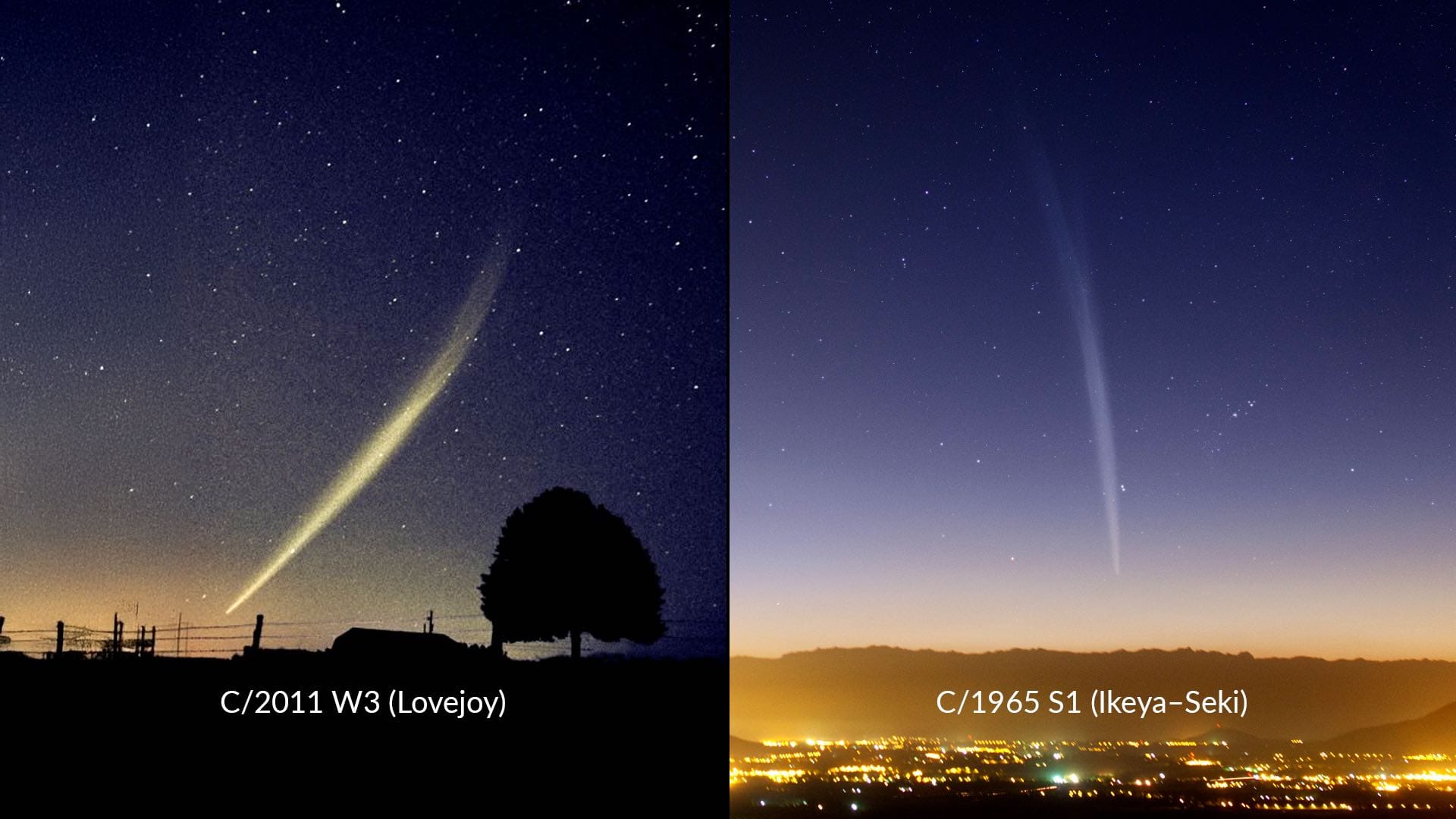
Another object to keep an eye on is C/2026 A1 (MAPS), a newly discovered Kreutz sungrazer. In the best-case scenario, it could even become visible to the naked eye in early April 2026.
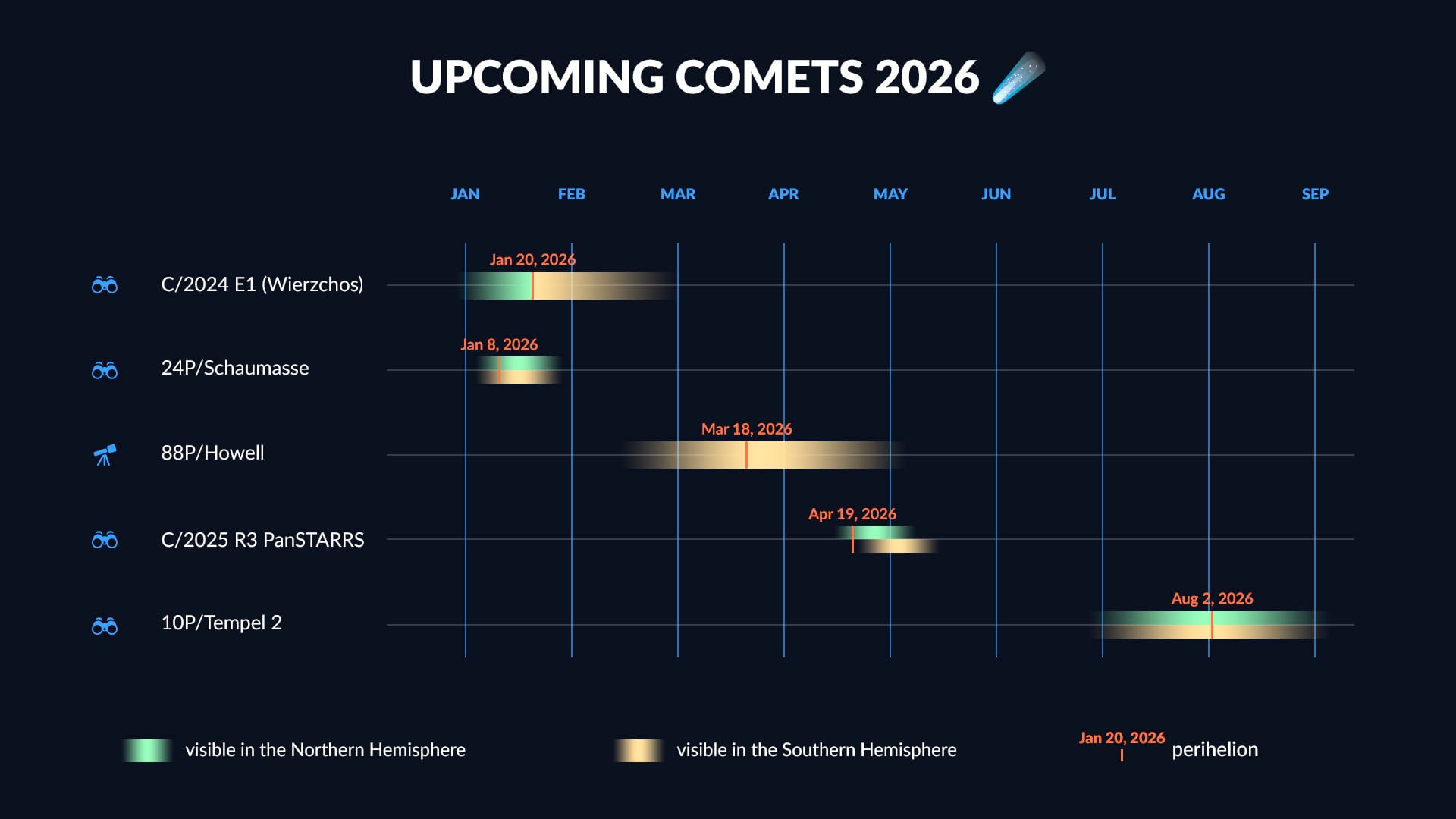
These comets are listed by when they’re actually visible from Earth, not by their perihelion or closest‐approach dates (some aren’t observable at those moments), so refer to each comet’s visibility window highlighted in the title.
Comet in January 2026 – early March 2026: C/2024 E1 (Wierzchos)
- Perihelion: January 20, 2026 (mag 8.1)
- Closest approach to Earth: Feb 17, 2026 (mag 8.7)
- Where to observe: Southern Hemisphere around perihelion; both hemispheres around closest approach to Earth
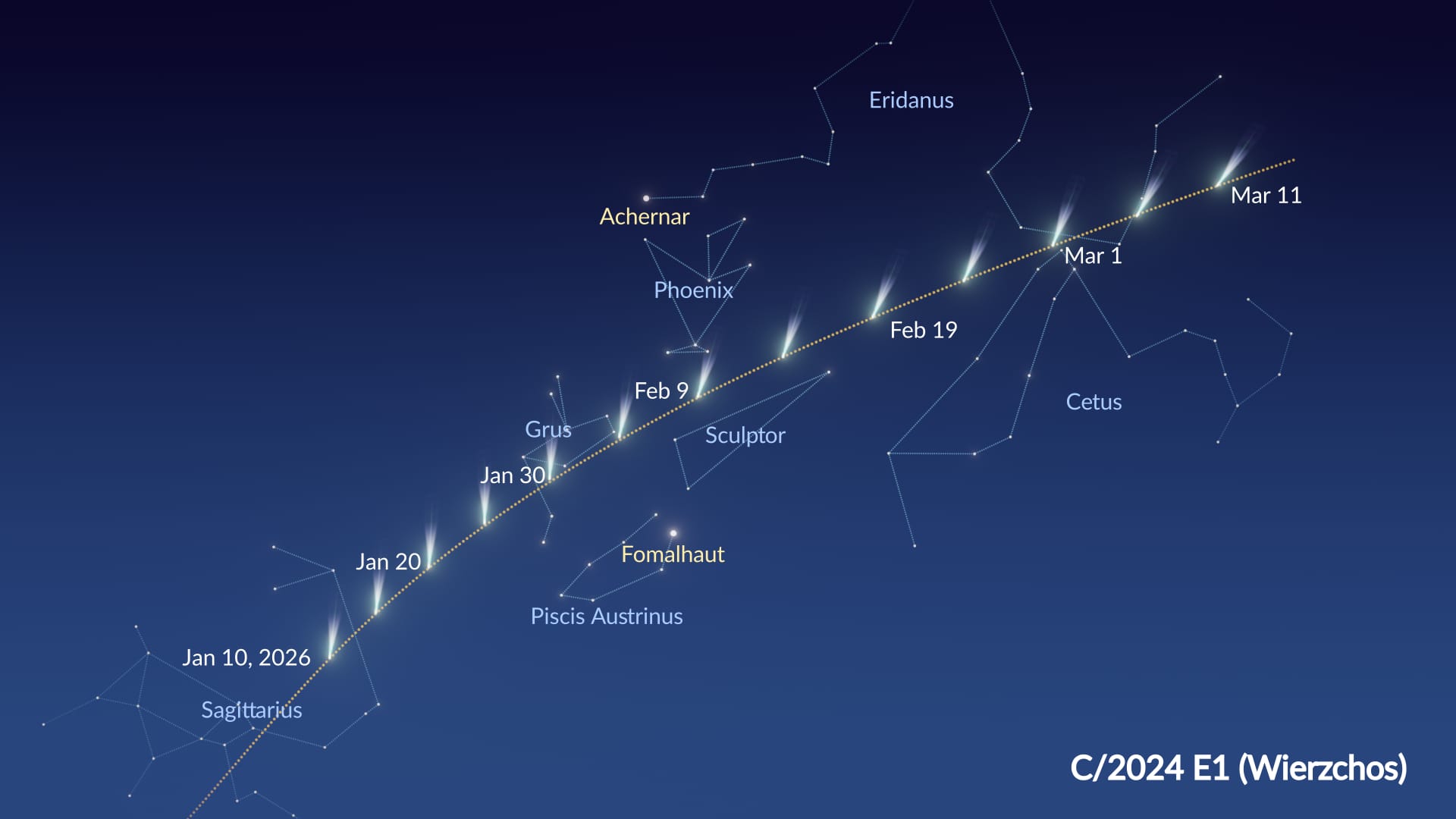
Will C/2024 E1 (Wierzchos) be visible from Earth?
C/2024 E1 (Wierzchos) first became visible from Earth in late 2025, when observers in the Northern Hemisphere could spot it with small telescopes or binoculars. After that, it moved too close to the Sun in the sky and was temporarily lost in its glare.
Around perihelion on January 20, 2026, the comet will appear again, this time in the Southern Hemisphere’s evening sky. It will be located about 22° away from the Sun, very low above the southwestern horizon. The most optimistic forecasts predict a brightness of about magnitude 5, making it relatively easy to see in binoculars under dark skies. However, more cautious estimates suggest a peak brightness around magnitude 8, meaning it will instead require larger binoculars or a modest telescope.
Comet Wierzchos will reappear in the Northern Hemisphere later, near its closest approach to Earth on February 17, 2026. By then, it will be farther from the Sun’s glare and will once again be visible in the evening sky from some northern locations (around 42°N and farther south), still very low above the southwestern horizon about an hour after sunset. In the Southern Hemisphere, at this time, the comet will stand relatively high in the southwestern sky.
By the time the comet reaches its closest approach to Earth, it is expected to fade to about 9th magnitude, but it should still be a reasonable target for observers using binoculars or a small telescope under dark skies.
When was C/2024 E1 (Wierzchos) discovered?
Comet C/2024 E1 Wierzchos was discovered by Polish astronomer Kacper Wierzchos on March 3, 2024, in images taken by the Mount Lemmon Survey. C/2024 E1 is a hyperbolic comet, which means it will travel through the Solar System only once before leaving it for interstellar space. However, despite its hyperbolic orbit, the comet still could originate from inside the Solar System — from the Oort Cloud.
Comet in January–February 2026: 24P/Schaumasse
- Perihelion: January 8, 2026 (mag 9.7)
- Closest approach to Earth: January 4, 2026 (mag 9.8)
- Where to observe: Both hemispheres
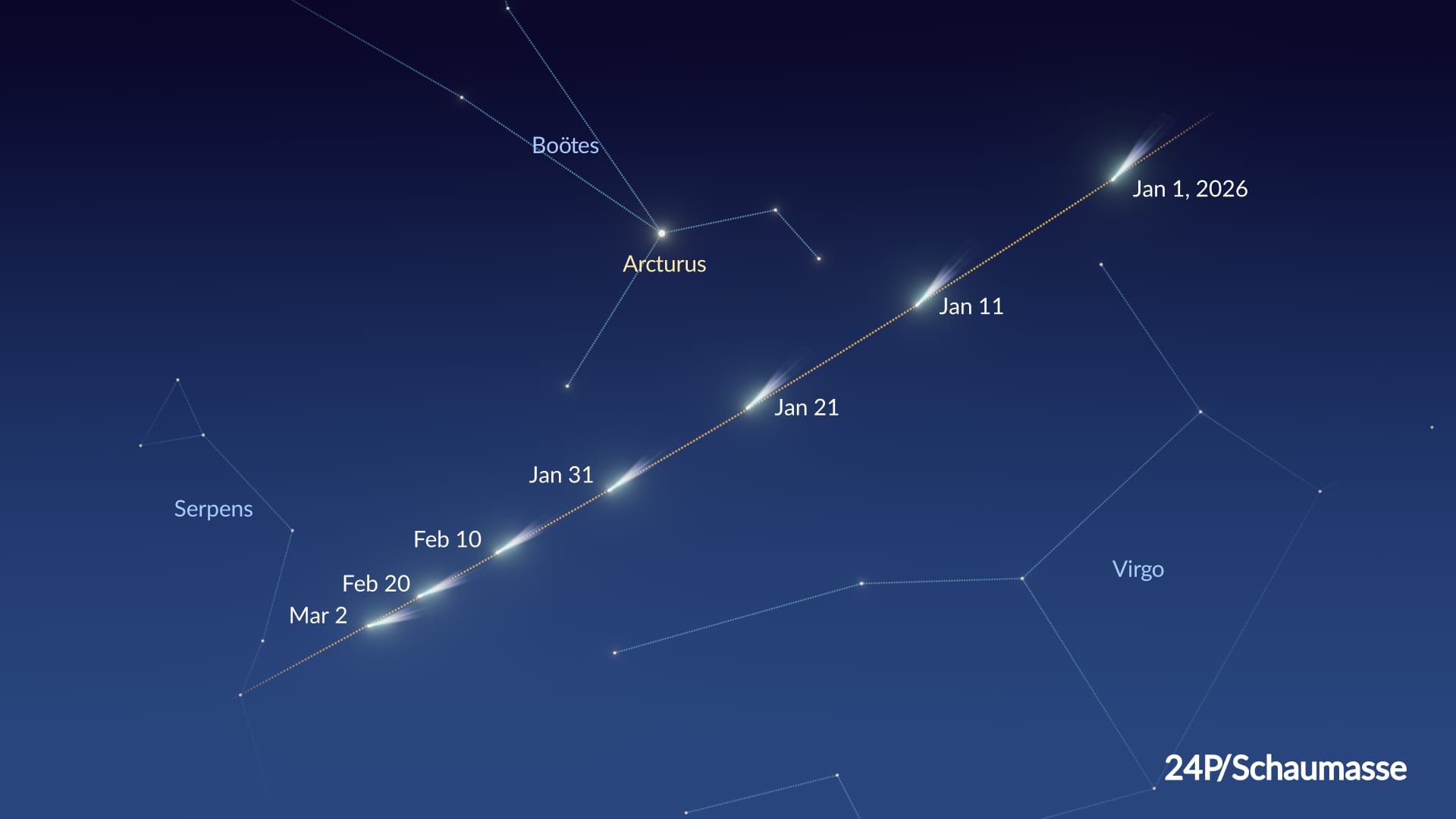
Will 24P/Schaumasse be visible from Earth?
Comet 24P/Schaumasse reached its maximum brightness of about magnitude 10 around January 8, 2026. Around this time, it is visible with telescopes under dark skies.
In the Northern Hemisphere, the comet will rise earlier and climb higher in the sky. Starting from about midnight, look above the eastern horizon — the comet will move southward, gradually fading into the morning twilight.
In the Southern Hemisphere, start observing from around 2 a.m. local time, looking toward the eastern horizon. Through the night, Comet 24P will travel north across the sky.
Comet Schaumasse will remain visible through telescopes until the end of February, fading to about magnitude 11 by then.
When was 24P/Schaumasse discovered?
Comet 24/P Schaumasse is a periodic comet discovered by French astronomer Alexandre Schaumasse on 1 December 1911 in Nice, France. It has an orbital period of 8.18 years. The comet nucleus is estimated to be 2.6 km (1.6 miles) in diameter.
Late March – early April 2026: Newly Discovered C/2026 A1 (MAPS)
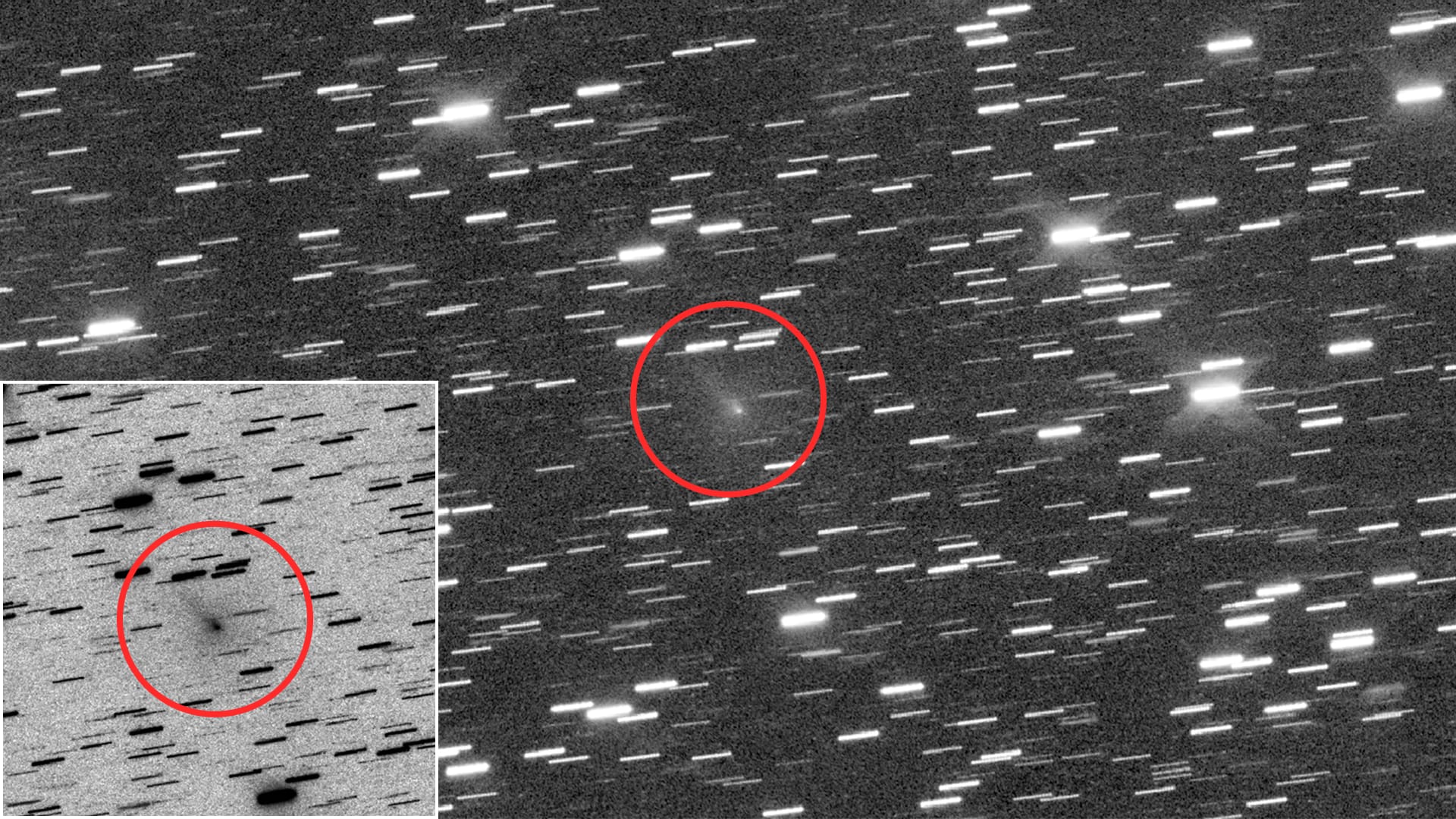
On January 13, 2026, astronomers spotted a new object that belongs to the Kreutz sungrazer family — comets that pass extremely close to the Sun and are thought to be fragments of a much larger comet that broke apart long ago.
Comet MAPS is the furthest Kreutz sungrazer comet ever discovered; it was found from the AMACS1 Observatory near San Pedro de Atacama, Chile, at roughly 2.06 AU from the Sun and 1.43 AU from Earth — much farther than any Kreutz comet has been discovered before.
What could happen next:
- Best case scenario: it brightens rapidly as it’s heading toward perihelion in early April 2026, potentially becoming a naked-eye Kreutz sungrazer — perhaps even a standout comparable to Comet Lovejoy (December 2011). However, observations would likely be brief and challenging because the comet will stay very close to the Sun, with the best chances in morning twilight and possibly even daylight.
- Worst case scenario: it breaks up near perihelion — a common fate for sungrazers, especially smaller ones, — and never becomes a famous comet.
Learn more: the latest news about the newly discovered Kreutz sungrazer comet.
Comet in mid-February – April 2026: 88P/Howell
- Perihelion: March 18, 2026 (mag 10)
- Closest approach to Earth: October 10, 2026 (mag 15.5)
- Where to observe: Southern Hemisphere

Will 88P/Howell be visible from Earth?
Comet 88P/Howell will be visible from southern latitudes from mid-February to about the end of April 2026. It will reach its peak brightness near perihelion on March 18, 2026, when it should be visible through telescopes.
Around that date, look for the comet early in the morning, low above the eastern horizon. The brightest star in Capricornus, Deneb Algedi, will be only about 4° to the east of the comet, which can help you find it.
When was 88P/Howell discovered?
88P/Howell was discovered on August 29, 1981, by Ellen Howell, an American astronomer and planetary scientist. It is a short-period comet with an orbital period of about 5.5 years. During a favorable return, the comet may reach around 7th magnitude.
Comet in late April – early May 2026: C/2025 R3 PanSTARRS 🌟
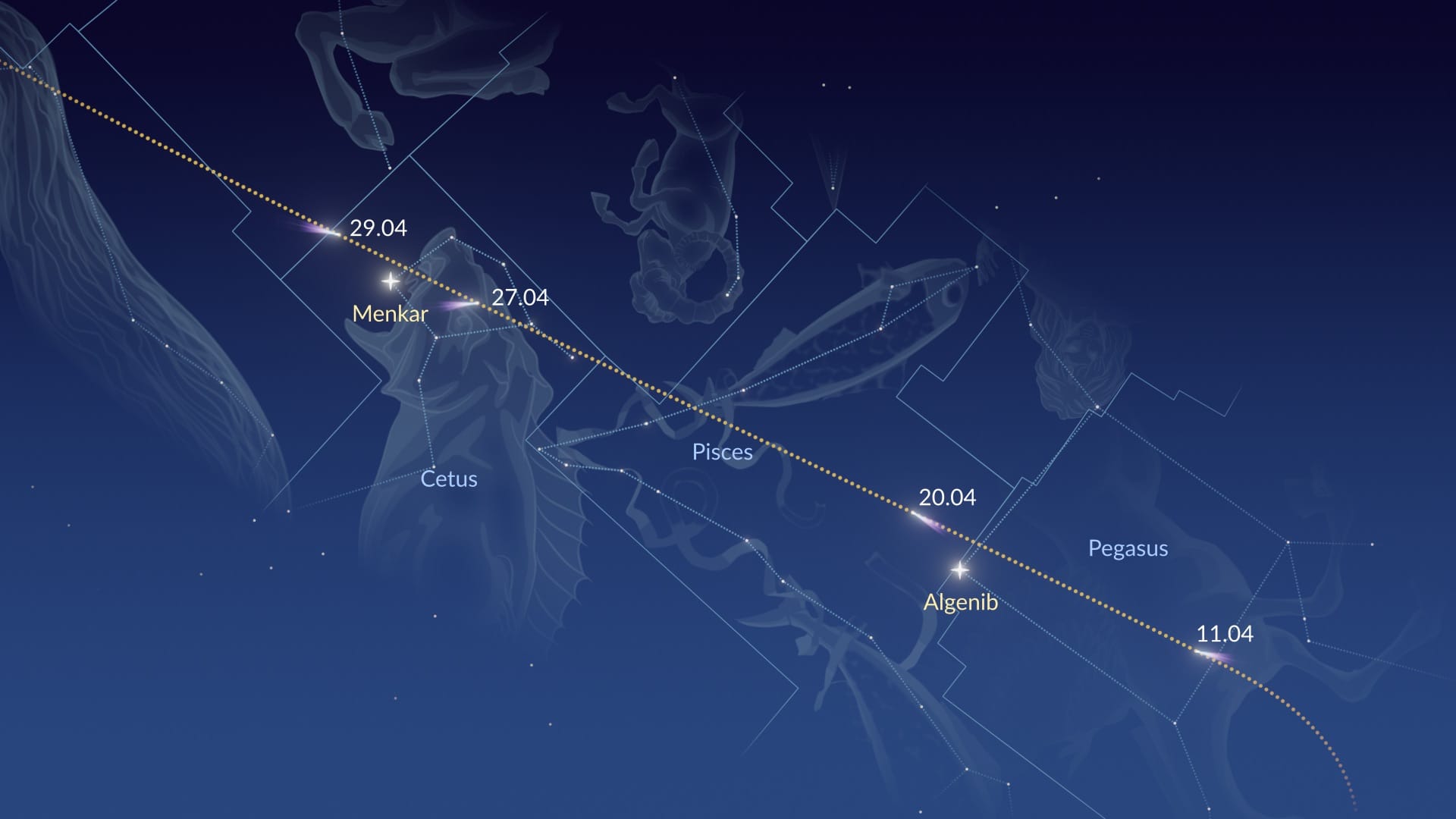
- Perihelion: April 19, 2026 (mag 6.8)
- Closest approach to Earth: April 26, 2026 (mag 6, possibly 3.3)
- Where to observe: Northern Hemisphere (before perihelion), Southern Hemisphere (after perihelion)
Will C/2025 R3 PanSTARRS be visible from Earth?
Comet C/2025 R3 is expected to reach about magnitude 7 — too dim for the naked eye, but visible with binoculars under dark skies. There’s also a chance it could brighten to around magnitude 3 due to forward scattering, which would make it visible to the naked eye. If that happens, Comet PanSTARRS could become the brightest comet of 2026! We’ve even included it in our list of the best events of 2026 — let’s hope it lives up to expectations.
The best time to look for C/2025 R3 PanSTARRS will be from late April to early May 2026, when it appears low in the twilight sky. Visibility will depend on your location: observers in the Northern Hemisphere may spot it in the morning in late April, while those in the Southern Hemisphere will have a chance to see it in the evening sky in early May.
Learn more: All you need to know about C/2025 R3 PanSTARRS
When was C/2025 R3 PanSTARRS discovered?
The comet was discovered on September 8, 2025, by the Pan-STARRS survey telescope in Hawaii. C/2025 R3 PanSTARRS is a long-period comet with an unknown orbital period. It may follow a hyperbolic path, making a single pass by the Sun before heading into interstellar space. If so, April 2026 could be humanity’s only chance to see it. Even if further calculations show the comet is still gravitationally tied to the Sun, its orbit would probably be so long that it won’t come back in our lifetimes.
Comet in early July – late August 2026: 10P/Tempel 2
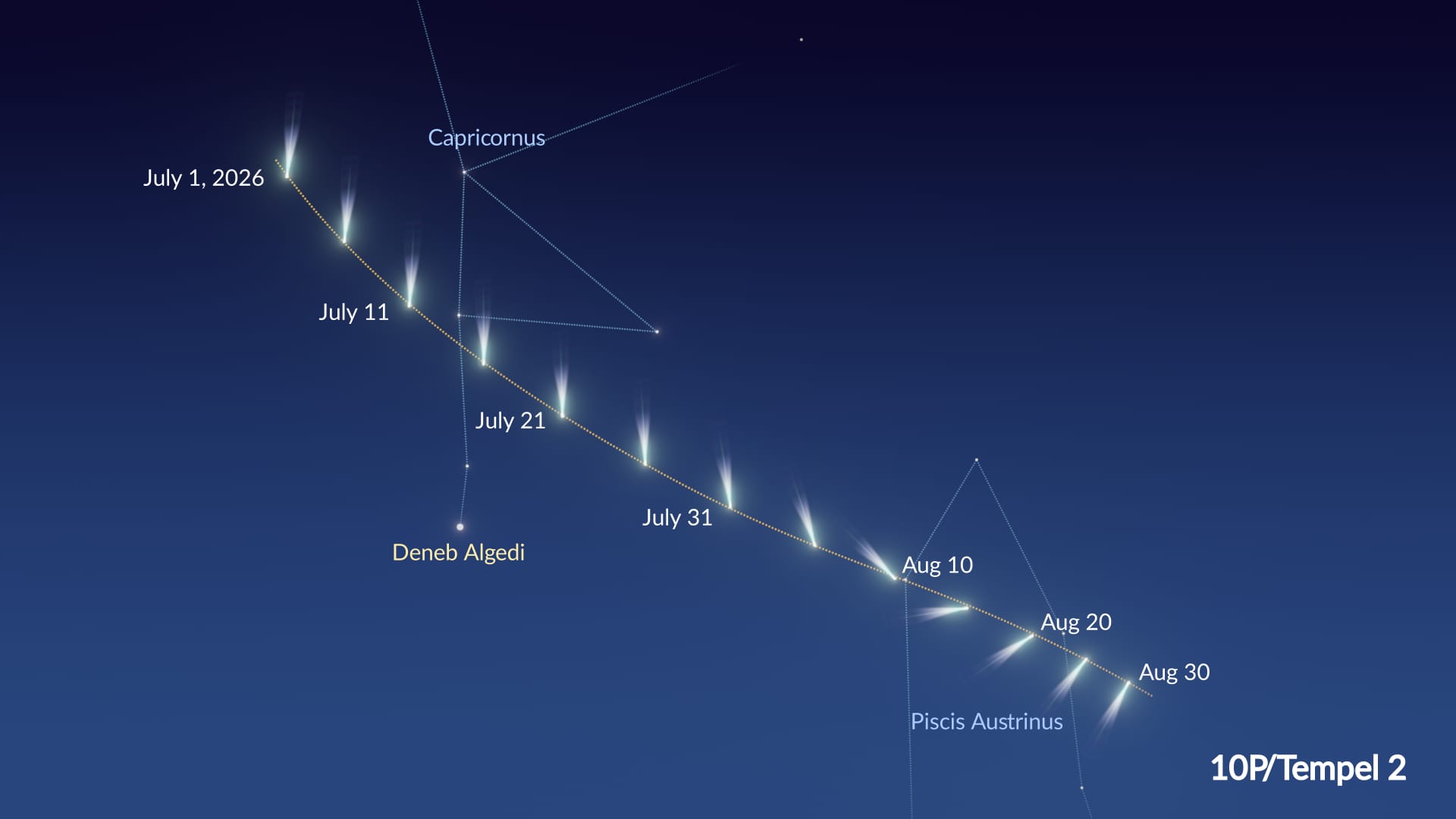
- Perihelion: August 2, 2026 (mag 6.9)
- Closest approach to Earth: August 3, 2026 (mag 6.9)
- Where to observe: Both hemispheres
Will 10P/Tempel 2 be visible from Earth?
From July 2026 onward, 10P/Tempel 2 will emerge in the evening sky after sunset. The comet will be visible in both hemispheres; in the Southern Hemisphere, it will rise much higher above the horizon than in the Northern Hemisphere. Around perihelion, the comet should brighten to about mag 7.0 — easily seen with binoculars or a small telescope under dark skies.
When was 10P/Tempel 2 discovered?
Discovered on July 4, 1873, by Wilhelm Tempel, 10P/Tempel 2 is a Jupiter-family periodic comet. It orbits the Sun every 1,960 days (≈5.37 years), traveling between 1.42 AU at perihelion and 4.71 AU at aphelion.
How to find a comet using Sky Tonight?
Comets are faint and fuzzy objects that are hard to detect, so it’s best to know their location for certain. The Sky Tonight app will help you quickly find any bright comet in the sky. Here’s what you need to do:
- Tap the magnifier icon at the lower part of the screen;
- In the Search field, enter the comet’s name or designation;
- Find the comet in the search results and tap the blue target icon next to its name;
- The app will show the comet’s current location in the sky;
- Point your device at the sky and follow the white arrow to find the comet.
You can also tap the comet’s name in the search results and then go to the Events tab to view the events related to the comet: perihelion and closest approach to Earth. Tap the blue target icon next to the event to see the comet’s location at the time of perihelion or closest approach.
Next comet visible from Earth: Bottom line
Comet C/2024 E1 (Wierzchos) reached peak visibility around January 20, but it’s still within reach of binoculars and small telescopes. Northern Hemisphere observers should get their best chance for viewing C/2024 E1 around the comet’s closest approach to Earth on February 17, 2026 — though it will likely be a bit fainter by then.
Another object to watch for is C/2026 A1 (MAPS), a newly discovered Kreutz sungrazer that could become an exciting target in March-April 2026.
Stay tuned for the latest comet updates! While we’re waiting for a bright comet to appear, let’s brush up on some astronomy basics in an easy, visual way. Learn how comets differ from meteors and asteroids with our All You Need to Know About Comets infographic.
While working on this article, we used data from the following sources:
- Comet Observation database;
- TheSkyLive;
- Astronomer Gideon van Buitenen;
- Astronomer Seiichi Yoshida.