July Full Moon 2027 (Buck Moon): Date, Time & Meaning
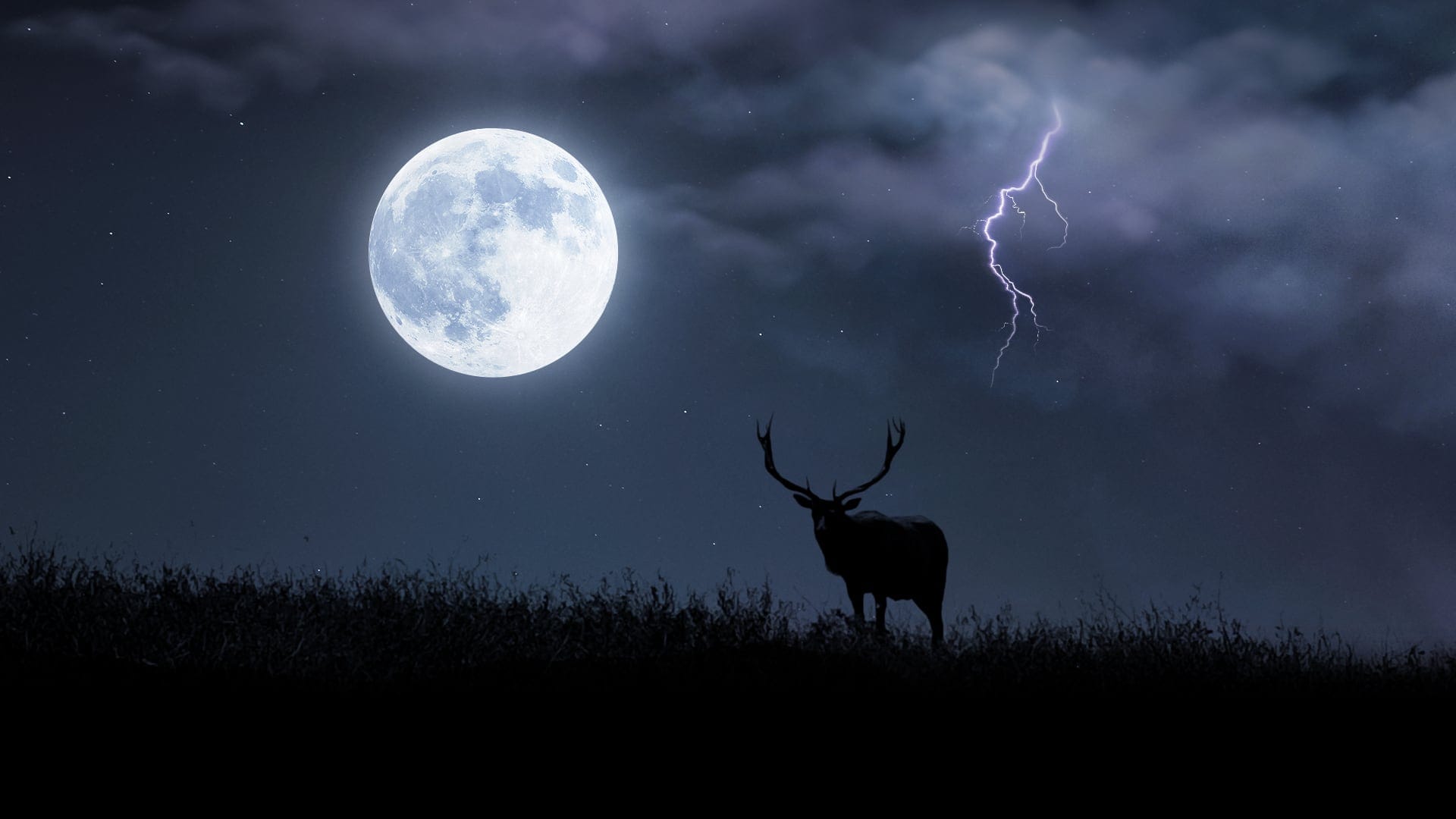
The Full Moon in July 2027 — traditionally called the Buck Moon — occurs on Sunday, July 18, 2027, at 15:45 GMT/UTC (11:45 AM EDT). The Moon will be located in the constellation Sagittarius. It will also be the smallest Full Moon of 2027. The lunar disk will look bright and round for several nights, especially on July 17, 18, and 19.
Want to know exactly when the Buck Moon rises in your city and what stars are nearby? Use the free astronomy app Sky Tonight. Read on to learn when to see the July Full Moon, why it’s called the Buck Moon, what constellation it appears in, and why it will be a Micromoon.
Contents
- July Full Moon 2027 at a glance
- Moon phases in July 2027: dates and times
- Best time to see the July Full Moon 2027
- What constellation is the July Full Moon in?
- July Micromoon 2027: the smallest Full Moon of the year
- July Buck Moon meaning: why is it called the Buck Moon?
- Is there an eclipse on July 18, 2027?
- July Full Moon 2027: key takeaways
July Full Moon 2027 at a glance
- Date: July 18, 2027
- Peak time: 15:45 GMT/UTC (11:45 AM EDT)
- Looks full: around July 17–19
- Name & meaning: Buck Moon — named after the new antlers growing on male deer in midsummer
- Where in the sky: constellation Sagittarius
- Path across the sky: the Moon will stay low for many Northern Hemisphere observers and climb high for many Southern Hemisphere observers
- Special feature: Micromoon — the smallest Full Moon of 2027
Moon phases in July 2027: dates and times
You can see how the Moon will look in the sky on any chosen date in the Sky Tonight app: tap the calendar icon, open the Moon tab, and select any date. You will see an accurate 3D image of the Moon, which reflects the angular size and orientation of the real Moon as seen from your location.
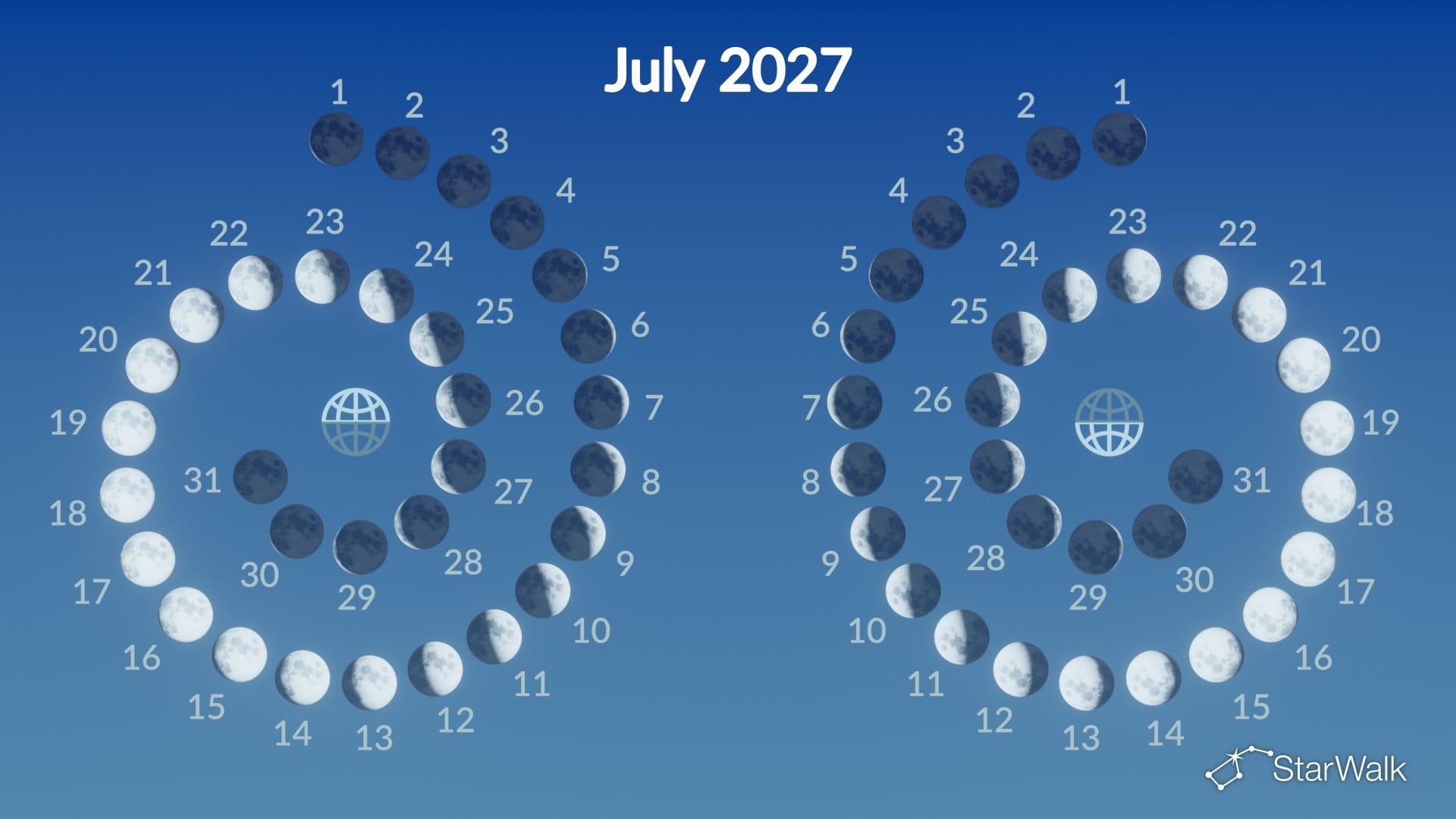
Here are the exact dates and times for the key lunar phases in July 2027:
- New Moon: July 4, 03:02 GMT/UTC (July 3, 11:02 PM EDT)
- First Quarter: July 10, 18:39 GMT/UTC (2:39 PM EDT)
- Full Moon: July 18, 15:45 GMT/UTC (11:45 AM EDT)
- Last Quarter: July 26, 16:55 GMT/UTC (12:55 PM EDT)
Did you know? The Full Moon is beautiful to see with the naked eye, but the best Moon phases for telescope or binocular observations are often the quarter phases. Around the First Quarter and Last Quarter, the shadows along the terminator — the line between lunar day and night — make craters and mountains easier to see.
For the complete schedule of Moon phases in July 2027, check our interactive Moon Calendar.
When is the Full Moon in July 2027?
The July Full Moon occurs on Sunday, July 18, 2027, at 15:45 GMT/UTC (11:45 AM EDT). At this moment, the Moon will reach its maximum illumination. In astronomy, the Full Moon is the exact moment in time when the Moon and Sun are on opposite sides of Earth. But to observers, the Moon looks full for about a day before and after that moment.
When is the New Moon in July 2027?
The New Moon will occur on July 4, 2027, at 03:02 GMT/UTC (July 3, 11:02 PM EDT). Around the New Moon, the lunar disk is invisible to the naked eye because the Moon is positioned between Earth and the Sun.
This is the best time of the month for observing faint deep-sky objects such as galaxies, nebulae, and star clusters, because bright moonlight won’t wash them out. The late-July meteor showers will also benefit from relatively dark skies: by their peak nights, the Moon will be a waning crescent.
Not sure what you can observe in your sky now? The Visible Tonight feature in the Sky Tonight app will guide you to the best sights for your exact location.
Best time to see the July Full Moon 2027
For most observers, the best time to see a Full Moon is around local moonrise, when it may appear unusually large because of the Moon illusion and take on a golden hue near the horizon. Moonrise also makes it easier to photograph the lunar disk alongside buildings, trees, or natural landscapes.
This table shows the exact Full Moon time and the closest moonrise and moonset in different cities:
| City | Exact Full Moon | Closest moonrise | Closest moonset |
|---|---|---|---|
| New York | July 18, 11:45 AM | July 18, 8:38 PM | July 18, 5:24 AM |
| Los Angeles | July 18, 8:45 AM | July 18, 8:22 PM | July 18, 5:48 AM |
| London | July 18, 16:45 | July 18, 21:18 | July 18, 04:28 |
| Paris | July 18, 17:45 | July 18, 21:56 | July 18, 05:32 |
| Beijing | July 18, 23:45 | July 18, 19:37 | July 19, 05:14 |
| Tokyo | July 19, 00:45 | July 18, 18:50 | July 19, 04:49 |
| Sydney | July 19, 01:45 | July 18, 16:38 | July 19, 07:14 |
All times are local. Moonrise and moonset times may vary slightly depending on the observer’s exact location, elevation, and local horizon.
Want the exact moonrise time for your location? In Sky Tonight, search for the Moon and tap on it. Open Events to see moonrise and moonset times for your location, or check Figures for the current phase, illumination, and brightness.
What constellation is the July Full Moon in?
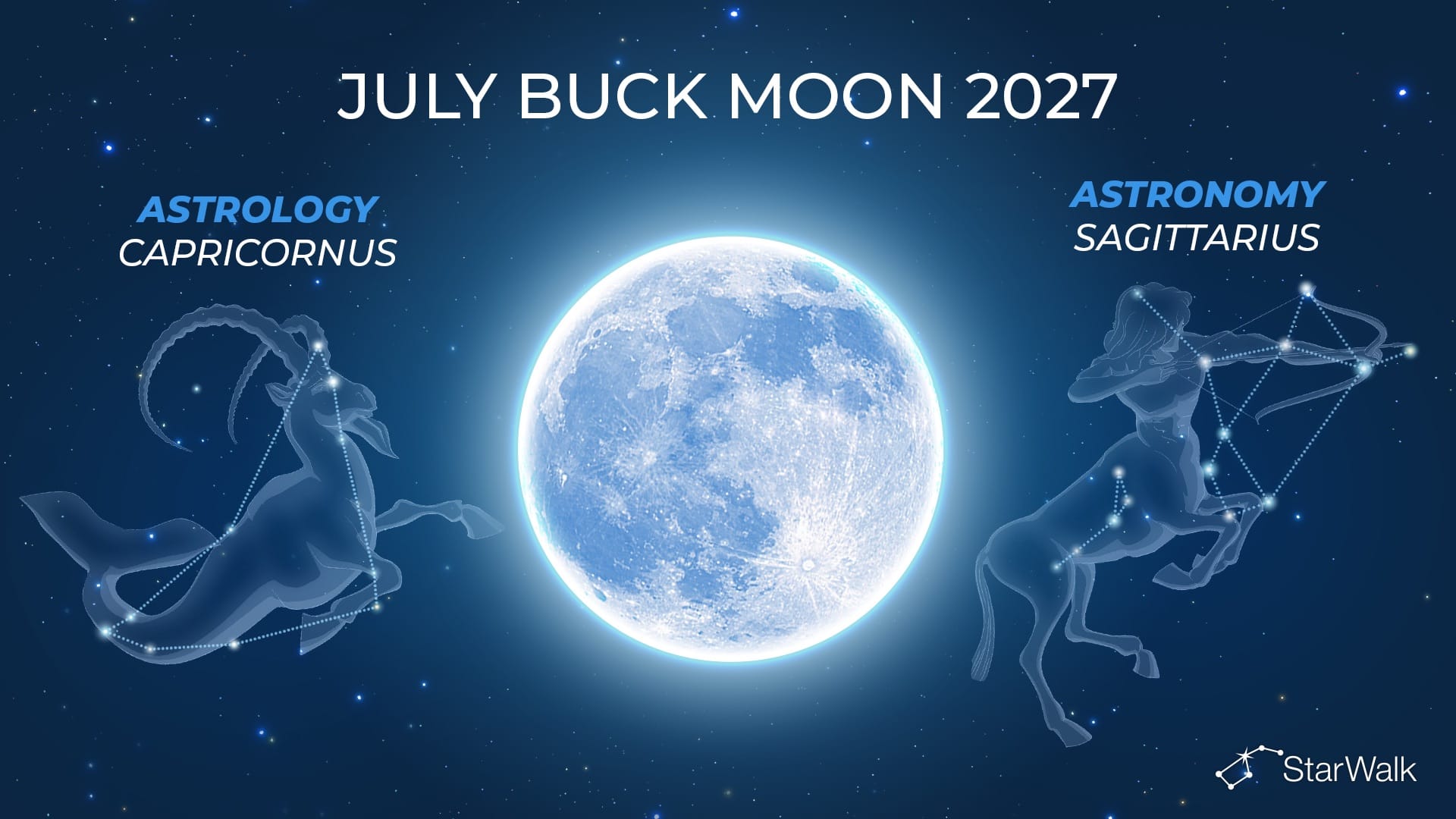
In the sky, the July Full Moon 2027 will be positioned in the constellation Sagittarius. According to astrologers, it will be in the sign of Capricorn.
The difference comes from the way astrology and astronomy divide the sky — and from the slow shift caused by Earth’s axial precession. Learn more in our infographic: 12 Zodiac Signs vs. 13 Constellations of Ecliptic.
July Micromoon 2027: the smallest Full Moon of the year
The Buck Moon on July 18 will be a Micromoon — and the smallest Full Moon of 2027. At the moment of the Full Moon, the Moon will be about 405,973 km (252,260 miles) from Earth. Its apparent diameter will be about 29.43 arcminutes, compared with approximately 31 arcminutes for an average Full Moon. This difference of about 5% will be difficult to notice with the naked eye. The Moon will reach apogee on July 19 at 11:52 GMT/UTC (7:52 AM EDT), approximately 20 hours after the Full Moon.
A Micromoon occurs when the Full Moon is close to apogee, the farthest point from Earth in the Moon’s elliptical orbit. It is the opposite of a Supermoon, which occurs near perigee, the Moon’s closest point to Earth. For instance, the January 2027 Wolf Moon will be a Supermoon and will occur much closer to Earth. You can learn more about Supermoons & Micromoons in our infographic.
July Buck Moon meaning: why is it called the Buck Moon?
The July Full Moon is traditionally known as the Buck Moon. The name is connected with male deer, or bucks, whose new antlers grow rapidly during this time of year. In early summer, buck antlers are covered in a soft, blood-rich layer called velvet; by mid-to-late July, the antlers are often nearly full-grown and begin to harden.
July Full Moon alternative names

The July Full Moon has many traditional names across cultures, reflecting local animals, plants, weather, and seasonal activities. The name Buck Moon is one of the best-known North American folk names, but it is not the only one.
Other July Full Moon names include:
- Thunder Moon — a Western Abenaki name, linked with the frequent thunderstorms of mid-summer
- Feather Moulting Moon — a Cree name referring to birds losing and replacing their feathers
- Hay Moon — a European name, marking the cutting and curing of hay in fields
- Salmon Moon — a name used in Pacific Northwest and Great Lakes traditions, when salmon begin their upstream runs
- Berry Moon — an Anishinaabe name for ripening wild berries
- Moon When the Chokecherries are Ripe — a Dakota name referring to the ripening of chokecherries
- Ripe Corn Moon — a Cherokee name, used when corn reaches the milky-kernel stage
- Halfway Summer Moon — an Anishinaabe name marking the middle of the summer season
- Mead Moon — a European name connected with honey collection and mead-making
- Wort Moon — an Old English name; “wort” meant herbs gathered for medicinal use
- Raspberry Moon — an Algonquin and Ojibwe name connected with ripening raspberries
Seasonal names of Full Moons in the Southern Hemisphere are often shifted by 6 months compared to the Northern Hemisphere. For this reason, the July Full Moon may be associated with names such as Wolf Moon and Ice Moon there.
Buck Moon spiritual meaning

In modern spiritual traditions, the Buck Moon is often associated with growth, strength, maturity, and renewal. Because deer antlers regrow every year, people sometimes connect the Buck Moon with personal development, rebuilding confidence, and moving into a stronger stage of life.
These meanings aren’t based in astronomy, but they can be a poetic way to reflect under the Full Moon. Scientifically, the Buck Moon is simply the Full Moon that occurs in July.
Is there an eclipse on July 18, 2027?
It depends on the calculation method. Both NASA and EclipseWise classify the July 18 event as an extremely shallow penumbral lunar eclipse. According to their calculations, the Moon will barely touch the outer edge of Earth’s penumbra for only about 12–18 minutes. However, timeanddate.com calculates that Earth’s shadow will narrowly miss the Moon and therefore does not classify the event as an eclipse.
Either way, the result for observers is the same: no darkening of the lunar disk will be noticeable from Earth.
The next eclipse after this borderline event will be a total solar eclipse on August 2, 2027, often nicknamed the Eclipse of the Century because its totality will last up to 6 minutes 23 seconds. The next lunar eclipse will be a penumbral lunar eclipse on August 16–17, 2027. Learn how lunar eclipses occur and see the schedule of upcoming events through 2030 in our complete lunar eclipse guide.
July Full Moon 2027: Frequently asked questions
When is the Buck Moon in 2027?
The Buck Moon reaches its exact Full Moon moment on July 18, 2027, at 15:45 GMT/UTC (11:45 AM EDT). Depending on your time zone, the peak may fall in the morning, afternoon or evening on July 18 or shortly after midnight on July 19. The Moon will still look full for about a day before and after this peak, so you can enjoy it on nearby nights even if you miss the exact time.
Why is the July Full Moon called the Buck Moon?
The July Full Moon is called the Buck Moon because male deer, or bucks, grow new antlers around this time of year. Many traditional Full Moon names reflect seasonal changes in nature, and the Buck Moon is one of the most vivid examples.
Where is the July Full Moon in the sky?
In 2027, the July Full Moon is located in the constellation Sagittarius. In astrology, you may see it described as a Capricorn Full Moon because zodiac signs and astronomical constellations are different systems. We explain this in more detail in our article: Zodiac Constellations And Zodiac Signs.
Is the July 2027 Buck Moon a Supermoon?
No. The July 2027 Buck Moon is the opposite of a Supermoon — a Micromoon — and the smallest Full Moon of the year. It occurs near apogee, the Moon’s farthest point from Earth. However, the difference in its apparent size will be difficult to notice with the naked eye.
Will the July Full Moon look orange?
It can. The Moon often looks yellow, orange, pink, or red when it is low above the horizon because its light passes through more of Earth’s atmosphere. The effect is strongest around moonrise and moonset.
Will the July Full Moon be high in the sky?
For many Northern Hemisphere observers, the July Full Moon will stay relatively low in the sky. That’s because a Full Moon lies opposite the Sun: in July, the Sun is high in the northern sky, so the Full Moon traces a path similar to the winter Sun. In the Southern Hemisphere, where July is winter, the opposite is true — the July Full Moon climbs much higher.
When is the next Full Moon?
The next Full Moon after the Buck Moon will occur on August 17, 2027, at 07:29 GMT/UTC (3:29 AM EDT). Traditionally known as the Sturgeon Moon, it will also be a Micromoon and will coincide with a penumbral lunar eclipse. Unlike the extremely shallow eclipse on July 18, the August eclipse will produce a more substantial — though still subtle — shading across part of the lunar disk.
When is the next Buck Moon?
The Buck Moon is the Full Moon that occurs in July, so the next Buck Moon after July 18, 2027, will take place next year — on July 6, 2028, at 18:11 GMT/UTC (2:11 PM EDT).
July Full Moon 2027: key takeaways
For the best view, look for the Buck Moon around local moonrise on July 18; it will appear nearly full from July 17 through July 19. This will be the smallest Full Moon of 2027, occurring close to apogee — the farthest point in the Moon’s orbit. Its traditional name refers to the new antlers growing on male deer in midsummer.
To get the exact moonrise time and Moon phase for your location, launch Sky Tonight, tap the Calendar icon and open the Moon tab.
We wish you clear skies and successful observations!