What Comet Is Visible Now? Best Comets to Watch in 2026–2027
Looking for the next comet visible from Earth? In this article, we’ve gathered the most promising comets of 2026–2027, with their visibility dates, expected brightness, and observing tips. For real-time comet tracking and visibility forecasts tailored to your location, use the free Sky Tonight app.
Contents
- Next comets visible from Earth in 2026–2027
- Comet in October 2026: 10P/Tempel 2
- Comet in October–December 2026: 161P/Hartley–IRAS
- Comet in December 2026–February 2027: 2P/Encke
- Comet in June–October 2027: C/2025 Y1 (ATLAS)
- Comet in July–October 2027: 45P/Honda–Mrkos–Pajdušáková
- Comet in September–November 2027: 104P/Kowal 2
- How to find a comet using Sky Tonight?
- Next comet visible from Earth: Bottom line
Next comets visible from Earth in 2026–2027
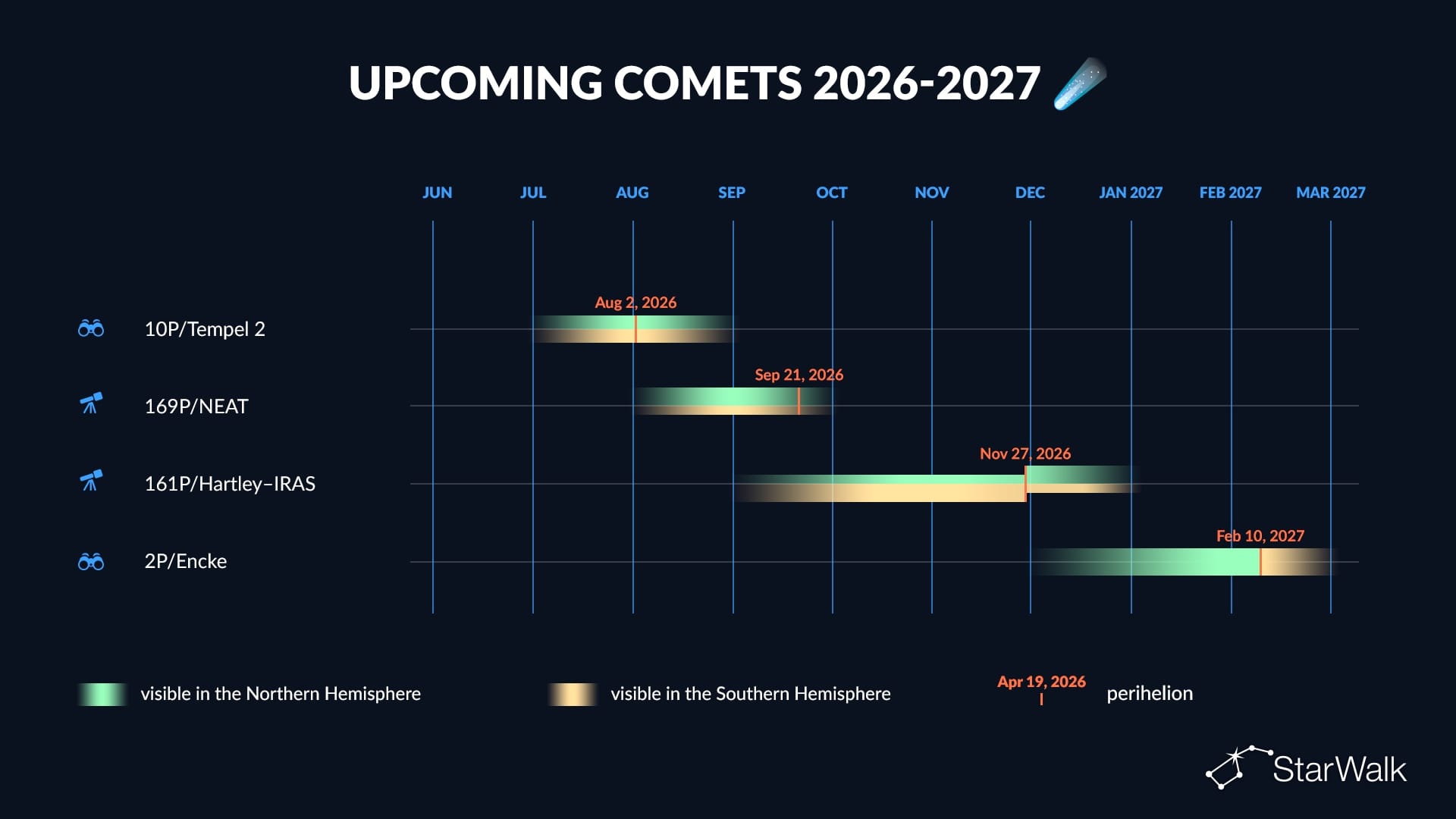
Several comets should be worth watching in 2026–2027. 10P/Tempel 2 is still observable in October 2026 and remains within reach of small telescopes, especially from the Southern Hemisphere. 161P/Hartley–IRAS will remain observable through late 2026 and should be within reach of small telescopes. It will be followed by 2P/Encke, which is expected to brighten significantly from December 2026 through February 2027 and may be worth trying in binoculars in late January, before it becomes too close to the Sun in the sky. In June 2027, C/2025 Y1 (ATLAS) should become a target for amateur telescopes and remain observable through October, with current estimates placing it around magnitude 11–12 during this period.
After that, another bright target will be 45P/Honda–Mrkos–Pajdušáková, which should be observable with a small telescope from mid-2027 and may become a good binocular target around its brightest period. Of course, comets are full of surprises, so a newly discovered visitor could always brighten unexpectedly in the meantime. Toward the end of 2027, 104P/Kowal 2 should reach around magnitude 10 and become visible in amateur telescopes.
These comets are listed by their suggested observing periods, not by their perihelion or closest‐approach dates (some aren’t observable at those moments), so refer to each comet’s visibility window highlighted in the title.
Comet in October 2026: 10P/Tempel 2
- Perihelion: August 2, 2026 (mag 8.7)
- Closest approach to Earth: August 3, 2026 (mag 8.7)
- Where to observe: Both hemispheres
Will 10P/Tempel 2 be visible from Earth?
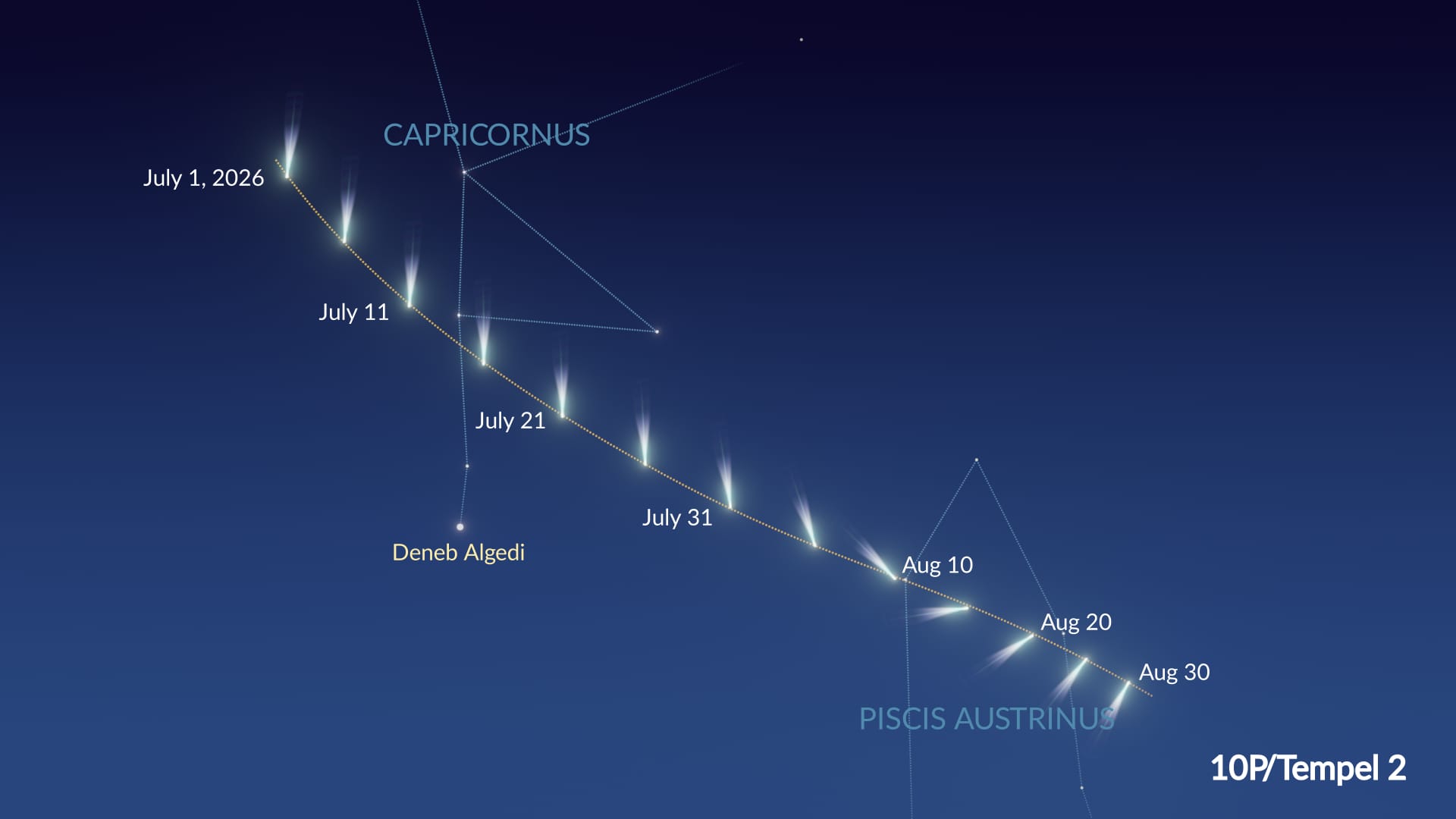
Comet 10P/Tempel 2 has already passed its peak brightness but remains within reach of amateur observers in October 2026. As of early October, it shines at around magnitude 10 and is gradually fading. A small telescope will give you the best chance of seeing it under dark skies.
The comet is visible in the evening sky after sunset. Observing conditions favor the Southern Hemisphere, where Tempel 2 appears higher above the horizon. From northern latitudes, Tempel 2 will also climb higher, but it will continue to fade as the month progresses.
For a more detailed guide to its visibility from different locations and what is happening with the comet right now, check out our dedicated article on Comet 10P/Tempel 2.
When was 10P/Tempel 2 discovered?
Discovered on July 4, 1873, by Wilhelm Tempel, 10P/Tempel 2 is a Jupiter-family periodic comet. It orbits the Sun every 1,960 days (≈5.37 years), traveling between 1.42 AU at perihelion and 4.71 AU at aphelion.
Comet in October–December 2026: 161P/Hartley–IRAS
- Closest approach to Earth: October 2, 2026 (mag 11.2)
- Perihelion: November 27, 2026 (mag 12.1)
- Where to observe: Both hemispheres
Will 161P/Hartley–IRAS be visible from Earth?
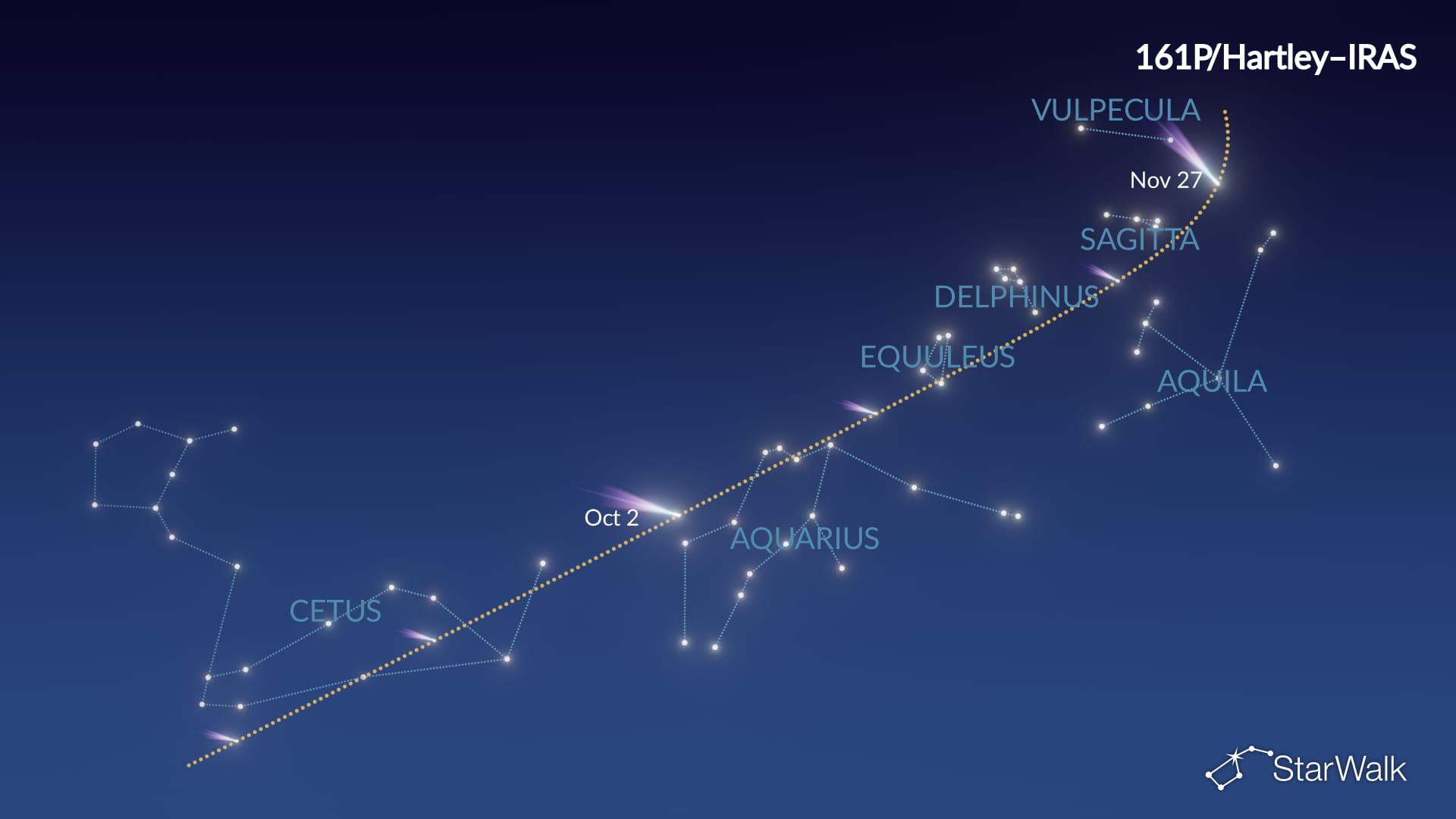
Comet 161P/Hartley–IRAS will remain visible in the evening sky through late December 2026 from northern latitudes, while southern observers will lose it much earlier. As of early October, it shines at around magnitude 11. Current forecasts suggest gradual fading to about magnitude 12 at perihelion on November 27 and around magnitude 13 by late December, so it will become increasingly challenging.
Observers in both hemispheres can spot the comet in October, but conditions increasingly favor the Northern Hemisphere as the apparition progresses. From southern latitudes, 161P will gradually get lower and may become unobservable by November. A telescope will give the best chance of seeing the comet.
When was 161P/Hartley–IRAS discovered?
161P/Hartley–IRAS was discovered by Malcolm Hartley on a photographic plate exposed on November 4, 1983. IRAS independently detected the comet on November 10, and the two objects were later confirmed to be the same comet. With an orbital period of about 21 years, 161P/Hartley–IRAS belongs to the Halley-type comets.
Comet in December 2026–February 2027: 2P/Encke
- Closest approach to Earth: February 3, 2027 (mag 6.2)
- Perihelion: February 10, 2027 (mag 5.9)
- Where to observe: Northern latitudes favored before perihelion; southern latitudes afterward
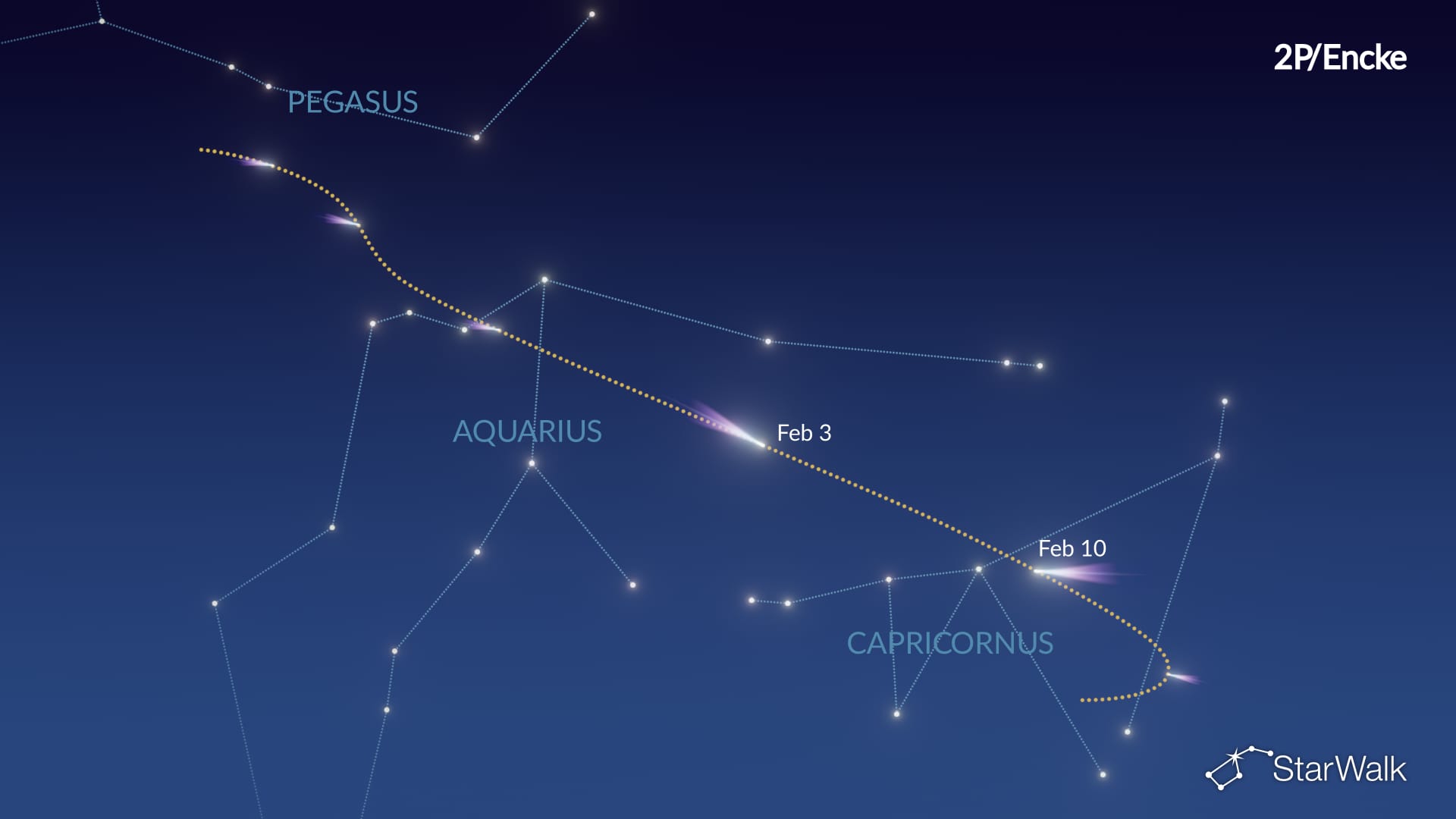
Will 2P/Encke be visible from Earth?
Beginning in December 2026, 2P/Encke will steadily brighten. A telescope will be the best choice for most of its evening appearance. Binoculars may be worth trying later in January 2027, but the comet will be sinking into twilight as it brightens.
Before perihelion, look for Encke in the evening sky. Around January 15–20, current forecasts put it near magnitude 9–10, while it is still reasonably placed after dark. Around perihelion, the comet will be lost in the Sun’s glare. Southern Hemisphere observers may recover it low in the morning sky in the second half of February, as it fades.
Want to know when and where to look for Encke? See our full observing guide to Comet 2P/Encke, with visibility details, tracking tips, and updates on the comet’s current status.
When was 2P/Encke discovered?
2P/Encke was first discovered on January 17, 1786, by the French astronomer Pierre Méchain. In 1819, Johann Franz Encke demonstrated that several earlier comet sightings were in fact returns of the same object, which is why the comet now bears his name. Orbiting the Sun once every 3.3 years, 2P/Encke has the shortest orbital period among well-observed comets.
Comet in June–October 2027: C/2025 Y1 (ATLAS)
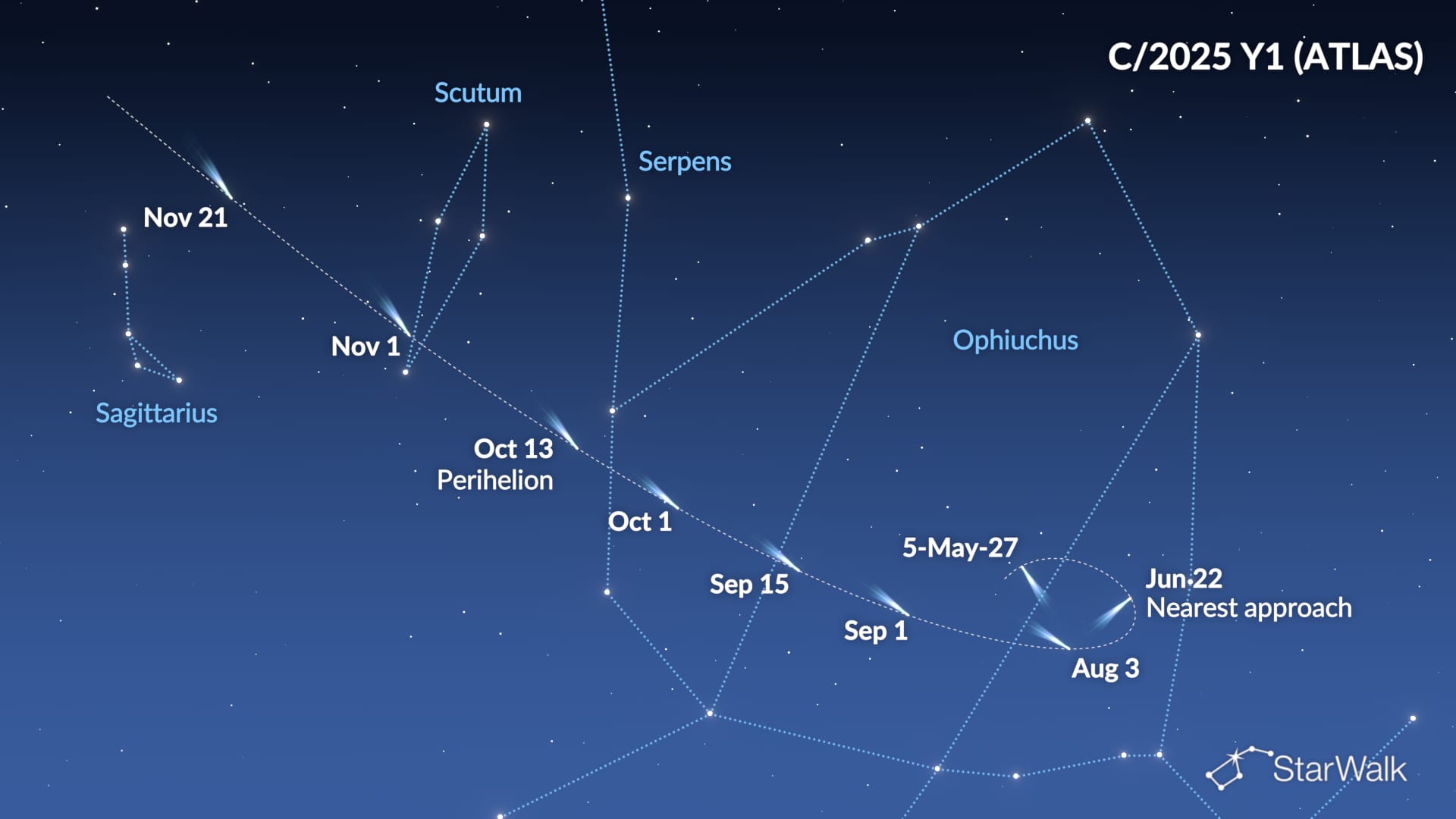
Will C/2025 Y1 (ATLAS) be visible from Earth?
C/2025 Y1 (ATLAS) should remain within reach of amateur telescopes from June through October 2027. Most current brightness estimates place the comet between about magnitude 11 and 12 during this period, with its brightest phase expected around June and July.
Observing conditions should be good in both hemispheres in June and July. From August onward, the Southern Hemisphere will become increasingly favorable, while the comet will gradually appear lower in the sky from mid-northern latitudes. It should remain observable through October, although it will be somewhat fainter and lower in the sky by then.
When was C/2025 Y1 (ATLAS) discovered?
C/2025 Y1 (ATLAS) was discovered by the Asteroid Terrestrial-impact Last Alert System (ATLAS) on December 26, 2025, at around magnitude 18.7. It is a long-period comet on a nearly parabolic orbit.
Comet in July–October 2027: 45P/Honda–Mrkos–Pajdušáková
- Closest approach to Earth: July 22, 2027 (mag 6.8)
- Perihelion: August 31, 2027 (mag 5.0)
- Where to observe: Both hemispheres
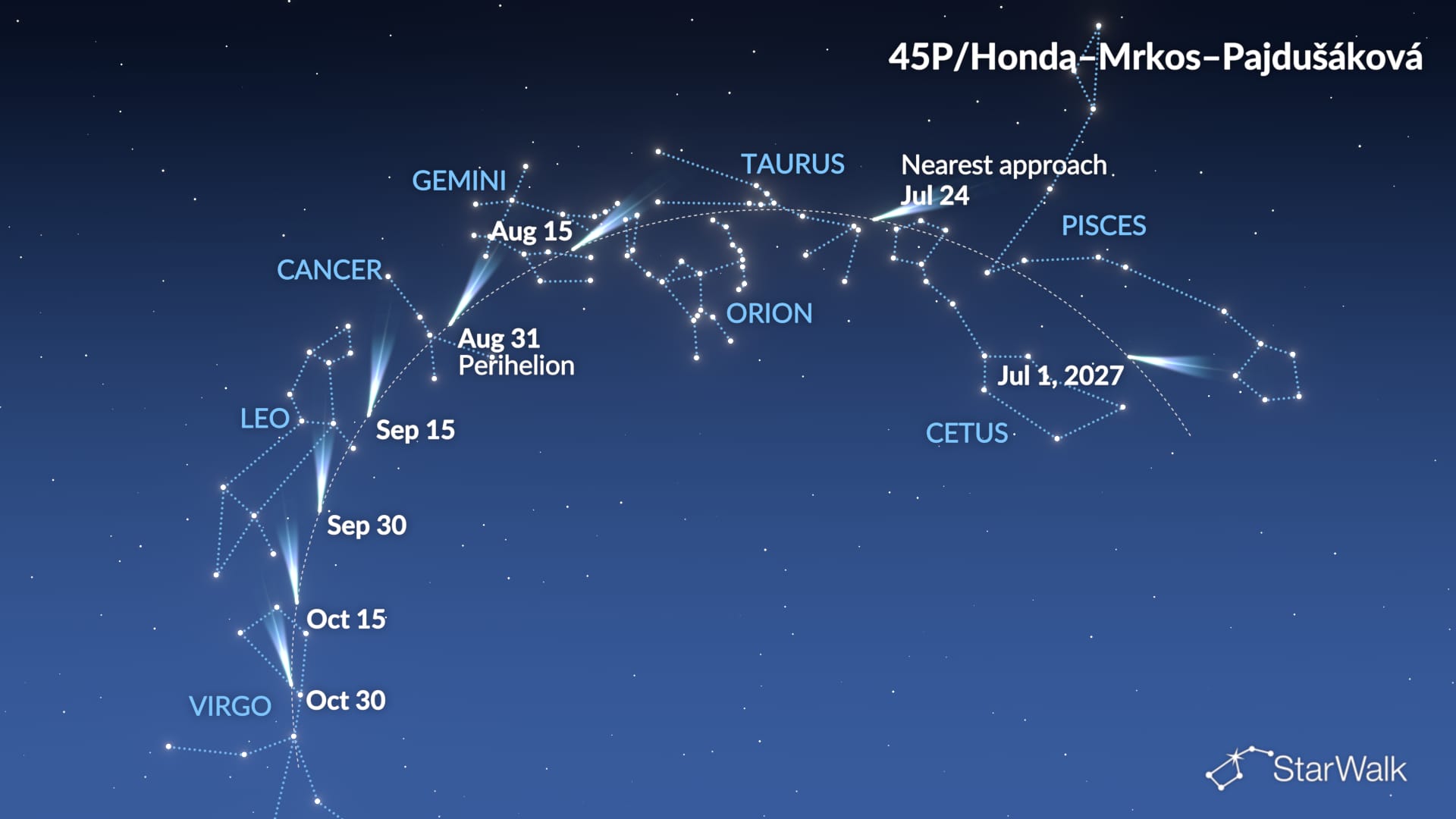
Will 45P/Honda–Mrkos–Pajdušáková be visible from Earth?
From around mid-July through mid-October 2027, Comet 45P/Honda–Mrkos–Pajdušáková should remain accessible to amateur observers with a small telescope. From late July through August, it may also become visible in binoculars under dark skies. July will offer a wider separation from the Sun, while closer to perihelion the comet will be brighter but more difficult to observe.
The comet will be visible in the morning sky before sunrise. Observing conditions will begin to worsen from around mid-August, especially in the Southern Hemisphere, where 45P will appear increasingly low above the horizon. After perihelion, it should gradually fade and remain difficult to observe, although conditions will generally be better in the Northern Hemisphere. In early to mid-October, the comet may still be detectable with a telescope, but it will be low in the sky and the observing windows will be short, especially from southern latitudes.
When was 45P/Honda–Mrkos–Pajdušáková discovered?
45P/Honda–Mrkos–Pajdušáková is a short-period Jupiter-family comet. It was first discovered by Japanese astronomer Minoru Honda on December 3, 1948. Ľudmila Pajdušáková independently found the comet on December 6, followed by Antonín Mrkos on December 7.
The comet currently completes one orbit around the Sun in about 5.34 years, traveling from about 0.56 AU from the Sun at perihelion to roughly 5.55 AU at aphelion.
Comet in September–November 2027: 104P/Kowal 2
- Closest approach to Earth: September 24, 2027 (mag 10.6)
- Perihelion: October 13, 2027 (mag 10.4)
- Where to observe: Both hemispheres
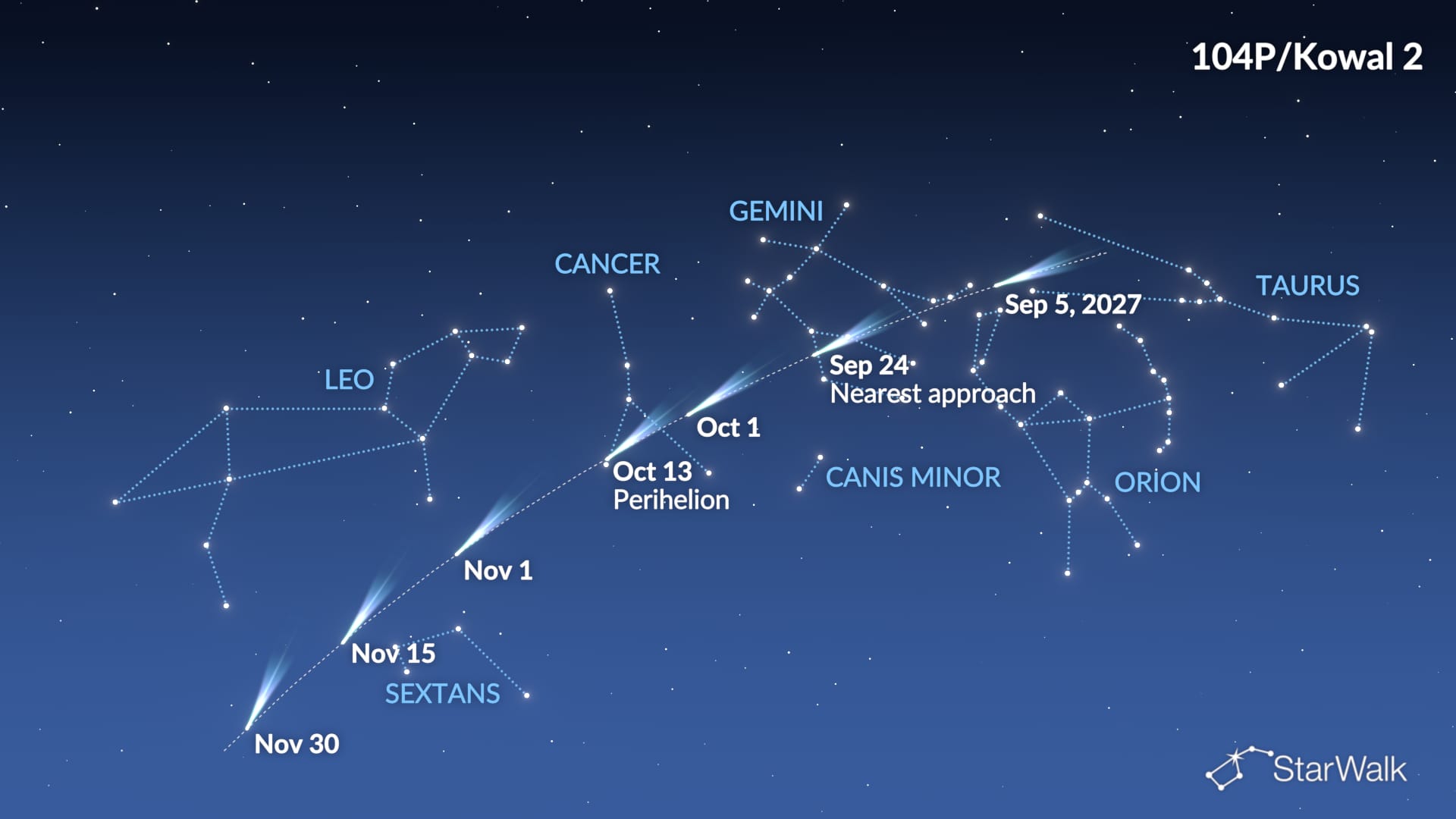
Will 104P/Kowal 2 be visible from Earth?
Comet 104P/Kowal 2 is expected to reach around magnitude 10–11 near its best dates in late September and October 2027. It should remain a telescope target into November, fading toward magnitude 12 by the end of the month.
The comet will be visible in the morning sky before sunrise. Observing conditions will initially favor the Northern Hemisphere, where 104P will climb higher above the horizon than it will from southern latitudes. As the comet moves through October and November, the difference between the hemispheres will gradually become less pronounced.
When was 104P/Kowal 2 discovered?
104P/Kowal 2 was discovered by American astronomer Charles T. Kowal on photographic plates taken at Palomar Observatory on January 27–29, 1979. At discovery, the comet was estimated to be around magnitude 17.
The comet follows a short-period orbit that has been significantly altered by encounters with Jupiter. Its perihelion distance has gradually decreased over successive returns, bringing the comet closer to the Sun and potentially making it brighter during recent and future apparitions.
How to find a comet using Sky Tonight?
Comets are faint and fuzzy objects that are hard to detect, so an accurate sky map helps you know where to look. The Sky Tonight app will help you quickly find any bright comet in the sky. Here’s what you need to do:
- Tap the magnifier icon at the lower part of the screen;
- In the Search field, enter the comet’s name or designation;
- Find the comet in the search results and tap the blue target icon next to its name;
- The app will show the comet’s current location in the sky;
- Point your device at the sky and follow the white arrow to find the comet.
You can also tap the comet’s name in the search results and then go to the Events tab to view the events related to the comet: perihelion and closest approach to Earth. Tap the blue target icon next to the event to see the comet’s location at the time of perihelion or closest approach.
Next comet visible from Earth: Bottom line
That’s it for the most promising comets to watch in 2026–2027. Comet brightness can change quickly, so check the latest visibility forecasts before planning your observations. Use Sky Tonight to find comets in the sky and see when they are best placed for your location.
Stay tuned for the latest comet updates! While you plan your next comet watch, brush up on some astronomy basics in an easy, visual way. Learn how comets differ from meteors and asteroids with our All You Need to Know About Comets infographic.

While working on this article, we used data from the following sources:
- Comet Observation database;
- TheSkyLive;
- Astronomer Gideon van Buitenen;
- Astronomer Seiichi Yoshida.