November 2026 Planet Parade: 4 Planets Align Around November 14
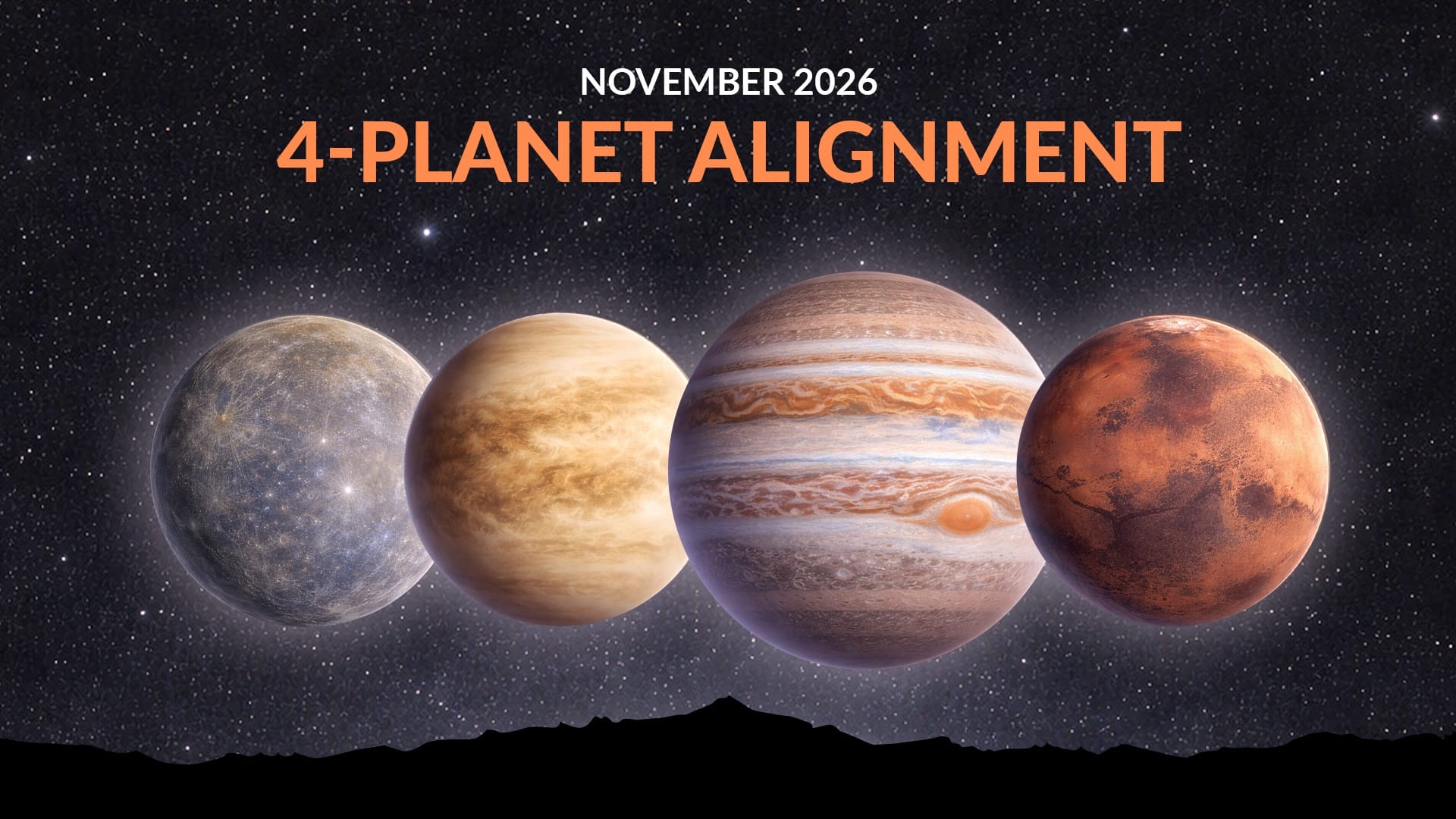
The planetary alignment in November 2026 brings Mercury, Venus, Mars, and Jupiter together before sunrise during November 13–22. This four-planet parade is best viewed from the Northern Hemisphere. November 14 is a good date to see the planets in a relatively compact arrangement, while November 20–22 offers better conditions for spotting Mercury. All four planets are bright enough to be seen with the naked eye, although Mercury will be tricky to find. Open Star Walk 2 and use the Planet Walk feature to see when and where the planets will line up in your sky.
Contents
- When Is the November 2026 Planet Parade? Best Dates to Watch
- Which Four Planets Align in November 2026, and Where Can You See Them?
November 2026 Planet Parade: Frequently Asked Questions
- Is November 14 or November 20 better for seeing the planetary alignment?
- What time is the November 2026 planet parade?
- Can you see all four planets without a telescope?
- Can you see the November 2026 planet parade after sunset?
- Will the planets form a straight line?
- Can you photograph all four planets together?
- Is a planetary alignment the same as a conjunction?
- November 2026 Planetary Alignment: Key Takeaways
When Is the November 2026 Planet Parade? Best Dates to Watch
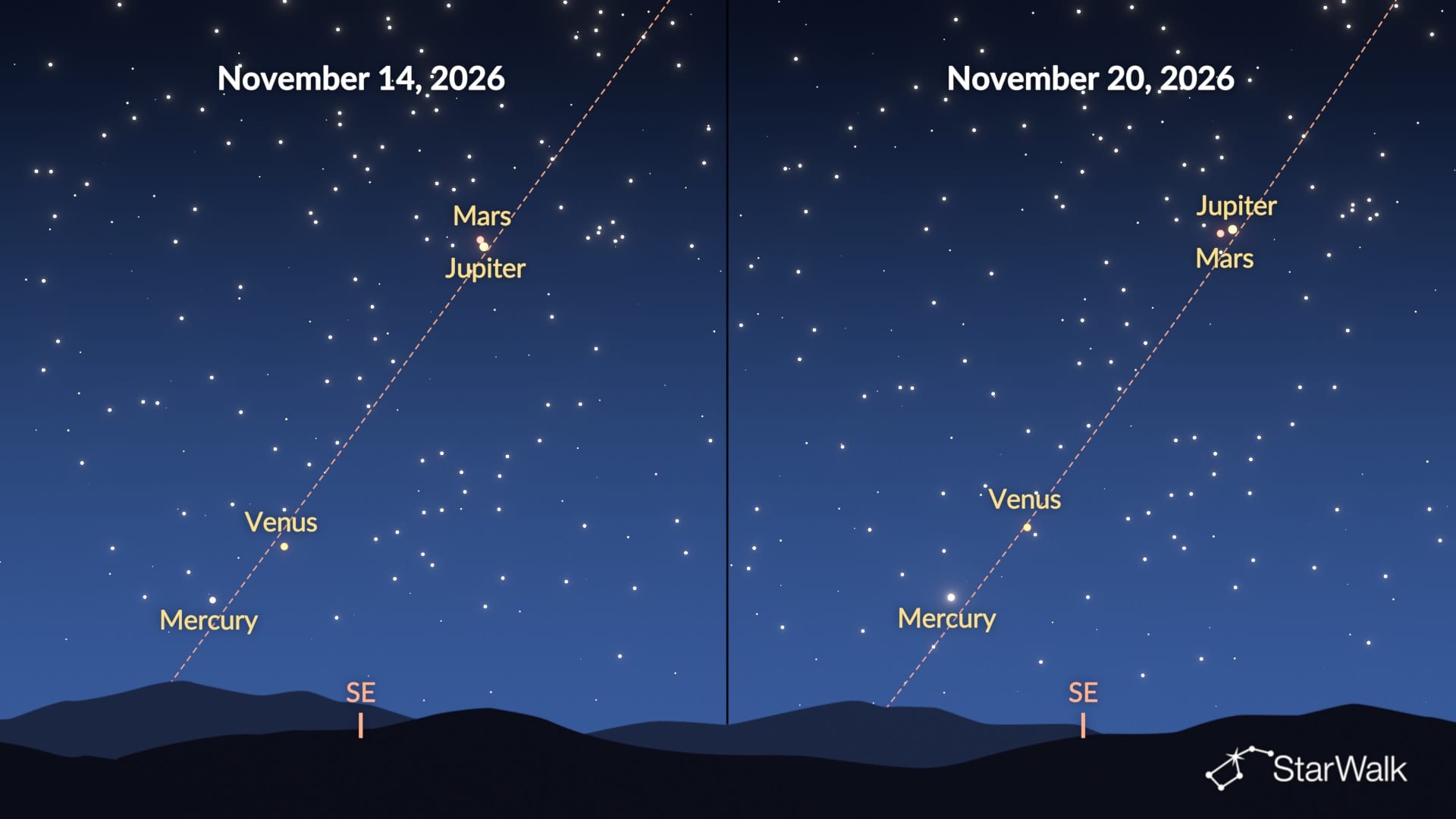
The lineup begins forming around November 8, but Mercury is very low at first. Different mornings offer different observing advantages:
- For easier observation of Mercury: try November 20–22, 2026. Mercury reaches its greatest elongation on November 20 (UTC), appearing about 19.6° from the Sun. Around this date, Mercury will be brighter and higher above the horizon before sunrise, making it easier to spot.
- For an early look at the parade: try November 14, 2026. At the same stage of dawn, the planets have a narrower horizontal spread on this date than on November 20 in most of the listed cities.
- For the Mars–Jupiter conjunction: choose a morning around November 15–16, 2026, when the planets appear about 1° apart.
Bonus: The Leonid meteor shower peaks around November 17–18, 2026. If you’re out before dawn to see the planets, you may also catch a few meteors under clear, dark skies.
November 15–16, 2026: Mars–Jupiter conjunction during the planetary alignment
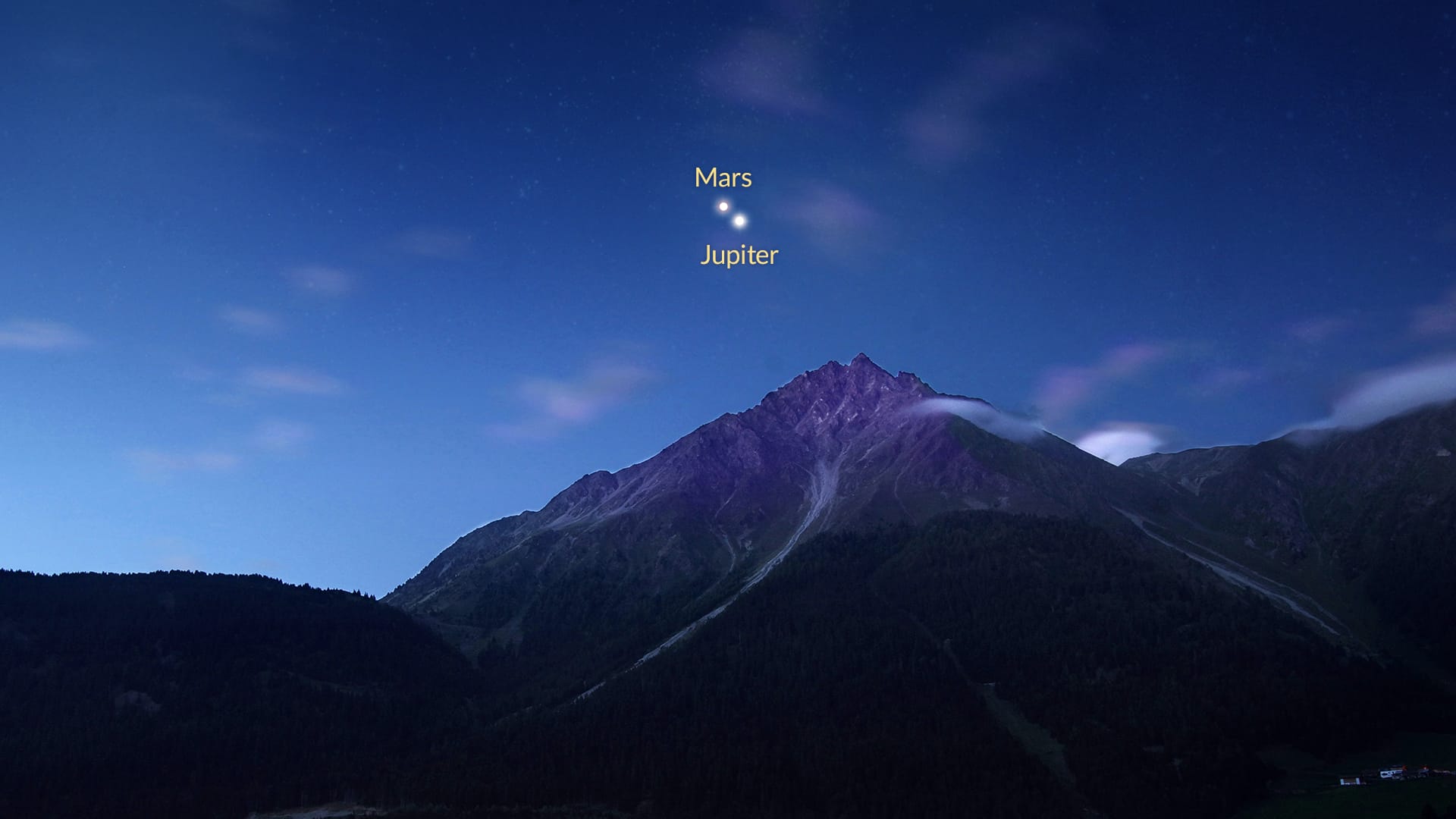
One of the highlights of the November 2026 planetary alignment is the Mars–Jupiter conjunction on November 15. At 02:42 UTC, the two planets will appear just 1°14′ apart. Their closest approach occurs on November 16 at 02:04 UTC, when the separation shrinks to 1°11′ — roughly the width of your little finger held at arm's length.
Look for brilliant Jupiter (mag −2.1) and reddish Mars (mag 0.7) near the Sickle asterism in the constellation Leo. Both planets are easily visible to the naked eye from late at night until dawn. Before sunrise, you can also look for Venus and Mercury to complete the four-planet parade. Learn more in our planetary conjunctions guide.
Also look for Regulus (mag 1.4) nearby. On November 22, Mars, Jupiter, and Regulus will form a nearly isosceles triangle before dawn. Read more in our Regulus guide.
November 20, 2026: Best planet alignment viewing times by city
On November 20, Mercury is better placed for morning observation. Compared with November 14, it appears higher above the horizon, although the planets are more spread out horizontally in most of the listed cities.
| City | Time zone | Visibility start | Best time on Nov 20 (local) | Visibility end | Mercury altitude | Azimuth span | Pair defining the span |
|---|---|---|---|---|---|---|---|
| Los Angeles, USA | PST (UTC−8) | 05:20 | 05:55 | 06:05 | 11° | 70.5° | Mercury–Jupiter |
| Mexico City, Mexico | CST (UTC−6) | 05:45 | 06:15 | 06:25 | 12° | 35.4° | Mercury–Jupiter |
| New York, USA | EST (UTC−5) | 05:35 | 06:10 | 06:20 | 11° | 72.5° | Mercury–Jupiter |
| London, UK | GMT (UTC+0) | 06:10 | 06:35 | 06:50 | 9° | 72.4° | Mercury–Jupiter |
| New Delhi, India | IST (UTC+5:30) | 05:40 | 06:15 | 06:20 | 12° | 64.7° | Mercury–Jupiter |
| Bangkok, Thailand | ICT (UTC+7) | 05:20 | 05:50 | 05:55 | 12° | 22.6° | Venus–Mars |
| Jakarta, Indonesia | WIB (UTC+7) | 04:40 | 04:55 | 05:05 | 9° | 65.8° | Mercury–Jupiter |
| Tokyo, Japan | JST (UTC+9) | 05:15 | 05:45 | 05:55 | 11° | 69.2° | Mercury–Jupiter |
- The viewing interval (from Visibility start to Visibility end) is when Mercury is at least 5° above the horizon, the other three planets are at least 10° above the horizon, and the Sun is below −6°.
- Best time is selected when the Sun is 8° below the horizon, then rounded to the nearest five minutes.
- Mercury altitude and Azimuth span are calculated for the displayed best time. Azimuth span measures the side-to-side spread of the planets along the horizon, between the two planets identified in the final column.
The viewing times depend on how bright the sky is before sunrise. Learn how the Sun’s altitude affects visibility in our guide to the different types of twilight.
November 14, 2026: Best planet alignment viewing times by city
Compared with November 20, the planets have a narrower horizontal spread on November 14 in most of the listed cities, but Mercury is still relatively low. Here’s when to look for all four planets from different locations.
| City | Time zone | Visibility start | Best time on Nov 14 (local) | Visibility end | Mercury altitude | Azimuth span | Pair defining the span |
|---|---|---|---|---|---|---|---|
| Los Angeles, USA | PST (UTC−8) | 05:30 | 05:50 | 06:00 | 9° | 55.1° | Mercury–Jupiter |
| Mexico City, Mexico | CST (UTC−6) | 05:55 | 06:10 | 06:20 | 9° | 11.3° | Mercury–Jupiter |
| New York, USA | EST (UTC−5) | 05:45 | 06:00 | 06:10 | 8° | 60.0° | Mercury–Mars |
| London, UK | GMT (UTC+0) | 06:15 | 06:25 | 06:40 | 7° | 65.1° | Mercury–Mars |
| New Delhi, India | IST (UTC+5:30) | 05:50 | 06:10 | 06:20 | 9° | 44.2° | Mercury–Jupiter |
| Bangkok, Thailand | ICT (UTC+7) | 05:30 | 05:45 | 05:55 | 8° | 24.2° | Venus–Mars |
| Jakarta, Indonesia | WIB (UTC+7) | 04:50 | 04:55 | 05:05 | 6° | 59.0° | Mercury–Mars |
| Tokyo, Japan | JST (UTC+9) | 05:20 | 05:40 | 05:50 | 9° | 55.7° | Mercury–Mars |
The same visibility criteria and best-time definition apply.
Can you see the November 2026 planet parade in Australia and the Southern Hemisphere?
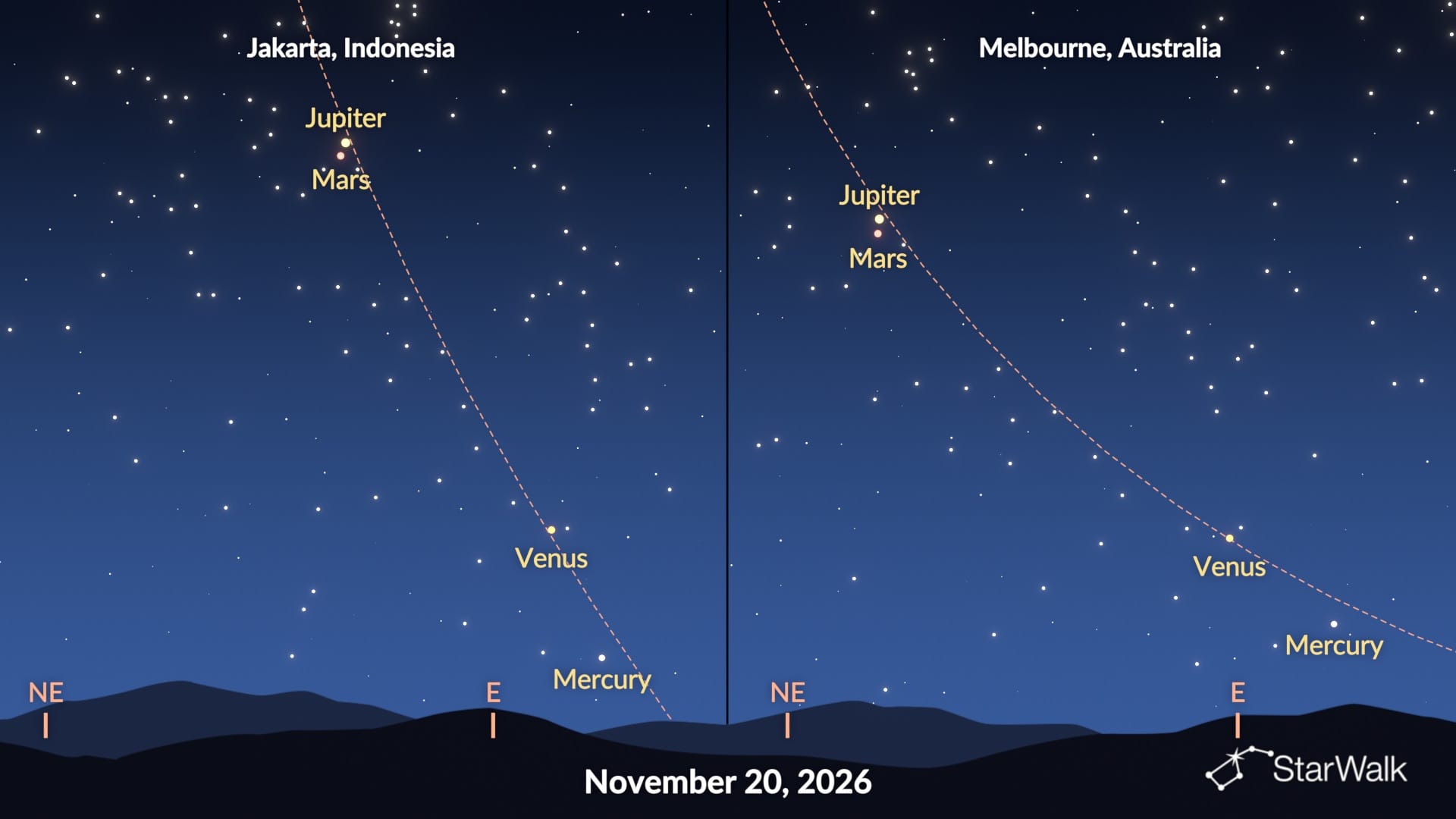
The complete alignment is difficult to observe from southern mid-latitudes. In cities such as Sydney, Melbourne, Cape Town, Santiago, and Buenos Aires, Mercury remains below 5° until civil twilight has begun throughout November 10–30.
This doesn’t rule out seeing Mercury later in twilight, but the brighter sky makes it harder to detect. Venus, Mars, and Jupiter are more accessible targets.
Conditions improve closer to the equator. Jakarta, for example, has an observing interval for all four planets on both November 14 and 20, although Mercury still requires a clear horizon.
Which Four Planets Align in November 2026, and Where Can You See Them?
This is a small planetary alignment, featuring four planets bright enough to be seen with the naked eye. However, spotting the complete lineup requires clear skies and good timing before sunrise. Mercury is the main challenge because it appears low in the brightening dawn sky.
| Planet | Constellation | Magnitude | How to recognize it |
|---|---|---|---|
| Jupiter | Leo | −2.1 | A bright point of light near Mars |
| Mars | Leo | 0.6 | Much fainter than Jupiter, with a reddish-orange color |
| Venus | Virgo | −4.9 | The brightest of the four planets |
| Mercury | Libra | −0.5 | Low in the dawn sky; the hardest to spot |
The constellations and approximate apparent magnitudes are given for November 20, 2026, when Mercury reaches its greatest western elongation.
For observers at northern mid-latitudes, choose a spot with a clear view of the east-southeastern horizon. Buildings, trees, hills, and haze can hide Mercury while the other planets remain clearly visible. For this event, a clear horizon matters more than escaping city lights.
Start with Jupiter and nearby Mars while the sky is still dark, then find brilliant Venus much lower in the sky. Leave Mercury for later, when it will be higher above the horizon. But don’t wait too long — the approaching sunrise will make it harder to see. Use the sky map to locate each planet.
Try 7×50 or 10×50 binoculars to help find Mercury. A telescope is optional: a 70–100 mm refractor at about 50–100× can reveal Venus’s phase and Jupiter’s large moons and main cloud belts. Never point binoculars or a telescope toward the Sun.
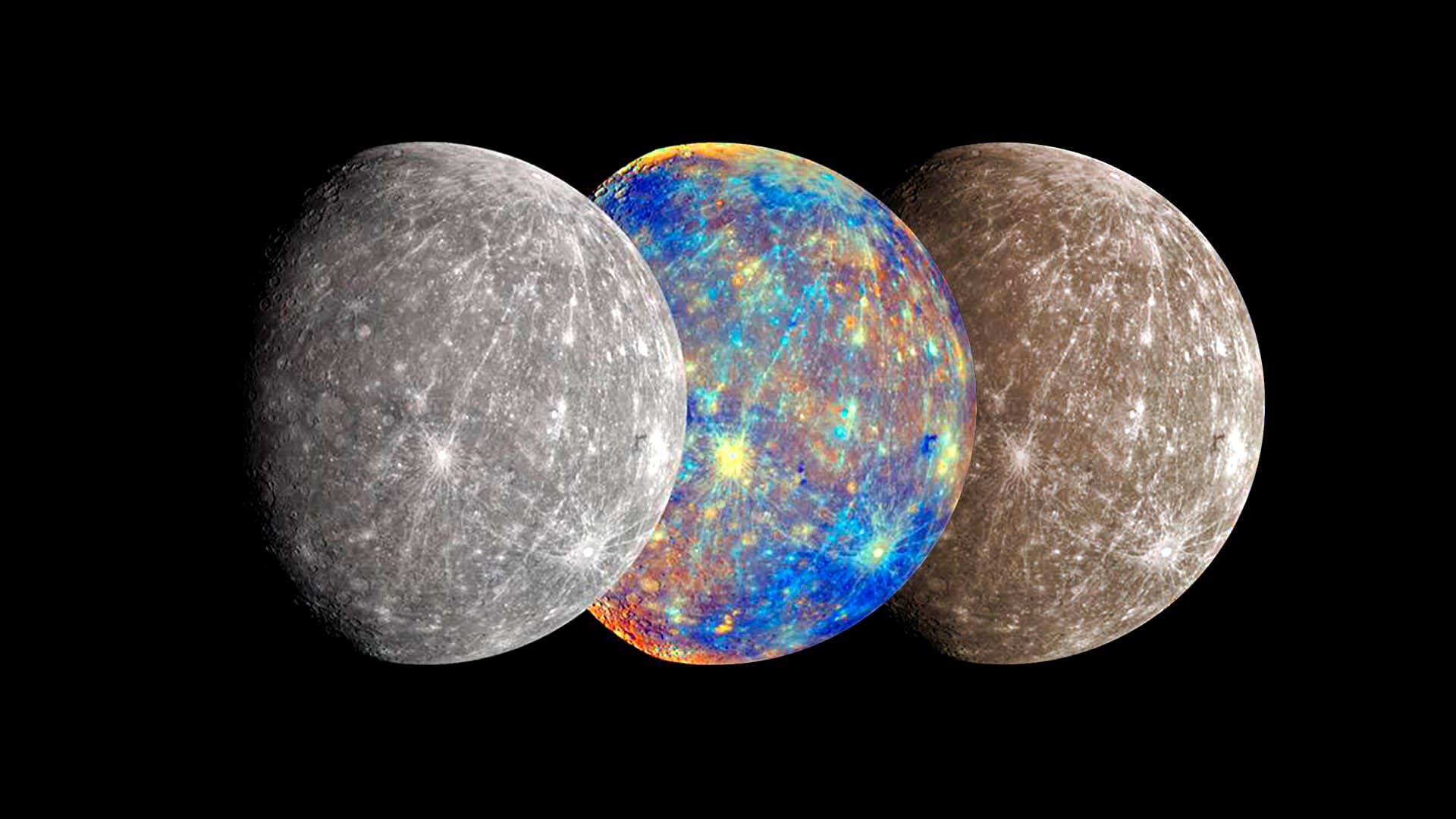
Mercury may be tricky to spot, but how much do you know about it? Test your knowledge with our Mercury quiz.
Planet Parade Sky Map: How to Find All 4 Planets
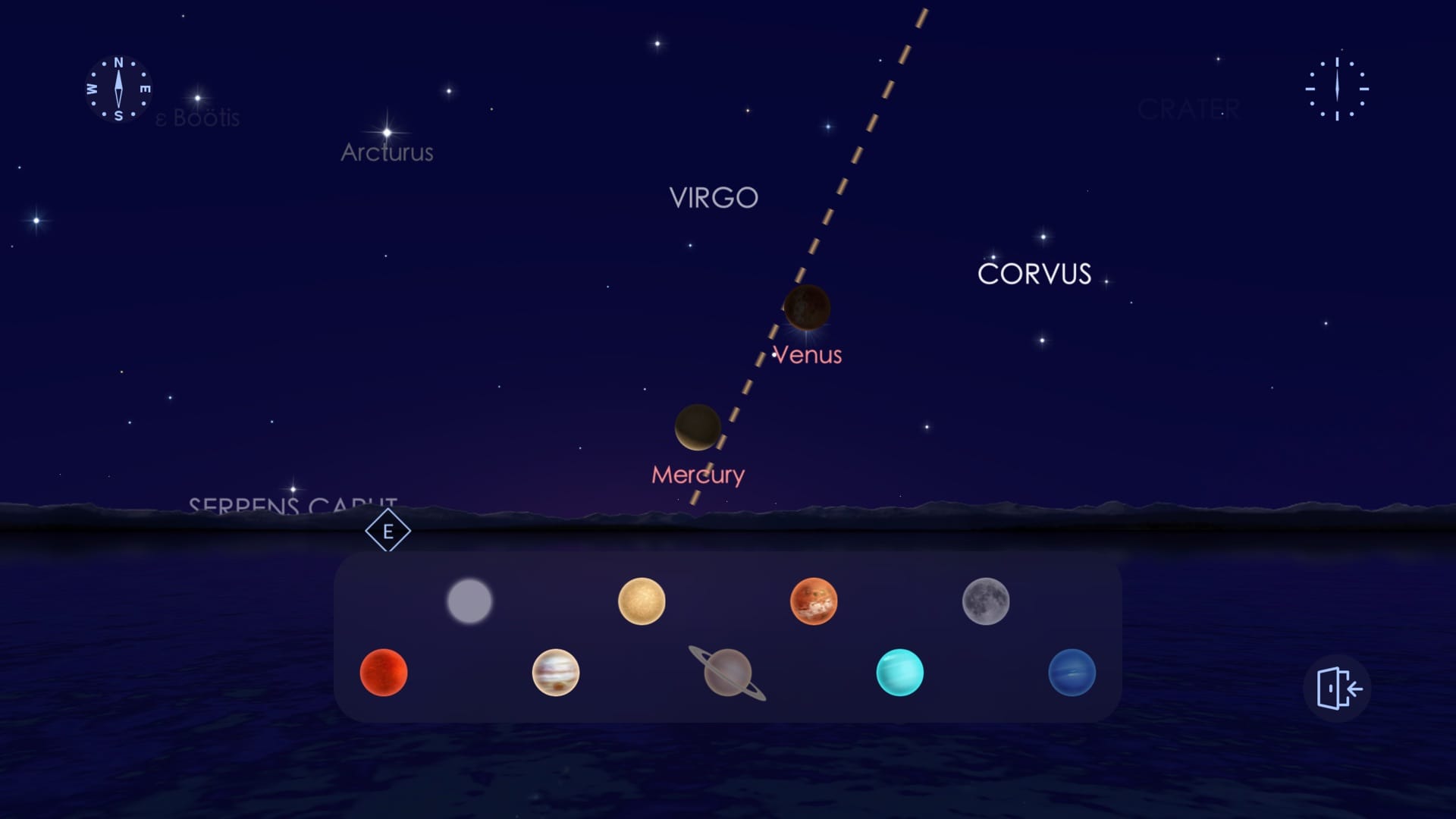
Use Star Walk 2 to see how the four planets will appear from your location and compare different observing dates.
- Open Menu > Planets.
- Tap Best nights to see planets.
- Select the November four-planet parade from the list.
- Tap Planet Walk to see when and where each planet will appear in your sky.
- To explore other dates and times, tap the date or time in Time Machine in the upper-right corner, then use the slider on the right side of the screen to adjust it.
November 2026 Planet Parade: Frequently Asked Questions
Here are answers to common questions about observing and photographing the four-planet parade.
Is November 14 or November 20 better for seeing the planetary alignment?
November 14 is better for seeing the four planets in a relatively tighter horizontal arrangement from most of the listed locations. However, November 20 is generally better for spotting Mercury, which appears higher and brighter before sunrise. If your goal is to identify all four planets, November 20–22 is a good choice. If you prefer a more compact-looking planet parade, try November 14.
What time is the November 2026 planet parade?
The November 2026 planet parade is best observed before sunrise, but the exact time depends on your location. On November 20, recommended local viewing times include 05:55 PST (UTC−8) in Los Angeles, 06:10 EST (UTC−5) in New York, 06:35 GMT (UTC+0) in London, and 05:45 JST (UTC+9) in Tokyo. Choose a spot with a clear eastern horizon and try to find Mercury before the sky becomes too bright.
Can you see all four planets without a telescope?
Yes, Mercury, Venus, Mars, and Jupiter are all bright enough to be seen with the naked eye in November 2026. Jupiter and Mars are relatively easy to recognize, while Venus shines brilliantly lower in the sky. Mercury is the hardest to spot because it stays close to the horizon and competes with dawn twilight. Binoculars can help, but stop using them before sunrise and never point them toward the Sun.
Can you see the November 2026 planet parade after sunset?
No. This four-planet grouping is a morning event. Mercury and Venus appear before sunrise, while Mars and Jupiter rise earlier in the night.
Will the planets form a straight line?
The planets will appear roughly aligned along the ecliptic, but won’t form a perfectly straight line. They won’t be lined up in space, either: the planets occupy different positions in their orbits around the Sun. The alignment is a matter of perspective from Earth.
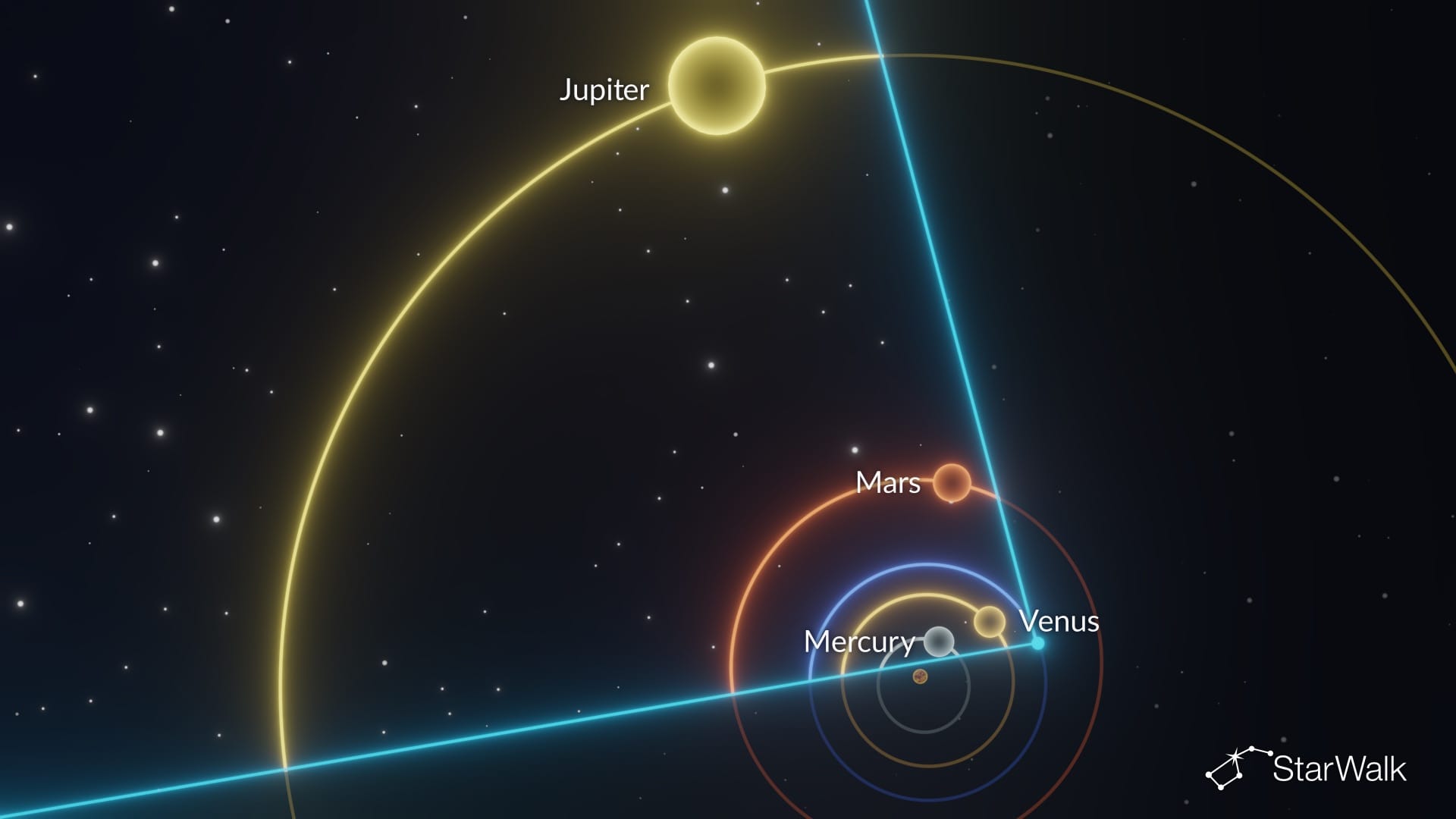
For a visual explanation, see our planetary alignment infographic.
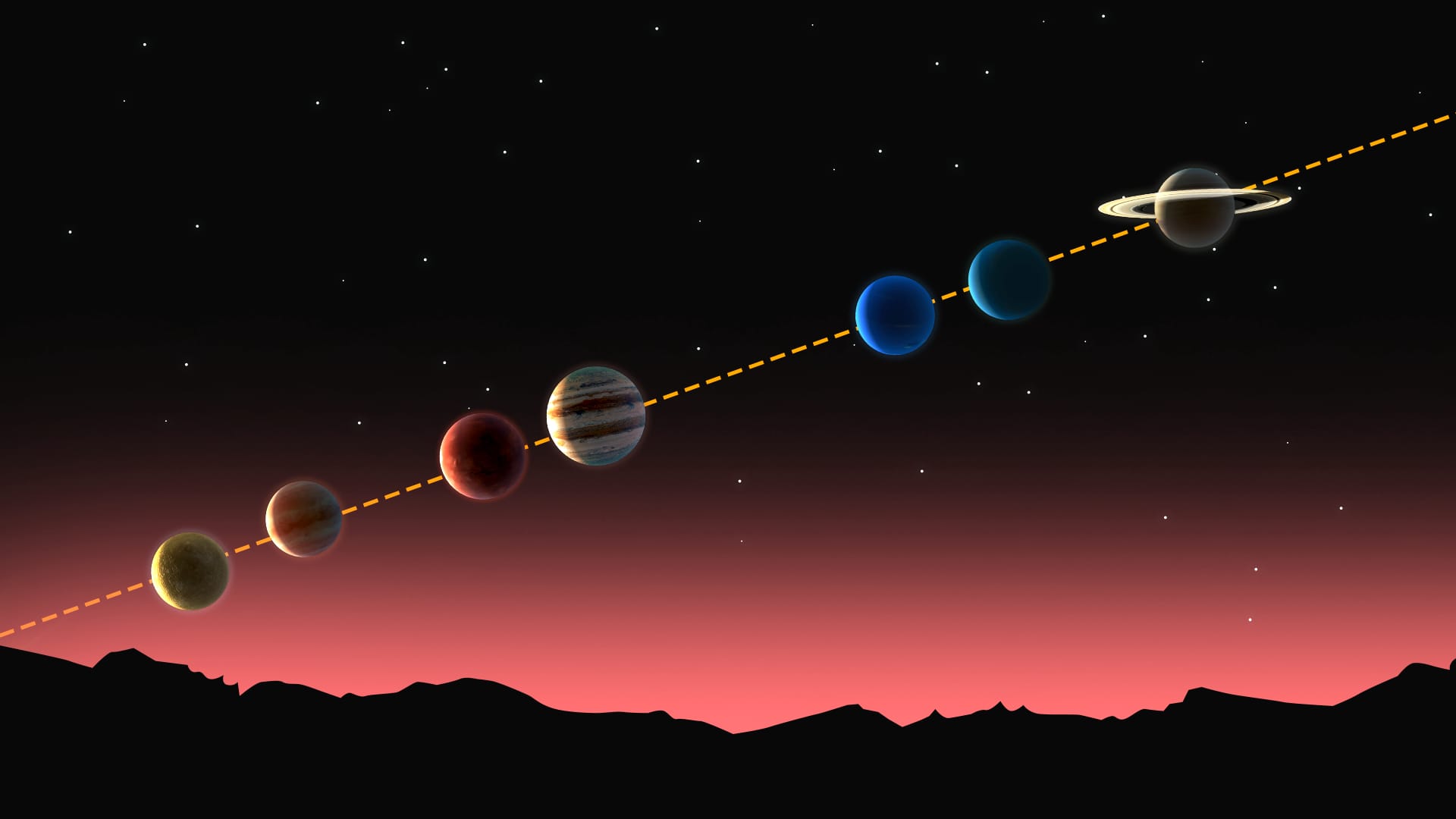
Can you photograph all four planets together?
Yes, but the planets will be spread across a large portion of the sky, so you’ll need a wide-angle lens or a panorama to capture all four. Use a tripod and take several exposures: Mercury may be difficult to capture against the brightening dawn. Preview the arrangement from your location with a stargazing app before deciding how to frame the scene.
For more camera settings and practical advice, see our beginner’s guide to astrophotography.
Is a planetary alignment the same as a conjunction?
No. A planetary alignment describes several planets appearing in the same region of the sky. A conjunction occurs when two objects share the same right ascension or ecliptic longitude — coordinates used to describe their positions.
November 2026 Planetary Alignment: Key Takeaways
Look for Mercury, Venus, Mars, and Jupiter before sunrise during November 13–22, 2026. November 14 offers a narrower horizontal arrangement in most of the listed cities, while around November 20–22, Mercury stands higher and is easier to spot. For the closest Mars–Jupiter pairing, observe around November 15–16. Choose a clear morning and an unobstructed horizon. Use Star Walk 2 to preview the planets’ positions and compare different dates from your location.
For another November observing target, look for the Moon near Jupiter, Mars, and Regulus around November 30.
