Meteor Showers in October 2026: Next Up – Orionids
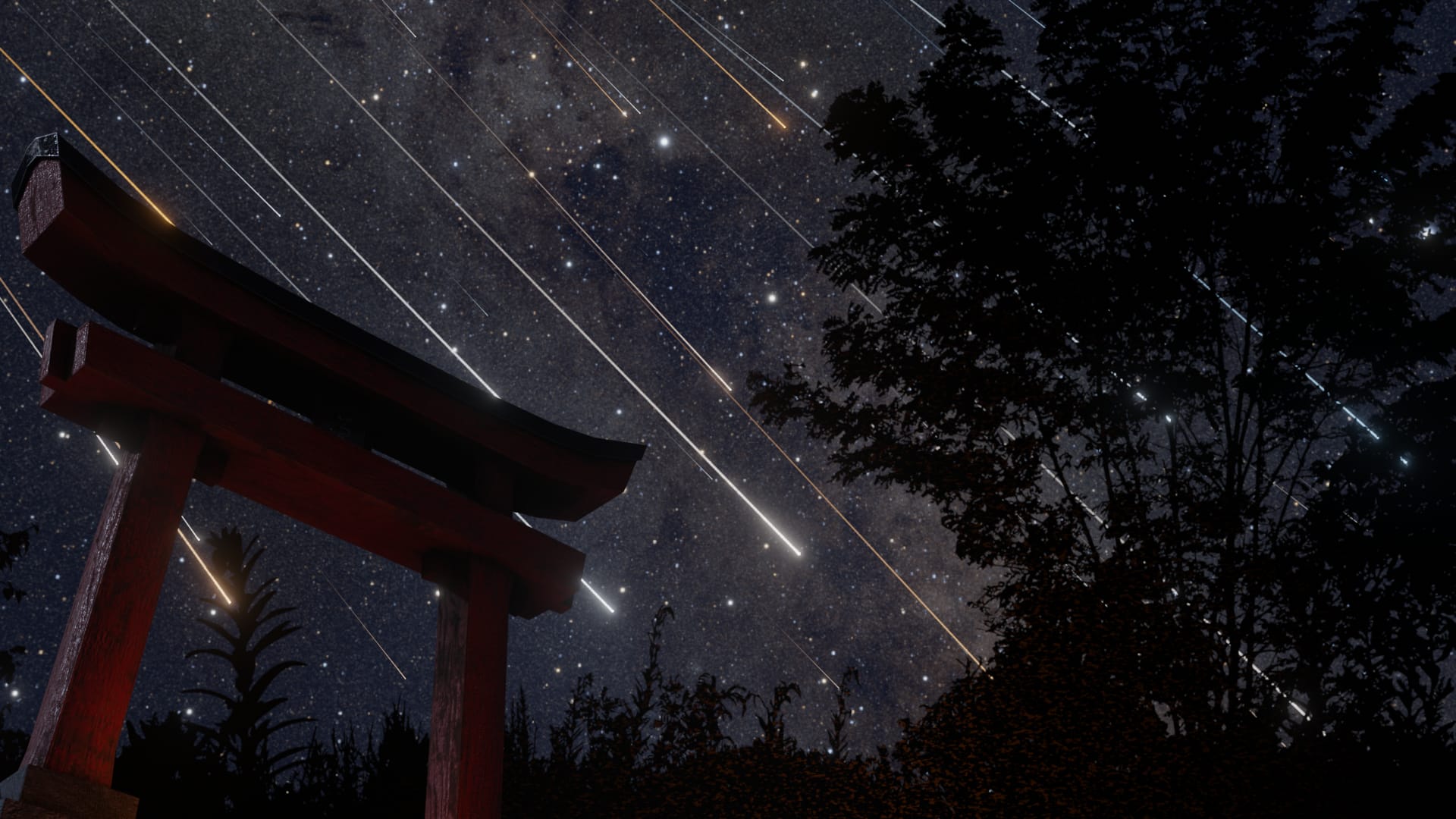
Eight meteor showers reach their maximum activity in October 2026. The month’s main events are the Draconids on October 8–9 and the Orionids on October 21–22, while several weaker showers, like October Camelopardalids, add extra chances to catch shooting stars throughout the month. Use the Sky Tonight app to locate each radiant in the sky and set reminders for the best observing times in your city.
Contents
- Upcoming October Meteor Showers 2026: Key Facts
- Major October Meteor Showers
- Minor October Meteor Showers
- How to Watch a Meteor Shower in October?
- What to See in the October Sky While Waiting for Meteors?
- October Shooting Stars: Conclusion
Upcoming October Meteor Showers 2026: Key Facts
Here is a brief overview of the meteor showers in October 2026. Hourly rates are ZHR estimates: the number of meteors visible in one hour under ideal dark skies with the radiant directly overhead. Actual counts are usually lower.
- Daytime Sextantids — peak on October 1; weak and difficult to observe because the radiant is close to the Sun.
- Draconids — peak on October 8–9 with about 5 meteors per hour under an almost moonless sky.
- Orionids — peak on October 21–22 with about 20 meteors per hour; the waxing Moon will interfere early in the night.
- Several weaker showers also peak during the month — the October Camelopardalids (October 6), Delta Aurigids (October 11), Southern Taurids (October 13), Epsilon Geminids (October 18), and Leonis Minorids (October 24).
Major October Meteor Showers
October brings two major meteor showers worth watching: the Draconids in early October and the Orionids later in the month.
October 8–9: Draconids’ Peak
- Meteors per hour: 5
- Moon phase: thin waning crescent Moon
- Active: October 6–10
- Radiant location: constellation Draco
- Visible from: Northern Hemisphere
The Draconid meteor shower is odd and unpredictable. Unlike the other meteor showers that are best visible before dawn, the Draconids provide the best view in the evening hours. Draconid meteors are also unusually slow-moving, which makes them easier to distinguish from many other October meteors. The Draconids’ parent body is the comet 21P/Giacobini-Zinner, which is why they are also sometimes called the Giacobinids.
In most years, the Draconids produce no more than ten meteors per hour under dark skies, but there have been times when they entertained stargazers with several hundred meteors in a single hour. Most recently, the shower reached about 300 meteors per hour in 2011 and around 150 per hour for four hours in 2018. A model published in 2011 predicts a possible strong outburst in 2062, but this does not rule out earlier outbursts.
Learn more: Draconid Meteor Shower.
Draconids’ Visibility Forecast
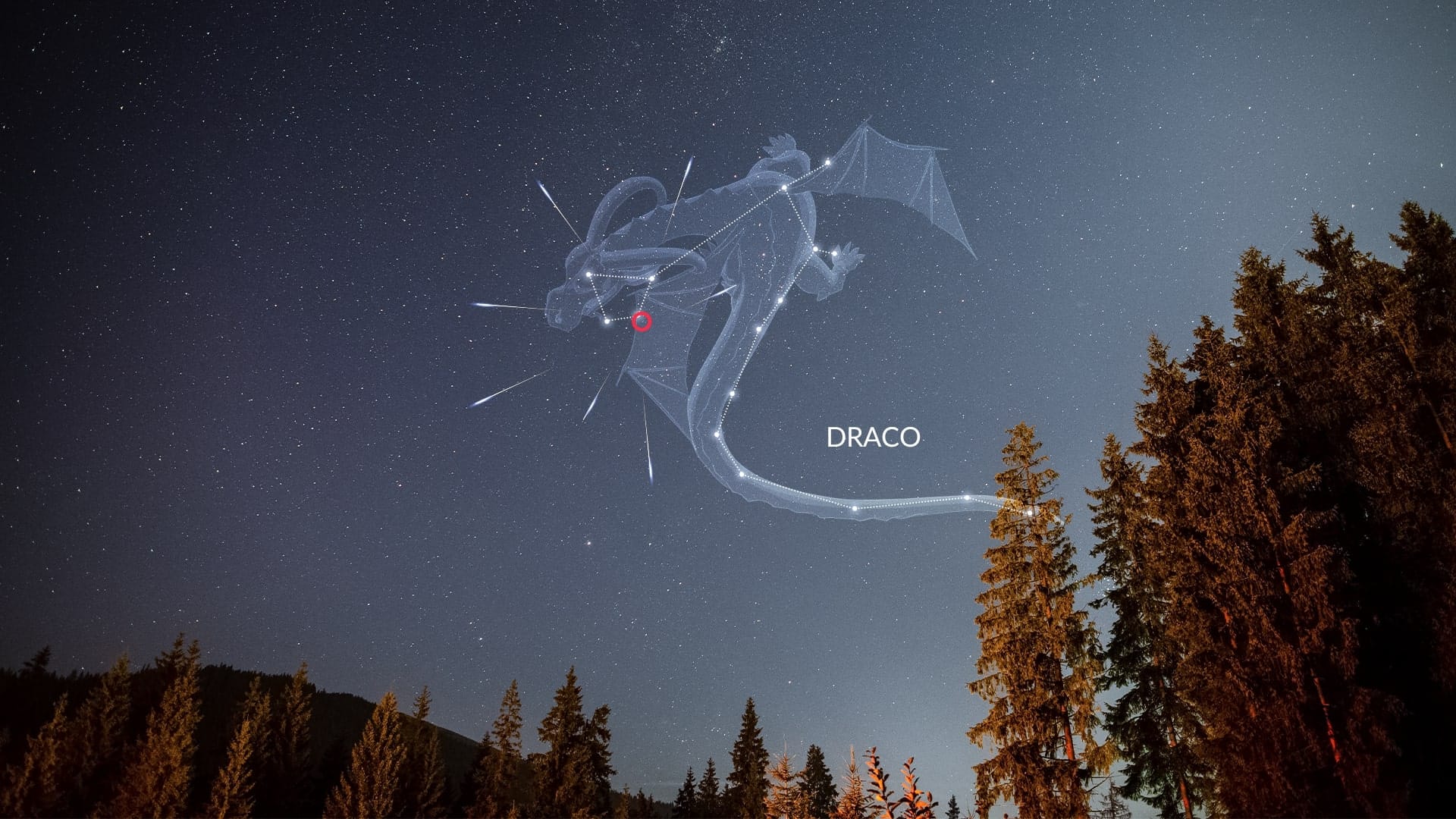
Observing conditions will be excellent for the Draconids in 2026 because the meteor shower peaks near the New Moon. However, no Draconid outburst is expected, so plan for a typical, modest rate of about 5 meteors per hour. The main advantage this year is the lack of moonlight at peak, which will make even faint Draconids easier to spot. The best viewing window is the evening of October 8 into the early hours of October 9, when the radiant in Draco is high in the northern sky.
October 21–22: Orionids’ Peak
- Meteors per hour: 20
- Moon phase: waxing gibbous Moon
- Active: October 2 – November 7
- Radiant location: constellation Orion
- Visible from: both hemispheres
The Orionids are known for their fast meteors and occasional bright fireballs. They enter the Earth’s atmosphere at 66 km/s (about 148,000 mph)! These fast meteors also produce ionized gas trails that last for several seconds. In general, Orionids are among the most beautiful meteor showers of the year.
Learn more: Orionid Meteor Shower
Orionids’ Visibility Forecast
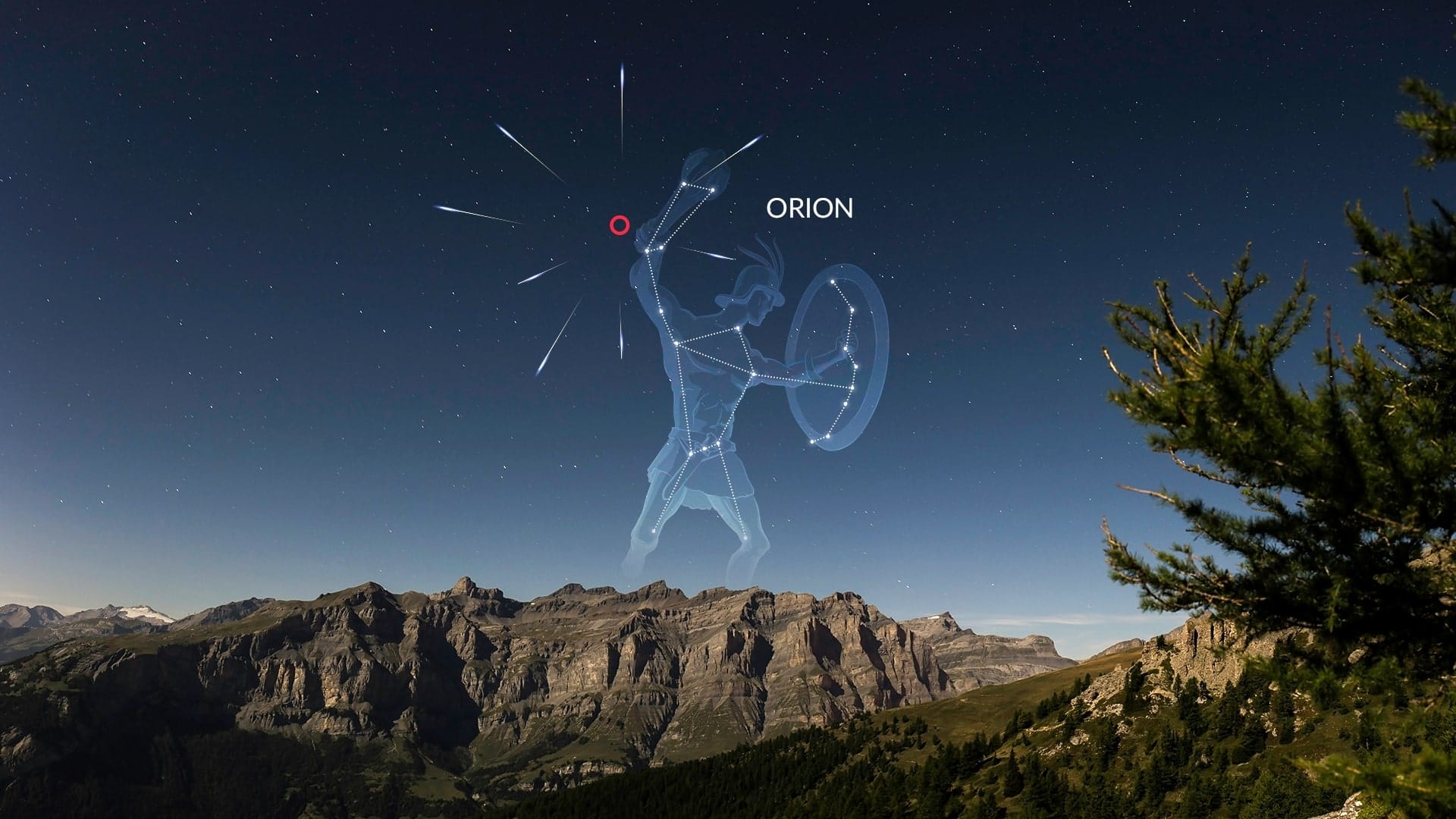
In 2026, the Orionids peak under a waxing Moon, which will brighten the sky considerably in the first half of the night, but there should still be some moon-free observing time before dawn. The radiant reaches a useful elevation from around local midnight in both hemispheres, somewhat earlier in the Northern Hemisphere, and continues climbing toward dawn.
The Orionids also don’t always produce one sharp maximum. Several smaller peaks are possible, and activity can remain at a similar level for several consecutive nights around the main peak. This makes the nights surrounding October 21–22 worth watching as well.
Minor October Meteor Showers
October also brings several minor meteor showers, each producing only a few meteors per hour. They may be less active, but some benefit from dark skies or stand out for bright, slow-moving meteors.
October 1: Daytime Sextantids’ Peak
- Meteors per hour: 5
- Moon phase: waning gibbous Moon
- Active: September 20 – October 6
- Radiant location: constellation Sextans
- Visible from: Both hemispheres
The Daytime Sextantids’ meteors are relatively slow — they enter the terrestrial atmosphere at a velocity of 32 km/s. The Apollo asteroid 2005 UD is a proposed parent body of this weak stream.
Daytime Sextantids’ Visibility Forecast
In 2026, the Daytime Sextantids will peak on October 1. The radiant of this meteor shower lies in the constellation Sextans, close to the Sun, so the Daytime Sextantids are only visible shortly before dawn. Although the meteor shower can produce up to 5 meteors per hour at peak under ideal conditions, in practice, visual observers will likely see far fewer. To spot the Daytime Sextantids’ meteors, try observing during the last hour before local sunrise, when a few shower meteors may become visible in the dawn sky.
October 6: October Camelopardalids’ Peak
- Meteors per hour: 5
- Moon phase: waning crescent Moon
- Active: October 5–6
- Radiant location: constellation Camelopardalis
- Visible from: Northern Hemisphere
The origin of the October Camelopardalids is a mystery. The meteors have an orbit that suggests they probably came from a Halley-type long-period comet. However, no known comet has been identified as the source of the Camelopardalids. The parent comet may simply remain undiscovered, or it may no longer exist.
October Camelopardalids’ Visibility Forecast
This year, conditions for observing the October Camelopardalids are relatively good — the waning crescent Moon is already below the horizon by evening observing time and doesn’t interfere with observations. Moreover, for observers north of about 11°N, the shower’s radiant is circumpolar and remains above the horizon all night. Because the stream may originate from a long-period parent body and its densest trail could still be ahead of us, unexpected increases in activity remain possible. However, no enhanced activity has been specifically predicted for 2026.
October 11: Delta Aurigids’ Peak
- Meteors per hour: 2
- Moon phase: thin waxing crescent Moon
- Active: October 10–18
- Radiant location: constellation Auriga
- Visible from: Northern Hemisphere
The δ-Aurigids (Delta Aurigids) are not broadly studied. Current information about this stream is based on IMO video data since the late 1990s; therefore, any observations might refine our knowledge about it.
Delta Aurigids’ Visibility Forecast
This year, conditions for observing the Delta Aurigids are favorable, as the peak falls very close to New Moon. However, with rates of only about two meteors per hour, this shower will appeal only to the most dedicated meteor hunters.
October 13: Southern Taurids’ Early Peak
- Meteors per hour: 5
- Moon phase: waxing crescent Moon
- Active: September 20 – November 20
- Radiant location: constellation Taurus
- Visible from: both hemispheres
This meteor shower is perfect for meteor photography newcomers. The Southern Taurids’ bright and relatively slow meteors are ideal targets for capturing; this stream also has a stable and low meteor rate that allows for practicing visual planning techniques. The parent body of the Southern Taurids is comet 2P/Encke. The meteor shower has a “sibling,” the Northern Taurids, which are active from October 20 to December 10 and peak on November 12.
Learn more: Taurid Meteor Showers
Southern Taurids’ Visibility Forecast
With a typical rate of about five meteors per hour, the Southern Taurids are a modest shower visible from both hemispheres. In 2026, activity around this October maximum may be slightly higher than average. The shower should still remain relatively modest, but its bright meteors can make it rewarding even when rates are low, especially under the mostly moonlight-free sky. The main November maximum will also be unaffected by moonlight. The radiant rises at its highest around 2–3 a.m. local time — this is the best time to hunt for meteors.
October 18: Epsilon Geminids’ Peak
- Meteors per hour: 3
- Moon phase: first quarter Moon
- Active: October 14–27
- Radiant location: constellation Gemini
- Visible from: both hemispheres
In comparison to the Geminids in December, the ε-Geminids (Epsilon Geminids) are way less entertaining. With only about three meteors per hour, the Epsilon Geminids are a minor shower, but they are still a nice addition to the Orionid meteors in general, as they peak at around the same time.
Epsilon Geminids’ Visibility Forecast
In 2026, viewing conditions for the Epsilon Geminids will be fairly favorable, with the peak occurring near the First Quarter Moon. The Moon will be up during the first part of the night, but it will set before the radiant climbs higher, improving visibility. In the Northern Hemisphere, start watching around local midnight. In the Southern Hemisphere, the radiant stays lower, so it’s best to begin later, closer to the pre-dawn hours.
October 24: Leonis Minorids’ Peak
- Meteors per hour: 2
- Moon phase: bright waxing gibbous Moon
- Active: October 19–27
- Radiant location: constellation Leo Minor
- Visible from: Northern Hemisphere
The Leonis Minorid stream was first found in photographic meteor data. Under a dark sky, this meteor shower can be visible with the naked eye, but it’s too weak to be an interesting target for amateur stargazers.
Leonis Minorids’ Visibility Forecast
In 2026, the conditions for observing the Leonis Minorids are unfortunate, as the peak will occur near the Full Moon. With a maximum rate of only two meteors per hour under favorable conditions, this meteor shower will likely go unnoticed by observers this year.
How to Watch a Meteor Shower in October?
You can prepare for the most successful meteor shower observations with the astronomy app Sky Tonight. Here are some important things to keep in mind:
- Find out the meteor shower’s peak date and time.
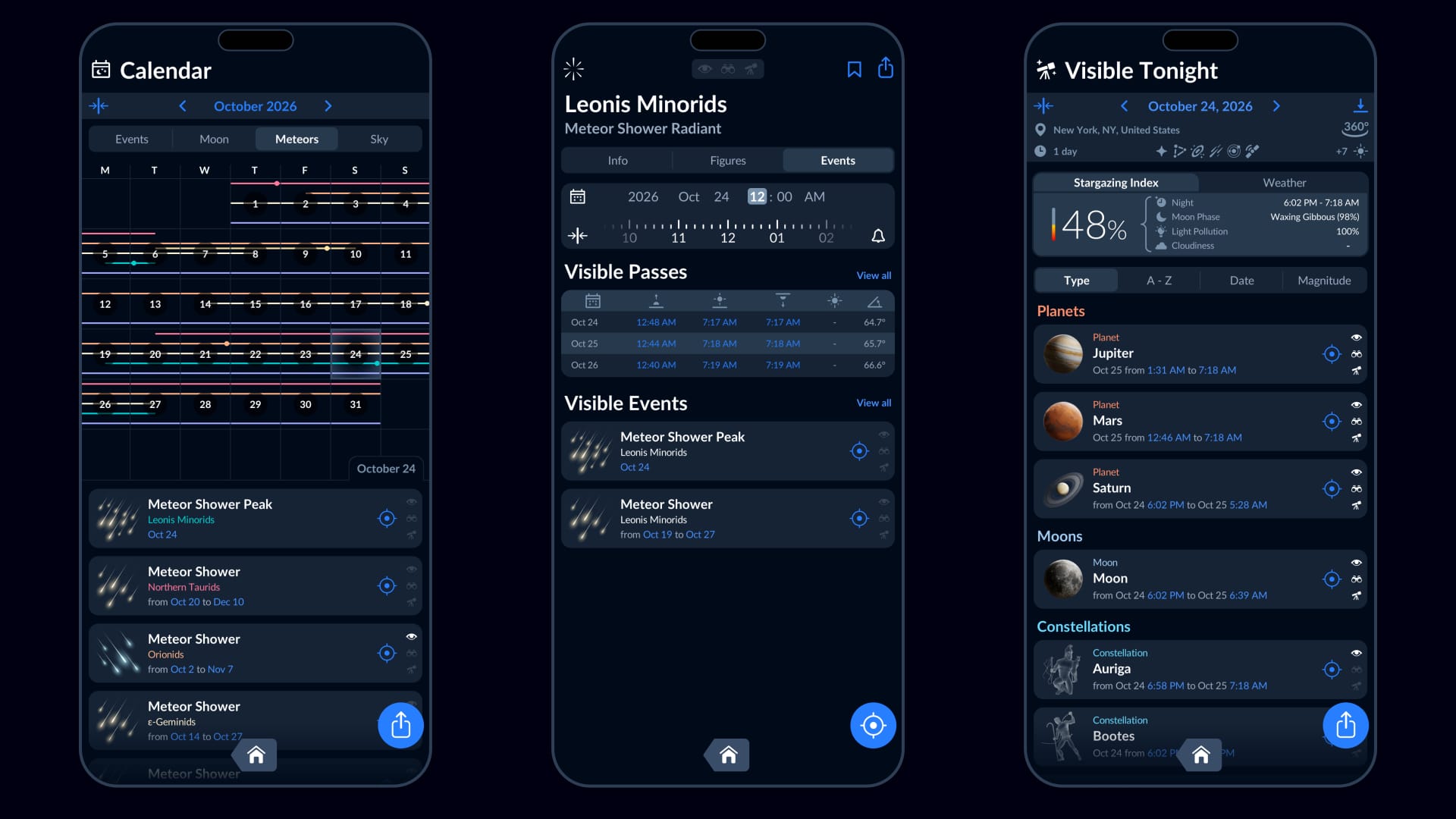
Open the Calendar feature in Sky Tonight and go to the Meteors section. Each meteor shower is marked as a colored line in the calendar, and the peak times are marked as dots. Choose the meteor shower you want to observe and tap on the event to get more information.
- Find out when the radiant is high in the sky.
To find out when the radiant is the highest, tap on the name of the meteor shower (it's marked blue in the Info section of the meteor shower’s event page), then go to the Events section, and look at Visible Passes. The middle time is the time when the meteor shower’s radiant is highest in the sky for your location. Tap on it to see the radiant’s position on the sky map at that moment.
- Check the weather forecast and the Moon’s phase.
In Sky Tonight, you can find the Moon’s phase, weather forecast, and more stargazing details for a given date in the Visible Tonight section (the telescope icon on the main screen).
Get more tips for watching meteor showers in our dedicated article. And if you think you are fully prepared, test your meteor-hunting skills by taking the quiz on how to catch a shooting star.

What to See in the October Sky While Waiting for Meteors?
Shooting stars aren’t quite like fireworks — they don’t appear at an exact predicted moment. Meteor watching takes time, patience, and often a strong neck! But don’t think of this wait as wasted time. While you’re out under the stars, there’s plenty to explore between meteors:
- October constellations: pay special attention to the constellations that contain the radiants of October’s meteor showers.
- Planets to see in October: Saturn is the planet of the month, reaching opposition on October 4 and remaining bright and visible throughout the night.
- Outstanding sky events in October: several notable events happen during meteor-shower activity, so you can plan to observe them on the same night. For example, on October 6, around the peak of the October Camelopardalids, you can also see the Moon near Jupiter with the naked eye.
October Shooting Stars: Conclusion
October 2026 will bring eight meteor showers, including two major ones — the Draconids and the Orionids. The Draconids’ meteor rate should be modest, but they peak under a moonless sky. The Orionids, by contrast, peak under a bright waxing gibbous Moon that sets after midnight, so the best strategy is to wait until the pre-dawn hours for darker skies. They should deliver one of the month’s best celestial shows, with around 20 meteors per hour.
Several smaller showers, such as the Southern Taurids and Epsilon Geminids, will also benefit from dark skies, though they produce only a few meteors per hour. Get ready for nights of shooting stars with the astronomy calendar in our app Sky Tonight!
Wishing you clear skies and happy observations!