Red Giant Star Aldebaran: The Follower of the Pleiades in Taurus
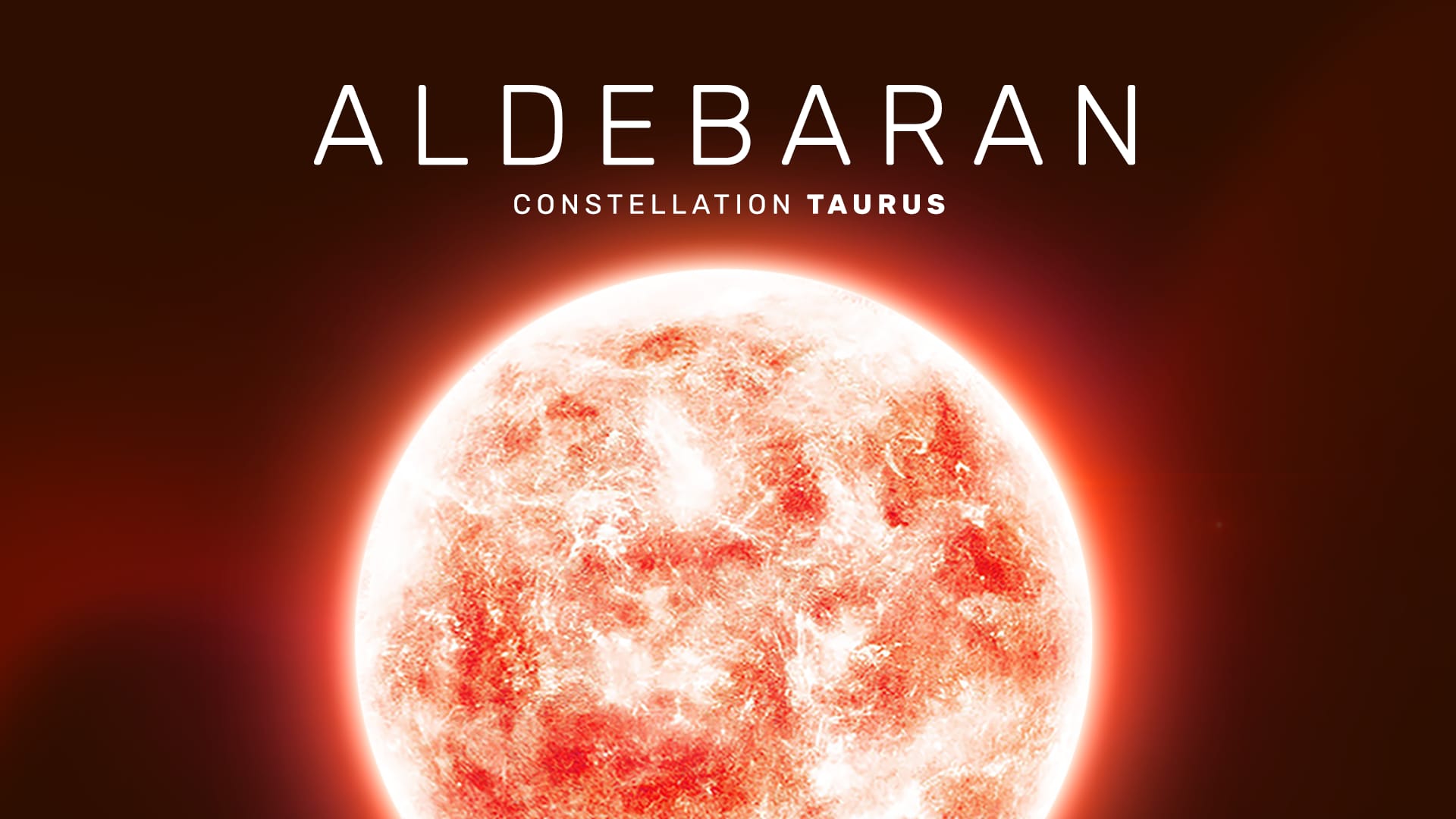
Aldebaran, one of the sky’s brightest stars, shines near the famous Pleiades in the zodiac constellation Taurus. It’s a stellar wonder you don’t want to miss! Locate the star easily with our free Sky Tonight app. And now, let's dive into this article to explore its rich mythology, physical characteristics, and upcoming events.
Contents
- Aldebaran – key star facts
- Where is Aldebaran in the sky?
- When to see Aldebaran?
- Aldebaran mythology: “The Follower” and “The Royal Star”
- Interesting facts about Aldebaran
- Aldebaran star: conclusion
Aldebaran – key star facts
- Official names: Aldebaran, Alpha Tauri, Alpha Tau, α Tau
- Catalog designations: HR 1457, HIP 21421, HD 29139
- Constellation: Taurus
- Star type: class K5 III red giant
- Right ascension: 04 h 35 m 55.23 s
- Declination: +16° 30′ 33.49″
- Apparent magnitude: 0.85
- Mass: 1.03 solar masses
- Luminosity: 439 L☉
- Radius: 44 solar radii
- Surface temperature: 3,900 K
- Distance from the Earth: 66.5 light-years
- Rotation period: 520 days
Where is Aldebaran in the sky?
Aldebaran is the brightest star in the constellation Taurus. It appears to be part of the Hyades cluster, as seen from the Earth, but it is actually about 90 light-years closer to us than the cluster. It’s the 14th brightest star in the sky and is quite easy to find if you know where to look.
How to find Aldebaran – the easiest way
The easiest way to locate Aldebaran, especially if you are searching for the first time, is to use an astronomy app like Sky Tonight. Here is a step-by-step guide:
- Type the star’s name in the app’s search.
- Tap the blue target button to the right of the matching result. The app will show you the star's position on the sky map.
- Tap the blue compass button at the bottom right of the screen, or just point your device at the sky. The app will use your device’s location to align the screen image with the real sky above you.
- Move your device following the white arrow until you see bright orange Aldebaran on the screen and in the real sky.

How to find Aldebaran using Orion’s Belt
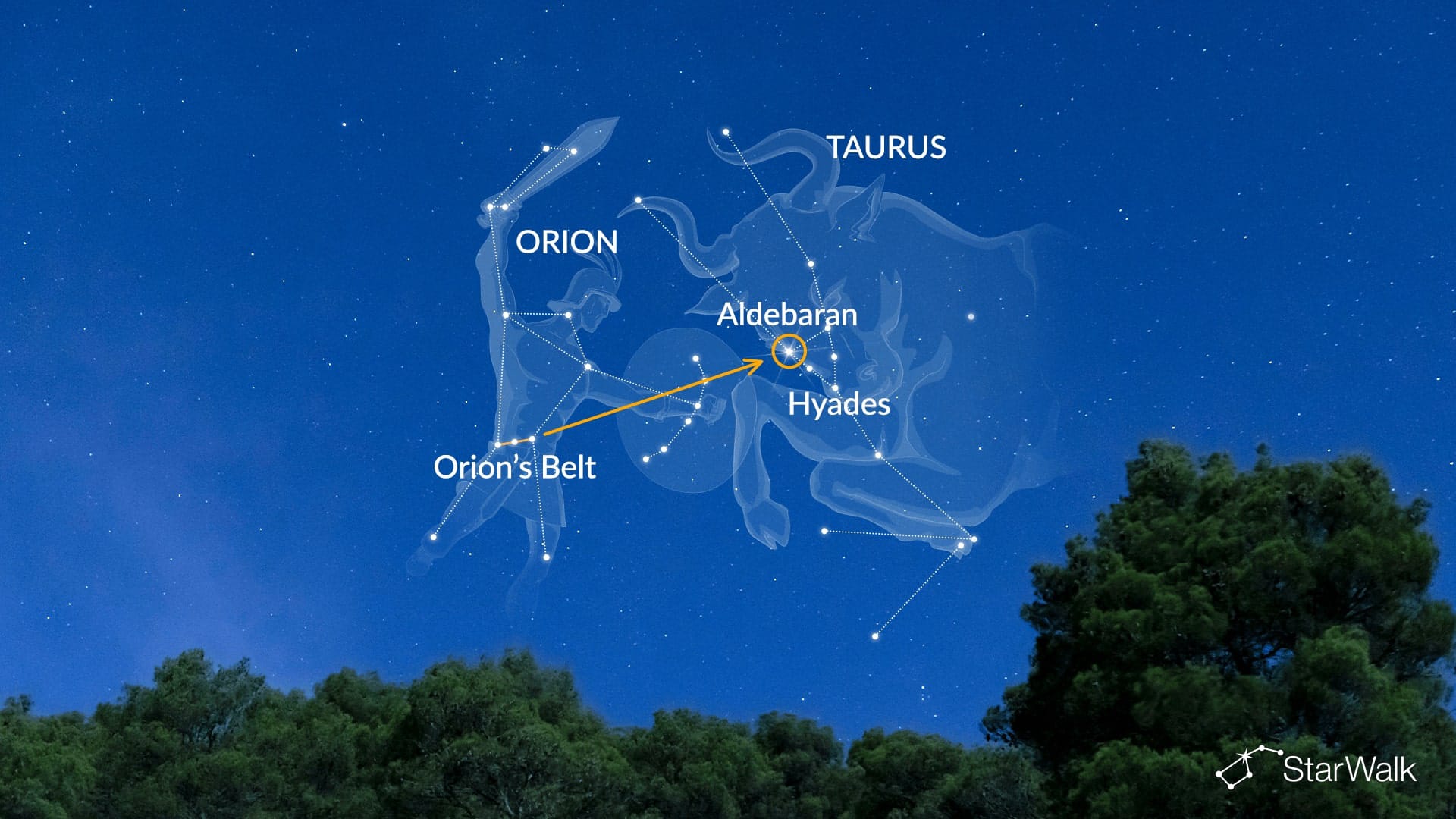
If you don't have a stargazing app at hand, you can use the constellation Orion to guide your way to Aldebaran. Find Orion's Belt asterism, the prominent line of three stars close together, and extend that line to the west. This line will lead you directly to Aldebaran, the first bright star along the way. We've created a poem for you, beautifully illustrated with a 3D video, showing the positions of Orion and Taurus relative to each other. Take a look – it's stunning and will help you remember!
In areas with minimal light pollution, you may also see the V-shaped Hyades cluster surrounding Aldebaran, further confirming its identity.
When to see Aldebaran?
Aldebaran is best seen from December to early May. This is when the star is well-placed in the evening and night sky. From the middle of May until late June, Aldebaran, as well as most of its parent constellation Taurus, is not observable because Taurus hosts the Sun. By the end of June, Aldebaran reappears in the predawn sky.
Aldebaran is located near the ecliptic, the path in the sky where Solar System objects appear to travel. That's why the star often encounters the Moon and planets.
October 28, 2026: Moon near Aldebaran
On October 28, 2026, the waning gibbous Moon will pass near Aldebaran. At 17:57 GMT (01:57 PM EDT), it will appear 10°22′ from the star. Look for the pair in the constellation Taurus, above the eastern horizon in the evening; they will climb higher in the sky during the night.
October 29–30, 2026: Moon forms an isosceles triangle with Aldebaran and Betelgeuse
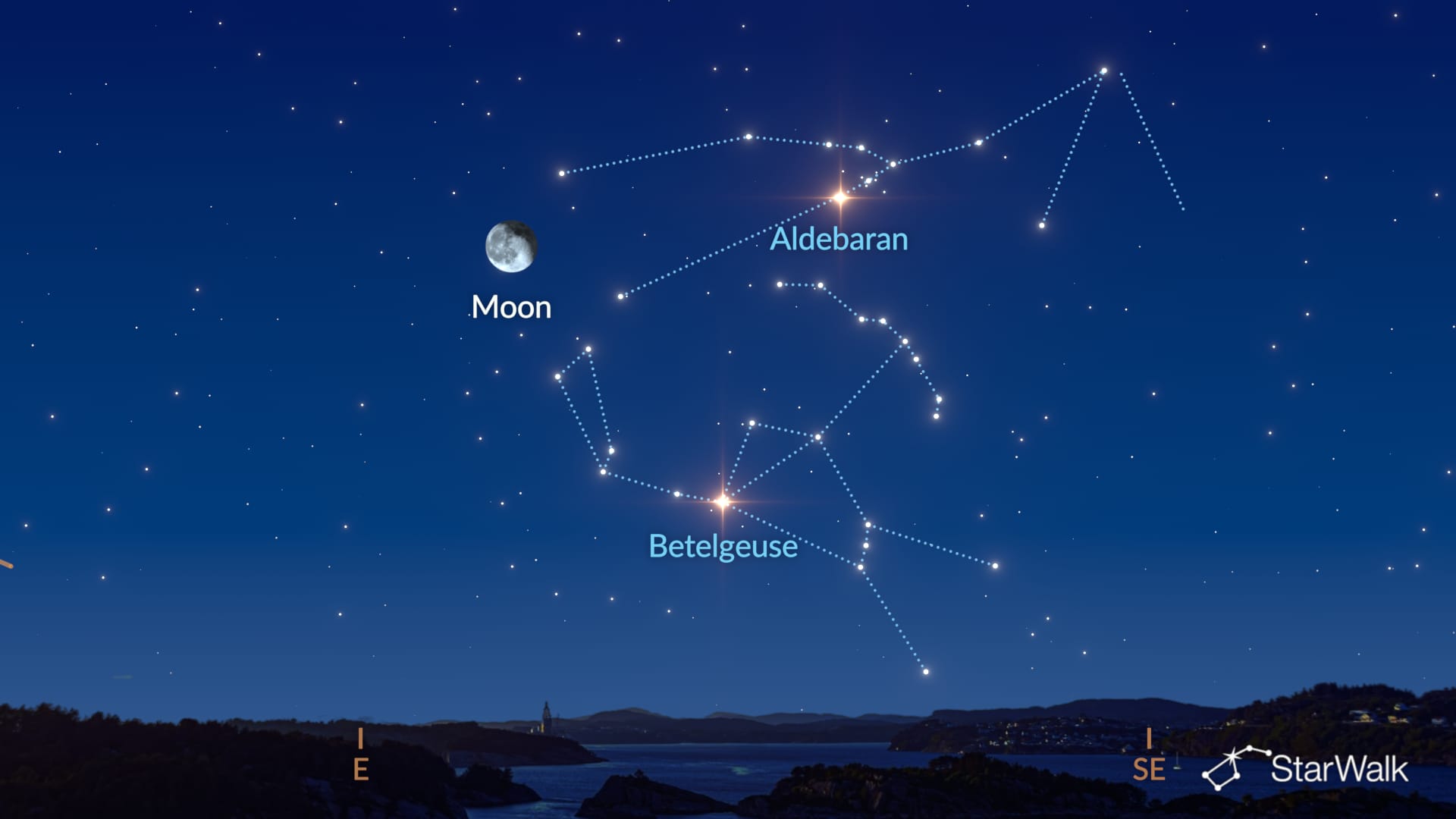
Look up at the evening on October 29 or before sunrise on October 30 to see the waning gibbous Moon form a large triangle with Aldebaran and Betelgeuse. From some locations, the Moon will appear equally far from both stars, creating an isosceles triangle.
The shape will vary by location and viewing time. Observers in parts of Europe, Africa, and South Asia can catch the most symmetrical arrangement. In Larnaca, Nairobi, and Karachi, the two sides meeting at the Moon will each span about 20–21° — roughly two clenched fists held at arm’s length. The base, from Aldebaran to Betelgeuse, will stretch about 21.4°. Elsewhere, the triangle will look more uneven because the moment of equal distances falls outside the local viewing window.
The triangle’s two stars are easy to recognize. Aldebaran (mag 0.9), the bright eye of Taurus, shines orange. Betelgeuse, marking Orion’s shoulder, looks orange-red; its brightness varies, typically between mag 0.0 and 1.6. The Moon will be around 80% illuminated.
No binoculars are needed. All three objects are bright enough to see from a city under a clear sky, and the wide triangle is best viewed with the naked eye. Look for the triangle from late evening through predawn, depending on your location.
| City | Time zone | Visibility start | Visibility end | Best time | Moon–Betelgeuse | Moon–Aldebaran | Side difference | Lowest object | Altitude |
|---|---|---|---|---|---|---|---|---|---|
| St. John's, Canada | NDT (UTC−02:30) | Oct 29, 22:50 | Oct 30, 07:10 | Oct 29, 22:50 | 19°41′ | 22°00′ | 2°19′ | Betelgeuse | 10° |
| Natal, Brazil | BRT (UTC−03:00) | Oct 29, 21:45 | Oct 30, 04:35 | Oct 29, 21:45 | 20°32′ | 22°18′ | 1°47′ | Moon | 10° |
| Larnaca, Cyprus | EET (UTC+02:00) | Oct 29, 21:40 | Oct 30, 05:40 | Oct 29, 23:40 | 20°08′ | 20°08′ | 0′ | Betelgeuse | 34° |
| Nairobi, Kenya | EAT (UTC+03:00) | Oct 29, 22:40 | Oct 30, 05:50 | Oct 30, 01:10 | 20°45′ | 20°45′ | 0′ | Moon | 42° |
| Chiang Mai, Thailand | ICT (UTC+07:00) | Oct 29, 22:20 | Oct 30, 06:00 | Oct 30, 06:00 | 20°30′ | 20°00′ | 30′ | Aldebaran | 40° |
| Hong Kong, China | HKT (UTC+08:00) | Oct 29, 22:20 | Oct 30, 06:05 | Oct 30, 06:05 | 20°30′ | 19°28′ | 1°02′ | Aldebaran | 39° |
| Perth, Australia | AWST (UTC+08:00) | Oct 29, 23:40 | Oct 30, 04:55 | Oct 30, 04:55 | 21°24′ | 19°33′ | 1°51′ | Moon | 26° |
| Dunedin, New Zealand | NZDT (UTC+13:00) | Oct 30, 02:25 | Oct 30, 05:45 | Oct 30, 05:45 | 22°01′ | 17°44′ | 4°17′ | Moon | 14° |
The Betelgeuse–Aldebaran angular distance equals 21°23′ in every row, so this column is omitted.
- Visibility window: All three objects are at least 10° above the horizon, and the Sun is below −6°.
- Best time: The moment when the two sides meeting at the Moon are closest to equal within the available viewing windows.
- Side difference: The difference between Moon–Betelgeuse and Moon–Aldebaran angular distances.
- Lowest object / Altitude: The lowest object and its altitude at the best time.
November 25, 2026: Moon near Aldebaran
On November 25, 2026, the nearly Full Moon will pass near Aldebaran. At 03:46 GMT (10:46 PM EST on November 24), it will appear 10°18′ from the star. Look for the pair in the constellation Taurus, above the eastern horizon after sunset or high in the sky around midnight.
December 22, 2026: Moon near Aldebaran
On December 22, 2026, the waxing gibbous Moon will pass near Aldebaran. At 15:12 GMT (10:12 AM EST), it will appear 10°19′ from the star. Look for the pair in the constellation Taurus, high in the sky in the evening or above the western horizon later at night.
Frequently asked questions about Aldebaran
What constellation is Aldebaran in?
Aldebaran is located in the constellation Taurus. It is the brightest star in the constellation, marking the eye of the celestial Bull.
What type of star is Aldebaran?
Aldebaran is a red giant star. Such stars are entering the late stages of their life cycle, having exhausted the hydrogen in their core and now fusing hydrogen in a shell around an inert helium core.
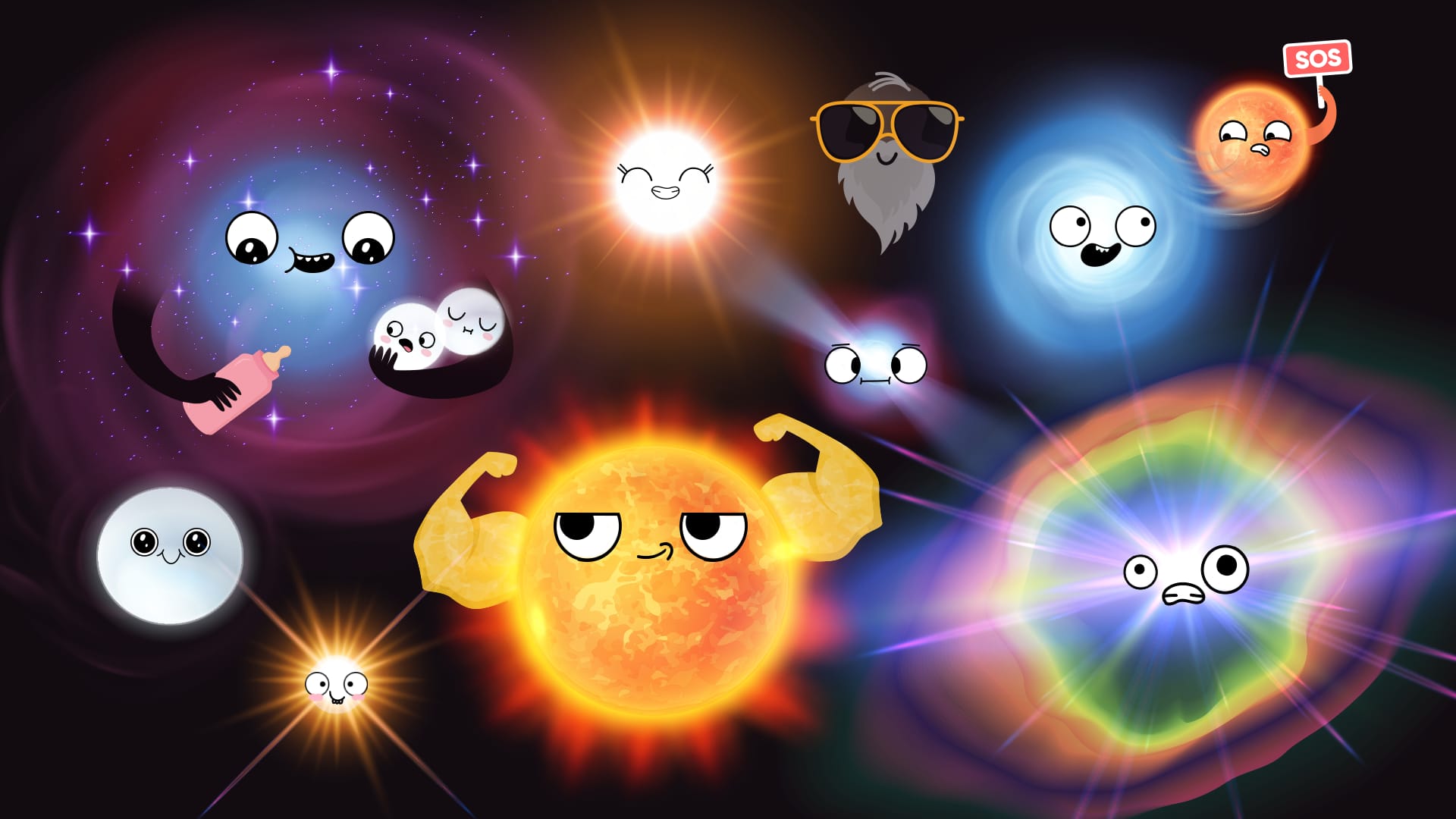
Curious to learn more about the life cycle of stars? Check out our colorful and easy-to-understand infographic on the topic.
What is the temperature of Aldebaran?
Red giant stars, such as Aldebaran, have relatively low surface temperatures. Aldebaran has a surface temperature of about 3,900 K. For comparison, the Sun’s surface is about 1.5 times hotter.
What color is Aldebaran?
Aldebaran, with its orange-red hue, is a classic example of a red giant, a phase in stellar evolution when a star expands and cools. Learn more about how stars evolve by checking out our infographic about the life cycle of stars!
How old is Aldebaran?
At around 6.4 billion years old, Aldebaran is significantly older than our Sun. In another few hundred million years, the star’s nuclear reactions will stop, and eventually, Aldebaran will shed its outer layers, creating a planetary nebula, while its remaining core will become a white dwarf.
How big is Aldebaran?
Aldebaran is 44 times larger than the Sun. If Aldebaran were to replace the Sun at the center of the Solar System, the star's surface would extend halfway to the orbit of Mercury and would cover 20 degrees of our sky (this is more than the width of the Big Dipper, including the handle).
How far is Aldebaran from Earth?
Aldebaran is about 66.5 light-years from Earth, which is relatively close in astronomical terms. To make it clearer, let's compare it to other bright stars:
- Alpha Centauri (the closest star system to Earth): 4.3 light-years
- Sirius (the brightest star in the sky): 8.6 light-years
- Vega (the brightest star in Lyra): 25 light-years
- Spica (the brightest star in Virgo): 250 light-years
- Antares (the brightest star in Scorpius): 550 light-years
- Betelgeuse (bright star in Orion): 642.5 light-years
Aldebaran mythology: “The Follower” and “The Royal Star”
The name "Aldebaran" comes from the Arabic "al Dabarān," which means "the follower." This is because Aldebaran seems to follow the Pleiades star cluster, which is also located in the constellation Taurus.
Aldebaran has been observed and honored for thousands of years. In Babylonia, around 3000 BC, it was known as "The Leading Star of Stars" because the arrival of the constellation Taurus marked the vernal equinox, the beginning of the Babylonian year. In Persia, Aldebaran was one of the four Royal Stars that symbolized the four seasons, along with Regulus, Antares, and Fomalhaut. The Mesopotamians called Aldebaran the "Messenger of Light."
In modern times, the star is often depicted as the bull's orange eye. Interestingly, however, in the Middle Ages it was called Cor Tauri – the heart of the bull. Different cultures had their own interpretations: some Native American tribes saw Taurus as the head of a bison, while the Inuit people of the Arctic saw Aldebaran as a polar bear.
Interesting facts about Aldebaran
A star system
Aldebaran is not alone! It is part of a multiple-star system with a tiny, faint companion called Alpha Tauri B. This red dwarf star is very faint, with an apparent magnitude of 13.6 and can’t be seen with the naked eye.
There are also more stars near Aldebaran in the sky – Alpha Tauri C, D, E, and F. In fact, two of them (Alpha Tauri C and D) are a binary system, but they aren’t related to Aldebaran. They are much farther away and belong to the Hyades cluster.
A potential exoplanet host
Aldebaran may have at least one exoplanet called Aldebaran b, which is about 6.5 times the mass of Jupiter. Discovered in 1993 and confirmed in 2015, its existence was later questioned again. In a paper published in 2019, scientists suggested that there should be either two or no exoplanets around Aldebaran. For now, Aldebaran b remains a candidate exoplanet until more data provides clarity.
If Aldebaran b does exist, it is an unlikely place for carbon-based life. Its equilibrium temperature should be around 1,500 K, and it receives significant radiation from Aldebaran.
A destination for the Pioneer 10 probe
The Pioneer 10 probe, launched in 1972, is on its way to Aldebaran. Although it no longer communicates with the Earth, it will reach Aldebaran in about 2 million years. At Carl Sagan's suggestion, Pioneer 10 and its twin Pioneer 11 carry gold-anodized aluminum plaques depicting human figures and symbols to convey information about the spacecraft's origins to potential extraterrestrial finders.
Aldebaran star: conclusion
Aldebaran is the brightest star in Taurus. It holds a special place in the constellation, often depicted as the fiery orange eye of the celestial bull. As the 14th brightest star in the entire night sky, Aldebaran is easy to find. It's also particularly interesting because it often meets Solar System objects such as planets or the Moon in the sky. Use our Sky Tonight app to guide your stargazing adventures and enjoy the beauty of Aldebaran.