Taurid Meteor Shower 2026: Peak Dates and Where to See

The Taurid meteor showers are here! The Southern Taurids peak on November 4–5. About a week later, the Northern Taurid meteor shower reaches its peak on November 11–12. Both streams are known for slow-moving meteors and occasional fireballs. In 2026, moonlight will cause little interference around their peak dates.
Plan your meteor watch with Sky Tonight: locate each shower’s radiant, check when the Moon rises or sets from your location, and choose the darkest hours for the best chance of spotting Taurid meteors.
Contents
- Southern and Northern Taurid Meteor Showers in 2026
- Where to See the Taurid Meteor Showers?
- How to See the Taurid Meteor Showers?
- Southern and Northern Taurid Meteor Showers: Conclusion
Southern and Northern Taurid Meteor Showers in 2026
The Taurid meteor shower is an annual meteor shower associated with the Encke Complex. One hypothesis suggests the Encke Complex formed when a large parent comet broke apart, leaving Comet 2P/Encke, several asteroids, and meteor streams.
The Taurids have two separate meteor streams — the Northern and Southern Taurids. The Southern Taurids originate from comet Encke itself, and the Northern Taurids are believed to come from one of the leftover asteroids, asteroid 2004 TG10.
The Southern Taurids and the Northern Taurids are both relatively weak in terms of hourly rates, but they are known for bright, slow-moving meteors and occasional fireballs. The Southern Taurids have an early maximum on October 12–13 and another maximum on November 4–5, while the Northern Taurids peak on November 11–12.
November 4–5, 2026: Southern Taurid meteor shower
- Meteors/hour¹: 5–10
- Moon phase: waning crescent Moon
- Active: September 20–November 20
- Early peak: October 12–13
- Radiant location: Taurus
- Visible from: both hemispheres
¹Actual meteor counts depend on radiant altitude, sky darkness, and observing conditions. The meteors-per-hour rate here describes an ideal hourly rate with the radiant directly overhead.
The long-lasting, weak Southern Taurid meteor shower is derived from debris dropped by a periodic comet 2P/Encke, the second comet recognized as periodic, after Halley’s Comet. The larger-than-average grain size of the cometary debris often produces bright fireballs.
Southern Taurids 2026 visibility forecast
The November maximum of the Southern Taurids comes under generally favorable conditions, with the waning crescent Moon causing little interference. Plan to observe around local midnight when the radiant is high in the sky. However, the Moon may interfere later in the night, so check its local rising time before planning an extended observation session. An observing site with little light pollution will help reveal fainter meteors.
The Taurids have a broad maximum, so missing the listed peak night does not mean missing the shower. If the night of November 4–5 is cloudy, choose a clear night nearby instead.
The Southern Taurids’ earlier maximum occurred around October 13, 2026, with little interference from the young waxing crescent Moon.
November 11–12, 2026: Northern Taurid meteor shower
- Meteors/hour: 5
- Moon phase: thin waxing crescent Moon
- Active: October 20–December 10
- Radiant location: Taurus
- Visible from: both hemispheres
The Northern Taurids belong to the same complex associated with 2P/Encke. Asteroid 2004 TG10 has been proposed as a possible parent body, but its role remains uncertain. We see the Northern Taurid meteor shower whenever Earth passes through this stream of particles.
Northern Taurids 2026 visibility forecast
In 2026, the Northern Taurids are expected to reach their maximum on November 11–12 under the waxing crescent Moon that won’t hinder observations. The thin crescent sets during the evening, leaving the hours around midnight largely free of moonlight.
The shower’s activity can remain near maximum for roughly ten days in early to mid-November, giving observers several good opportunities to watch it. The New Moon on November 9 provides dark skies, making this period ideal for spotting the Northern Taurids’ characteristic slow, bright meteors.
Where to See the Taurid Meteor Showers?
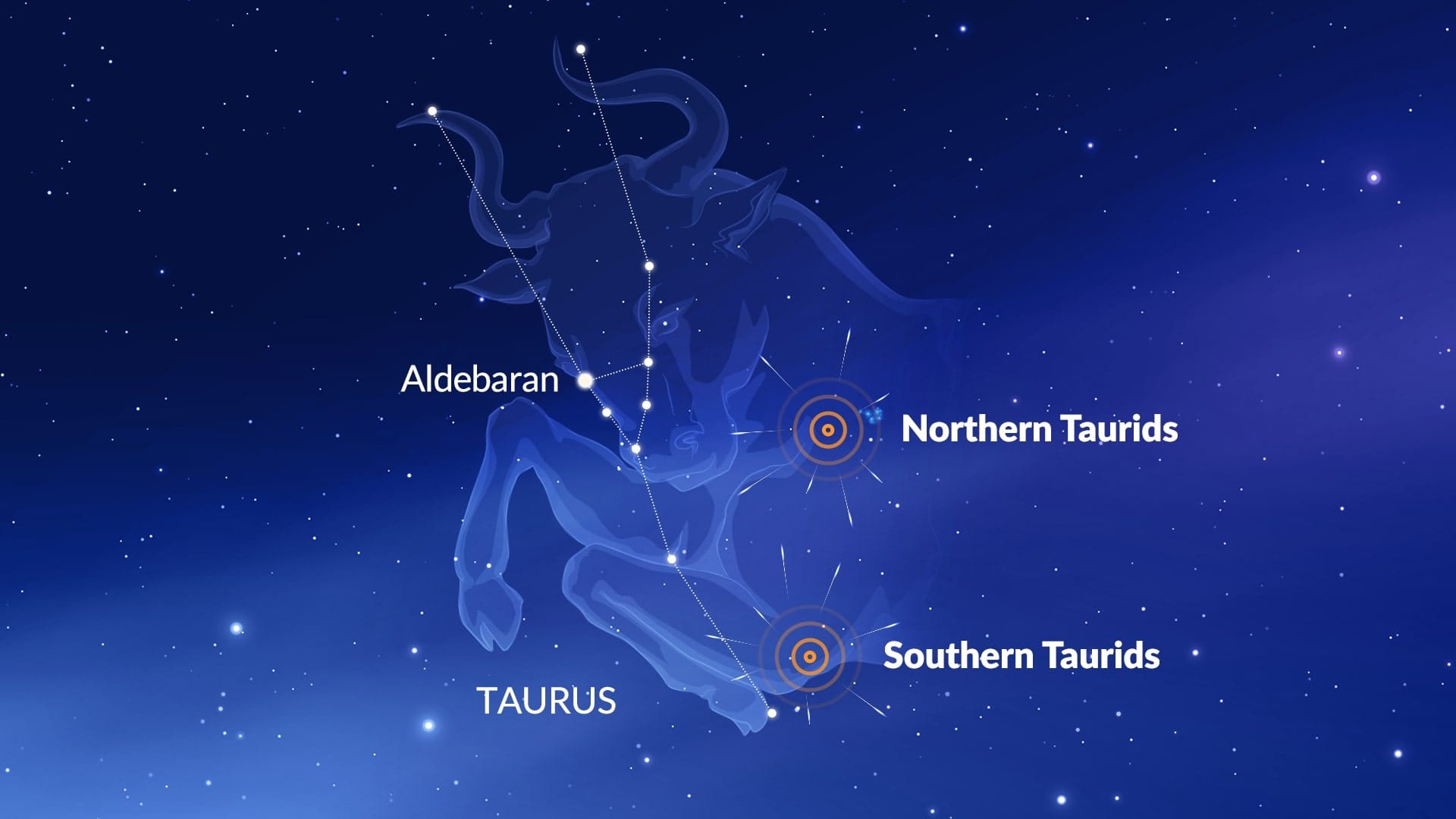
Around their November peaks, the Northern and Southern Taurid meteor showers appear to radiate from distinct regions of the constellation Taurus. The Northern Taurid radiant lies closer to the Pleiades, while the Southern Taurid radiant lies farther south, in the region near the star Xi Tauri.
The Southern Taurids also have an earlier maximum in October, when their radiant is in Cetus. As the radiant gradually shifts across the sky, it moves into Aries, and then into Taurus by early November.
For better viewing, wait until the radiants are well above the horizon, usually around local midnight. However, don’t stare directly at them: keep a broad, dark area of sky in view. Meteors can appear far from their radiants, and their trails tend to look longer farther away.
The Taurids are visible from both hemispheres, although their radiants generally rise higher in the northern latitudes. The Taurids are minor showers with relatively low meteor rates, but their slow-moving meteors and occasional bright fireballs make them appealing targets for astrophotography.
The Taurid asteroid swarm: is it dangerous for Earth?
The Taurids’ parent comet 2P/Encke is also believed to have “given birth” to the Taurid Swarm Complex. The Taurid Complex includes a concentration of meteoroids known as the Taurid resonant swarm. Unlike the regular Taurid meteor streams, which Earth encounters every year, the swarm approaches Earth more closely in certain years. Astronomers have long monitored this region because it may host a significant number of large, kilometer-class asteroids. One hypothesis even links the object responsible for the 1908 Tunguska airburst to the Taurid complex. The Tunguska body itself was comparatively small — roughly 50 to 100 meters across — but larger objects can cause destruction on a regional scale if they collide with Earth.

For a long time, it was unclear how many large objects the Taurid swarm might actually contain. A recent University of Maryland study suggests that the threat may be lower than previously feared: researchers estimate that the swarm contains no more than about 9 to 14 objects at least 100 meters across, significantly fewer than some earlier estimates. This is reassuring for planetary defense, although the authors still stress the importance of continued observations and better detection methods.
Another recent study suggests that Earth may pass through a denser part of the Taurid debris stream in 2032. According to the study, this could increase the amount of cometary material entering Earth’s atmosphere and raise the likelihood of airbursts — atmospheric explosions caused by incoming objects — in 2032 and 2036.
So, does the Taurid swarm pose an immediate danger? Current research does not suggest that a major impact from the swarm is expected. However, the Taurid complex remains scientifically important because it contains a wide range of debris sizes, from ordinary meteor-producing particles to much larger bodies that astronomers continue to monitor.
Visit our dedicated article to learn how astronomers detect potentially hazardous objects and what can be done if one is ever found on a collision course with Earth.
How to See the Taurid Meteor Showers?
Watch the Taurids with the unaided eye — binoculars and telescopes narrow your field of view. Here are some tips to enhance your meteor-hunting experience:
-
Check the weather forecast and the Moon’s phase to determine the optimal observation date for the meteor shower.
-
Use stargazing apps as your guides. Our apps, Sky Tonight and Star Walk 2, will help you locate the meteor shower’s radiant and provide essential information about any meteor shower you want to observe.
-
Keep as much of the sky in your field of view as possible. Find a location with a clear horizon and a dark sky, recline on a blanket or a folding chair, and prepare for the celestial spectacle. Look slightly sideways from the radiant’s position to spot meteors with more prominent, longer trails.
-
Preserve your night vision. Your eyes need time to adjust to the darkness to see more meteors. Use red flashlights and night mode on your phone to maintain your night vision.
-
Dress warmly and bring hot drinks. The night may get chilly as you observe the meteors for an extended period, so make sure you’re comfortable and prepared.
Get more tips on observing the meteor showers in our dedicated article and test yourself with the quiz on how to catch a shooting star to learn if you are fully prepared.
Southern and Northern Taurid Meteor Showers: Conclusion
In 2026, the Taurids offer favorable observing conditions, with both branches peaking under mostly dark skies. Although the Southern and Northern Taurids are minor meteor showers — about 5–10 meteors per hour for the Southern Taurids and around 5 per hour for the Northern Taurids — their slow, bright meteors and occasional fireballs make them rewarding targets for patient observers and astrophotographers in both hemispheres.
Use the Sky Tonight app to find each Taurid radiant, check when it is highest from your location, see when the Moon rises or sets, and choose the darkest hours for observing. Set a reminder for the peaks, then head outside at the right time and watch for slow Taurid meteors — and, with luck, a bright fireball.
Want more chances to catch shooting stars? See our guide to meteor showers in November.
