What Is Antares? Explore & Observe the Red Star
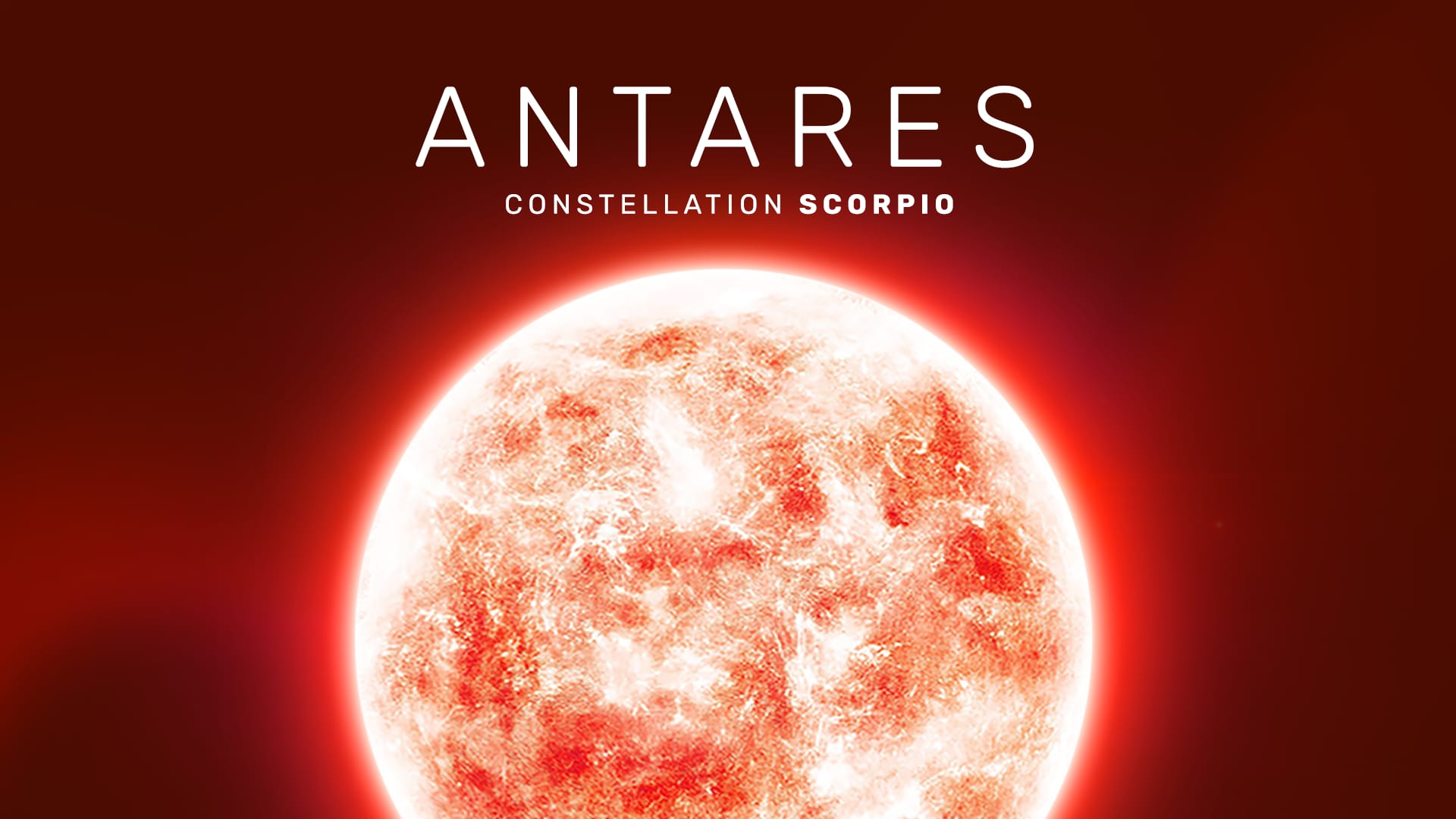
Antares, the “rival of Mars”, is a supergiant star that appears as a bright reddish dot to the naked eye. To easily find Antares in the sky from your exact location, use the free Star Walk 2 app. Read on to learn interesting and useful facts about this star.
Contents
- Where is Antares in the sky?
- When to see the red star next to the Moon and planets? Sky events with Antares
- What is Antares: key facts about the red star
- More facts about Antares
- Antares FAQ
- Antares, the rival of Mars: Conclusion
Where is Antares in the sky?
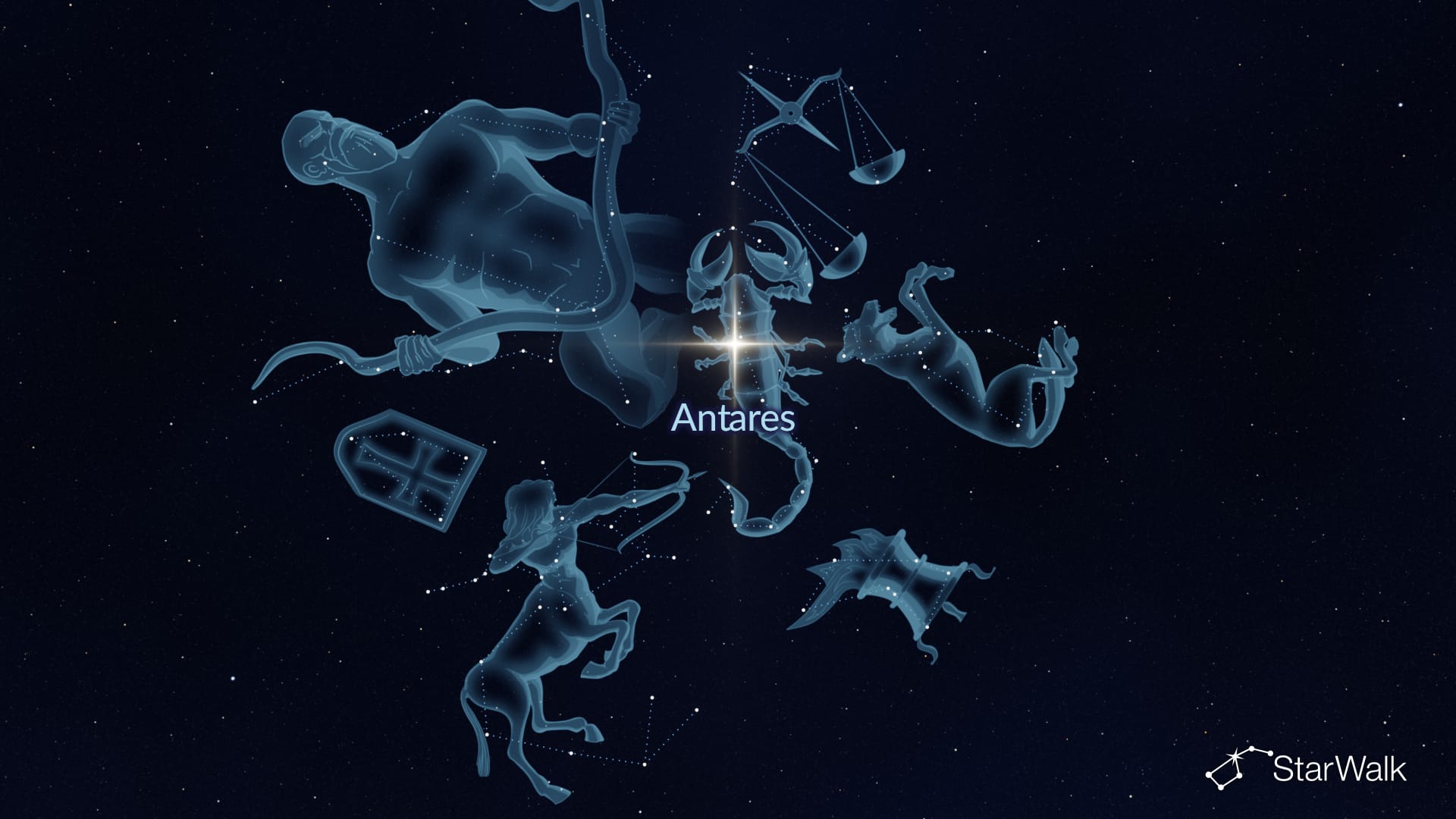
Antares lies in the heart of the constellation Scorpius, close to the ecliptic. It marks the central part of the Scorpion’s body and is surrounded by several notable stars of the constellation, including Acrab and Dschubba to the northwest and Shaula and Lesath farther southeast toward the Scorpion’s tail. Nearby constellations include Libra to the west, Ophiuchus to the north, Sagittarius to the east, and Lupus to the south.
Where is Antares visible?
In the Northern Hemisphere, the star is visible from locations south of about 63°N. In the Southern Hemisphere, Antares rises high in the sky and is circumpolar south of about 63°S latitude.
When is Antares visible?
Antares is visible for much of the year, but it disappears into the Sun’s glare in late November and early December, when the Sun passes closest to it in the sky. For evening observing, Antares is best placed from May through August and is especially prominent during the Northern Hemisphere summer and Southern Hemisphere winter.
How to find Antares?
Antares is surrounded mostly by 2nd and 3rd-magnitude stars, so there are no similarly bright stars nearby to use as easy reference points. It is especially prominent from the Southern Hemisphere, while observers in the Northern Hemisphere usually see it lower above the southern horizon. You can also navigate by the Moon or planets when they're near Antares. Read on to find out the upcoming Antares conjunction dates.
Another easy way to find Antares is to use the Star Walk 2 app. Simply search for the star and follow the arrow on the screen to locate Antares in the sky above you. The app is available for free, but you can subscribe for additional features.

When to see the red star next to the Moon and planets? Sky events with Antares
Below is the list of upcoming celestial events featuring Antares. You can also find these events through the Star Walk 2 calendar, where you can enable alerts and see how these objects will appear in the sky from your location on the specified dates.
November 11: Moon and Antares; lunar occultation of Antares
- Occultation start: 02:24 GMT
- Occultation end: 06:52 GMT
- Close approach time: 04:38 GMT
- Conjunction time: 04:42 GMT
- Close approach & conjunction distance: 0°16′
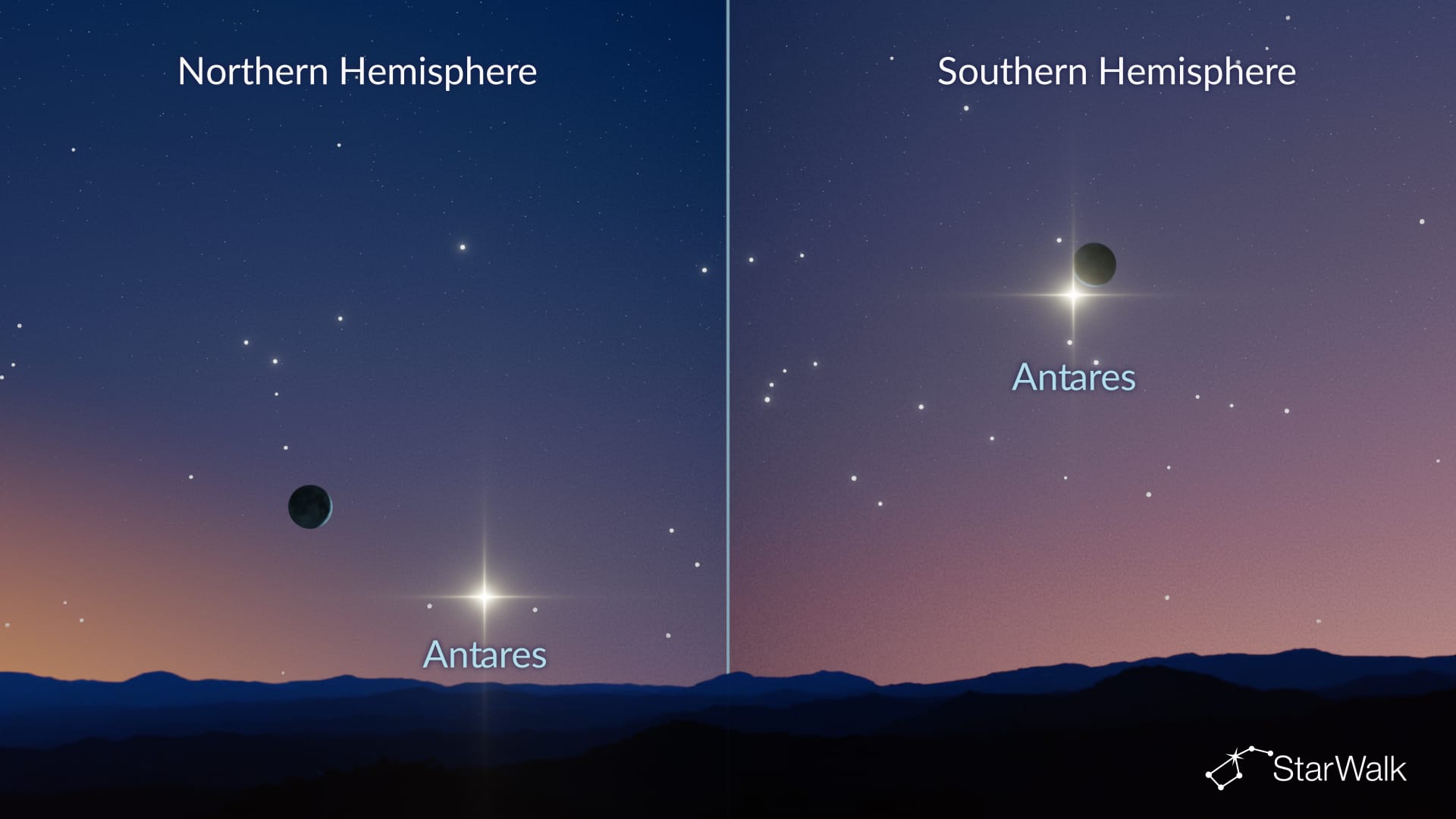
On November 11, a very thin crescent Moon will pass extremely close to Antares. Observers in the Southern Hemisphere will have the best view, as the pair will stand higher above the horizon and can be seen against a darker evening sky. Farther north, Antares will appear lower and closer to the Sun’s glow.
In the Americas, the pair will be best seen on the evening of November 10 local time, several hours before the closest approach occurs on November 11 GMT.
| City | Time zone | Best time (local) | Separation | Moon altitude | Antares altitude | Sun altitude |
|---|---|---|---|---|---|---|
| Miami, USA | EST (UTC−5) | Nov 10, 5:59 PM | 3°38′ | 4° | 7° | −6° |
| Bogotá, Colombia | COT (UTC−5) | Nov 10, 6:00 PM | 3°43′ | 9° | 13° | −6° |
| Lima, Peru | PET (UTC−5) | Nov 10, 6:34 PM | 3°26′ | 12° | 15° | −6° |
| São Paulo, Brazil | BRT (UTC−3) | Nov 10, 6:50 PM | 4°17′ | 12° | 16° | −6° |
| Buenos Aires, Argentina | ART (UTC−3) | Nov 10, 8:00 PM | 3°38′ | 12° | 16° | −6° |
| Santiago, Chile | CLST (UTC−3) | Nov 10, 8:46 PM | 3°16′ | 13° | 16° | −6° |
- Best time is selected to balance darker skies, good altitude, and a close apparent separation between the Moon and Antares.
- Separation shows the apparent distance between the Moon and Antares in the sky.
- Altitude shows how high the Moon and Antares are above the horizon: 0° is on the horizon, 30° is about one-third of the way up the sky, and 90° is directly overhead.
- Sun altitude shows how far the Sun is below the horizon. At about −6°, civil twilight ends and the sky becomes noticeably darker.
- If the objects are below about 10°, choose a spot with a clear, unobstructed horizon.
On the same day, the Moon will occult Antares, temporarily hiding the bright red star behind its disk. The occultation path will cross a broad region stretching from the southern Indian Ocean through Australia and New Zealand into the South Pacific. In many populated locations, however, the occultation will occur in daylight or bright twilight, making Antares extremely difficult or impossible to see. Do not attempt to search for the star with binoculars or a telescope when the Sun is nearby!
| City | Occultation visibility, local time |
|---|---|
| Sydney, Australia | Nov 11, 16:01–17:12 |
| Melbourne, Australia | Nov 11, 15:39–17:02 |
| Adelaide, Australia | Nov 11, 14:59–16:15 |
| Auckland, New Zealand | Nov 11, 18:27–19:37 |
| Wellington, New Zealand | Nov 11, 18:23–19:30 |
| Suva, Fiji | Nov 11, 18:09–18:41 |
December 8: Moon and Antares; lunar occultation of Antares
- Occultation start: 09:02 GMT
- Occultation end: 13:26 GMT
- Close approach time: 11:15 GMT
- Conjunction time: 11:19 GMT
- Close approach & conjunction distance: 0°14′
On December 8, a thin waning crescent Moon will pass very close to Antares. The event will be extremely difficult to observe because Antares will rise almost at the same time as the Sun and remain very close to its glare.
On the same day, the Moon will also occult Antares. The occultation path will cross parts of South America, the South Atlantic, the southwestern Indian Ocean, and southern Africa. However, throughout the visibility region, the event will occur in daylight or very bright twilight, making Antares extremely difficult or impossible to see. Do not attempt to search for Antares with binoculars or a telescope when the Sun is nearby!
| City | Occultation visibility, local time |
|---|---|
| Recife, Brazil | Dec 8, 06:16–06:51 |
| Salvador, Brazil | Dec 8, 06:07–07:07 |
| Rio de Janeiro, Brazil | Dec 8, 06:14–07:22 |
| São Paulo, Brazil | Dec 8, 06:15–07:19 |
| Cape Town, South Africa | Dec 8, 13:19–14:39 |
| Johannesburg, South Africa | Dec 8, 14:04–14:50 |
December 12–13: Mercury and Antares
- Conjunction time: December 12, 12:21 GMT
- Conjunction distance: 4°48′
- Close approach time: December 13, 05:25 GMT
- Close approach distance: 4°40′
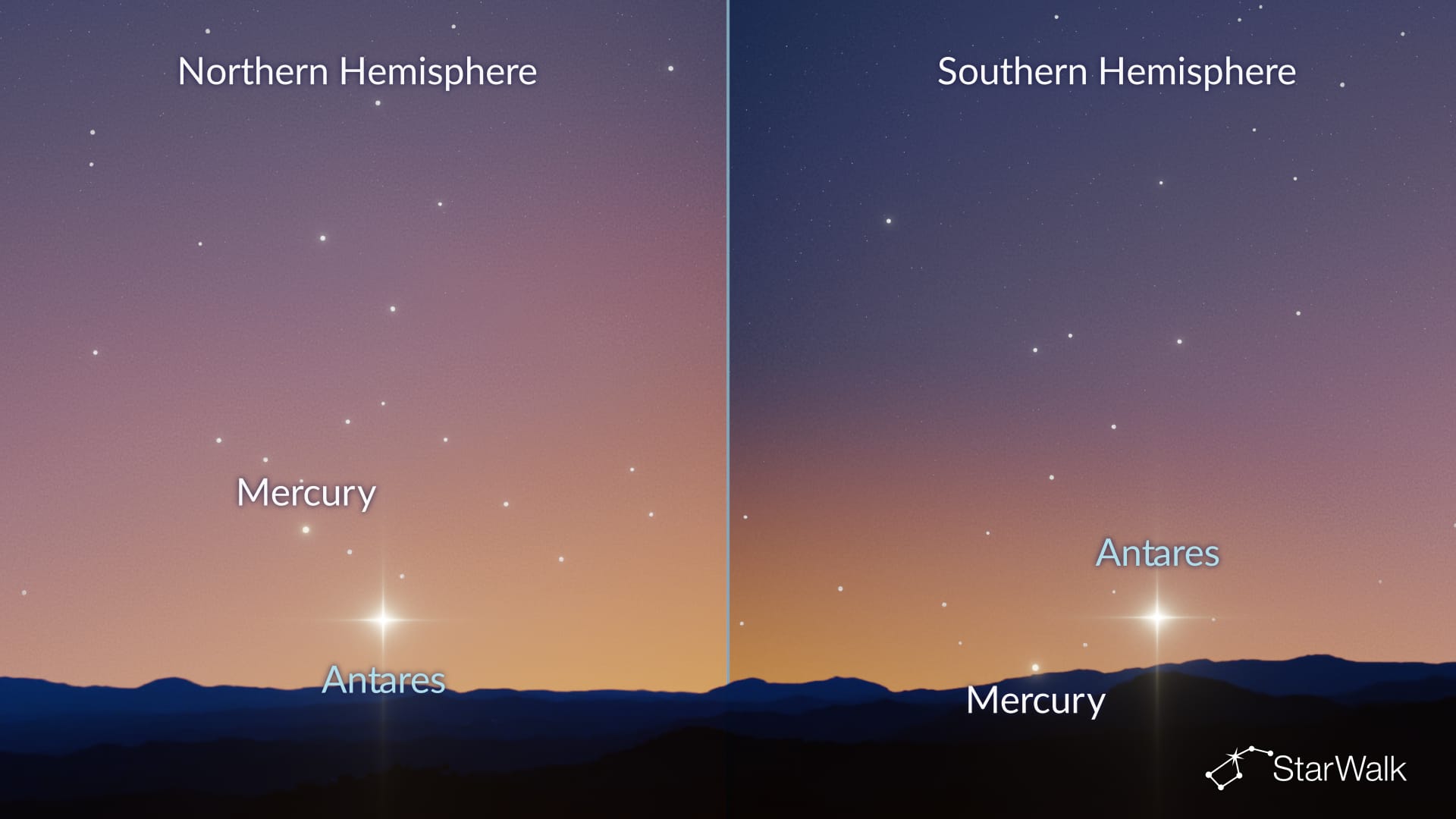
On December 12–13, Mercury will pass near Antares in the morning sky. Look for the pair low above the southeastern horizon before sunrise. Mercury will be much brighter than Antares, but both may be difficult to spot in the growing twilight, so choose a location with a clear, unobstructed horizon.
Depending on the location, the pair will be best seen on the morning of December 12 or 13 local time.
| City | Time zone | Best time (local) | Separation | Mercury altitude | Antares altitude | Sun altitude |
|---|---|---|---|---|---|---|
| Miami, USA | EST (UTC−5) | Dec 13, 6:33 AM | 4°41′ | 4° | 3° | −6° |
| Mexico City, Mexico | CST (UTC−6) | Dec 13, 6:37 AM | 4°42′ | 4° | 4° | −6° |
| Bogotá, Colombia | COT (UTC−5) | Dec 13, 5:32 AM | 4°41′ | 5° | 5° | −6° |
| Lima, Peru | PET (UTC−5) | Dec 12, 5:14 AM | 4°50′ | 4° | 5° | −6° |
| São Paulo, Brazil | BRT (UTC−3) | Dec 12, 4:47 AM | 4°53′ | 3° | 5° | −6° |
| Santiago, Chile | CLST (UTC−3) | Dec 12, 5:57 AM | 4°51′ | 2° | 4° | −6° |
- Best time is selected to balance darker skies, good altitude, and a close apparent separation between Mercury and Antares.
- Separation shows the apparent distance between Mercury and Antares in the sky.
- Altitude shows how high Mercury and Antares are above the horizon: 0° is on the horizon, 30° is about one-third of the way up the sky, and 90° is directly overhead.
- Sun altitude shows how far the Sun is below the horizon. At about −6°, civil twilight ends and the sky becomes noticeably darker.
- If the objects are below about 10°, choose a spot with a clear, unobstructed horizon.
What is Antares: key facts about the red star
- Official name: Antares, α Scorpii (Alpha Scorpii)
- Alternative names: Cor Scorpii, Kalb al Akrab, Scorpion's Heart, Vespertilio
- Catalog designations: 21 Scorpii, HD 148478, SAO 184415, HIP 80763
- Constellation: Scorpius
- Star type: class M1.5Iab-Ib red supergiant
- Right ascension: 16 h 29 m 24.46 s
- Declination: −26° 25′ 55.21″
- Apparent magnitude: from 0.6 to 1.6
- Mass: ≈ 12 solar masses
- Luminosity: 75,900 L☉
- Radius: ≈ 680 solar radii
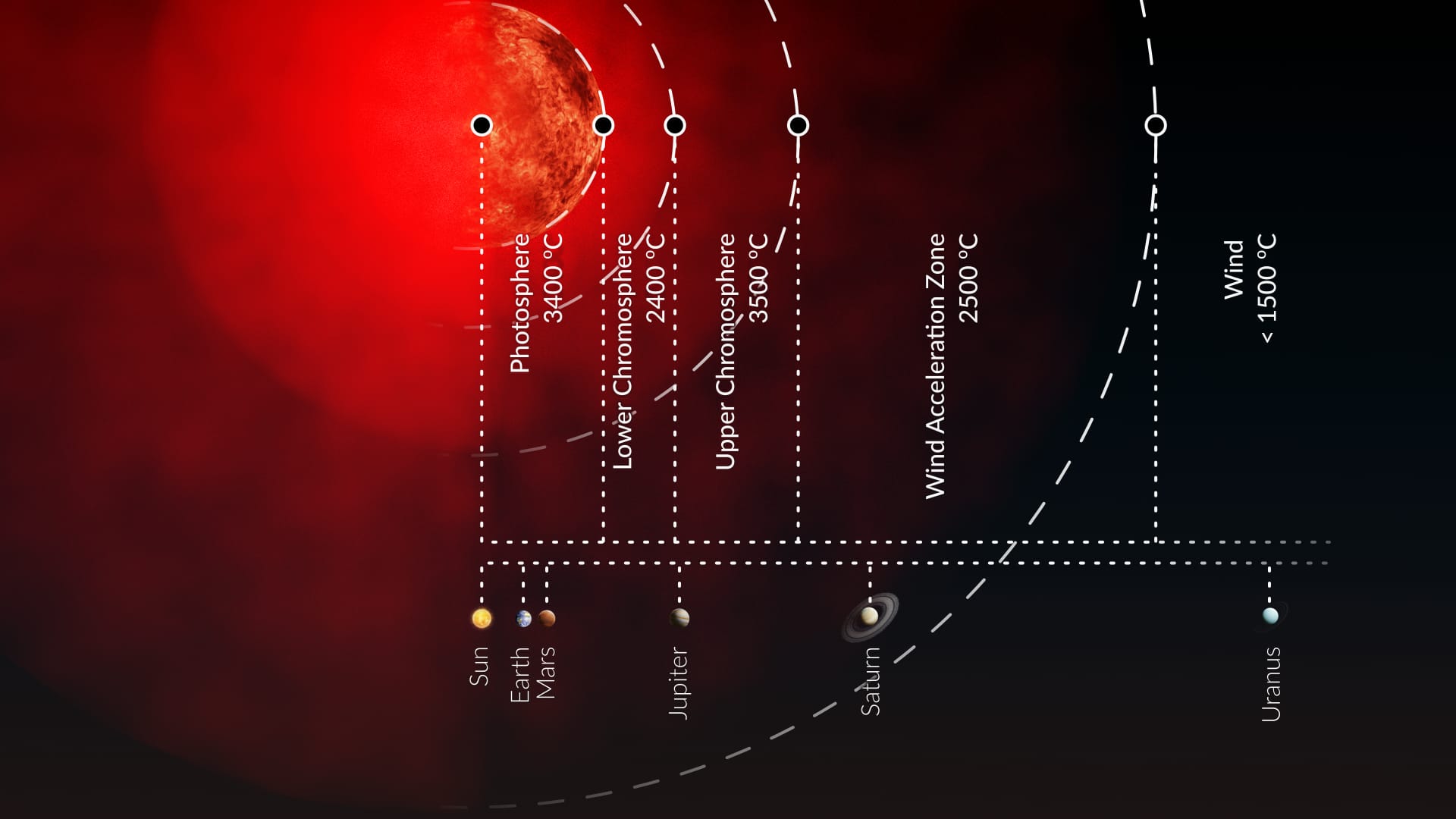
- Surface temperature: 3,400 °C (3,660 K)
- Distance from Earth: ≈ 550 light-years
- Rotation period: unknown
How big is Antares?
Antares is one of the largest known stars. It is about 700 times larger in diameter than the Sun. It's also tens of thousands of times brighter, although its surface temperature is quite low (about 1.5 times cooler than that of the Sun) — all because of the star’s enormous size. Antares is so large that if it were in the position of our Sun, it would extend beyond the orbit of Mars, and the star’s chromosphere would extend past Jupiter.
Antares color & brightness
Antares is classified as a spectral type M1.5Iab-Ib star. “M1.5” here signifies a temperature of around 3,400 °C (3,660 K). The stars of this temperature appear orange-red. “Iab” is the designation of an intermediate-size luminous supergiant, “Ib” being a less luminous supergiant. Antares lies between these classes.
Antares is a variable star, with its visual magnitude changing irregularly from 0.6 to 1.6. It’s the brightest star in the constellation Scorpius and the 15th-brightest star in the whole night sky.
The name “Antares” is of Greek origin and literally means "rival of Ares", that is, rival of Mars. The star is very similar in brightness and color to the Red Planet. And because of its proximity to the ecliptic, Antares occasionally meets Mars in the sky, making the celestial objects appear together like twin brothers.
More facts about Antares
The life cycle of Antares
Antares is a red supergiant, which means it is in the final stages of its life cycle. One day it will run out of fuel and collapse, possibly causing a supernova that we could see from Earth. We don't know exactly when it will happen, but stellar-evolution models suggest that Antares may have roughly another million years before it explodes as a supernova.
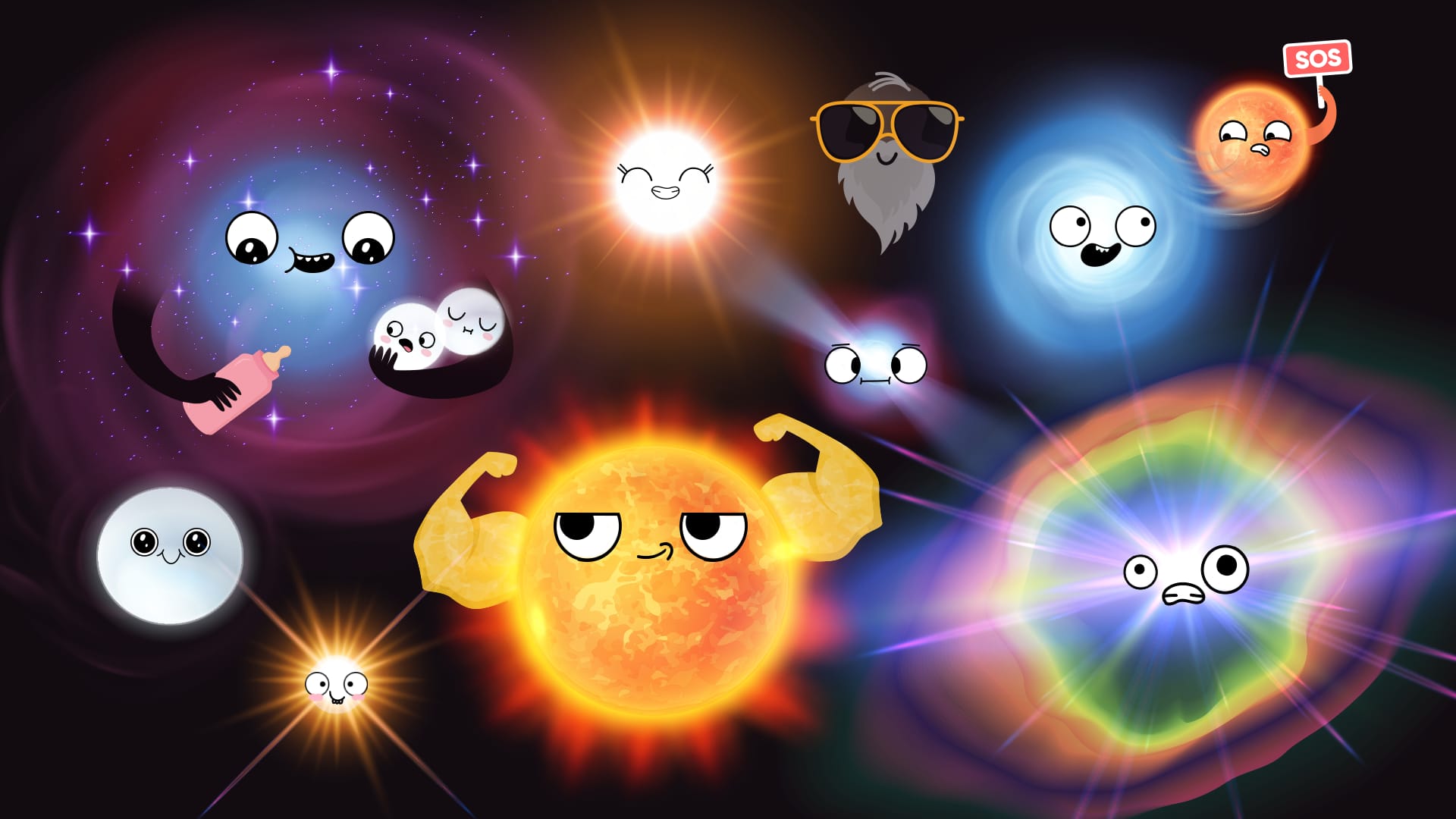
Want to know more about the life of stars? Here is our fun infographic – check it out!
Antares B: the lesser-known companion
Antares is, in fact, a binary star system consisting of the red supergiant Antares A and the blue-white main-sequence star Antares B. Antares B, situated approximately 2.5 arcseconds west of Antares A, was first observed in 1819 by astronomer Johann Tobias Bürg when Antares A was obscured by the Moon.
Antares B shines with a magnitude of 5.5 and has a blue-white hue, though it can appear greenish because of the color contrast with orange-red Antares A. To catch a glimpse of Antares B, use a telescope with an aperture of about 6-8 inches and high magnification under steady seeing.
Antares name in different cultures
Different cultures have different names for the star and its constellation. We already know the Greek name, which means "rival of Ares". In ancient China, Antares was called the Fire Star and was part of a dragon constellation. In Hawaiian stories, the constellation represents a fishing hook used by the hero Maui to lift the islands out of the sea. Antares (Lehua Kona) sits just above the point of the hook. In addition, both the Arabic and Latin names for the star translate to "heart of the scorpion".
Antares FAQ
Is Antares the brightest star in Scorpius?
Yes. Antares is the brightest star in the constellation Scorpius. Its apparent magnitude varies from 0.6 to 1.6 because Antares is a variable star, but it usually remains the most prominent star in the constellation.
Why is Antares red?
Antares appears red because it is a cool red supergiant. Its surface temperature is much lower than that of the Sun, so most of the visible light it emits is shifted toward the orange-red part of the spectrum.
Why is Antares called the “rival of Mars”?
The name Antares comes from Greek and means “rival of Ares” — Ares being the Greek counterpart of the Roman god Mars. The star earned this name because its reddish-orange color and brightness can make it look surprisingly similar to Mars. Since Antares lies close to the ecliptic, Mars occasionally passes near it in the sky, making the resemblance especially noticeable.
Is Antares bigger than the Sun?
Yes, by a huge margin. Antares is one of the largest stars visible to the naked eye. Its diameter is roughly 700 times that of the Sun. If it were placed at the center of our Solar System, its outer layers would extend beyond the orbit of Mars.
How far is Antares from Earth?
Antares is about 550 light-years away from Earth. Because distance estimates for very large stars can have uncertainties, different sources may give slightly different values.
What is the best time to see Antares?
Antares is best seen in July, when Scorpius is one of the most prominent constellations in the night sky. It is especially well placed for observers in the Southern Hemisphere, where it rises much higher above the horizon. Learn more in our guide to the best constellations to see in July.
Antares, the rival of Mars: Conclusion
Antares is a bright orange-red star in the constellation Scorpius. It’s best seen from the Southern Hemisphere but can also be spotted in the Northern Hemisphere. To easily locate Antares, try the free Star Walk 2 app or observe it near the Moon or planets.
Wishing you clear skies and happy stargazing!