Lunar Eclipse in August 2026: How to See Red Moon Tonight
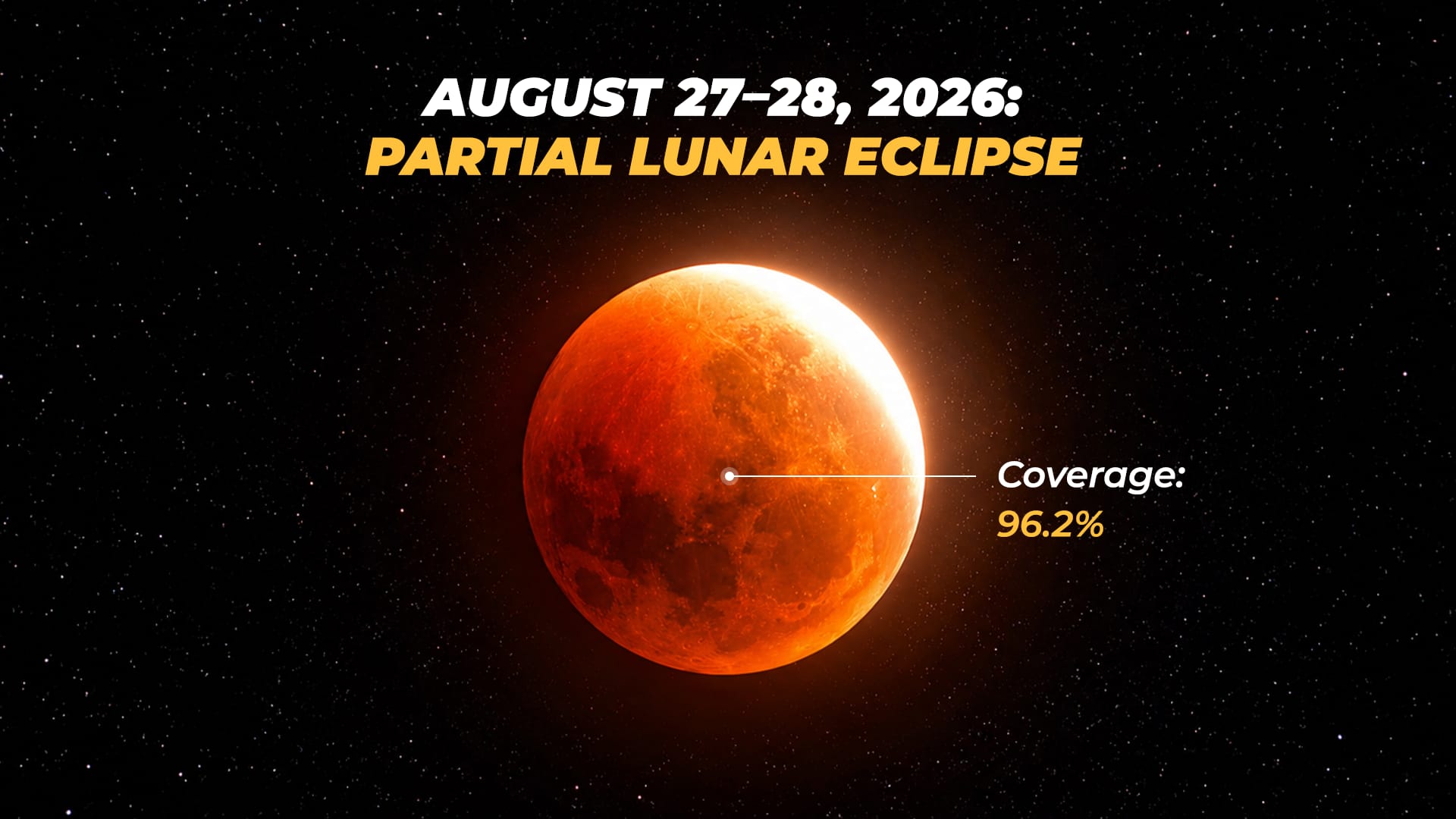
Tonight is the August 28, 2026 partial lunar eclipse — beginning on August 27 in the Americas — and it’s set to be the most dramatic lunar eclipse until late 2028. On August 27–28, up to 96% of the Moon will slip into Earth’s dark shadow, creating an impressive “almost Blood Moon.”
The eclipse will reach its maximum at 04:12 UTC on August 28 (5:12 a.m. BST and 12:12 a.m. EDT on August 28; 9:12 p.m. PDT on August 27).
Use Sky Tonight to check the exact eclipse times, visibility, and Moon position for your location.
Contents
- Partial lunar eclipse 2026: time, date, and key facts
- August 2026 lunar eclipse map: visibility around the world
- What time does the August 2026 lunar eclipse start? Timeline and stages
- Blood Moon 2026: will the August 28 lunar eclipse turn the Moon red?
- What is a lunar eclipse, and what makes this one partial?
- August 2026 lunar eclipse in the USA: times, map, and visibility
- Lunar eclipse August 2026: map & time for the UK
- August 2026 lunar eclipse in Europe: visibility and local times
- August 2026 lunar eclipse in South America: map, time, and visibility
- August 2026 lunar eclipse in Africa: map, time, and visibility
- Can I see the lunar eclipse from my location?
- Viewing August 2026 lunar eclipse
- How to photograph the August 2026 partial lunar eclipse
- What will be near the Moon during the eclipse in August 2026?
Partial lunar eclipse in August 2026: frequently asked questions
- When is the next lunar eclipse?
- What time is the August 2026 lunar eclipse?
- Is the August 2026 lunar eclipse total or partial?
- When is the next Blood Moon?
- Why is the August 2026 lunar eclipse the best until late 2028?
- Will the August 2026 lunar eclipse be visible in the United States?
- What time is the eclipse in New York?
- Will the August 2026 lunar eclipse be visible in the UK?
- What time is the eclipse in London?
- Will the August 2026 lunar eclipse be visible in South America?
- Will the August 2026 lunar eclipse be visible in South Africa?
- What time is Chandra Grahan in August 2026?
- How long will the August 2026 lunar eclipse last?
- Will the August 2026 lunar eclipse be a Blood Moon?
- Will the Moon turn red during the lunar eclipse?
- Do I need eclipse glasses to watch the lunar eclipse?
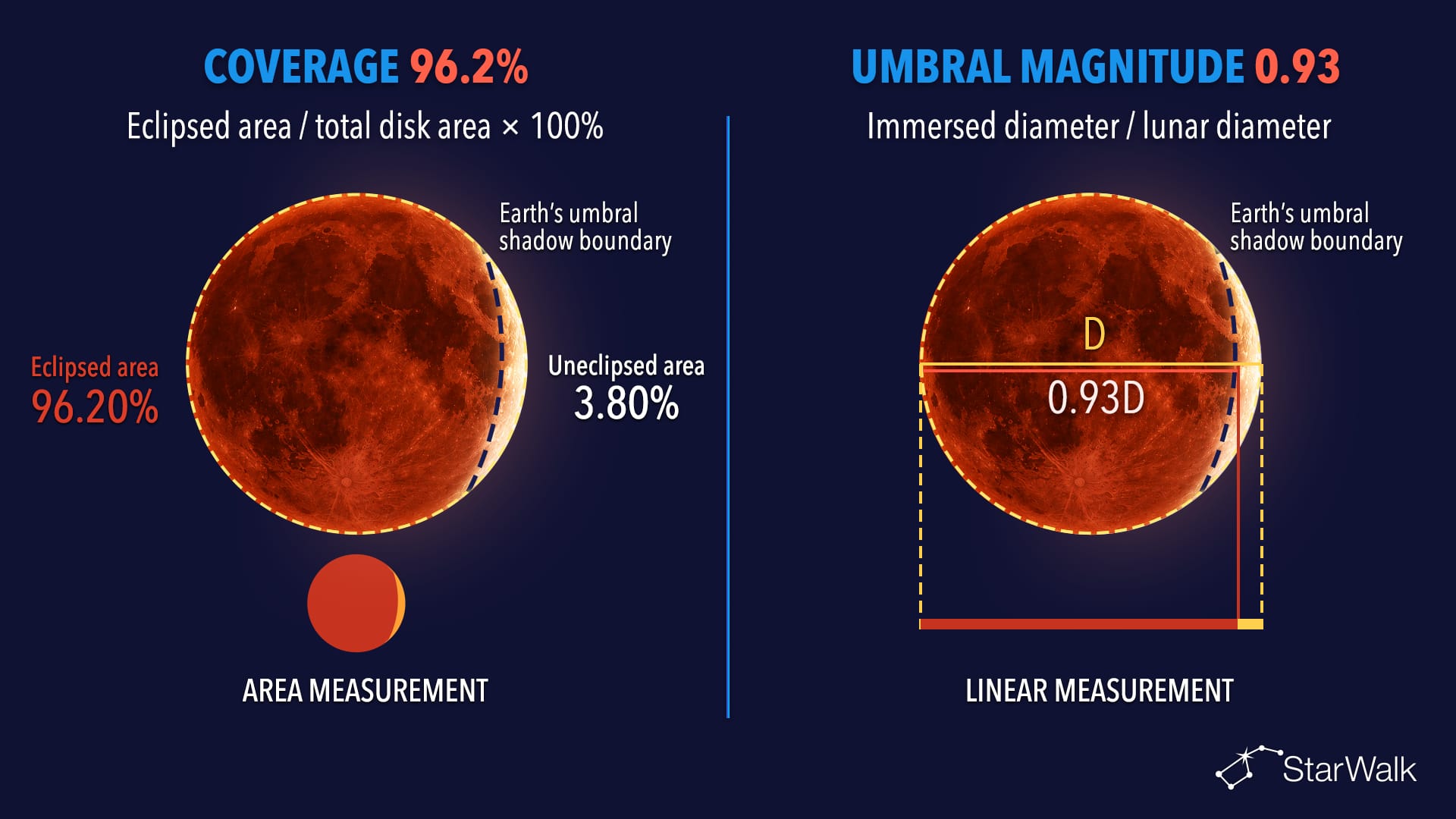
- Why is the eclipse 96.2% if the magnitude is 0.93?
- Partial lunar eclipse in August 2026: what to remember
Partial lunar eclipse 2026: time, date, and key facts
- Date: August 27–28, 2026
- Date in the US: Thursday evening, August 27, into early Friday, August 28
- Date in the UK: Early Friday morning, August 28
- Type: Deep partial lunar eclipse — not a total lunar eclipse
- Maximum eclipse time: August 28 at 04:12 UTC
- Eclipse duration: 5 hours 38 minutes
- Partial phase duration: 3 hours 18 minutes
- Coverage: 96.2%
- Umbral magnitude: ~0.93
- Will it be a Blood Moon? The eclipsed part of the Moon may look reddish or copper-colored, but this will not be a total lunar eclipse
- Eye safety: no eclipse glasses or special filters are needed
So, is there a lunar eclipse tonight? Yes. In the United States, the eclipse is visible on Thursday night, August 27, and lasts until just after midnight even on the West Coast. In the UK, it takes place before dawn on Friday, August 28.
| Region | Visibility | What to expect |
|---|---|---|
| North & Central America | Very good across most areas | Maximum visible from most locations; some western areas may miss the beginning |
| South America | Excellent across most of the continent | The entire eclipse visible with the Moon high in the sky |
| UK & Europe | Visible before moonset | Best in western Europe; the Moon will be low in the western sky |
| Africa | Best in western Africa | Conditions worsen farther east as the Moon approaches moonset |
| Asia & Australia | Mostly not visible | A brief penumbral phase may be visible from limited parts of western Asia and the Pacific; Australia misses the eclipse |
August 2026 lunar eclipse map: visibility around the world
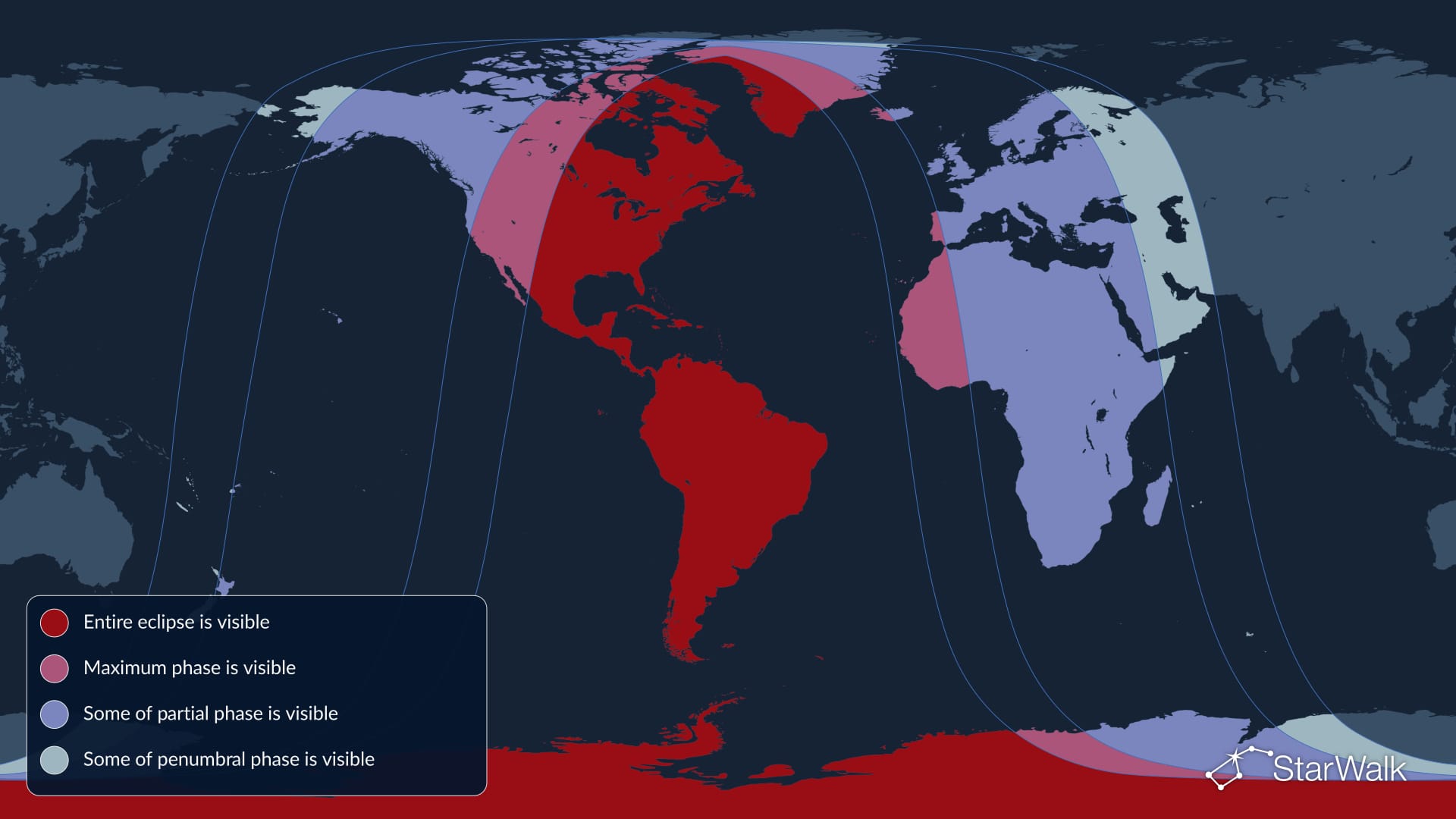
Does the August 2026 lunar eclipse have a path?
A lunar eclipse does not follow a narrow path like a solar eclipse. It can be seen from anywhere the Moon is above the horizon during the event.
- The entire eclipse: much of the central and eastern US, eastern Canada, Central America, South America, parts of Greenland and Antarctica
- Moonrise during the eclipse: western North America, western Canada, and parts of the Pacific
- Partial eclipse before moonset: much of Africa, southeastern Europe, Turkey, the eastern Mediterranean, parts of the Middle East, and the far west of Russia
- Penumbral phase only: parts of western and central Asia, including Georgia, Azerbaijan, Kazakhstan, and some western regions of Russia
- Not visible: Australia and much of Asia, including India, China, Southeast Asia, and most of Russia
In other words, the “lunar eclipse path” on the map is really a broad visibility area: everyone on the night side of Earth can potentially see the eclipse if the Moon is above their local horizon and the sky is clear.
What time does the August 2026 lunar eclipse start? Timeline and stages
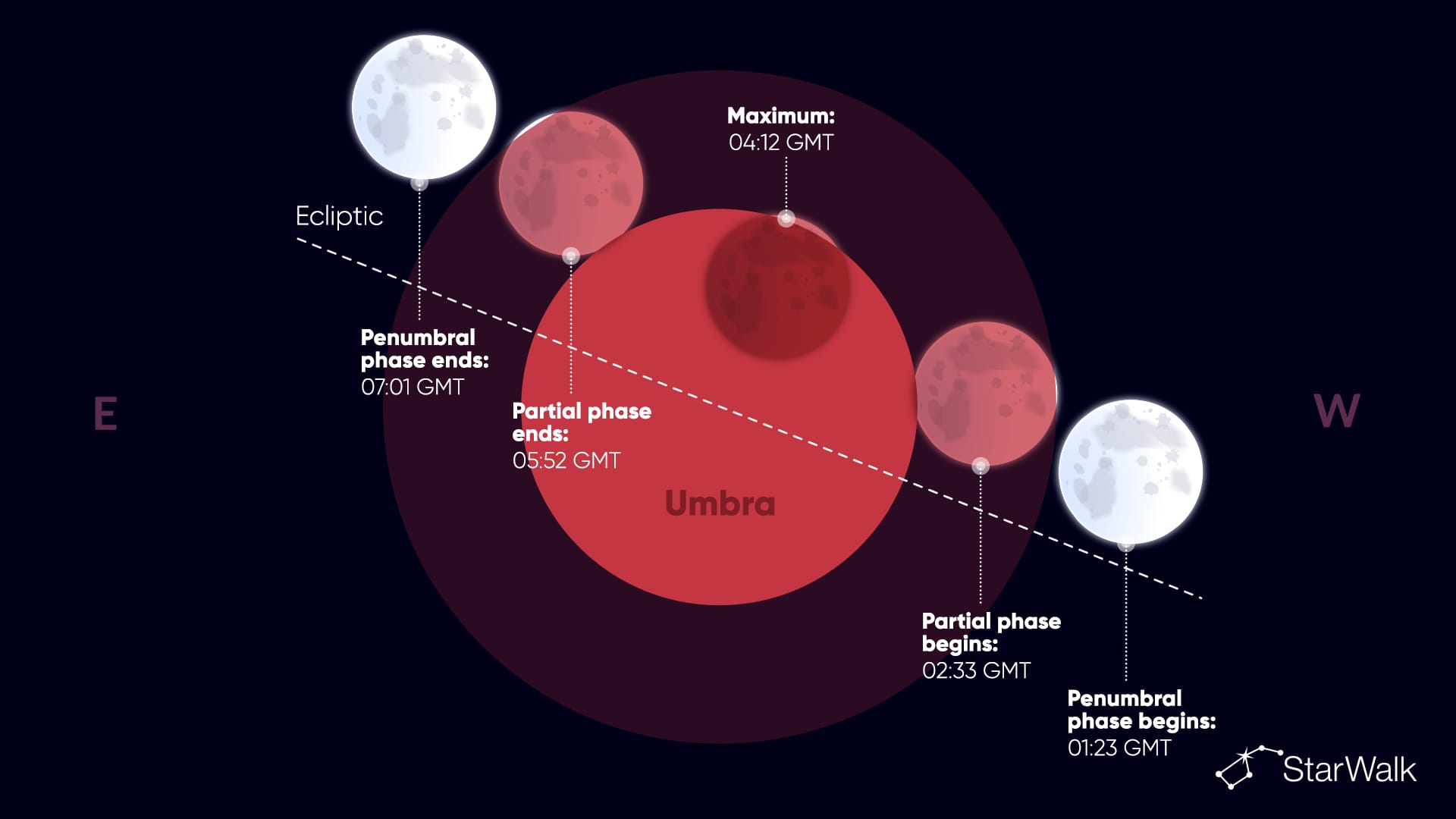
These are the five stages of the August 2026 partial lunar eclipse, from the first subtle penumbral shading to the moment the Moon completely leaves Earth’s outer shadow.
The eclipse will last for 5 hours 38 minutes, from 01:23 to 07:01 UTC on August 28. The partial phase begins at 02:33 UTC, peaks at 04:12 UTC, and ends at 05:52 UTC.
| Time | Eclipse phase | What happens |
|---|---|---|
| 01:23 UTC | Penumbral eclipse begins | The Moon enters Earth’s faint outer shadow; the dimming is subtle. |
| 02:33 UTC | Partial eclipse begins | Earth’s dark umbral shadow begins to cover the Moon. |
| 04:12 UTC | Maximum eclipse | About 96% of the lunar disk is covered. |
| 05:52 UTC | Partial eclipse ends | Earth’s dark shadow completely leaves the lunar disk. |
| 07:01 UTC | Penumbral eclipse ends | The Moon leaves Earth’s outer shadow and the eclipse ends. |
Blood Moon 2026: will the August 28 lunar eclipse turn the Moon red?
The event is often described as the Blood Moon of August 2026, but it is not a total lunar eclipse. At maximum, Earth’s dark umbral shadow will cover about 96.2% of the Moon’s visible surface, while a small bright edge remains outside the umbra.
Most of the eclipsed part may still look dark red, brown, or copper-colored. This happens because sunlight passes through Earth’s atmosphere before reaching the Moon; the atmosphere filters out much of the blue light and bends redder light into Earth’s shadow.
So, will there be a Blood Moon tonight? The Moon may look almost like one, but this is still a deep partial lunar eclipse, not a total one. The next total lunar eclipse — and the next true Blood Moon — will occur on December 31, 2028.
What is a lunar eclipse, and what makes this one partial?
A lunar eclipse occurs when the Sun, Earth, and Moon align so that the Moon passes through Earth’s shadow. The faint outer part of the shadow is called the penumbra, while the darker central part is the umbra.
During a total lunar eclipse, the entire Moon enters the umbra. During a partial lunar eclipse, only part of the lunar disk does. On August 28, about 93% of the Moon’s diameter will be inside the umbra. This corresponds to 96.2% of its visible area, which is why the eclipse will look almost total without technically becoming total.
August 2026 lunar eclipse in the USA: times, map, and visibility
The United States will have some of the best viewing conditions for the August 2026 lunar eclipse. Across much of the central and eastern US, the Moon will remain above the horizon for the entire event.
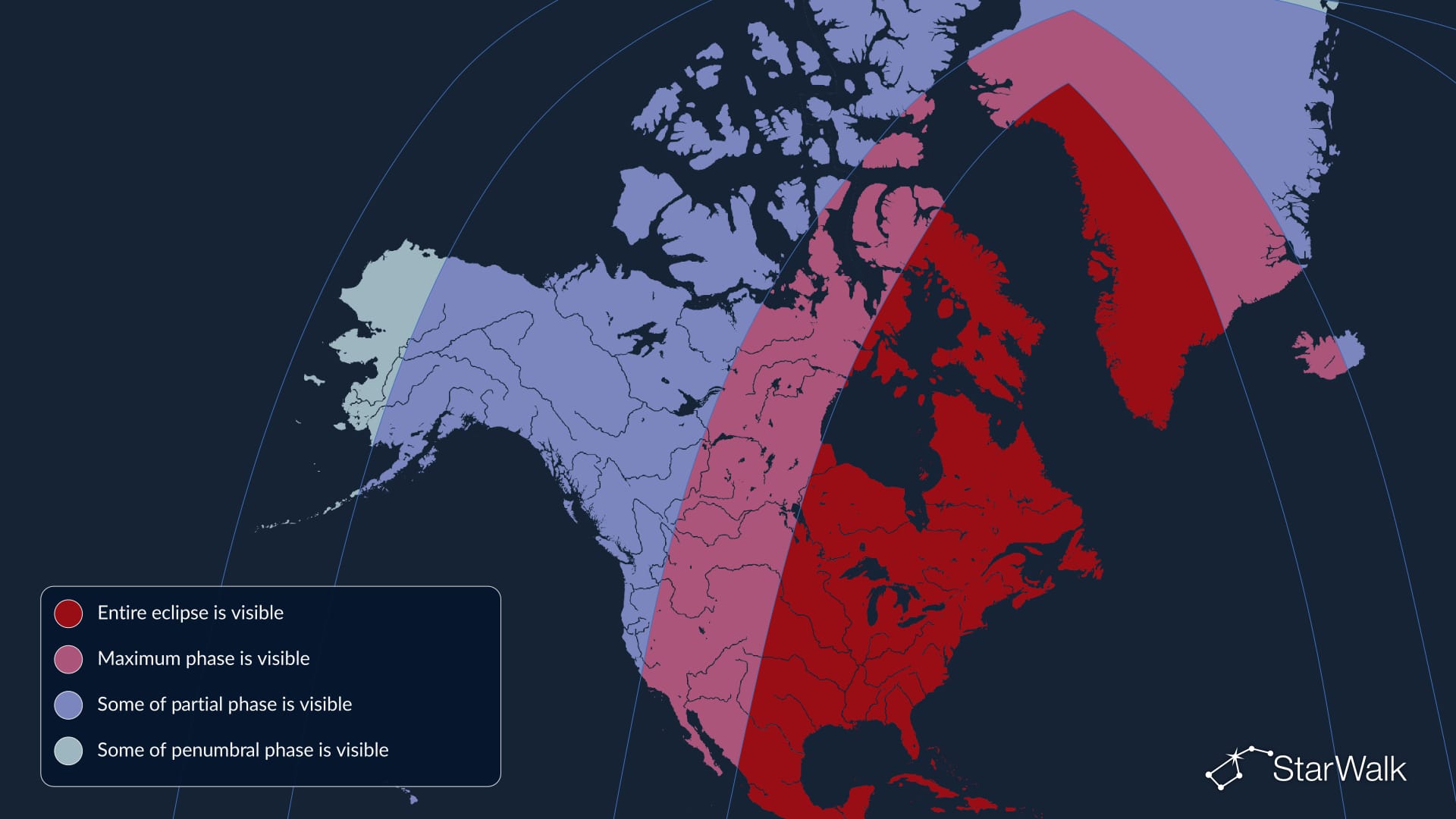
Where is the August 2026 lunar eclipse visible in the United States?
-
The entire eclipse will be visible across much of the central and eastern United States, including New York, Chicago, Miami, Houston, and Dallas. Observers will be able to follow the Moon from the subtle penumbral dimming through the deep partial phase and back to its normal appearance.
-
The maximum eclipse will be visible from much of the western United States, including Denver, Los Angeles, San Francisco, Las Vegas, and Seattle. The Moon may rise after the eclipse begins, so some viewers may miss the start of the event.
-
More limited views are expected in Alaska, Hawaii, and the far western Pacific region. In some locations, the Moon will rise too late to see the maximum, leaving only the later partial or penumbral phases visible.
At maximum, about 96% of the lunar disk will be inside Earth’s dark umbral shadow. Most of the Moon may appear dark red, brown, or copper-colored, with a small bright edge remaining outside the shadow.
What time is the lunar eclipse tonight in the USA?
The eclipse reaches maximum at 12:12 a.m. EDT on August 28, or at 11:12 p.m. CDT, 10:12 p.m. MDT, and 9:12 p.m. PDT on August 27. The partial phase begins at 10:33 p.m. EDT, 9:33 p.m. CDT, 8:33 p.m. MDT, or 7:33 p.m. PDT.
The table shows the locally visible part of the eclipse. Moonrise or moonset is noted where it shortens the visibility of a particular eclipse phase.
| City | Time zone | Start | Maximum | End | Moon altitude at maximum |
|---|---|---|---|---|---|
| New York | EDT | Aug 27, 9:23 p.m. | Aug 28, 12:12 a.m. | Aug 28, 3:01 a.m. | 38.3° |
| Chicago | CDT | Aug 27, 8:23 p.m. | Aug 27, 11:12 p.m. | Aug 28, 2:01 a.m. | 33.3° |
| Miami | EDT | Aug 27, 9:23 p.m. | Aug 28, 12:12 a.m. | Aug 28, 3:01 a.m. | 50.6° |
| Houston | CDT | Aug 27, 8:23 p.m. | Aug 27, 11:12 p.m. | Aug 28, 2:01 a.m. | 39.4° |
| Dallas | CDT | Aug 27, 8:23 p.m. | Aug 27, 11:12 p.m. | Aug 28, 2:01 a.m. | 36.3° |
| Denver | MDT | Aug 27, 7:29 p.m. (moonrise) | Aug 27, 10:12 p.m. | Aug 28, 1:01 a.m. | 26.7° |
| Los Angeles | PDT | Aug 27, 7:17 p.m. (moonrise) | Aug 27, 9:12 p.m. | Aug 28, 12:01 a.m. | 21.3° |
| San Francisco | PDT | Aug 27, 7:38 p.m. (moonrise) | Aug 27, 9:12 p.m. | Aug 28, 12:01 a.m. | 16.6° |
| Seattle | PDT | Aug 27, 7:51 p.m. (moonrise) | Aug 27, 9:12 p.m. | Aug 28, 12:01 a.m. | 11.9° |
Lunar eclipse August 2026: map & time for the UK
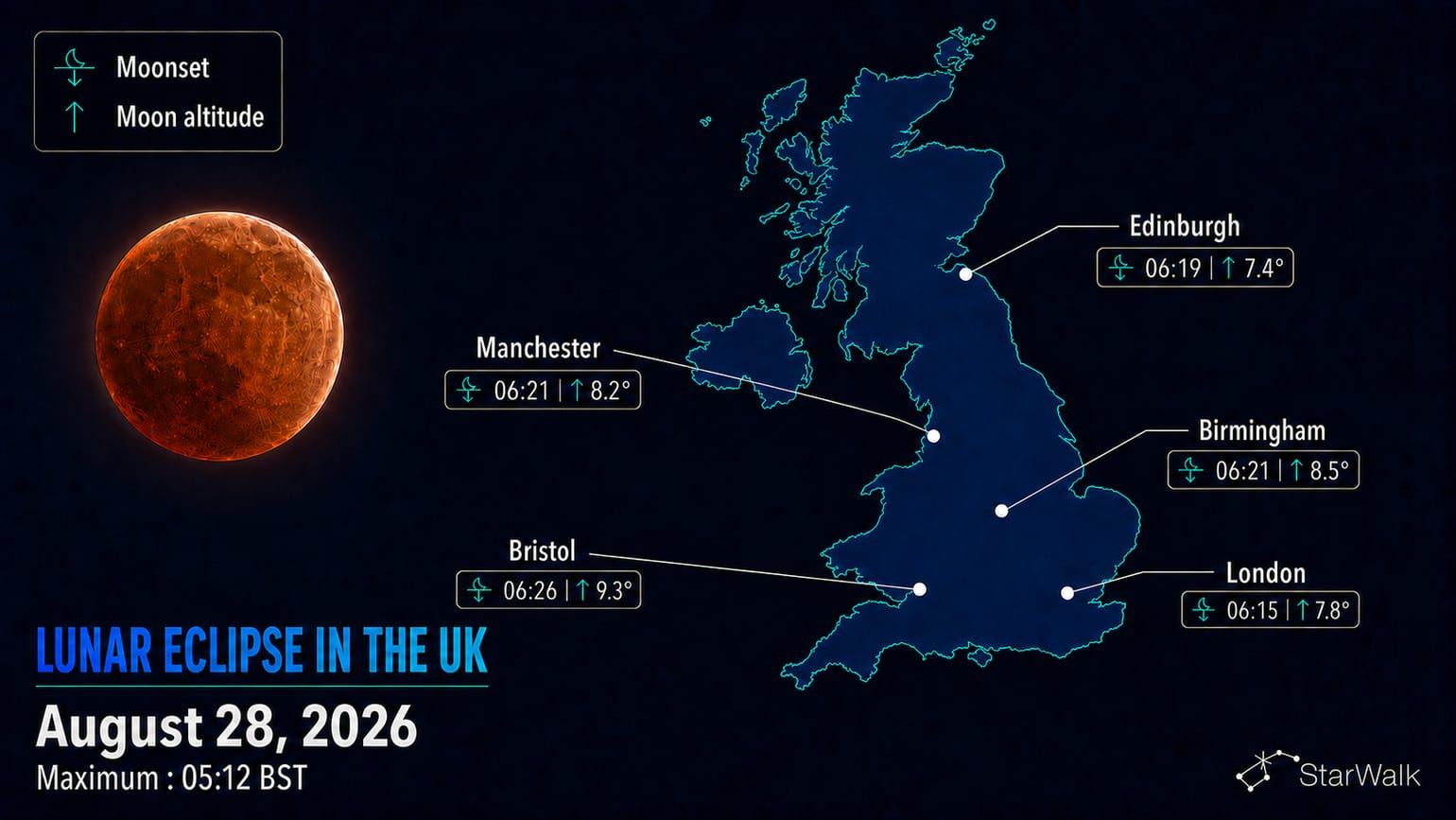
The next lunar eclipse visible in the UK is the deep partial eclipse before dawn on August 28. Maximum occurs at 5:12 a.m. BST, when the Moon will be only about 7–9° above the western horizon in many British cities. A low, unobstructed view to the west will be essential.
Where will the August 2026 lunar eclipse be visible in the UK?
The maximum eclipse will be visible across the UK, including London, Bristol, Birmingham, Manchester, and Edinburgh. However, the Moon will be low and descending toward moonset, so buildings, hills, trees, and haze may easily block the view.
What time is the lunar eclipse today in the UK?
Across the UK, the penumbral eclipse begins at 2:23 a.m. BST, the clearly visible partial phase starts at 3:33 a.m., and maximum occurs at 5:12 a.m. The Moon will set before the partial phase ends, so the final stages will not be visible.
The table shows the locally visible part of the eclipse. Moonset is noted where it shortens the visibility of the event.
| City | Time zone | Start | Maximum | End | Moon altitude at maximum |
|---|---|---|---|---|---|
| London | BST | Aug 28, 2:23 a.m. | Aug 28, 5:12 a.m. | Aug 28, 6:15 a.m. (moonset) | 7.8° |
| Bristol | BST | Aug 28, 2:23 a.m. | Aug 28, 5:12 a.m. | Aug 28, 6:26 a.m. (moonset) | 9.3° |
| Birmingham | BST | Aug 28, 2:23 a.m. | Aug 28, 5:12 a.m. | Aug 28, 6:21 a.m. (moonset) | 8.5° |
| Manchester | BST | Aug 28, 2:23 a.m. | Aug 28, 5:12 a.m. | Aug 28, 6:21 a.m. (moonset) | 8.2° |
| Edinburgh | BST | Aug 28, 2:23 a.m. | Aug 28, 5:12 a.m. | Aug 28, 6:19 a.m. (moonset) | 7.4° |
Will the August 2026 eclipse look like a Blood Moon in the UK?
It may. Near maximum, most of the Moon could appear dark red or copper-colored, but low altitude, morning twilight, and haze may make the color less vivid. Technically, it is not a true Blood Moon because a small part of the lunar disk remains outside Earth’s umbra.
August 2026 lunar eclipse in Europe: visibility and local times
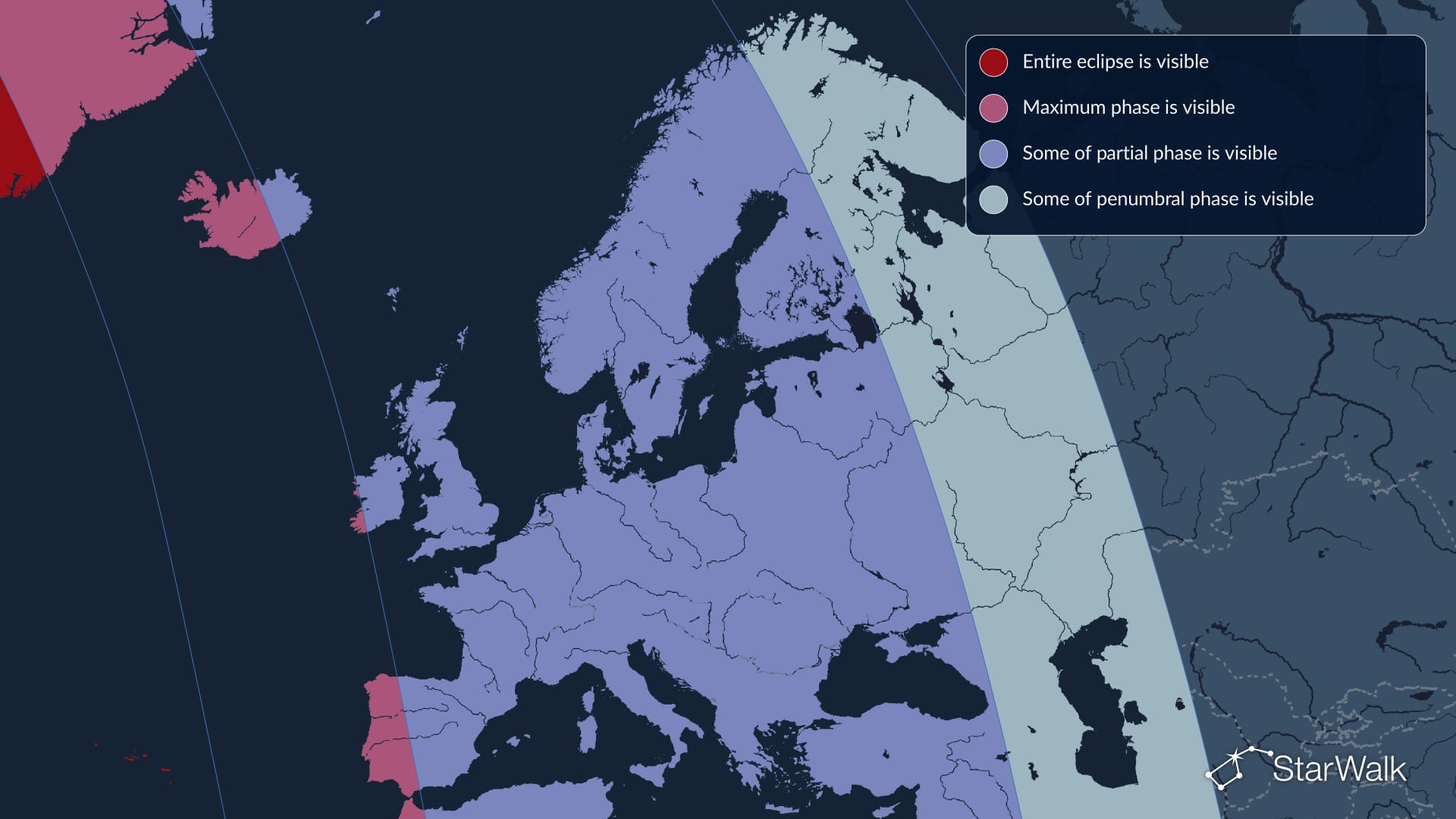
The eclipse will be visible from much of Europe during the early morning of August 28. The best viewing conditions will be in the UK, Ireland, Portugal, Spain, and other parts of western Europe, where the Moon will remain higher above the horizon for longer.
For observers in Europe, the Moon will descend toward the western horizon as the eclipse progresses.
Where will the August 2026 lunar eclipse be visible in Europe?
-
The deepest phases will be visible in western Europe, including London, Dublin, Lisbon, Madrid, Paris, and Reykjavík. The Moon will be low in the western sky, but the maximum may still be visible.
-
Central Europe will see the eclipse close to moonset, including cities such as Amsterdam, Brussels, Zurich, and Milan. Buildings, hills, trees, and haze may easily block the view.
-
Farther east, including Berlin, Vienna, Prague, Warsaw, Budapest, Bucharest, Vilnius, Riga, and Tallinn, the Moon will be extremely low or may set before the deepest phase.
The eclipsed part of the Moon may appear reddish or copper-colored, but the color could be subtle because the Moon will be close to the horizon.
What time is the lunar eclipse in Europe?
The table shows the locally visible part of the eclipse. Moonrise or moonset is noted where it shortens the visibility of a particular eclipse phase.
| City, country | Time zone | Start | Maximum | End | Moon altitude at maximum |
|---|---|---|---|---|---|
| Dublin, Ireland | IST | Aug 28, 2:23 a.m. | Aug 28, 5:12 a.m. | Aug 28, 6:38 a.m. (moonset) | 10.3° |
| Lisbon, Portugal | WEST | Aug 28, 2:23 a.m. | Aug 28, 5:12 a.m. | Aug 28, 7:10 a.m. (moonset) | 19.7° |
| Madrid, Spain | CEST | Aug 28, 3:23 a.m. | Aug 28, 6:12 a.m. | Aug 28, 7:46 a.m. (moonset) | 15.2° |
| Paris, France | CEST | Aug 28, 3:23 a.m. | Aug 28, 6:12 a.m. | Aug 28, 7:09 a.m. (moonset) | 7.6° |
| Berlin, Germany | CEST | Aug 28, 3:23 a.m. | Aug 28, 6:12 a.m. | Aug 28, 6:16 a.m. (moonset) | 0.3° |
August 2026 lunar eclipse in South America: map, time, and visibility
South America will have excellent viewing conditions. Across most of the continent, the Moon will remain above the horizon for the entire eclipse and will be high in the sky during maximum.
Observers will be able to follow the eclipse from the first subtle penumbral dimming to the end of the event.
Where will the August 2026 lunar eclipse be visible in South America?
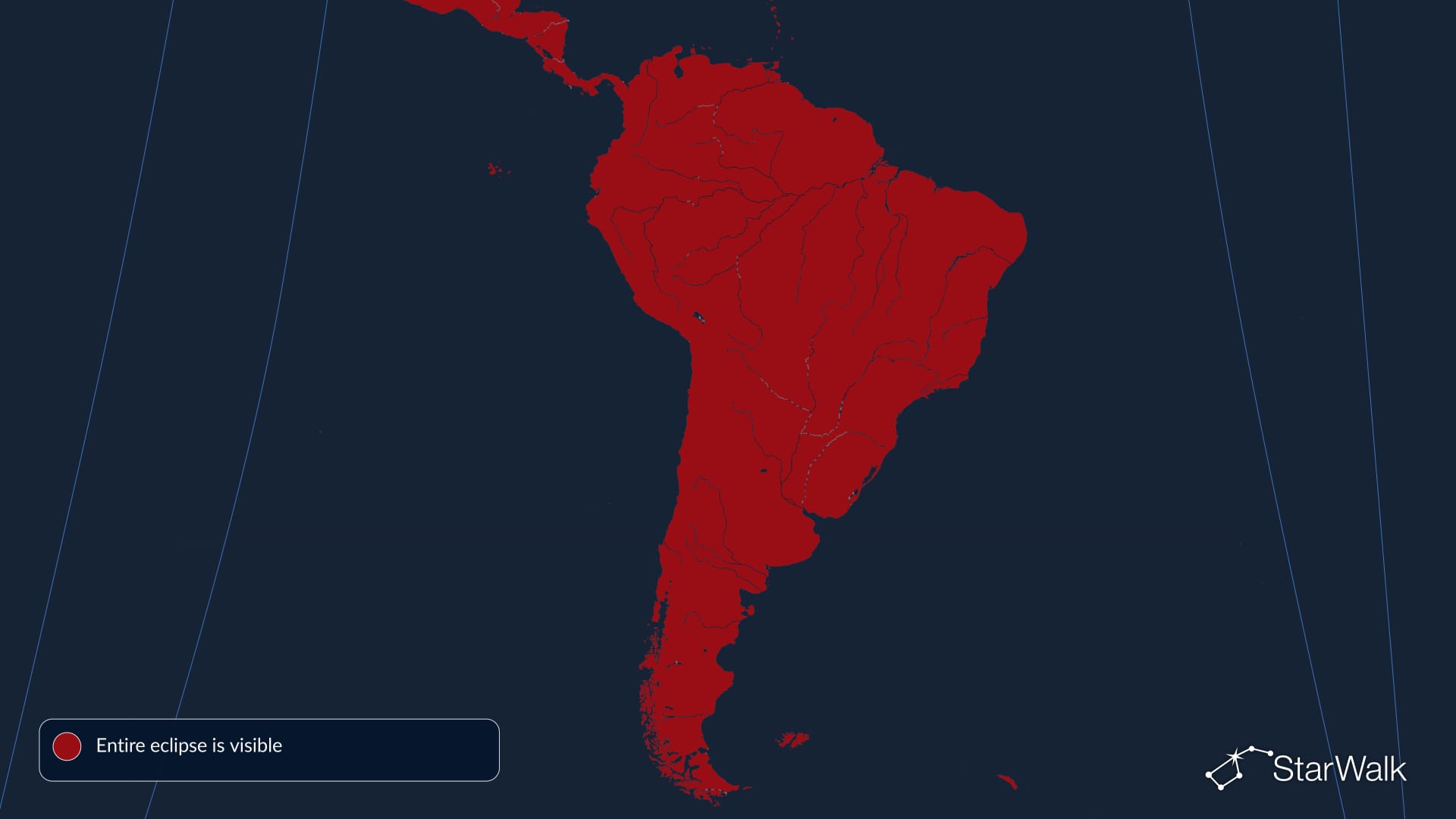
The entire eclipse will be visible across most of South America, including Buenos Aires, Santiago, Montevideo, São Paulo, Rio de Janeiro, Brasília, Lima, Bogotá, Quito, Caracas, La Paz, and Asunción.
Observers will first notice a slight dimming during the penumbral phase. A dark “bite” will then begin to grow across the Moon as it enters Earth’s umbra. At maximum, about 96% of the disk will be covered.
What time is the August 2026 lunar eclipse in South America?
The table shows the locally visible part of the eclipse. Moonrise or moonset is noted where it shortens the visibility of a particular eclipse phase.
| City, country | Time zone | Start | Maximum | End | Moon altitude at maximum |
|---|---|---|---|---|---|
| Buenos Aires, Argentina | UTC−3 | Aug 27, 10:23 p.m. | Aug 28, 1:12 a.m. | Aug 28, 4:01 a.m. | 63.9° |
| Santiago, Chile | UTC−4 | Aug 27, 9:23 p.m. | Aug 28, 12:12 a.m. | Aug 28, 3:01 a.m. | 64.5° |
| Lima, Peru | UTC−5 | Aug 27, 8:23 p.m. | Aug 27, 11:12 p.m. | Aug 28, 2:01 a.m. | 75.8° |
| Bogotá, Colombia | UTC−5 | Aug 27, 8:23 p.m. | Aug 27, 11:12 p.m. | Aug 28, 2:01 a.m. | 72.0° |
| Caracas, Venezuela | UTC−4 | Aug 27, 9:23 p.m. | Aug 28, 12:12 a.m. | Aug 28, 3:01 a.m. | 69.5° |
August 2026 lunar eclipse in Africa: map, time, and visibility
The eclipse will be visible from much of Africa before sunrise on August 28. Western and northwestern Africa will have the best conditions, while observers farther east may lose the Moon below the horizon before maximum.
Where will the August 2026 lunar eclipse be visible in Africa?
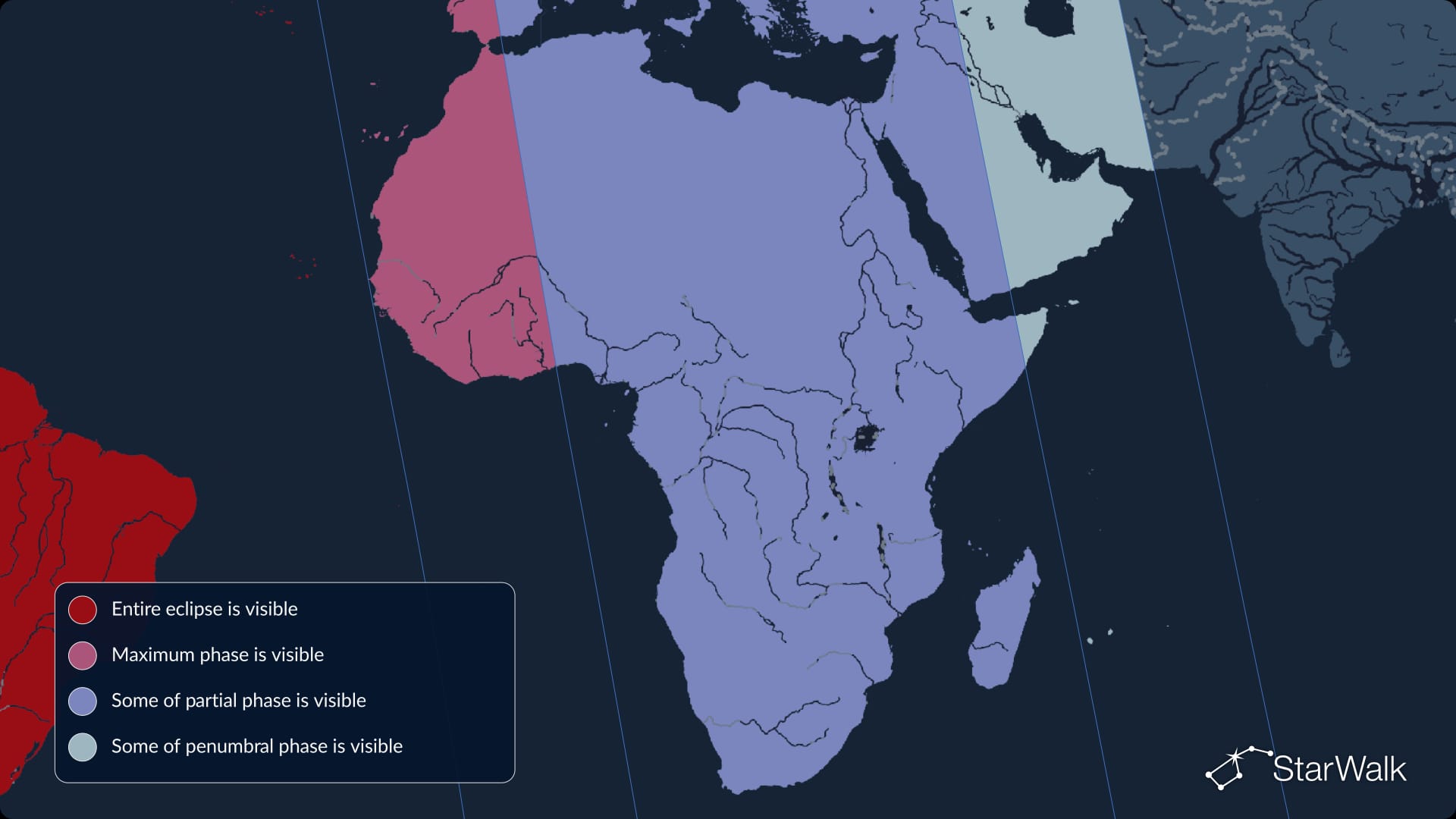
- Western Africa will have the best conditions, with the Moon still relatively high during maximum.
- Central and southern Africa will see the Moon lower in the western sky.
- Eastern and northeastern Africa may see only the earlier phases because the Moon will set before or near maximum.
What time is the August 2026 lunar eclipse in Africa?
The table shows the locally visible part of the eclipse. Moonrise or moonset is noted where it shortens the visibility of a particular eclipse phase.
| City, country | Time zone | Start | Maximum | End | Moon altitude at maximum |
|---|---|---|---|---|---|
| Dakar, Senegal | UTC | Aug 28, 1:23 a.m. | Aug 28, 4:12 a.m. | Aug 28, 7:01 a.m. | 38.0° |
| Casablanca, Morocco | UTC+1 | Aug 28, 2:23 a.m. | Aug 28, 5:12 a.m. | Aug 28, 7:09 a.m. (moonset) | 21.2° |
| Lagos, Nigeria | UTC+1 | Aug 28, 2:23 a.m. | Aug 28, 5:12 a.m. | Aug 28, 6:44 a.m. (moonset) | 21.0° |
| Cape Town, South Africa | SAST | Aug 28, 3:23 a.m. | Aug 28, 6:12 a.m. | Aug 28, 7:12 a.m. (moonset) | 11.3° |
| Cairo, Egypt | EEST | Aug 28, 4:23 a.m. | Not visible | Aug 28, 6:31 a.m. (moonset) | Below the horizon |
Can I see the lunar eclipse from my location?
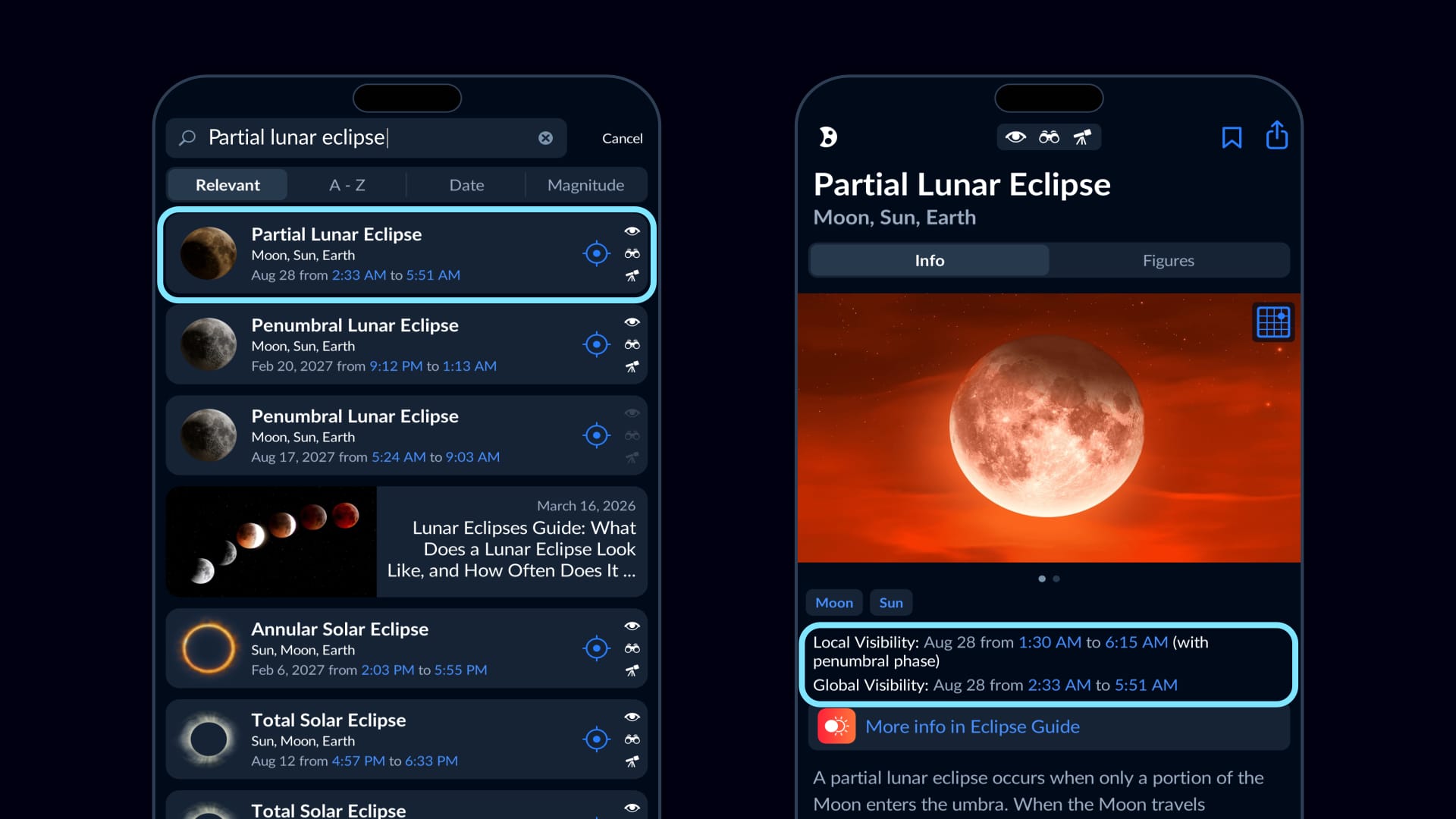
The easiest way to check whether the eclipse will be visible from your exact location is to use the Sky Tonight app. It shows local eclipse times, visibility, the Moon’s position in your sky, and a detailed visibility map.
- Open the app and enter “lunar eclipse” in the search field.
- Select the August 2026 partial lunar eclipse.
- Check the local visibility period shown below the event image.
- Open the visibility map to see which phases can be observed from your region.
- Use the sky map to find where the Moon will appear.
This is particularly useful in locations where the Moon rises or sets during the eclipse.
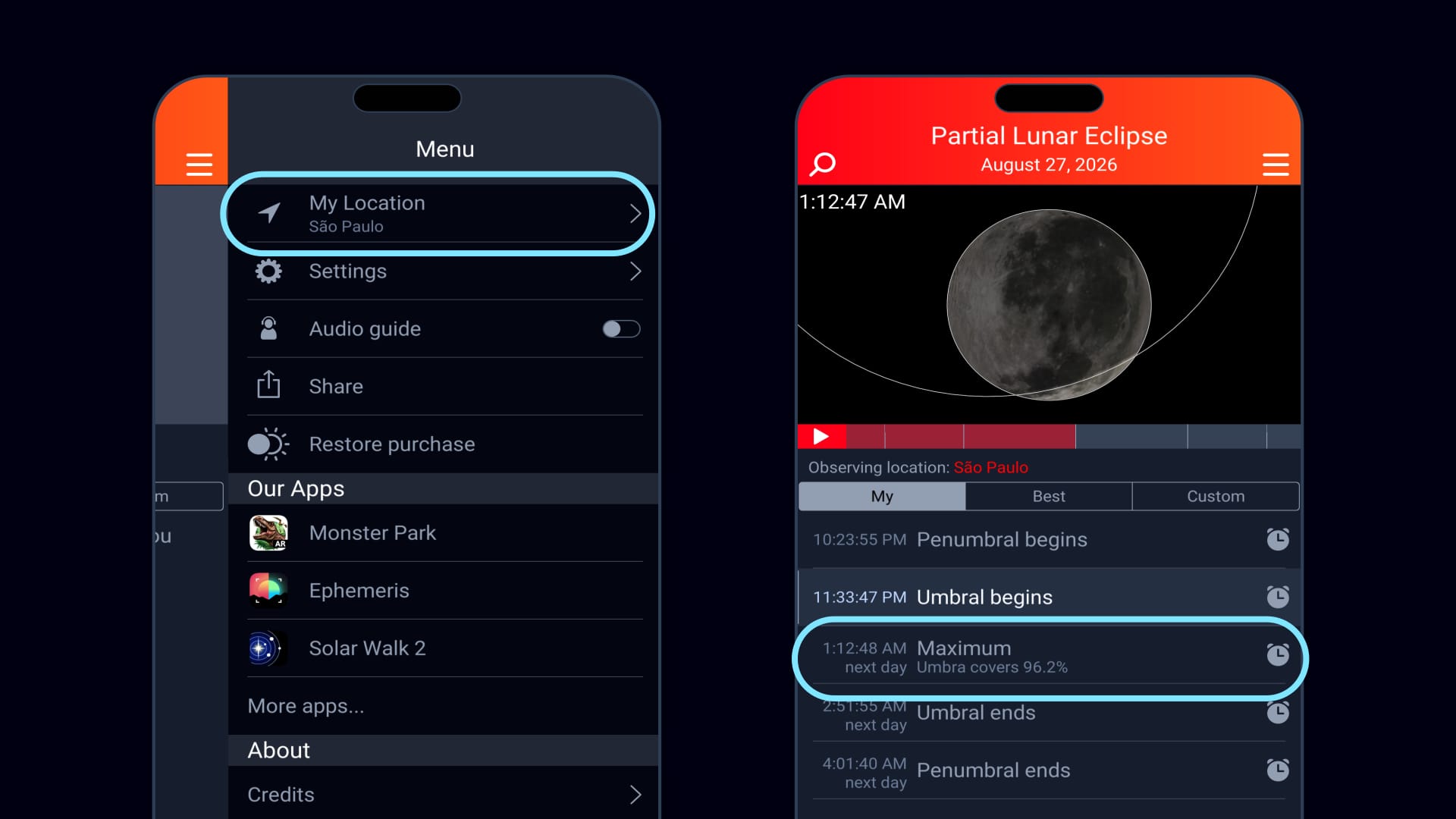
For a detailed phase-by-phase timeline, use Eclipse Guide. It calculates when the penumbral and partial phases begin and end, the time of maximum eclipse, and which stages will be above your horizon.
Viewing August 2026 lunar eclipse
Lunar eclipses are safe to observe with the naked eye. You do not need eclipse glasses, solar filters, or any other protective equipment.
- For the most dramatic part of the eclipse, start watching 30–60 minutes before maximum. To follow the partial phase from the beginning, start around 02:33 UTC.
- Check the weather forecast and cloud cover.
- Choose a location with an open view of the Moon.
- In western North America, look for a clear eastern horizon near moonrise.
- In Europe and Africa, find a clear western horizon before moonset.
- Use binoculars or a small telescope to see the edge of Earth’s shadow more clearly.
Now that you know when and where to see the eclipse, test your knowledge with our solar and lunar eclipse quiz.

How to photograph the August 2026 partial lunar eclipse
Photographing a lunar eclipse is a little more demanding than shooting a normal Full Moon because the Moon’s brightness changes throughout the event and longer exposures can introduce blur.
- Arrive early and take a few test shots to check the Moon’s position, composition, focus, and exposure before the eclipse reaches its deepest phase.
- Use a tripod or stable phone mount.
- Use a telephoto lens or optical zoom if available.
- Adjust exposure as the Moon darkens; near maximum, bracket several shots with different settings.
- Keep exposures short enough to avoid motion blur.
For more detailed settings and techniques, see our guide on how to photograph a lunar eclipse.
What will be near the Moon during the eclipse in August 2026?
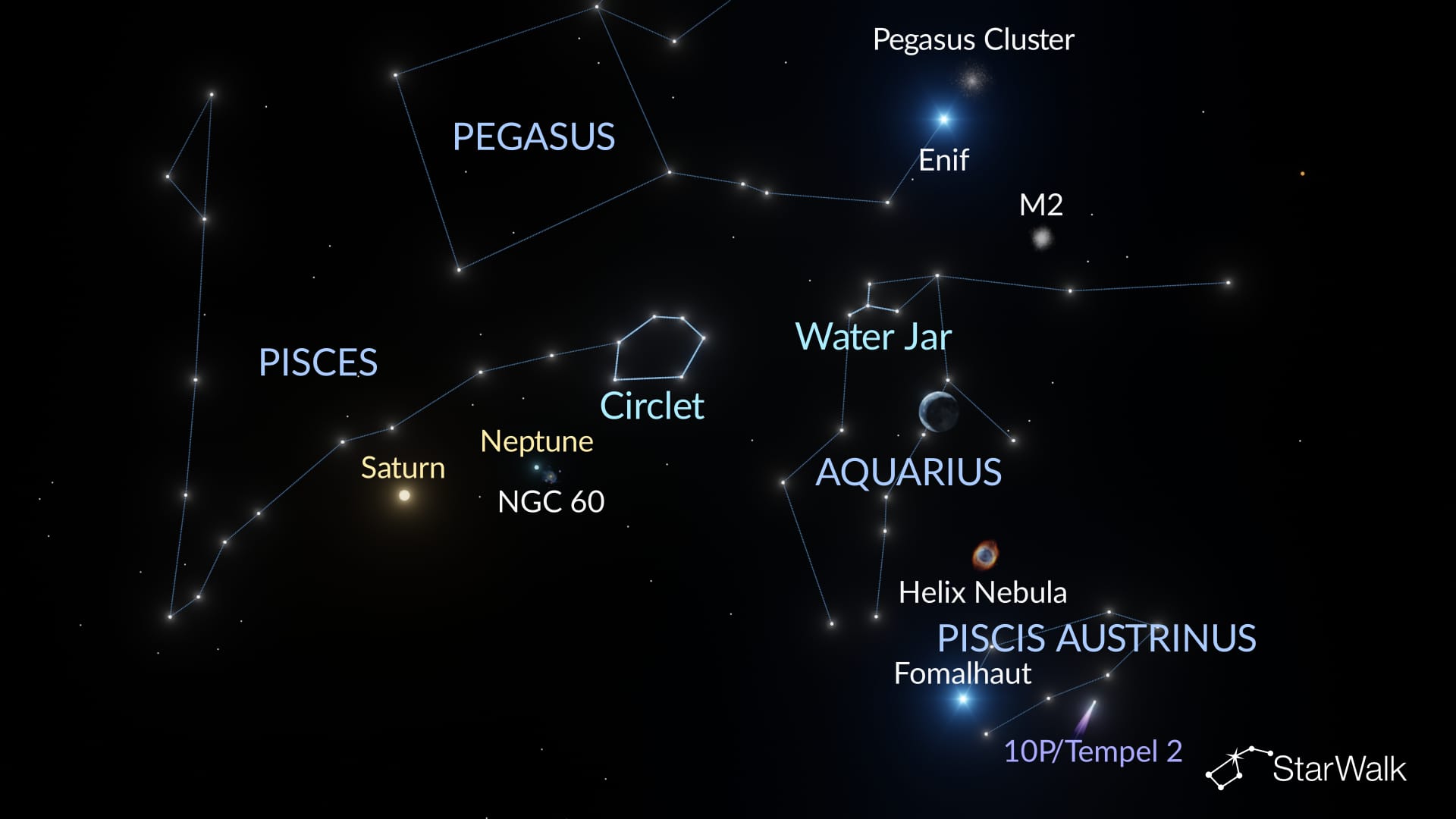
At maximum eclipse, the Moon will be in the constellation Aquarius. Several bright objects will also be nearby in the sky:
- Visible to the naked eye: Saturn, Fomalhaut, Enif, the Water Jar asterism.
- With binoculars or a small telescope: the globular clusters M2 and M15.
- With a telescope: Neptune, which is much fainter and harder to identify.
- More challenging: the Helix Nebula, whose low surface brightness makes it difficult to see near the bright Moon.
- Also worth noting: The eclipse will take place during the August Full Moon, traditionally known as the Sturgeon Moon. Learn more about its name, meaning, and timing in our guide to the Sturgeon Full Moon.
Partial lunar eclipse in August 2026: frequently asked questions
When is the next lunar eclipse?
The next lunar eclipse is the deep partial lunar eclipse of August 27–28, 2026. At maximum, about 96% of the Moon will be covered by Earth’s umbral shadow.
The following lunar eclipse will be a penumbral eclipse on February 20–21, 2027. See our regularly updated guide to the next five solar and lunar eclipses.
What time is the August 2026 lunar eclipse?
The eclipse reaches maximum at 04:12 UTC on August 28, 2026. The partial phase lasts from 02:33 to 05:52 UTC.
Is the August 2026 lunar eclipse total or partial?
The August 28 event is a partial lunar eclipse, not a total lunar eclipse. The year 2026 did include a total lunar eclipse on March 3, but during the August eclipse, a small edge of the Moon remains outside Earth’s umbra.
When is the next Blood Moon?
The next true Blood Moon — a total lunar eclipse — will occur on December 31, 2028. The August 2026 eclipse may look almost like a Blood Moon because 96.2% of the lunar disk’s visible area will be covered, but it remains partial.
Why is the August 2026 lunar eclipse the best until late 2028?
The August 2026 eclipse will be especially dramatic because Earth’s umbral shadow will cover about 96% of the Moon’s visible disk. Near maximum, the eclipsed portion may appear dark red or copper-colored, while only a small bright sliver remains outside the shadow.
The lunar eclipses that follow in 2027 and most of 2028 will be penumbral or much shallower partial eclipses, so they won’t produce such a striking effect. After August 2026, we’ll have to wait until December 31, 2028, to see the Moon turn red again during a total lunar eclipse.
Will the August 2026 lunar eclipse be visible in the United States?
Yes. The entire eclipse will be visible across much of the central and eastern United States. In the western US, the Moon will rise after the eclipse begins, but the maximum and the later phases will still be visible from many locations.
What time is the eclipse in New York?
In New York, the eclipse begins at 9:23 p.m. EDT on August 27, with the partial phase starting at 10:33 p.m. It reaches maximum at 12:12 a.m. EDT on August 28, when the Moon will be about 38.3° above the horizon. The partial phase ends at 1:52 a.m., and the eclipse is over by 3:01 a.m. The entire event will be visible.
Will the August 2026 lunar eclipse be visible in the UK?
Yes. Maximum occurs at 5:12 a.m. BST on August 28. The Moon will be very low in the western sky, so an unobstructed horizon will be essential.
What time is the eclipse in London?
In London, the eclipse begins at 2:23 a.m. BST on August 28, with the partial phase starting at 3:33 a.m. It reaches maximum at 5:12 a.m. BST, when the Moon will be only about 7.8° above the western horizon. The Moon sets around 6:15 a.m., before the partial phase ends, so the later stages of the eclipse will not be visible.
Will the August 2026 lunar eclipse be visible in South America?
Yes. Most of South America will have excellent conditions, with the entire eclipse visible and the Moon high during maximum.
Will the August 2026 lunar eclipse be visible in South Africa?
Yes, but the Moon will be low in the western sky. In Cape Town, maximum occurs at 6:12 a.m. SAST, with the Moon about 11.3° above the horizon.
What time is Chandra Grahan in August 2026?
The August 2026 Chandra Grahan (Hindi for lunar eclipse) will occur on August 27–28, reaching its maximum at 04:12 UTC on August 28. The eclipse will not be visible from India. In parts of Pakistan, only a brief penumbral phase may be visible near moonset; the partial phase will not be visible. The best views will be from the Americas, with the eclipse also visible from parts of Europe and Africa.
How long will the August 2026 lunar eclipse last?
The entire eclipse will last 5 hours 38 minutes, from 01:23 to 07:01 UTC. The partial phase will last 3 hours 18 minutes, from 02:33 to 05:52 UTC.
Will the August 2026 lunar eclipse be a Blood Moon?
Not exactly. “Blood Moon” usually refers to a total lunar eclipse, when the entire Moon enters Earth’s dark umbral shadow. During this eclipse, a small bright edge will remain outside the umbra. Learn more in our complete guide to lunar eclipses.
Will the Moon turn red during the lunar eclipse?
The eclipsed portion may appear dark red, brown, or copper-colored, especially near maximum. However, the entire Moon will not turn red because this is a partial eclipse.
Do I need eclipse glasses to watch the lunar eclipse?
No. Lunar eclipses are safe to observe with the naked eye. Eclipse glasses, filters, and other eye protection are not required.
Why is the eclipse 96.2% if the magnitude is 0.93?
The two numbers measure different things. A magnitude of 0.93 means that about 93% of the Moon’s diameter is inside Earth’s dark shadow. The 96.2% figure refers to how much of the Moon’s visible surface is covered by that shadow. Because one measures distance and the other measures area, the numbers are different.
Partial lunar eclipse in August 2026: what to remember
The deep partial lunar eclipse of August 27–28, 2026, will cover about 96% of the Moon, making it look almost total.
The United States will have some of the best viewing conditions. Across much of the central and eastern US, the entire eclipse will be visible. In the western states, the Moon will rise after the event begins, but maximum should still be visible in many locations.
South America will also have excellent conditions, with the Moon high in the sky. In the UK and much of Europe, a clear western horizon will be essential as the Moon approaches moonset. West Africa will have good viewing conditions, with visibility becoming less favorable farther east.
Use Sky Tonight to check the exact local times and visibility from your city.