Shooting Stars in March–June 2027: Gamma Normids, April Lyrids, Eta Aquariids and More

From March to June 2027, stargazers can enjoy a variety of meteor showers, from well-known annual displays to weaker streams that may bring a few surprises. Among the highlights, the April Lyrids peak on April 22–23, although bright moonlight will interfere with observations. The Eta Aquariids peak on May 6 under a New Moon. In June, the Daytime Arietids provide another chance to catch shooting stars just before dawn.
Contents
- Meteor Showers in March 2027
- Meteor Showers in April 2027
- Meteor Showers in May 2027
- Meteor Showers in June 2027
- Tips on Viewing Meteor Showers This Month
- March–June Meteor Showers: Conclusion
This guide covers peak dates, expected meteor rates, visibility forecasts, and observing tips for meteor showers from March through June 2027. Use the Sky Tonight app to locate each shower’s radiant in your sky and set reminders for upcoming peaks.
Meteor Showers in March 2027
March is a quiet month for meteor activity, with no major annual meteor shower peaking. However, it’s still possible to spot a few shooting stars from minor streams:
- Xi Herculids: peak around March 12; a weak shower best observed from the Northern Hemisphere, with favorable Moon conditions in 2027.
- Gamma Normids: peak around March 14; a minor shower that favors observers in the Southern Hemisphere.
- Eta Virginids: peak around March 18; a weak stream known for occasional bright fireballs, but a bright waxing Moon will interfere this year.
- Possible activity from Comet 252P/LINEAR: March 31–April 2; astronomers have calculated encounters with several dust trails, but any resulting meteor activity remains uncertain.
The hourly meteor rates below are ZHR values: rates standardized to a radiant directly overhead and a very dark, clear sky. Actual counts depend on the radiant’s altitude, moonlight, and local conditions and are usually lower.
March 12: Xi Herculids
- Designation: 346 XHE
- Meteors/hour: <2
- Moon phase: waxing crescent Moon
- Peak date: March 12
- Active: March 6–20
- Radiant location: Hercules
- Best visible from: Northern Hemisphere
The Xi Herculids (ξ Herculids) are a poorly studied meteor shower that typically produces just a handful of meteors. The Xi Herculids were first identified from video-meteor network data in 2009. Astronomers know that they appear to originate from a radiant in Hercules and enter the atmosphere at about 35 km/s, but many details remain uncertain.
Xi Herculids visibility forecast
In 2027, the Xi Herculids peak just four days after the New Moon. The waxing crescent Moon will set before midnight, leaving darker skies later at night. This creates relatively favorable conditions for watching the shower, especially from the Northern Hemisphere.
However, the Xi Herculids are a very weak stream, so observers should expect only occasional meteors. For the best chance, choose a dark location and watch late at night and in the pre-dawn hours, when the radiant in Hercules is higher.
March 14: Gamma Normids
- Designation: 118 GNO
- Meteors/hour: 6
- Moon phase: waxing crescent Moon
- Peak date: March 14
- Active: February 25–March 28
- Radiant location: Norma
- Best visible from: Southern Hemisphere
The Gamma Normids (γ-Normids) are a weak meteor stream with a poorly defined activity period. Its parent body is also unknown. An IMO analysis from 1988 to 2007 showed that this meteor shower averages about 6 meteors per hour at peak and fewer than 3 per hour during the rest of its activity period.
Gamma Normids visibility forecast
In 2027, the Gamma Normids are expected to peak one day before the First Quarter Moon. The waxing crescent Moon will brighten the evening sky, but conditions should improve after midnight. The shower is best observed from the Southern Hemisphere, where its radiant in Norma climbs higher before dawn.
March 18: Eta Virginids
- Designation: 011 EVI
- Meteors/hour: <2
- Moon phase: waxing gibbous Moon
- Peak date: March 18
- Active: March 8–25
- Radiant location: Virgo
- Best visible from: both hemispheres
The Eta Virginids are a weak meteor shower, but they may still be worth watching: they’re poor in faint meteors yet can produce occasional bright fireballs. A 2026 study of Eta Virginids using data from the European Fireball Network confirmed a roughly four-year activity cycle of the meteor stream. The researchers also found that the meteoroids resemble those of the Geminids in their physical properties, pointing to a likely asteroidal origin. The shower’s exact parent body remains unknown.
Eta Virginids visibility forecast
In 2027, the Eta Virginids peak under a waxing gibbous Moon. Moonlight will make faint meteors hard to spot, especially early in the night.
A recent study found that the Eta Virginids’ activity follows a roughly four-year cycle, with two more active years followed by two quieter ones. If this pattern continues, 2027 is unlikely to be a particularly active year. Still, observers may catch an occasional bright meteor. Watch after midnight, when the radiant in Virgo is higher, and try to hide the Moon behind a tree or hill.
March 31–April 2: Possible meteor activity from Comet 252P/LINEAR
Astronomers have identified a possible meteor-watching opportunity in late March and early April 2027. According to the International Meteor Organization, Earth may pass close to several old dust trails left behind by Comet 252P/LINEAR.
The first possible encounter is expected on March 31, between 14:00 and 16:00 UTC, although the dust concentration is predicted to be very low. A potentially more interesting encounter may follow on April 1–2.
Two meteor models suggest different times for this second encounter: April 1 at 19:39 UTC and April 2 at 02:55 UTC. The activity could reach 10–20 meteors per hour under ideal conditions, but the dust trail is highly disturbed, so both the timing and strength remain uncertain.
Any meteors from this encounter would appear to originate from a point roughly 4° from Rigel in the Orion region. The waning crescent Moon around March 31–April 2 will rise late at night, giving several hours of darkness.
An enhanced display is not guaranteed. The event is a prediction based on dust-trail models, rather than a confirmed annual meteor shower.
Meteor Showers in April 2027
April brings two notable meteor showers: the April Lyrids, peaking on April 22–23, and the Pi Puppids, reaching their maximum around April 24. The Lyrids are best seen in the Northern Hemisphere, but the bright waning gibbous Moon will interfere with observations. The Pi Puppids favor the Southern Hemisphere and offer better viewing conditions. Their radiant is well placed in the evening, and observers can catch a few meteors in the dark sky after nightfall and before moonrise.
April 23: April Lyrids
- Designation: 006 LYR
- Meteors/hour: 18
- Moon phase: bright waning gibbous Moon
- Peak date: April 23
- Active: April 14–30
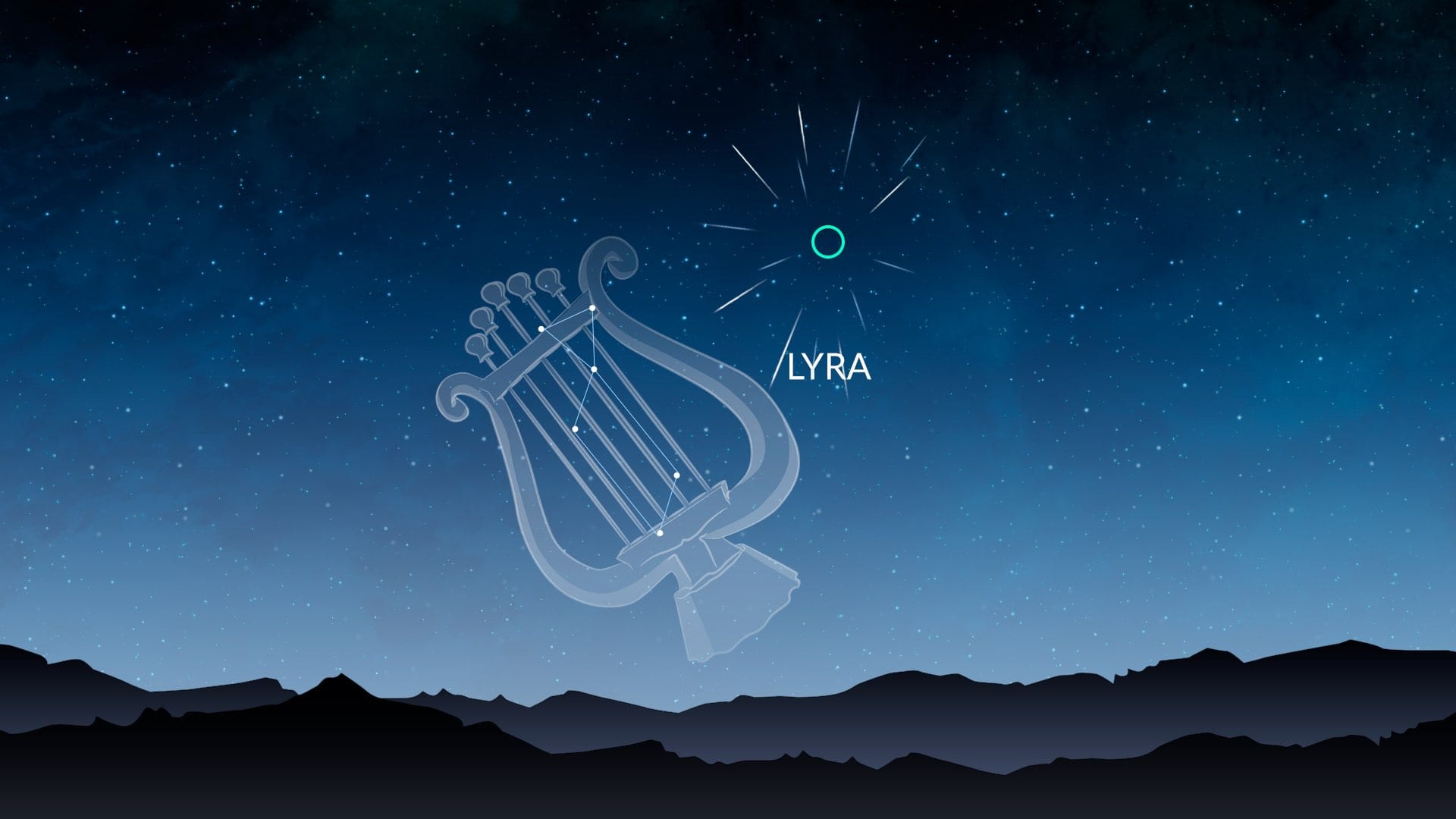
- Radiant location: Hercules, about 8° southwest of Vega in Lyra (RA 271°, Dec +34°)
- Best visible from: Northern Hemisphere
The April Lyrids are one of the oldest known meteor showers that have been observed since 687 BC. Although the shower is named after Lyra, its radiant actually lies in the neighboring constellation Hercules, about 8° southwest of the bright star Vega. The April Lyrids’ meteors are pieces of debris from the long-period comet C/1861 G1 Thatcher. The maximum number of meteors typically ranges from 5 to 20 per hour, but the shower can intensify, resulting in a meteor outburst with an activity rate of up to 100 meteors per hour, as reported in 1803 (Virginia), 1922 (Greece), 1945 (Japan), and 1982 (U.S.). Next time it’s expected to happen in 2042 – hopefully, we’ll still be keeping you updated on the event via our site or Sky Tonight app.
April Lyrids visibility forecast
In 2027, the April Lyrids are expected to reach their maximum around 01:40 UTC on April 23, just three days after the Full Moon. This means bright moonlight will interfere with observations, making many faint meteors difficult to see. For the best chance of spotting meteors, watch late at night and in the pre-dawn hours, when the radiant is high, and try to block the Moon’s glare with a building, tree, or hill.
To make the most of your meteor-watching experience, be sure to check out our comprehensive guide on the April Lyrids.
April 24: Pi Puppids
- Designation: 137 PPU
- Meteors/hour: Variable
- Moon phase: waning gibbous Moon
- Peak date: April 24
- Active: April 15–28
- Radiant location: Puppis
- Best visible from: Southern Hemisphere
Discovered in 1972, the Pi Puppids (π-Puppids), associated with the comet 26P/Grigg-Skjellerup, have shown notable activity in 1977 and 1982, with around 40 meteors per hour detected. Also, in 1983, an activity rate of approximately 13 meteors per hour was reported. Records from 2018 and 2019 report low but still detectable rates.
Pi Puppids visibility forecast
In 2027, the Pi Puppids peak around April 24, four days after the Full Moon. However, observing conditions may be better than they first appear: the shower’s radiant is best positioned in the evening, when the waning gibbous Moon has not yet risen in many locations. Find a dark observing site and start watching in the evening, before the Moon rises.
Lesser-known meteor showers in April 2027
Even on nights when no major meteor shower is active, you may still catch a few meteors — especially under a dark sky. Some of them are sporadic meteors, which don’t belong to any known meteor shower, while others may come from lesser-known weak meteor showers. Here’s a list of those quieter displays. The meteor showers in this list produce fewer than 2 meteors per hour.
| Meteor shower | Activity | Peak Date | Moon Phase | Radiant Location |
|---|---|---|---|---|
| Zeta Cygnids (ZCY) | Mar 21–May 1 | Apr 6 | New Moon | Cygnus |
| April Epsilon Delphinids (AED) | Mar 31–Apr 19 | Apr 10 | Waxing crescent | Delphinus |
| Phi Serpentids (PSR) | Apr 13–17 | Apr 15 | Waxing gibbous | Serpens Caput |
| Alpha Virginids (AVB) | Apr 6–May 1 | Apr 15 | Waxing gibbous | Virgo |
| Nu Cygnids (NCY) | Mar 22–Apr 23 | Apr 21 | Bright waning gibbous | Cygnus |
| H-Virginids (HVI) | Apr 24–May 4 | Apr 29 | Waning crescent | Virgo |
| April Rho Cygnids (ARC) | Apr 20–May 11 | Apr 30 | Waning crescent | Cygnus |
Meteor Showers in May 2027
May offers some of the best meteor-watching conditions of the season. The month’s highlight is the Eta Aquariids, peaking on May 6 under a New Moon — an excellent opportunity for meteor hunting, especially for Southern Hemisphere observers. The much weaker Eta Lyrids follow around May 11, also with favorable Moon conditions.
May 6: Eta Aquariids

- Designation: 031 ETA
- Meteors/hour: 50
- Moon phase: New Moon
- Peak date: May 6
- Active: April 19–May 28
- Radiant location: Aquarius
- Best visible from: Southern Hemisphere
The Eta Aquariids (η-Aquariids) are the strongest meteor shower visible in May. They provide fast meteors, often leaving persistent trains, and perform best in the Southern Hemisphere and tropical latitudes. In the Northern Hemisphere, Eta Aquarid meteors are more likely to appear as Earthgrazers – long, slow meteors that streak low across the horizon, seeming to skim Earth’s surface.
The parent comet of the Eta Aquariids is 1P/Halley, one of the most famous comets. The pieces of space debris shed by the comet centuries ago form a meteoroid stream that Earth encounters as the Eta Aquariids in May and the Orionids in October.
Eta Aquariids visibility forecast
In 2027, the Eta Aquariids are expected to reach their maximum around 09:00 UTC on May 6 under the New Moon. Observing conditions will be excellent, with virtually no moonlight to interfere with the meteor display.
The best time to watch is during the pre-dawn hours, when the radiant in Aquarius rises higher before sunrise. The shower favors the Southern Hemisphere, where observers may see more meteors in the dark sky. In the Northern Hemisphere, the best views are generally south of about 40°N, though meteor rates will be lower.
The Eta Aquariids also have a broad period of strong activity, so observers don’t have to rely on a single night. Good opportunities are expected around May 3–10, especially under dark, clear skies.
To make sure you catch the most shooting stars, check out our detailed guide on the Eta Aquariids.
May 11: Eta Lyrids
- Designation: 145 ELY
- Meteors/hour: 3
- Moon phase: waxing crescent Moon
- Peak date: May 11
- Active: May 5–14
- Radiant location: Lyra
- Best visible from: Northern Hemisphere
The Eta Lyrids (η-Lyrids) are a weak meteor shower associated with Comet C/1983 H1 (IRAS–Araki–Alcock). In May 1983, the comet passed just 4.7 million km from Earth. This was one of the closest recorded comet encounters with Earth. The Eta Lyrids typically produce only about 3 meteors per hour. Because of their low activity, they can easily be mistaken for sporadic meteors.
Eta Lyrids visibility forecast
In 2027, the Eta Lyrids reach their maximum around May 11, under a waxing crescent Moon. Observing conditions will be very favorable, as the Moon sets early, leaving most of the night dark.
The shower is best observed from the Northern Hemisphere, where its radiant in Lyra remains at a useful elevation throughout the night. However, with a typical peak rate of only 3 meteors per hour, the Eta Lyrids require patience. Choose a dark location and watch late at night or in the pre-dawn hours for the best chance of spotting a few meteors.
Meteor Showers in June 2027
June’s main event is the Daytime Arietids, one of the strongest daytime meteor showers of the year, peaking around June 8–9. Another interesting event to monitor is possible activity from the Gamma Delphinids around June 11, though it remains uncertain.
June 8–9: Daytime Arietids
- Designation: 171 ARI
- Meteors/hour: 30
- Moon phase: waxing crescent Moon
- Peak date: June 8–9
- Active: May 14–June 24
- Radiant location: Aries
- Best visible from: both hemispheres
The Daytime Arietids are the strongest daytime meteor shower of the year. The proposed parent bodies of the stream include comets 96P/Machholz and P/1999 J6.
Daytime Arietids visibility forecast
In 2027, the Daytime Arietids are expected to peak around June 8–9, with little moonlight interference in the pre-dawn hours. The International Meteor Organization’s 2027 calendar gives June 8 as the maximum based on the IAU Meteor Data Center's reference data, while Hiroshi Ogawa’s radio-observation analysis, summarized in the same calendar, points to June 9.
The main challenge for observation of the Daytime Arietids isn’t the Moon but the Sun: the shower’s radiant lies only about 30° from it, making most meteors impossible to see during the day.
The best chance to catch a few bright Arietid meteors is shortly before dawn, while the sky is still dark enough. Choose a location away from city lights with a clear horizon, and begin watching before morning twilight becomes too bright.
Although the Arietids have a listed rate of about 30 meteors per hour, observers shouldn’t expect to see that many. Much of the shower’s activity is detected by radio and radar rather than by eye.
Find out about other daytime meteor showers from the dedicated article.
June 11: Gamma Delphinids
- Designation: 065 GDE
- Meteors/hour: Unknown
- Moon phase: First Quarter
- Possible peak date: June 11
- Active: June 6–13
- Radiant location: Delphinus
- Best visible from: Northern Hemisphere
The Gamma Delphinids (γ-Delphinids) are a poorly studied meteor shower. Observers in Maryland, USA, reported them in 1930, when they spotted an unusual burst of shooting stars despite bright moonlight. The shower has rarely been observed since, and its parent comet remains unknown. Astronomers predicted another possible outburst in 2013, but no significant increase in meteor activity was detected.
Gamma Delphinids visibility forecast
According to the International Meteor Organization, Earth is expected to pass close to a modeled dust trail of the Gamma Delphinids on June 11 at approximately 21:55 UTC. A similar encounter occurred in 2013 without producing a noticeable outburst, but the predicted distance to the dust trail will be about half as large in 2027 as in 2013.
The First Quarter Moon will brighten the sky in many locations, making faint meteors harder to spot. The shower favors the Northern Hemisphere, where the radiant in Delphinus rises higher in the sky. However, the predicted encounter may occur during daylight or twilight in some regions, so visibility will depend on location.
No reliable meteor rate has been predicted, and an outburst is far from guaranteed. Still, the Gamma Delphinids have surprised observers before, making June 11 an interesting date for dedicated meteor watchers.
Tips on Viewing Meteor Showers This Month
Getting ready to catch the shooting stars? Learn all you need to know about meteor showers from our infographic and check the basic tips for meteor hunters. To solidify your knowledge, take our quiz.
Also, use the Sky Tonight app to learn when and where to observe a meteor shower. Tap the calendar icon at the bottom of the screen and switch to the Meteors tab. You’ll see which meteor showers are active in the selected month (the peak dates are marked with dots). Choose a meteor shower and tap the blue target icon opposite its name. The app will show where the radiant will be at midnight local time. You can set the desired time using the Time Machine panel at the top of the screen. Then, point your device up and follow the white arrow to see where the radiant will be in the real night sky.
March–June Meteor Showers: Conclusion
There are several reasons to keep an eye on the night sky from March through June of 2027. The Eta Aquariids promise the best observing conditions, especially in the Southern Hemisphere; the April Lyrids may reward patient observers with bright meteors despite the moonlight. June brings the unusual Daytime Arietids, which are best observed shortly before dawn, and a possible Gamma Delphinid outburst — an unpredictable event that could provide an extra surprise.
To catch the most shooting stars, observe from a dark location and use the Sky Tonight app to find when each radiant is highest in your sky and plan your meteor hunting!
