May Full Moon 2027 (Flower Moon): Date, Time & Meaning
The Full Moon in May 2027 — traditionally called the Flower Moon — occurs on Thursday, May 20, 2027, at 10:59 GMT/UTC (06:59 EDT). The Moon will be located in the constellation Libra. This Full Moon is also a seasonal Blue Moon — the third Full Moon in a season with four Full Moons.
Want to know exactly when the Moon rises where you live and what bright objects are nearby? Use the free astronomy app Sky Tonight. Read on to learn the meaning of the Flower Moon, why it’s also called a Blue Moon in 2027, and everything else you need to know about the May Full Moon.
Contents
- May Full Moon 2027 at a glance
- May 2027 Moon dates & times
- Best time to see the Flower Moon
- Is the May 2027 Full Moon a Blue Moon?
- What constellation hosts the May Full Moon in 2027?
- May Flower Moon meaning: why is it called the Flower Moon?
- May Full Moon alternative names
- May Full Moon 2027: key takeaways
May Full Moon 2027 at a glance
- Date: May 20, 2027
- Peak time: 10:59 GMT/UTC (06:59 EDT)
- Looks full: around May 19–21
- Name & meaning: Flower Moon — named after the abundance of flowers blooming in May
- Where in the sky: constellation Libra
- Special feature: seasonal Blue Moon
May 2027 Moon dates & times
May Moon phases 2027
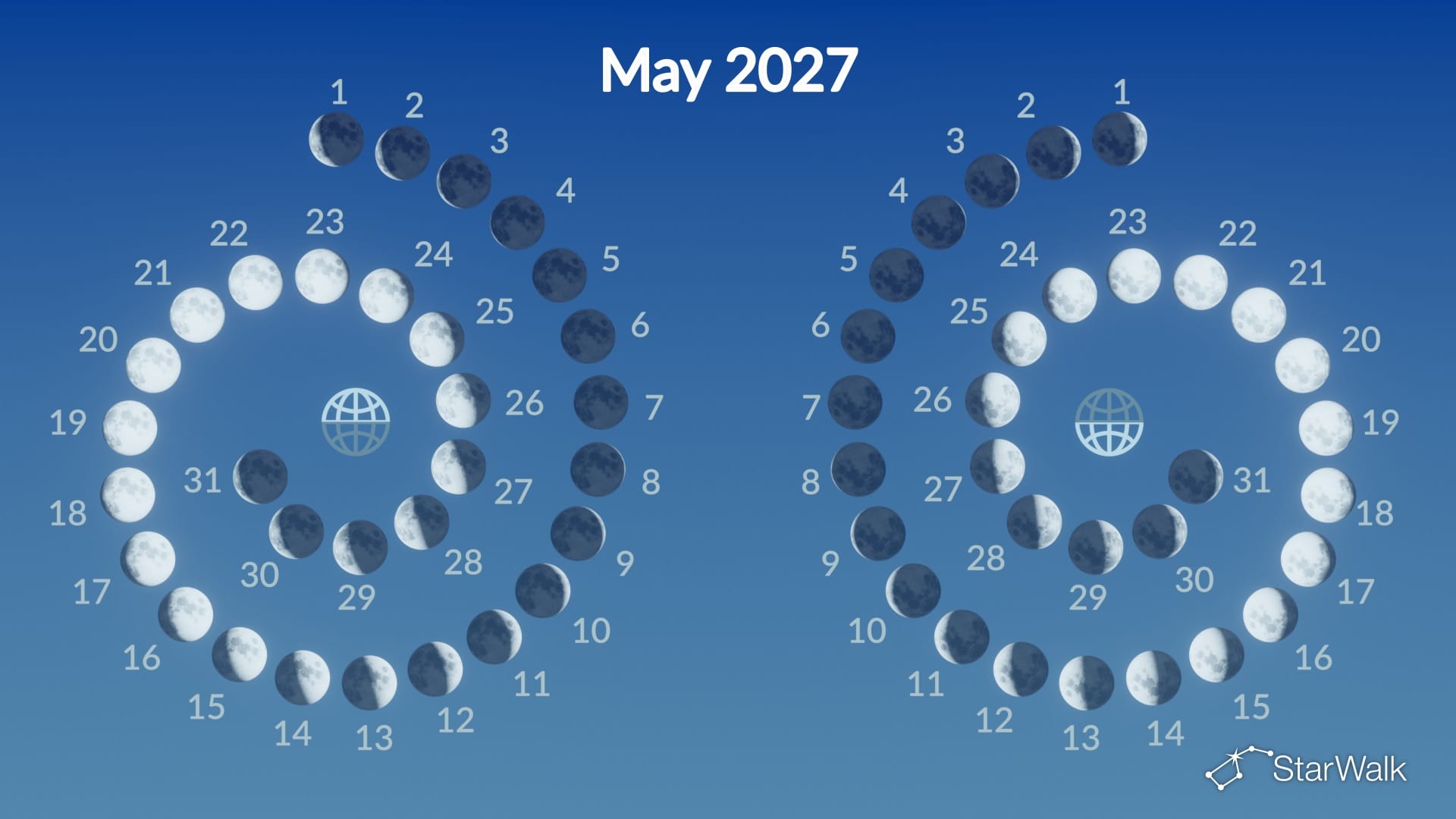
Here are the exact dates and times for the key lunar phases in May 2027:
- New Moon: May 6, 10:58 GMT/UTC (06:58 EDT)
- First Quarter: May 13, 04:44 GMT/UTC (00:44 EDT)
- Full Moon: May 20, 10:59 GMT/UTC (06:59 EDT)
- Last Quarter: May 28, 13:58 GMT/UTC (09:58 EDT)
Did you know? While the Full Moon is a stunning sight on its own, the best time to view the Moon through a telescope or binoculars is during its quarter phases! At these times, the Moon isn't overly bright, and the shadows cast across its surface reveal more detail.
Want to know the dates of all the Moon phases in May 2027? Check the interactive Moon Calendar on our website.
When is the Full Moon in May 2027?
The May Full Moon occurs on Thursday, May 20, 2027, at 10:59 GMT/UTC (06:59 EDT). At this moment, the Moon will be exactly opposite the Sun in the sky and will reach its maximum illumination.
In astronomy, the Full Moon is the exact moment in time, but to observers on Earth, the Moon looks full for about a day before and after that moment. Around the Full Moon, you can see the bright lunar disk rising in the east in the evening, climbing highest in the sky around midnight, and setting in the west near sunrise.
You can see how the Moon will look in the sky on any chosen date in the Sky Tonight app: tap the calendar icon, open the Moon tab, and select any date. You will see an accurate 3D image of the Moon, which reflects the angular size and orientation of the real Moon as seen from your location.
Full Moon in May 2027: Time in popular time zones
Here’s when the May Full Moon peaks in a few popular time zones.
North & South America
- US ET: 6:59 AM on May 20
- US CT: 5:59 AM on May 20
- US MT: 4:59 AM on May 20
- US PT: 3:59 AM on May 20
- Brazil (BRT): 07:59 on May 20
Europe
- UK (BST): 11:59 on May 20
- Central Europe (CEST): 12:59 on May 20
Asia
- India (IST): 4:29 PM on May 20
- China (CST): 18:59 on May 20
- Japan (JST): 19:59 on May 20
Oceania
- Australia (AEST): 20:59 on May 20
- New Zealand (NZST): 22:59 on May 20
Best time to see the Flower Moon
- In most places, the best time to see the Flower Moon is around moonrise, near local sunset.
- Moonrise is also a good time for photos, because the Moon is low on the horizon, where it can appear golden or orange and make for more dramatic compositions with foreground objects.
- The Moon will appear full on the nights around May 19, May 20, and May 21, so you have more than one good chance to observe it.
What time does the Full Moon rise in May?
Because a Full Moon sits roughly opposite the Sun, it usually appears near the eastern horizon around sunset and stays in the sky most of the night, setting close to sunrise. The exact moonrise time depends on your location and the Moon’s path across the sky, so it can differ noticeably even between nearby cities.
Here are example moonrise times on the day of the Full Moon in May 2027:
- London, UK: 9:42 PM (May 20)
- Belfast, UK: 10:29 PM (May 20)
- Edinburgh, UK: 10:29 PM (May 20)
- New York, USA (ET): 8:57 PM (May 20)
- Chicago, USA (CT): 8:58 PM (May 20)
- Denver, USA (MT): 9:02 PM (May 20)
- Los Angeles, USA (PT): 8:38 PM (May 20)
Want the exact time for your city? In Sky Tonight, search for Moon, tap on it, and check:
- Events — Moonrise and moonset times for your location
- Figures — the current phase, illumination, and brightness
Tip: the best time to enjoy and photograph the Full Moon is often right after moonrise, when the Moon hangs low above the horizon and may appear golden or orange because of Earth’s atmosphere.
When is the New Moon in May 2027?
The New Moon will occur on May 6, 2027, at 10:58 GMT/UTC (06:58 EDT). Around the New Moon, the lunar disk is invisible to the naked eye because the Moon is positioned between Earth and the Sun.
This is the best time of the month for observing faint deep-sky objects such as galaxies, nebulae, and star clusters, because bright moonlight won’t wash them out. Check out our guide to learn what you can see this month: Deep-Sky Objects in May.
Is the May 2027 Full Moon a Blue Moon?
Yes. The May 20, 2027 Full Moon is a seasonal Blue Moon.
There are two common meanings of “Blue Moon”:
- Monthly Blue Moon: the second Full Moon in one calendar month
- Seasonal Blue Moon: the third Full Moon in an astronomical season that has four Full Moons
The May 2027 Full Moon is the third Full Moon between the March equinox and the June solstice, so it fits the seasonal Blue Moon definition.
Will it look blue? No — the name is about calendar timing, not color. The Moon will look like a regular Full Moon, though it may appear yellow, orange, or red when it is low above the horizon.
Want to learn more about this rare event? Read our dedicated article: Next Blue Moon.
What constellation hosts the May Full Moon in 2027?
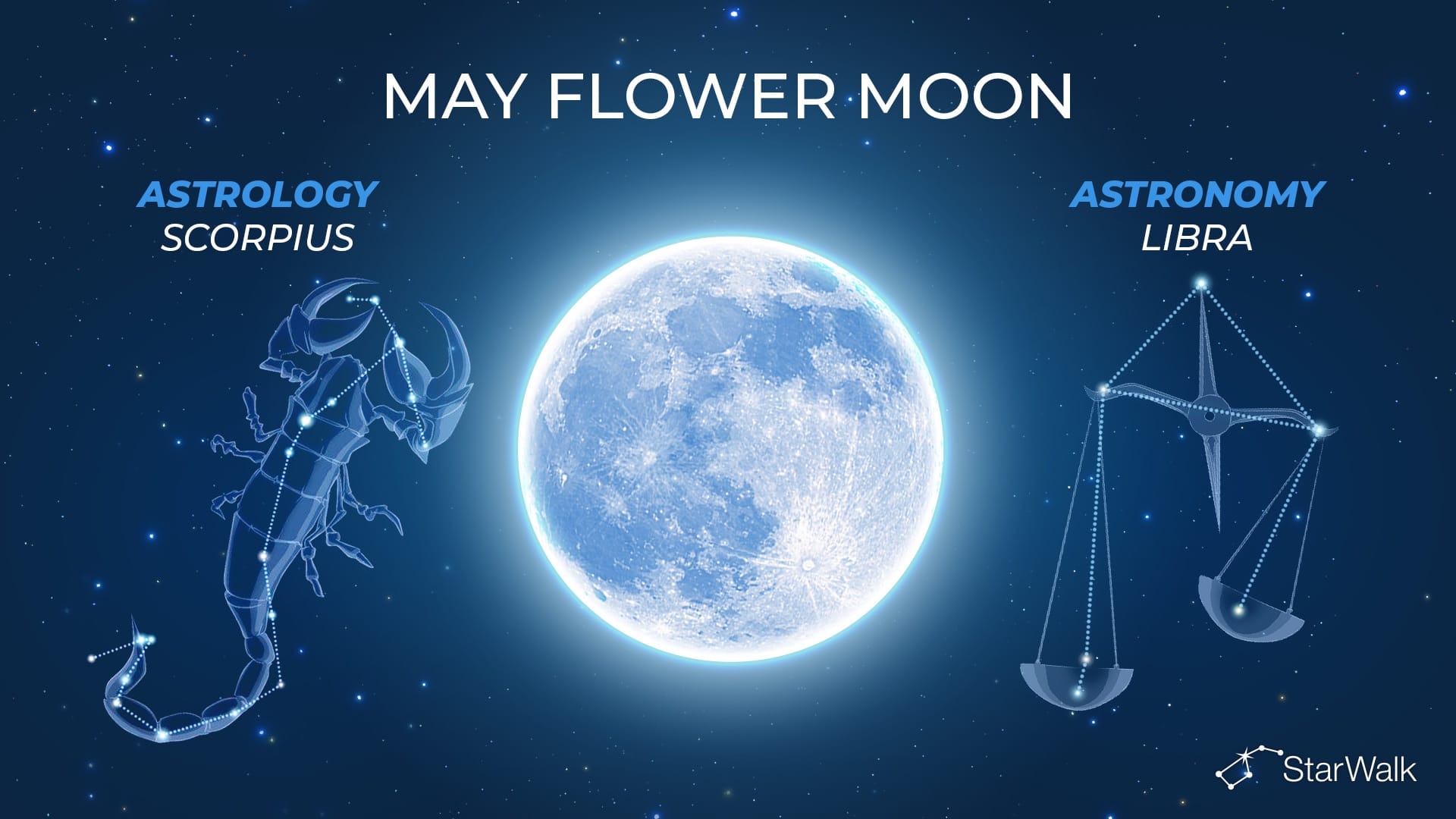
From the astronomical point of view, the May Full Moon will be located in the constellation Libra. In astrology, however, you may see this Full Moon described as a “Full Moon in Scorpio.” This difference happens because astrological zodiac signs and astronomical constellations don’t match perfectly. To learn more, read our article: Zodiac Constellations And Zodiac Signs.
Bright stars near the May Full Moon
At the moment of the Full Moon on May 20, the Moon will be located in Libra, a constellation without bright first-magnitude stars. One of the nearby stars is Zubenelgenubi, a multiple star system in Libra that shines at about magnitude 2.7. It won’t be very easy to spot next to the brilliant Full Moon, especially from light-polluted areas, but binoculars can help.
The next night, on May 21, the Moon will appear very close to Antares (mag 1.0), the reddish “heart” of the constellation Scorpius. Antares is much brighter than the stars of Libra, so it’s easier to notice even near the bright Moon.
To confirm you're looking at the right star, use Sky Tonight. It will help you identify celestial objects effortlessly.
May Flower Moon meaning: why is it called the Flower Moon?
The May Full Moon is traditionally known as the Flower Moon because May is the month when many flowers bloom across the Northern Hemisphere. The name reflects the visible return of color and abundance in nature after spring has fully arrived.
So no — the Flower Moon doesn’t mean the Moon will look like a flower or change color. However, near the horizon, the Moon can appear yellow, orange, or reddish because its light passes through a thicker layer of Earth’s atmosphere.
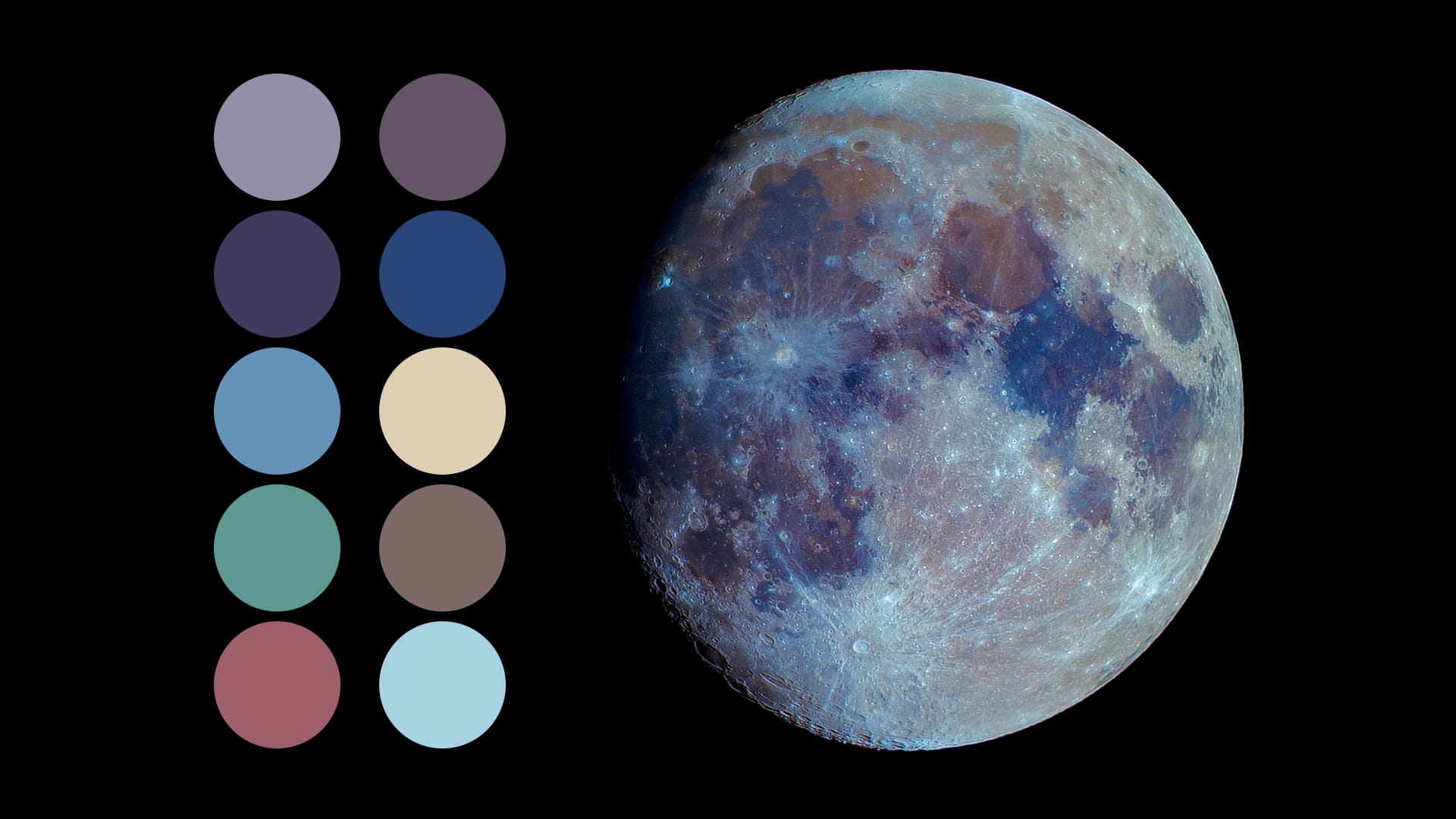
By the way, the Moon does appear in a spectrum of colors in visual and metaphorical senses. Take our quiz to learn more about the colors of the Moon!
Flower Moon spiritual meaning
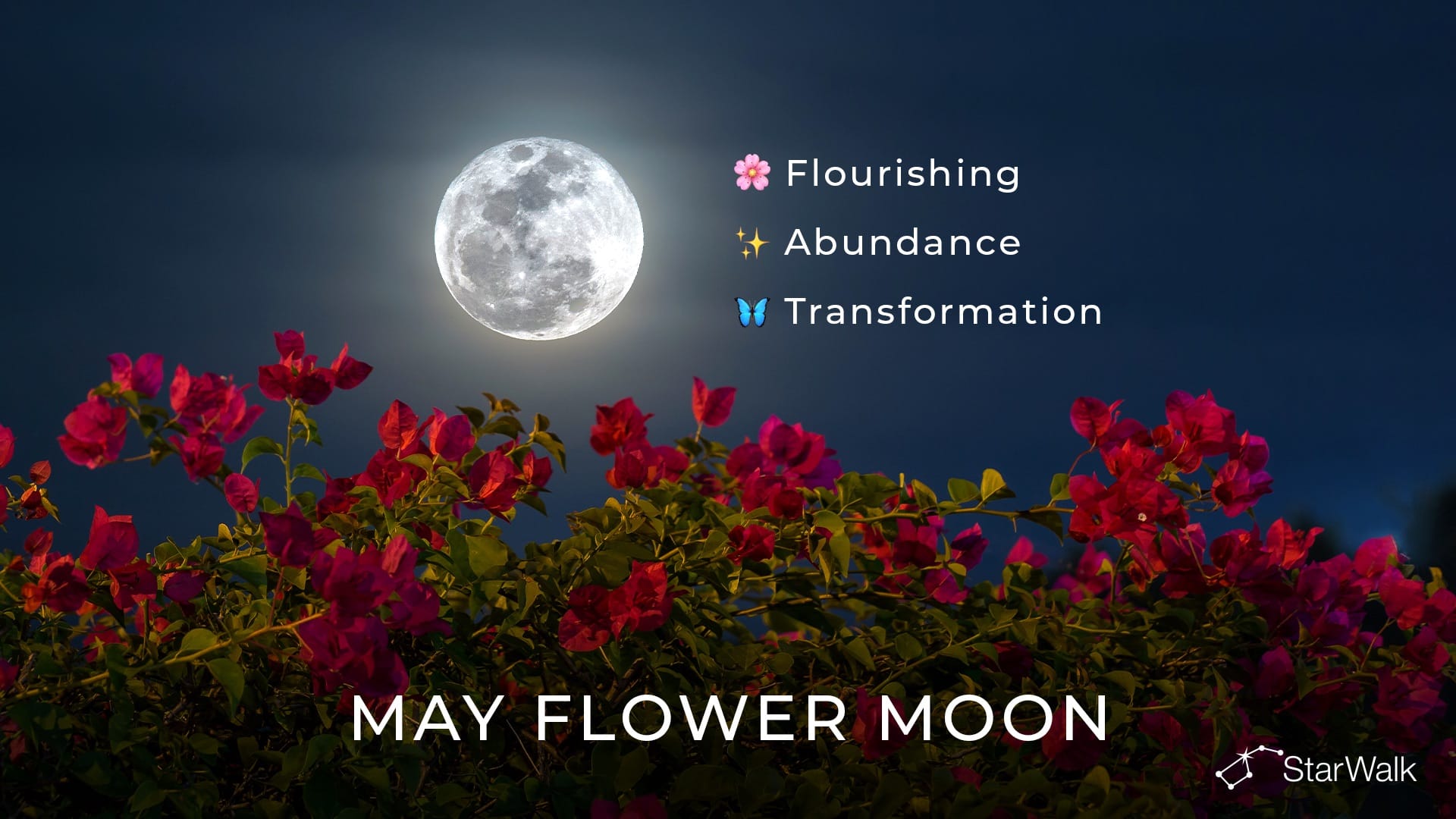
Spiritually, the Flower Moon is often associated with flourishing, abundance, and fertility. Because it arrives during a season of blossoming and visible change, many people connect it with personal transformation and new beginnings.
In Western astrology, the May Full Moon is considered a Scorpio Full Moon. The sign of Scorpio is often linked with intuition, deep emotions, and personal growth, so this Full Moon is sometimes seen as a time for letting go of old patterns, revealing hidden feelings, and embracing inner change.
May Full Moon alternative names
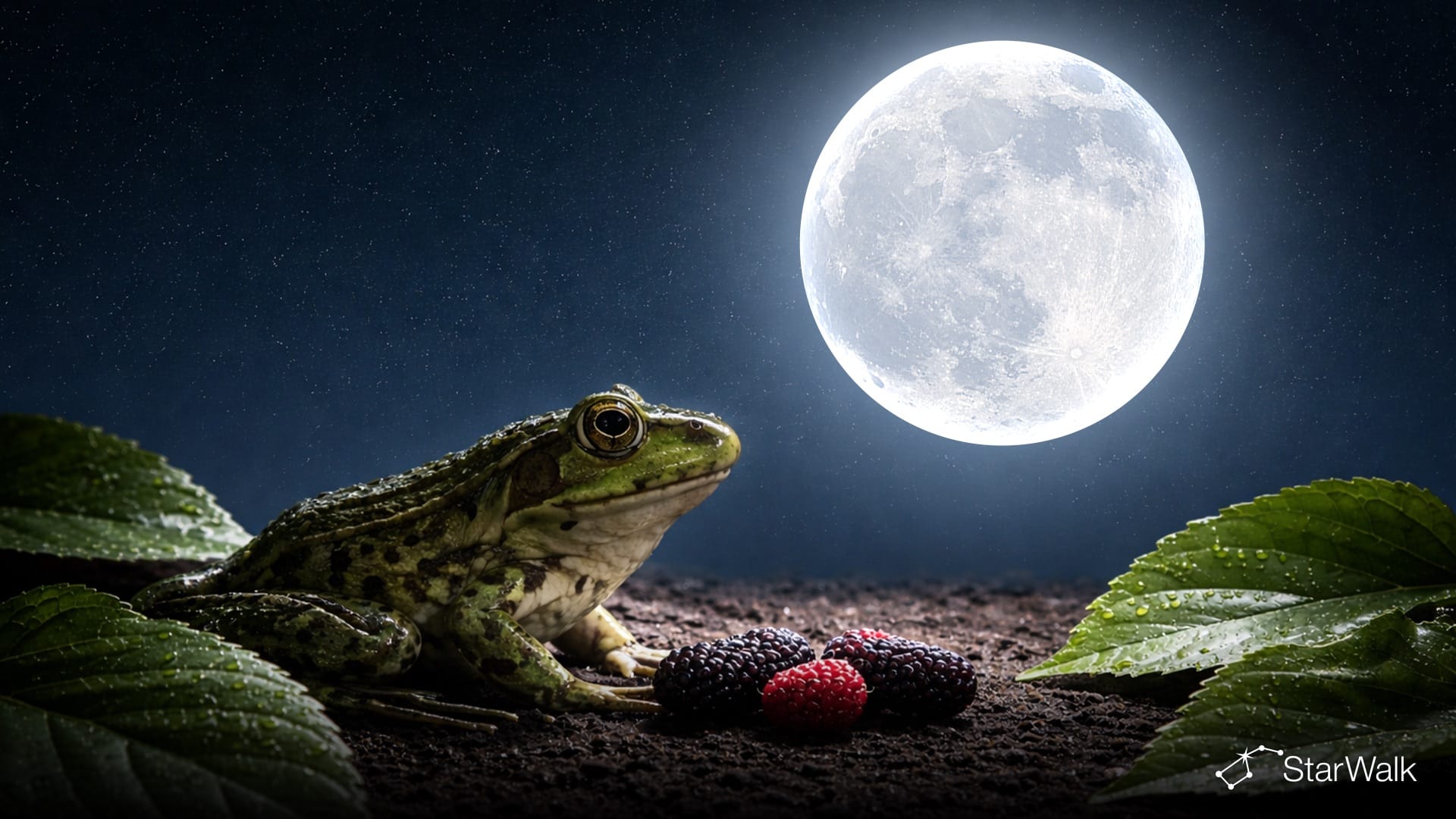
May’s Full Moon is best known as the Flower Moon, but different cultures and traditions use different names — and even within one culture, names can vary by region and source. The name Flower Moon is associated with Algonquin traditions, while other folk names are also widely recorded. Let’s take a look at some of them:
- Budding Moon (Cree — Subarctic and Plains regions, Canada)
- Planting Moon (Dakota, Lakota — Northern Plains / Great Plains, USA)
- Moon of the Green Leaves (Lakota — Great Plains, USA)
- The Time of Big Leaf (Mohawk — Northeast / upper New York, USA)
- Mulberry Moon (Choctaw — Southeastern USA)
- Egg Laying Moon (Cree — Subarctic and Plains regions, Canada)
- Frog Moon (Cree — Subarctic and Plains regions, Canada)
- Moon When Ponies Shed Their Coats (Oglala — Great Plains, USA)
- Alewife Moon (Passamaquoddy — Northeastern North America)
- Milk Moon (traditional European folk name)
- Hare Moon (Celts — Northwestern Europe / the British Isles)
- Grass Moon (Celts — Northwestern Europe / the British Isles)
Seasonal names of Full Moons in the Southern Hemisphere are often shifted by 6 months compared to the Northern Hemisphere:
- Hunter’s Moon / Frost Moon (Southern Hemisphere)
Full Flower Moon and Buddha Purnima
In India, the May Full Moon is also associated with Buddha Purnima (or Buddha Jayanti / Vesak), one of the most important Buddhist holidays. It commemorates the birth, enlightenment, and death of Gautama Buddha and is observed on the Full Moon day. In 2027, Buddha Purnima in India falls on May 20, the same day as the Flower Moon.
May Full Moon 2027: Frequently asked questions
When is the Flower Moon in 2027?
The Flower Moon reaches its exact Full Moon moment on May 20, 2027, at 10:59 GMT/UTC (06:59 EDT). Depending on your time zone, the peak may fall in the morning, afternoon, or evening of May 20. The Moon will still look full for about a day before and after this peak, so you can enjoy a bright, nearly full Moon on nearby nights even if you miss the exact time.
Why is the May Full Moon called the Flower Moon?
The May Full Moon is called the Flower Moon because May is associated with abundant blooming flowers in the Northern Hemisphere. Many traditional Full Moon names reflect seasonal changes in nature, and the Flower Moon is one of the most widely recognized examples.
Why is the May 2027 Full Moon called a Blue Moon?
The May 20, 2027 Full Moon is called a seasonal Blue Moon because it is the third Full Moon in an astronomical season that has four Full Moons. The name refers to calendar timing, not color — the Moon won’t actually turn blue.
Where is the May Full Moon in the sky?
In 2027, the May Full Moon is located in the constellation Libra. In astrology, you may see it described as a Scorpio Full Moon because zodiac signs and astronomical constellations are different systems.
Is the May 2027 Flower Moon a Supermoon?
No, the May 2027 Flower Moon is not a Supermoon. A Supermoon occurs when a Full Moon happens near perigee — the Moon’s closest point to Earth in its orbit. In 2027, only two Full Moons are Supermoons: the Wolf Moon on January 22 and the Snow Moon on February 20.
When is the next Full Moon?
The next Full Moon after the Flower Moon will occur on June 19, 2027, at 00:44 GMT/UTC (20:44 EDT on June 18). Traditionally known as the Strawberry Moon, it is named after the strawberry harvest season in parts of North America.
When is the next Flower Moon?
The Flower Moon is the Full Moon that occurs in May, so the next Flower Moon after May 20, 2027, will take place next year — on May 8, 2028, at 19:49 GMT/UTC (15:49 EDT).
May Full Moon 2027: key takeaways
- Date: May 20, 2027
- Peak time (100% illumination): 10:59 GMT/UTC (06:59 EDT)
- Looks full to the eye: about three nights, around May 19–21
- Where in the sky: constellation Libra
- Name & meaning: Flower Moon — named after the abundance of flowers blooming in May
- Special feature: seasonal Blue Moon — the third Full Moon in a season with four Full Moons
- Will it look blue? No — “Blue Moon” refers to timing, not color.
To find the exact moonrise time and the Moon’s phase for your location, open Sky Tonight, search for Moon, and check the Events tab (rise/set time) and Figures tab (illumination and phase).
We wish you clear skies and successful observations!
Further reading: