Best Constellations of January: Night Sky Map for 2026
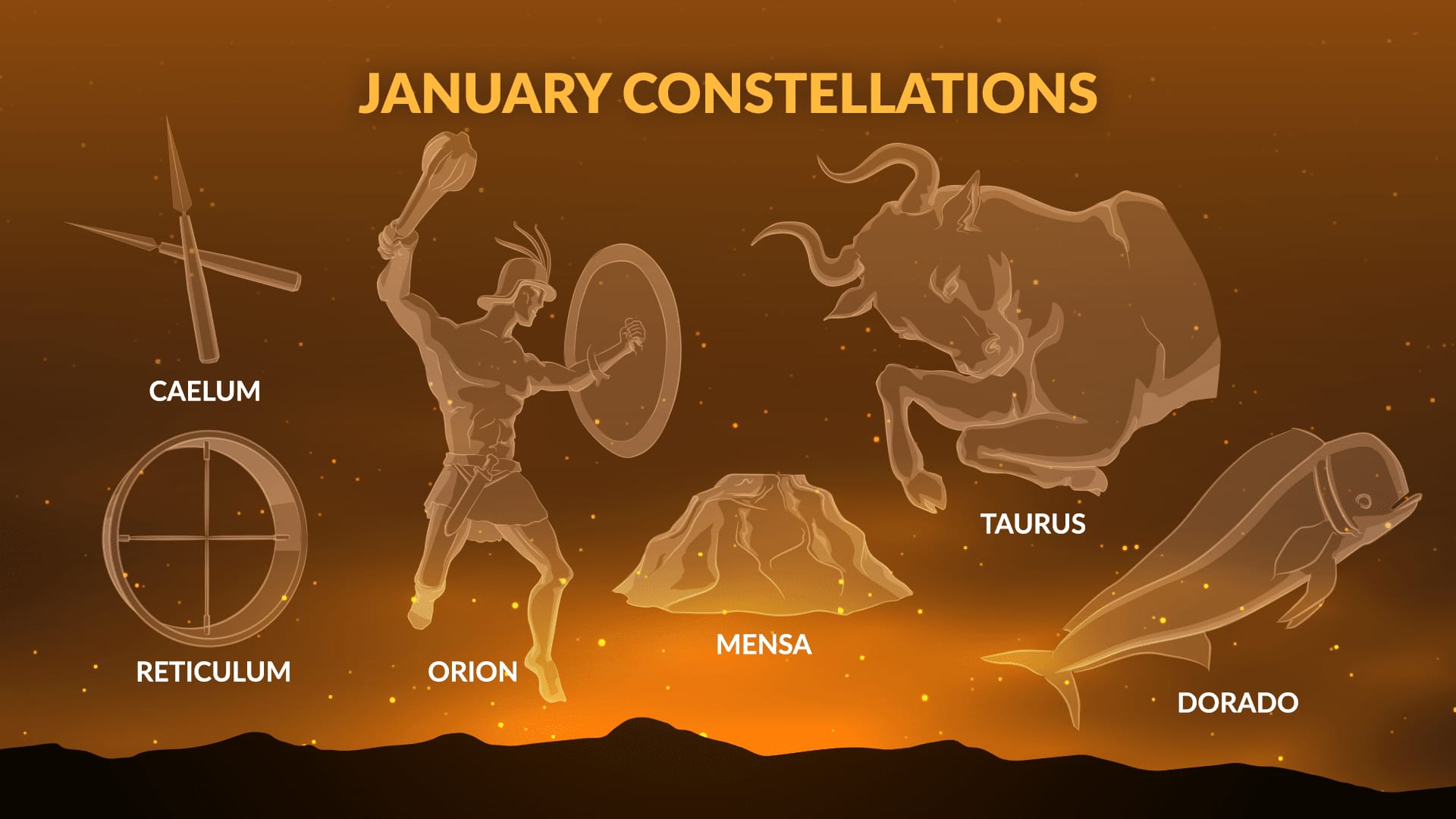
Enjoy the night sky this January by spotting Orion, Taurus, and other beautiful star patterns! With the free Star Walk 2 app, finding them is easy — it only takes several seconds. Read this article to learn about all the must-see January constellations, the best times to view them, and more.
Contents
- List of January constellations
- How to find constellations in the night sky?
- Constellations visible in January: bottom line
List of January constellations
In this article, we highlight the most prominent constellations to look for in January. Each month has its best “featured” constellations — we focus on those that reach their highest point in the sky around 9 p.m. local time. But keep in mind that constellations remain visible for more than one month.
The directions below assume you’re observing at 9–10 p.m. local time, when the sky is dark. Each entry also includes the latitude range where the constellation can be seen. To check visibility from your exact location and easily find any constellation in the sky, use the Star Walk 2 app.
Orion
- Brightness: ☆☆☆
- Visible between: 85°N and 75°S
- Brightest star: Rigel (mag 0.1)
- Brightest deep-sky object: Orion Nebula (M42, mag 4.0)
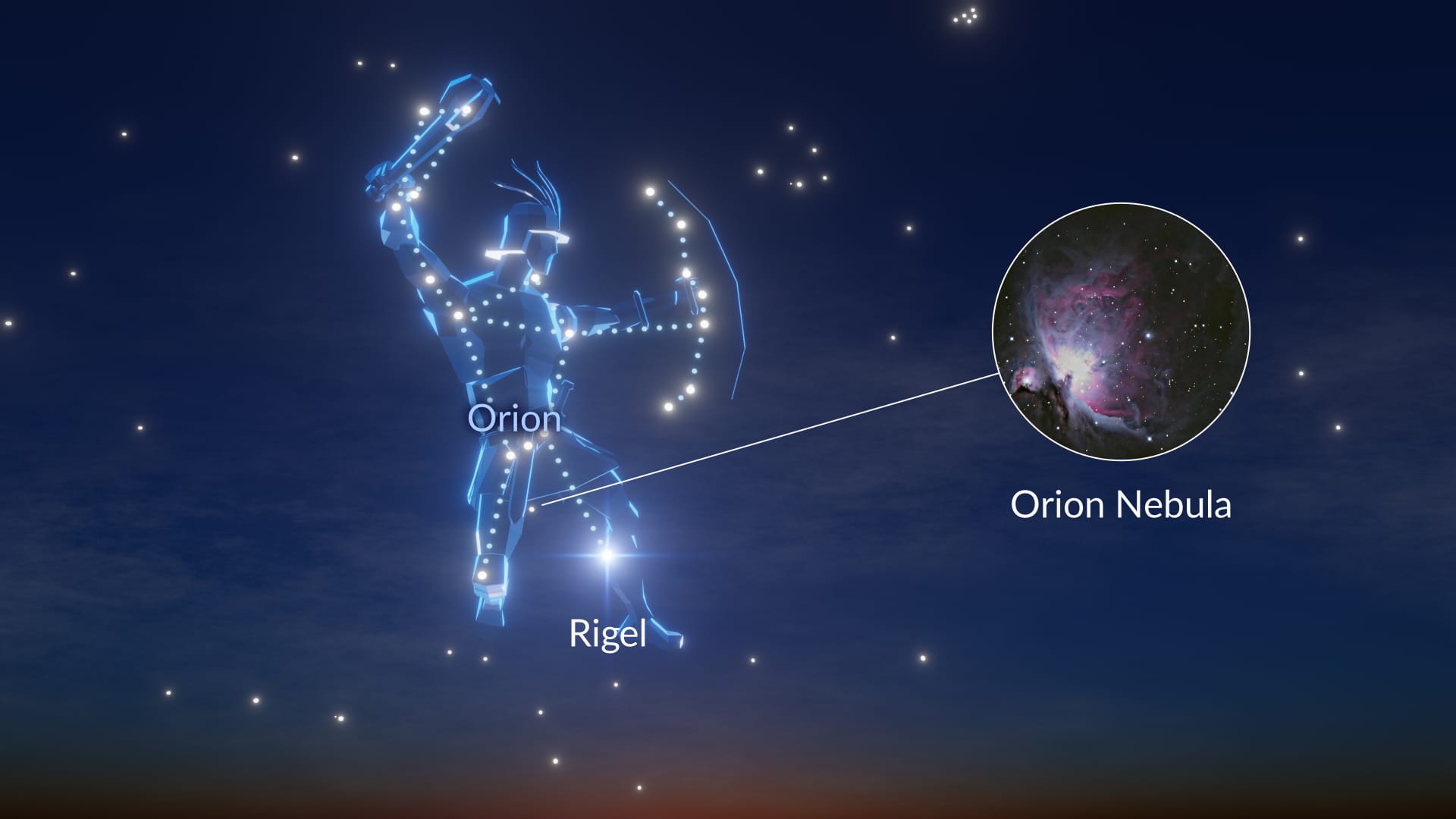
Orion dominates the skies in January. When the darkness falls, see the constellation above the southern horizon. The three stars forming Orion’s Belt (Alnitak, Alnilam, and Mintaka) are equally bright and lined up in a straight row. Near them is the Orion Sword — its middle “star” is actually the Orion Nebula, where new stars and planets are being born.
Orion’s seven brightest stars shine through light pollution, making it one of the easiest constellations to spot, even in a city. In the Northern Hemisphere, look for its famous pattern to the south; in the Southern Hemisphere, look north-northeast.
Taurus
- Brightness: ☆☆☆
- Visible between: 90°N and 65°S
- Brightest star: Aldebaran (mag 0.8)
- Brightest deep-sky object: Pleiades (M45, mag 1.6)
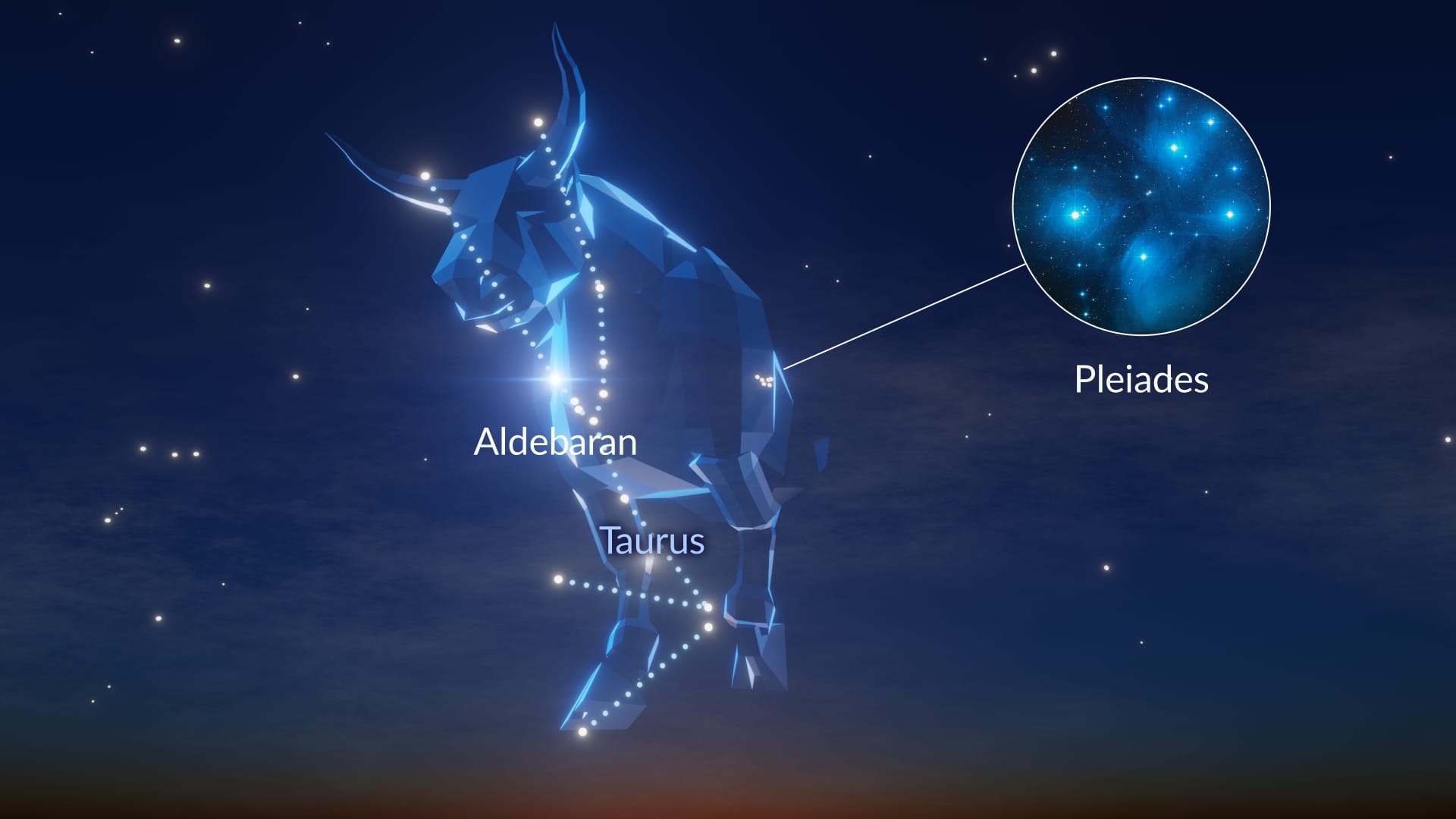
The zodiac constellation Taurus sits west of Auriga and is known for the fiery red star Aldebaran and the gorgeous Pleiades cluster. In mythology, this bull charges Orion, who defends himself with a club and shield. The Pleiades include over 300 stars; you can often see 6 or 7 of them with the naked eye.
Another major star cluster in Taurus is the Hyades. Aldebaran appears among the Hyades but isn’t actually part of the cluster: the star is 65 light-years from Earth, while the Hyades are 153 light-years away. In this constellation, you’ll also find the Crab Nebula (M1), a remnant of a supernova observed in 1054.
Find Taurus near Orion in the sky.
- Northern Hemisphere: Face south — Taurus is above Orion.
- Southern Hemisphere: Face north — Taurus is below Orion.
Dorado
- Brightness: ☆☆
- Visible between: 15°N and 90°S
- Brightest star: Alpha Doradus (mag 3.3)
- Brightest deep-sky objects: part of Large Magellanic Cloud (LMC, mag 0.9), Tarantula Nebula (30 Doradus, mag 8.0)
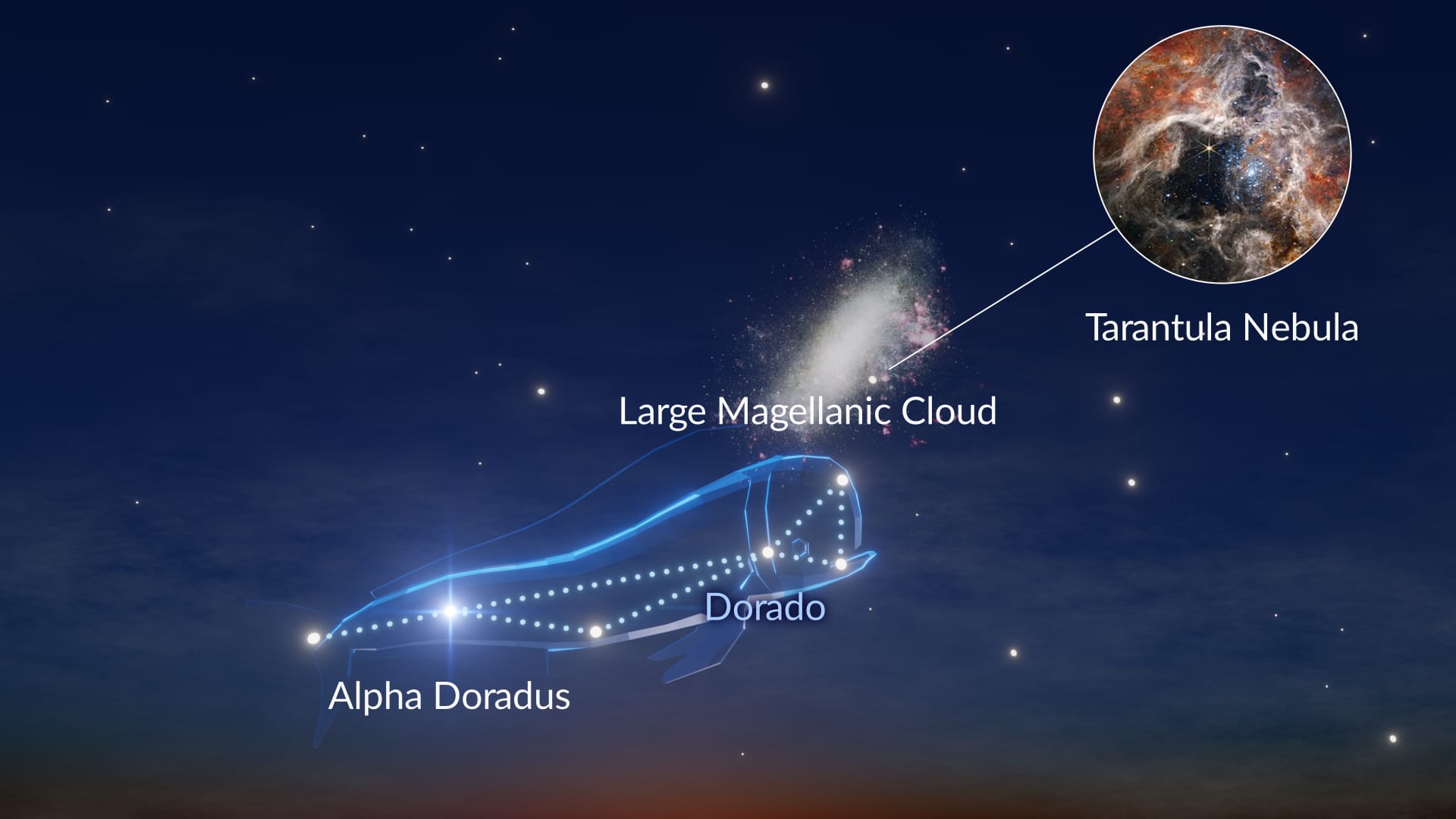
Dorado is a faint Southern Hemisphere constellation. Its brightest star, Alpha Doradus (mag 3.3), is best visible to the naked eye only under dark, low-light-pollution skies. Dorado contains much of the Large Magellanic Cloud (LMC) — the standout object in this region. The LMC can be seen without optical aid, but binoculars or a telescope reveal far more of its star clusters and nebulae, including the Tarantula Nebula (30 Doradus).
From the Southern Hemisphere, look high above the southern horizon to find Dorado. A helpful nearby landmark is the bright star Canopus in the constellation Carina, shining just to the east. From most of the Northern Hemisphere, Dorado doesn’t rise above the horizon.
Reticulum
- Brightness: ☆☆
- Visible between: 20°N and 90°S
- Brightest star: Alpha Reticuli (mag 3.3)
- Brightest deep-sky objects: NGC 1313 (mag 10.0), NGC 1559 (mag 10.5)
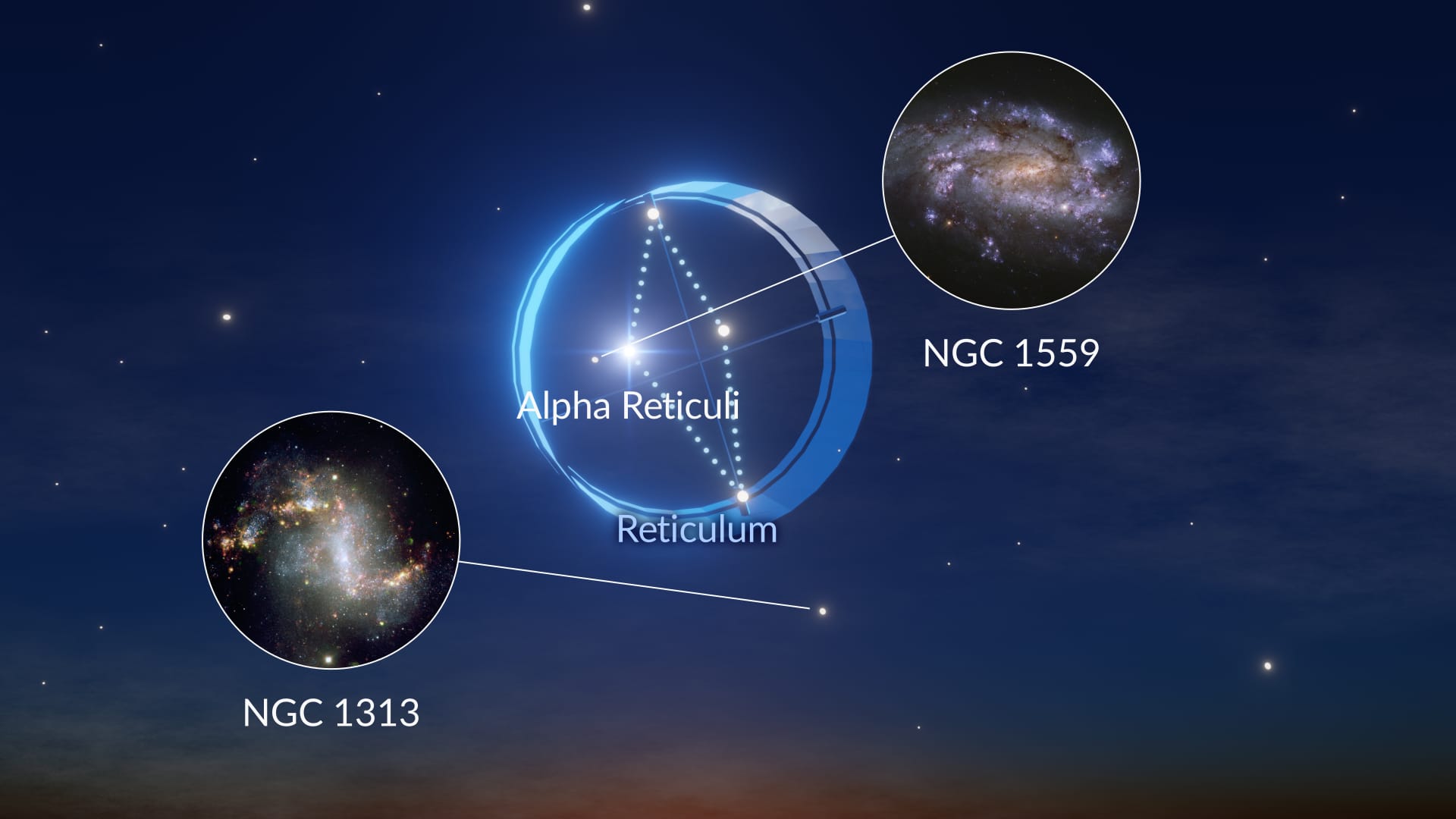
Once you’ve found Dorado, look just to its west for Reticulum — an even smaller Southern Hemisphere constellation. Its main pattern resembles a diamond, but you’ll need dark, moon-free skies to pick it out.
Caelum
- Brightness: ☆
- Visible between: 40°N and 90°S
- Brightest star: Alpha Caeli (mag 4.4)
- Brightest deep-sky object: NGC 1679 (mag 11.4)
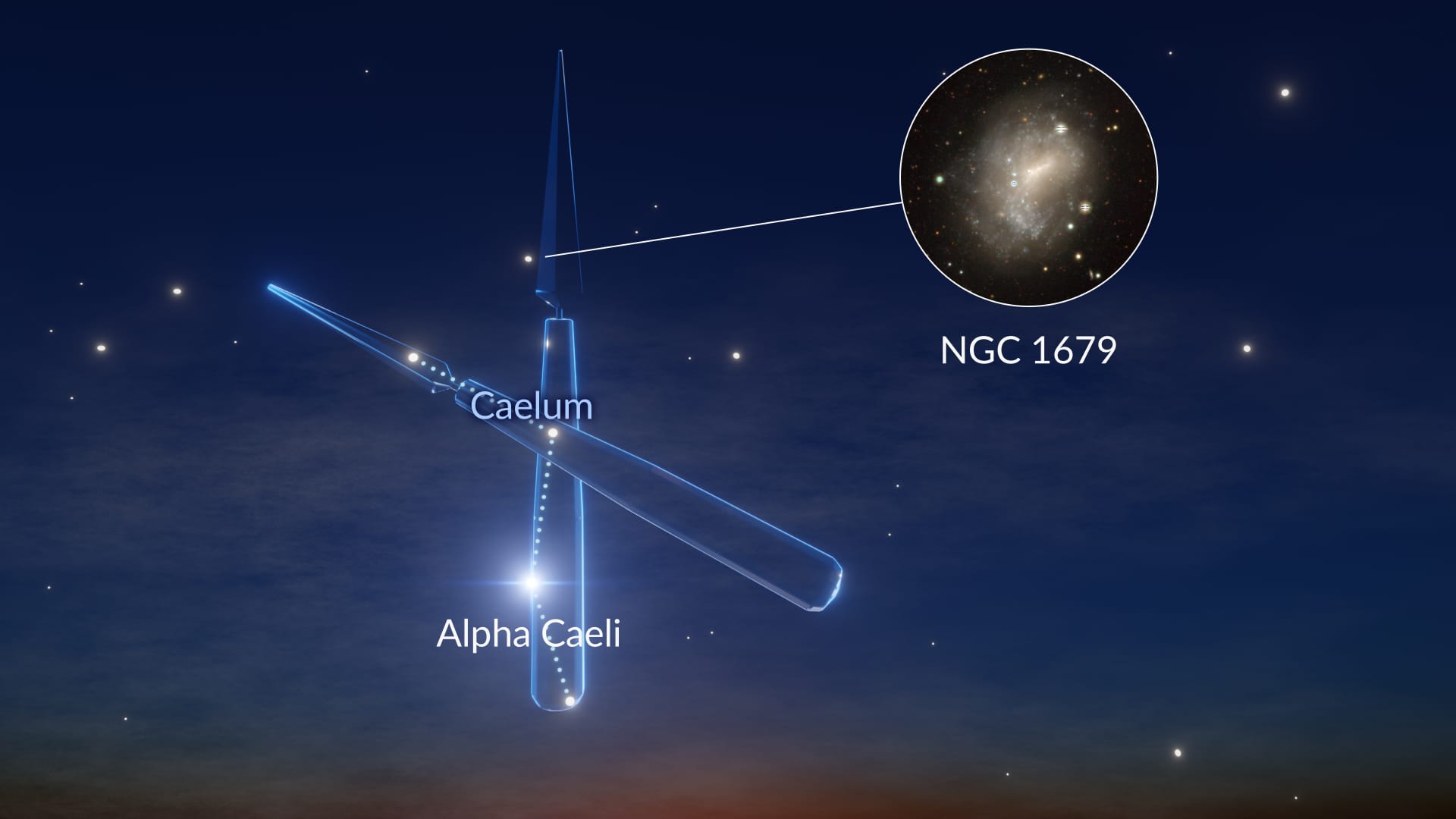
Caelum is a small, faint constellation. It appears high in the sky across much of the Southern Hemisphere, while observers in the southern parts of the Northern Hemisphere can spot it low above the southern horizon. A dark, moonless sky far from city lights is essential: its brightest star, Alpha Caeli, is only 4th magnitude, and the rest are even dimmer.
Because Caelum is small and lies away from the Milky Way, it doesn’t have any noteworthy deep-sky objects.
Mensa
- Brightness: ☆
- Visible between: 0°N and 90°S
- Brightest star: Alpha Mensae (mag 5.0)
- Brightest deep-sky object: part of Large Magellanic Cloud (LMC, mag 0.9)
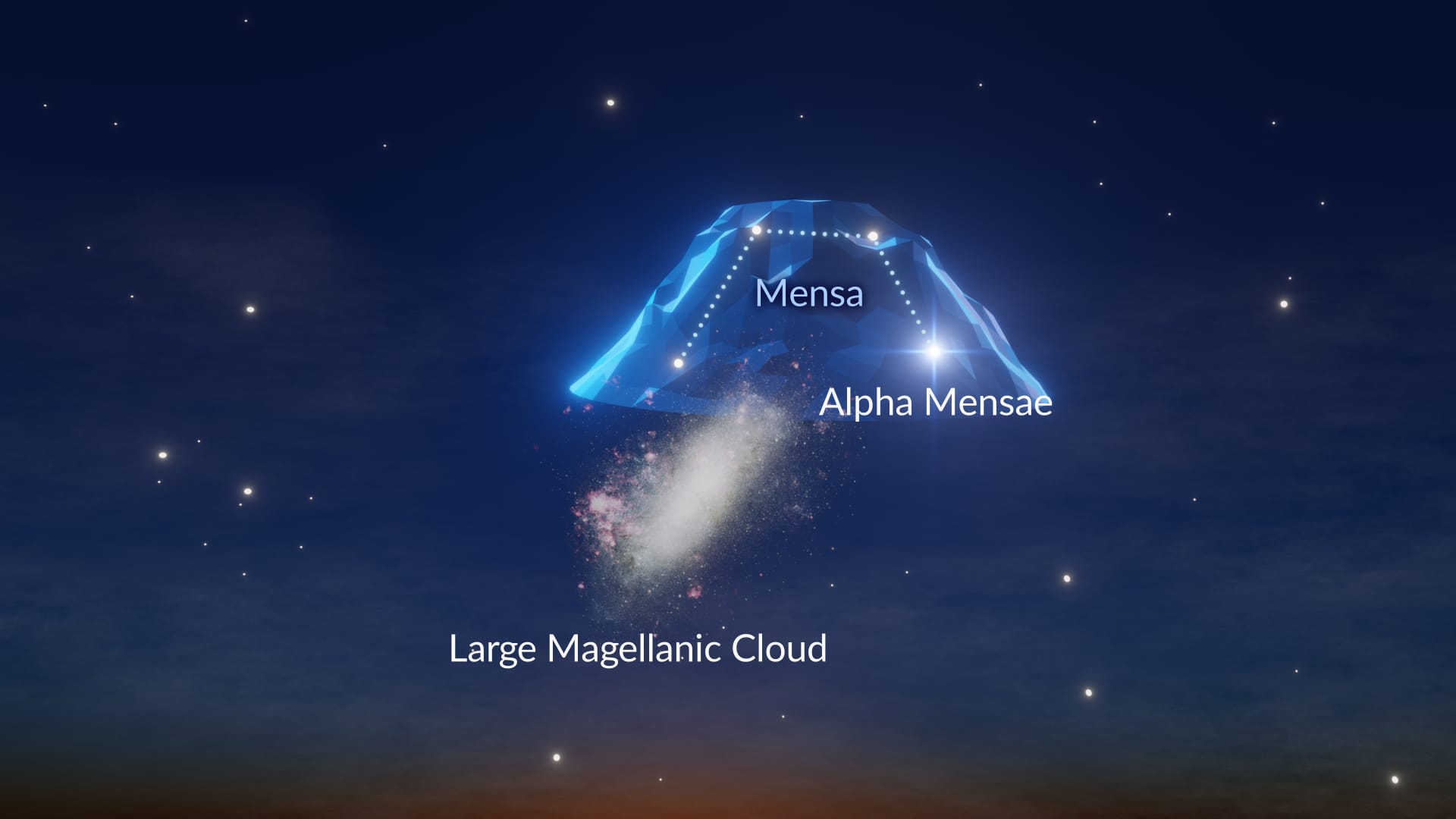
Mensa is an extremely faint constellation: its brightest star, Alpha Mensae (mag 5.0), is barely visible to the naked eye under dark skies. In fact, Mensa has the dimmest brightest star of all 88 constellations, which is why it’s often considered the faintest constellation overall.
Mensa contains nearly half of the Large Magellanic Cloud, but most of its other deep-sky objects — including open and globular clusters — are quite dim. Dorado borders Mensa to the north, so if you want to take on the challenge of spotting Mensa, start by finding Dorado first.
How to find constellations in the night sky?
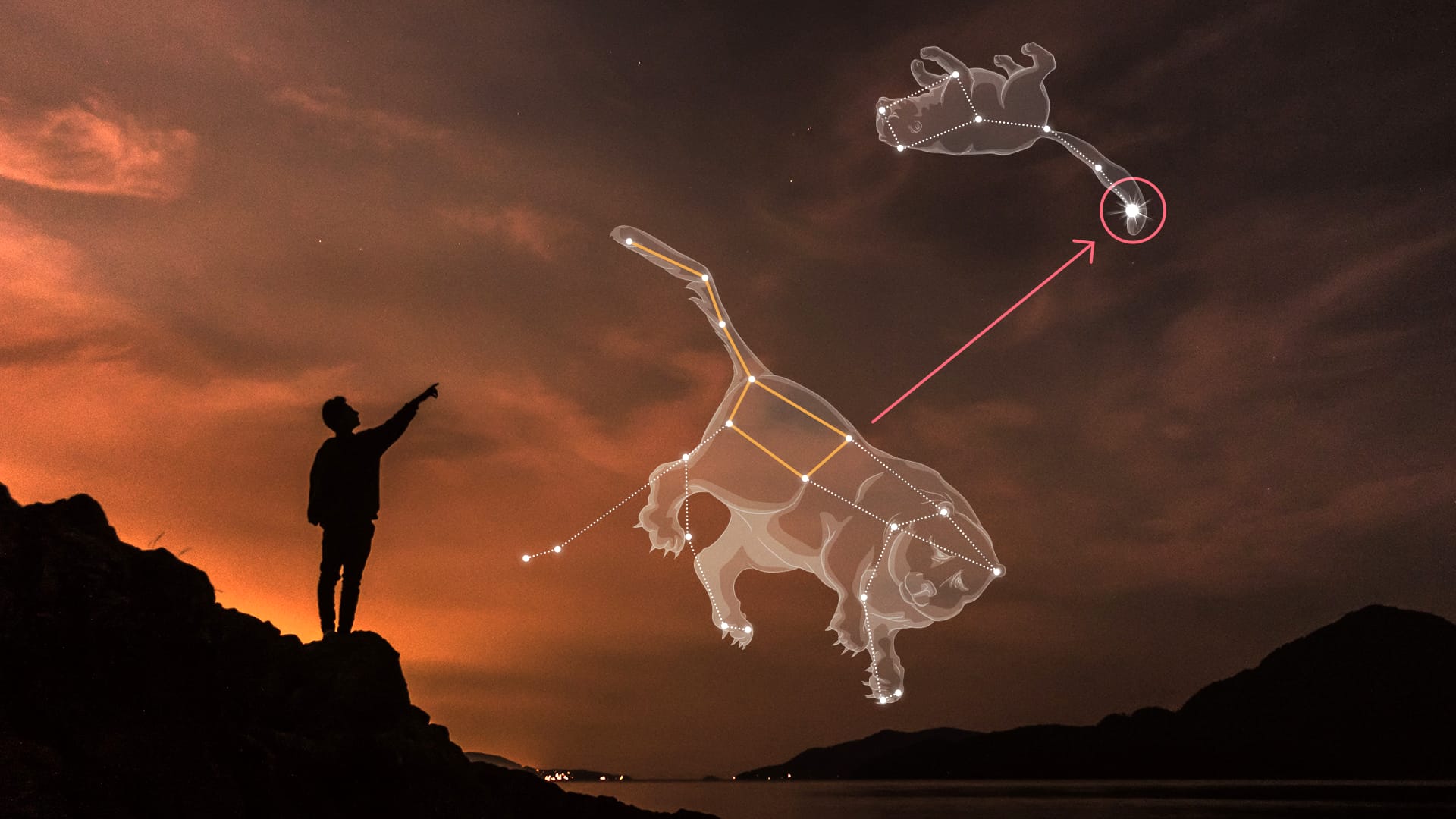
The simplest way to locate any constellation or star is by using the free Star Walk 2 app. If you’d rather go old-school, try star-hopping: our handy infographic shows how to find 15 famous stars using the Big Dipper or Orion’s Belt. After trying this classic method, confirm your discoveries with the interactive sky map in Star Walk 2 — it works offline, so you can test your skills wherever you are!
Constellations visible in January: bottom line
January nights are perfect for spotting showstoppers like Orion (with Orion’s Belt) and Taurus (home to the Pleiades). You can also hunt down fainter constellations — they’re more challenging, but rewarding with a bit of sky navigation. For the easiest way to find any constellation or star from your location, use the Star Walk 2 app.