Next Mars Opposition: See Mars at Its Best in February 2027

On February 19, 2027, Mars will reach opposition, offering the year’s best opportunity to observe the Red Planet. Around this date, Mars will remain visible nearly all night and appear brighter and larger than at any other time until its next opposition in 2029. Use the free Sky Tonight app to locate Mars in your sky, and read on to learn what makes the 2027 opposition special.
Contents
- Mars opposition 2027: Date, time, and key facts
- What is a Mars opposition?
- Why is the 2027 Mars opposition worth seeing?
- How to see Mars during the 2027 opposition
- Upcoming Mars opposition dates
- Mars opposition 2027: FAQ
- Mars opposition 2027: Bottom line
Mars opposition 2027: Date, time, and key facts
- Opposition: February 19, 2027, at 15:44 GMT (10:44 AM EST)
- Closest approach to Earth: February 20, 2027, at 00:07 GMT (February 19 at 7:07 PM EST)
- Distance from Earth: 101.4 million km (63 million miles)
- Apparent magnitude: −1.3
- Angular diameter: 13.8 arcseconds
- Constellation: Leo
- Best time to observe: around local midnight
- Visibility: nearly all night from both hemispheres
You do not need to observe Mars at the exact moment of opposition. The planet will look almost equally bright and large for several weeks around February 19, making February 2027 an excellent month for observing it.
What is a Mars opposition?
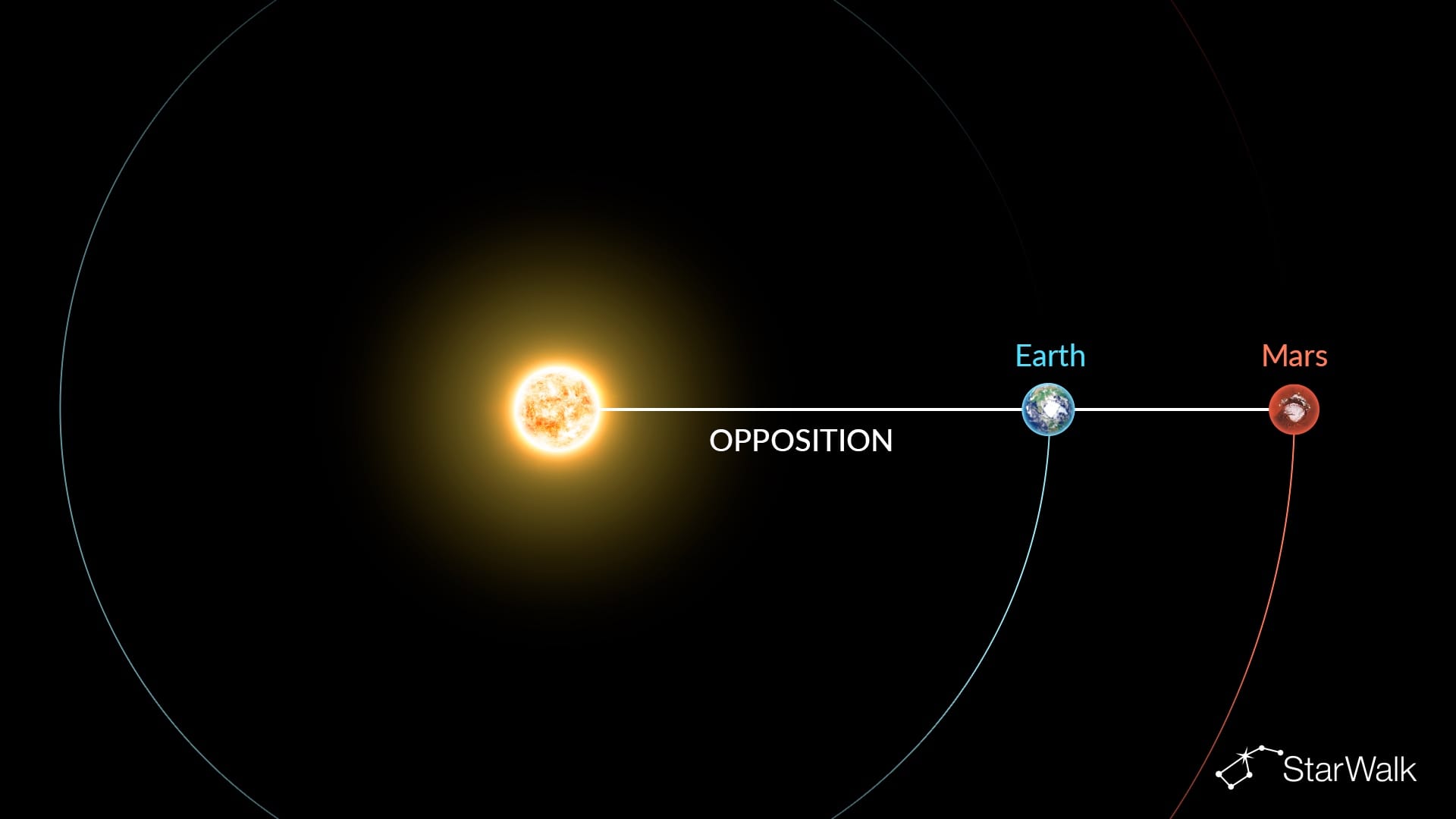
A Mars opposition occurs when Earth passes between Mars and the Sun. From our perspective, Mars and the Sun appear on opposite sides of the sky.
At opposition, Mars:
- Rises around sunset, reaches its highest point around midnight, and sets around sunrise;
- Appears almost fully illuminated (because the planets’ orbits are slightly tilted relative to each other, the three bodies do not form a perfectly straight line);
- Is near its closest point to Earth;
- Looks brighter and larger than during most of its orbital cycle.
Oppositions of Mars occur approximately once every 780 days, or 26 months, so the planet’s best observing conditions return only a little more than once every two years.
Want to understand the event visually? Explore our Mars opposition infographic to see why Mars becomes brighter and larger at opposition and compare its apparent size from one opposition to another.
Why is the 2027 Mars opposition worth seeing?
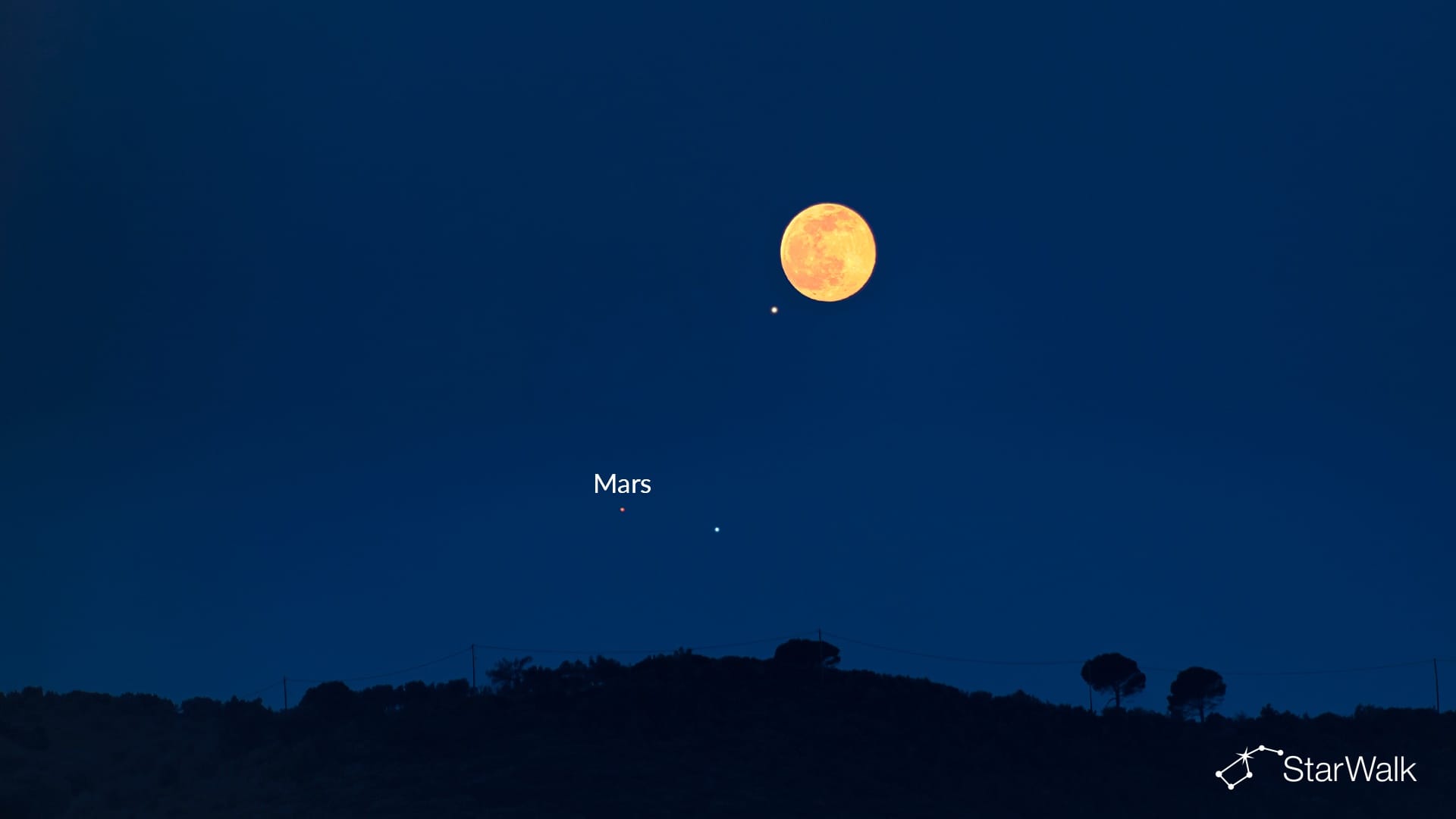
- Mars will be easy to see with the naked eye, even from a light-polluted city. At magnitude −1.3, it will shine almost as brightly as Sirius, the brightest star in the night sky.
- The planet will appear almost four times wider than when it is farthest from Earth. It will still look like a bright reddish point to the naked eye, but a telescope will reveal a noticeably larger disk than usual.
- Mars will be visible nearly all night, so you’ll have plenty of time for observation. Look for it in the east after sunset, high in the sky around midnight, and in the west before sunrise.
- The planet will be especially well placed for observers in the Northern Hemisphere. Its position north of the celestial equator means it will climb high above the horizon at northern latitudes.
- Another opposition will not occur until March 2029.
Below, you’ll find some more reasons to look up during the 2027 Mars opposition.
Mars and Jupiter are both at their best in February 2027
Mars won't be the only bright planet dominating the night sky. Jupiter reaches opposition on February 11, just over eight days before Mars. This means that around February 19, both planets will be near their brightest and visible for most of the night.
Jupiter will shine at magnitude −2.5, while Mars will reach about magnitude −1.3. Both will be in Leo, separated by roughly 11°, making them easy to compare with the naked eye.
February 19–20: Moon and Jupiter meet on the night of Mars opposition
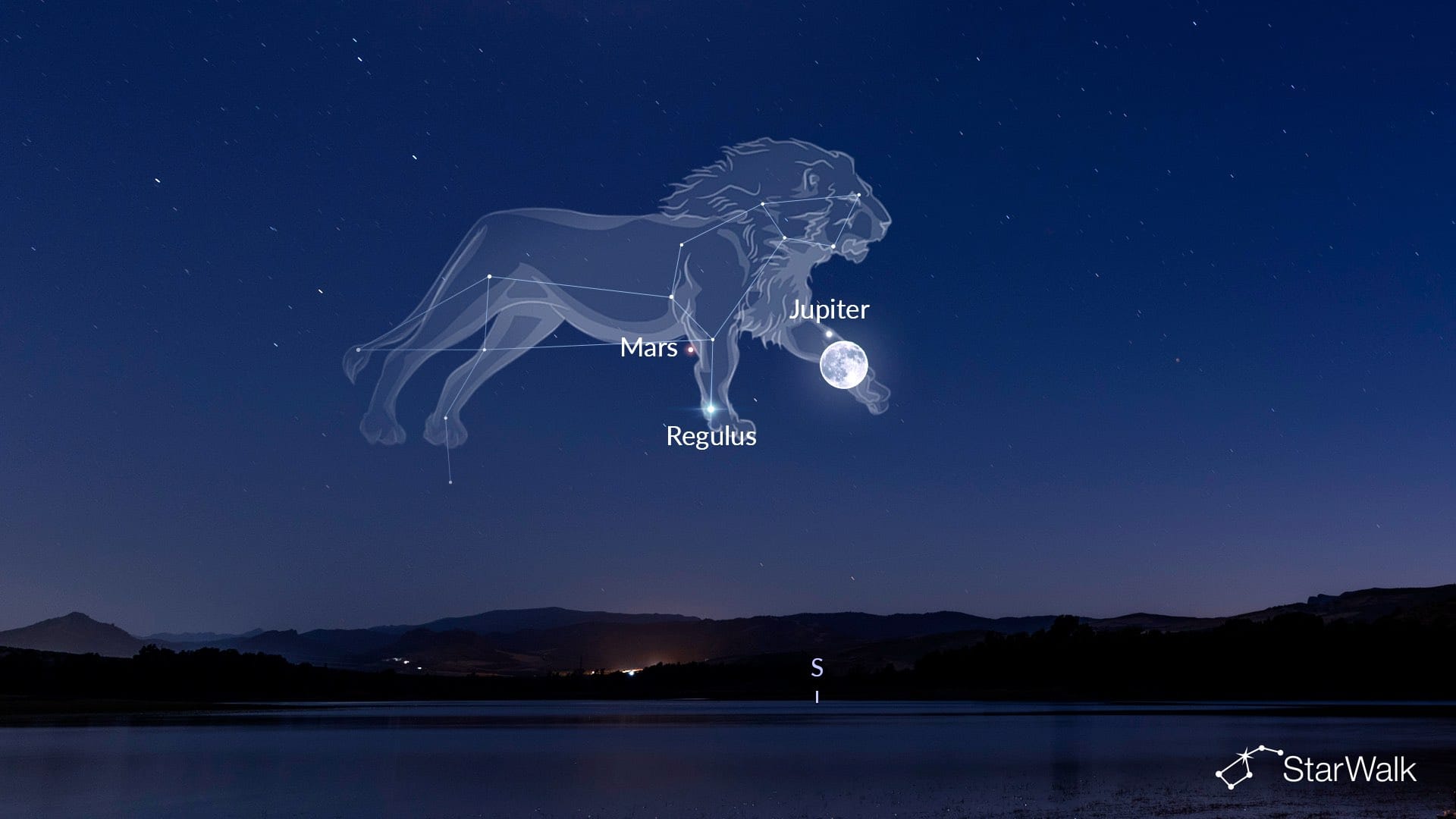
On the night of February 19–20, the nearly Full Moon will pass just over 1° from Jupiter.
- Close approach time: February 20 at 04:57 GMT (February 19 at 11:57 PM EST)
- Close approach distance: 1°05′
- Conjunction time: February 20 at 05:43 GMT (12:43 AM EST)
- Conjunction distance: 1°11′
Look for the brilliant Moon and Jupiter (mag −2.5) close together, with reddish Mars (mag −1.3) about 11° away near the bright star Regulus (mag 1.3).
Together, the Moon, Jupiter, Mars, and Regulus will form an eye-catching pattern that can be seen with the naked eye. The exact arrangement will depend on your location, so use Sky Tonight to check the view from your city.
February 20: Full Moon near Mars during a lunar eclipse

The night after the opposition brings another interesting sight. On February 20, the Full Moon will pass near Mars in Leo. Regulus will also appear nearby, forming a loose grouping with the Moon and Mars.
- Close approach time: February 20 at 19:41 GMT (2:41 PM EST)
- Close approach distance: 5°19′
- Conjunction time: February 20 at 23:49 GMT (6:49 PM EST)
- Conjunction distance: 5°55′
The pair will be too far apart to fit within a typical telescope's field of view, but they will be easily visible together with the naked eye. Depending on the binoculars, both objects may also fit within the same field of view.
At the same time, the Moon will undergo a penumbral lunar eclipse:
- Eclipse begins: February 20 at 21:12 GMT (4:12 PM EST)
- Maximum eclipse: February 20 at 23:12 GMT (6:12 PM EST)
- Eclipse ends: February 21 at 01:13 GMT (February 20 at 8:13 PM EST)
During a penumbral eclipse, the Moon passes through the lighter outer part of Earth’s shadow. It will not turn red, but part of the lunar disk may appear subtly shaded.
Check our upcoming eclipses infographic to see when and where the next solar and lunar eclipses will be visible.
How to see Mars during the 2027 opposition
On the night of February 19–20, first find the nearly Full Moon and brilliant Jupiter beside it. Then look about 11° to the east — roughly the width of your fist held at arm’s length — to find Mars. It will appear as a bright reddish-orange point near the star Regulus in Leo.
You won’t need dark skies or any equipment to see Mars. For telescopic observations, choose a night close to the opposition when the bright Moon is farther from the planet, and observe when Mars is high above the horizon. Under steady atmospheric conditions, you may see its northern polar cap and dark surface markings.
If you’re unsure which bright point is Mars, use Sky Tonight or Star Walk 2 to identify it from your location.
How to find Mars using Sky Tonight
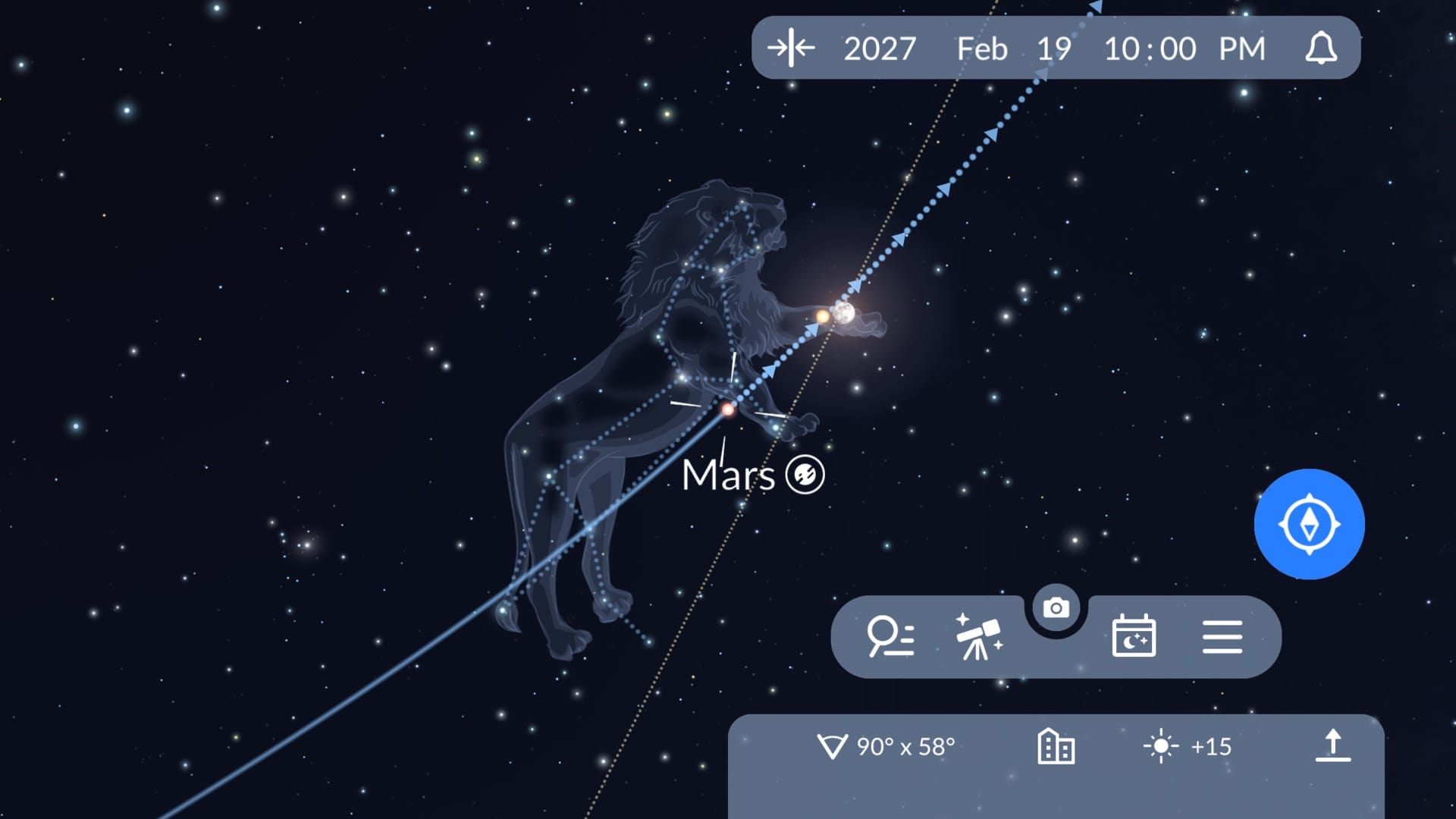
- Tap the magnifier icon at the bottom of the screen;
- Type “Mars” in the search field;
- Tap the blue target icon to see where Mars is located in your sky;
- Point your device toward the sky and follow the on-screen arrow.
You can also open the Time Machine at the top of the screen and set the date to February 19, 2027, to see where Mars will appear during the opposition.
How to find Mars using Star Walk 2
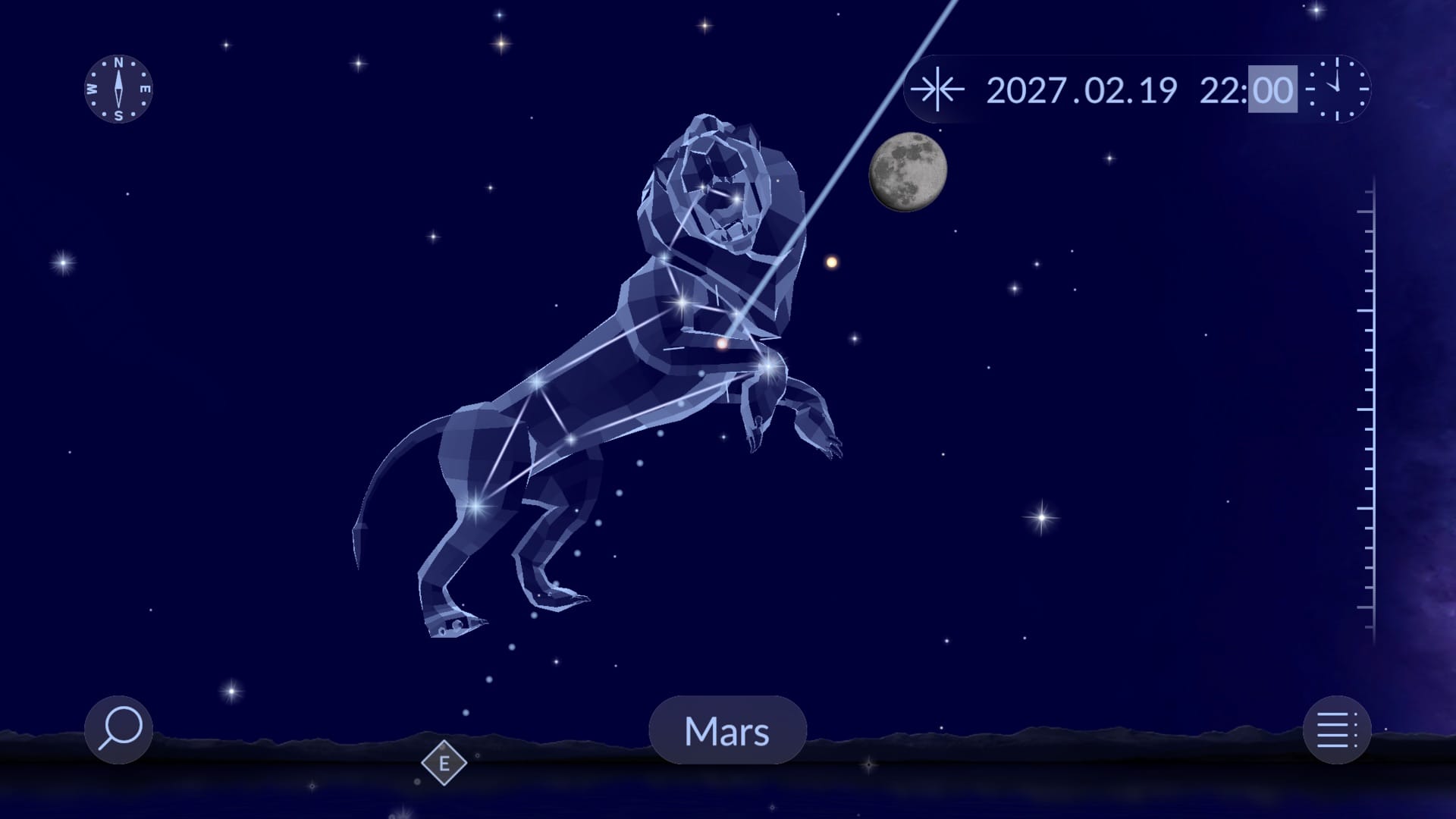
- Tap the magnifier icon in the bottom-left corner;
- Type “Mars” in the search field;
- Tap the corresponding result;
- Point your device toward the sky and follow the on-screen arrow to locate Mars.
You can also tap the clock icon and set the date to February 19, 2027, to see where Mars will appear during the opposition.
Upcoming Mars opposition dates
The next Mars opposition after 2027 will occur on March 25, 2029. The following oppositions will bring Mars progressively closer to Earth, culminating in a particularly favorable opposition in 2035.
| Date | Distance from Earth | Angular diameter | Apparent magnitude |
|---|---|---|---|
| February 19, 2027 | 101.4 million km (63.0 million mi) | 13.8″ | −1.3 |
| March 25, 2029 | 97.1 million km (60.3 million mi) | 14.4″ | −1.5 |
| May 4, 2031 | 83.6 million km (51.9 million mi) | 16.8″ | −1.9 |
| June 28, 2033 | 63.9 million km (39.7 million mi) | 21.9″ | −2.7 |
| September 15, 2035 | 57.1 million km (35.5 million mi) | 24.5″ | −2.9 |
The apparent size of Mars varies greatly from one opposition to another because its orbit is noticeably elliptical. Oppositions that occur when Mars is closer to its perihelion bring the planet much nearer to Earth.
Mars opposition 2027: FAQ
Where will Mars be in the sky during the 2027 opposition?
Mars will be in Leo, near the bright star Regulus. Look east after sunset; around midnight, the planet will be near its highest point in the sky.
Can you see Mars without a telescope?
Yes. Around opposition, Mars will look like a very bright reddish-orange point and will be easily visible to the naked eye, even from cities.
What can you see on Mars through a telescope?
Depending on your telescope and observing conditions, you may see the northern polar cap, dark surface markings, and lighter orange regions. Even at opposition, Mars will appear as a small disk through a telescope, so a sharp view will depend on calm, steady air with minimal atmospheric distortion.
How often does Mars reach opposition?
Mars reaches opposition about once every 780 days, or 26 months. The next opposition after February 19, 2027, will occur on March 25, 2029.
When will Mars be closest to Earth in 2027?
Mars will come closest to Earth on February 20 at 00:07 GMT (February 19 at 7:07 PM EST), passing about 101.4 million km (63 million miles) from our planet.
Think you know the Red Planet? Take our Mars quiz and test your knowledge of its surface, exploration history, and unusual features.
Mars opposition 2027: Bottom line
Mars reaches opposition on February 19, 2027, at 15:44 GMT (10:44 AM EST). Look for the bright reddish planet in Leo from sunset until sunrise; the best views will come around local midnight, when Mars is highest in the sky.
February is especially good for planet watching because Jupiter reaches opposition just over eight days earlier. On February 19–20, Jupiter will appear beside the nearly Full Moon. The following night, the Full Moon will pass near Mars while undergoing a penumbral lunar eclipse.
Use Sky Tonight or Star Walk 2 to check exactly where Mars will appear from your location.