“Ring of Fire” at the Edge of the World: All You Need to Know
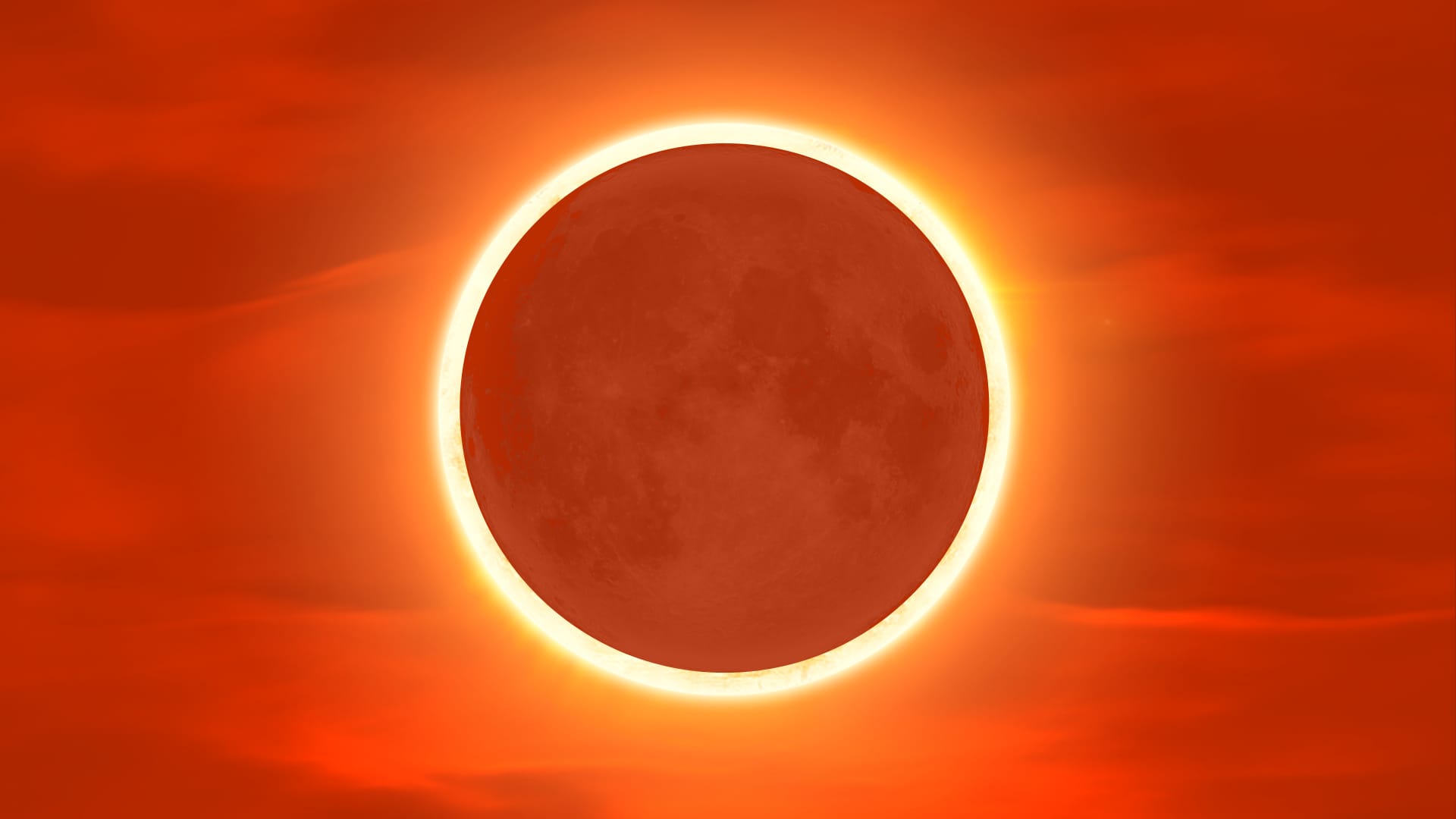
On February 17, 2026, the Moon will slide in front of the Sun, creating the “ring of fire” solar eclipse. But astronomy isn’t for the weak — to see it in person, you’ll need to head to Antarctica and possibly crash at a Russian research station. Not into extreme cold (or extreme logistics)? Track the eclipse with the Eclipse Guide app instead. This article explains what makes this eclipse genuinely special… even if it’s basically off-limits for 99.9999% of humanity.
And if Antarctica sounds a bit too ambitious, 2026 has another solar spectacle in store. On August 12, a total solar eclipse will cross Greenland, Iceland, Spain, and Portugal — making it much easier to catch without an expedition to the edge of the world.
Contents
- Quick facts about the solar eclipse in February 2026
- What kind of eclipse is it?
- What time is the solar eclipse in February 2026?
- Map of the February 2026 solar eclipse: where is it visible?
- What makes this eclipse special?
Solar eclipse: F.A.Q.
- What is the difference between an annular and a total solar eclipse?
- Where will the “ring of fire” be visible on Feb 17, 2026?
- Where will the partial phase of the eclipse on Feb 17, 2026, be visible?
- What time is the eclipse?
- Is there a solar eclipse today?
- Will it get dark during this eclipse?
- Is it safe to look at an annular eclipse without sunglasses during the “ring of fire”?
- Can I use my phone, binoculars, or a telescope to view the eclipse?
- What if I’m not in the visibility zone — how can I experience it?
- When is the next solar eclipse after February 2026?
- Eclipse on February 17, 2026: Bottom line
Quick facts about the solar eclipse in February 2026
- Date: Tuesday, February 17, 2026
- Type: Annular solar eclipse (“ring of fire”)
- Where annularity is visible: remote Antarctica, the Southern Ocean
- Where a partial eclipse is visible: parts of southern Africa and the far south of South America, plus much of Antarctica
- What time is the eclipse: from 09:56 GMT to 14:27 GMT
What kind of eclipse is it?
This is an annular solar eclipse — sometimes called a “ring of fire” eclipse — because the Moon will cover the center of the Sun (96% of the visible surface) while leaving a bright ring of sunlight visible around its edge (but only for observers inside the thin annularity path).
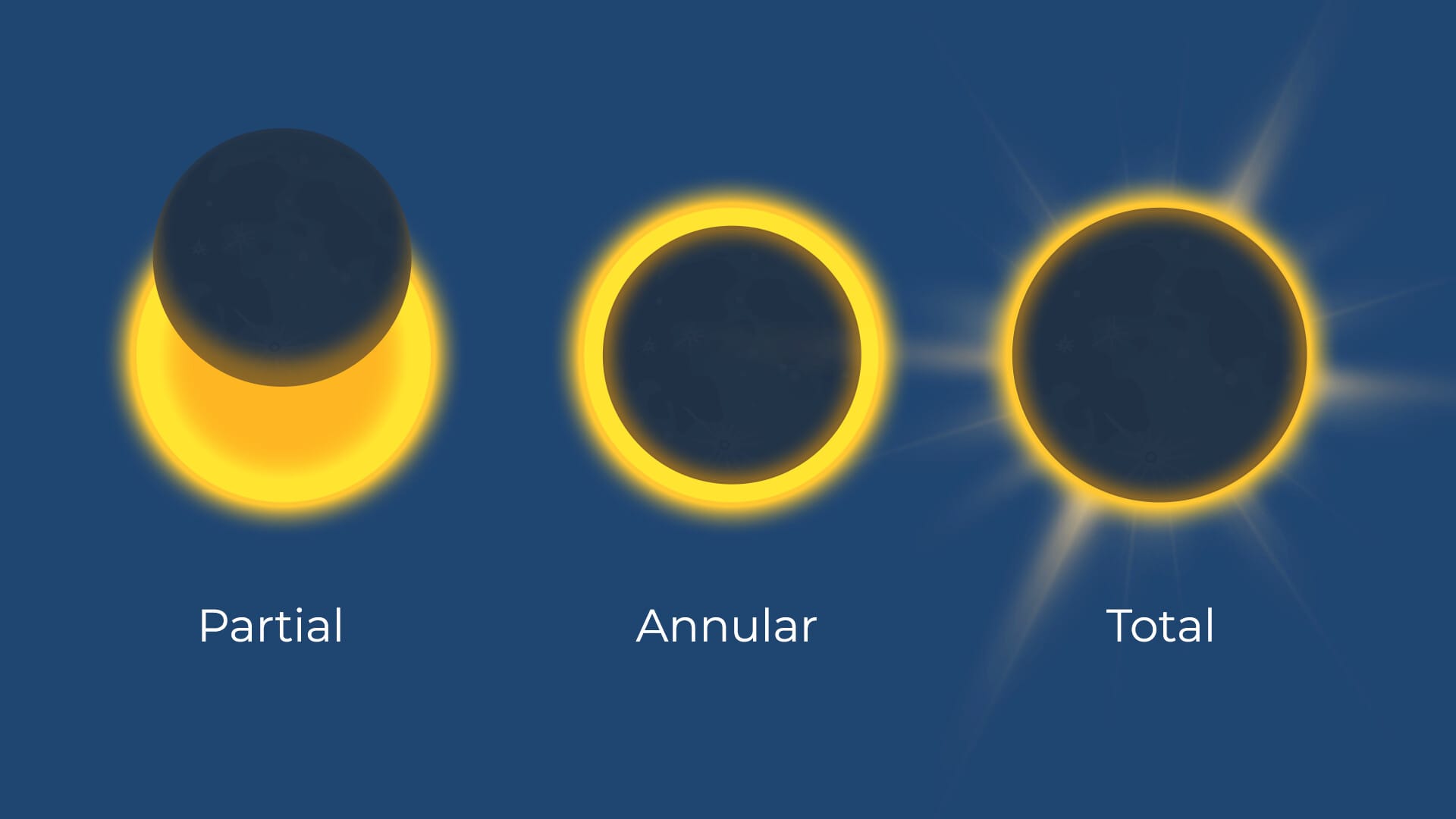
Remember: a solar eclipse is never safe to look at directly with the naked eye. Even when the Sun looks “almost covered,” the remaining sunlight is still intense enough to damage your eyes.
What time is the solar eclipse in February 2026?
Eclipse timeline (GMT):
- Partial eclipse begins: 09:56 GMT
- Annularity begins: 11:42 GMT
- Maximum eclipse: 12:12 GMT
- Annularity ends: 12:41 GMT
- Partial eclipse ends: 14:27 GMT
This is the global timeline. The exact timing of eclipses always differs depending on where you are — a solar eclipse starts at one place on Earth and ends at another. To explore the exact timings for this and other eclipses in your exact location, download the Eclipse Guide app.
Map of the February 2026 solar eclipse: where is it visible?
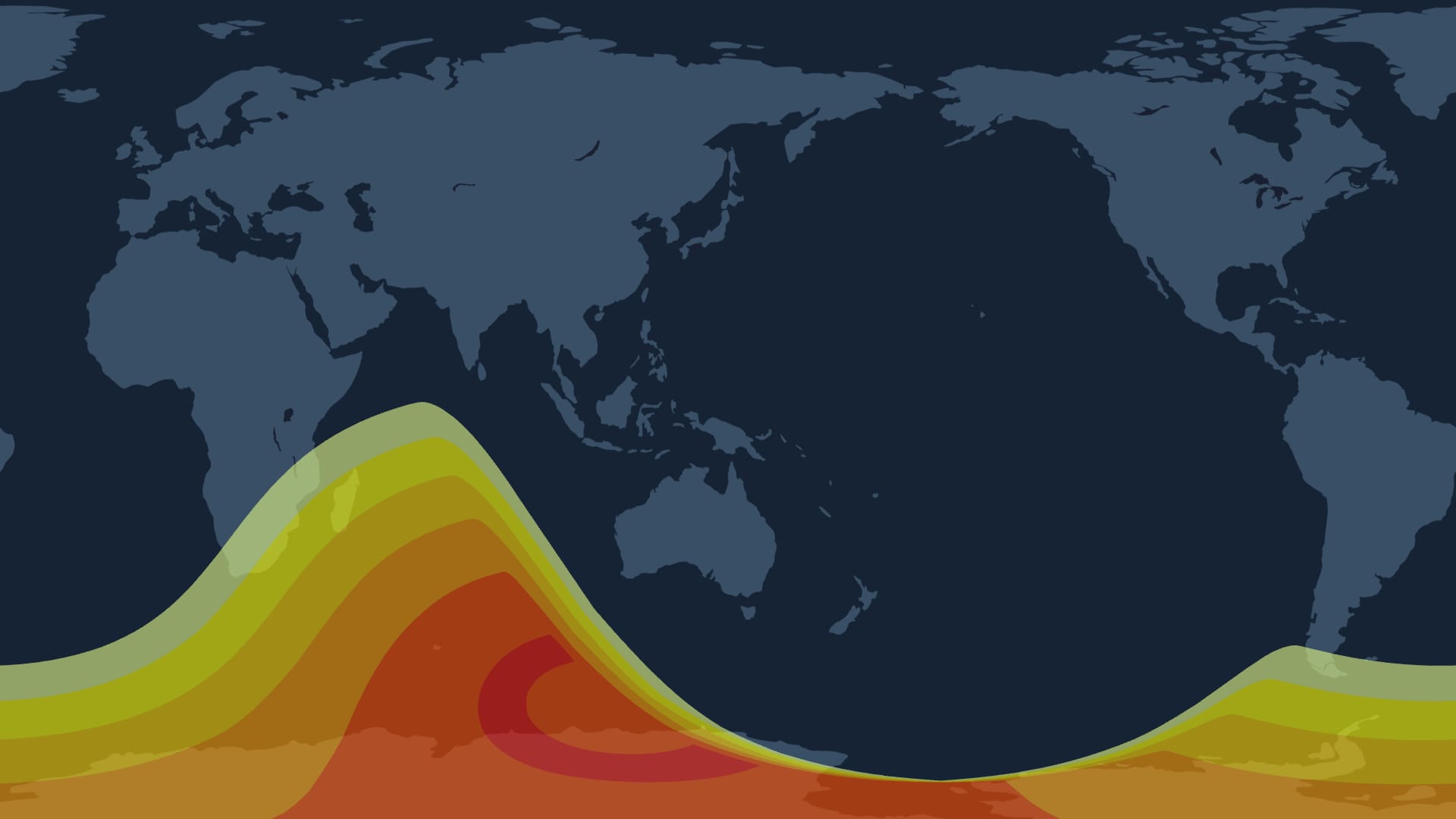
Unfortunately, most of the world will miss the solar eclipse in February 2026 entirely — the eclipse path is confined to the Southern Hemisphere’s remote regions. Let’s see where the eclipse will actually be visible.
1) “Ring of fire” visibility (annularity)
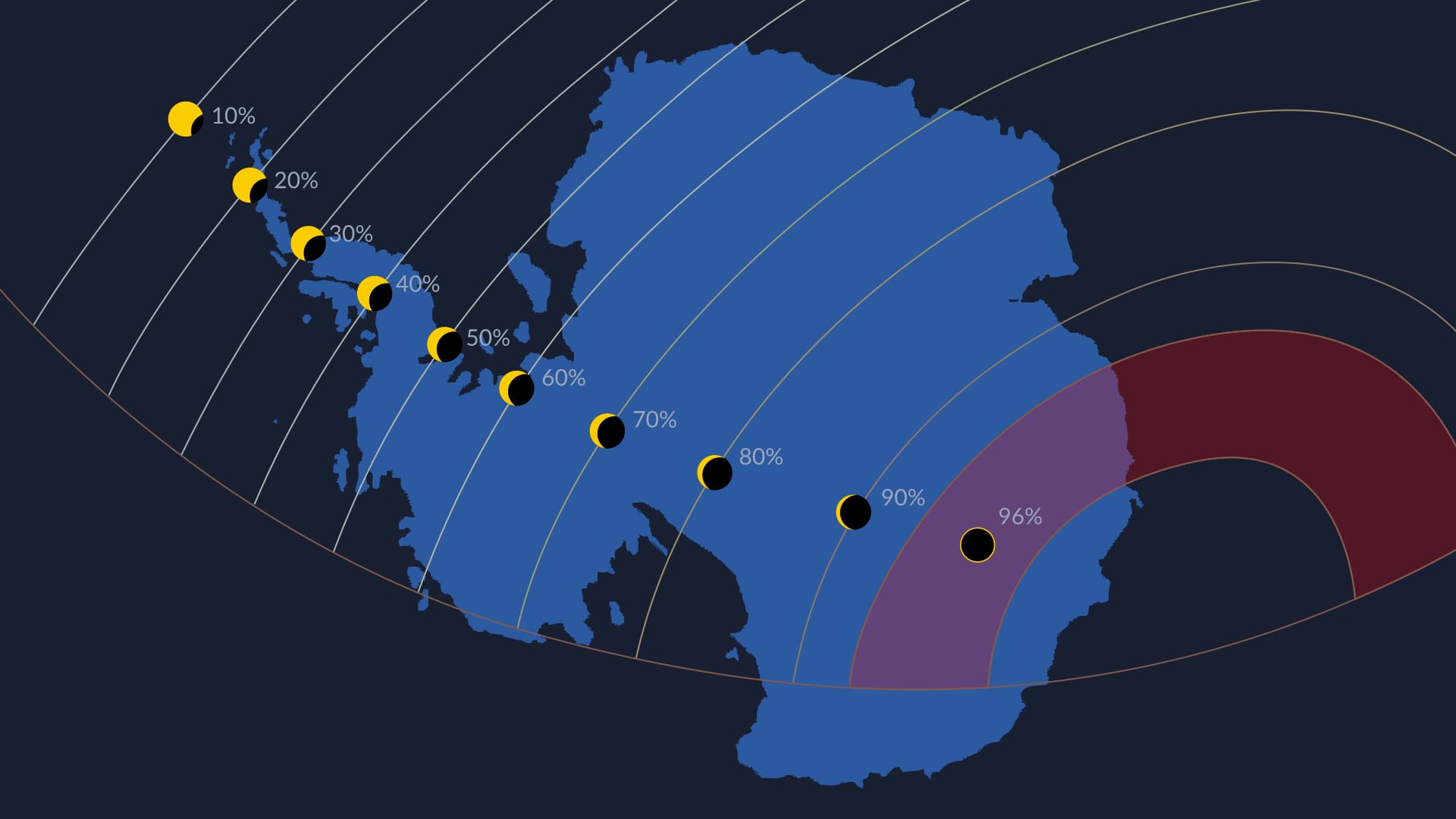
The annular phase will be visible only across remote Antarctica and nearby ocean areas — a path so isolated that only a handful of observers within the annularity path in Antarctica and nearby waters will see the eclipse in person.
Ironically, the annularity track is actually wide (about 616 km) by eclipse standards. For comparison, the track of the 2027 annular solar eclipse will be 282 km wide. That eclipse will be visible across Chile and Argentina and will last for more than 7 minutes.
Best locations to see the “ring of fire” eclipse in February 2026
If you could travel to Antarctica and stand inside the annularity path, you’d see the Sun transform into a thin ring for a couple of minutes. Here are the limited locations where the "ring of fire" will be visible during the annular solar eclipse on February 17, 2026:
Mirny Station (Antarctica):
- Annularity duration: 1 minute 52 seconds
- Time: 12:07 GMT
- Sun height: about 10° above the horizon
Concordia Research Station (Antarctica):
- Annularity duration: 2 minutes 1 second
- Time: 11:46 GMT
- Sun height: about 5° above the horizon
As you can see, even in the “best” spots, the Sun will be very low above the horizon — making weather, haze, and local terrain the crucial factor in the eclipse visibility.
2) Partial eclipse visibility
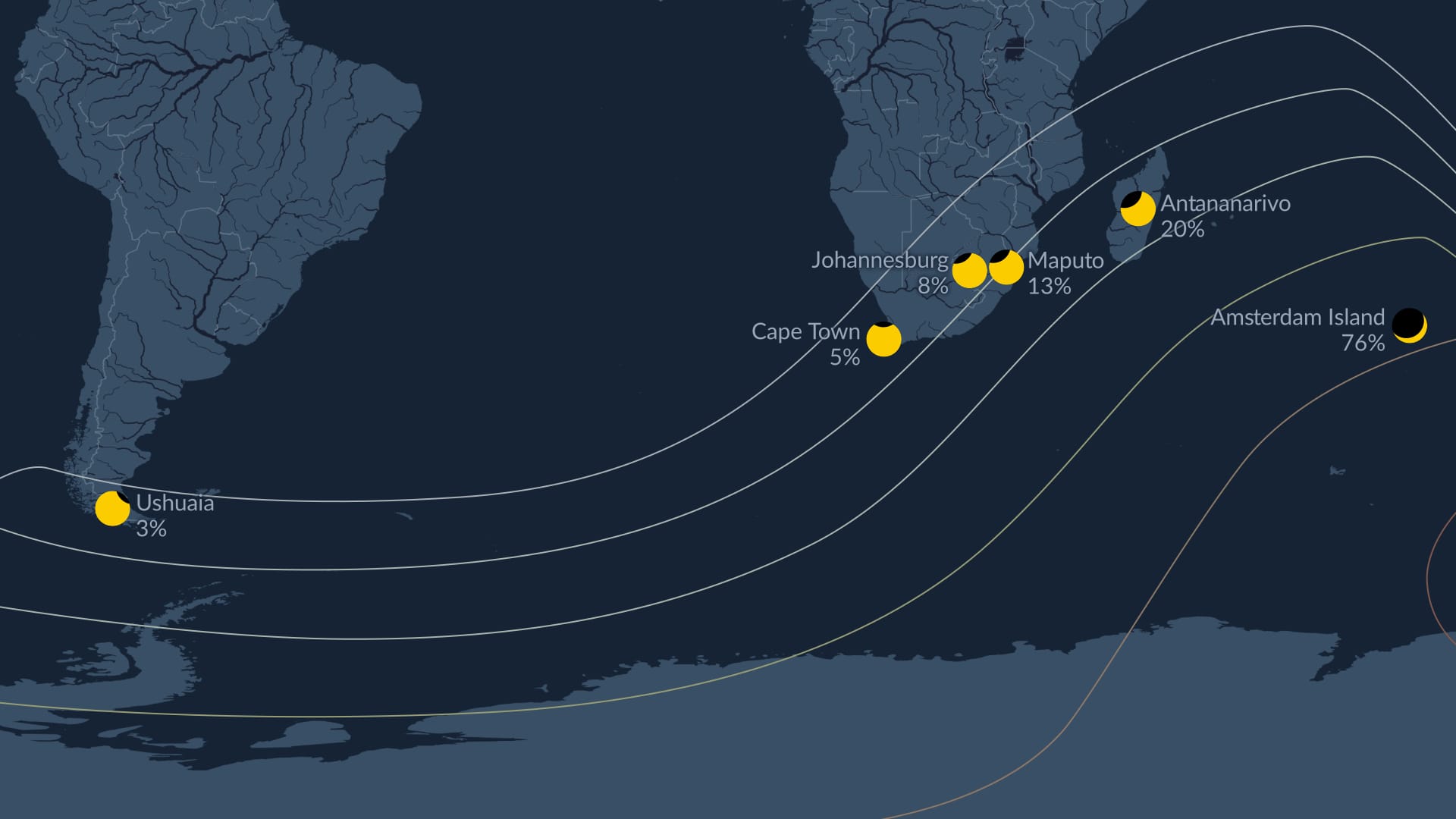
Observers in locations outside the annular shadow path will get to see a partial solar eclipse — the Sun will look like a “bite” was taken from it. This phenomenon will be visible across:
- much of Antarctica
- the southern tip of South America
- parts of southern Africa
- plus surrounding ocean regions
3) Not visible at all: the rest of the world
If you’re outside those regions (North America, Europe, Asia, etc.), there’s no local eclipse on February 17, 2026, to watch — but you can still follow the event via astronomy apps, like Eclipse Guide.
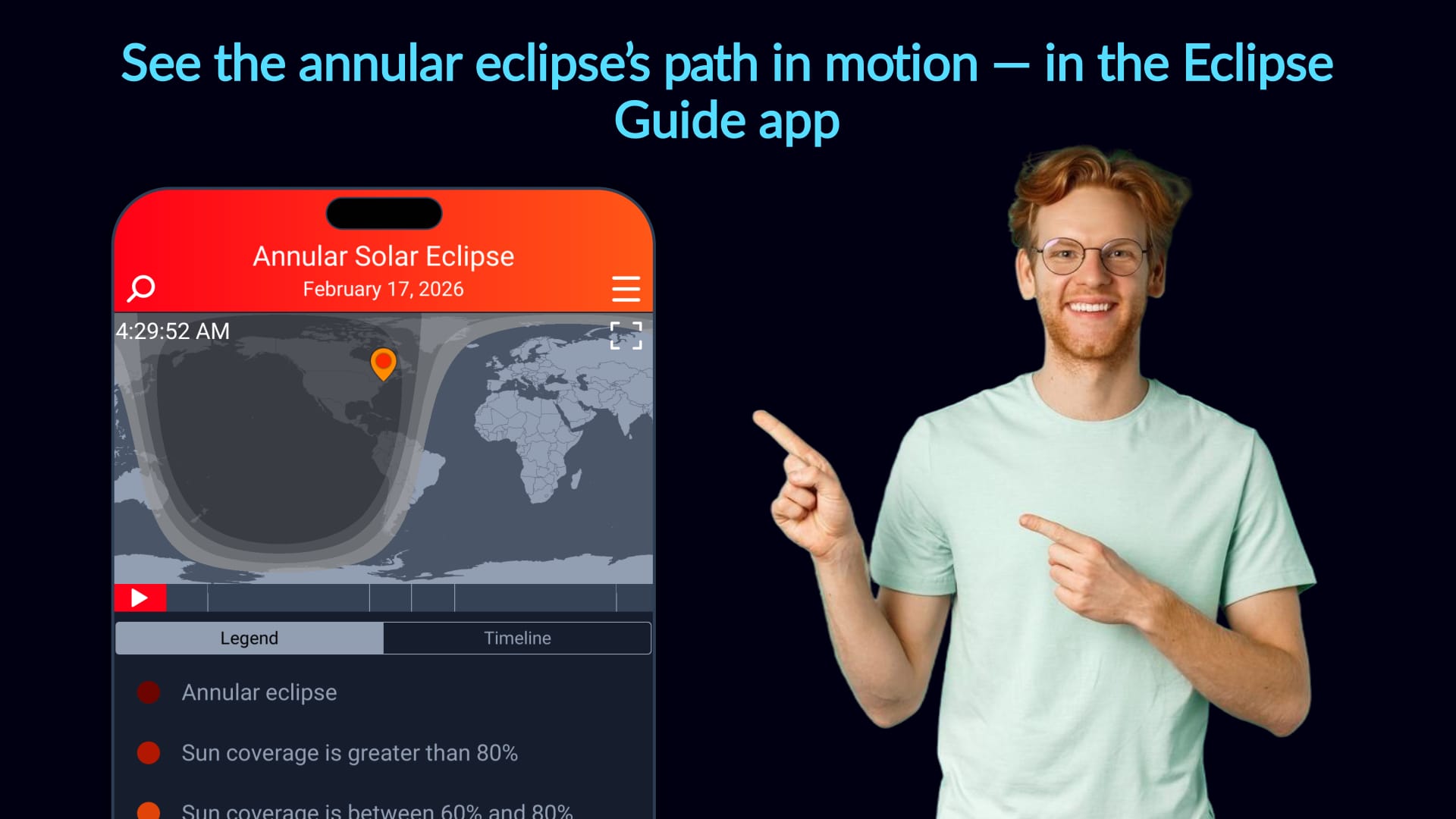
The Eclipse Guide app is designed for tracking eclipses. If you’re searching “is there a solar eclipse today”, check the live map in the app — tap the magnifying glass icon in the upper left corner to see a list of all upcoming solar eclipses. Those visible from your location are marked with an eye icon.
What makes this eclipse special?
The February 2026 solar eclipse stands out for several reasons:
- Visible by more penguins than people
The “ring of fire” path runs across remote Antarctica, so the best in-person views are basically limited to a handful of research stations. Spectacular? Yes. Convenient? Absolutely not.
- It’s a deep annular eclipse
At maximum, the Moon covers about 96% of the Sun — leaving a thin, striking ring. It’s one of the more dramatic annular eclipses you can get… if you were actually able to see it.
- It kicks off a “ring of fire” streak
This is the first eclipse of 2026 — and the start of three annular eclipses in three consecutive years:
- Feb 17, 2026 — Antarctica (the quiet opener)
- Feb 6, 2027 — a much more “human-friendly” track across the Atlantic toward Africa
- Jan 26, 2028 — best for vacation plans: Galápagos + Spain
Never miss an upcoming solar or lunar eclipse with our constantly updated infographic.
- A rare eclipse in a rare place
This eclipse won’t be the easiest or the most convenient to see, but its extreme location also makes it unique. An annular eclipse over Antarctica offers something few eclipses can: dramatic polar landscapes, low Sun angles, and a setting that is rarely combined with a solar eclipse.
For professional photographers, expedition teams, or observers already working in polar regions, this could be a once-in-a-lifetime opportunity to capture an eclipse in one of the most remote environments on Earth.
Solar eclipse: F.A.Q.
What is the difference between an annular and a total solar eclipse?
During a total eclipse, the Moon fully covers the Sun, briefly revealing the solar corona. During an annular eclipse, the Moon is farther away, appearing slightly smaller than the Sun and can’t cover it completely, leaving a bright ring of sunlight (“ring of fire”) around the Moon.
Where will the “ring of fire” be visible on Feb 17, 2026?
The annular (“ring of fire”) phase will be visible along a narrow path across remote Antarctica (and nearby ocean regions).
Where will the partial phase of the eclipse on Feb 17, 2026, be visible?
Outside the annularity path, a partial eclipse will be visible from much of Antarctica, plus parts of the far Southern Hemisphere, including the southern tip of South America and parts of southern Africa.
What time is the eclipse?
Using GMT (global reference time), the partial eclipse begins at 09:56 GMT, the maximum eclipse is at 12:12 GMT, and the partial eclipse ends at 14:27 GMT. But local timing depends on where you are.
Is there a solar eclipse today?
It depends on the date and your location. The closest eclipse is the annular solar eclipse on February 17, 2026. To check whether there’s an eclipse today and where it’s visible, use the Eclipse Guide app.
Will it get dark during this eclipse?
Not like during a total eclipse. Because this is an annular eclipse, the Sun won’t be fully covered, so daylight will dim, but it won’t turn into night.
Is it safe to look at an annular eclipse without sunglasses during the “ring of fire”?
No. Never look at the Sun directly during an annular eclipse without proper solar protection. The exposed part of the Sun’s surface is still an intense light that can damage your eyes. Use ISO 12312-2 eclipse glasses or indirect-viewing methods.
Can I use my phone, binoculars, or a telescope to view the eclipse?
Only if they have a proper solar filter designed for that specific device (especially for binoculars and telescopes). Without a filter, you can permanently damage your eyes and/or the equipment.
What if I’m not in the visibility zone — how can I experience it?
Use an interactive eclipse map to follow the event in real time and look for livestream coverage closer to the date.
When is the next solar eclipse after February 2026?
The next solar eclipse after February 17, 2026, is the total solar eclipse on August 12, 2026. It will be visible from parts of Russia, Greenland, Iceland, and Spain, with the total phase lasting for 2 minutes and 18 seconds.
Eclipse on February 17, 2026: Bottom line
On February 17, 2026, an annular “ring of fire” solar eclipse will happen — but the “ring” is only visible from remote Antarctica. A partial solar eclipse will be seen across the southern tip of South America, southern Africa, and most of Antarctica. This eclipse also kicks off a run of three annular eclipses in three consecutive years (2026–2028). To check exact timings for your location and plan your viewing, use the Eclipse Guide app.
While you’re waiting for an eclipse you can actually see without traveling to the end of the world, become an eclipse expert: take our eclipses quiz for fun facts and a quick knowledge check.
The next eclipse is coming very soon, and it will be visible across much of the world! On March 2–3, 2026, the Blood Moon 2026 will occur. Over 3 million observers from North America, Japan, southeast Asia, China, India, most of Russia, Australia, and northwest South America will see at least some of the total phase.