Kreutz Sungrazers Explained: What They Are and How to Spot One
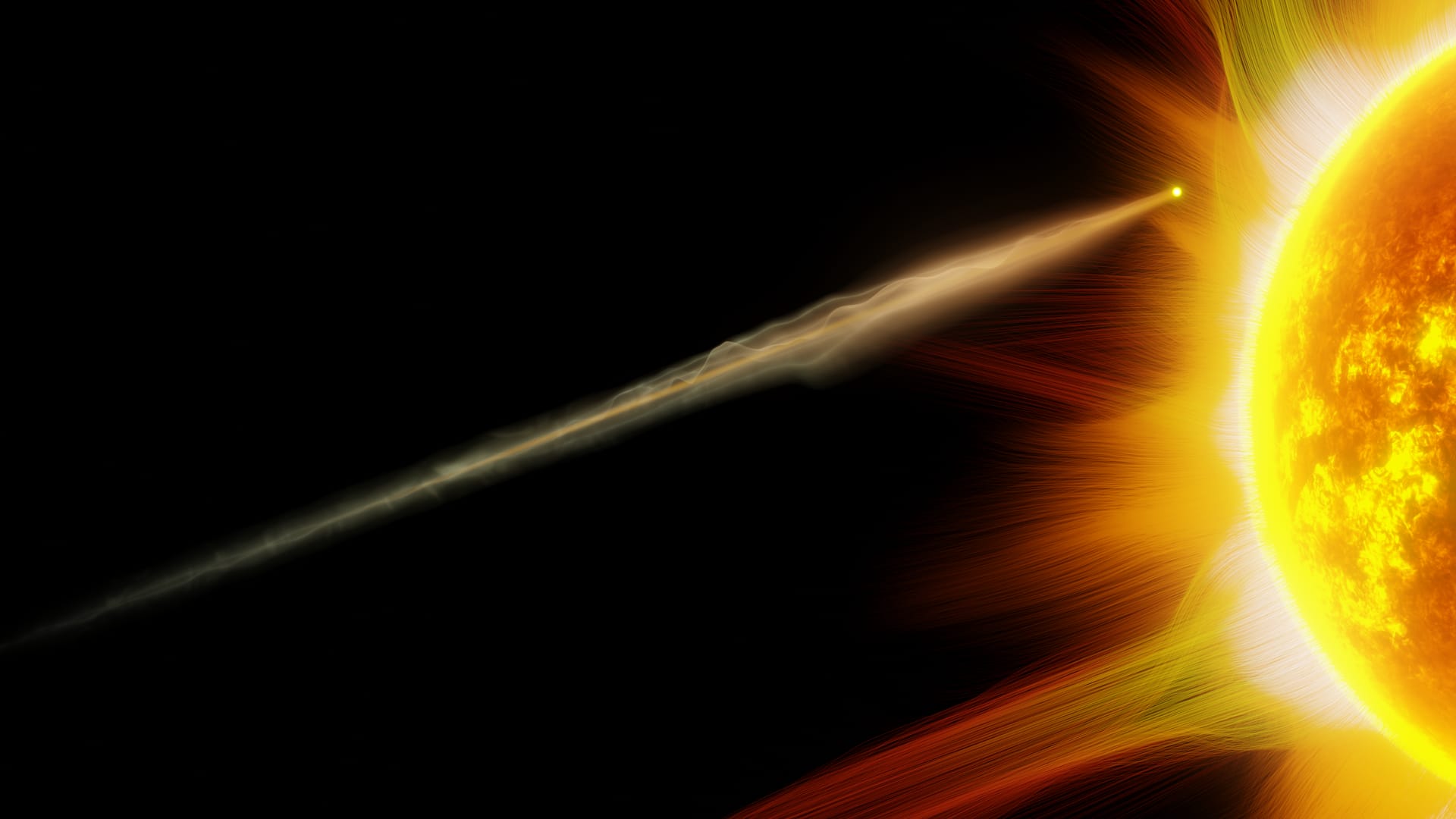
Bright sungrazing comets have made many people interested in Kreutz sungrazers — comets that pass extremely close to the Sun. In this guide, we explain what makes a comet a true member of the Kreutz family, which famous Kreutz visitors made history, and what the chances are of seeing a Kreutz sungrazer from your backyard. Use Star Walk 2 to quickly locate comets in the sky above you and follow other interesting visitors.
Contents
- What are Kreutz comets?
- What makes a comet a Kreutz sungrazer?
- What are the chances to see a Kreutz sungrazer?
- Kreutz sungrazers that made history
- Kreutz sungrazers today: how we find them and whether you can see one
Kreutz sungrazers: frequently asked questions
- How many Kreutz comets are there?
- How often do Kreutz sungrazers become great comets?
- Do Kreutz sungrazers ever hit the Sun?
- Do Kreutz sungrazers affect the Sun or cause solar storms?
- Can a Kreutz sungrazer be seen from Earth?
- Are all sungrazers part of the Kreutz group?
- What is the name of the Kreutz sungrazers’ parent comet?
- Kreutz sungrazers: bottom line
What are Kreutz comets?
Kreutz comets are a family of sungrazing comets — icy bodies that pass extremely close to the Sun at perihelion, sometimes only about 1–2 solar radii (just a few hundred thousand kilometers) above its surface. At such distances, they plunge through the Sun’s outer atmosphere, the corona, endure extreme heating, and often disintegrate completely.
Want a refresher before diving into sungrazers? Our detailed guide to comets covers the basics in depth — what comets are made of, why they grow tails, and how they behave as they approach the Sun. If you’d rather start fast, try our one-minute comet cheat sheet — a bright, visual overview you can skim in under a minute.
Why are they called Kreutz comets?
Kreutz comets are named after German astronomer Heinrich Kreutz, who noticed something unusual about several spectacular comets seen in the 1800s. When he compared their paths — how close they came to the Sun and how their orbits were tilted and oriented — he found that they matched so well that they couldn’t be a coincidence. His conclusion was simple: these bright comets weren’t unrelated visitors, but fragments of the same ancient object that had broken apart long ago.
Kreutz showed that the great comets of 1843, 1880, and 1882 followed nearly the same route around the Sun, and the name Kreutz sungrazers stuck for any comet on that distinctive orbit.
Kreutz sungrazers you might have heard about
| Comet | Year | Estimated brightness | Why it’s famous |
|---|---|---|---|
| The Great Comet of 1843 (C/1843 D1) | 1843 | – | Seen in broad daylight ~1° from the Sun; closest-known pass to the Sun at the time |
| Eclipse Comet of 1882 (X/1882 K1) | 1882 | mag 0 | Spotted next to the Sun during the total solar eclipse of May 17, 1882 |
| The Great Southern Comet of 1887 (C/1887 B1) | 1887 | mag 1 | The “Headless Wonder” — seen mainly as a bright tail with little or no head |
| Comet Ikeya–Seki (C/1965 S1) | 1965 | mag -10 | One of the brightest comets of the 20th century |
| Comet Lovejoy (C/2011 W3) | 2011 | mag -4 | One of the brightest comets of the 21st century |
What makes a comet a Kreutz sungrazer?
Not every comet that dives toward the Sun is a Kreutz sungrazer. A comet belongs to the Kreutz group if it follows a very specific path around the Sun — an orbital “signature” that suggests these objects are related fragments, likely from the breakup of one giant parent comet.
The signature orbit of Kreutz sungrazers
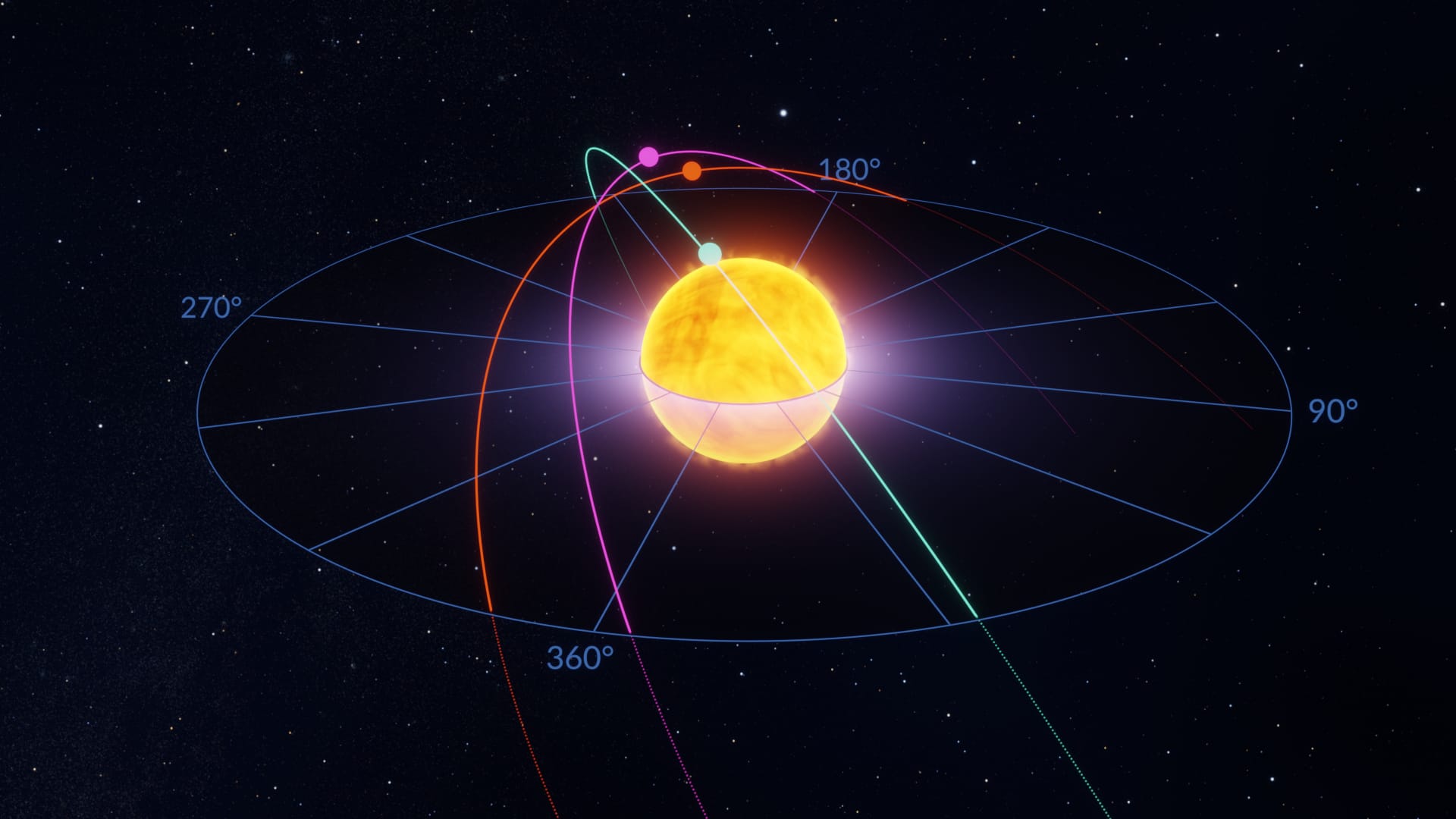
All Kreutz comets travel along nearly the same type of orbit. You can think of it as a steep, Sun-hugging “highway” that many fragments share:
- Their perihelion distance is extremely small — often less than 0.01 AU (about 1.5 million km) from the Sun’s center. Since the Sun’s radius is about 0.00465 AU (≈ 696,000 km), this translates to roughly 0.00535 AU (about 0.8 million km) above the Sun’s surface. Some pass even closer, effectively skimming through the Sun’s hot outer atmosphere — the corona.
- They come in at a steep angle and move the “wrong way” compared to planets. Their orbits are tilted by about 144°, which means they travel on a retrograde path (opposite the direction in which planets orbit the Sun). This is one reason their trajectories look so dramatic on diagrams.
- Their paths are long and stretched out. Kreutz sungrazers typically follow very elongated, long-period orbits. Many have orbital periods of hundreds of years, though most fragments don’t survive their perihelion passage.
Kreutz sungrazers’ giant parent comet
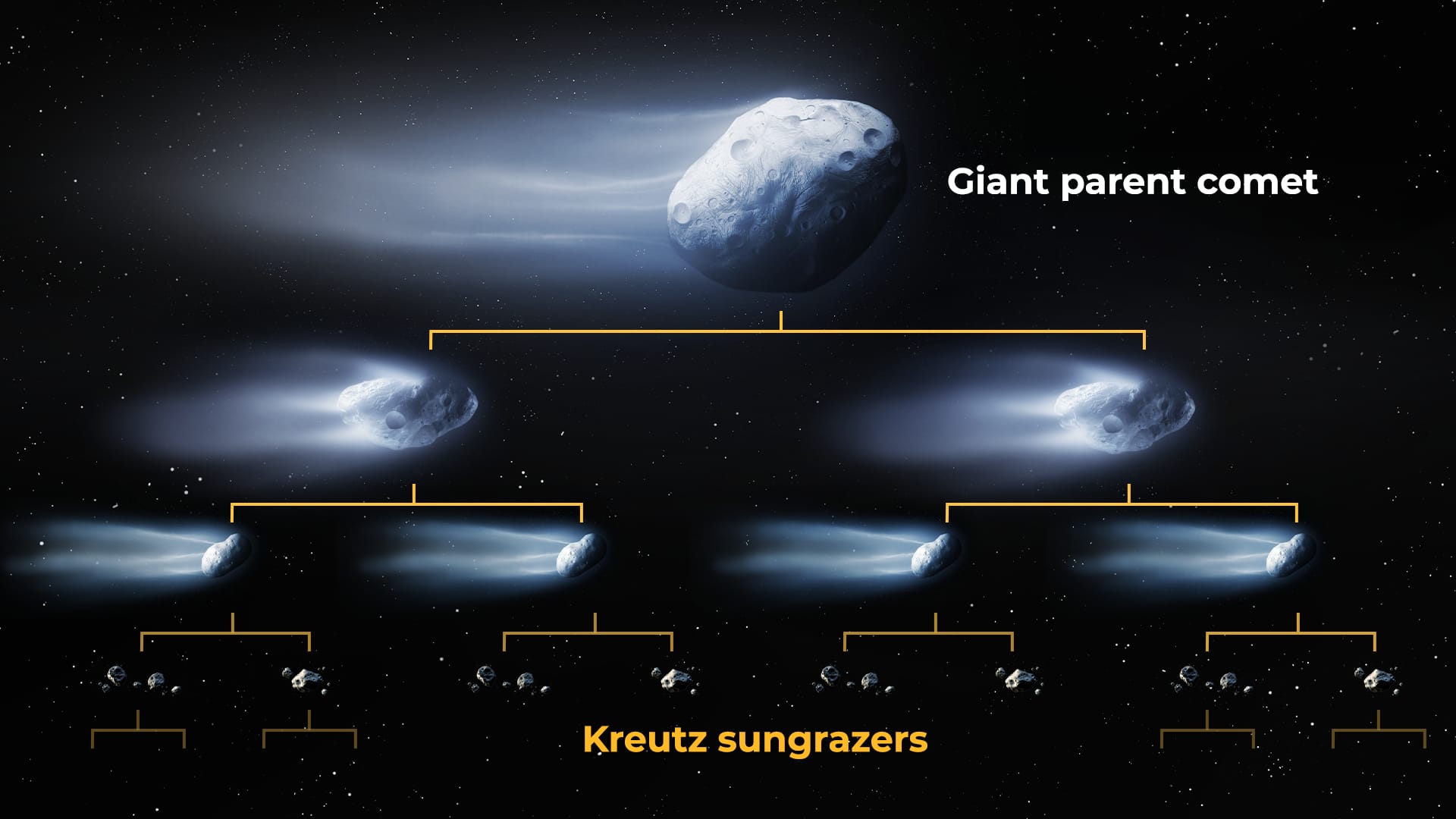
Most researchers agree that the Kreutz family began with a single, very large long-period comet, and that its original orbit likely brought it in from the Oort cloud — the distant reservoir of icy bodies at the edge of the Solar System. At some point, this comet passed extremely close to the Sun, where intense heating and the Sun’s strong tidal pull put its nucleus under enormous stress.
Instead of surviving as one object, it broke into several large fragments. Those fragments kept returning on similarly stretched-out orbits, and each close pass by the Sun increased the chances of further splitting. Over many cycles, the large pieces turned into smaller ones — and smaller ones into swarms of tiny fragments.
That’s why we see what looks like a “family tree” today: many icy fragments traveling along nearly the same orbit, most of them small and short-lived, and only rarely a larger piece that becomes a truly bright comet.
What are the chances to see a Kreutz sungrazer?
Even though Kreutz sungrazers are hard to predict, they tend to follow a few typical scenarios. Below are the most realistic outcomes — from the most common to the rarest (but still possible) “Great Comet” finale.
Break-up before perihelion (no real show)
A small sungrazer can start falling apart on the way in and simply not make it through the solar dive. That’s what happened to C/2024 S1 (ATLAS) — it could have brightened to a magnitude of -5 to -7, but disintegrated a few hours before reaching perihelion.
Disintegration at perihelion (a “headless comet”)
Sometimes, a Kreutz sungrazer’s nucleus fades or breaks up so quickly that observers mostly see the tail. A famous example is the Great Southern Comet of 1887 (C/1887 B1), often nicknamed the “Headless Wonder.” It was seen mainly after perihelion as a bright (about mag 1), detached tail with little or no obvious “head,” and it faded quickly soon afterward.
A modest display after perihelion (binocular/telescope target)
Occasionally a Kreutz comet is real and trackable, yet never turns into a big public spectacle. For example, C/1945 X1 (du Toit) was a Kreutz sungrazer reported at about 7th magnitude — not a “Great Comet,” but still a surviving member observed from the ground.
Better visibility after perihelion (bright twilight comet)
If the nucleus holds together and stays active, the comet can become a prominent twilight object. Comet Pereyra (C/1963 R1) is a classic example: it was discovered after passing perihelion at a magnitude 2, and was even visible to the naked eye for a short time.
A true Great Comet (rare, historic-level)
A Great Comet-class Kreutz sungrazer can become extraordinarily bright near the Sun — sometimes even visible in daylight — and leave behind a huge, dramatic tail that dominates the twilight sky. The textbook examples are Ikeya–Seki (C/1965 S1), the Great Comet of 1843 (C/1843 D1), and the Great Comet of 1882 (C/1882 R1).
Kreutz sungrazers that made history
Most Kreutz comets don’t survive their close approach to the Sun — they fade, fragment, and vanish near perihelion. For example, Kreutz comet C/2011 N3 (SOHO) was discovered on July 4, 2011 and disintegrated at perihelion just two days later, on July 6 — a timeline that’s typical for many small sungrazers.
But for a rare few, that daring plunge becomes their finest hour. When a larger fragment holds together long enough, the intense heating can drive strong outgassing and dust production, making it appear brilliantly bright, visible even in bright twilight — and sometimes in daylight. Here are some of the brightest Kreutz sungrazers in recorded history — true Great Comets.
The Great Comet of 1843 (C/1843 D1)
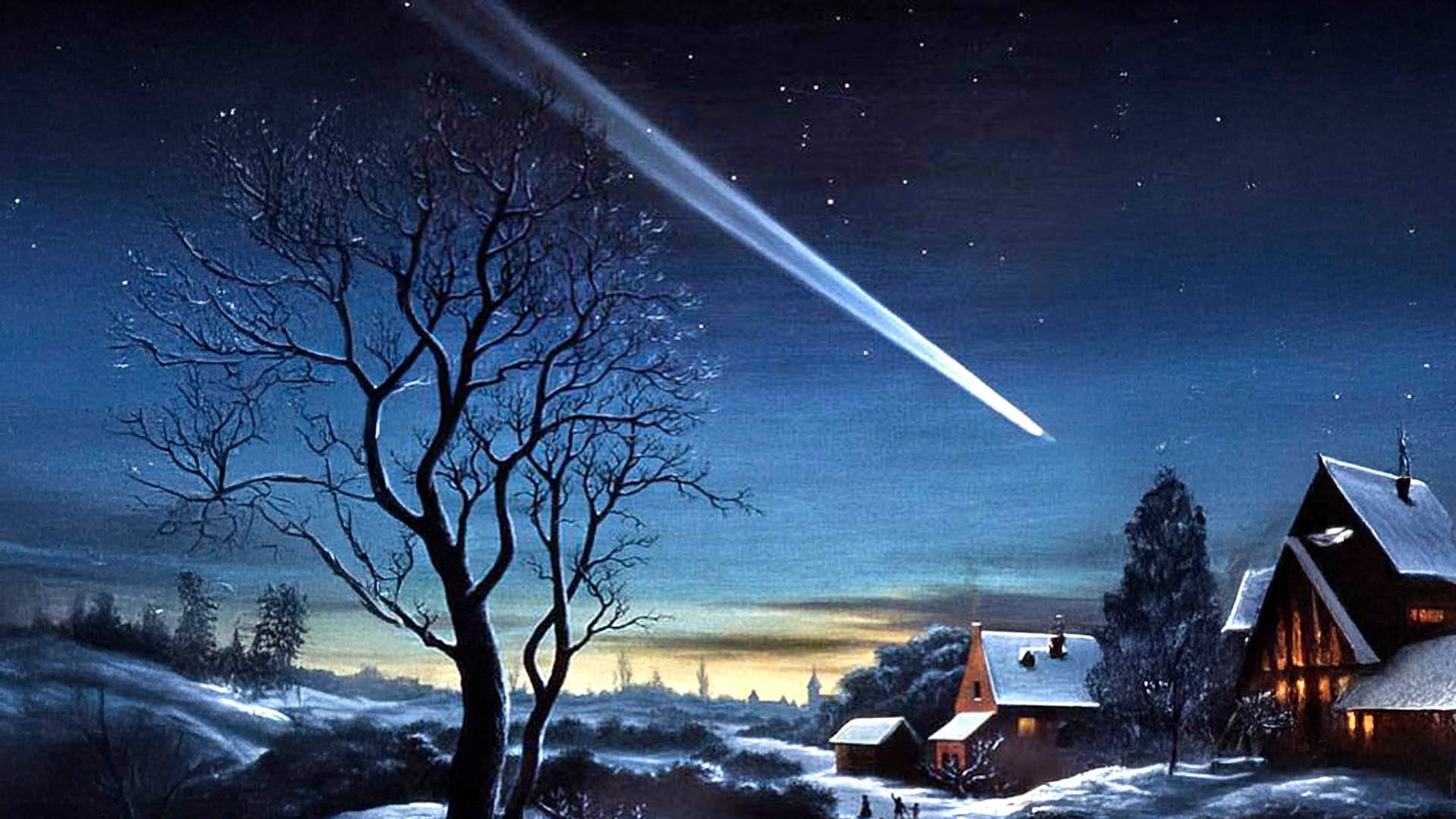
This comet developed a tail stretching over 60 degrees across the sky. It was visible in daylight and became one of the most spectacular naked-eye comets of the 19th century. Its extreme perihelion distance confirmed it as a sungrazer.
The Great Comet of 1882 (C/1882 R1)
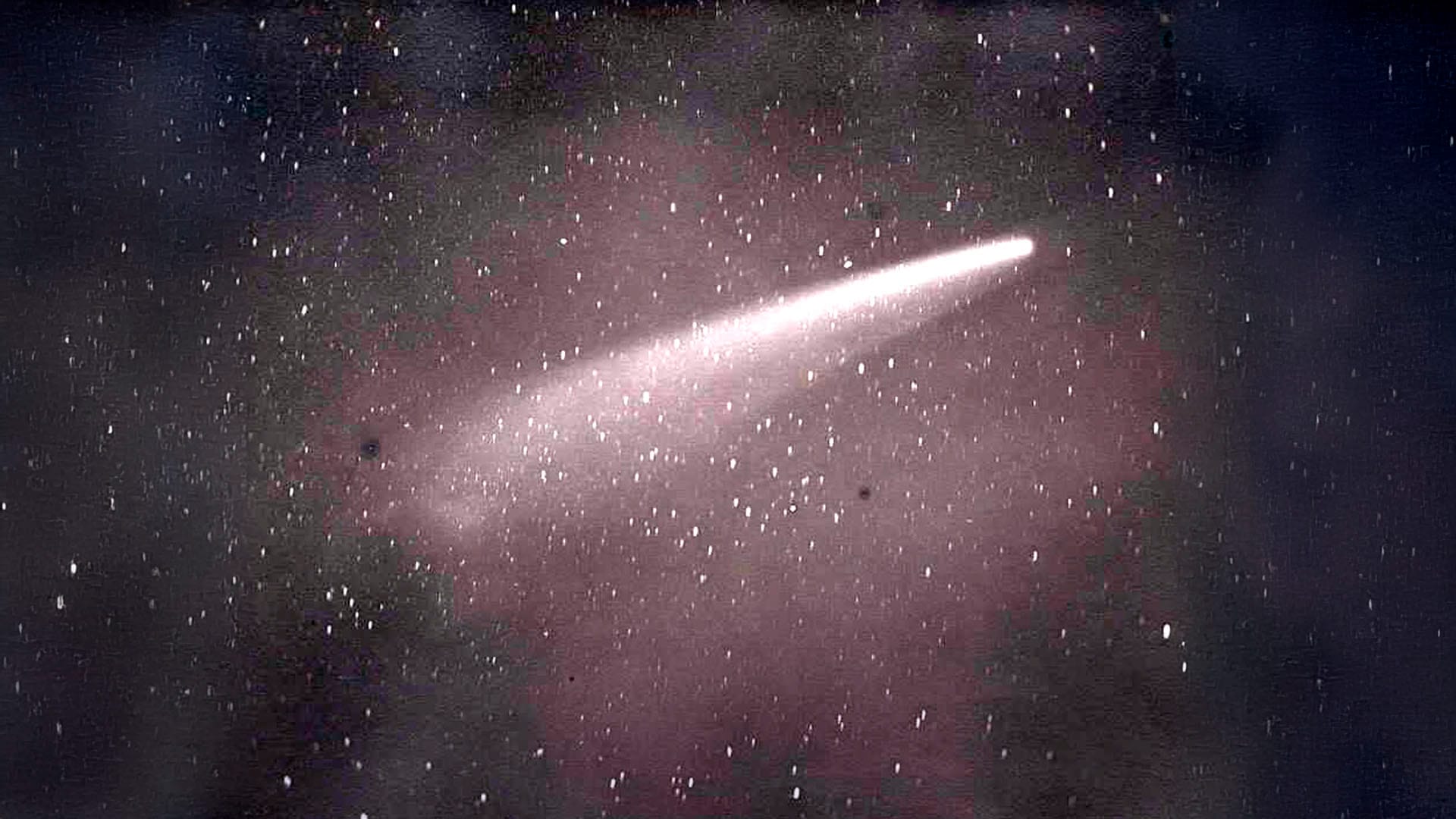

One of the first comets ever photographed, it became bright enough to be seen next to the Sun in broad daylight. After perihelion, observers noticed that its nucleus had split into multiple components — direct evidence of ongoing fragmentation within the Kreutz family.
Eclipse Comet of 1882 (X/1882 K1)
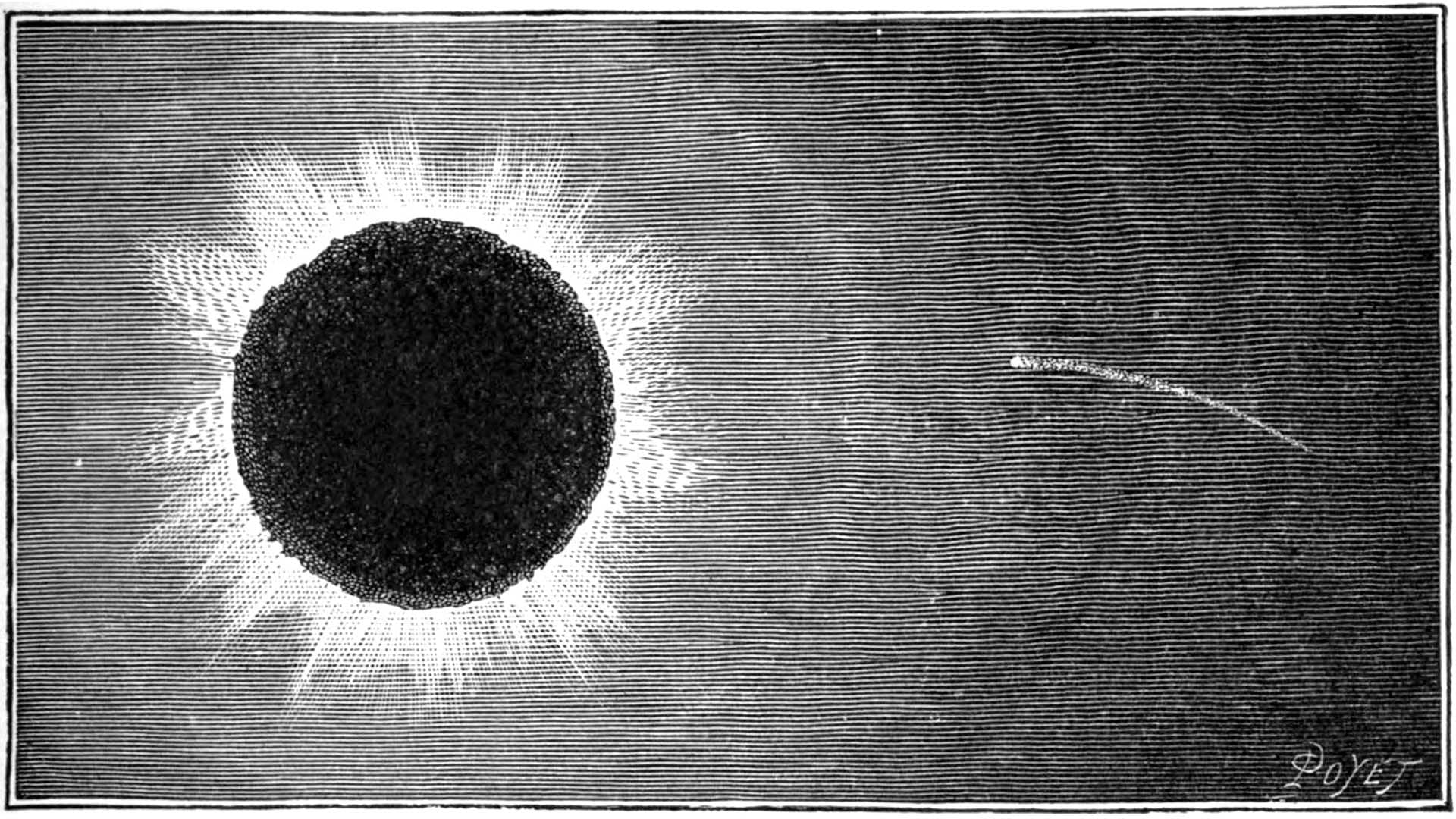

Another Kreutz visitor is famous for being spotted during the total solar eclipse of May 17, 1882, when observers saw a bright streak near the hidden Sun. That streak was a Kreutz sungrazer at its perihelion — and the eclipse turned out to be the only time it was ever observed.
Comet Ikeya–Seki (C/1965 S1)
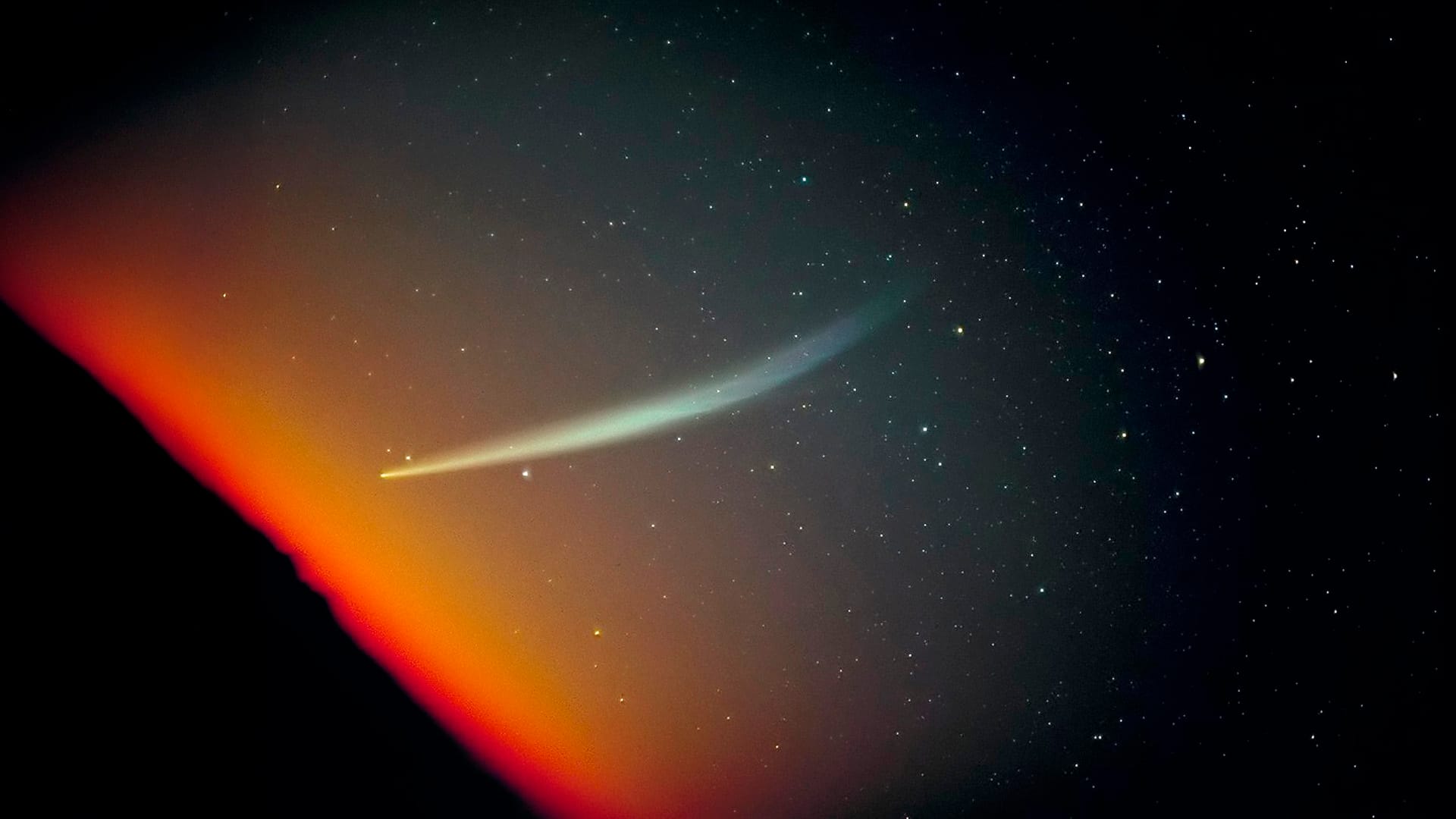

Often called the brightest comet of the 20th century, this object passed within about 450,000 km of the Sun’s surface in October 1965. At peak brightness, it rivaled the Full Moon. It fragmented near perihelion, but remained visible for weeks.
Comet Lovejoy (C/2011 W3)
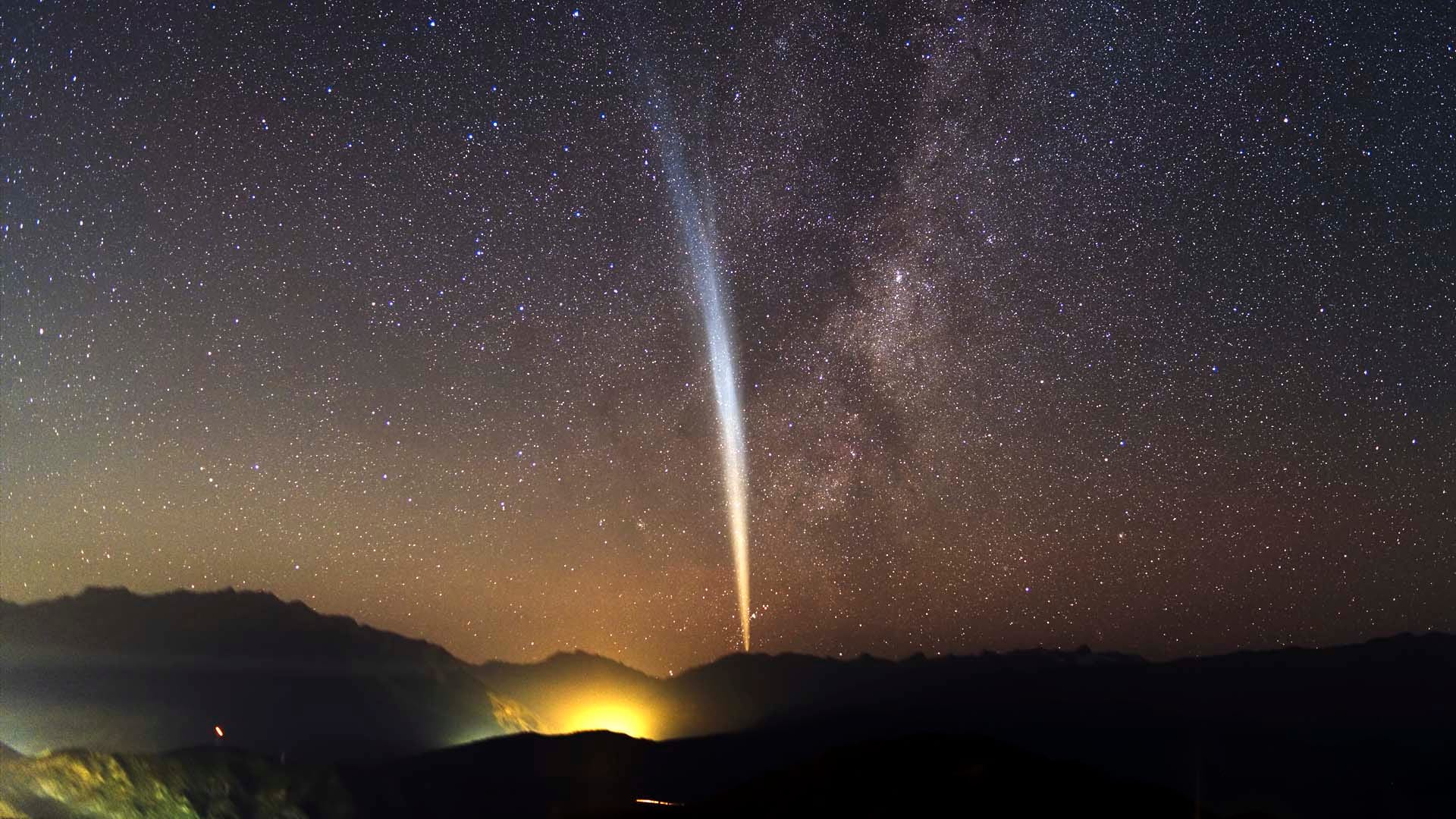
On December 16, 2011, comet Lovejoy passed just about 140,000 km above the Sun’s surface — close enough that most sungrazers would be destroyed. Yet Lovejoy survived, though its nucleus was badly damaged and likely fragmented. After perihelion, it grew a long dust tail and became a clear naked-eye sight from the Southern Hemisphere, turning into one of the most spectacular comets of the 21st century.

Kreutz sungrazers today: how we find them and whether you can see one
Until 1979, only about 30 Kreutz sungrazing comets were known from ground-based observations. Today, the number of confirmed Kreutz sungrazers has climbed to over 4,000 — not because the comets suddenly became more common, but because we finally got a reliable way to look for them in the brightest place in the sky: right next to the Sun.
How do we find most Kreutz sungrazers?
From Earth, the Sun’s glare hides almost everything nearby. Space missions solved this problem with coronagraphs — instruments that block the Sun’s bright disk and create an “artificial eclipse,” making faint objects close to the Sun visible.
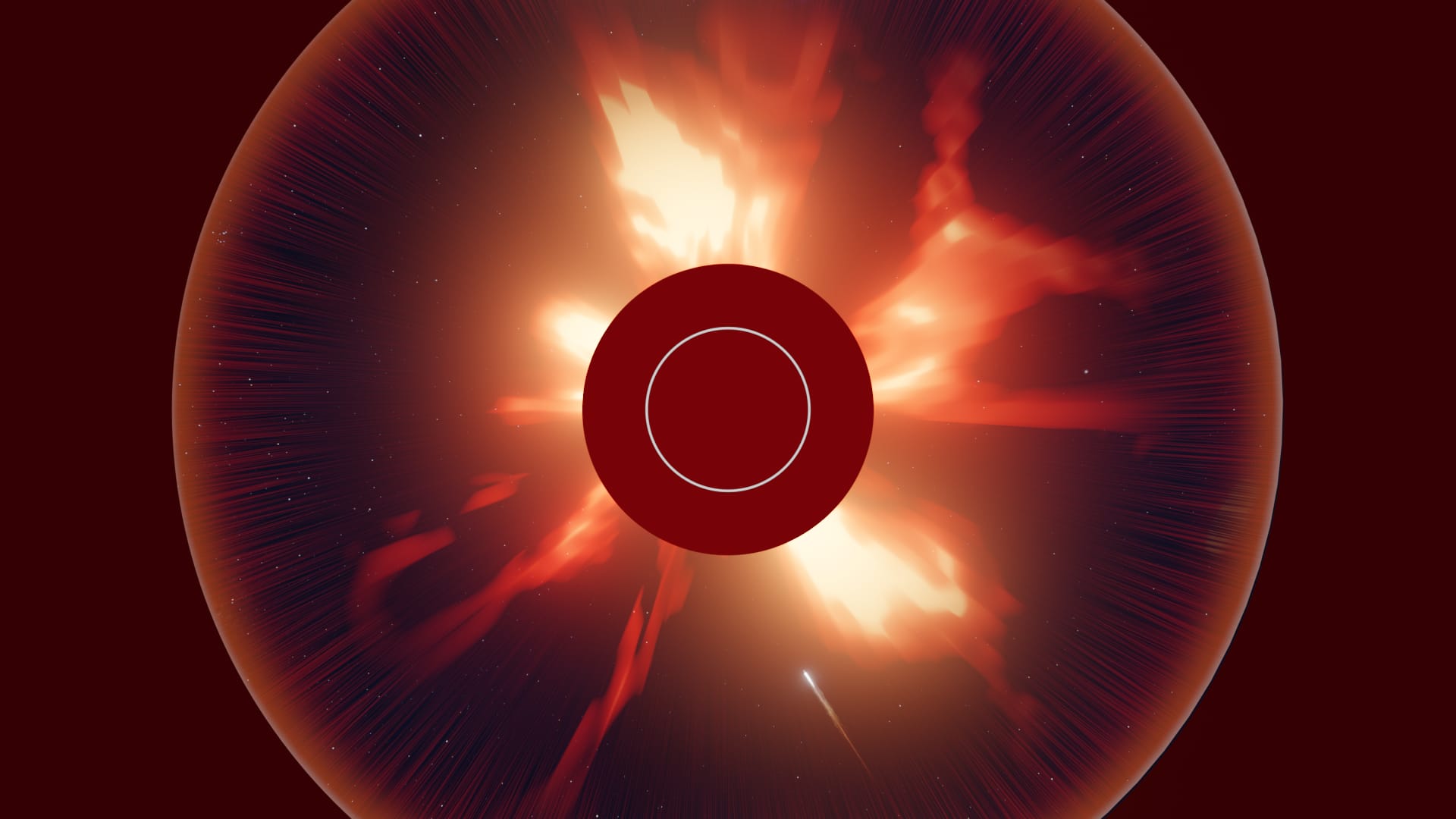
That’s why modern Kreutz discoveries are dominated by spacecraft. The ESA/NASA mission SOHO has been the main “comet finder” for decades, spotting thousands of sungrazers in coronagraph images. Other missions, including STEREO, have also contributed. Thanks to this constant monitoring, new Kreutz comets are still being found regularly — most of them tiny fragments that appear briefly and then disappear, since many don’t survive the intense heat and the influence of solar tidal forces near perihelion.
Can you see a Kreutz sungrazer from your backyard?
Most Kreutz sungrazers are unobservable from Earth: they spend their most dramatic moments extremely close to the Sun in the sky, where the glare is overwhelming. Most of them are also small and fragile, so they brighten only briefly and often break apart near perihelion.
Another reason they’re so hard to catch is timing: many sungrazers are discovered only when they’re already very close to the Sun, because that’s when they show up in coronagraph images. By the time we notice them, there may be little time to plan a safe ground-based observation.
But sometimes, a ground-based sighting is possible. A rare larger fragment can become bright enough to show up low in bright twilight, shortly before sunrise or after sunset. Even then, the viewing conditions are often challenging: Kreutz comets tend to favor the Southern Hemisphere, because the typical Kreutz orbit geometry often places the comet very low above the horizon for northern observers. Early discovery also matters: if a sungrazer is found in advance, observers have time to plan the safest, best-positioned twilight window.
In short, it’s rare for all the right conditions to line up for seeing a Kreutz comet from Earth. That’s why astronomers and skywatchers pay close attention whenever a Kreutz sungrazer is discovered early and has a chance to brighten.
Kreutz sungrazers: frequently asked questions
How many Kreutz comets are there?
More than 4,000 Kreutz sungrazers have been confirmed in SOHO and STEREO observations, according to the Sungrazer Project’s official confirmation lists.
How often do Kreutz sungrazers become great comets?
Very rarely. There are thousands of Kreutz objects discovered, but only a handful of them became truly spectacular comets visible to the public. However, the Kreutz family is famous because it has produced several of the most dramatic bright comets — especially those seen very close to the Sun, sometimes even in daylight.
Do Kreutz sungrazers ever hit the Sun?
Almost never. Most Kreutz comets pass just above the Sun’s surface. Many of them break apart and evaporate before they can get any farther. From images, it may look like a crash into the Sun, but usually it’s more like the comet falls apart and disappears during the close pass.
Do Kreutz sungrazers affect the Sun or cause solar storms?
No. A comet is far too small to trigger a solar flare or a solar storm. Its dust and gas can mix into the Sun’s outer atmosphere, but it doesn’t change what the Sun is doing.
Can a Kreutz sungrazer be seen from Earth?
Most of the time, no. These comets stay very close to the Sun in the sky, so the glare hides them. Sometimes, if a fragment is big and bright enough, it can be seen low in twilight (just before sunrise or after sunset). The best displays are rare, and the window can be short. While hunting sungrazers, remember one important rule: never search near the Sun with binoculars or a telescope — it can permanently damage your eyes.
Are all sungrazers part of the Kreutz group?
No. “Sungrazer” is a broad label for any comet that passes extremely close to the Sun. The Kreutz group is the largest and most famous family of sungrazers, but it’s not the only one. SOHO observations show that most sungrazers belong to the Kreutz family, while the rest include other groups such as the Meyer, Marsden, and Kracht groups, plus a smaller number of “non-group” (sporadic) comets.
What is the name of the Kreutz sungrazers’ parent comet?
There’s no single confirmed “parent comet” with a definite name. Astronomers think the Kreutz family started when a very large comet broke apart long ago, but linking that original object to one specific historical comet is still uncertain. The most commonly mentioned candidates are the Great Comet of 371 BC, also known as Aristotle’s comet, and the Great Comet of 1106, along with a few other ancient apparitions sometimes discussed in the literature.
Kreutz sungrazers: bottom line
Kreutz sungrazers are fragments of an ancient comet that still follow the same Sun-skimming route today. Most are tiny, short-lived, and seen mainly in spacecraft images — but once in a while, a larger fragment survives long enough to become a Great Comet.