April 2026 Planetary Alignment: When and Where to See Mercury, Mars, Saturn, and Neptune
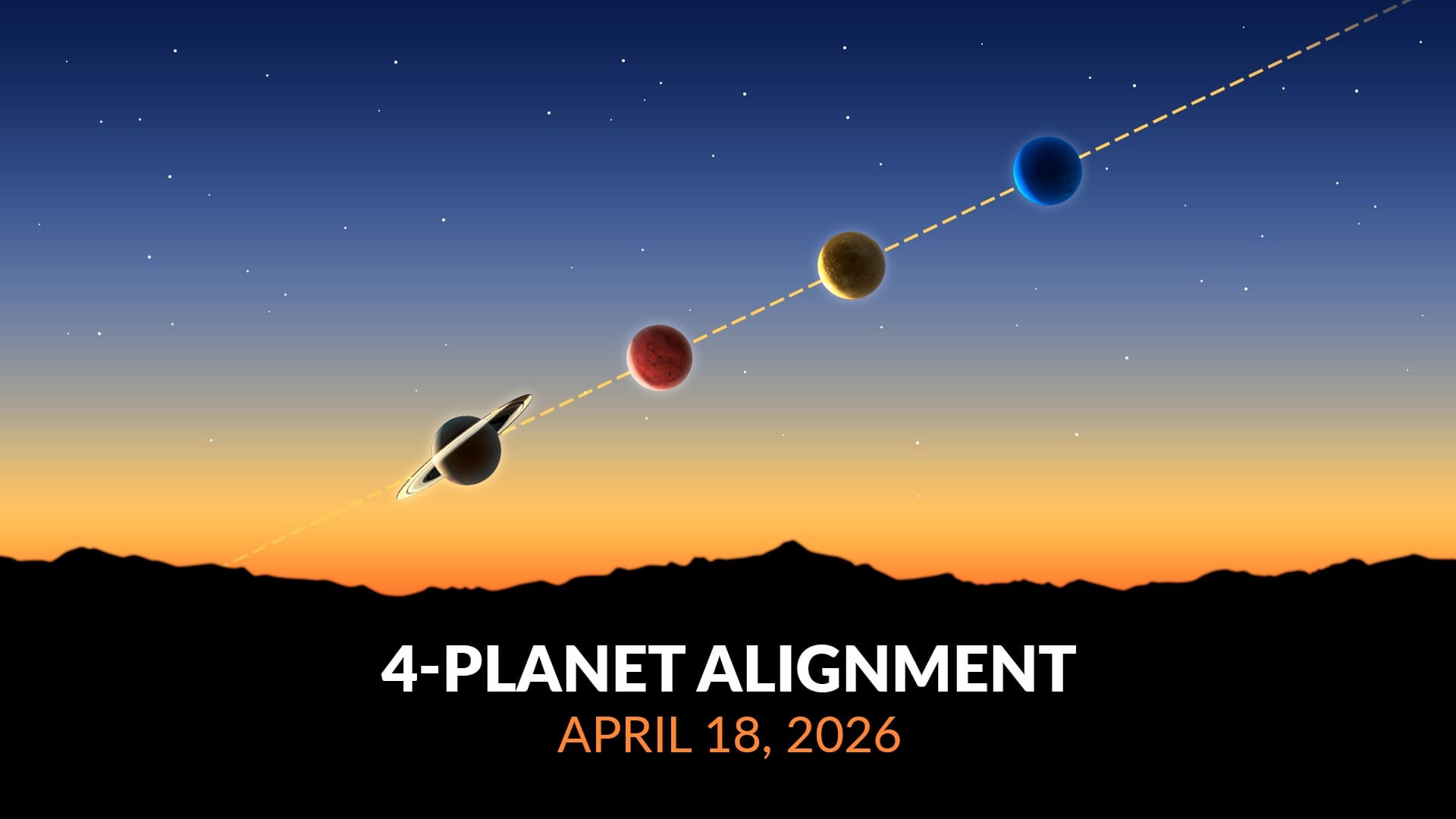
From about April 16 to 23, 2026, Mercury, Mars, Saturn, and Neptune gather in a compact pre-dawn planetary alignment low in the eastern sky. The best mornings are April 18–20, but the exact view depends on your location: observers in the Southern Hemisphere get the easiest view, while many Northern Hemisphere locations will see the planets very low in bright twilight. In this guide, you’ll learn the best dates, when to look, where the view is best, and which planets are realistic targets from your city.
Contents
- April planet alignment: Key details
- What happens during the April 2026 planet alignment?
- Where to look in the sky
- What time to see the April 2026 planet alignment
- Which planets can you actually see without a telescope?
- April 2026 planetary alignment visibility by location
- Best dates to see the April 2026 planet parade
- Safety note: Never point optics near the Sun!
FAQ: Planetary alignment in mid-April 2026
- What is a planetary alignment (or “planet parade”)?
- Which planets are involved in the alignment on April 18, 2026?
- What time should I look?
- Can I see all four planets with the naked eye?
- Is this alignment visible everywhere?
- What if it’s cloudy on April 18?
- Do the planets form a perfectly straight line in space?
- 4-planet alignment on April 18, 2026: key takeaway
April planet alignment: Key details
- Main date: April 18, 2026*
- Planets: Mercury, Mars, Saturn, Neptune
- Best time: ~30 minutes before sunrise (Northern Hemisphere), 60–90 minutes before sunrise (Southern Hemisphere)
- Where to look: low in the east
- Naked-eye targets: Mercury and Mars; Saturn may be visible in good conditions
- Telescope target: Neptune (usually too faint in bright dawn)
*The planets stay grouped for several mornings around this date, so treat April 18 as the peak of a multi-day viewing window for most locations, not the only day to try.
Your chances to see the alignment depend much more on your latitude than on the date alone. Before heading outside, check how high the planets will rise above your eastern horizon from your exact location. Ideally, look when the planets are at least about 10° above the horizon — below that, dawn twilight and haze can make them difficult to spot.
New to “planetary alignment / planet parade”? Learn everything about this phenomenon in our article: What is a planet parade?.
What happens during the April 2026 planet alignment?
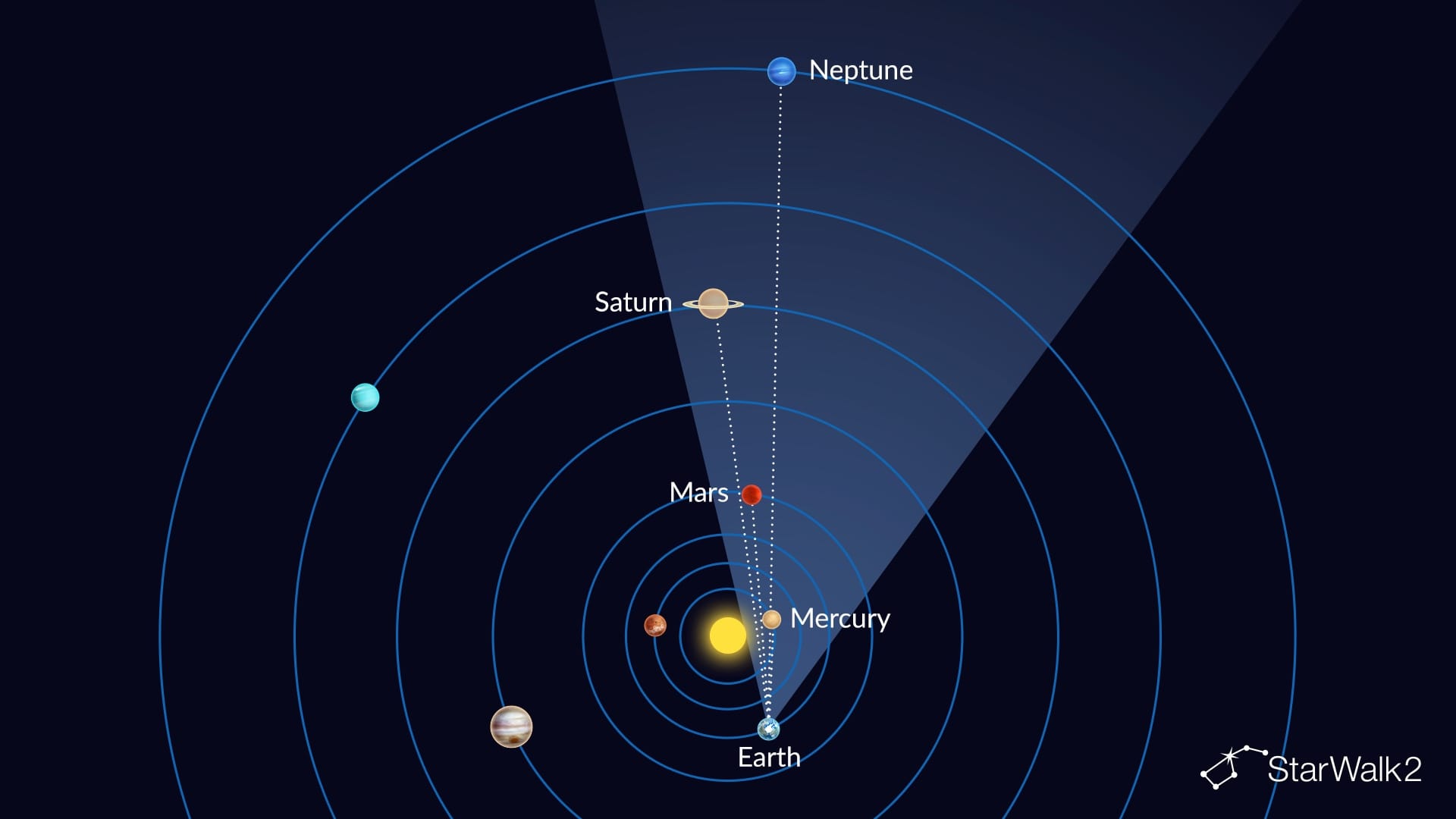
On and around April 18, 2026, Mercury, Mars, Saturn, and Neptune appear close together in the pre-sunrise sky, forming a compact “planet parade” along the ecliptic — the same sky path the Sun follows. They aren’t perfectly lined up in space, but from Earth, the planets gather into a neat dawn grouping.
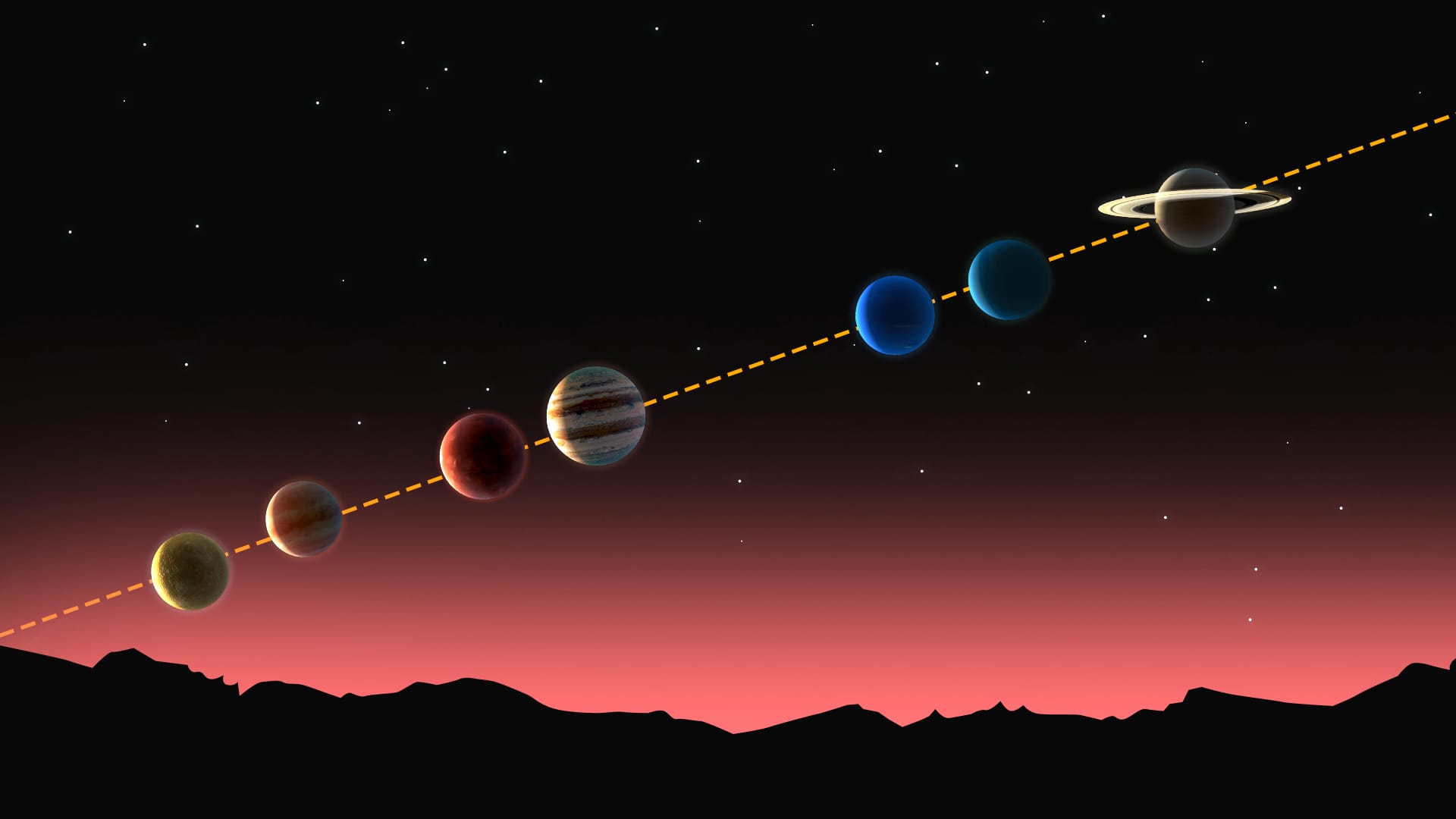
Want to understand better how planetary alignments form? See our visual guide: Planetary Alignment: A Celestial Parade.
Where to look in the sky
Look low above the eastern horizon, along the ecliptic — the same sky path the Sun follows. In mid-April 2026, the planetary group sits in the faint zodiac region where Pisces meets Cetus, so think of the alignment as a compact dawn grouping near the Pisces–Cetus border rather than as a pattern anchored to one bright star.
From April 13 to 17, the tightest pairings occur in Pisces: Mars passes Neptune on April 13, and Mercury passes Neptune on April 16. By April 19–20, Mercury, Mars, and Saturn have shifted into Cetus, so the lineup changes not only in shape but also in its exact sky backdrop from morning to morning.
Don’t expect bright guide stars right next to the planets. Pisces is a faint constellation, and Cetus has only a few stars that stand out clearly to casual observers. If you want broad regional markers, Alrescha can help identify the Pisces side of the sky, while Diphda and Menkar belong to Cetus — but in practice, the planets themselves are better signposts than the stars during this event.
A better natural pointer is the thin crescent Moon on April 15–16, when it passes through the same part of the dawn sky. If you miss the Moon, just return to the same low eastern horizon on the following mornings and look for a compact group of planets rather than a single standout object.
What time to see the April 2026 planet alignment
In the Northern Hemisphere, start looking about 30 minutes before local sunrise — the planets often rise late and stay low in brightening twilight, especially above ~30°N. In the Southern Hemisphere, you can usually begin 60–90 minutes before sunrise, because the lineup stands higher above the horizon and remains easier to spot for longer.
| City | Sunrise (Apr 18, 2026) | Start looking |
|---|---|---|
| Sydney, Australia | 06:19 | 04:49–05:19 |
| Cape Town, South Africa | 07:11 | 05:41–06:11 |
| Rio de Janeiro, Brazil | 06:07 | 04:37–05:07 |
| New York, USA | 06:12 | ~05:42 |
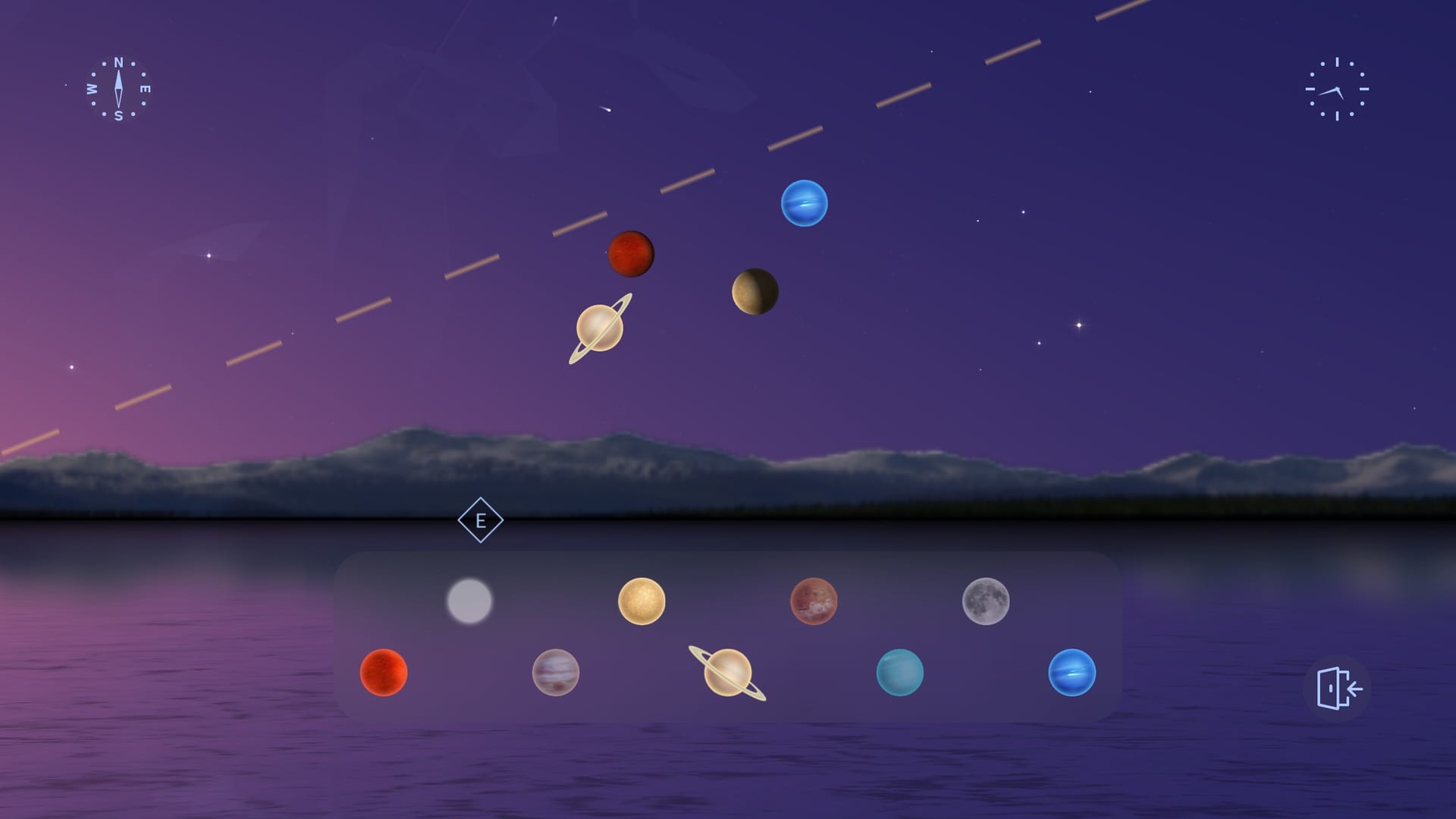
For the most reliable planning, check the lineup in Star Walk 2 → Planet Walk for your location: it will show when each planet rises and how high it will be before the sky gets too bright.
Which planets can you actually see without a telescope?
During the April 18, 2026 morning alignment, Mercury, Mars, Saturn, and Neptune are involved — but they won’t be equally easy to spot. More importantly, your chances of seeing these planets depend heavily on your location.
Northern Hemisphere: low and difficult
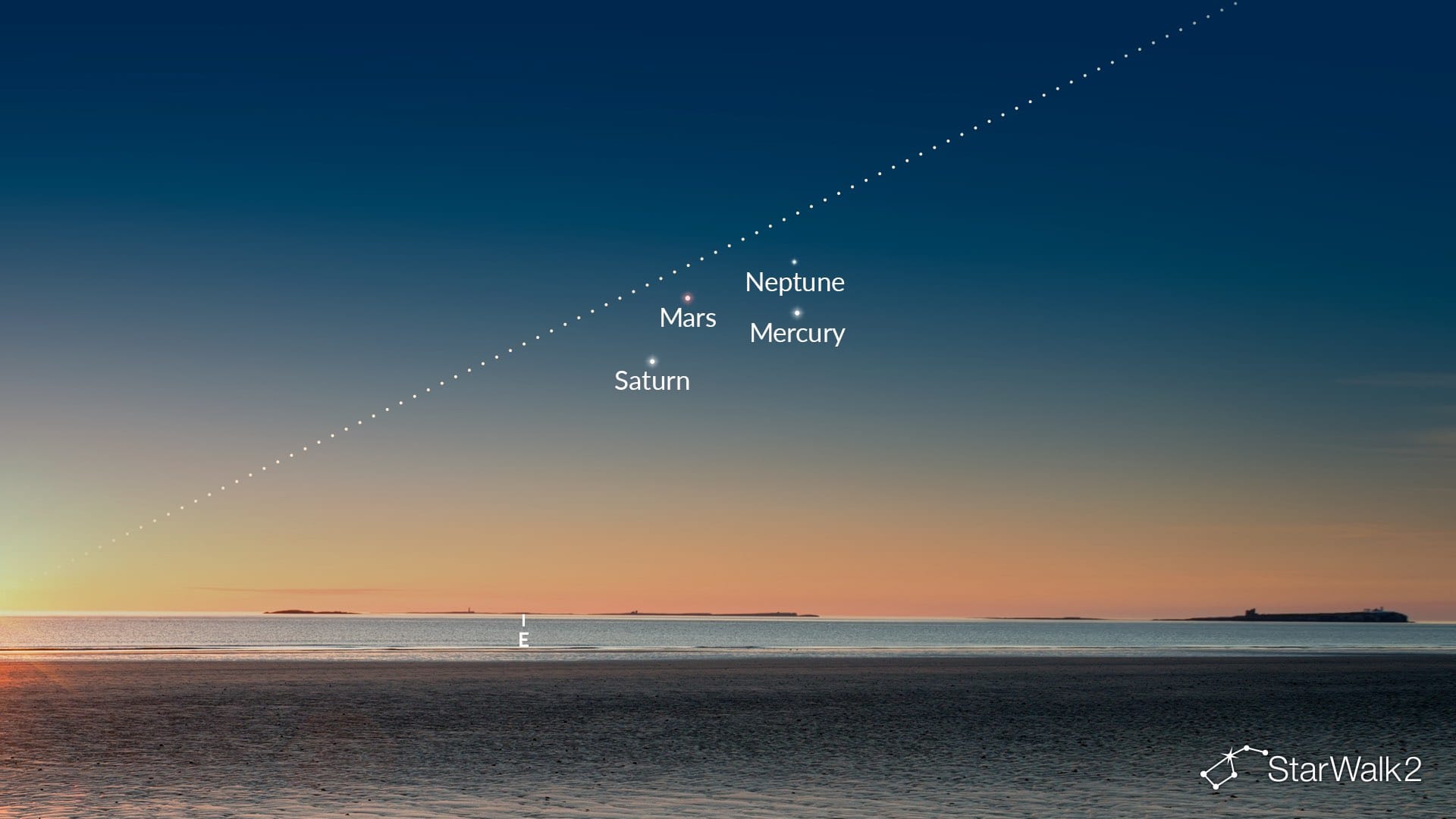
In much of the Northern Hemisphere, the ecliptic meets the eastern horizon at a shallow angle on spring mornings, keeping the planets hugging the horizon in dawn twilight.
- Mars (mag 1.2) and Mercury (mag -0.1) are at roughly the same height — if your eastern horizon is clear and the sky is not too bright, you have a chance to spot them with the naked eye.
- Saturn (mag 0.9) sits lower, so it’s more sensitive to haze, light pollution, and obstructions near the horizon.
- Neptune (mag 7.8) is usually not worth attempting in bright dawn conditions (it’s too faint for most observers).
Southern Hemisphere: higher and much easier
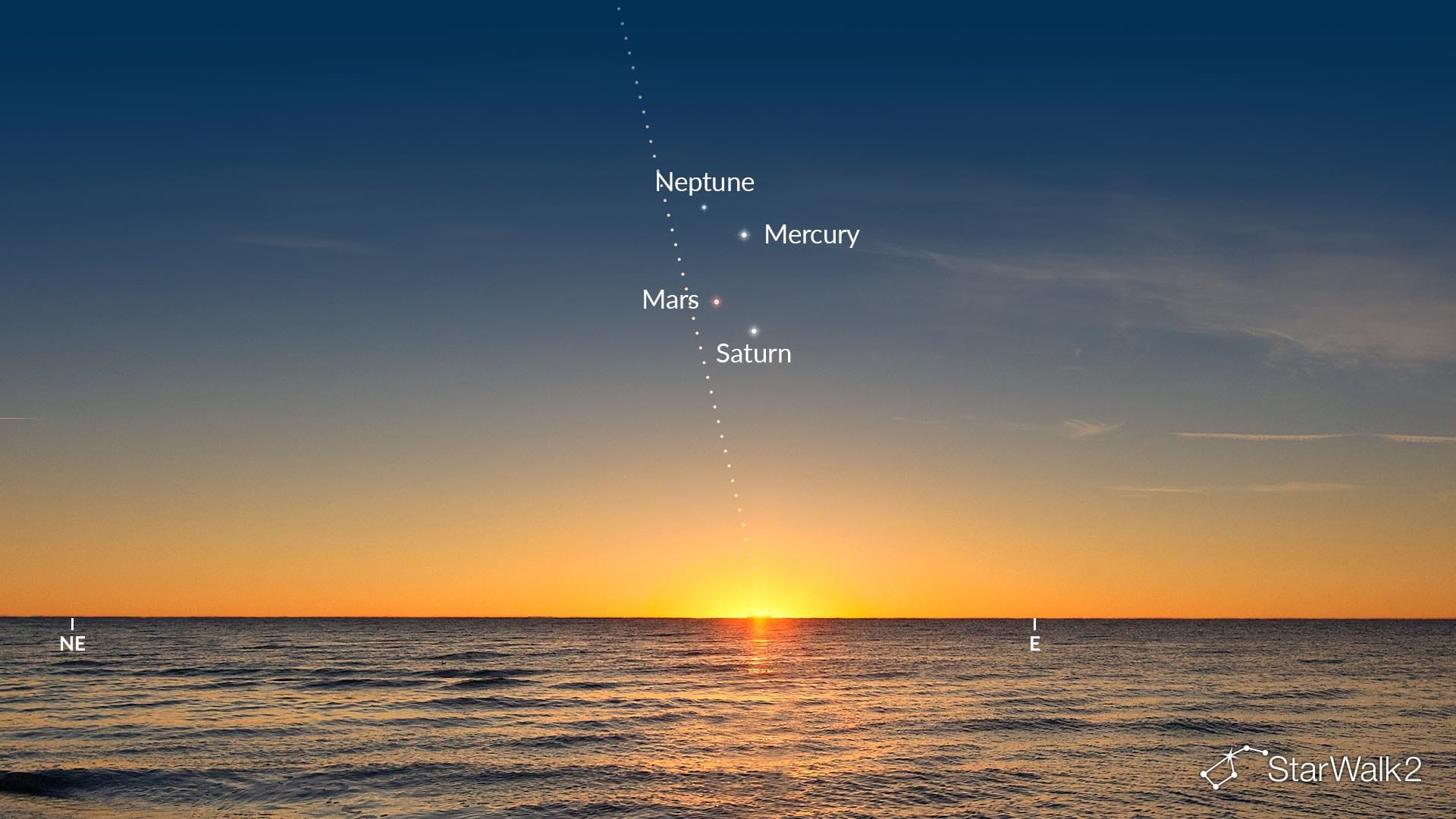
From many Southern Hemisphere locations, the lineup stands noticeably higher above the eastern horizon before sunrise, so you get a darker window to work with, and the planets are easier to pick out.
- Mercury (mag -0.1) is the most eye-catching of the bright planets here and can appear surprisingly high for a dawn object.
- Mars (mag 1.2) is also easy to spot nearby once you know where to look.
- Saturn (mag 0.9) shines steadily and is usually visible without much trouble when it’s up.
- Neptune (mag 7.8) remains the challenging one — you’ll need at least large binoculars (ideally a telescope) to observe it. The good news is, it’s positioned highest of the four planets, so it’s less affected by horizon haze and obstructions.
To learn how the planetary alignment will look from your exact location and what planets will be easiest to see, use the Planet Walk feature in the Star Walk 2 app.
April 2026 planetary alignment visibility by location
Can you see the April 2026 planet alignment from the USA?
In most of the continental USA, the April 2026 planet alignment will be challenging rather than spectacular. From many U.S. locations — especially above about 30°N — Mercury, Mars, Saturn, and Neptune stay very low in the bright pre-dawn east, which makes the viewing window short and sensitive to haze, light pollution, and anything blocking the horizon.
Your best chance is from the southernmost parts of the country and from places with a flat, unobstructed eastern horizon, such as beaches, lakeshores, deserts, or open fields. In many U.S. locations, it makes sense to start looking about 30 minutes before local sunrise. For most observers, Mercury and Mars will be the most realistic naked-eye targets, Saturn may be possible in very clear air, and Neptune is generally a telescope-only object. If April 18 is cloudy, try again on the mornings just before and after it — this is a multi-day event, not a one-morning-only alignment.
Can you see the April 2026 planet alignment from India?
India is one of the more promising Northern Hemisphere regions for this event, especially from central and southern latitudes. The four planets still sit low in the eastern sky before sunrise, but from much of India the geometry is generally more favorable than it is from higher northern latitudes, giving observers a better chance to catch the lineup.
In practical terms, start looking low in the east about 30–45 minutes before local sunrise. A clean horizon will matter a lot: even bright planets can fade quickly in dawn haze near the horizon. Mercury and Mars should be the easiest planets to spot, Saturn will be more delicate in poor transparency, and Neptune is not a realistic naked-eye target. Southern India should get the best Indian views, while northern India will face a shorter and more difficult viewing window. Because the lineup changes from day to day, it is worth trying several mornings around April 18 instead of focusing on only one date.
Can you see the April 2026 planet alignment from Europe?
For most of Europe, this is a difficult dawn alignment. The planets rise very low in bright twilight, and in northern Europe the useful observing window may be extremely short. A clear, flat eastern horizon is essential, and even then the view can be limited by haze and the rapidly brightening sky.
Try looking about 30 minutes before local sunrise, and be realistic about what you can expect. On the best mornings, Mercury and Mars may be visible to the naked eye; Saturn will be harder because it sits lower and is more easily lost in the horizon glow; Neptune is usually not worth attempting for casual observers. Southern Europe offers the best European chance, but even there this event is more of a challenge alignment than an easy, high-in-the-sky planet show.
Best views of the April 2026 planet alignment: Southern Hemisphere
The Southern Hemisphere offers the best view of the April 2026 planet alignment. From many southern locations, the planets rise along a steeper path before sunrise, so the lineup stands higher above the eastern horizon in a darker sky. That gives you a longer observing window and a much better chance to appreciate how the shape of the lineup changes from morning to morning.
Start looking about 60–90 minutes before local sunrise from a site with a clear eastern horizon. In good conditions, Mercury, Mars, and Saturn should all be realistic naked-eye targets, while Neptune remains a faint binocular-or-telescope object. Australia, South Africa, and much of southern South America are especially well placed for this event. If you want the easiest and most photogenic version of the April 2026 planet parade, this is the hemisphere to watch from.
Viewing the April 2026 planet alignment from Australia
From much of Australia, the planets appear higher above the eastern horizon before sunrise than they do from many northern locations, giving you a longer, darker viewing window, before twilight becomes too bright.
Here are sunrise times on April 18, 2026 for major cities, plus a simple “when to start” window (60–90 minutes before sunrise, local time):
| City | Sunrise (Apr 18, 2026) | Start looking |
|---|---|---|
| Sydney | 06:19 | 04:49–05:19 |
| Brisbane | 06:06 | 04:36–05:06 |
| Canberra | 06:29 | 04:59–05:29 |
| Melbourne | 06:49 | 05:19–05:49 |
| Adelaide | 06:41 | 05:11–05:41 |
| Perth | 06:39 | 05:09–05:39 |
| Hobart | 06:45 | 05:15–05:45 |
| Darwin | 06:52 | 05:22–05:52 |
Best dates to see the April 2026 planet parade
The April 2026 planet alignment is not a one-morning-only event. In most locations, the lineup is worth watching from about April 16 to 23, with the best mornings usually falling on April 18–20. The lineup changes noticeably from day to day as Mercury and Mars move along the ecliptic, passing Neptune and Saturn and reshaping the group over several mornings. That changing geometry is exactly what makes this event worth following on several mornings, not just on April 18.
For exact conjunction timings, see our guide to planetary conjunctions.
The Moon and the comet C/2025 R3 also pass through the same part of the sky, giving observers even more reasons to watch the changing planetary lineup throughout mid-April.
| Date | What changes in the sky | Why it matters |
|---|---|---|
| April 13 | Mars passes Neptune low in the pre-dawn east. | A good early sign that the compact mid-April lineup is taking shape. Mars is the easy target; Neptune requires optics. |
| April 14 | The four-planet group becomes more compact. | A good morning to start following the alignment if you want to watch it evolve day by day. |
| April 15 | A thin crescent Moon enters the same part of the dawn sky. | The Moon adds a beautiful visual reference and helps draw attention to the low eastern horizon before sunrise. |
| April 16 | The Moon continues through the planetary group. | One of the first mornings when the alignment becomes especially attractive as a multi-object dawn scene. |
| April 17 | Mercury passes Neptune. | All four planets are gathered in a very compact area of sky, making this one of the most interesting mornings of the week. |
| April 18 | Main reference date for the 4-planet alignment. | Mercury, Mars, Saturn, and Neptune appear grouped together low in the east. This is the headline date, but not the only morning worth trying. |
| April 19 | Mars passes Saturn. | One of the best mornings to compare the bright planets in a tight grouping, especially if you are trying to spot three naked-eye planets at once. |
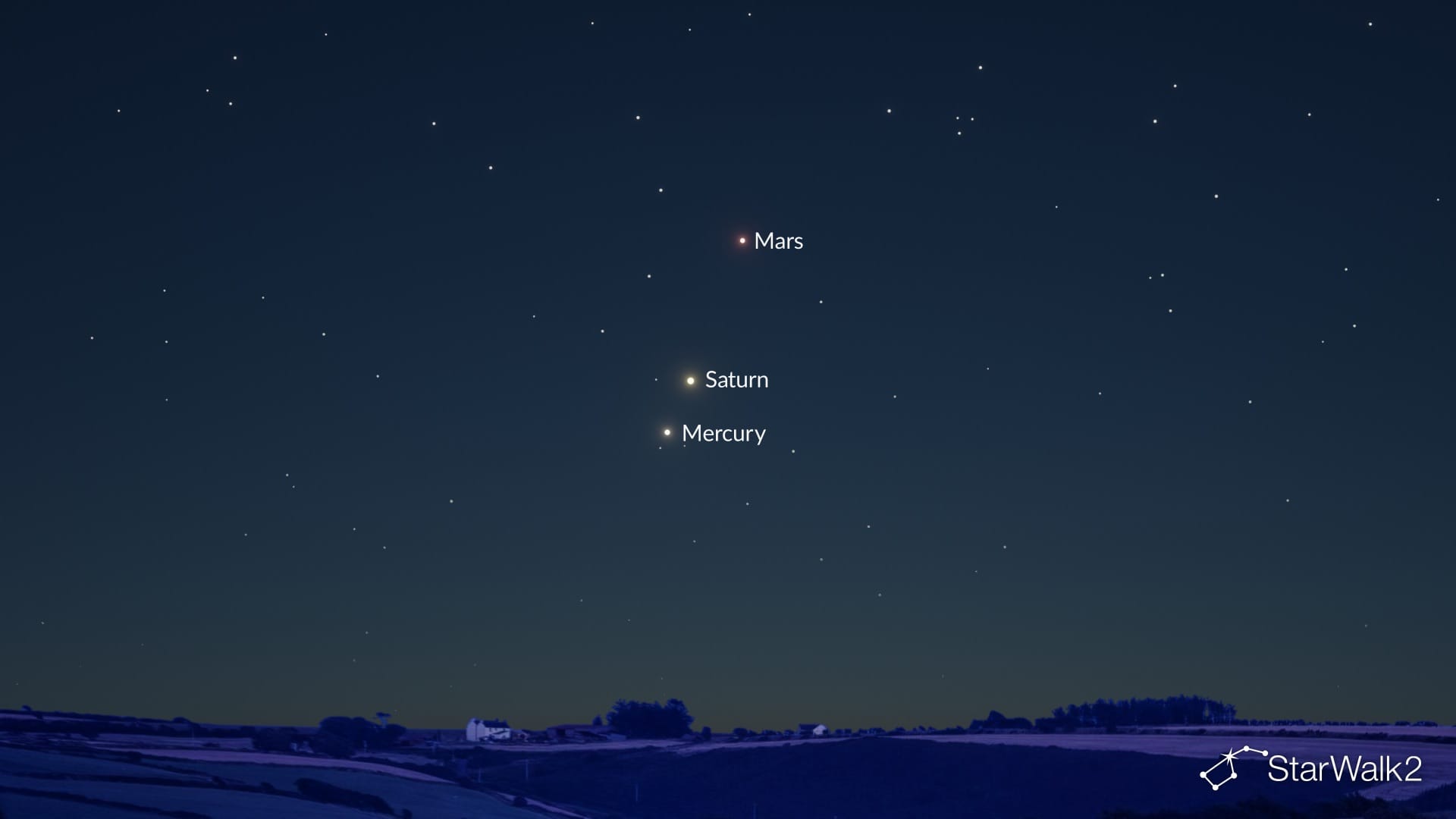
| April 20 | Mercury passes Saturn and Mars; Mercury, Saturn, and Mars form a straight line. | This is one of the most photogenic stages of the event and one of the best mornings to notice how quickly the lineup is changing. |
| April 21 | The compact group opens into a neat triangle made by Mercury, Saturn, and Mars. | A strong reminder that this is a changing planet parade, not a static one-date event. If you watched earlier mornings, this is when the geometry looks obviously different. |
One of the most striking moments comes on April 20 at around 10:00 GMT (6:00 AM EDT), when Saturn, Mars, and Mercury appear very close together and form a straight line that spans only about 1.6° — roughly the width of three Full Moons placed side by side.
A bonus target on April 19 is Comet C/2025 R3 (PanSTARRS): it reaches perihelion that day and lies about 15° from the planet grouping. It is not part of the alignment itself, but it adds extra interest to the same area of the pre-dawn sky.
The exact best morning depends on your latitude, your local horizon, and how transparent the dawn sky is. Think of April 18 as the center of the event, not the only day to look.
Safety note: Never point optics near the Sun!
The planetary alignment in April 2026 happens close to the rising Sun. Stop using binoculars or a telescope at least several minutes before sunrise — the Sun can enter the field of view unexpectedly and cause instant, permanent eye damage. You can check the sunrise time for your exact location in the Star Walk 2 app.
FAQ: Planetary alignment in mid-April 2026
What is a planetary alignment (or “planet parade”)?
A planetary alignment (often called a “planet parade”) is when several planets appear grouped along the ecliptic — the Sun’s path across the sky — creating a noticeable lineup from Earth’s point of view.
Which planets are involved in the alignment on April 18, 2026?
The planetary alignment on April 18, 2026, features Mercury, Mars, Saturn, and Neptune appearing close together in the pre-sunrise sky.
What time should I look?
The alignment happens shortly before sunrise. The exact best time depends on your location because the planets sit low and twilight brightens quickly. In general, you can start looking about 30 minutes before sunrise in the Northern Hemisphere and 60–90 minutes before sunrise in the Southern Hemisphere.
Can I see all four planets with the naked eye?
Not really. First, you’ll need binoculars or a telescope to spot Neptune — and even then it can be washed out by the dawn glow. The other three planets — Mercury, Mars, and Saturn — are typically bright enough to be seen with the naked eye, but their proximity to the Sun can make them difficult to catch, especially in the Northern Hemisphere.
Is this alignment visible everywhere?
Not equally. The alignment is much better positioned in the Southern Hemisphere and can be quite difficult to observe above ~30°N, where the planets stay very low in brightening dawn twilight.
What if it’s cloudy on April 18?
No worries — don’t treat the alignment as a one-morning-only event. The planets stay in a similar formation for several days around the peak, so you can try again on the mornings before or after April 18. Just aim for the same general rule: look shortly before sunrise, when the planets are above your horizon but the sky hasn’t brightened too much. To pick the best backup morning for your location, check the Star Walk 2 app for the planets’ rise times and altitude.
Do the planets form a perfectly straight line in space?
No. “Alignment” is mostly about how the planets appear from Earth. They gather near the same line in the sky because the Solar System is roughly flat (most planets orbit in nearly the same plane).
4-planet alignment on April 18, 2026: key takeaway
On and around April 18, 2026, Mercury, Mars, Saturn, and Neptune will appear close together in the pre-sunrise sky. This dawn alignment is best seen from the Southern Hemisphere and much harder above ~30°N, where the planets stay low in bright twilight.
For the best chance, don’t chase a single minute — treat it as a multi-day window around April 18, find a spot with a clear eastern horizon, and start observing when the planets are actually above your horizon. Expect Mars, Mercury, and Saturn to be your realistic naked-eye targets; consider Neptune a bonus that usually requires large binoculars or a telescope and excellent conditions.
To avoid guesswork, use the Planet Walk feature in the Star Walk 2 app to check the lineup for your exact location (rise times and height above the horizon) and time your session before sunrise glow takes over.
Clear skies!