Best September Astrophotography Targets: Brightest Galaxies, Star Clusters & Nebulae
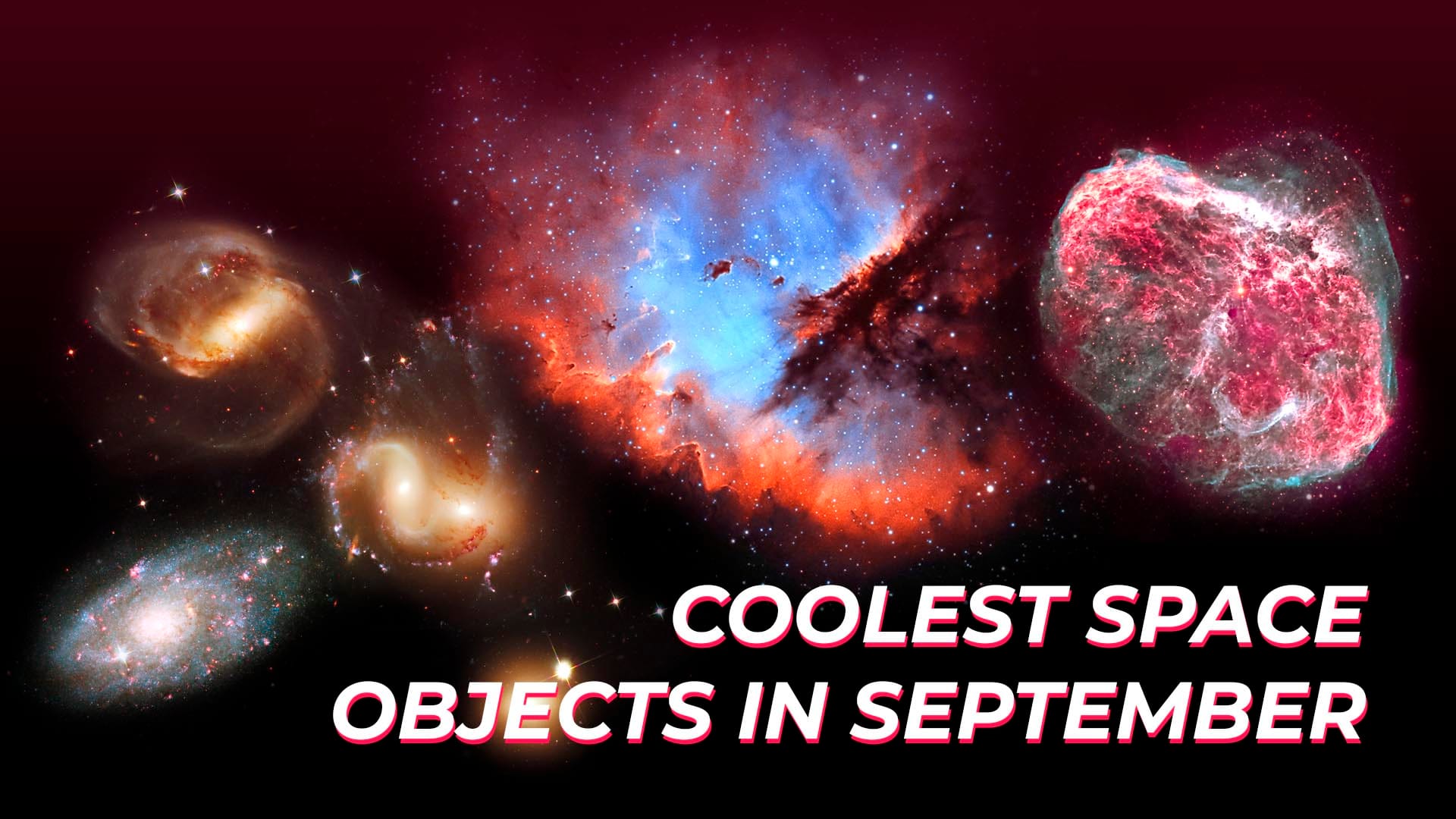
The September night sky is full of spectacular deep-sky objects, from glittering star clusters to glowing nebulae and distant galaxies. Below, you’ll find the best targets to observe and photograph in September, with practical notes on visibility, observing, and astrophotography. Grab your binoculars or telescope, use the Sky Tonight app to locate them, and enjoy the best deep-sky objects of September!
Contents
- Check the Moon Phase Before Shooting Deep-Sky Objects
- Best Astrophotography Targets in September: Galaxies
- Best Astrophotography Targets in September: Nebulae
- Best Astrophotography Targets in September: Star Clusters
- Deep-sky Objects in September: FAQ
- More Great Deep-Sky Objects to Photograph in September
- September Deep-Sky Objects: Key Facts
Check the Moon Phase Before Shooting Deep-Sky Objects
Dark skies make a major difference when observing and photographing faint galaxies and nebulae. Bright moonlight is especially troublesome for low-surface-brightness targets such as the Iris Nebula or Stephan’s Quintet.
In September 2026, the New Moon falls on September 11 at 03:27 GMT, making roughly September 7–15 the best period for deep-sky astrophotography. The first few evenings of the month can also work well: the Last Quarter occurs on September 4, so the Moon rises relatively late. Try to avoid the nights around the Full Moon on September 26 at 16:49 GMT, when faint deep-sky objects will be much harder to capture.
For exact Moon phase dates, illumination, moonrise, and moonset times for your location, check our Moon Calendar.
Best Astrophotography Targets in September: Galaxies
Galaxies are enormous collections of billions of stars, gas, and dark matter bound together by gravity. They lie far beyond our Milky Way, so they usually appear as faint smudges in the eyepiece. The Andromeda Galaxy is the easiest to see in September — even visible to the naked eye under dark skies — while others demand dark conditions and larger telescopes. Photographing galaxies requires patience and long exposures, but the results capture the grand spirals and structures of entire star systems.
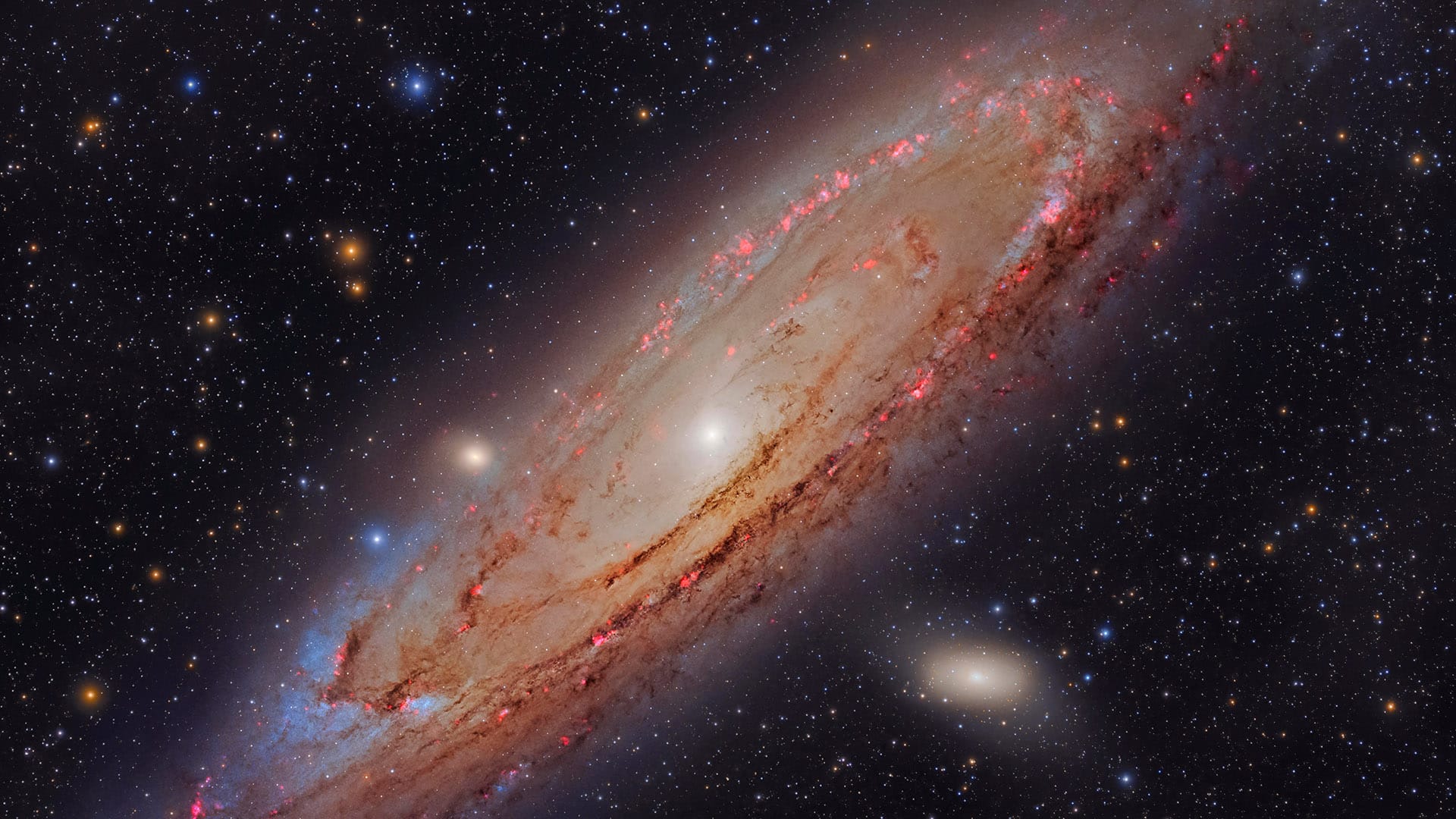
Andromeda Galaxy
- Alternative names: M31, NGC 224
- Apparent size: 3° × 1° (6 × Moon)
- Apparent magnitude: 3.4
- Constellation: Andromeda
- Where to observe: Northern Hemisphere
The Andromeda Galaxy is a barred spiral galaxy and the nearest major galaxy, lying roughly 2.5 million light-years from Earth. It is the largest member of the Local Group of galaxies, which also contains our home galaxy, the Milky Way and over a hundred smaller galaxies.
It’s widely believed that in about 4.5 billion years, Andromeda and the Milky Way will collide and eventually merge into a single giant galaxy. However, recent studies suggest there's actually about a 50% chance the collision might not happen within the next 10 billion years. Want to learn more about our galaxy’s past, present, and future? Take this quiz about the Milky Way!
Tips for observing and astrophotography
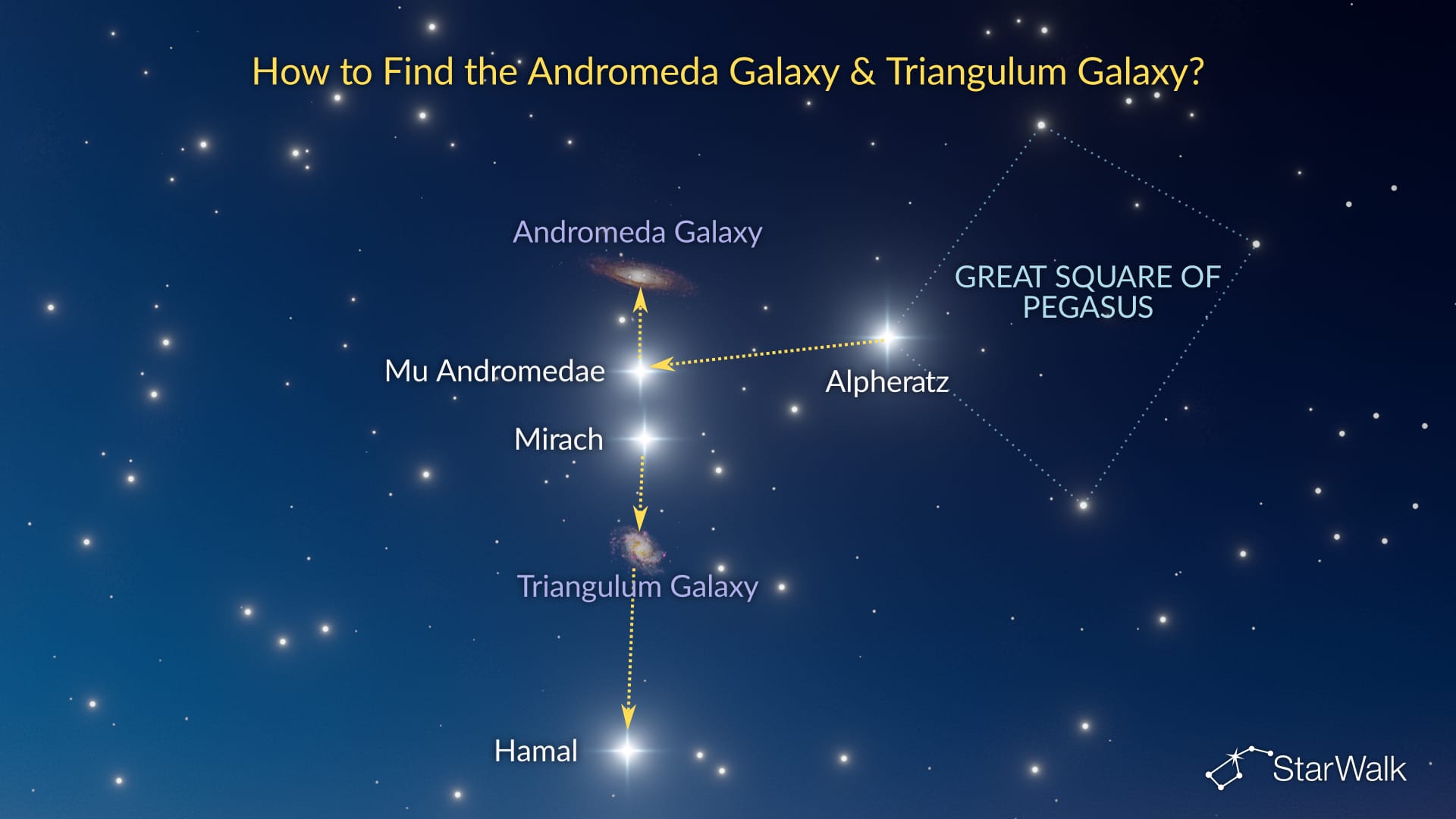
Under dark, clear skies, the Andromeda Galaxy is visible to the naked eye as a soft, hazy glow. Binoculars (7×50 or 10×50) or a small telescope will bring out its stretched oval form and brighter core.
For astrophotography, use a camera lens or small refractor with a wide enough field of view to fit the galaxy. Combining shorter exposures of the bright core with longer exposures of the faint outer disk can help preserve detail across the huge brightness range.
Triangulum Galaxy
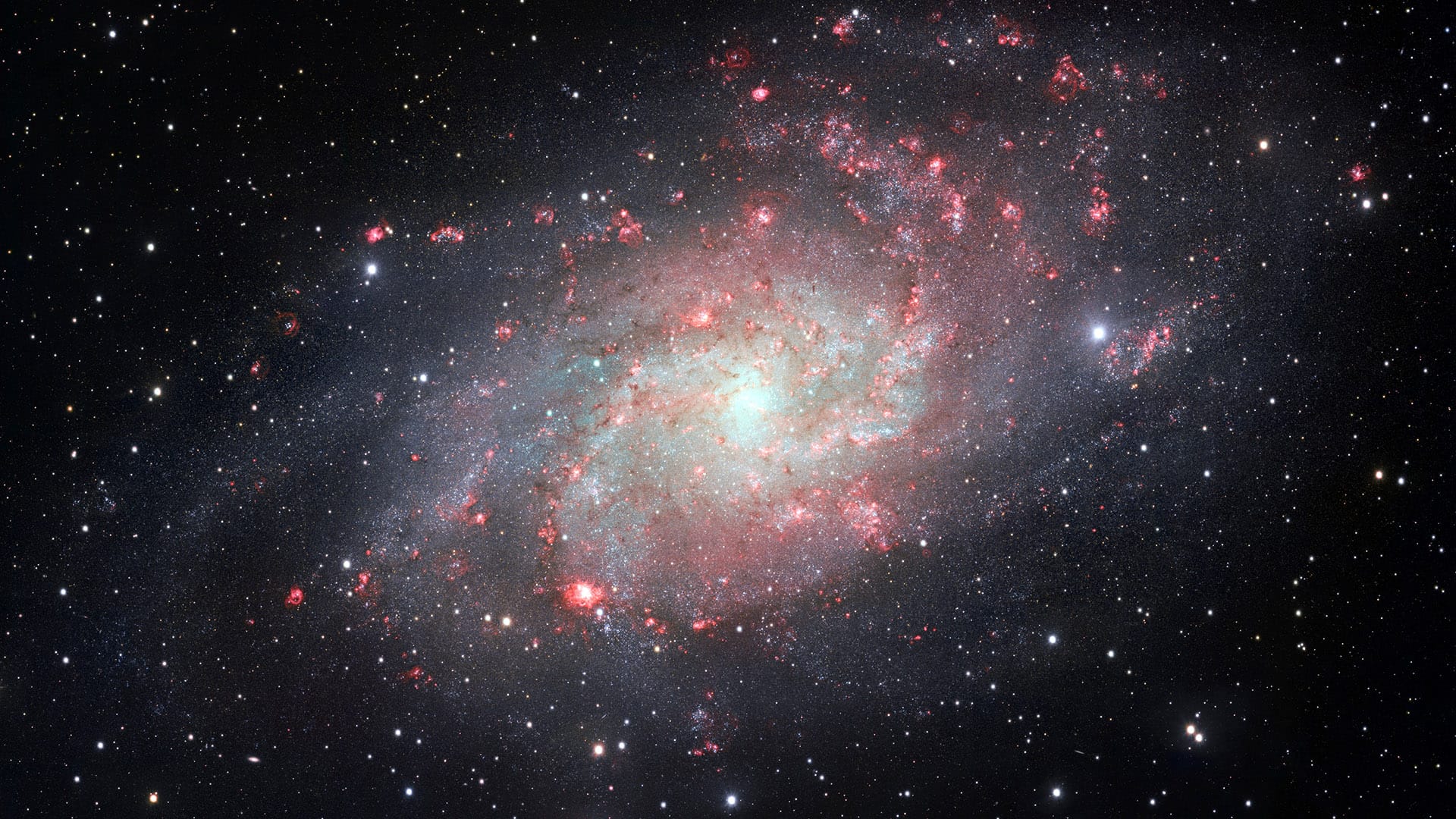
- Alternative names: M33, NGC 598
- Apparent size: 1° × 41′ (2 × Moon)
- Apparent magnitude: 5.7
- Constellation: Triangulum
- Where to observe: Northern Hemisphere
The Triangulum Galaxy is a face-on spiral lying about 2.73 million light-years away. It is the third-largest member of the Local Group, after Andromeda and the Milky Way.
Tips for observing and astrophotography
The Triangulum Galaxy is bright enough to be seen through binoculars as a faint, misty patch, while a telescope reveals finer details.
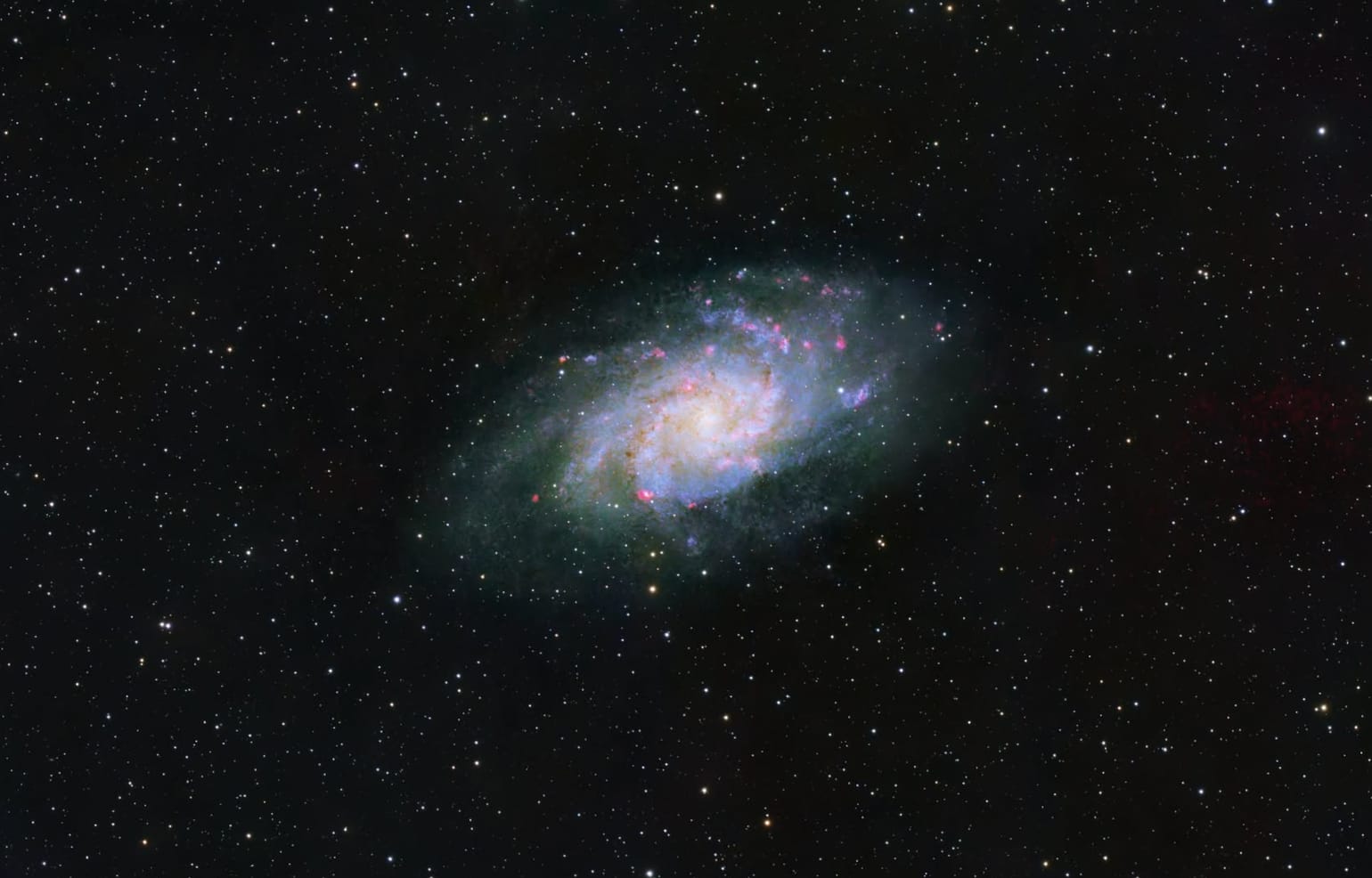
For astrophotography, use a small telescope or a medium focal length, and collect plenty of total exposure time to reveal the galaxy's loose spiral arms and numerous star-forming regions. Use broadband color imaging to capture the galaxy’s natural colors and spiral structure. You can also add H-alpha data to make the hydrogen-rich star-forming regions stand out more clearly.
Want an easier way to photograph the Triangulum Galaxy? With the Seestar S50, you can find the galaxy automatically and let the telescope handle focusing, tracking, and live stacking. Its field of view is well suited to this large galaxy, making it an easy way to reveal M33’s spiral structure and bright star-forming regions without assembling a traditional astrophotography setup.
Grab Seestar S50 now: global users, US-store, EU-store.
Stephan’s Quintet
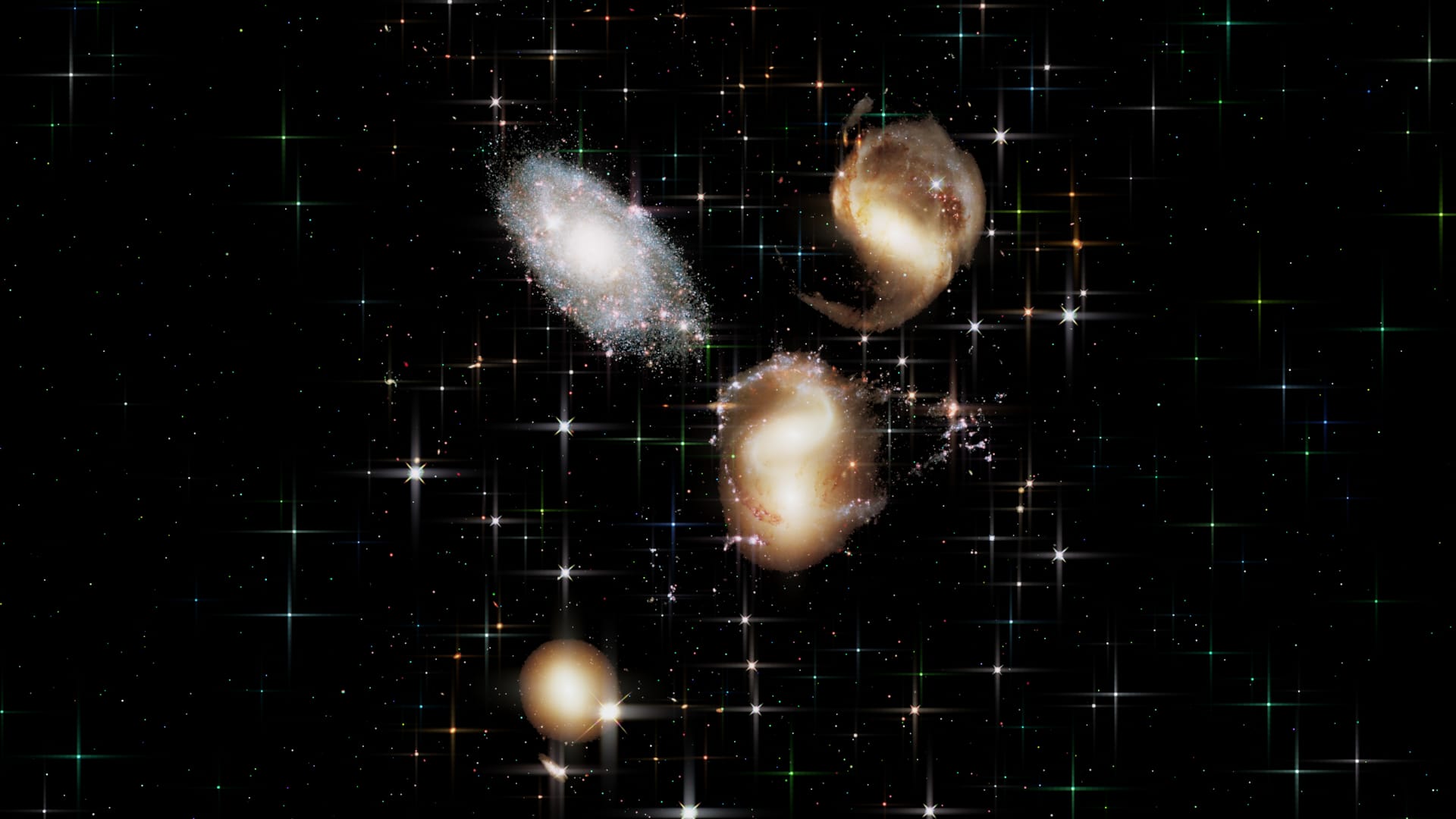
- Alternative names: HCG 92, Arp 319, VV 288, SQ
- Apparent size: 4.4′ × 4.4′ (0.1 × Moon)
- Apparent magnitude: 13.9-16.7
- Constellation: Pegasus
- Where to observe: Both hemispheres
Stephan’s Quintet is a group of five galaxies. One member, NGC 7320, is much closer to us at about 40 million light-years away, while the other four (NGC 7317, NGC 7318A, NGC 7318B, and NGC 7319) lie about 290 million light-years away and are physically interacting. The group is one of the best-studied compact galaxy groups.
Tips for observing and astrophotography
Stephan’s Quintet is faint and challenging – you’ll need a large telescope with a high aperture under dark skies to glimpse it.
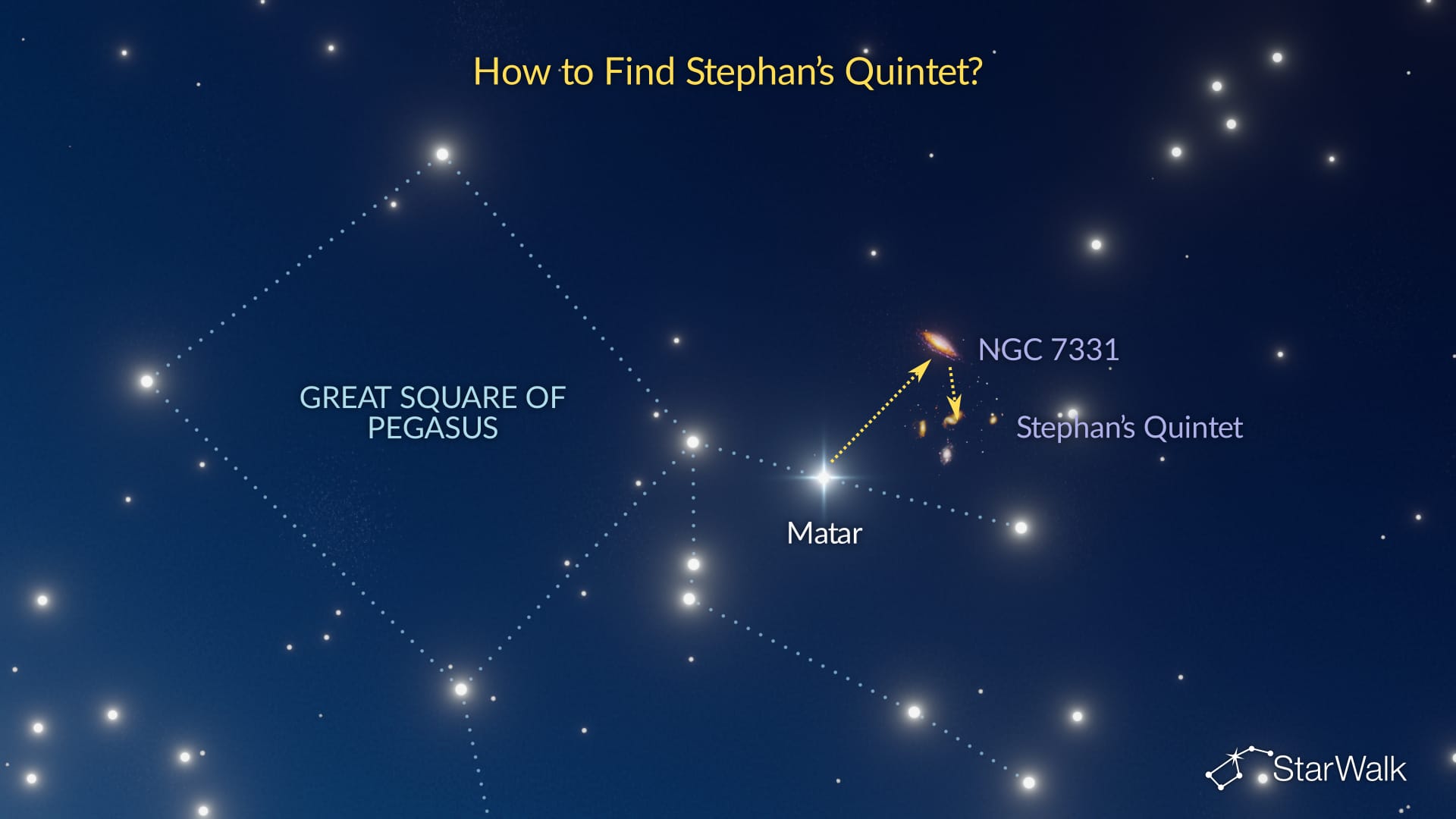
For astrophotography, Stephan’s Quintet is a small and challenging target, so use a telescope with a long focal length and image from a dark site if possible. Collect several hours of total exposure time to bring out the faint galaxies and their details. During processing, be careful not to over-brighten or oversaturate the galaxies, as they differ noticeably in brightness and color. If your field of view allows, include the nearby NGC 7331 for a more striking composition.
Sculptor Galaxy
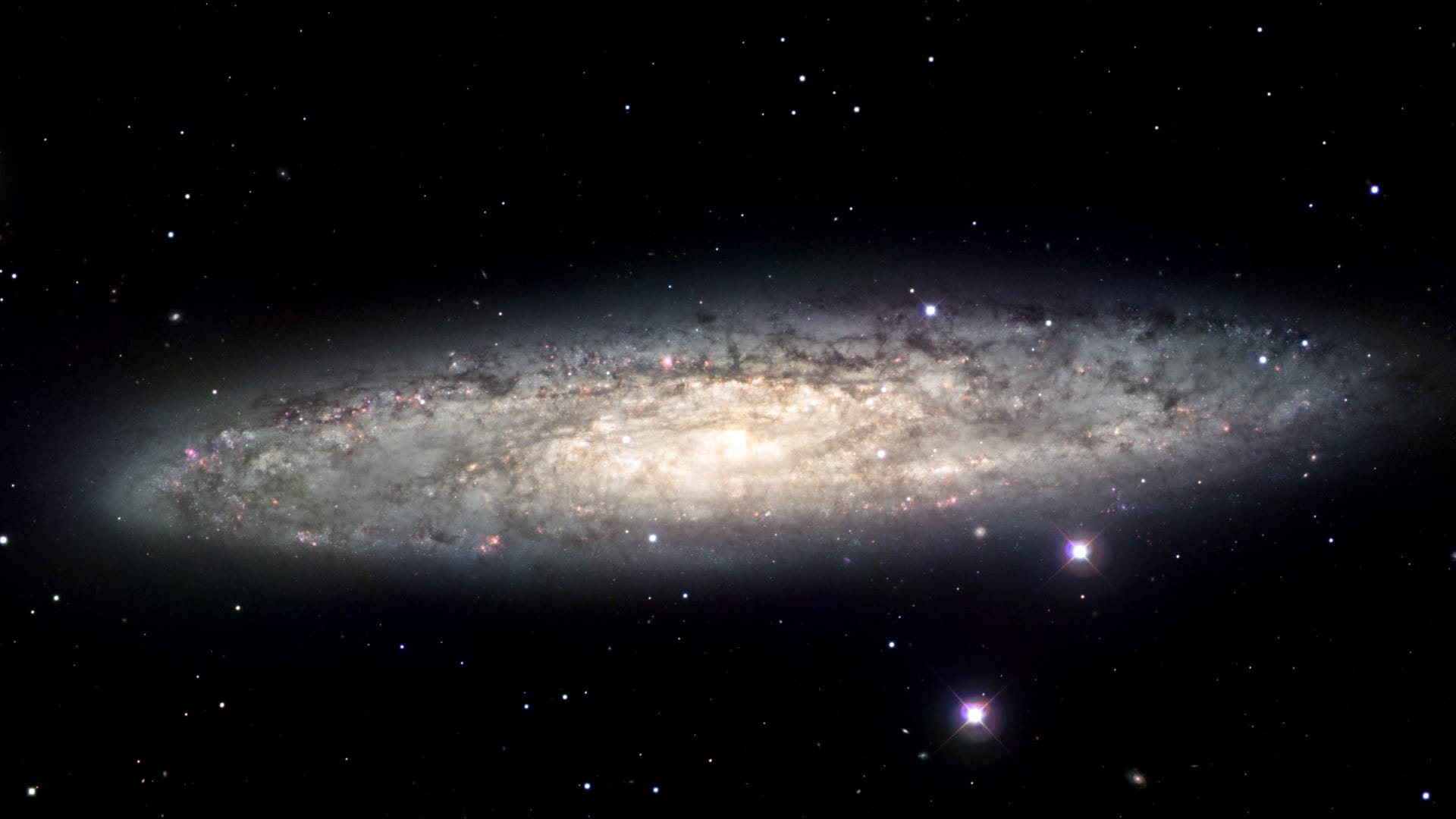

- Alternative names: NGC 253, Silver Coin Galaxy, Silver Dollar Galaxy, Caldwell 65
- Apparent size: 28.8′ × 5.9′ (1 × Moon)
- Apparent magnitude: 7.6
- Constellation: Sculptor
- Best viewed from: Southern Hemisphere
The Sculptor Galaxy (NGC 253) is a large spiral galaxy seen almost edge-on, located roughly 10 million light-years away. It is the dominant member of the Sculptor Group and is classified as a starburst galaxy because it is forming new stars at an unusually high rate. Its tilted disk is crossed by prominent dark dust lanes, while bright young stars and star-forming regions fill much of the galaxy.
Tips for observing and astrophotography
The Sculptor Galaxy is visible even in a small telescope under dark skies. Southern Hemisphere observers get the best view, while observers at mid-northern latitudes will find it low above the southern horizon.
For astrophotography, use a medium focal length or small telescope to frame the galaxy’s long, narrow disk. Broadband imaging works well for capturing its natural colors and dark dust lanes, while longer total exposure time will reveal fainter structures around the disk. Optional H-alpha data can help emphasize its active star-forming regions.
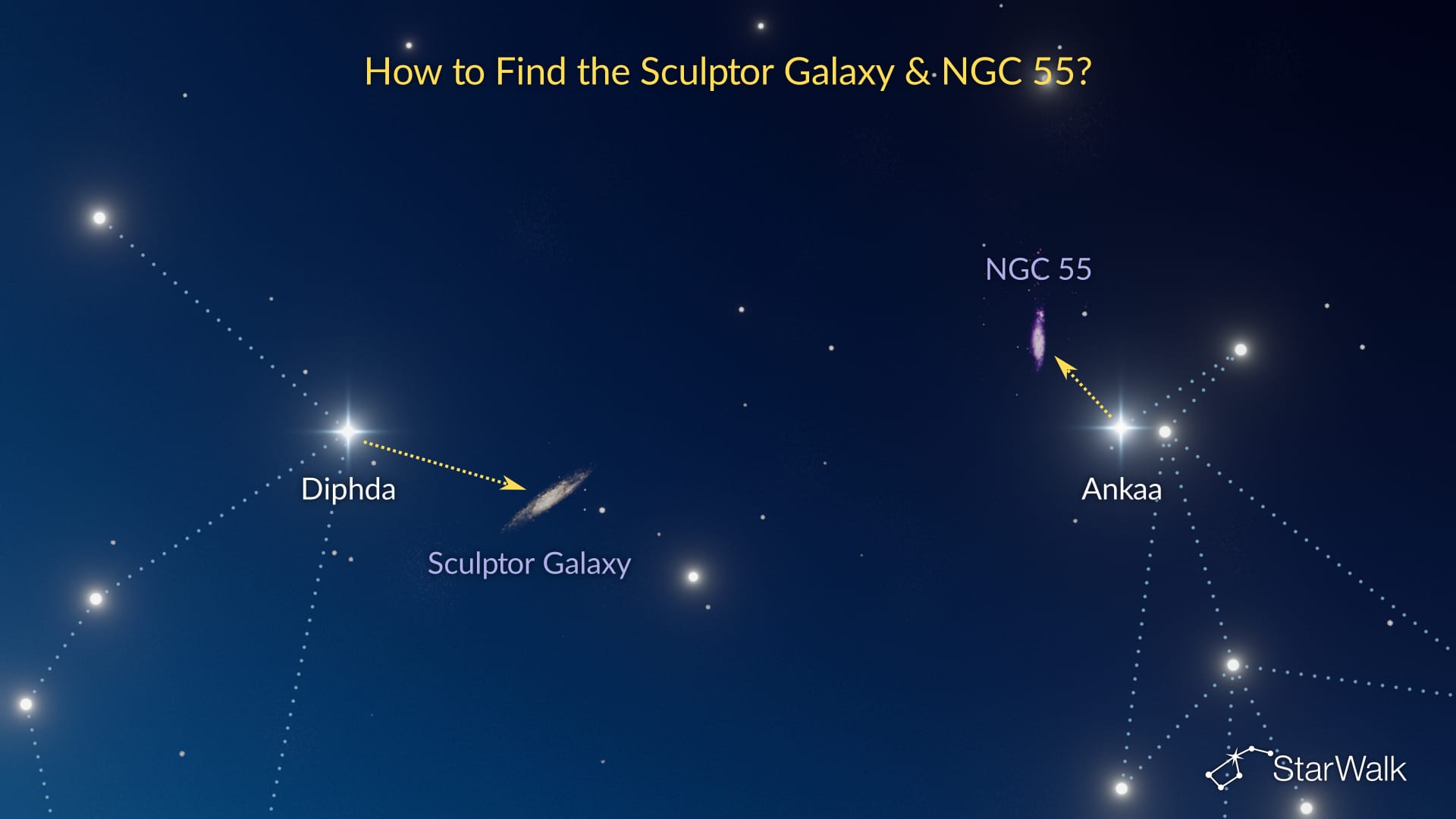
NGC 55
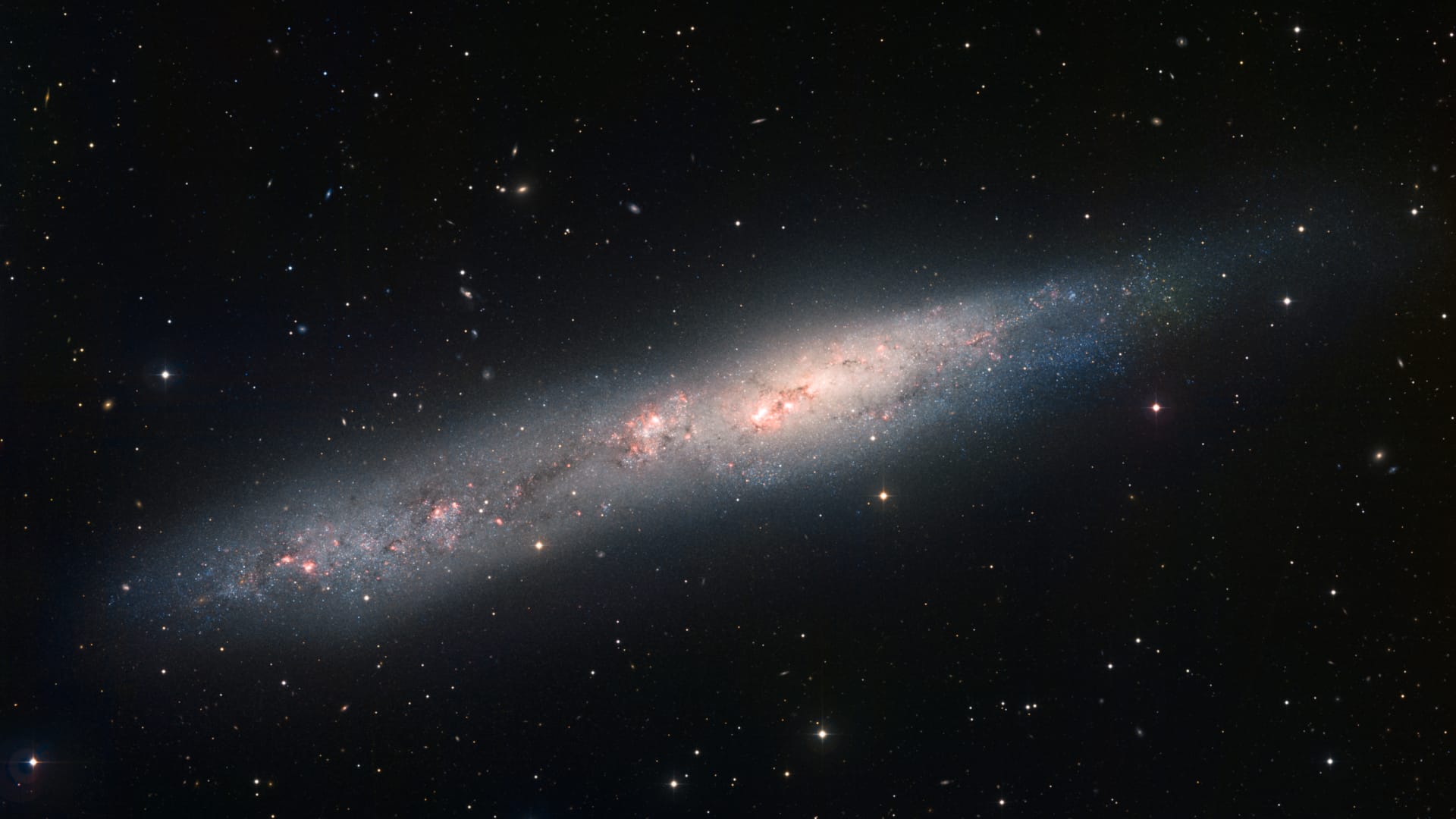
- Alternative names: Caldwell 72
- Apparent size: 32.4′ × 4.0′ (1.1 × Moon)
- Apparent magnitude: 7.8
- Constellation: Sculptor
- Best viewed from: Southern Hemisphere
NGC 55 is a barred irregular spiral galaxy located about 6.5 million light-years away. It belongs to the Magellanic type of galaxies and resembles a smaller version of the Large Magellanic Cloud. Because we see it nearly edge-on, it appears as a long, narrow streak filled with uneven patches of stars, gas, and dust.
Tips for observing and astrophotography
Under a dark sky, NGC 55 is bright enough to be spotted with binoculars. A small telescope provides a clearer view of its elongated shape, and the galaxy is best viewed from the Southern Hemisphere.
For astrophotography, use a medium-focal-length or small telescope to fit the entire elongated galaxy within the frame. Broadband imaging will capture its natural stellar colors, while long total exposure time will help reveal the mottled structure, dust, and faint outer regions.
Best Astrophotography Targets in September: Nebulae
Nebulae are vast clouds of gas and dust where stars are born and where dying stars shed their outer layers. They often appear faint and diffuse, making them some of the trickiest objects to spot visually. While large, bright nebulae like the Pelican Nebula can sometimes be glimpsed with binoculars under dark skies, most require telescopes and often filters (UHC or OIII) to bring out their delicate details. For astrophotographers, nebulae are among the most rewarding targets — long exposures reveal stunning shapes and colors invisible to the eye.
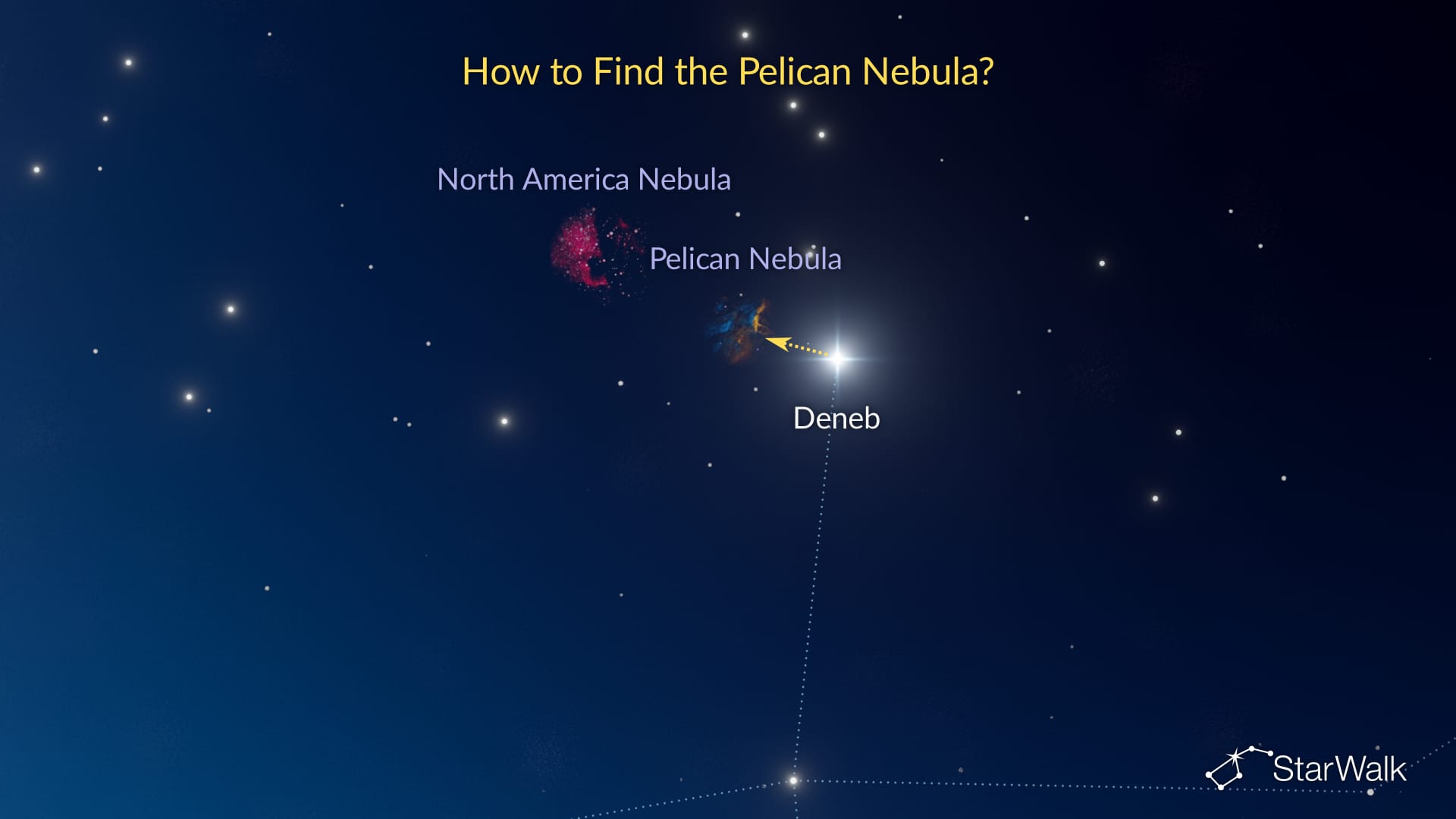
Pelican Nebula
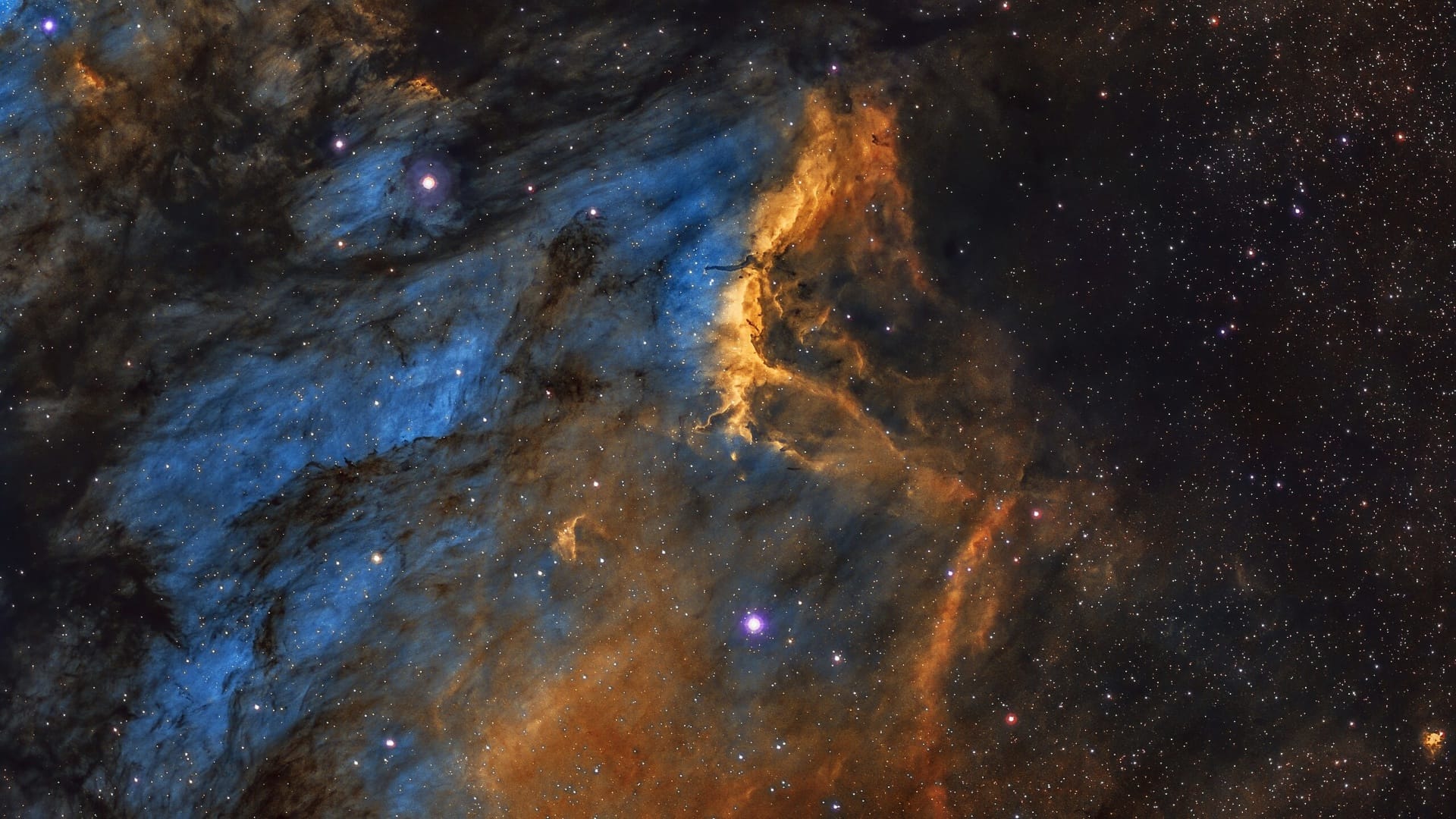

- Alternative names: IC 5070
- Apparent size: 1° × 0.8° (1.8 × Moon)
- Apparent magnitude: 5.9
- Constellation: Cygnus
- Where to observe: Northern Hemisphere
The Pelican Nebula is an emission nebula located approximately 1,800 light-years from Earth. It is named for its resemblance to a pelican and is part of the same interstellar cloud as the nearby North America Nebula (NGC 7000).
Tips for observing and astrophotography
Some observers claim to have seen the Pelican Nebula through small 7x42 binoculars without any filters. You can try to do it this way, too, or use a 76mm (3") telescope with a UHC or an O III filter for a better result.
For astrophotography, use a camera lens, a small refractor, or a wide-field telescope to capture the Pelican Nebula along with the surrounding Cygnus star field. It is part of the same large H II region as the nearby North America Nebula, so the two make an excellent wide-field composition. A longer total exposure time will reveal more of the faint gas and dust, while H-alpha or dual-band filters are especially useful for bringing out the glowing hydrogen emission, particularly in light-polluted skies.
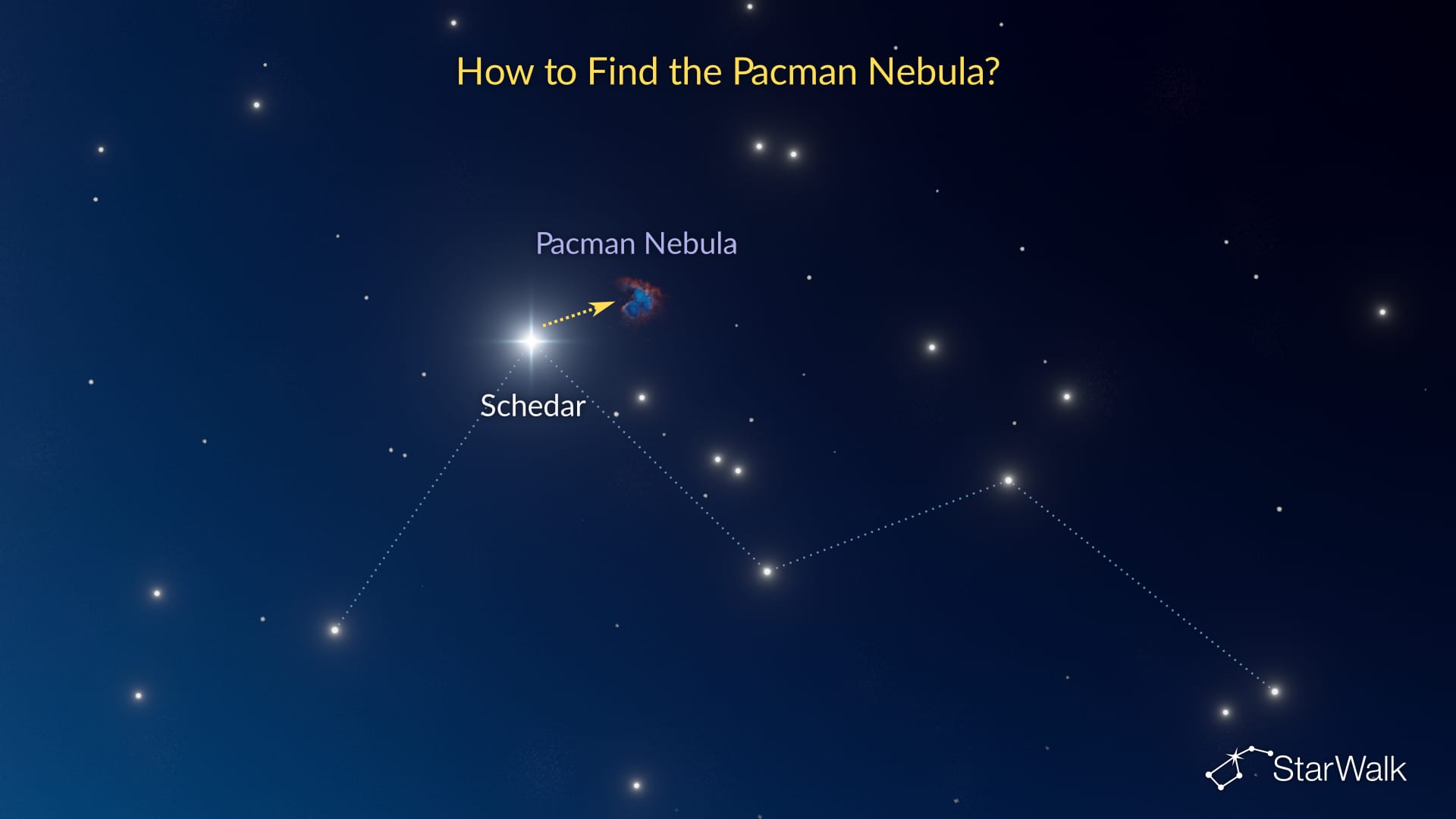
Pacman Nebula
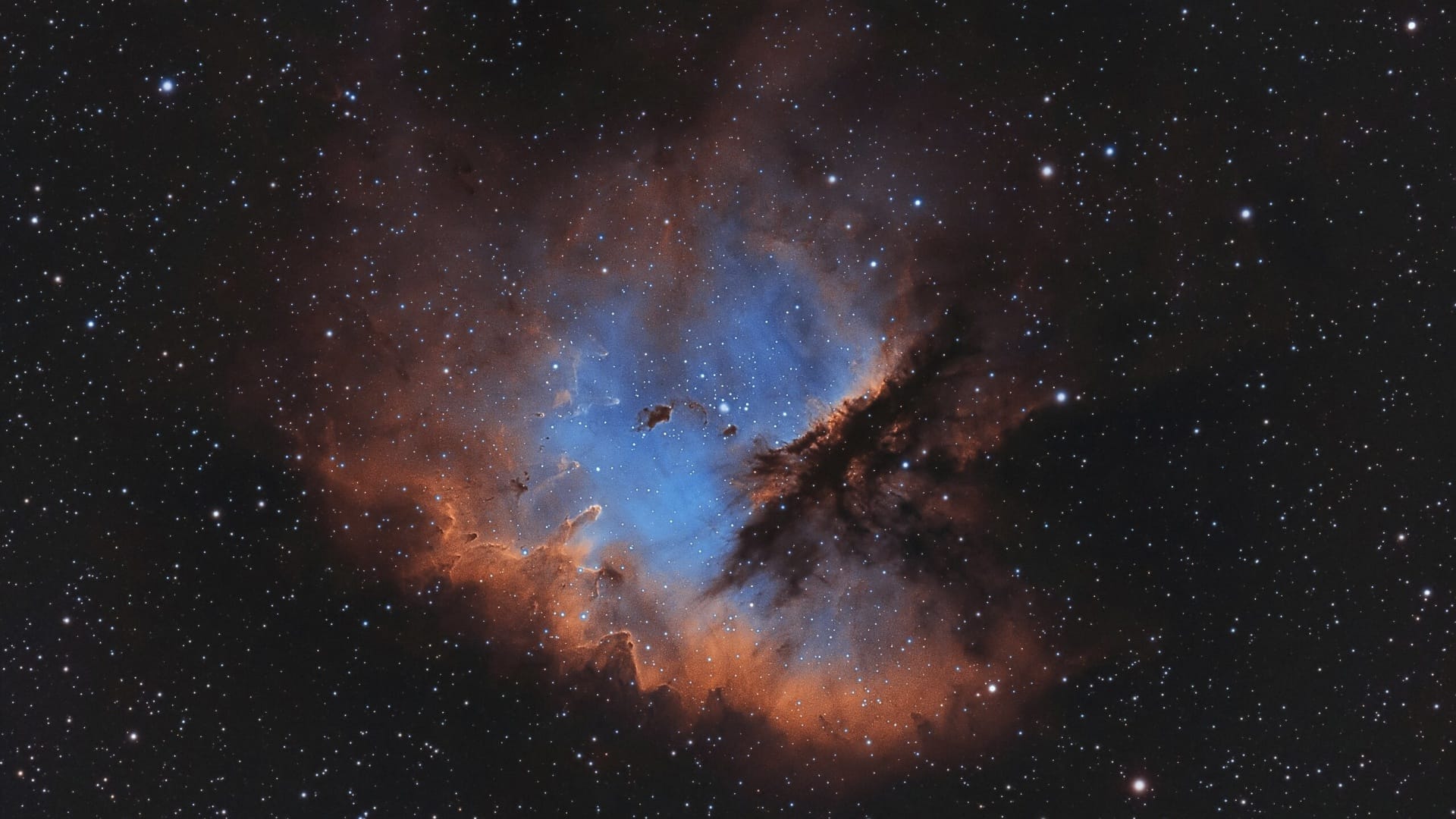

- Alternative names: NGC 281, Sh2-184
- Apparent size: 35' (1.2 × Moon)
- Apparent magnitude: 7.3
- Constellation: Cassiopeia
- Where to observe: Northern Hemisphere
The Pacman Nebula (NGC 281) is a bright emission nebula and part of the Perseus Spiral Arm in the Milky Way. The nebula is located about 9,500 light-years from us and resembles the famous video game character.
Tips for observing and astrophotography
From dark sky locations, you can see the Pacman Nebula with a 200mm (8") telescope. Use an OIII filter to get a better view of the nebula.
For astrophotography, use a small refractor or medium focal length to capture the whole nebula and its surrounding star field. Long total exposure times will help reveal bright emission regions and dark dust structures, while H-alpha or dual-band filters are especially useful for increasing contrast in light-polluted skies.
The Seestar S50 smart telescope is a great match for photographing this target: its built-in dual-band filter helps bring out the nebula’s glowing hydrogen and oxygen emission, even under light-polluted skies. Select NGC 281 in the Seestar app, let the telescope find and track it automatically, and watch the image become more detailed as the exposures are stacked.
Grab Seestar S50 now: global users, US-store, EU-store.
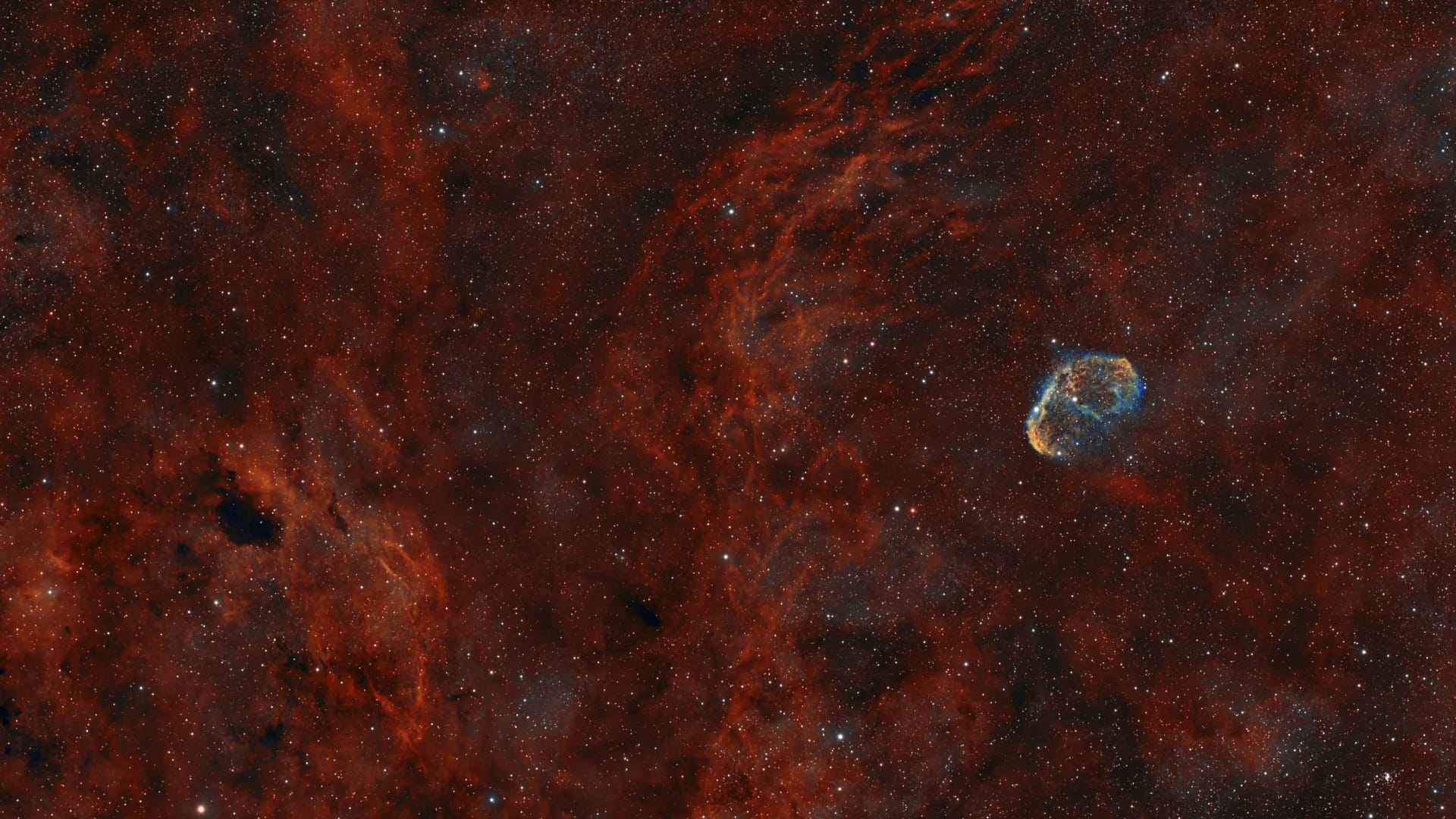
Crescent Nebula
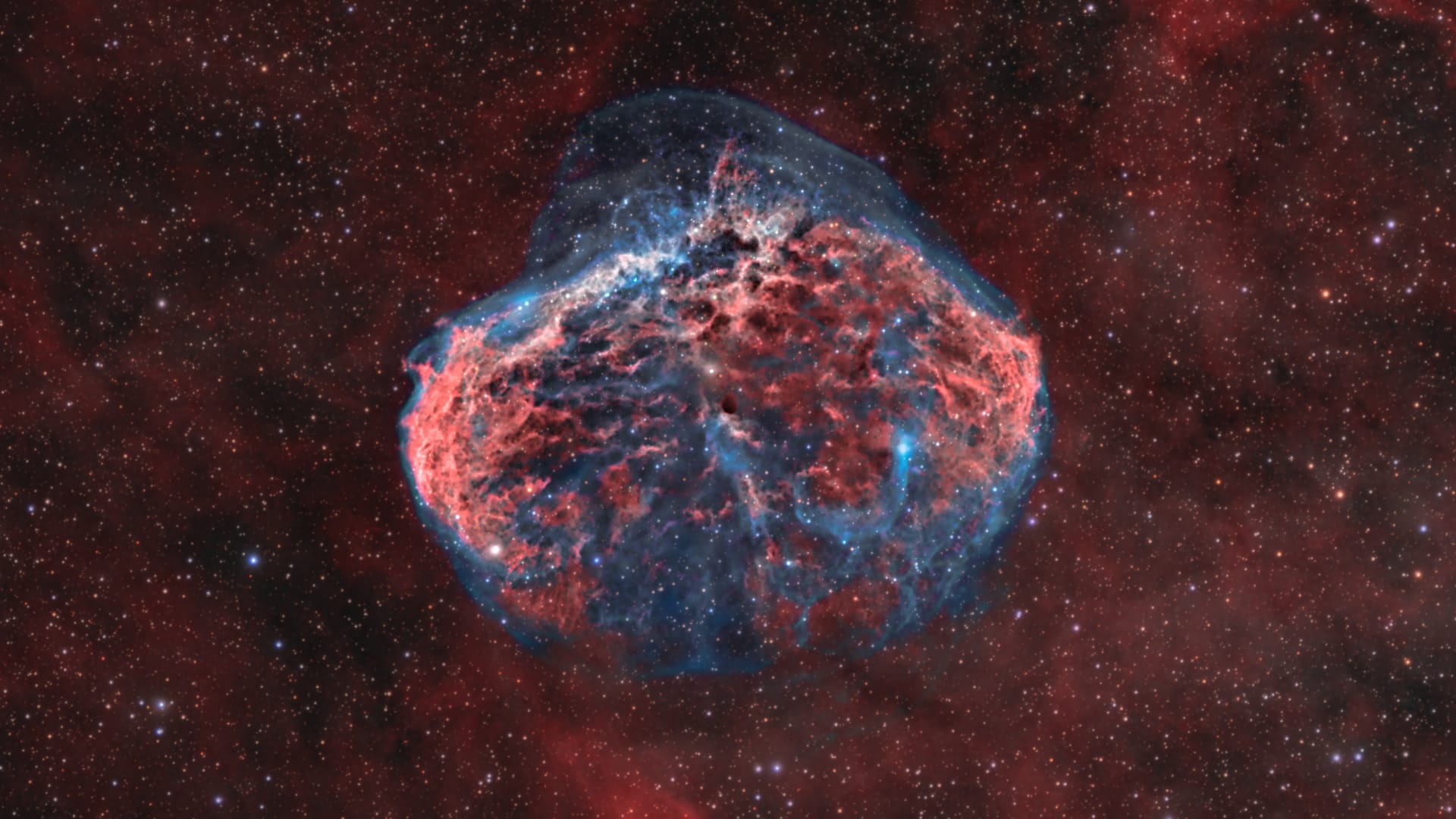
- Alternative names: NGC 6888, Caldwell 27
- Apparent size: 18' × 12' (0.5 × Moon)
- Apparent magnitude: 7.4
- Constellation: Cygnus
- Where to observe: Northern Hemisphere
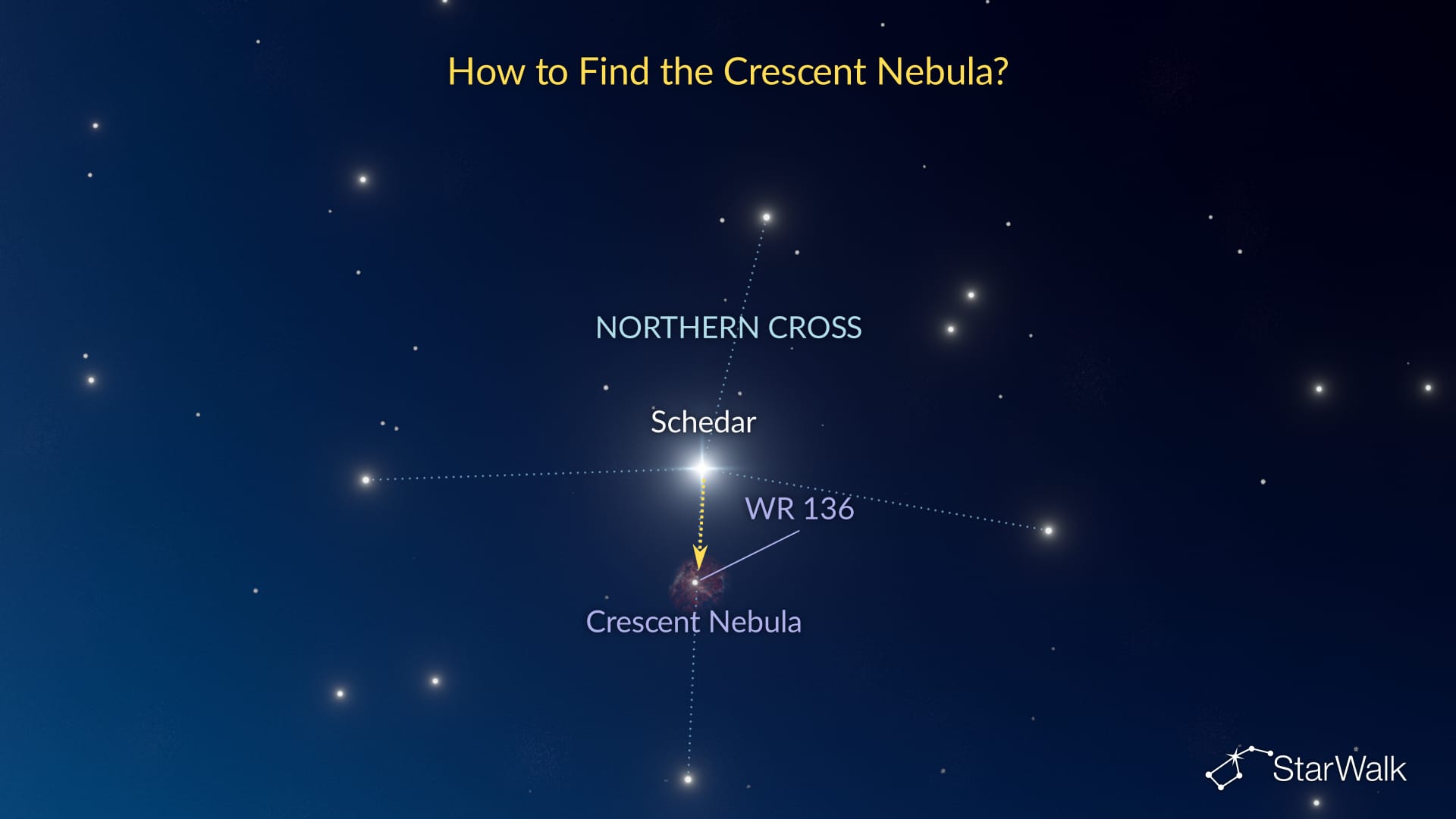
The Crescent Nebula is an emission nebula located about 5,000 light-years away from Earth. At the heart of the nebula, there’s an extremely hot star, WR 136, that belongs to the rare type of Wolf-Rayet stars.
Tips for observing and astrophotography
For visual observing, use a UHC or O III filter and averted vision; an 8-inch (200 mm) telescope offers a much better chance of seeing the fainter shell. For astrophotography, a medium-focal-length setup with H-alpha and O III or a dual-band filter works well for capturing both the shell and the surrounding Cygnus star field.
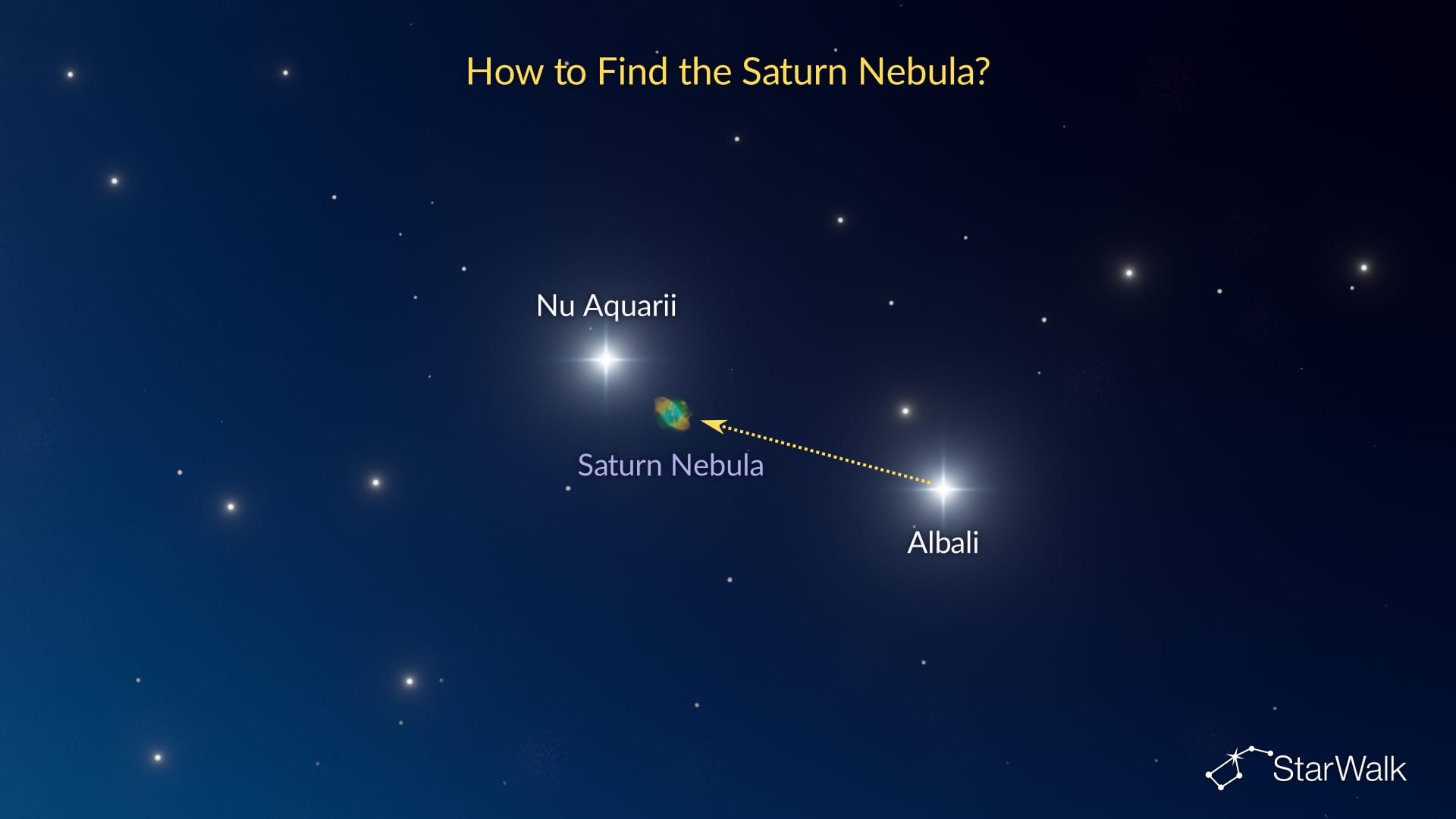
Saturn Nebula
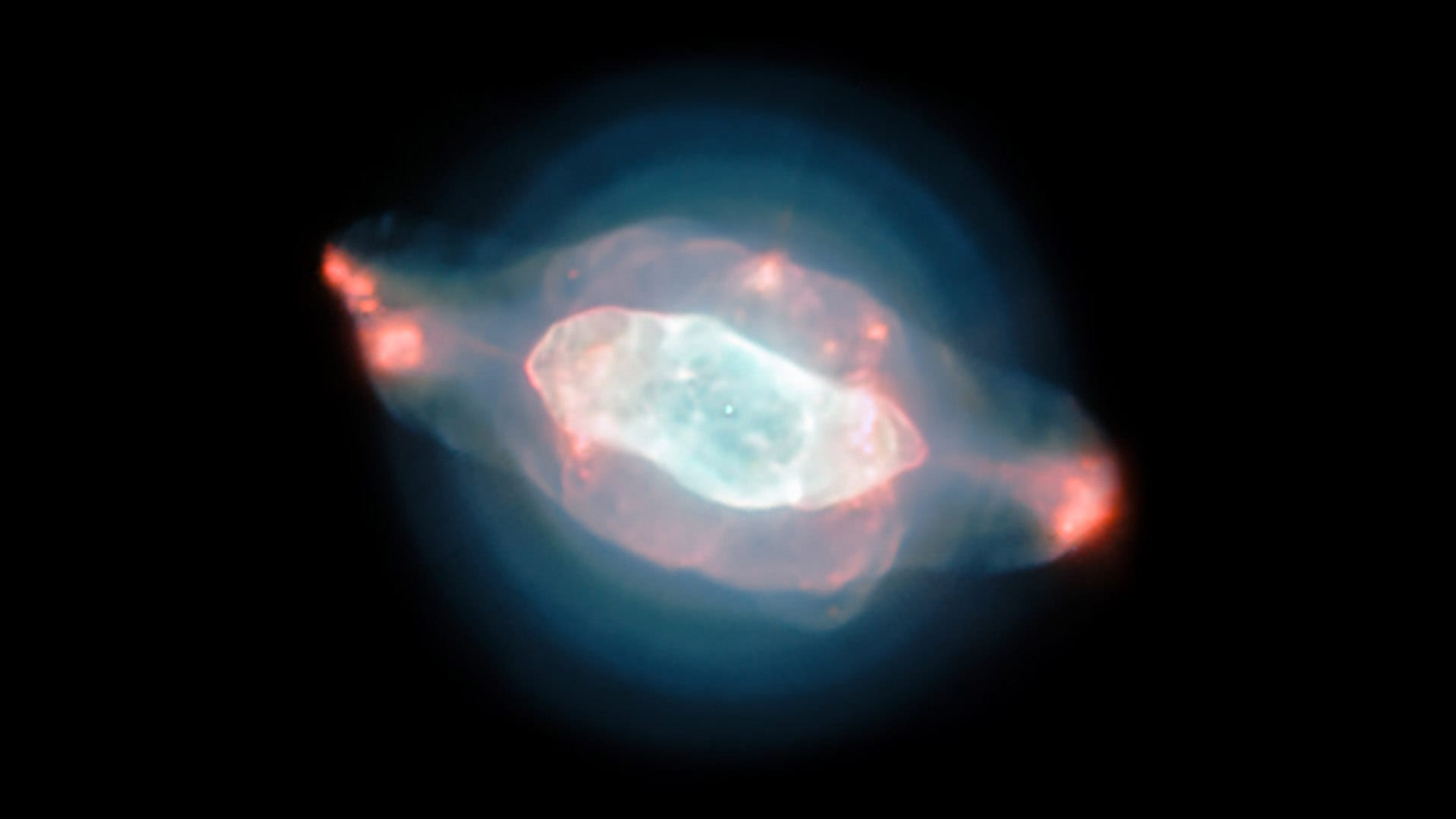

- Alternative names: NGC 7009, Caldwell 55
- Apparent size: 41" × 35" (0.02 × Moon)
- Constellation: Aquarius
- Apparent magnitude: 8.0
- Where to observe: Both hemispheres
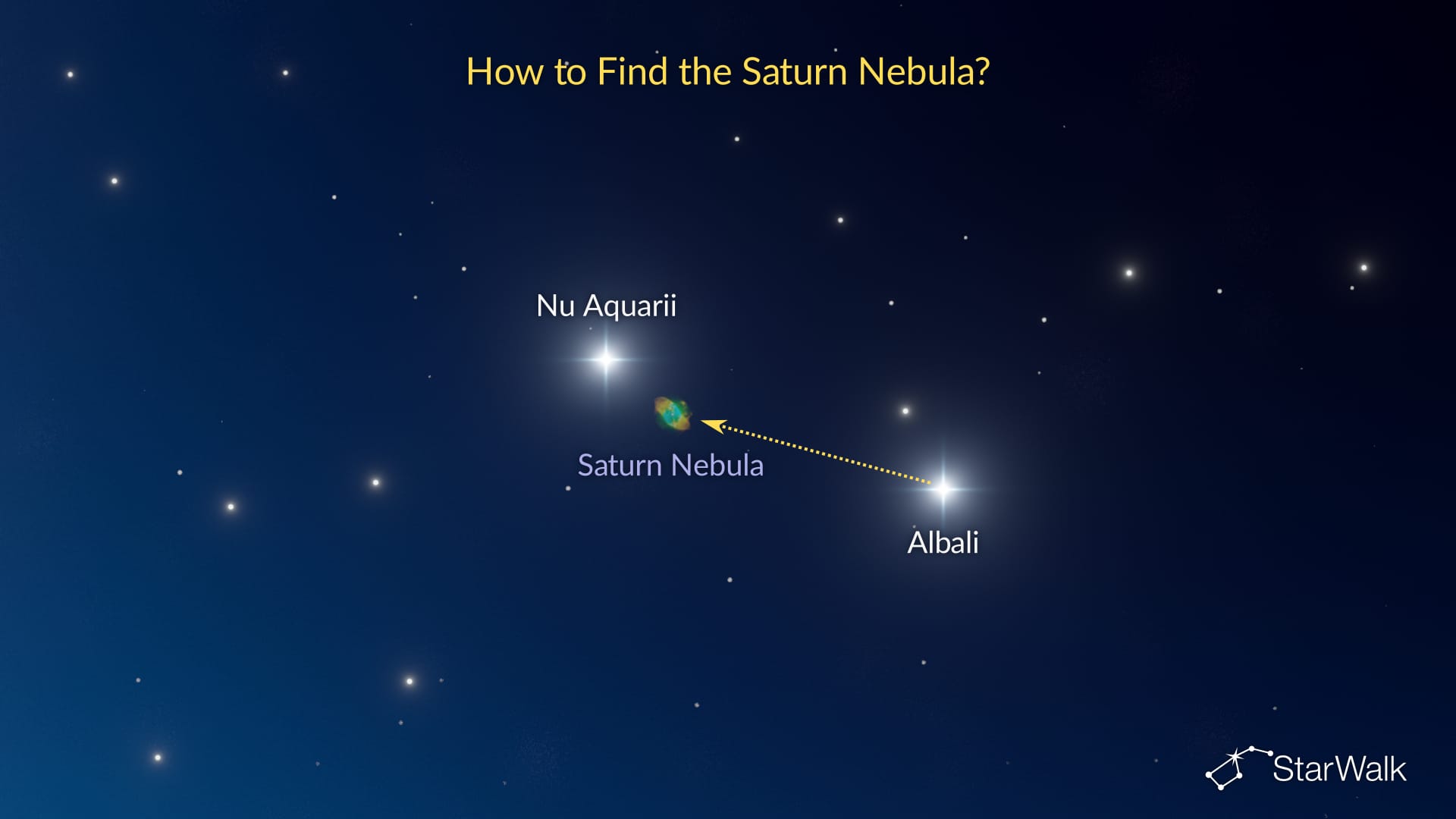
The Saturn Nebula (NGC 7009) is a planetary nebula located about 2,000 light-years away from Earth. It gets its name because it has extended lobes that resemble Saturn’s rings. The nebula’s unique shape is the result of multiple ejections of gas from the dying star at its center.
Tips for observing and astrophotography
In a small telescope, the Saturn Nebula appears as a tiny, nearly stellar object with a greenish tint. A larger telescope and high magnification are needed to reveal its elongated shape and faint “handles.”
For astrophotography, use a telescope with a long focal length to capture this small planetary nebula in detail. Accurate tracking and stacking multiple exposures will help reveal its bright central region and faint outer structures without losing detail. An OIII filter can be useful for emphasizing the nebula’s ionized oxygen emission and increasing contrast.
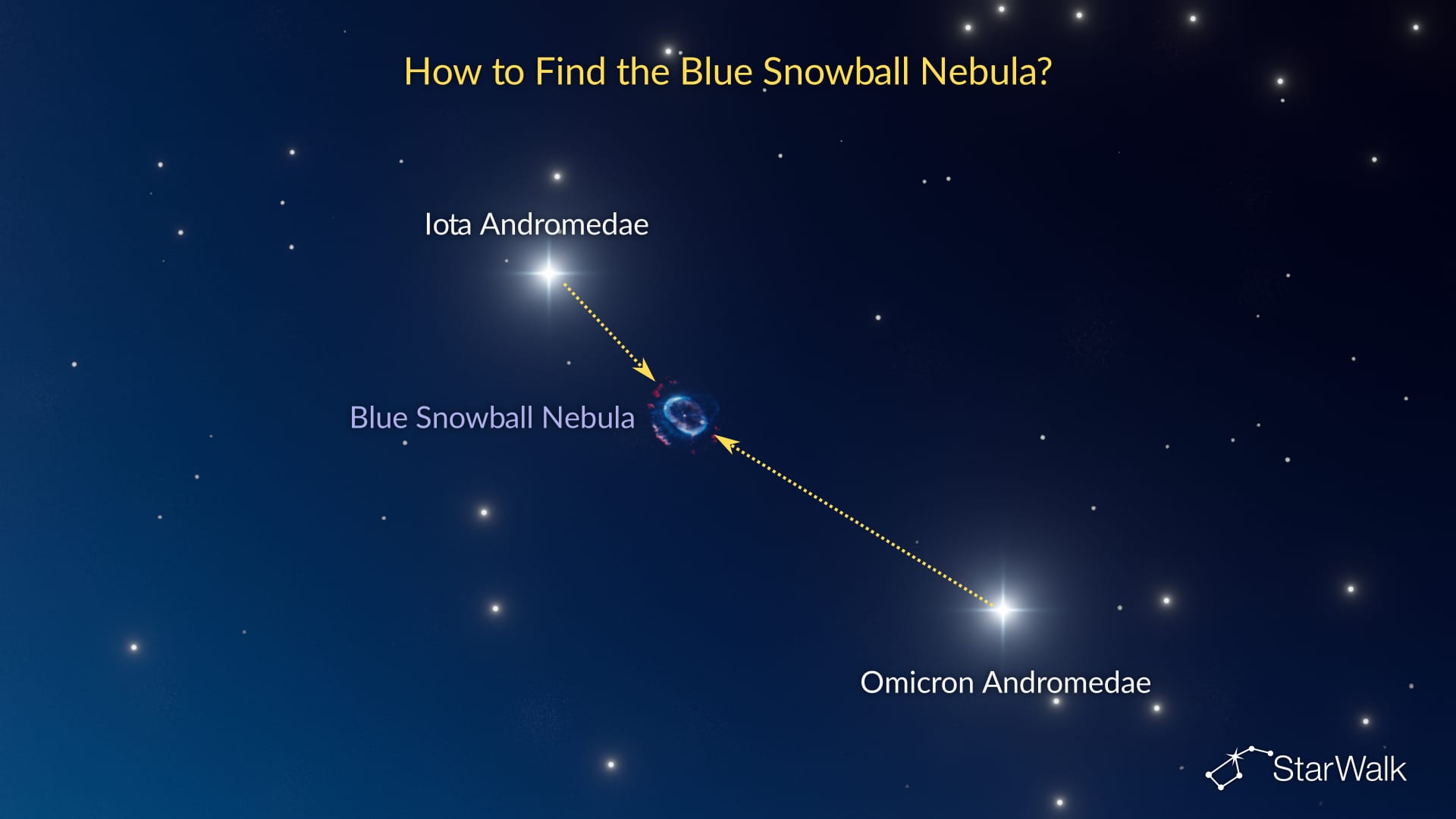
Blue Snowball Nebula
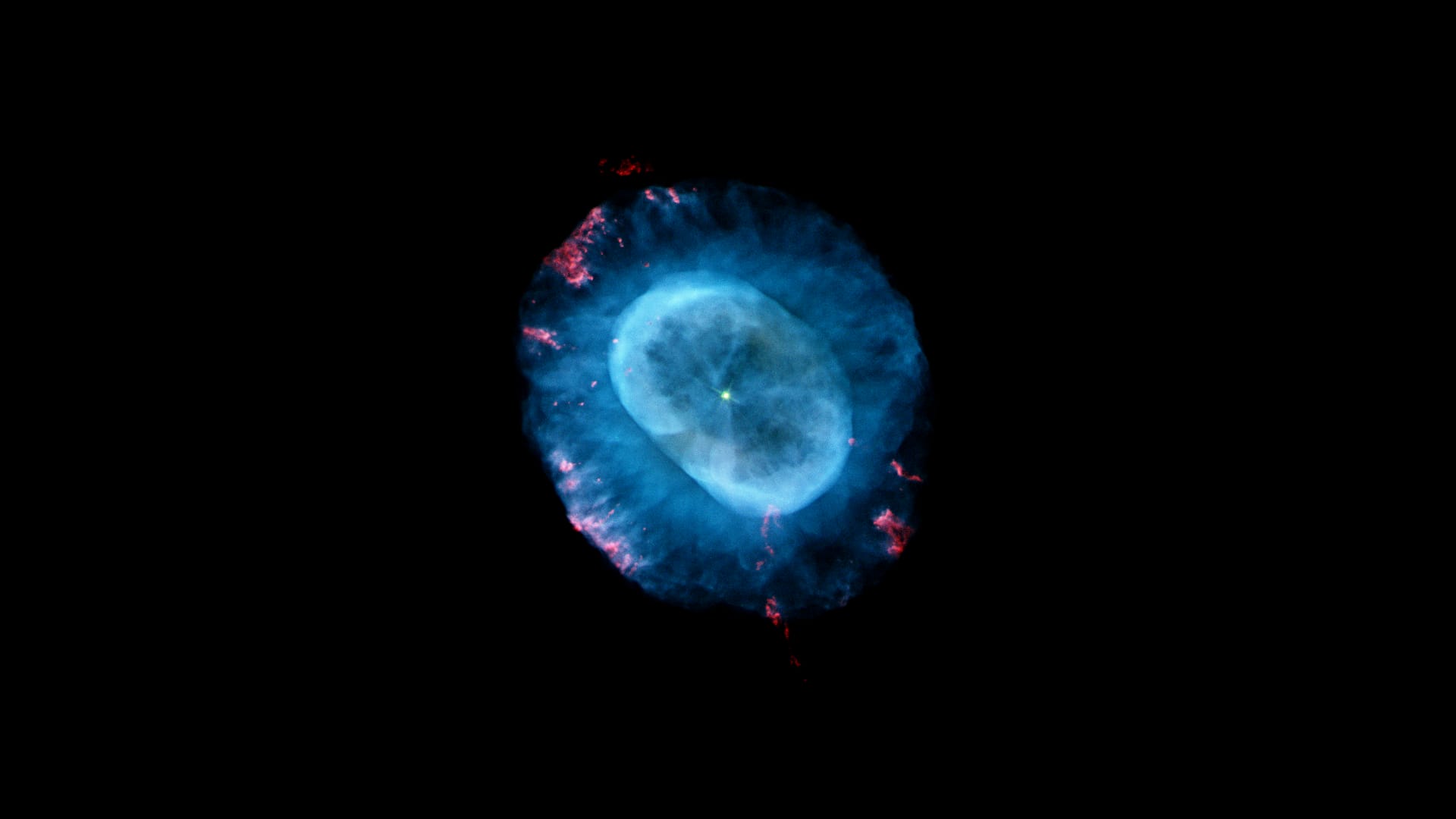
- Alternative names: NGC 7662, Snowball Nebula, Caldwell 22
- Apparent size: about 0.5′ (0.02 × Moon)
- Apparent magnitude: 8.3
- Constellation: Andromeda
- Best viewed from: Northern Hemisphere
The Blue Snowball Nebula (NGC 7662) is a compact planetary nebula located about 2,500 light-years away. It formed when a dying Sun-like star expelled its outer layers, leaving a hot stellar remnant at the center that illuminates the surrounding gas. Its bright, rounded appearance and vivid blue-green color inspired the nickname Blue Snowball Nebula.
Tips for observing and astrophotography
The Blue Snowball Nebula can be seen in telescopes of different sizes, although at low magnification it may look almost like a star. Higher magnification makes its small disk easier to distinguish, while a medium-sized telescope provides a better view of the nebula itself.
For astrophotography, its tiny apparent size makes NGC 7662 a target for a long-focal-length, high-resolution setup. Use accurate tracking and stack many relatively short exposures to preserve the bright central region while bringing out the surrounding shells. A narrowband filter can also help reveal structure in the glowing gas.
Skull Nebula
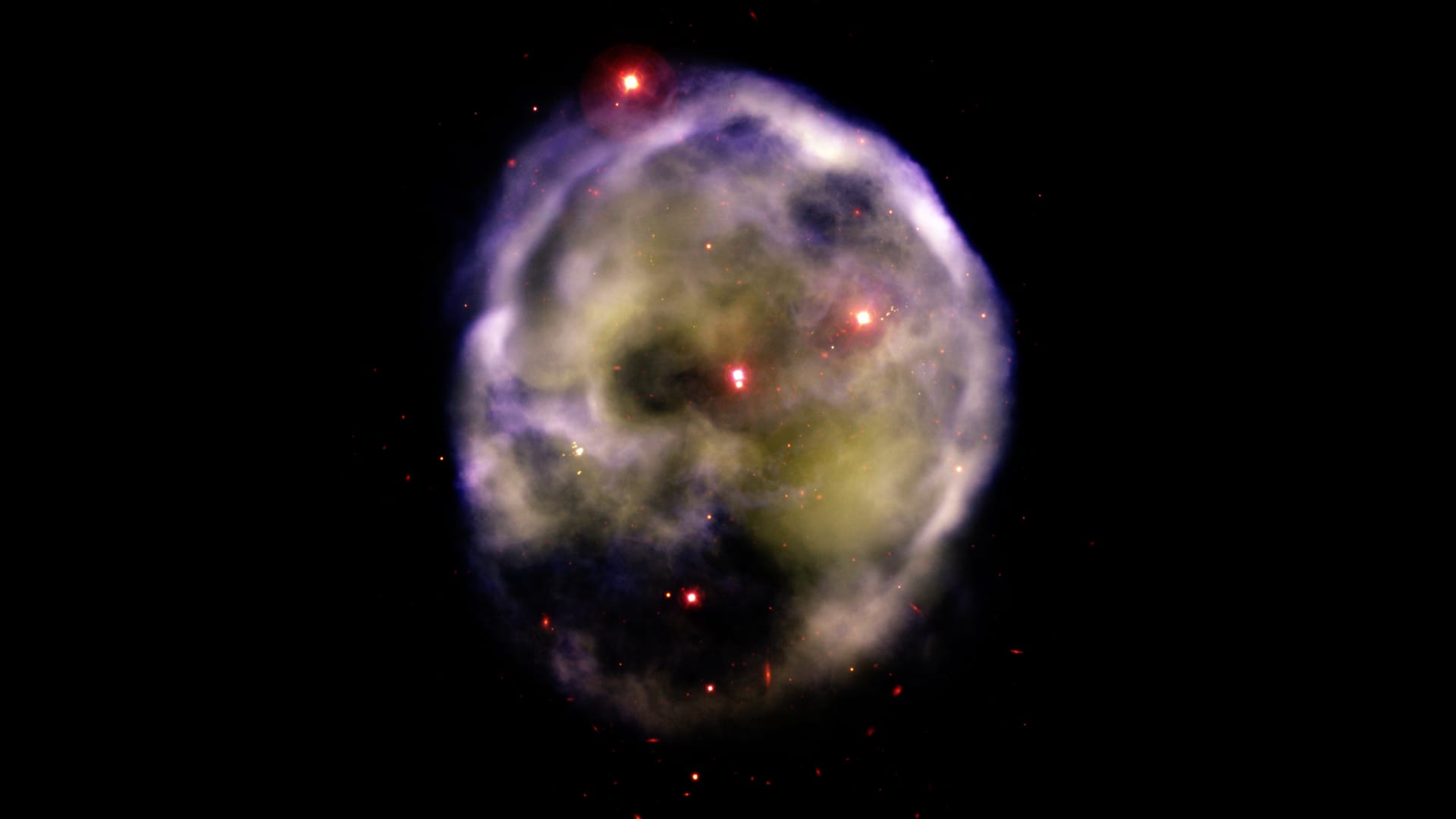
- Alternative names: NGC 246, Caldwell 56
- Apparent size: 3.7′ (0.1 × Moon)
- Apparent magnitude: 8.0
- Constellation: Cetus
- Best viewed from: Both hemispheres
The Skull Nebula (NGC 246) is a planetary nebula located about 1,600 light-years away. It consists of gas expelled by a dying Sun-like star, whose hot remnant now shines as a white dwarf near the center of the nebula. Its large, patchy shell gives the object the appearance of a skull in deep photographs.
Tips for observing and astrophotography
Through a moderately sized telescope, NGC 246 appears as a faint, roughly circular glow with several stars apparently projected across it. Dark skies are important for viewing because the nebula is fairly large and diffuse.
For astrophotography, use a medium focal length to capture the entire shell with some surrounding star field. A long total exposure time will help reveal its faint outer structure, while O III, H-alpha, or dual-band data can increase the contrast of the glowing gas.
Best Astrophotography Targets in September: Star Clusters
Star clusters are groups of stars that formed together and remain gravitationally bound. Open clusters are relatively young and often easy to see through binoculars or small telescopes. Globular clusters are much older and appear as dense, glittering spheres that benefit from medium-sized telescopes. Clusters are some of the easiest deep-sky objects to observe, making them excellent beginner targets. And for astrophotographers, they’re especially rewarding — their stars pop out clearly without the need for filters or hours of exposure, allowing beautiful images even with modest equipment.
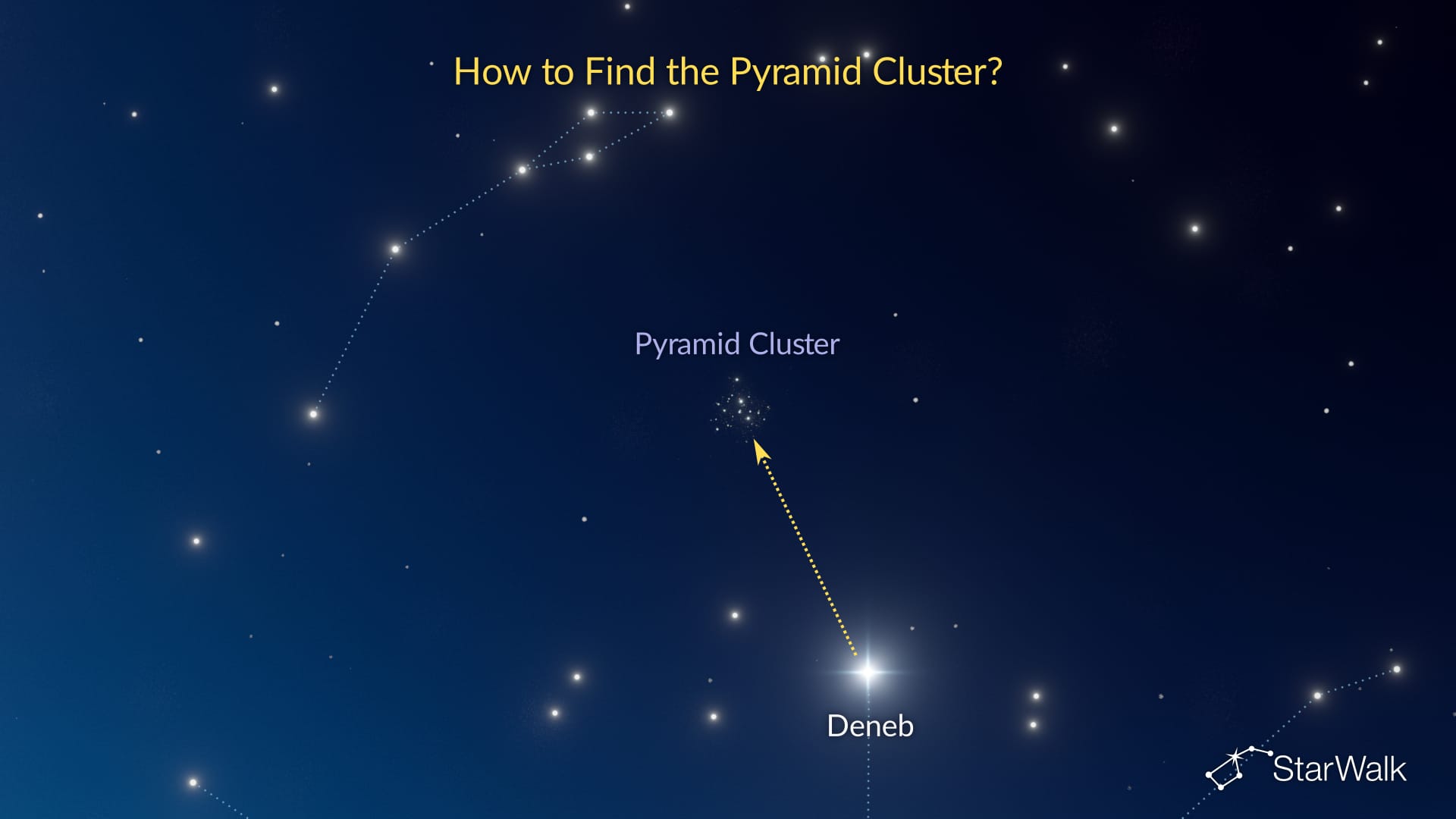
Pyramid Cluster
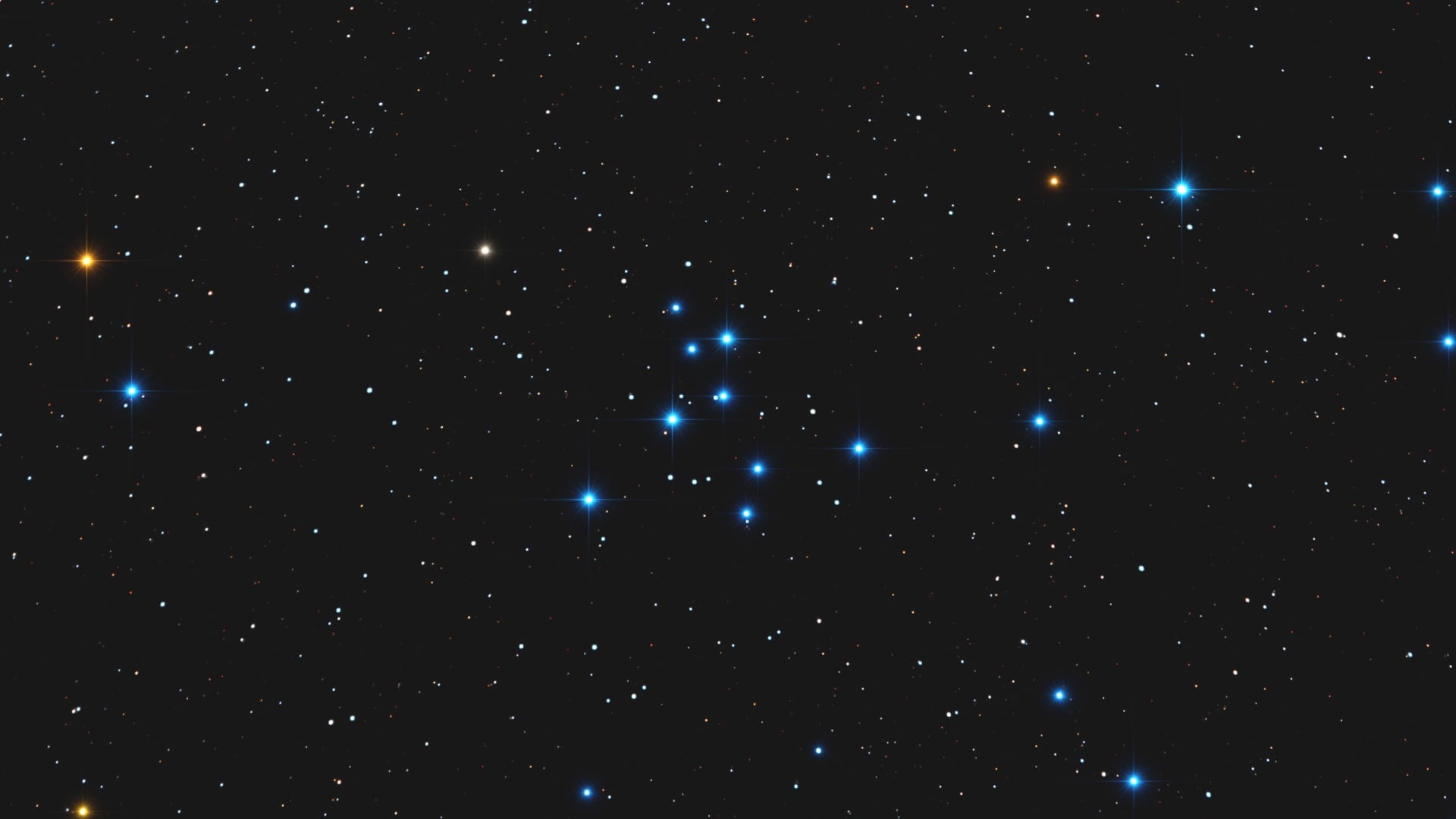
- Alternative names: M39, NGC 7092
- Apparent size: 29′ (0.9 × Moon)
- Apparent magnitude: 4.6
- Constellation: Cygnus
- Where to observe: Northern Hemisphere
The Pyramid Cluster (M39) is an open star cluster located approximately 1,000 light-years away from Earth. M39 has hundreds of identified members, although its 15 brightest stars form the prominent loose triangular pattern.
Tips for observing and astrophotography
You can use a small telescope to observe M39, but the cluster is best viewed with binoculars. Through 10×50 binoculars, you can see about seven stars in the cluster; 15x70 binoculars will reveal about a dozen stars. Under really good conditions, the Pyramid Cluster can even be seen with the naked eye!
For astrophotography, use a telephoto lens or small refractor to keep the entire cluster and some of the surrounding Milky Way in the frame. No special filters are needed; prioritize sharp focus and avoid exposures long enough to saturate the brighter stars.
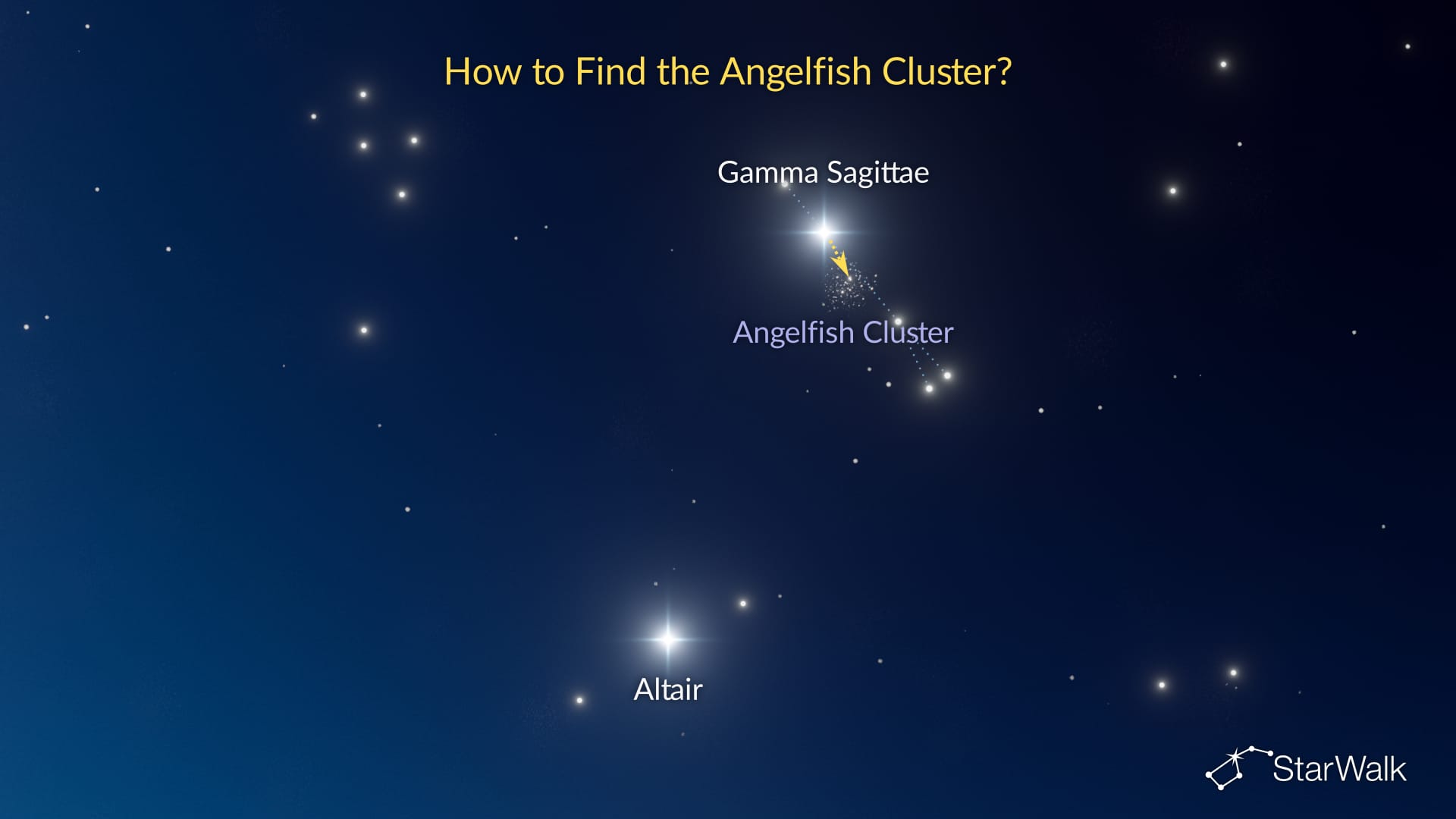
Angelfish Cluster
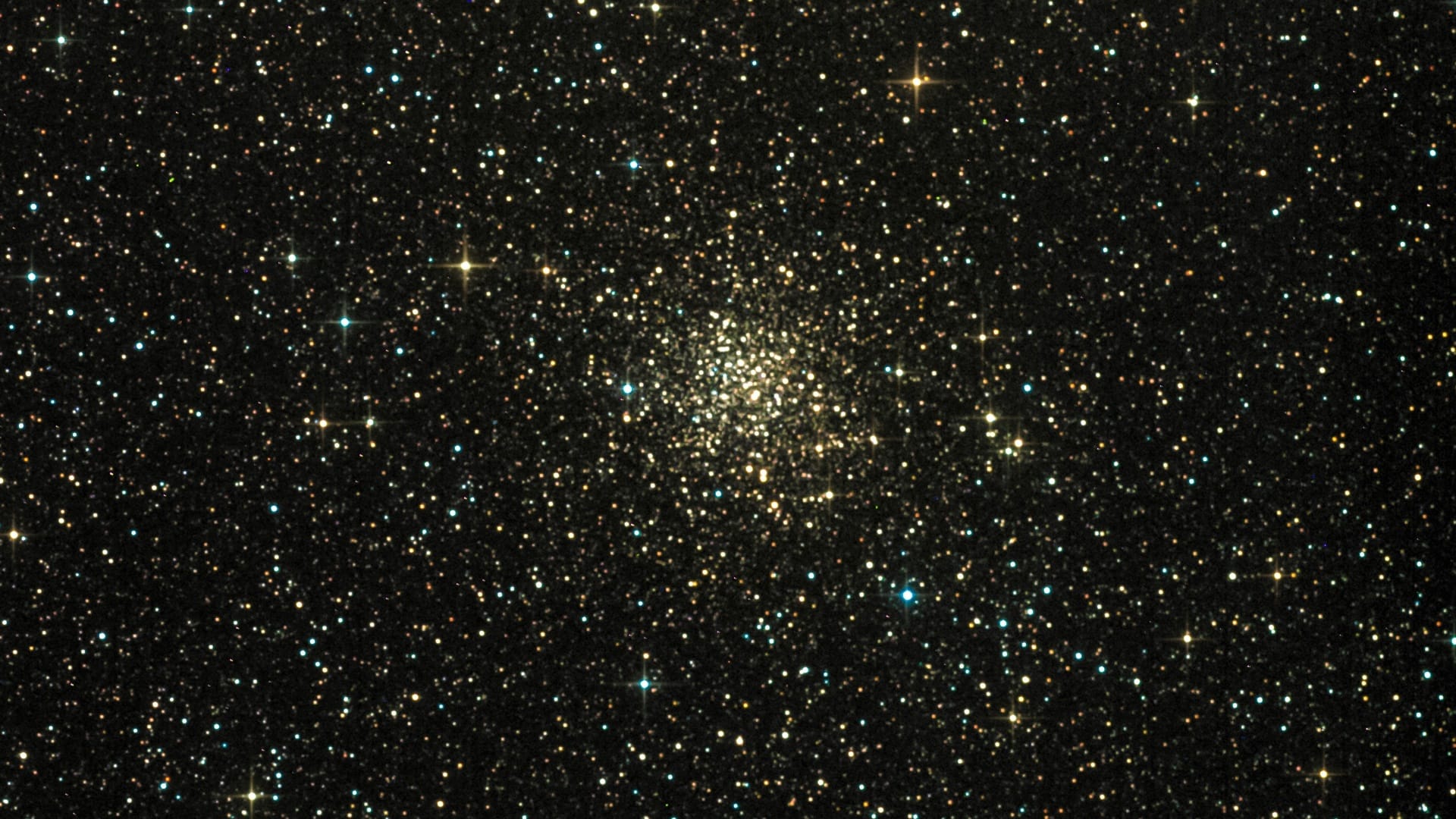
- Alternative names: M71, NGC 6838
- Apparent size: 7.2' (0.2 × Moon)
- Apparent magnitude: 5.9
- Constellation: Sagitta
- Where to observe: Northern Hemisphere
The Angelfish Cluster is a globular cluster located about 13,000 light-years away from Earth. Until the 1970s, it was considered an open cluster, but was then designated as a relatively sparse globular cluster.
Tips for observing and astrophotography
On a dark moonless night, you can see the Angelfish Cluster through 10×50 binoculars. Use a 100mm (4") telescope to get a closer look at the cluster.
For astrophotography, use a medium focal length to capture the cluster in good detail. No special filters are needed. Keep the tracking accurate, and combine multiple exposures to reveal the fainter stars without making the brightest ones too bright.
Caroline’s Rose
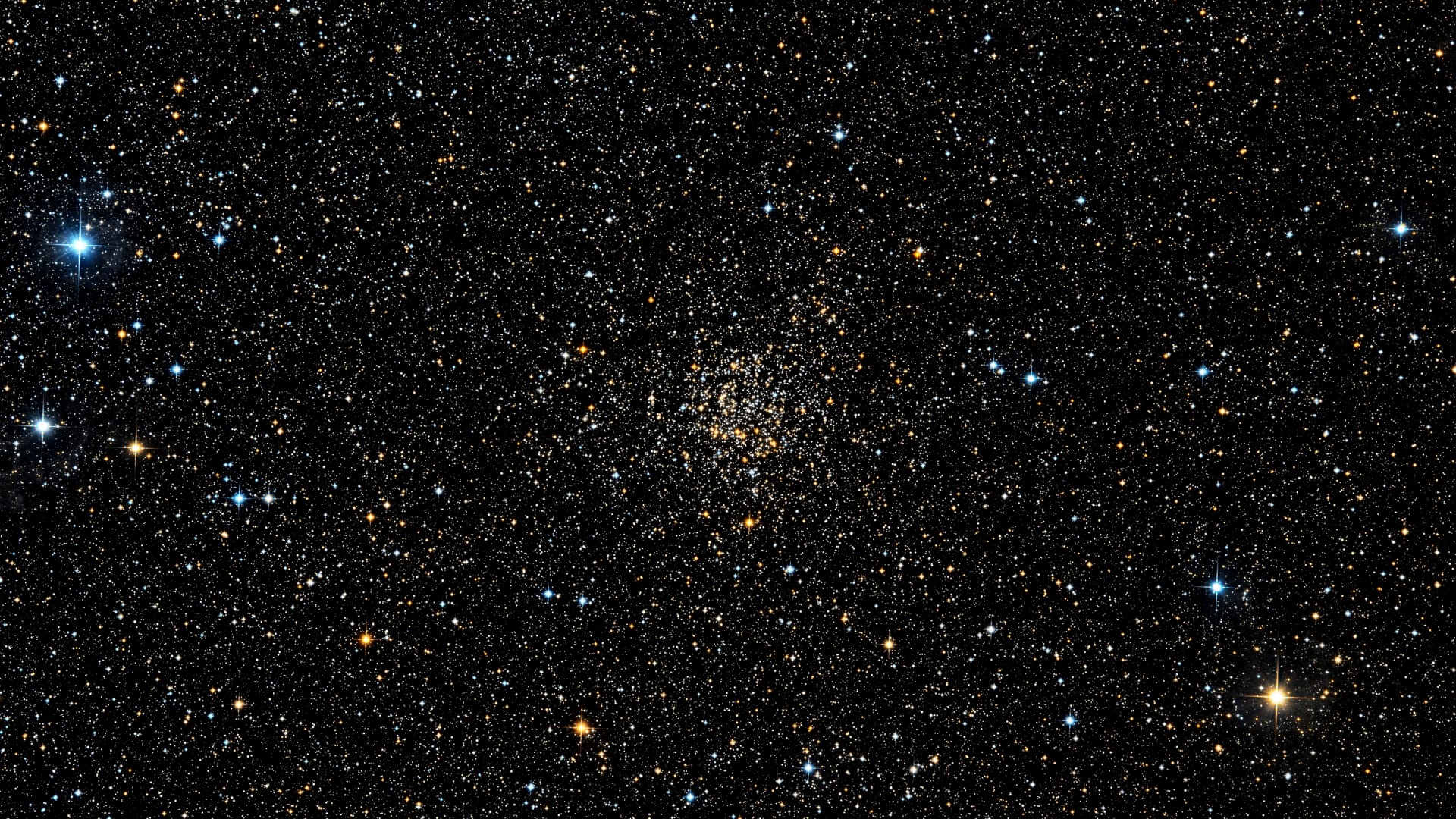
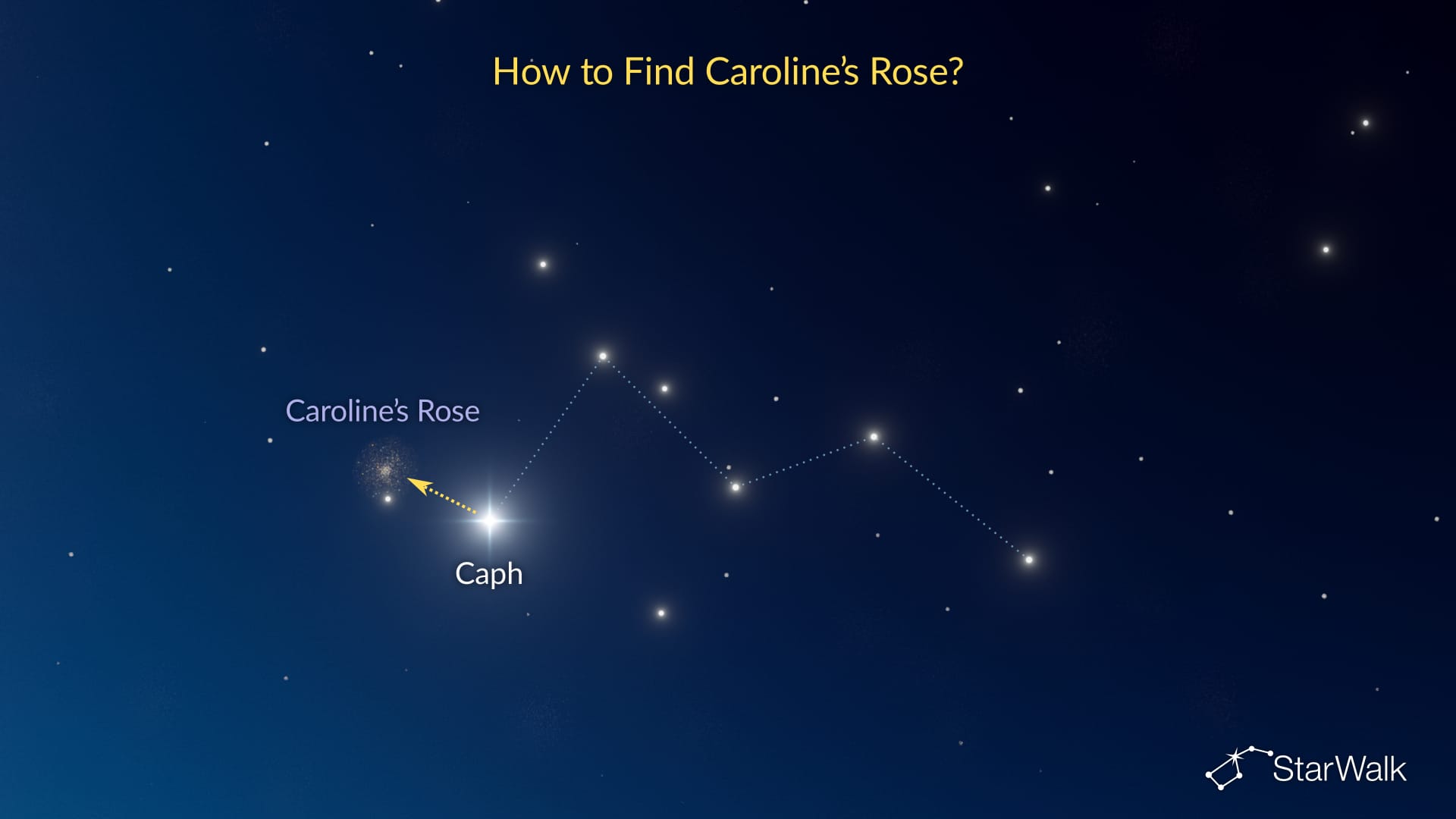
- Alternative names: NGC 7789, Caroline’s Rose Cluster
- Apparent size: 25.3′ (0.8 × Moon)
- Apparent magnitude: 6.7
- Constellation: Cassiopeia
- Best viewed from: Northern Hemisphere
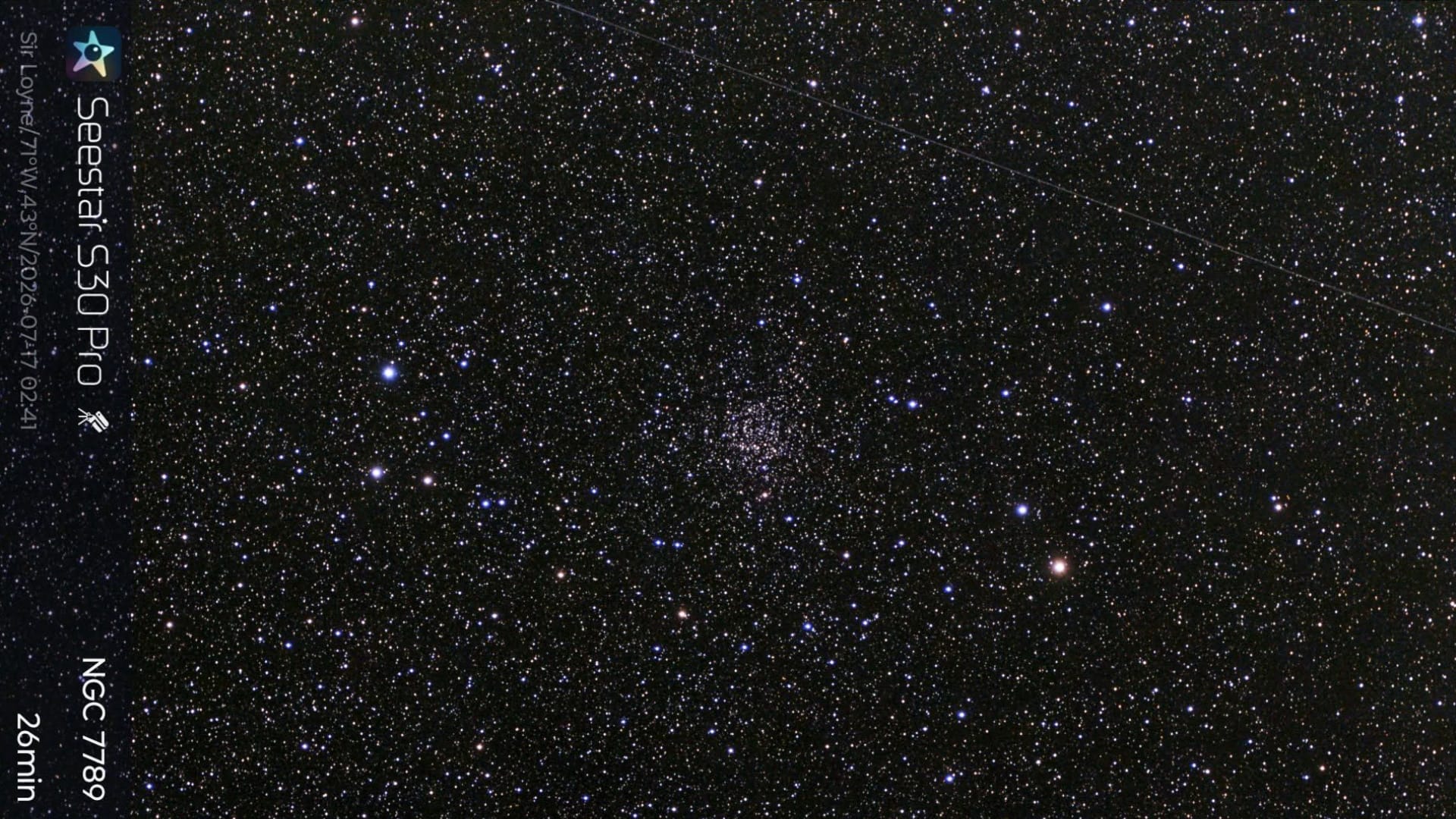
Caroline’s Rose (NGC 7789) is a rich open star cluster located about 8,000 light-years away. It was discovered by Caroline Herschel and is estimated to be about 1.6 billion years old. The pattern of bright stars and darker gaps inside the cluster resembles layers of rose petals, which inspired its nickname.
Tips for observing and astrophotography
Binoculars show Caroline’s Rose as a rich concentration of stars, but a small telescope reveals its rose-like pattern much more clearly. Use low-to-medium magnification to keep most of the 25′-wide cluster in the field of view.
For astrophotography, use a telephoto lens, a small refractor, or a telescope that can frame the entire cluster. No special filters are needed. Accurate focus and tracking will help separate the dense star field, while moderate exposures will preserve the brighter stars and reveal the many fainter cluster members.
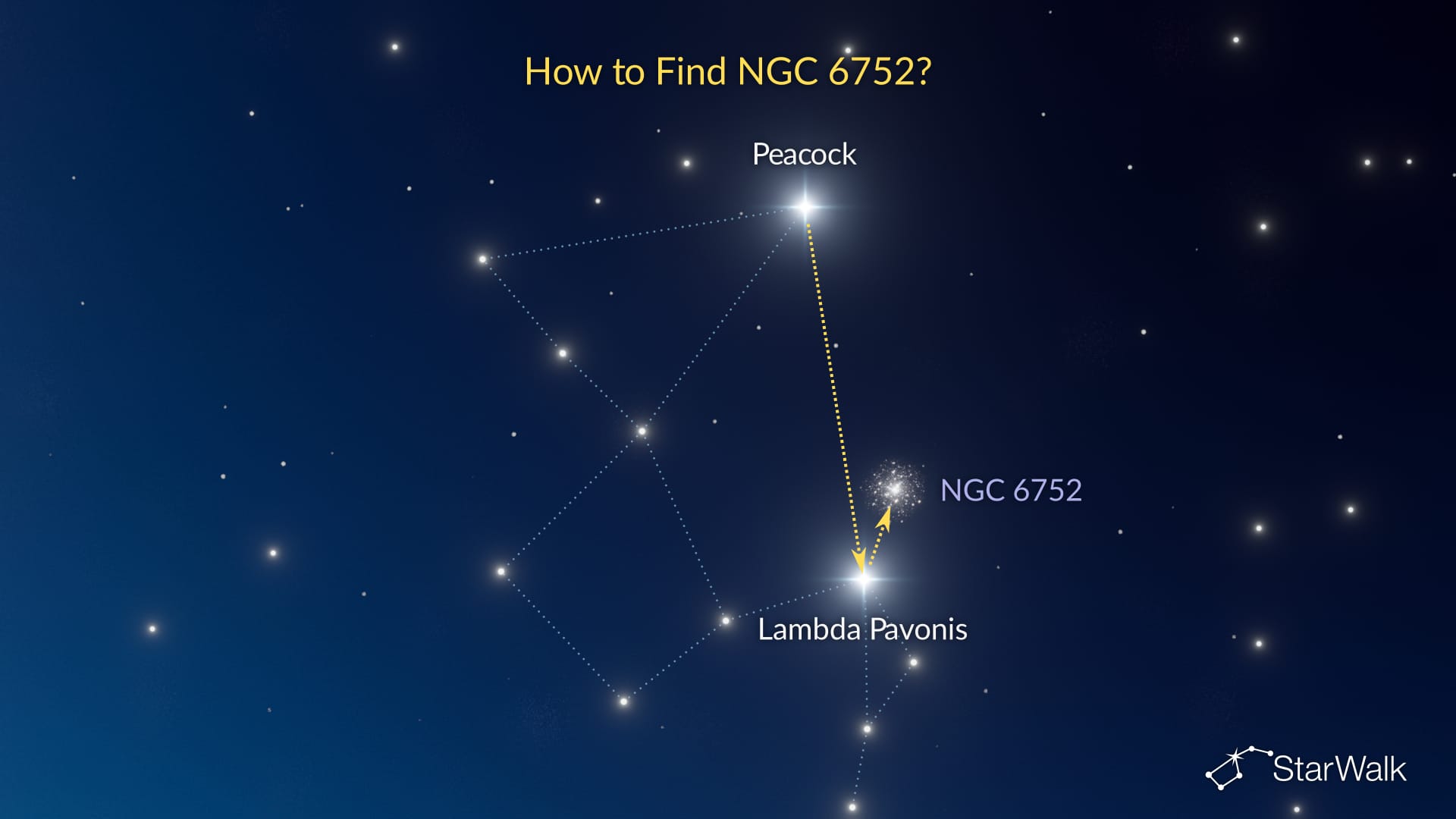
NGC 6752
- Alternative names: Caldwell 93
- Apparent size: 20.4′ (0.7 × Moon)
- Apparent magnitude: 5.4
- Constellation: Pavo
- Best viewed from: Southern Hemisphere
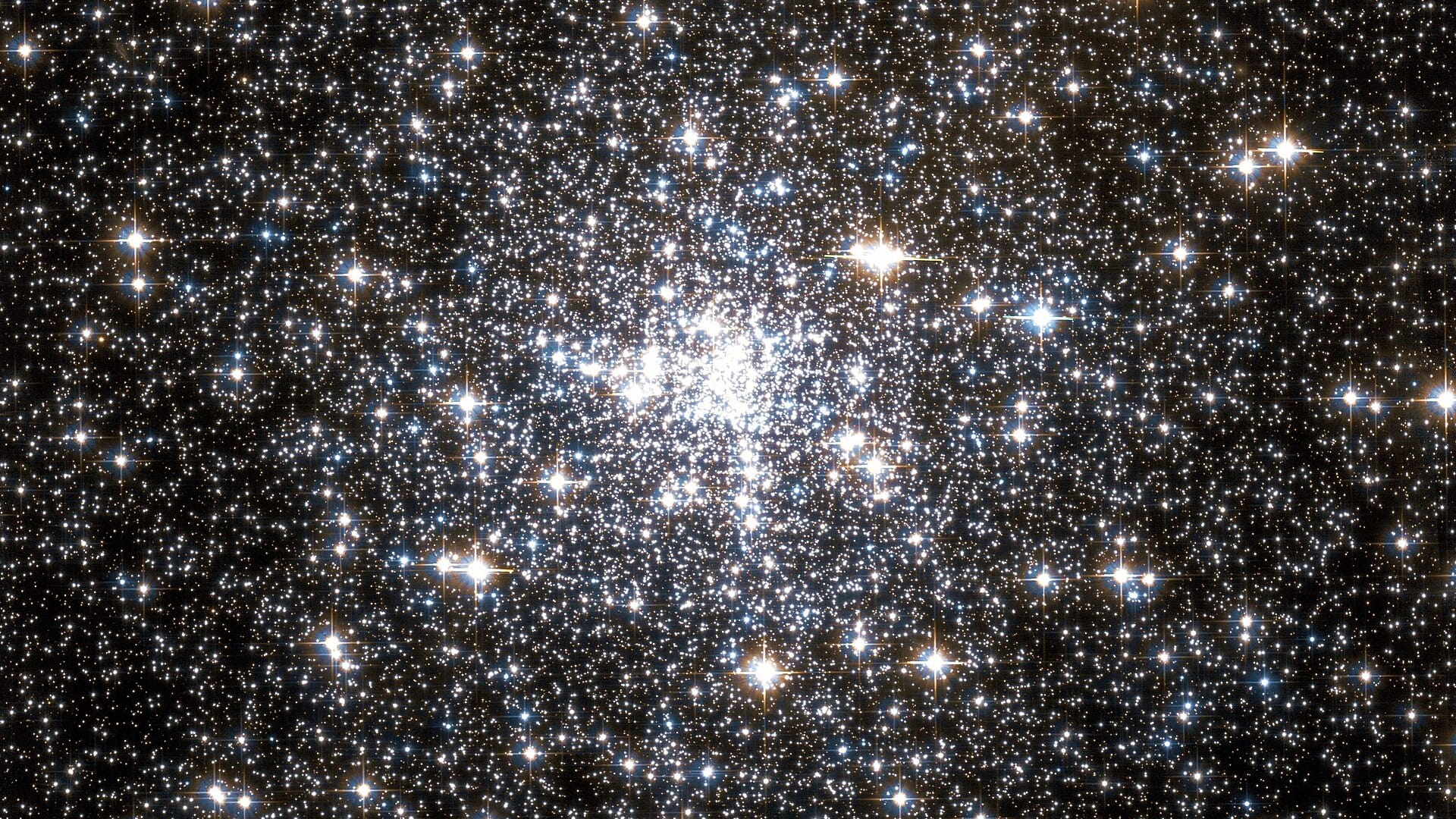
NGC 6752 is a bright globular cluster located about 13,000 light-years away in the halo of the Milky Way. It contains more than 100,000 stars packed into a region roughly 100 light-years across, and its stars are thought to be around 10 billion years old.
Tips for observing and astrophotography
NGC 6752 is one of the brightest globular clusters in the night sky and may be visible to the naked eye from a very dark location. Binoculars show it easily as a compact glow, while a telescope begins to resolve its densely packed stars. It is best placed for Southern Hemisphere observers.
For astrophotography, use a medium or long focal length to resolve the crowded core and surrounding halo of stars. No special filters are needed. Combine shorter exposures that preserve the bright center with longer exposures that reveal the fainter stars farther from the core.
Deep-sky Objects in September: FAQ
What is a deep-sky object?
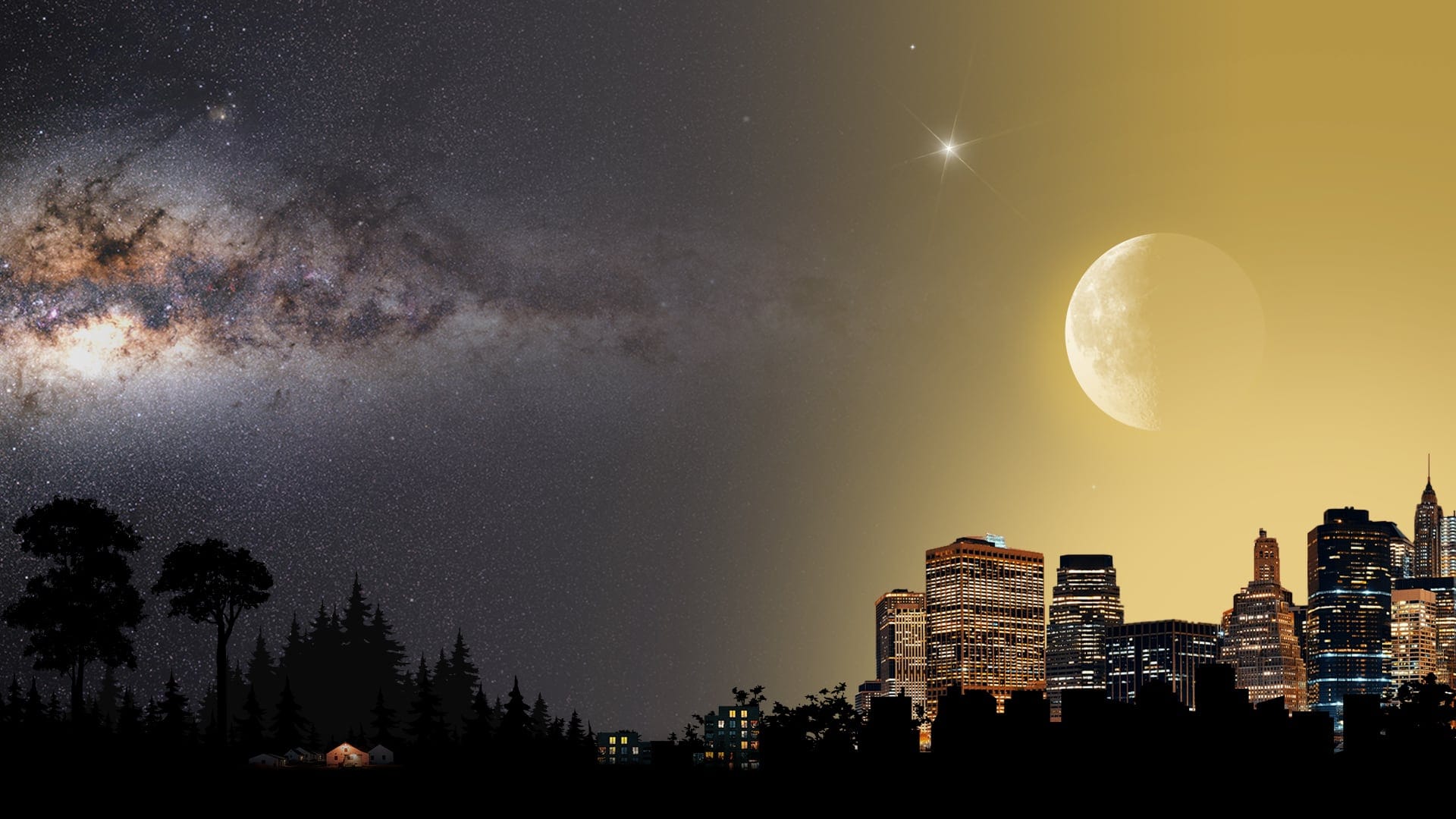
A deep-sky object (DSO) is an astronomical object beyond our Solar System, including galaxies, nebulae, and star clusters. Because DSOs are usually faint, they are best observed with binoculars or telescopes. However, a few spectacular ones – such as the Triangulum Galaxy and the Andromeda Galaxy – can be seen with the naked eye under dark skies (about Class 1–4 on the Bortle Scale, which measures light pollution).
What are the brightest deep-sky objects in September?
If you’re short on time and want to see the standout objects this month, here are the brightest and most rewarding targets from each category:
- Galaxy: The Andromeda Galaxy (M31) takes the crown — at magnitude 3.4, it’s visible to the naked eye from dark locations and breathtaking in binoculars or a small telescope.
- Star cluster: The Pyramid Cluster (M39) in Cygnus is the brightest cluster of the month, at magnitude 4.6. It’s easily seen with binoculars, and under excellent conditions, even with the naked eye.
- Nebula: The Pelican Nebula in Cygnus has a magnitude of 5.9 and can potentially be seen through small 7×42 binoculars. Although it’s not a naked-eye object, it’s still interesting to observe!
How to easily find the best deep-sky objects for my location?
To quickly discover which deep-sky objects are visible in your sky tonight, follow these simple steps using the Sky Tonight app:
- Tap the telescope icon to open the Visible Tonight section.
- Scroll to the “Deep-sky objects” section, or tap the top filter bar and select the galaxy icon to narrow the list.
- Tap the blue target icon next to any object to see when and where it appears in the sky.
Want a visual walkthrough? Watch our video tutorial for step-by-step guidance.
More Great Deep-Sky Objects to Photograph in September
Many deep-sky objects featured in our previous guides remain excellent targets in September. Here are a few more nebulae, galaxies, and star clusters worth observing and photographing this month:
- Fireworks Galaxy (NGC 6946)
- North America Nebula (NGC 7000)
- Iris Nebula (NGC 7023)
- Veil Nebula (NGC 6960)
- Cocoon Nebula (IC 5146)
- Wild Duck Cluster (M11)
September Deep-Sky Objects: Key Facts
In the first month of autumn (or spring, if you’re in the Southern Hemisphere), you can see some beautiful deep-sky objects, especially if you own binoculars or a telescope. The Pyramid Cluster and Andromeda Galaxy are straightforward binocular targets under dark skies, while the Pelican Nebula is much more challenging and is better observed with a wide-field telescope and a UHC filter. The Sky Tonight app will help you quickly find any desired object in the sky. We wish you clear skies and successful observations!
Best Deep-Sky Objects by Month: Year-Ahead Calendar
Deep-sky wonders aren’t limited to September. Discover what the universe has to offer each month with our guides to deep-sky objects: